+971-8000321216



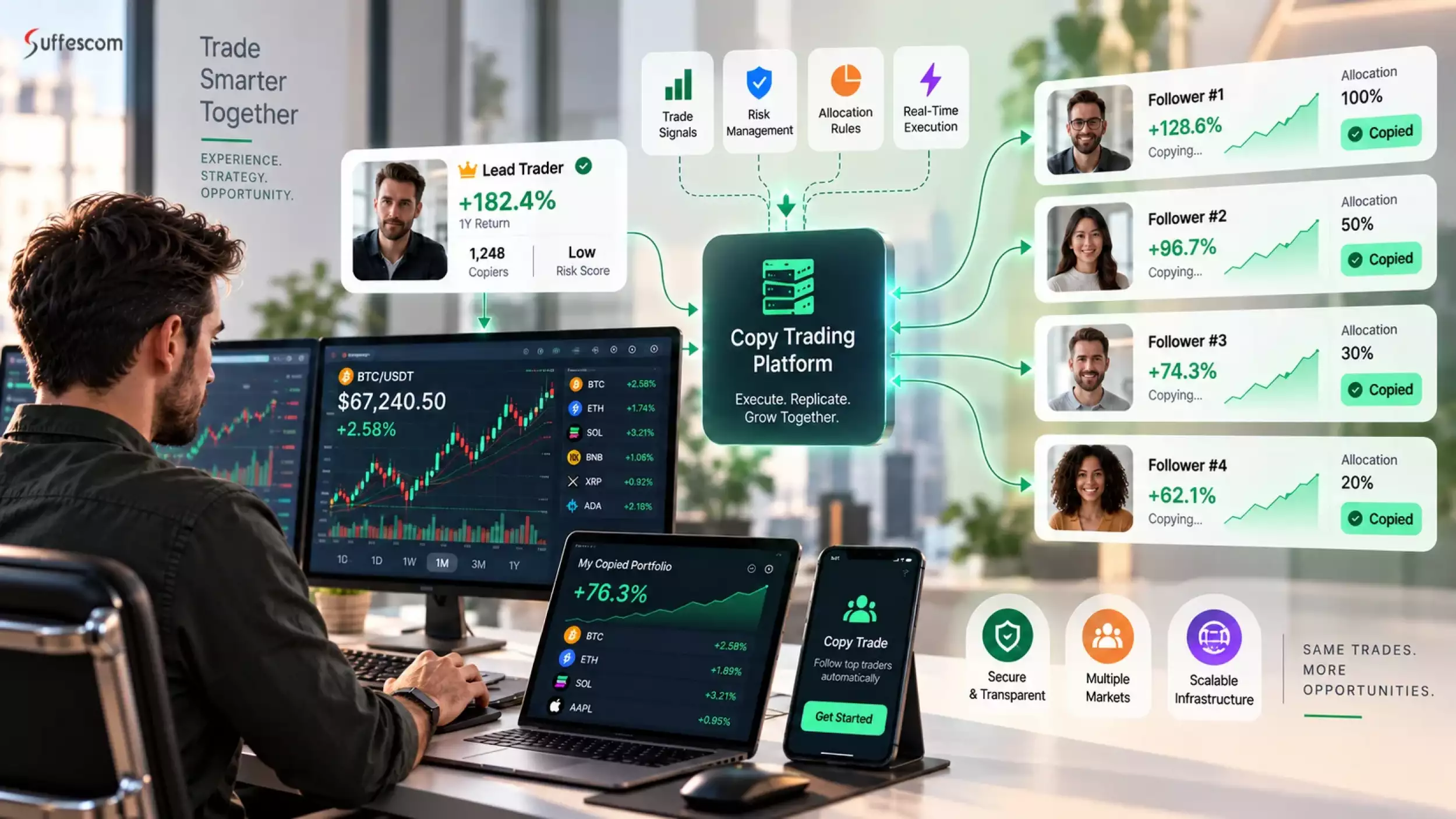
Key Takeaways:
- The opportunity is already large. eToro reported 3.81 million funded accounts across 75+ countries, while U.S. retail trading regularly exceeds $70 billion in daily activity.
- A reliable copy trading platform needs more than trade mirroring. Trader discovery, portfolio management, proportional sizing, drawdown controls, KYC/AML, analytics, notifications, broker integrations, and secure account connectivity form the core product.
- Execution quality can make or break the experience. Low-latency signal capture, position sizing, slippage management, partial-fill handling, order reconciliation, circuit breakers, and real-time exposure monitoring are essential for reliable trade replication.
- AI can turn copying into an intelligent platform. AI can support trader scoring, personalized discovery, anomaly detection, drawdown alerts, diversification, performance reporting, sentiment analysis, and controlled AI-agent workflows.
- The technology must be built around real-time trading. Event-driven architecture, a dedicated replication and risk engine, broker and exchange APIs, PostgreSQL, Redis, Kafka, WebSockets, cloud infrastructure, monitoring, encryption, and audit controls create the foundation for scale.
- Budget and timeline depend heavily on scope. Development can range from $40K–$90K for an MVP to $350K–$500K+ for enterprise platforms, while a production-ready platform typically takes 6–9 months.
- Regulation must shape the product from day one. There is no universal copy trading license, and requirements can vary based on jurisdiction, assets, custody, execution, advice, and platform structure. U.S. businesses may need to assess broker-dealer, investment-adviser, custody, and other applicable requirements.
What if your users could follow a trading strategy they trust without spending every hour watching the markets? That is the idea behind copy trading. Instead of analyzing every price movement themselves, users can discover traders, evaluate their performance, set their risk limits, and automatically replicate selected trades across their connected accounts.
This model has already reached millions of investors. eToro reported approximately 3.81 million funded accounts across 75+ countries as of December 2025. This highlights the scale that social and copy-based investing platforms can achieve. Copy trading platform development is far from building a trading platform on which there is a "Copy" button for businesses. It involves real-time trade replication, broker and exchange integration, risk management, secure account integration, compliance processes, performance analytics, and, more than ever, AI-driven insights.
This guide breaks down how to build a secure, scalable copy trading platform in 2026, from architecture and features to development costs, monetization, and AI capabilities.
What Is a Copy Trading Platform?
A copy stock/trading platform is a software platform that enables users to automatically copy the trades of other users or signal providers. It links traders who issue market signals to followers who wish to follow the market signals with the allocation rules, risk rules, and execution rules. A typical platform includes trader accounts, follower accounts, trade signals, a copy engine, broker or exchange connections, risk controls, and performance tracking. The copy engine captures eligible trades, calculates the follower's position size, applies risk rules, and sends the order to the connected broker or exchange.
How Does Copy Trading Work?
Copy trading follows a simple but highly automated workflow:
Trader Opens Position → Signal Captured → Risk Rules Applied → Order Replicated → Execution Confirmed → Portfolio Updated
- Trader opens position: The trader enters a supported order.
- Signal received: The platform receives the trade via an API, webhook, FIX, or other integration.
- Risk rules applied: The system monitors the allocation, balance, leverage, exposure, stop loss, and instrument restrictions.
- Order replicated: The copy engine figures out the size of the order on the follower and sends the order to the connected broker/exchange.
- Execution confirmed: The platform records the order status, fill, rejection, slippage, and fees.
- Portfolio updated: Positions, returns, exposure, and other performance metrics are updated for the follower.
The copy engine is the core of the platform. The main part of the platform is the copy engine. It has to reliably handle trading events without duplication and maintain the execution state while not losing any positions in the event of connection failure.
Copy Trading vs Social Trading vs Mirror Trading
These models are related but have different primary purposes.
| Model | How It Works | Primary Focus |
| Copy Trading | Automatically replicates selected trades in a follower's account | Trade execution |
| Social Trading | Users follow, discuss, share, and analyze traders or strategies | Community and discovery |
| Mirror Trading | Replicates trades generated by a predefined strategy or trading system | Strategy replication |
| Signal Trading | Sends trade alerts that users can review and execute manually | Trade signals |
So a copy trading app will have to have a robust execution engine, and a social trading platform may focus more on feeds, profiles, ratings, comments, community interaction, etc.
Copy Trading vs. PAMM/MAM
In the case of copy trading, the user will determine the methods for the trades to be copied in their own accounts; PAMM (Percentage Allocation Management Module) and MAM (Multi-Account Manager) will apply structured models of money management and allocation.
| Factor | Copy Trading | PAMM | MAM |
| Account structure | Individual follower accounts | Managed account structure | Multiple managed accounts |
| Capital management | Follower chooses allocation and risk settings | Funds are allocated under a money manager | Manager controls allocation across connected accounts |
| Trade ownership | Trades generally remain in the follower's own brokerage account | Investors participate through the managed structure | Investors generally retain separate accounts |
| Allocation | Percentage, fixed amount, risk multiplier, or other platform-defined rules | Usually proportional to investor capital | Flexible allocation rules depending on configuration |
| Execution | Copy engine replicates eligible trades | Manager's trades are allocated across participating accounts | Manager's trades are distributed across linked accounts |
| User control | Typically higher at the individual account level | More dependent on the money-management structure | Varies by implementation |
| Regulatory considerations | Depends on jurisdiction, assets, execution model, and platform structure | Can involve regulated money-management activities | Regulatory treatment depends on jurisdiction and implementation |
This is subject to the jurisdiction, asset type, custody arrangement, and platform design. The requirement for KYC/AML, licensing, investor protection, and execution should thus be evaluated prior to launch.
Who Uses Copy Trading Platforms?
Copy trading platforms can serve both retail users and financial businesses. Common users of copy trading platforms include:
- Retail traders: Follow experienced traders and automate selected strategies.
- Brokers: Add copy and social trading capabilities to their existing platforms.
- FinTech companies: Build investment products around trader discovery and automated execution.
- Prop trading businesses: Create controlled environments for strategy following and trader performance.
- Asset managers: Distribute or manage strategies through structured portfolio workflows where permitted.
- Crypto exchanges: Offer copy trading for supported digital assets and connected accounts.
- Trading communities: Combine trader discovery, education, signals, and automated execution.
The audience has a direct influence on the structure of businesses that are planning on developing a copy trading platform. Depending on the type of retail application, mobile UX and straightforward risk controls may be more important, while in the case of a broker platform or enterprise solution, integrations, compliance workflows, analytics, and execution reliability may be more crucial.
Why Build a Copy Trading Platform in 2026?
The U.S. retail trading market offers a strong opportunity for copy trading platforms. U.S. retail trading regularly exceeds $70 billion in daily activity, while Charles Schwab reported 39.8 million retail brokerage accounts and 11.9 million daily average retail trades in Q2 2026.
This scale allows for new platforms to make trades easier to discover and execute, more automated, personalized, and risk-aware.
Growing Demand for Automated Trade Replication
Automated trade replication reduces the gap between discovering a strategy and executing it. Users can connect brokerage accounts and let predefined rules handle eligible trades instead of manually entering every order.
FINRA notes that auto-trading services can send trading instructions directly to a customer's brokerage account, making registration, disclosures, and investor protection important considerations for U.S. platforms.
Expansion Across U.S. Stocks, ETFs, and Crypto
Copy trading can extend across stocks, ETFs, options, and supported crypto assets. Each asset class requires different execution, liquidity, margin, and risk rules.
U.S. brokerage activity reflects this scale. Robinhood reported $333 billion in equity notional trading volume and 324 million options contracts in July 2026.
Demand for Portfolio-Based Copy Trading
Portfolio-based copy trading lets users distribute capital across multiple traders or strategies instead of copying individual positions only.
Key capabilities include:
- Multi-trader allocation
- Fixed-dollar or percentage-based copying
- Drawdown limits
- Exposure controls
- Diversification analytics
- Automatic stop-copy rules
This turns copy trading into a broader portfolio-management experience.
AI Is Changing Trader Discovery and Risk Analysis
AI can evaluate trading behavior beyond simple historical returns. Platforms can analyze drawdowns, volatility, holding periods, concentration, trading frequency, and unusual activity to help users assess strategies.
The need for better digital discovery is growing in the U.S. FINRA reports that 45% of investors receive financial advice from the internet, while 24% use social media for financial information.
Brokers Are Adding Social and Copy Trading Capabilities
Social and copy trading can add strategy discovery and automated execution to traditional brokerage experiences. Trader profiles, performance analytics, community features, and copying can operate within one ecosystem.
For U.S. businesses, compliance must be considered early. FINRA notes that securities copy trading can raise federal securities law, broker-dealer, and investment adviser considerations.
Demand for Mobile-First Trading Experiences
Copy trading should be mobile-first because people want to trade their portfolios via their smartphones. Trader discovery, allocation changes, alerts, position monitoring, and stop-copy controls should work without requiring a desktop terminal.
Before vs. After Copy Trading Automation
| Before Automation | After Copy Trading Automation |
| Manual signals | Real-time signal capture |
| Delayed execution | Automated trade replication |
| Inconsistent position sizing | Rule-based allocation |
| Manual risk checks | Automated risk validation |
| Multiple dashboards | Centralized portfolio monitoring |
| Reactive decisions | AI-assisted insights |
It's more than a "Copy" button. A scalable trading platform can bring trader discovery, broker connectivity, execution automation, portfolio management, risk controls, analytics, and artificial intelligence to the U.S. trading arena in a single package.
Core Modules Every Copy Trading Platform Must Include
Any platform that offers copy trading services must have specific sections for discovering traders, executing trades, managing risk, connecting accounts, ensuring compliance, and tracking portfolios, all of which must be scalable. The modules should communicate with each other in a secure way via APIs and process data in real time.
Trader / Signal Provider Module
The trader module gives users the information they need to evaluate a signal provider before copying. It should include:
- Trader profile and strategy description
- Verified trading history
- Returns, win rate, drawdown, and risk metrics
- Risk profile and trading style
- Follower count and copied assets
- Account verification status
Risk Management Module
The risk management module helps followers control how much capital and exposure they take when copying a trader. It should include:
- Stop-loss and take-profit controls
- Maximum drawdown limits
- Position-size limits
- Copy and exposure limits
- Maximum daily loss limits
- Leverage controls
- Automatic stop-copy rules
Trader Discovery & Ranking Module
The trader discovery module helps users find and compare signal providers based on performance, strategy, and risk characteristics. It should include:
- Trader search and filtering
- Performance history
- Return and drawdown data
- Volatility and consistency metrics
- Risk-adjusted performance
- Assets and strategies traded
- Trader comparison tools
Wallet & Payment Management
The wallet and payment module manages user funds, platform fees, deposits, and withdrawals. It should include:
- Account balances
- Deposits and withdrawals
- Transaction history
- Platform and performance fees
- Payment processing
- Fund reconciliation
- Transaction monitoring
KYC/AML Module
The KYC/AML module helps verify users and support applicable financial compliance workflows. It should include:
- Identity verification
- Document verification
- Sanctions screening
- Transaction monitoring
- User risk classification
- Verification status tracking
- Compliance records
Follower Portfolio Module
The follower portfolio module gives users visibility and control over their copied strategies and allocated capital. It should include:
- Active copied traders
- Capital allocation
- Open and closed positions
- Portfolio returns
- Drawdown and exposure
- Trade history
- Copy, pause, and stop controls
Broker & Exchange Integration Layer
The integration layer connects the platform with brokers, exchanges, market-data providers, and trading APIs. It should include:
- Secure account authentication
- Account and balance synchronization
- Market-data integration
- Order submission
- Execution-status updates
- Position synchronization
- API failure and retry handling
Notification & Alert Module
The notification module keeps users informed about important trading, account, and security events. It should include:
- Trade execution alerts
- Failed-order notifications
- Drawdown alerts
- Margin and exposure alerts
- Strategy-change notifications
- Deposit and withdrawal alerts
- Security notifications
Admin & Compliance Dashboard
The admin dashboard gives operators centralized control over users, traders, transactions, trading activity, and compliance operations. It should include:
- User and trader management
- KYC/AML status
- Strategy and copy activity monitoring
- Transaction management
- Risk-rule configuration
- Dispute management
- Compliance and audit records
- System alerts
Analytics & Reporting Module
The analytics module converts trading and platform activity into actionable performance and operational reports. It should include:
- P&L and ROI reporting
- Win-rate and drawdown analysis
- Risk-adjusted performance
- Trader comparison
- Copy-trading performance
- Execution-quality metrics
- User and platform reports
All these modules combined make up the backbone of a dependable copy trading platform, enabling automated execution, user management, risk control, compliance, and on-the-spot portfolio tracking.
Build Your Copy Trading Platform With the Right Foundation
Have a copy trading idea in mind? Suffescom can help you turn it into a secure, scalable platform with the right trading engine, integrations, and risk controls.
Key Features of a Modern Copy Trading Platform
Automated trade execution, risk management, trader discovery, portfolio management, and engagement capabilities are all essential components of a modern copy trading platform. These are essential features that need to be included in a scalable platform.
Real-Time Trade Mirroring
The real-time trade mirroring feature enables automatic replication of eligible trades on follower accounts in real time from selected traders. It should support:
- Instant trade signal detection
- Automated order execution
- Position synchronization
- Trade status updates
- Duplicate-order prevention
- Slippage handling
Adjustable Copy Ratios
Adjustable copy ratios let users control how closely their accounts follow a trader's activity. Users should be able to:
- Set custom copy ratios
- Increase or reduce exposure
- Pause copying temporarily
- Change ratios without disconnecting the strategy
Proportional Position Sizing
Proportional position sizing automatically adjusts copied trades based on the follower's available capital. It should support:
- Percentage-based allocation
- Fixed-dollar allocation
- Equity-based sizing
- Maximum position limits
- Minimum trade-size rules
Stop-Loss & Take-Profit Controls
Stop-loss and take-profit controls help users manage individual copied positions. The platform should support:
- Custom stop-loss levels
- Take-profit targets
- Trader-level defaults
- Follower-level overrides
- Automatic order closure
Maximum Drawdown Protection Rules
Drawdown protection can automatically reduce or stop copying when losses reach predefined limits. Key controls include:
- Maximum portfolio drawdown
- Trader-level drawdown limits
- Daily loss limits
- Exposure thresholds
- Automatic stop-copy triggers
Multi-Trader Portfolio Copying
Multi-trader copying allows users to allocate capital across several traders or strategies. It should include:
- Multiple active strategies
- Individual allocation limits
- Portfolio-level exposure controls
- Trader diversification
- Combined performance tracking
Multi-Broker & Multi-Exchange Account Linking
Multi-account connectivity lets users connect supported brokerage and exchange accounts from one platform. It should support:
- Secure account linking
- Broker and exchange APIs
- Multiple trading accounts
- Account balance synchronization
- Order and position synchronization
Trader Performance Analytics
Performance analytics help users evaluate traders using return, risk, and consistency metrics. Key metrics should include:
- ROI
- Win rate
- Maximum drawdown
- Profit factor
- Sharpe ratio
- Sortino ratio
- Trading frequency
- Average holding period
Trader Leaderboards
Trader leaderboards make it easier to discover and compare signal providers. They should support:
- Performance-based rankings
- Risk-based filters
- Time-period filters
- Asset-class filters
- Follower and popularity metrics
Trader Commentary & Social Feed
A social feed allows traders to explain strategies, market views, and portfolio changes while followers can interact with them. It should include:
- Trader posts and commentary
- Strategy updates
- Likes and comments
- Follower discussions
- Trade-related announcements
Demo & Paper Copy Trading
Demo and paper trading let users test copy strategies before committing real capital. Users should be able to test:
- Trader selection
- Capital allocation
- Copy ratios
- Risk settings
- Execution behavior
- Simulated portfolio performance
Push Notifications & Trading Alerts
Real-time alerts keep users informed about important trading and account events. Notifications can cover:
- Copied trade execution
- Order failures
- Drawdown thresholds
- Margin or exposure alerts
- Trader strategy changes
- Deposits and withdrawals
- Security events
KYC, Account Security & Compliance Controls
Security and compliance features protect user accounts and support required operational workflows. They should include:
- KYC/identity verification
- AML screening
- Two-factor authentication
- Device and session management
- Login and transaction alerts
- Audit logs
Portfolio Monitoring & Reporting
Portfolio monitoring gives users a centralized view of their copied strategies and trading results. It should provide:
- Real-time portfolio value
- Open and closed positions
- P&L
- Capital allocation
- Exposure
- Trade history
- Performance reports
Multi-Language & Multi-Currency Support
Multi-language and multi-currency features enable platforms to cater to users in various markets. It should include:
- Multiple interface languages
- Multiple base currencies
- Currency conversion
- Localized number and date formats
- Currency-specific reporting
Mobile Trading Dashboard
A mobile-first dashboard lets users manage copied strategies and monitor portfolios from anywhere. It should provide:
- Trader discovery
- Copy and allocation controls
- Portfolio monitoring
- Trade history
- Risk alerts
- Push notifications
- Account management
Is Copy Trading Legit? Risks, Scams & Trust Mechanisms
Copy trading is a legitimate trading model, but it is not a guaranteed-profit system. The technology allows trades from one account or strategy to be replicated across other accounts. Risks vary based on the assets being traded, the way they are executed, the trading strategy employed, the platform infrastructure, and any relevant regulations.
When using a copy trading service in the U.S., the difference between a real and a dubious service becomes significant. FINRA has warned about unregistered auto-trading services that promote risk-free or unusually consistent returns, while the SEC has also taken action against fraudulent trading platforms and investment schemes promoted through social media.
Is Copy Trading a Legitimate Trading Model?
Yes. Copy trading is a type of automated trading where a user's account copies certain trading activity based on pre-specified rules. But there are still regulatory, disclosure, and investor protection obligations that remain to be met by the platform and service provider based on its business model and assets.
A legitimate platform should clearly explain:
- Who operates the platform
- Which assets can be copied
- How trades are executed
- Where user funds are held
- How fees are charged
- What registrations or licenses apply
- How performance is calculated
Why Copy Trading Does Not Guarantee Profits
There is no guarantee that a successful copy trader will have the same success when they follow a trader. The result can be affected by market conditions, at-the-click factors, slippage, liquidity, account size, and fees, as well as risk settings.
A platform should never position copy trading as risk-free or promise fixed returns. FINRA specifically identifies guaranteed returns, unusually consistent performance claims, and unsupported profitability claims as warning signs.
Why Some Trader Profiles Can Look Better Than They Are
Historical performance can hide the level of risk taken to generate those returns. A trader profile should therefore show enough information to put performance into context.
Common issues include:
- Short track records: A strategy may appear to be working well and have only been successful in certain market conditions.
- Higher leverage: There could be significant risk to the capital alongside the higher returns.
- Survivorship bias: If a strategy fails or a trader goes out of business, they may fall from the list, while a successful one stays.
- Selection of screenshots: Individual profitable trades do not constitute all-time performance.
- Unrealized gains: Open positions may display gains that are not realized when the position gets closed.
- Lots of hidden drawdowns: A high overall return can be followed by times of heavy losses.
- High-risk strategies: Simple return comparisons can be distorted by high-risk strategies like options, concentrated positions, leverage, or other aggressive strategies.
How to Evaluate a Copy Trader
Trader evaluation should consider both returns and the risk taken to achieve them. Useful indicators include:
| Metric | What it helps show |
| Track record | How long the strategy has been active |
| Maximum drawdown | Largest decline from a previous peak |
| Risk-adjusted performance | Return relative to the risk taken |
| Leverage | Degree of borrowed or amplified exposure |
| Number of trades | Depth of the trading history |
| Trading consistency | Whether performance is sustained over time |
| Exposure | Concentration across assets or positions |
| Strategy duration | Whether results cover different market conditions |
Why Win Rate Alone Is Not Enough
Win rate measures how often trades are profitable, not how much risk the strategy takes. A trader can achieve a high percentage of winning trades but may still lose a few big bucks now and then.
This is why it is important that platforms display win rates alongside average win, loss, profit factors, maximum drawdown, leverage, total return, and risk-adjusted figures.
Verified Trading History vs. Self-Reported Performance
Verified trading data provides a stronger basis for comparison than manually reported results. Platforms should clearly distinguish between:
- Broker or exchange-synced records
- API-verified trading history
- Audited performance
- Self-reported results
- Uploaded screenshots or statements
Detecting Suspicious Trader Behavior
Automated monitoring can assist in the detection of unusual trading activity and possible market manipulation. AI and rule-based systems can identify:
- Abnormal trading patterns
- Account clustering
- Excessive leverage
- Sudden strategy changes
- Potential wash trading
- Manipulated performance
- Unusual API activity
- Coordinated trading behavior
What Information Should a Copy Trading Platform Display?
Transparency is one of the strongest trust mechanisms a copy trading platform can provide. A complete trader profile should show:
- Verified trading history
- Returns and P&L
- Maximum drawdown
- Risk-adjusted metrics
- Win rate and profit factor
- Number of trades
- Average holding period
- Assets traded
- Leverage and exposure
- Strategy description
- Strategy duration
- Fees and copying costs
- Verification status
Copy Trading Risk Disclosure
Every copy trading platform should provide clear risk disclosures before users activate a live strategy. The disclosure should explain:
- Market and volatility risk
- Potential loss of capital
- Slippage and execution risk
- Leverage and margin risk
- Liquidity risk
- Technology and API failures
- Changes in trader strategy
- Past-performance limitations
- Platform and counterparty risks
- Fees and other trading costs
The platform should also avoid claims such as "guaranteed returns," "risk-free trading," or "consistent profits." FINRA has specifically identified these types of claims as red flags in auto-trading promotions.
Copy Trading Platform vs. Trade Copier
A primary function of a trade copier is to copy trades, and a copy trading platform includes additional functions such as trader discovery, analytics, risk management, and portfolio management. The right choice will be determined by the business's requirements for an execution tool or for a full trading platform.
| Copy Trading Platform | Trade Copier |
| Trader discovery | Primarily execution |
| Trader profiles | Limited analytics |
| Performance rankings | Usually absent |
| Advanced risk management | Depends on the solution |
| Social features | Usually absent |
| Portfolio management | Limited or absent |
| Account replication | Yes |
| Broker/API integration | Often required |
| Performance analytics | Usually comprehensive |
| User-facing dashboard | Full platform experience |
When Should You Build a Trade Copier Instead?
A trade copier makes more sense when the primary requirement is reliable trade replication between connected accounts. It can be suitable for:
- Brokers needing account-to-account trade replication
- Prop trading firms managing multiple accounts
- Traders operating several personal accounts
- Businesses that already have a trader community
- Platforms that do not need public trader discovery or social features
- Internal trading systems focused mainly on execution
A trade copier generally requires less functionality than a full copy trading platform, which can reduce initial development complexity.
When Does a Full Copy Trading Platform Make More Sense?
A full copy trading platform is more suitable when the goal is to create a complete marketplace or user-facing trading ecosystem. It can support:
- Trader discovery and profiles
- Performance rankings
- Risk and performance analytics
- Multi-trader portfolio copying
- Social feeds and trader commentary
- User allocation and copy controls
- Broker and exchange integrations
- Portfolio monitoring
- Notifications and alerts
- KYC, compliance, and administration
In simple terms, a trade copier is more about the movement of trades, and a copy trading platform is more about finding, analyzing, choosing, copying, and managing trading strategies.
Build vs. Buy vs. White-Label Copy Trading Software
Businesses can choose between custom development, white-label software, or a hybrid approach. The right model depends on customization needs, time to market, integrations, regulatory requirements, and budget.
| Approach | Best For | Advantages | Limitations |
| Custom Development | Brokers, fintechs, enterprises | Full control, custom workflows, scalable architecture | Higher cost and longer development time |
| White-Label | Businesses seeking faster launch | Faster deployment and lower initial development effort | Vendor dependency and limited customization |
| Hybrid | Businesses balancing speed and control | Combines ready infrastructure with custom features | Integration and architecture complexity |
When Custom Development Makes Sense
Custom development is suitable when the platform requires proprietary trading logic, complex broker integrations, custom risk controls, or a highly differentiated user experience.
When White-Label Makes Sense
White-label software can help businesses enter the market faster using prebuilt trading and copy-trading infrastructure. Vendor capabilities, integrations, customization, security, ownership, and ongoing fees should be evaluated carefully.
When a Hybrid Approach Makes Sense
A hybrid model can combine third-party infrastructure for selected trading, KYC, or compliance services with custom development for the user experience, analytics, risk layer, and business-specific workflows.
Innovative Must-Have Copy Trading Features for 2026
Copy trading platforms are becoming more intelligent and transparent with the help of AI, automation, and verifiable trading data. These could be beneficial to users when looking for a trader that fits their requirements, managing risk, and understanding the performance of the portfolio.
AI-Powered Trader Risk Scoring
By analyzing performance and trading behavior, AI can be used to create a dynamic risk score for each trader. Drawdown, volatility, leverage, concentration, frequency of trading, and consistency can all be taken into account in the score.
AI-Based Trader Discovery
Users can be matched to traders through AI-powered suggestions, depending on their risk profile, resources, trading targets, and favored positions. This gives traders a more personalized ranking compared to just return.
Predictive Drawdown Alerts
Patterns can be detected and predicted that can signify a higher risk of drawdown. Users have the opportunity to receive early warnings if a strategy that has been copied exhibits unusual volatility or exposure, or falls out of performance.
AI Portfolio Diversification Recommendations
AI can look at the traders a user has copied and notice if they are overly concentrated in similar securities or have exposure to the same securities. It can recommend alterations to diversify traders, assets, and strategies.
Sentiment-Aware Copy Filters
Sentiment analysis algorithms can analyze market news, social media, and other relevant sentiment indicators before copying selected strategies. Users could filter or pause copying when market conditions reach preset conditions.
AI-Powered Trade Explanations
AI can transform intricate trading activity into easy-to-understand explanations. For instance, users might have the ability to understand the reasoning behind a trader's entry, the amount of exposure, and the variables that impacted the performance of their portfolio.
Automated Portfolio Rebalancing
When a copied portfolio shifts beyond its limits, automated rebalancing will be able to rebalance the portfolio. The platform can rebalance to maintain target percentages, risk levels, or user-defined rules.
Multi-Trader Robo-Copy Baskets
Robo-copy baskets allow users to copy a predefined combination of traders through a single allocation. Baskets can be organized around risk profiles, asset classes, strategies, or trading styles.
AI-Powered Performance Reports
AI can provide quick, accurate performance reports based on raw trading data. Reports can include details on returns, declines, changes in risk, changes in allocation, and significant trading events.
Behavioral Anomaly Detection
AI monitoring can identify unusual changes in trader behavior before they affect large numbers of followers. It can flag sudden leverage increases, abnormal trade frequency, account clustering, or major strategy changes.
Blockchain-Based Trade Verification
Blockchain can provide an immutable record of selected trading events and verification data. This can strengthen transparency where tamper-resistant records are useful.
Verifiable Trader Track Records
Verifiable track records allow users to confirm that performance data comes from connected broker or exchange accounts rather than manually submitted claims. Platforms can display the source and verification status of performance data.
Copy-Trading Cooldown Controls
Cooldown controls can temporarily delay new copied trades after specific risk events or major strategy changes. This gives users and risk systems time to reassess before additional capital is exposed.
AI-Powered Market Context
AI-powered crypto exchange development can add market context to copied trades by analyzing relevant price movements, volatility, news, and broader market conditions. Users can then understand the environment surrounding a trader's activity rather than viewing the trade in isolation.
How Is AI Transforming Copy Trading Platforms?
By incorporating these aspects, AI can transform a copy trading platform into a smarter tool that provides more valuable insights for traders. AI can be used for more than just automating trade execution; it can also aid in trader selection, risk management, fraud prevention, reporting, and user interaction.
AI Trader Scoring
AI can generate a dynamic trader score using multiple performance and risk variables rather than relying only on ROI. The scoring model can analyze:
- Drawdown
- Volatility
- Leverage
- Trading frequency
- Holding period
- Risk-adjusted performance
- Strategy consistency
AI Trader Matching
AI can match followers with traders based on their individual preferences and historical behavior. Matching can consider:
- Risk tolerance
- Asset preferences
- Investment horizon
- Historical trading behavior
- Portfolio exposure
AI-Powered Risk Monitoring
AI can continuously monitor copied portfolios and identify changes that may increase risk. It can flag:
- Sudden drawdowns
- Position concentration
- Unusual leverage
- Correlated trades
- Volatility spikes
AI Drawdown Prediction
AI can analyze historical trading behavior and market variables to identify conditions associated with elevated drawdown risk. The system should present these as risk alerts or probability-based signals, not guaranteed predictions.
AI Fraud & Manipulation Detection
AI can identify patterns that may indicate trading manipulation or suspicious account activity. Detection models can look for:
- Wash trading
- Abnormal account behavior
- Coordinated trades
- Performance manipulation
- Suspicious account clusters
AI Sentiment Analysis
AI can analyze permitted internal and external data to provide additional market context. Potential inputs include:
- Financial news
- Market commentary
- Public sentiment
- Trader commentary
AI Portfolio Diversification Assistant
AI in investment can identify concentration and overlapping exposure across copied strategies. It can highlight:
- Trader concentration
- Asset concentration
- Strategy overlap
- Correlated exposure
The assistant can then present diversification options for the user's consideration.
Generative AI Trading Reports
Generative AI can convert complex trading data into simple, natural-language summaries. For example:
"Trader A generated most of the month's return through three technology-sector positions, while portfolio drawdown increased during the final week."
Conversational Copy Trading Assistant
A conversational AI assistant can let users explore their copy trading activity using natural-language questions. Users could ask:
- "Why did this trader's drawdown increase?"
- "Which traders have similar strategies?"
- "Show my highest portfolio exposures."
- "Summarize my copied trades this month."
AI Trading Journal
AI can automatically create structured trading journals from executed trades and market data. Each entry can summarize:
- Entry
- Exit
- Strategy
- Market conditions
- Outcome
- Risk exposure
AI-Powered Trader Reputation Monitoring
AI can continuously evaluate changes in trader behavior instead of treating historical performance as static. It can track changes in risk, leverage, strategy, consistency, trading frequency, and exposure, and update trader risk signals as new data becomes available.
The strongest AI layer is not the one that simply predicts trades. It is the one that helps users understand traders, identify changing risks, and make the platform more transparent and responsive.
AI Copy Trading vs Autonomous AI Trading
AI copy trading and AI autonomous trading are quite different in their application of artificial intelligence. AI copy trading can simulate human traders and assist users in choosing, tracking, and optimizing trading strategies. If you use autonomous AI trading, you can see how it can make its own indicators, adjust its trading plan, and even make its own trades without relying on a particular human trader.
| AI Copy Trading | Autonomous AI Trading |
| Analyses traders | Generates its own strategies |
| Scores trader risk | Generates trading signals |
| Recommends portfolios | May execute trades |
| Detects anomalies | Continuously adapts |
| Supports user decisions | Can act automatically |
| Copies human strategies | May operate independently |
AI Assistants for Copy Trading
AI-powered assistants can guide users to comprehend and operate their duplicated strategies in natural language. They can respond to queries relating to the performance of the traders, exposure to the portfolio, risk settings, and recent trading activity.
AI Agents for Trader Monitoring
AI agents are able to constantly track the trader's actions and spot meaningful changes. They can monitor drawdowns, leverage, frequency of trading, exposures, and strategy changes, and escalate unusual activity for review.
AI Agents for Portfolio Reporting
AI agents are able to convert portfolio information into brief reports. Reports can include a summary of returns, allocation changes, copied trades, significant gains or losses, and new risk patterns.
AI Agents for Risk Alerts
AI agents can track pre-defined risk conditions and trigger alerts when risk thresholds are met. This can be through excess drawdown, concentration, leverage, volatility, or a sudden change in trader behavior.
AI Agents for Customer Support
AI agents can handle common copy trading questions without requiring manual support for every interaction. They can explain platform features, copying settings, trade statuses, account information, and basic troubleshooting steps.
AI Agents That Can Trigger Trading Workflows
AI agents can initiate predefined trading workflows, but execution authority should be tightly controlled. Before allowing an agent to place, modify, or close trades, the platform should define:
- Which actions require user approval
- Which actions can be automated
- Maximum transaction and exposure limits
- Permitted assets and accounts
- Risk and compliance checks
- Human override and emergency-stop controls
- Complete audit logs of agent actions
Make Your Copy Trading Platform AI-Ready
Add intelligent trader analysis, risk monitoring, personalized discovery, and AI-powered insights to your copy trading platform with Suffescom.
How to Prioritize Copy Trading Features for an MVP?
A copy trading MVP should focus on safe trade replication, account connectivity, user protection, and basic performance visibility. Advanced AI and automation can be introduced after the core trading workflow is stable.
Must-Have Features for MVP
Phase 1 Features
The first version should include the functionality required to onboard users, connect accounts, copy trades, and manage risk:
- User registration and account management
- KYC verification
- Trader profiles
- Real-time trade replication
- Basic risk controls
- Wallet and transaction management
- Broker/API integration
- Basic performance analytics
- Trading and security notifications
Phase 2 Features
Phase 2 should improve discovery, engagement, analytics, and personalization once the core platform is validated:
- Social feed
- Advanced performance analytics
- Multi-broker support
- AI trader scoring
- AI-generated performance reports
- Demo and paper trading
Phase 3 Features
Phase 3 can introduce deeper automation and intelligence after sufficient trading data and operational maturity are available:
- AI portfolio assistant
- AI agents
- Multi-asset copy baskets
- Advanced fraud detection
- Automated portfolio rebalancing
Feature Roadmap
| Phase | Focus | Key Features |
| Phase 1 | Core platform | Copy engine, KYC, wallet, risk controls |
| Phase 2 | Differentiation | AI scoring, advanced analytics, social features |
| Phase 3 | Intelligence | AI agents, predictive analytics, automation |
Trade Execution & Risk Engine Architecture
The trade execution and risk engine is the technical core of an algorithmic trading software and copy trading platform. It must capture trader signals, validate them against follower-specific rules, route orders efficiently, handle execution exceptions, and continuously monitor portfolio exposure.
For U.S. securities platforms, execution quality should be measured systematically because routing, execution speed, price, and likelihood of execution can materially affect results.
Order Routing
The routing layer determines where and how a follower's order is sent for execution. It should consider:
- Broker and exchange availability
- Order type and asset
- Liquidity
- Execution price
- Speed and reliability
- Account-specific restrictions
Signal Capture
The engine should capture trader actions in real time and convert them into structured trade signals. Each signal should contain the instrument, direction, quantity, order type, price, timestamp, and relevant strategy information.
Position Sizing
Position sizing converts the original trader's order into an appropriate follower position. The engine can apply:
- Copy ratio
- Account equity
- Available buying power
- Maximum position size
- User-defined exposure limits
Slippage Management
Slippage occurs when the follower receives a different execution price from the trader. The engine should monitor expected versus actual prices and apply configurable slippage limits where supported.
Partial Fill Handling
Partial fills require the platform to synchronize only the quantity actually executed. The engine should track remaining quantities, execution updates, and the follower's resulting position.
Order Rejection Handling
Rejected orders should never leave the follower's portfolio out of sync. The platform should record the rejection reason, retry only when appropriate, notify the user when necessary, and reconcile the resulting position.
Real-Time Exposure Aggregation
The risk engine should calculate total exposure across all copied traders and accounts in real time. This helps identify:
- Concentrated positions
- Excessive leverage
- Overlapping assets
- Correlated exposure
- Portfolio-level risk breaches
Circuit Breakers
Circuit breakers provide an emergency layer when predefined risk or system conditions are breached. They can pause new copy orders when there are:
- Extreme losses
- Excessive exposure
- Abnormal execution failures
- Broker/API disruptions
- System-level anomalies
Auto-Pause During Extreme Volatility
The platform can temporarily pause new copied trades when market conditions become unusually volatile. Existing positions should remain governed by their configured risk and exit rules rather than being automatically closed without authorization.
Copy Execution Latency
Latency directly affects how closely follower executions match the original trader. The system should timestamp every stage from signal creation to order submission and final fill to identify bottlenecks.
Measuring Execution Quality
Execution quality should be measured using actual trading data, not just claimed execution speed. Key metrics include:
- Signal-to-order latency
- Order-to-fill latency
- Slippage
- Fill rate
- Rejection rate
- Price deviation
Why Followers May Get Different Results From the Original Trader
A follower will not always receive the same price or return as the original trader. Differences can result from:
- Slippage: The market moves before the follower's order executes.
- Spreads: Entry/exit spreads are altered by bid-ask differences.
- Latency: Network, API, broker, or platform delays modify execution time.
- Liquidity: It may not have the required liquidity at the available price.
- Position sizing: Different account sizes can produce different order quantities.
- Partial fills: Only part of an order may execute at the intended price.
- Broker differences: Different brokers may provide different liquidity, routing, fees, and execution conditions.
Example: A lead trader buys 100 shares of a stock at $50. A follower receives the signal 300 milliseconds later, and the market moves to $50.08 before the order fills. The follower now has a different entry price even though the platform copied the same trade. At scale, these small execution differences can materially affect reported performance
Copy Trading Platform Architecture
The modern copy trading platform should be built on a low-latency, event-driven architecture, which should be capable of isolating trading execution, user management, risk management, analytics, and AI processing. This enables the platform to be easily scaled, monitored, secured, and integrated with different brokers and exchanges.
Low-Latency Event-Driven Architecture
An event-driven architecture has the ability to send events from one service to another as they happen. A message broker or event bus can be used to send signals, order updates, fills, risk events, and account changes without being tightly coupled to core services.
User & Account Management Layer
This layer encompasses users, profiles, account preferences, permissions, attached trading accounts, and portfolio preferences. It also correlates users with KYC and account-level trading limits.
Trading Signal Layer
The signal layer captures trades from verified traders and converts them into standardized events. It should preserve instrument, direction, quantity, price, timestamp, and strategy metadata.
Trade Replication Engine
The replication engine converts trading signals into follower-specific orders. It applies copy ratios, position sizing, account constraints, and execution rules before sending orders to the appropriate broker or exchange.
Risk Management Layer
The risk layer acts as a control gate before and during trade execution. It evaluates exposure, drawdown, leverage, position limits, daily loss limits, and circuit-breaker conditions.
Broker & Exchange API Layer
This integration layer is responsible for communication between the platform and the brokers, exchanges, market-data providers, and execution services. It deals with authentication, ordering, fills, balances, positions, any failure of the API, and account synchronization.
AI/ML Processing Layer
The AI/ML layer processes the trades, risk, market context, and user preferences. Can enable trader scoring, anomaly detection, drawdown alerts, recommendations, and natural language reporting.
Analytics Layer
The analytics layer transforms trading events and makes performance measurable. It should be able to compute returns, P&L, drawdown, exposure, risk-adjusted metrics, execution quality, and trader performance.
Notification Layer
The notification layer creates time-sensitive events and pushes them to the supported channels. It supports trade confirmations, risk alerts, drawdown warnings, account events, security alerts, and system updates.
Security & Identity Layer
Security needs to be built in at all levels, not as an add-on. Core controls are encryption, secure API credentials, role-based access, multi-factor authentication, session controls, and secrets management.
Audit & Compliance Layer
The audit layer maintains an immutable record of important user, trading, risk, and administrative events. It should include KYC/AML workflow capabilities, consent records, transaction history, compliance review capabilities, and regulatory reporting capabilities as appropriate.
Monitoring & Observability Layer
With observability, operators will gain real-time visibility into system health and trading workflows. Track errors of APIs, latency of execution, queue delays, service errors, rejected orders, synchronization problems, and odd system behavior.
Multi-Region Deployment Architecture
Availability and resilience of platforms that serve users in multiple markets can be enhanced with multi-region deployment. Critical services should have regional redundancy, disaster recovery, data replication, and controlled failover, adhering to relevant data-residency requirements.
The architecture should keep the trade path as short and reliable as possible:
Trader Signal → Event Bus → Risk Engine → Replication Engine → Broker/Exchange → Execution Update → Portfolio & Analytics
This separation allows the platform to scale individual components without slowing down the core trade execution path.
How Does Data Flow Through a Copy Trading Platform?
A copy trading platform facilitates a structured sequence of trading events from the initial trader to the trader's followers. Data is validated, modified, or recorded at each stage before the next action is taken.
Core Trade Execution Flow
Trader Account → Broker/Exchange API → Signal Capture → Event Bus → Risk Engine → Copy Engine → Follower Broker Account → Execution Confirmation → Portfolio Analytics
- Trader's Account: Trader puts or changes an order via the connected broker/exchange.
- Broker/Exchange API: The platform is connected via a secure API to the respective account and trading event.
- Signal Capture: The platform transforms the event into a common trading signal.
- Event Bus: The signal is transmitted to the necessary services in the minimum amount of time.
- Risk Engine: Validation of risk rules, exposure, and follower-specific limits and position sizing.
- Copy Engine: The approved signal is transformed into orders for the following.
- Follower Broker Account: The order is placed via the linked broker or exchange.
- Execution Confirmation: Fill, rejection, partial-fill, and execution-price data are returned.
- Portfolio Analytics: It keeps users up-to-date with the positions, P&L, exposure, performance, and trading history.
AI Data Flow
Trading Data → Feature Engineering → AI Models → Risk/Behavior Insights → User/Admin Dashboard
- Trading Data: Record trades, positions, execution information, portfolios, and trading-related market information.
- Feature Engineering: Extract raw data to create features like volatility, drawdowns, leverage, concentration, and trading frequency.
- AI Models: Identify patterns for trader scoring, anomaly detection, risk monitoring, and portfolio insights.
- Risk/Behavior Insights: Create alerts, risk signals, trader behavior changes, and performance insights.
- User/Admin Dashboard: Report back on trader profiles, trader portfolio dashboards, alerts, reports, and administrative controls.
AI Technologies Powering Copy Trading Platforms
Trading data can be converted to risk signals, recommendations, alerts, and automated insights with the help of AI technologies. The right technology will depend on the type of use case, data available, latency requirements, and level of control required by the platform.
Machine Learning for Trader Risk Scoring
Historical behavior can be used to score traders with machine learning models, not just returns. Some valuable inputs to consider are maximum drawdown, volatility, leverage, frequency of trades, length of holding period, concentration, and risk-adjusted performance.
The models should be tested frequently with new trading data, and performance drift should be monitored.
Predictive Analytics for Drawdown Monitoring
Predictive models can detect patterns that can be associated with the risk of drawdown going up. They can gain insight into historical drawdowns, volatility fluctuations, leverage, position concentration, and trading activity and trigger early-warning signals.
These outputs should be called risk indicators rather than predictions of guaranteed future outcomes.
NLP for News & Sentiment Analysis
Financial information, market analysis, and permitted public information can be structured into sentiment or market-context signals using natural language processing (NLP).
These indicators can be utilized to offer context for trader performance, asset visibility, or sudden market shifts in a copy trading platform.
Anomaly Detection for Fraud Prevention
Anomaly detection models can detect trading behavior that is vastly different from the known behavior. Some signals could be unusual leverage, sudden changes in trading frequency, multiple account activity, unusual API activity, or unusual performance patterns.
Every unusual trade should not be automatically considered fraud but rather subject to a review process if detected.
Recommendation Engines for Trader Discovery
Recommendation engines can match traders or strategies with users by their measurable preferences and behavior. Risk tolerance, preferred assets, investment time horizon, historical copying behavior, and portfolio exposure are some input variables.
The system should explain why a trader or strategy was recommended and not provide a ranking that is unclear.
Generative AI for Performance Reports
Structured trading data can be transformed into easily digestible performance summaries using the power of generative AI. It can describe the changes in returns, drawdown, exposure, trading frequency, and portfolio allocation.
The underlying figures should come from verified platform data, while the AI handles summarization and explanation.
AI Agents for Platform Operations
AI agents can automate selected operational workflows under defined permissions. Potential applications include:
- Monitoring trading and system events
- Generating daily portfolio reports
- Responding to account and platform questions
- Escalating unusual risk events
- Checking predefined operational conditions
- Triggering approved workflows
Trading-related actions should have strict permissions, risk limits, audit logs, and human override controls.
Reinforcement Learning for Portfolio Research
Reinforcement learning (RL) can be used to research portfolio allocation and decision-making under simulated market conditions. A model can learn how different actions affect a defined reward function over time.
RL should primarily be treated as a research and optimization technique. Backtested or simulated performance does not guarantee profitable live trading.
Build vs. Buy AI Components
Businesses can choose between several AI implementation approaches:
| Approach | Best suited for |
| AI APIs | Fast deployment and general-purpose AI features |
| Open-source models | Greater control and customization |
| Custom ML models | Proprietary scoring and prediction systems |
| Private model hosting | Sensitive data and greater infrastructure control |
| Fine-tuned models | Domain-specific language or classification tasks |
How Does the AI Data Pipeline Work?
An AI data pipeline converts raw trading activity into validated model outputs that can support risk controls and user decisions. The pipeline should separate data processing and model operations from the core trade execution path.
Trading Data → Data Processing → Features → AI Model → Score/Prediction → Risk Rules → Human/User Action → Feedback
Trading Data Collection
The pipeline begins by gathering trustworthy data on trading and portfolio. This can be as simple as trades, orders, positions, P&L, drawdowns, leverage, exposure, execution data, market data, and trader behavior. Accurate timings and information about the source of data should be included so that data can be analyzed with reliability.
Data Cleaning & Normalization
Any raw trading data must be cleaned and standardized prior to being fed into an AI model. It must deal with missing data, duplicates, inconsistencies in the data format, mismatched timings, and any records that do not fit the criteria. The mapping of different brokers and exchanges to a common data structure should be done.
Feature Engineering
Increased raw trading data is processed into features that are understandable by AI models in feature engineering. These can be measures such as volatility, maximum drawdown, leverage, concentration, trading frequency, average holding period, risk-adjusted returns, etc.
Model Training
The model can be trained with past data to find patterns of trading behavior and the desired behavior output. It is important to isolate the training data from the test and validation data to avoid overfitting.
Model Validation
Model validation checks if the AI model functions well with data outside of the training set. The test should include varying market conditions and other tests such as precision, false positives, stability, and out-of-sample performance as appropriate.
Human Review
For high-impact or ambiguous AI output, there is an extra control of human review. Administrators or compliance have a chance to inspect outlier trading activity, fraud alerts, or any major risk changes prior to acting on them.
Production Monitoring
Production monitoring is used to monitor the model performance after deployment and determine whether it is still performing as expected. Track the accuracy of the predictions, data drift, feature changes, false alerts, latency, and unusual model behavior.
This is separate from infrastructure monitoring, which tracks APIs, servers, queues, and system health.
Model Retraining
Models should be retrained when new data or changing market conditions reduce their effectiveness. Retraining should use controlled datasets and validation processes rather than automatically updating the model after every new trade.
A strong pipeline creates a continuous feedback loop:
New Trading Data → Updated Features → Model Output → Risk/User Action → Feedback → Model Improvement
Technology Stack for Copy Trading Platform Development
The technology stack should prioritize low latency, reliability, scalability, security, and real-time data processing. The final choices depend on asset classes, broker integrations, transaction volume, AI requirements, and deployment model.
| Layer | Recommended Technologies |
| Web | React / Next.js |
| Mobile | Flutter / React Native |
| Backend | Go / Node.js |
| AI/ML | Python / PyTorch / TensorFlow |
| Database | PostgreSQL |
| Time-Series Data | TimescaleDB |
| Cache | Redis |
| Messaging | Apache Kafka |
| Real-Time Communication | WebSockets |
| APIs | REST / gRPC |
| Trading Protocol | FIX, where applicable |
| Generative AI | LLM APIs / Private Models |
| Vector Search | Vector Database |
| Infrastructure | Kubernetes + Cloud Infrastructure |
| Monitoring | Prometheus / Grafana |
| Security | IAM + Encryption + Audit Logs |
Build a Reliable Trading Architecture
Suffescom can help you design the architecture, trading engine, and broker integrations needed for reliable real-time trade replication.
Broker & Exchange Integration Requirements
Broker and exchange integrations determine whether a copy trading platform can reliably capture signals, place orders, synchronize positions, and report execution results. Each fintech software integration should be evaluated before development begins.
API & Trading Access
The integration should support the required trading APIs, authentication methods, order types, market data, and account permissions.
Order & Position Synchronization
The platform should synchronize orders, fills, balances, open positions, cancellations, and rejected orders between the broker and copy trading engine.
Real-Time Connectivity
WebSockets, streaming APIs, webhooks, or equivalent mechanisms can provide faster updates than continuous polling where supported by the broker.
Rate Limits & Reliability
The integration should account for API rate limits, connection failures, retries, timeouts, duplicate requests, and temporary broker outages.
Sandbox & Testing Support
A sandbox or paper-trading environment allows developers to test order execution, partial fills, rejections, synchronization, and failure scenarios before live deployment.
Integration Checklist
Before selecting a broker or exchange, verify:
- API availability and documentation
- Supported asset classes
- Supported order types
- Market data access
- Authentication and permissions
- Rate limits
- Streaming or webhook support
- Sandbox availability
- Order and position synchronization
- Execution reporting
- API uptime and recovery procedures
Real-World Broker & Exchange API Examples
The integration strategy depends on the asset classes and markets the platform supports. Common developer-facing examples include Alpaca for U.S. equities and related trading workflows, Interactive Brokers APIs for multi-asset brokerage access, and exchange APIs such as Binance or Coinbase Advanced Trade for supported crypto markets. The exact availability of trading, market-data, paper-trading, and account-management capabilities depends on the provider and account type.
Developers should evaluate each API for authentication, order types, streaming connectivity, rate limits, sandbox support, position synchronization, execution reporting, and commercial restrictions before selecting it.
Development Process for a Copy Trading Platform
Copy trading platform development should follow a controlled sequence from business validation to production monitoring. The following is the process of copy trading platform development:
Step 1: Business Requirement Discovery
Start by defining the trading model before choosing the technology. Establish target users, asset classes, supported markets, copy mechanics, revenue model, jurisdictions, custody model, and required broker integrations.
Step 2: Regulatory & Licensing Assessment
Determine the regulatory scope before development begins. For a U.S.-focused platform, assess whether the business model may involve broker-dealer, investment adviser, or other regulatory considerations. FINRA notes that auto-trading services can involve registration and investor-protection requirements depending on how they are structured.
Step 3: Broker and Exchange Partnership Planning
Broker and exchange availability can determine what the platform can actually offer. Confirm API access, supported order types, market data, authentication, rate limits, sandbox availability, execution capabilities, and commercial terms before finalizing the architecture.
Step 4: Technical Architecture
Design the architecture around the trade path first. Define the event flow, replication engine, risk layer, data services, API adapters, security controls, observability, and failure-recovery mechanisms.
Step 5: UI/UX Design
Design around trading decisions rather than dashboard decoration. Core journeys should cover trader discovery, risk evaluation, allocation, copying, position monitoring, alerts, and stop-copy controls.
Step 6: Core Trading Engine Development
Build the signal-to-order path before secondary platform features. Implement signal capture, position sizing, order creation, execution updates, partial fills, rejection handling, reconciliation, and transaction state management.
Step 7: Risk Engine Development
Place risk controls between signal capture and order execution. Implement position limits, exposure controls, drawdown thresholds, leverage rules, copy limits, circuit breakers, and emergency stop mechanisms.
Step 8: Broker/API Integrations
Build broker integrations as independent adapters rather than tightly coupling them to the core engine. Each adapter should handle authentication, orders, fills, balances, positions, rate limits, API failures, and synchronization.
Step 9: AI Feature Development
Add AI after reliable trading data and core risk controls are established. Start with practical capabilities such as trader scoring, anomaly detection, drawdown alerts, recommendations, and performance reporting.
Step 10: Security Testing
Run security tests prior to opening production trading accounts. Provide protection and security for API credentials, authentication, authorization, encryption, secrets management, account isolation, audit logs, penetration testing, and common application vulnerabilities.
Step 11: Load & Latency Testing
Try out the platform with real trading volume, not only with normal user volume. Test signal-to-order latency, order-to-fill latency, concurrent follower execution, queue delay, API rate limits, and recovery during traffic spikes.
Step 12: Paper Trading / Sandbox Testing
Run the entire trading process without risking real money. Test market events, rejected orders, partial fills, API outages, duplicate signals, extreme volatility, risk-limit triggers, and more.
Step 13: Pilot Deployment
Launch with a controlled group before opening the platform broadly. Use limited accounts, predefined trading limits, enhanced monitoring, and clear rollback procedures to identify production issues.
Step 14: Production Launch
Move to live trading only after technical, operational, and compliance gates are cleared. Enable production broker connections gradually and maintain emergency controls for execution failures or abnormal system behavior.
Step 15: Post-Launch Monitoring
Production monitoring should cover both platform health and trading behavior. Track execution quality, API failures, latency, rejected orders, risk breaches, account synchronization, unusual activity, and AI model performance.
A reliable development sequence is
Requirements → Regulatory Scope → Broker Readiness → Architecture → UX → Trading Engine → Risk Controls → Integrations → AI → Security → Load Testing → Sandbox → Pilot → Production → Continuous Monitoring
This helps prevent finding out that there is something about the broker, execution, compliance, or scalability that will cause issues once the platform has been constructed.
Development Timeline for a Copy Trading Platform
A production-ready copy trading platform typically requires around 6–9 months for initial development, depending on the number of brokers, supported asset classes, regulatory scope, AI requirements, and platform complexity.
| Development Phase | Estimated Duration | Primary Deliverables |
| Discovery & Planning | 2–4 weeks | Requirements, product scope, technical and regulatory assessment |
| UI/UX Design | 2–3 weeks | User flows, wireframes, prototype, design system |
| Core Platform & Trading Engine | 12–20 weeks | User platform, copy engine, trading workflows, portfolio management |
| Broker & Exchange Integrations | 4–8 weeks | API connectivity, order execution, account and position synchronization |
| AI/ML Layer | 4–10 weeks | Trader scoring, anomaly detection, analytics, AI-powered features |
| Security & Performance Testing | 3–5 weeks | Security testing, load testing, latency and failure testing |
| Sandbox, Pilot & Deployment | 1–3 weeks | Paper trading, controlled pilot, production deployment |
How the Timeline Actually Works
These phases can overlap rather than running strictly one after another. UI/UX can progress while requirements are being finalized, broker integration can begin during core development, and AI development can start once sufficient trading data and APIs are available.
A typical parallel workflow looks like this:
Discovery → UI/UX + Architecture → Core Development + Integrations → AI → Testing → Pilot → Production
| Workstream | Typical Calendar Window |
| Discovery & regulatory assessment | Weeks 1–4 |
| UI/UX + architecture | Weeks 3–8 |
| Core platform & trading engine | Weeks 5–22 |
| Broker/API integrations | Weeks 8–20 |
| AI/ML features | Weeks 15–25 |
| Security & performance testing | Weeks 22–28 |
| Sandbox, pilot & production | Weeks 29–36 |
What Can Extend the Development Timeline?
The final schedule can increase when the platform requires:
- Multiple broker or exchange integrations
- Multiple asset classes
- Complex regulatory or licensing requirements
- Institutional-grade execution
- Advanced AI/ML models
- Multi-region infrastructure
- Extensive security and compliance controls
- Custom payment, wallet, or custody infrastructure
- High-volume real-time trading
Global Regulatory & Licensing Considerations
There is no universal "copy trading license." The applicable requirements depend on the jurisdiction, financial instruments, custody model, execution structure, client type, and whether the platform provides advice, discretionary management, execution, custody, or only technology.
FCA Considerations
UK copy trading can fall within regulated portfolio management when trades are automatically executed without further client intervention. The FCA states that this can require appropriate authorization and ongoing obligations.
Platforms should assess permissions, client classification, suitability, disclosures, and client-asset requirements before launch.
ESMA & MiFID II
EU copy trading involving financial instruments can trigger MiFID II requirements depending on how the service operates. ESMA highlights areas including suitability and appropriateness, product governance, costs and charges, marketing communications, and trader qualifications.
ASIC Requirements
Australian platforms providing regulated financial services generally need the appropriate Australian Financial Services (AFS) authorization unless an exemption applies. Requirements depend on the financial products and services offered, client type, and custody model. ASIC is also working to clarify licensing arrangements for copy trading services.
CySEC Requirements
Cyprus-based platforms offering regulated investment services may fall under CySEC's investment-firm framework. The required permissions depend on activities such as portfolio management, investment advice, order reception, execution, or custody. CySEC's public register demonstrates that these activities are authorized separately within investment firms.
US Regulatory Considerations
U.S. copy trading businesses need to assess their structure against federal and applicable state financial services requirements. Depending on the model, this can involve broker-dealer, investment adviser, trading, custody, or other regulatory considerations. FINRA has specifically warned that auto-trading services can create registration and investor-protection issues.
The regulatory analysis should therefore happen before designing the final execution and custody model.
Crypto-Specific Regulatory Considerations
Crypto copy trading requires a separate regulatory analysis because the applicable framework depends on the asset and service being provided. In the EU, ESMA states that crypto copy trading must be assessed case by case under MiCA to determine the relevant crypto-asset service and authorization.
In the U.S., additional questions can arise around whether a crypto asset is a security and who provides brokerage, custody, or other services.
KYC/AML Requirements
KYC and AML controls should be aligned to the regulated activities and jurisdictions of the platform. The typical use cases are identity verification, sanctions screening, customer risk classification, transaction monitoring, suspicious-activity workflow, and record-keeping.
FATF also outlines the requirements for customer due diligence, reporting suspicious transactions, and relevant originator/beneficiary information for virtual-asset businesses.
Data Privacy & GDPR Requirements
Copy trading platforms can process identity information, account details, trading activity, financial information, device data, and broker connection data. If the platform serves users in the EEA, UK, or other jurisdictions with comprehensive privacy laws, its architecture should account for applicable data-protection requirements from the beginning.
Key areas include:
- Lawful basis for processing
- Privacy notices and user disclosures
- Data minimization
- Retention and deletion policies
- User access and correction rights
- Consent management where required
- Processor and third-party vendor agreements
- Cross-border data transfers
- Encryption and access controls
- Breach response procedures
- Data residency requirements where applicable
Client Asset & Fund Handling Considerations
The regulatory and technical requirements greatly change with custody. The platform may need to have security controls, money/reconciliation controls, safeguarding, reporting, and custody controls if it holds or controls client money or securities.
For instance, the CASS regulations apply to firms regulated by the FCA that have funds belonging to clients or safe-custodial assets. Appropriate rules also impose customer protection and segregation requirements on U.S. broker-dealers.
Cross-Border Regulatory Challenges
Where the technology is the same, but the user is located in a different country, there can be several different obligations to serve users. Platform onboarding, disclosures, product restrictions, licensing, data controls, and geo-blocking may be required in the jurisdiction.
One way to do this is to first identify the desired jurisdictions, then outline the services and permissions needed within those jurisdictions, and then build a platform based on those jurisdictions.
Build With Security and Compliance in Mind
Create a copy trading platform with secure infrastructure, user controls, auditability, and compliance requirements built into the development process.
Security, Risk & Compliance in Copy Trading Software
Copy trading software handles trading credentials, financial data, account permissions, and potentially client assets, making security a core part of the product architecture. Controls should protect both the platform and every connected trading account.
Encryption
Protect sensitive data while it is being sent and stored. Sensitive configuration data, trading credentials, personal information, financial records, and other data should be more protected than ordinary application data.
Role-Based Access Control
Access should be limited based on responsibility for operations in the context of RBAC. Different access permissions for traders, users, service teams, compliance, developers, and administrators limit the access of compromised accounts.
Multi-Factor Authentication
User and administrative accounts should be protected by MFA. For sensitive operations, like changing the setting for withdrawals, connection to brokers, security settings, or access to privileged systems, strong authentication should be required.
API Key Security
The API keys for brokers should never be considered as regular application data. Keep secrets in a secrets-management system; use encryption; limit access; rotate credentials as necessary; and only give the permissions needed.
Wallet Security
Security is essential for wallets when they manage crypto assets or a user's funds. Implement key-management controls, limits on transactions, segregation, withdrawal protection, multi-signature, and institutional custody as applicable.
Secure Broker Connections
Broker integrations should use authenticated, encrypted connections with strict permission scopes. The platform should monitor token expiry, failed authentication, API abuse, rate limits, and unexpected account-state changes.
Transaction Monitoring
The monitoring of transactions should detect unusual financial and trading activities. Track deposits and withdrawals, trades, unusual account changes, unusual transaction patterns, and violations of the risk rules.
Penetration Testing
The entire attack surface should be covered in a penetration test. Pre-production tests a wide range of web and mobile applications, APIs, authentication processes, broker integrations, admin interfaces, and important trading flows.
Security Audits
There are regular security audits to ensure that controls are effective upon deployment. Infrastructure, access permissions, application security, logging, 3rd-party integrations, and compliance controls are all areas that should be reviewed.
Incident Response
A copy trading platform needs a defined response process for security and trading incidents. It should cover detection, account isolation, credential revocation, trading suspension where necessary, investigation, recovery, communication, and post-incident review.
Dispute Resolution & Trade Reconciliation
A copy trading platform should have a documented process for handling disputed executions, unexpected fees, failed orders, and account-state differences. When a follower reports a problem, the system should preserve the relevant order ID, signal timestamp, broker response, fill information, fees, slippage, account state, and risk-rule decisions.
AI Model Security
AI features introduce a separate security layer that should be controlled independently. Key safeguards include:
- Prompt injection: Security measures to stop the manipulation of AI prompts by untrusted content.
- Sensitive-data controls: Don't expose unnecessary personal data, credentials, and confidential trading information to models.
- Implement access controls: Limit access to models, prompts, training data, and AI infrastructure.
- Output validation: Check AI-generated recommendations, reports, and actions before they impact sensitive workflows.
- AI audit logs: Track relevant model inputs, outputs, actions, and approvals.
Responsible AI for Copy Trading Platforms
Where AI outputs can impact trading decisions, risk controls, or user behavior, responsible AI is crucial. A copy trading platform should be thinking of AI as a controlled decision support tool, validated, monitored, and supervised by human beings.
AI Explainability
The scores and recommendations created by AI should be clear to the users and administrators. Describe the primary reasons for a trader risk score, recommendation, alert, or portfolio insight without revealing any sensitive model logic.
Model Bias Monitoring
Systematic bias from incomplete or imbalanced training data should be tested for in the AI models. Track if the model performs in an unfair manner based on trader type, asset class, market conditions, account attributes, etc.
AI Hallucination Controls
Generative AI should not invent trading performance, transactions, market events, or financial facts. Ground AI responses in verified platform data, restrict unsupported claims, and clearly indicate when information is unavailable.
AI Errors, Liability & Accountability
An incorrect AI output can create financial, regulatory, contractual, and reputational risk if users rely on it when making trading decisions. For example, an AI-generated trader-risk score could incorrectly classify a high-risk strategy as low risk, or a generative AI assistant could incorrectly summarize a trader's historical performance.
Human Approval for High-Impact Actions
Unless explicitly authorized under predefined controls, there must be suitable human approval for high-impact account actions or trading. This can be anything ranging from changing major risk limits to suspension of accounts, moving funds, etc., or launching major trading workflows.
AI Model Monitoring
AI models require continuous monitoring after deployment. Track model accuracy, drift, false alerts, unexpected outputs, latency, and changes in the underlying trading data.
Training Data Governance
The information in the training data should be accurate, traceable, relevant, and well governed. Ensure the continuity of data lineage, access control, retention policies, and versioned datasets and processes for sensitive and restricted data.
User Disclosure When AI Is Used
Users should be aware of the time when AI is used to materially inform recommendations, risk scores, reports, or other decisions. Describe what the AI does, its constraints, and whether important things are checked by humans.
AI Output Validation Before Trading Actions
Never use AI to replace deterministic trading and risk management. Ensure that the asset restrictions, position limits, exposure rules, user permissions, compliance controls, and pre-defined risk thresholds are checked before an AI-generated recommendation or action is executed.
The core principle is simple: AI can analyze and recommend, but every trading action must remain within explicit system permissions and risk controls.
How Much Does It Cost to Build a Copy Trading Platform in 2026?
Construction of a copy trading platform in 2026 can cost approximately $40,000 for a focused MVP to $500,000+ for an enterprise-grade system. The cost can vary based on the exchange of infrastructure, integration, regulatory needs, AI features, security measures, and deployment scale.
These are development estimates, not fixed market prices. A platform using one broker, limited assets, and basic risk controls will require significantly less engineering than a multi-broker, multi-asset platform with advanced AI and compliance infrastructure.
Copy Trading Platform Cost by Complexity
| Platform Type | Typical Scope | Indicative Development Range |
| MVP | Copy engine, basic risk controls, KYC, single/few integrations | $40K–$90K |
| Mid-Level | Multi-broker, analytics, social features, advanced portfolio controls | $90K–$200K |
| AI-Enhanced | AI trader scoring, anomaly detection, advanced analytics | $200K–$350K+ |
| Enterprise | Multi-asset, advanced AI, high-scale infrastructure, compliance | $350K–$500K+ |
What Influences Development Cost?
The number of integrations and trading requirements usually has a greater impact on cost than the number of screens. Major cost drivers include:
- Platform and trading-engine complexity
- Number of brokers, exchanges, and APIs
- Supported asset classes
- AI and data-engineering requirements
- Security and compliance controls
- Mobile applications
- Cloud and real-time infrastructure
- Multi-region deployment
- Custody, wallet, or payment requirements
AI-Specific Development Costs
AI adds costs beyond model development itself. A production AI layer may require:
- Model or API usage
- Historical and real-time data pipelines
- Model evaluation and validation
- Model monitoring and retraining
- RAG and vector-search infrastructure
- AI-agent orchestration
- Private model hosting and GPU infrastructure
For example, enterprise AI infrastructure can introduce substantial recurring infrastructure and licensing costs, making AI architecture an important part of the initial cost estimate rather than a simple feature add-on.
Ongoing Costs After Launch
Launching the platform does not end the technology budget. Recurring expenses can include:
- Cloud infrastructure
- Broker and exchange API services
- Market-data feeds
- AI inference and model hosting
- Security monitoring
- KYC/AML and compliance services
- Software maintenance and upgrades
- Monitoring, support, and incident response
Want to know how much it costs to build an AI copy trading platform?
Share your platform requirements with Suffescom and get a development estimate based on your features, integrations, AI scope, and scalability needs.
Revenue & Monetization Models for Copy Trading Platforms
A copy trading platform can combine transaction-based, subscription, performance-based, and technology revenue streams. The right mix depends on the platform's regulatory structure, custody model, target users, and supported assets.
Commission-Based Model
The platform charges a fee when users execute or copy trades. This can be structured as a fixed transaction fee or a percentage of eligible trading activity.
Spread Markup
The platform adds a markup to the trading spread or execution cost where the business model and applicable rules permit it. Pricing should be transparent and clearly disclosed to users.
Performance Fee
A performance fee charges users based on eligible investment gains or strategy performance. The calculation method, high-water marks, applicable disclosures, and regulatory requirements should be defined clearly.
Subscription Plans
Subscription plans provide recurring revenue for premium platform capabilities. Tiers can be based on advanced analytics, portfolio tools, trader insights, alerts, or account limits.
Premium Trader Access
Platforms can charge for access to selected traders, strategies, research, or specialized trading communities. Access rules and pricing should be clearly disclosed.
PAMM/MAM Fees
PAMM and MAM solutions can generate management, performance, or administration fees depending on the operating model. The applicable regulatory and client-asset requirements should be assessed before implementation.
White-Label Copy Trading Software
Businesses can license a ready-made copy trading platform under their own brand. Revenue can come from setup fees, licensing, integration charges, and recurring platform fees.
AI Premium Features
AI can support premium subscription tiers through features such as
- AI trader analysis
- Advanced risk analytics
- AI portfolio assistant
- AI-generated performance reports
These features could be made available in paid extras or on higher-priced subscription plans.
API-Based Revenue
Platforms can monetize their trading infrastructure through API access. Brokers, fintech applications, and institutional clients can pay for access to selected trading, portfolio, analytics, or copy-trading capabilities.
Which Metrics Should You Track for AI and Copy Trading ROI?
Copy trading businesses should measure both commercial performance and AI effectiveness. A growing user base alone does not show whether the platform's trading engine, AI features, or support automation are creating value.
Trader Conversion Rate
Measures the percentage of users who discover or evaluate traders and eventually start copying one. It shows how effectively trader discovery converts into actual platform activity.
Follower Activation Rate
Measures the percentage of registered users who take the important actions to become active followers. Monitor milestones including KYC, broker connection, funding, and the first copied trade.
Copying Volume
Measures the value or number of trades copied through the platform. Track volume by asset, trader, user segment, and time period to understand platform activity.
Average Revenue per User
The Average Revenue per User (ARPU) is the average revenue per user over a specified time. It enables you to compare the performance of your monetization strategies (subscription, transaction, and premium features).
Trader Retention
Measures how consistently followers continue copying traders over time. Monitor retention by trader, strategy, asset class, and user cohort.
Copy Execution Success Rate
Measures how often eligible copy orders are successfully executed and synchronized. Track rejected orders, partial fills, failed API requests, and reconciliation errors alongside the success rate.
AI Feature Adoption
Measures how many active users actually use AI-powered features. Track adoption of trader scoring, AI reports, risk alerts, portfolio assistants, and other AI capabilities.
Risk Alert Accuracy
Measures whether AI-generated risk alerts identify meaningful events without excessive false positives. Monitor precision, false-alert rates, and outcomes after alerts are triggered.
Support Automation Rate
Measures the percentage of eligible support interactions resolved by AI without human intervention. Quality and escalation rates should be tracked alongside automation volume.
AI Cost per Active User
Measures AI infrastructure and inference costs against active users. Track model/API usage, GPU costs, retrieval infrastructure, and agent execution to determine whether AI features are economically sustainable.
The most useful dashboard connects these metrics: acquisition → activation → copying → retention → revenue, with AI adoption, execution quality, risk accuracy, and AI cost measured alongside each stage.
Why Choose Suffescom for Copy Trading Software Development
Suffescom combines fintech engineering, trading infrastructure, AI, integrations, and security into one development workflow. Our current fintech development includes stock trading, investment, wealth management, crypto, and algorithmic trading solutions.
FinTech Development Experience
Suffescom brings dedicated fintech development experience across trading, investment, payments, wealth management, and financial software. Its fintech practice currently lists 120+ financial software deliveries and 150+ fintech and software experts.
Trading Engine Expertise
Trading systems require more than a conventional backend. Our trading engineering capabilities cover order management, execution layers, strategy engines, risk modules, market-data processing, and event-driven architecture.
Broker & Exchange Integration Experience
Copy trading depends on reliable external connectivity. We work closely with financial APIs, market-data services, banking systems, exchanges, and third-party financial infrastructure to connect trading workflows with external systems.
AI/ML Development Capabilities
AI can be integrated into trader scoring, fraud detection, predictive analytics, portfolio insights, and intelligent automation. Suffescom's fintech practice includes AI/ML, predictive analytics, anomaly detection, and AI-powered financial software solutions.
Security & Compliance Experience
Security and compliance can be built into the platform from the architecture stage. We highlight encryption, MFA, RBAC, secure APIs, audit logs, KYC/AML, transaction monitoring, and compliance testing across our fintech solutions.
Performance & Low-Latency Engineering
Predictability of event processing and quick execution paths are required in copy trading. We have developed our trading engineering approach based on event-driven architecture, microservices, and high-throughput messaging for real-time trading workflows.
Post-Launch Support
Software trading is an after-launch activity. It can involve new feature development, bug fixing, API updates, cloud management, performance optimization, or security updates.
Questions to Ask a Development Partner
Before selecting a vendor, ask:
- Which trading platforms have you built?
- Which brokers and exchanges can you integrate?
- How do you handle trade replication failures?
- How is execution latency measured?
- What security and compliance controls are included?
- Can the architecture support multiple brokers and asset classes?
- Who owns the source code and infrastructure?
- What support is provided after launch?
Copy Trading Vendor Evaluation Checklist
| Criteria | Importance |
| Trading platform experience | High |
| Broker/API integration | High |
| Security | High |
| Regulatory knowledge | High |
| AI capability | High |
| Scalability | High |
| Post-launch support | High |
| Pricing transparency | Medium |
Future of Copy Trading Beyond 2026
Copy trading is likely to evolve from simple trade replication toward AI-assisted portfolio management, autonomous workflows, richer trader verification, and multi-agent systems. These technologies should complement deterministic risk controls rather than replace them.
Autonomous AI Trading Agents
AI agents may eventually execute predefined trading workflows within strict permissions and risk limits. Human override, transaction limits, and audit trails will remain important.
AI Portfolio Managers
AI portfolio managers can continuously analyze allocations, trader exposure, diversification, and risk. Their role can expand from reporting to controlled portfolio adjustments.
Multimodal Trading Assistants
Multimodal assistants can combine charts, market data, text, documents, and portfolio information. This could make complex trading information easier to interpret.
Voice-Based Trading Interfaces
Voice interfaces may allow users to query portfolios, receive alerts, or manage approved settings conversationally. High-impact trading actions should require explicit confirmation and strong authentication.
AI-Powered Trader Reputation Systems
AI can continuously evaluate trader behavior instead of relying only on historical returns. Reputation signals could incorporate consistency, risk changes, execution behavior, and verified trading history.
Blockchain-Based Track Record Verification
Blockchain can provide tamper-resistant records for selected trading events and performance attestations. It can improve verification where multiple parties need to trust the same record.
Tokenized Trader Performance Credentials
Tokenized credentials could represent verifiable records of trader achievements or strategy history. Their usefulness will depend on regulatory treatment, data verification, and genuine demand.
Predictive Portfolio Risk Systems
Predictive risk systems can combine portfolio data, market conditions, and trader behavior to identify emerging concentration or drawdown risks. These should remain risk indicators rather than guaranteed forecasts.
Multi-Agent Trading Workflows
Multiple specialized AI agents could collaborate across trader analysis, risk monitoring, portfolio reporting, compliance checks, and support. A central permission layer should control what each agent can access and execute.
The next generation of copy trading will likely focus less on simply copying trades and more on verified strategies, continuous risk intelligence, and controlled automation.
Ready to Build Your Copy Trading Platform?
Turn your trading platform concept into a market-ready product with Suffescom's fintech, AI, trading, and integration expertise.
Build the Next Generation of Copy Trading
Creating a successful copy trading platform isn't as simple as just having a trade copy engine. It must have dependable broker integrations, minimal latency execution, intelligent risk management, secure architecture, regulatory compliance, and AI capabilities. At Suffescom, we integrate all the stock & trading development capabilities to help businesses create scalable, secure, and future-proof trading infrastructure that fits the market and business model. We can take care of your entire development lifecycle, from MVP to enterprise-grade solutions.
Ready to launch your own copy trading platform? Partner with Suffescom and turn your trading platform idea into a market-ready product. Contact our experts today to discuss your requirements and get started.
FAQs
1. What is a copy trading platform?
Copy trading is a platform that allows users to automatically copy the trades of their preferred traders. It usually involves trader discovery, risk management, analytics, and broker integration.
2. How does copy trading work?
The platform captures a trader's executed order, applies the follower’s risk and sizing rules, and sends the corresponding order to their connected account.
3. Is copy trading legitimate?
Yes, copy trading is a trading model, and yes, it can be profitable, but there is no certainty. Platforms need to adhere to financial regulations, licensing regulations, disclosure requirements, and investor protection laws.
4. Is copy trading suitable for new traders?
While copy trading can make it easier for anyone to get involved in the market, beginning traders can still lose money. It is essential to have risk limits, diversification, transparent performance information, and appropriate disclosures.
5. How much does it cost to build a copy trading platform in 2026?
Depending on integrations, assets, AI, security, and compliance requirements, the cost of development can vary from $40,000 for a focused MVP to $500,000 or more for an enterprise platform.
6. How long does it take to develop a copy trading platform?
Initial development for a production-ready platform is a process that takes 6-9 months. The timeframe depends upon the scope of the platform, integrations, regulatory needs, and AI features.
7. What features should a copy trading platform include?
Some of the key features are trade mirroring, trader discovery, risk controls, performance analytics, broker integrations, KYC/AML compliance, notifications, portfolio tracking, and secure account management.
8. What is the difference between copy trading and a trade copier?
Copy trading is a full platform, including trader discovery, analytics, portfolios, and social. The main thing a trade copier does is copy trades between accounts that are connected.
9. What is the difference between copy trading and PAMM/MAM?
Copy trading allows users to select and copy certain traders. The account-management types are PAMM and MAM, which are created for distributing or handling trades between different client accounts.
10. How does AI improve copy trading platforms?
AI can help analyze trader behavior, identify risks, identify anomalies, personalize trader discovery, generate performance insights, and assist in portfolio diversification.
11. Can AI automatically select traders for users?
Yes, AI can recommend traders based on risk tolerance, trading history, asset preferences, and portfolio exposure. The users should have the last say on final choices.
12. How can a copy trading platform reduce slippage?
Low-latency execution, efficient order routing, broker connectivity, liquidity-aware execution, and real-time monitoring can help reduce slippage.
13. Can copy trading support forex, crypto, and stocks?
Yes. A platform can support multiple asset classes if the connected brokers or exchanges provide the required APIs, market access, and regulatory permissions.
14. How can followers control their risk?
Followers can use position-sizing rules, stop-loss limits, maximum drawdown limits, exposure caps, trader diversification, and automatic copy-pause controls.
15. Can users test copy trading before using real funds?
Yes. Platforms can offer demo accounts or paper trading so users can test trader strategies and copying workflows without using real funds.
16. How are copy trading platforms regulated?
Regulation depends on the jurisdiction, assets, custody, execution model, and whether the platform provides advice or portfolio management. Licensing requirements should be assessed before development.
17. What revenue models can a copy trading platform use?
Common models include commissions, subscriptions, performance fees, spread markups, premium trader access, white-label licensing, API fees, and AI-powered premium features.
18. How do I choose a copy trading software development company?
Evaluate the vendor's trading infrastructure experience, broker integrations, security practices, regulatory knowledge, AI capabilities, scalability, execution expertise, and post-launch support.