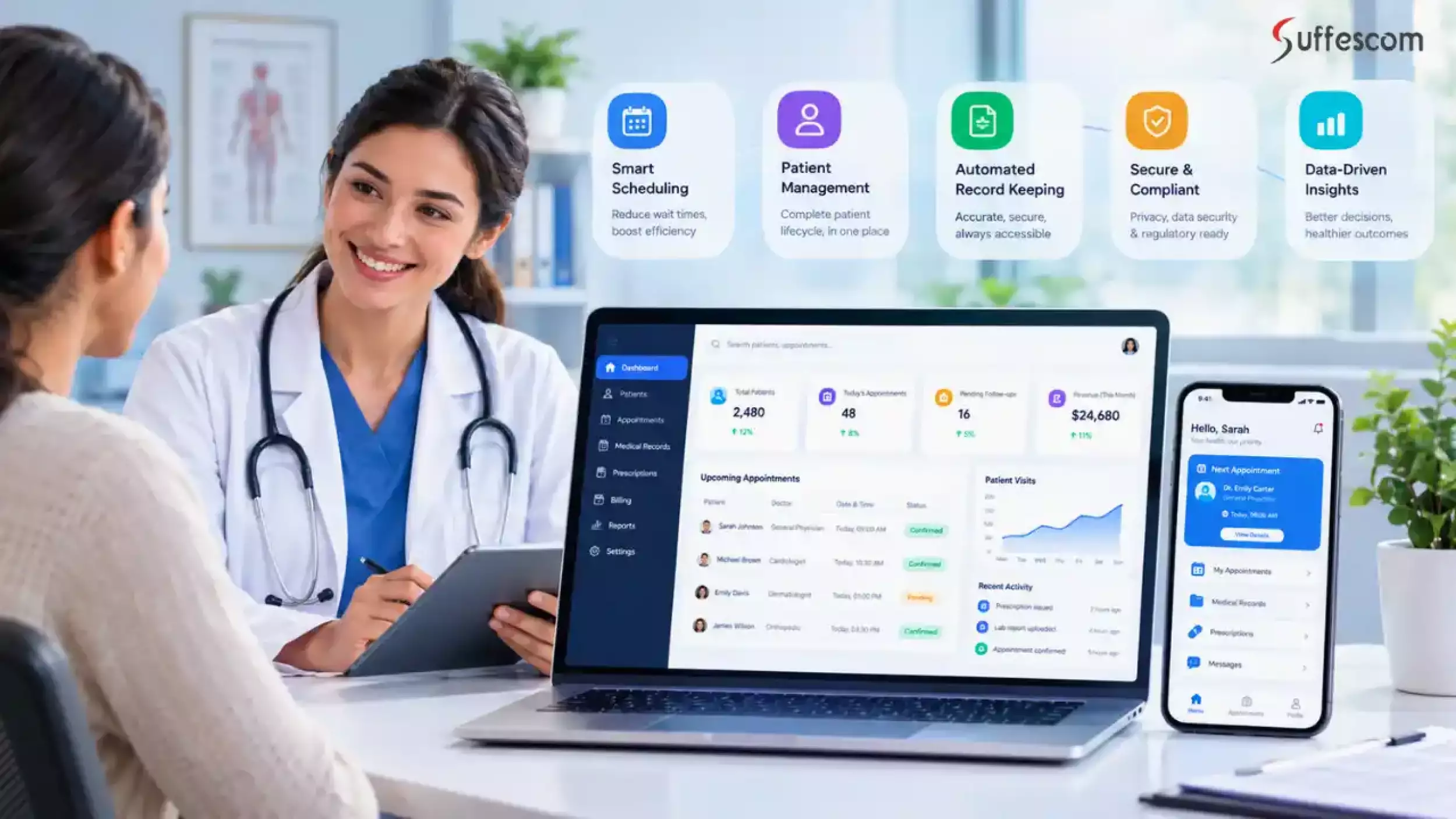
Healthcare is moving beyond digital record-keeping. AI now helps clinics manage patients, workflows, and data. These platforms connect records, scheduling, billing, communication, EHR/EMR systems, and telehealth.
AI adoption in healthcare is accelerating. The AMA reports that 81% of physicians used AI tools in 2026, up from 38% in 2023. The global practice management system market is also projected to reach $17.2 billion by 2026.
AI does more than power chatbots. It can predict no-shows and identify care gaps. It can prioritize follow-ups and assess patient risks. It can also support clinical decisions with human oversight.
Interoperability is essential for modern clinics. Platforms can connect EHRs, labs, pharmacies, billing systems, telehealth tools, and wearables. HL7 FHIR helps these systems exchange healthcare data securely.
Clinical AI needs strong validation and governance. Platforms need explainable AI and clinician oversight. They also need encryption, access controls, consent management, audit trails, and model monitoring. Compliance may include HIPAA, GDPR, or PDPA.
AI clinic platform development can cost $45,000 to $300,000+. A focused MVP may cost $45,000–$70,000. Mid-tier platforms can cost $90,000–$160,000. Enterprise platforms may reach $180,000–$300,000+.
The right development model depends on your goals. Custom development offers more control. SaaS solutions offer faster deployment. Hybrid development combines both approaches. The choice depends on your workflows, budget, integrations, and AI requirements.
Clinics are facing an increasing demand to treat more patients while simultaneously not adding additional administrative tasks to already overworked care teams. In fact, 57% of doctors surveyed by the American Medical Association (AMA) said that the greatest opportunity for AI in healthcare is reducing administrative burden via automation. To solve these issues, AI Clinic Patient Management Platform Development integrates scheduling, patient registration, EHR/EMR data, billing, communication, care coordination, and clinical workflows into an intelligent and connected system.
Whereas a traditional patient management system simply records details and schedules reminders, an AI-based system can foretell no-shows, automate repetitive processes, detect patient risk factors, assist with patient care decisions, and customize patient communications while minimizing clinician stress and time.
This guide covers everything from the features you need to advanced clinical decision support powered by artificial intelligence, technology stack, interoperability, security and compliance, the build vs buy vs hybrid decision-making framework, and more.
What Is an AI Clinic Patient Management Platform?
An AI clinic patient management platform is a digital healthcare solution that integrates patient management software with AI capabilities to streamline workflows, leverage healthcare data for insights, assist in clinical decision-making, and enhance patient engagement. While traditional clinic software primarily records appointments and schedules, an AI-powered system can see patterns, anticipate potential dangers, automate repetitive tasks, and highlight pertinent information for care teams.
AI Clinic Patient Management Platform Development isn't just about integrating an AI chatbot into current software; it's about building a platform that embodies the core of patient care and operates in harmony with it. It involves the seamless integration of patient information, clinical workflows, EHR/EMR systems, AI models, and administrative procedures in a secure and interoperable environment.
Core Components of an AI-Driven Patient Management System
A modern patient management system with the power of AI usually comes with four main layers:
Patient Management Layer
Manages patient registration, medical records, appointments, digital forms, prescriptions, billing, communication, and care plans.
AI and Analytics Layer
Facilitates AI-driven medical scheduling, reduces no-show rates, improves patient risk assessment, summarizes data, and provides personalized patient communication and predictive analytics.
Integration Layer
Integrates the platform with EHR/EMR, labs, pharmacies, billing, telehealth, and connected health devices through APIs and interoperability standards.
Security and Governance Layer
Ensures the safeguarding of sensitive health data by employing access controls, encryption, consent management, audit trails, data governance, and AI monitoring.
AI Patient Management vs. Traditional Clinic Management Software: Key Differences
Traditional clinic software is based on existing administrative procedures and processes that are already in place. It can be used for staff to store information, schedule appointments, generate invoices, and communicate with patients.
An AI platform adds intelligence to these workflows. It can analyze data from the past, find patterns, make predictions, automate repetitive tasks, and offer context to health care teams.
For instance, in the case of traditional software, the same appointment reminder will be sent to all patients. The AI-powered system can detect patients at increased risk for appointment no-shows and send personalized reminders or follow-up processes.
Capability
Traditional Patient Management
AI-Powered Patient Management
Patient records
Stores and retrieves data
Analyses and summarises relevant data
Scheduling
Calendar and rule-based booking
AI-assisted scheduling and no-show prediction
Communication
Manual or predefined messages
Personalized automated communication
Analytics
Standard reports
Predictive analytics and risk insights
Clinical support
Basic alerts
AI-assisted decision support with human oversight
Follow-ups
Staff-driven
Automated, context-aware workflows
Patient intake
Digital forms
Intelligent extraction and summarisation
An AI clinic system for patients does not replace the healthcare systems per se. Instead, it has the potential to become an intelligence and workflow layer that can seamlessly integrate with various aspects of the digital health ecosystem.
EHR/EMR systems offer access to clinical data like medications, allergies, medical notes, lab results, and diagnoses. Healthcare CRM systems can be used to facilitate communication and engagement with patients, while HIS platforms can deliver more comprehensive organizational information.
The AI platform can consolidate this information across these systems and leverage it to trigger automation or actionable insights. Interoperable systems can facilitate the exchange of healthcare information with the help of standards like HL7 FHIR. HL7 defines FHIR as a standard for the exchange of electronic health care information, which is based around reusable resources and APIs.
This integration allows clinics to integrate patient management, clinical workflows, analytics, engagement, and AI capabilities into one digital health platform.
Clinic patient management is transitioning from simple scheduling, record-keeping, and billing to seamless, AI-powered systems that can automate workflows and enhance care teams' performance. The practice management system market is expected to hit $17.2 billion by 2026, growing from $14.5 billion in 2024 at a CAGR of 10.2% from 2025 to 2030.
The segment dedicated to AI is growing even faster. According to Fortune Business Insights, the global AI in the patient management market is expected to reach $2.35 billion by 2026 with a compound annual growth rate of 29.33% until it hits $18.40 billion in 2034.
Global Market Size and Projected CAGR
The numbers reveal two related trends: First, clinics are still continuing their digital transformation of core management processes; second, AI has emerged as an extra layer of intelligence in patient access, care coordination, risk management, and remote monitoring.
Market indicator
2026 figure
Growth outlook
Global practice management systems
$17.2B
10.2% CAGR, 2025–2030
Global AI in patient management
$2.35B
29.33% CAGR, 2026–2034
Turn Your Healthcare Idea Into a Product
Planning to build an AI-powered clinic management platform? From patient workflows and AI automation to EHR/EMR integration and healthcare compliance, Suffescom can help you turn your concept into a secure, scalable digital health product.
An AI clinic patient management platform is not just an AI application but a connected workflow. It gathers patient data from various sources and harmonizes it; feeds the standardized data into the appropriate AI models; converts the data output from the models into clinical or operational actions.
A typical workflow is like this:
Patient → Intake/Devices → Data Layer → AI Engine → Recommendations/Automation → Clinician Review → Action → Outcome Data
Patient Data Collection
It starts with patient data getting entered into the platform via various touchpoints, including
Digital intake forms and patient registration.
EHR/EMR systems
Telehealth consultations
Laboratory and diagnostic systems.
Embedded medical devices and wearables.
Remote patient monitoring (RPM) platforms
Record of previous appointments and medical records
Only data necessary for the intended workflow is collected from the platform, and appropriate access and consent controls are applied.
Data Processing & Normalization
Healthcare information may be delivered in a variety of formats from disconnected systems. The platform's pre-AI processing capabilities include:
Validate incoming data.
Adhere to standardized healthcare data formats.
Clean up or mark incomplete information with question marks.
Provide information about the map from various systems.
Structure and organize clinical data, both structured and unstructured.
Analyze and develop relevant data for AI models.
Healthcare standards like HL7 FHIR can facilitate the exchange of health data between various health care applications and enable information to be usable in interoperable systems.
AI/ML Analysis Layer
The processed data is then fed into the relevant AI or machine-learning model that is suitable for the use case.
Common applications include:
Machine learning for patient risk prediction.
NLP for analyzing clinical notes.
LLMs for summarization and conversational workflows.
The use of predictive models for appointment and no-show patterns.
AI-assisted patient prioritization.
Analytics to identify gaps in care.
The scope for the AI model should be clearly defined. The use of the model should not be considered automatically being correct for all clinical decisions.
Clinical and Operational Decision Layer
AI results are transformed into valuable recommendations, alerts, prioritization, or workflow automation.
The platform can, for instance:
Mark a patient for further follow-up.
Outline a possible care need.
Create priority appointments according to specific criteria.
Create a summary for a clinician for patients.
Set a reminder to yourself automatically.
Upscale if certain conditions are met.
This layer is the link between the AI insights and the clinic's operational processes.
Human Review and Action
In clinical cases, AI should be used to help guide appropriate clinical judgment, not to replace it.
The clinician or authorized staff member can:
Check the AI-generated text.
Check the underlying patient information.
Accept, recognize, or deny a suggestion.
If it is needed, escalate a case.
Note the last action.
In the healthcare field, NIST's guidance on AI also highlights situations where healthcare professionals still review AI-generated outputs and make decisions.
Continuous Feedback and Model Monitoring
After an AI recommendation has been implemented, the workflow goes on. The platform can monitor:
Model performance
User feedback
Wrong or unusual results.
Changes in the quality of the data.
Model drift
Workflow outcomes
Safety and escalation events:
This establishes a vicious cycle:
Data → AI Analysis → Decision → Action → Outcome → Monitoring → Improvement
This monitoring can ensure that AI capabilities remain aligned with their intended use, as the clinic, patient population, workflows, and underlying data all evolve.
Key Benefits of Building an AI Clinic Patient Management Platform
An AI clinic patient management platform can transform a clinic from a reactive, staff-driven model to a more connected and proactive approach. It's not just about incorporating AI capabilities. It's related to how patient and operational information can be used to minimize repetitive tasks, assist care teams, enhance the patient experience, and make clinic operations more efficient.
Operational Benefits for Clinic Administrators
AI healthcare workflow automation has the potential to streamline clinic workflows and minimize administrative tasks that can consume staff time.
Routine tasks are automated: Appointment reminders, intake processing, follow-ups, documentation support, and other repetitive tasks are automated.
Smarter scheduling: AI-powered scheduling and no-show predictions to optimize appointment utilization and avoid unnecessary gaps.
One integrated information system: Integrate patient, appointment, billing, and communication information into a connected workflow.
Improved resource optimization: Operational data analysis to identify limiting resources and optimize staff and appointment allocation.
Clinical Benefits for Doctors and Care Teams
An AI platform can help the clinician by providing easy access to the relevant information and also decrease the non-clinical workload.
Access patient information faster: Summarize important medical history, notes, results, and past experiences.
Clinical workflow support: Clinical gaps on the surface, risk indicators, or relevant information for review.
Documentation support: Save clinicians time in writing notes and other routine documentation.
Care coordination: Support teams to monitor referrals, follow-ups, and patient care.
Experience Benefits for Patients
AI can also be used in the proper segments of the care journey to benefit patients.
Quick responses: AI assistants can answer common inquiries and guide patients to resources.
Easy access: Digital scheduling, reminders, telehealth, and patient portals.
Contextual engagement: Customize reminders and follow-up communication to patient context.
Reduced friction: Low-friction registration, intake, and appointment management.
Financial and ROI Benefits for Clinic Owners
The financial benefit of AI patient management is, for the most part, the efficiency gains and better utilization of resources.
Reduce administrative burden: Automate repetitive tasks and save time.
More effective use of appointment time: Minimize unnecessary time gaps in the schedule and optimize capacity planning.
Improved speed of the revenue cycle workflow: Facilitate coding, documentation, claims, and billing processes.
Better Staff Productivity: Provide staff with more time to spend on higher-value activities.
Growth operations: Be able to manage as patients are added without the ratio of administrative load.
The ROI will vary based on clinic size, number of patients, workflow complexity, AI capabilities, integration needs, and implementation costs. So don't just take it for granted that ROI will follow the use of AI; it should be based on specific operational and financial KPIs instead.
Must-Have Features in AI Clinic Patient Management Software Development
A modern AI clinic patient management platform should combine core patient-management capabilities with intelligent automation, clinical support, and operational intelligence. The exact feature set will depend on the clinic's specialty, workflow, patient volume, and AI use cases.
A patient portal or mobile application can provide a single access point for:
Appointment booking and reminders.
Digital registration and forms.
Medical documents and care information.
Secure communication.
Telehealth access.
Payments and billing.
Medication and follow-up reminders.
Conversational Patient Record
A conversational patient record can help clinicians find information using natural-language questions instead of searching through multiple screens. For example, clinicians could ask:
What changed during the patient's last three visits?
Show recent abnormal results.
Which medications are currently active?
When was the last follow-up?
AI-Powered Clinic Digital Twin
An AI-powered digital twin can represent clinic operations using appointment, patient flow, staffing, capacity, and historical data. It can help:
Simulate appointment demand.
Identify operational bottlenecks.
Test scheduling scenarios.
Forecast resource requirements.
Model patient-flow changes before implementation.
Multimodal Clinical Intelligence
Next-generation platforms can combine different forms of healthcare data instead of relying solely on structured records. Depending on the intended use, the AI layer can process:
Clinical notes and messages.
Lab results and vital signs.
Medical images.
Patient-generated data.
Consultation audio.
Documents and reports.
Feature
Business Impact
Development Complexity
AI scheduling & no-show prediction
Higher appointment utilization
High
Smart intake & EHR/EMR integration
Less manual data entry
High
Ambient AI documentation
Faster clinical documentation
High
AI chatbot & virtual assistant
Faster patient support
Medium
Predictive analytics
Earlier identification of risks and care gaps
High
Agentic patient journey orchestration
More automated care coordination
High
Billing, coding & claims automation
Greater revenue-cycle efficiency
High
Telehealth & RPM integration
Extends care beyond the clinic
High
Patient portal & mobile app
Better patient access and engagement
Medium
Conversational patient record
Faster access to patient information
High
AI-powered clinic digital twin
Better operational planning
High
Multimodal clinical intelligence
Deeper analysis across data types
High
Build Around Your Clinic's Workflow
Your clinic shouldn't have to adapt to generic software. Build a patient management platform around your specialties, workflows, integrations, and AI requirements. Talk to our healthcare software experts to define the right features and development roadmap.
Use Cases of AI Clinic Patient Management Platforms
AI clinic patient management platforms can support different healthcare workflows based on specialty, patient volume, and operational needs. The following scenarios show how clinics can apply AI to solve specific day-to-day challenges.
Multi-Specialty Clinics
For example, a patient visits a multi-specialty clinic and needs consultations with three different departments. The platform can connect appointments, records, referrals, and follow-ups across departments. AI can prioritize pending tasks and identify care gaps, giving care teams a unified view of the patient's journey.
Chronic Disease Management
Consider a diabetes patient whose glucose readings, medication history, and follow-ups are stored across different systems. The platform can combine this data and identify concerning trends. It can then prioritize the patient for review or trigger a follow-up when predefined monitoring thresholds are reached.
Primary Care Clinics
For example, a patient completes digital intake before arriving for a primary care visit. AI can extract relevant information, prepare a patient summary, and flag missing details for staff. After the consultation, the platform can automate reminders and follow-ups.
Specialty Clinics
Imagine a cardiology patient with test results, medications, referrals, and clinical notes from multiple visits. AI can bring relevant information together and support specialty-specific triage, risk assessment, documentation, and follow-up. The workflow can be configured around the requirements of the specialty.
Telehealth and Virtual Care
For example, a patient completes a virtual consultation and continues monitoring from home. The platform can connect the consultation, patient messages, wearable data, and follow-up tasks. This gives care teams continuity between virtual and in-person encounters.
Preventive and Population Health
Consider a clinic with thousands of patients who are overdue for screenings or follow-ups. AI can identify these care gaps and group patients based on risk and priority. Staff can then launch targeted outreach instead of manually reviewing every record.
Healthcare Networks and Multi-Clinic Groups
For example, a healthcare group operates 10 clinics using different workflows and systems. A centralized platform can connect patient information, analytics, access controls, and standardized processes. New locations can then be added without rebuilding the core platform.
AI-Powered Referral Triage
Imagine a specialist clinic receiving hundreds of referral documents every week. AI can extract relevant information, identify referral urgency, and route cases to the appropriate specialty or review queue. Staff can focus on complex referrals instead of manually sorting every document.
Intelligent Medication Adherence and Follow-Up
For example, a patient repeatedly misses medication-related follow-ups. The platform can analyze appointment history, medication records, messages, and patient-reported information to identify potential adherence issues. It can then trigger reminders or assign a follow-up task to the care team.
AI-Powered Clinic Capacity Planning
Consider a clinic where waiting times increase sharply during certain hours. AI can analyze appointment demand, patient flow, staffing, and historical patterns to identify bottlenecks. Managers can then test different scheduling or staffing scenarios before making operational changes.
Post-Visit Care Coordination
For example, a patient leaves the clinic with a lab test, medication change, specialist referral, and follow-up appointment. The platform can automatically create and track these tasks. AI can flag incomplete actions and route them to the appropriate staff member.
Patient Journey Personalization
Imagine two patients with the same condition but different communication preferences and care needs. AI can use patient history, preferences, engagement patterns, and care plans to personalize reminders and follow-up timing. This creates a more relevant patient experience without changing the underlying clinical workflow.
The AI Clinical Decision Support (CDSS) Layer
The traditional patient management system is basically used to store as well as move information. A clinical decision support system (CDSS) provides an intelligence layer that can process relevant patient data and provide clinicians with timely and evidence-informed insights.
In the case of an AI clinic patient management platform, the primary design principle should be that AI complements clinical judgment rather than replacing it. The WHO suggests that humans should have control over decisions in healthcare and, when using AI in healthcare, prioritize safety, transparency, explainability, accountability, and continual evaluation.
Symptom-to-Specialist AI Triage Engine
An AI triage engine can help route patients to the appropriate care pathway or specialist based on the information available.
It can analyze:
Reported symptoms and patient history
Existing conditions and medications
Urgency indicators and predefined clinical criteria
Previous encounters and relevant records
Specialty availability and clinic capacity
The output may be a triage recommendation or priority level that may be checked by an approved healthcare practitioner before making further decisions. There should also be clear pathways of escalation for potentially urgent cases, but not rely on that system to de-escalate.
AI-Assisted Diagnostic Recommendations with Human-in-the-Loop Safeguards
AI can process the clinical information and identify possible diagnoses, patterns, or supporting evidence that could then be shown to the clinician for review. It can be machine learning models, NLP, knowledge-based systems, or any other AI approach depending on the application.
A robust implementation should include:
Clearly defined intended use and patient population
Appropriate input and data-quality requirements
Evidence or rationale supporting the recommendation
Confidence or uncertainty information where appropriate
Clinician review and approval
Ability to reject, modify, or override the output
Audit records of significant AI-assisted decisions
The FDA's 2026 CDS guidance highlights the importance of enabling healthcare professionals to independently review the basis for certain software recommendations, including information about the inputs, algorithm or methodology, and validation.
Patient Risk Stratification and Early Warning Scoring Models
There are also risk models that can be used to identify patients at risk who may need more attention or follow-up care. The platform could integrate clinical history, lab data, vital signs, encounter data, and other pertinent data in order to calculate a risk score or prioritization indicators based on context.
Potential applications include:
Deterioration-risk identification
Care-gap prioritization
Follow-up risk assessment
Chronic-condition monitoring
Readmission-risk support
RPM alert prioritization
These models should be tested to ensure they work for the intended population and workflow, and cannot be taken as a given that a model that works well in one context will work in another.
Explainable AI (XAI) for Clinician Trust and Auditability
AI recommendations should not be presented as a "score" or "instruction" without explanation. For the clinicians to grasp the rationale behind the output, including the system's reasoning and limitations.
An explainable CDSS can provide:
Key factors contributing to an output
Relevant patient data used by the model
Model or recommendation rationale
Confidence or uncertainty indicators where appropriate
Version and timestamp information
Audit logs for significant AI interactions
This helps to facilitate clinician review, troubleshooting, governance, and post-deployment monitoring. Transparency and explainability are explicitly identified by WHO as key principles of responsible AI use in healthcare, and strict testing and evaluation are called for where the AI will be used.
Tech Stack for AI Clinic Patient Management Platform Development
Playing with the technology stack of an AI clinic patient management platform isn't merely about application development. It needs to process sensitive health care information, manage real-time workflows, and support AI workloads, interoperability, scalability, and secure access by patients, clinicians, and administrators.
Frontend Frameworks: React, Flutter, and Angular
The front-end should offer user-friendly interfaces for various users and workflows.
React: Appropriate for clinician dashboards and administrative portals on the web.
Flutter: Patient and staff mobile applications that share a codebase for cross-platform development.
Angular: Ideal for enterprise applications with complex workflows and structured web apps.
The selection should be based on the users of the platform, device needs, user experience design, and long-term maintenance plan.
Backend and Cloud Infrastructure
The backend deals with business logic, APIs, authentication, integrations, workflows, and communication between the platform's services.
Node.js: Ideal for applications that use the API and real-time workflows.
Python/Django: Useful for healthcare applications involving data processing, analytics, and AI/ML integration.
AWS, Azure, or Google Cloud: Provide scalable infrastructure, storage, databases, monitoring, identity services, and AI capabilities.
Security considerations such as data residency, encryption, access controls, auditability of data, backup, and relevant regulatory requirements should also be taken into account in the cloud architecture for healthcare deployments.
AI/ML Frameworks: TensorFlow, PyTorch, and LLM/NLP Layers
Depending on the use case, the AI layer can integrate the advantages of traditional machine learning with NLP and generative AI.
TensorFlow or PyTorch: For developing and deploying machine learning models.
NLP frameworks: To handle clinical notes, patient messages, and other health care text.
LLM layers: Use cases like summarization, conversational assistants, and workflow support.
Model monitoring: Observing performance, drift, errors, and unexpected results following deployment.
Clinical AI should be designed with a clear intended use, tested with relevant data, and be overseen by appropriate human oversight.
Interoperability Standards: HL7, FHIR, and DICOM
Interoperability is a requirement because patients often have to pass through several healthcare systems.
HL7: Enables the sharing of healthcare data across systems.
FHIR: Offers a new, API-oriented way to share healthcare information.
DICOM: A DICOM is standard for the storage and communication of medical imaging information.
The right interoperability standards can ease the process of incorporating EHR/EMRs into the system and enable the system to share data with labs, imaging systems, pharmacies, telehealth platforms, and other healthcare applications.
Database Architecture for Structured and Unstructured Health Data
Healthcare systems frequently involve having to deal with structured data and unstructured information like clinical notes and documents.
A standard architecture is to employ:
PostgreSQL or MySQL: Structured patient, appointment, billing, and operational data.
MongoDB or similar NoSQL database: Flexible document-oriented data when appropriate.
Object storage: Medical documents, reports, and other large files.
Vector databases: AI applications that need semantic search/retrieval over trusted, unstructured content.
The database architecture should not only be the most popular database, but it should also be designed to meet the needs of data integrity, availability, access control, encryption, backup, and scalability.
Recommended Tech Stack by Layer
Platform Layer
Recommended Technologies
Primary Purpose
Frontend
React, Flutter, Angular
Web portals and mobile applications
Backend
Node.js, Python/Django
APIs, business logic, and workflows
AI/ML
PyTorch, TensorFlow, NLP, LLMs
Prediction, NLP, and AI-assisted workflows
Database
PostgreSQL, MySQL, MongoDB
Structured and flexible healthcare data
Storage
AWS S3, Azure Blob, Google Cloud Storage
Documents and large healthcare files
Cloud
AWS, Azure, Google Cloud
Hosting, scaling, security, and infrastructure
Interoperability
HL7, FHIR, DICOM
Healthcare data exchange
Step-by-Step AI Clinic Patient Management Platform Development Process
AI clinic patient management platform development shouldn't be limited to creating apps for scheduling appointments, patient records, and dashboards. The process should link clinical workflow and applications with AI and incorporate issues such as data quality and interoperability, security, validation, and clinical oversight.
The platform can leverage machine learning, NLP, LLMs, or predictive models for use cases like risk prediction, summarization, triage, and care-gap detection, depending on the specific use case.
The development cycle should cover:
Data preparation and quality checks
Model selection and training/fine-tuning
Performance and subgroup testing
Bias and robustness evaluation
Explainability
Human-in-the-loop controls
Model monitoring and drift detection
For clinical AI, accuracy alone is not enough. Models should also be evaluated for clinical relevance, safety, false positives, false negatives, and workflow impact.
Healthcare QA must test both the software and its clinical behavior.
Testing should cover:
Functional and integration testing
Security and compliance testing
AI accuracy, robustness, and edge cases
Clinical workflow testing
Access controls, audit trails, and data handling
AI produces overrides, escalations, and pathways.
The version of the model, validation results, significant changes, and clinical overrides should be tracked and maintained for continuing governance.
Deployment, Integration & Post-Launch Support
Implement the platform in a gradual manner, instead of all AI features simultaneously.
Pilot → Validate → Deploy → Monitor → Improve
Post-launch monitoring should monitor:
AI performance and override rates
Data quality and model drift
Integration failures
Security events
System performance
Clinician and patient feedback
In the case of workflows or patient populations evolving, AI models might need revalidation or retraining. This makes post-launch monitoring an ongoing part of AI clinic patient management platform development, rather than a final support step.
Get a Technical Development Roadmap
Ready to move from an idea to development? Get a practical roadmap covering architecture, AI models, EHR/EMR integration, HL7 FHIR interoperability, security, clinical validation, and deployment.
How to Integrate EHR, EMR, and Other Healthcare Systems
The utility of an AI clinic patient management platform is greatly enhanced when it is able to communicate with the systems that clinics are already using. Integration brings together patient records, diagnostics, prescriptions, billing, devices, and virtual care into a single workflow.
EHR/EMR Integration
Integrate EHR/EMR platforms to ensure secure sharing of patient information like demographics, medical histories, encounters, medications, allergies, clinical notes, and test results.
The integration must include support for real-time or scheduled data replication, the ability to detect duplicates, error handling, access control, and auditing.
HL7 and FHIR APIs
HL7 standards facilitate the exchange of healthcare data, and FHRI offers a contemporary, API-oriented structure to exchange healthcare information between applications.
The platform can integrate with EHRs, labs, pharmacies, patient apps, and other digital health systems via FHIR-based APIs and minimize the need for custom point-to-point integrations.
Laboratory and Diagnostic System Integration
Integrate laboratory information systems and diagnostic platforms to automatically receive:
Test orders and status
Laboratory results
Diagnostic reports
Reference ranges
Imaging-related information
For medical imaging workflows, DICOM supports communication and exchange of biomedical and diagnostic imaging information.
Pharmacy Integration
Prescription and medication workflows can be integrated with the platform via pharmacy integrations. The system can facilitate prescription transmission, medication history, medication requests, medication availability, and medication notifications, depending on the market and available APIs.
Medical Billing and Insurance Integration
Integrate billing and insurance processes with the exchange of patient eligibility, claims, payment status, procedure information, and more. This minimizes redundant data entry and links clinical documentation to revenue cycle processes.
The integration of wearables and IoT
Wearables and connected medical devices can gather data like heart rate, blood pressure, glucose, oxygen saturation, activity, or other monitors. The platform can forward pertinent readings to the patient record, analytics engine, or RPM workflow and send alerts when a predefined threshold or risk condition is reached.
Telehealth Integration
Telehealth integration aims to link virtual consultations with the patient's overall health information. The video consultation, secure messaging, appointment information, clinical notes, prescriptions, follow-up appointments, patient communications, and more can all be integrated into the platform.
This ensures seamless continuity in both care settings, rather than different workflows for face-to-face and telecare.
Health Information Exchange
The platform might be required to take part in more extensive networks for health information exchange in multi-provider or multi-organization settings. This allows trusted health care entities to access and exchange pertinent patient data without the loss of security, consent, and privacy.
What Data to be Exchanged between the Systems?
Not all patient information is required for all systems. The exchange of data should be based upon the minimum data necessary and the purpose applicable to the workflow and relevant regulations.
The platform should also store information on data provenance, timestamps, identifiers, consent status, and audit information to enable clinicians and administrators to track where data is from and when it has changed.
The aim is not just to hook more systems up. To establish a cohesive, interoperable data layer that provides AI models and care teams with timely, accurate data at the right place in the workflow.
Data Privacy, Security & Regulatory Compliance in Healthcare AI Development
Compliance with regulatory standards and privacy and security are essential features of healthcare AI platforms, given the critical nature of patient data. Specific controls will vary based on the target audience, data types, and the purpose of the platform.
Global Health Data Regulations (HIPAA, GDPR, PDPA, and Regional Equivalents)
Compliance requirements vary by jurisdiction. A platform serving the U.S. may need to address HIPAA, while European deployments may need GDPR and other applicable national requirements. Singapore deployments may fall under the PDPA, with other regions having their own healthcare and privacy frameworks.
Compliance planning should cover:
Data collection, processing, storage, and transfer
Patient privacy and applicable data-subject rights
Data retention and deletion requirements
Third-party and vendor access
Cross-border data transfers
Breach and incident response
Compliance should be identified when designing and discovering, not as a checklist for the end of development.
End-to-End Encryption and Role-Based Access Control
Data should be securely transmitted and securely stored in line with the applicable encryption and key management. The Security Rule of HIPAA mandates that electronic protected health information be adequately protected through access control, authentication, audit control, and transmission security measures.
For sure, role-based access control (RBAC) should be used to make certain that users can access only the information they must for their duties. It is not a requirement that a doctor, billing administrator, nurse, and patient have the same permissions.
Consent Management and Audit Trail Requirements
The system should be able to provide clear access and change information on patients by users, sharing, and actions.
Important controls include:
Patient consent and preference management
Purpose-based data access
User authentication and authorization
Immutable or tamper-evident audit logs
Data access and modification history
Consent withdrawal and data-handling workflows
These controls also support investigation, accountability, and regulatory reporting when required. HIPAA specifically requires mechanisms to record and examine activity in systems containing electronic protected health information.
AI Governance: Bias Testing and Model Transparency
AI governance adds another layer of responsibility beyond conventional healthcare software security.
Before and after deployment, AI models should be evaluated for:
Bias and performance differences across relevant patient groups
Accuracy, reliability, and robustness
Explainability and supporting evidence
Model version and training-data traceability
Human review and override mechanisms
Model drift and performance degradation
NIST's AI Risk Management Framework identifies characteristics such as validity, safety, security, transparency, explainability, privacy, and fairness as important elements of trustworthy AI.
For clinical AI, the objective is not simply to make the model accurate. It is to make its use understandable, auditable, appropriately governed, and safe within its intended clinical workflow.
Cost to Develop an AI Clinic Patient Management Platform
The cost to develop an AI clinic patient management platform typically ranges from $45,000 to $300,000+.
A focused MVP can cost around $45,000–$70,000, while a mid-tier platform with AI, EHR/EMR integration, telehealth, billing, analytics, and compliance features can range from $90,000–$160,000. Enterprise platforms with advanced clinical AI, multiple integrations, multi-clinic support, custom models, and high-scale infrastructure can exceed $180,000–$300,000+.
These estimates align with current healthcare AI development benchmarks while accounting for the broader clinical-AI scope of an AI clinic patient management platform.
Cost Breakdown by Development Phase
Development Phase
Estimated Cost
Discovery, architecture & compliance planning
$5,000–$12,000
UI/UX design
$7,000–$15,000
Core platform development
$25,000–$50,000
AI development & integration
$15,000–$35,000
EHR/EMR, HL7/FHIR & third-party integrations
$10,000–$30,000
QA, security & clinical validation
$8,000–$20,000
Deployment & initial support
$5,000–$12,000
Total MVP Estimate
$45,000–$70,000
The phases can overlap, so these numbers are meant to be viewed as ranges, not just numbers being added up. The project can be pushed to the upper end of the range by custom AI model training, complex integrations, and multi-system deployments.
Factors That Influence Final Development Cost
The final investment will be based largely on:
The more complex the AI: The cost of AI chatbots and workflow automation is less than predictive analytics or clinical decision support.
EHR/EMR integration: Several systems, custom APIs, and intricate data mapping raise development efforts.
Clinical AI validation: Additional testing, validation, explainability, and monitoring for higher-risk AI functions.
Architecture for platform scale: Multi-clinic or multi-tenant architecture demands more infrastructure and engineering work.
Compliance requirements: Architecture and testing are impacted by compliance requirements such as HIPAA, GDPR, regional regulations, security controls, and audit requirements.
Data readiness: Preparing, structuring, labeling, and cleaning healthcare data may be time-consuming.
Third-party services: Telehealth, payment, pharmacy, laboratory, AI model, cloud, and device APIs can come with development and recurring costs.
Customization: Highly specific clinical workflows will often be more expensive than configuring standard modules.
MVP vs. Enterprise-Grade Platform Cost Comparison
An MVP needs to test the highest-value workflows and should not be overambitious to start building the whole healthcare ecosystem.
Platform Level
Estimated Cost
Typical Feature Scope
Basic MVP
$45,000–$70,000
Patient registration, appointments, patient records, basic AI chatbot/automation, admin dashboard, basic billing, core security and one or two integrations
Advanced CDSS, custom AI models, multi-clinic/tenant architecture, multiple EHR and third-party integrations, advanced analytics, RPM, telehealth, enterprise security, extensive validation and scalable cloud infrastructure
The final quote will vary based on the number of AI use cases/integrations, target markets, clinical-risk level, and deployment scale.
Get a Cost Estimate for Your Platform
Know what your AI clinic platform could cost before development begins. Share your required features, AI use cases, integrations, and target market with our team to receive a tailored development estimate.
Build vs. Buy vs. Hybrid: Choosing the Right Development Approach
No one size fits all when it involves development. The decision will come down to the complexity of the clinic's workflow, budget considerations, integration needs, AI requirements, and future expansion goals.
Fully Custom Development: Pros, Cons, Ideal Use Case
Pros
Full access to workflows, artificial intelligence, data infrastructure, and integration.
It is more straightforward to create clinical decision-support capabilities.
More security, compliance, and scalability control.
Avoiding vendor limitations with regard to the product roadmap.
Cons
Higher upfront investment.
Longer development & validation time.
Constantly needs technical and AI upkeep.
Best for: Multi-specialty clinics, healthcare networks, or organizations with complex workflows or longer-term digital health plans.
White-Label / SaaS Patient Management Platforms: Pros & Cons & Ideal Use Case
Pros
Faster deployment.
Reduced investment cost.
Built-in patient management and administrative capabilities.
Infrastructure and product upgrades are usually done by the vendor.
Cons
Limited customization.
There will be a mix of general and specific AI skills.
There may be restricted integration options.
Relying more on the vendor for future changes and data architecture.
Best for: Standard patient management is sufficient for small clinics and practices.
API-First Hybrid Approach: Pros, Cons, Ideal Use Case
The hybrid system is a mix of both an existing healthcare system and customized development and specific APIs.
Pros
Speeds up building from scratch.
Substantially less expensive than a fully custom platform.
Custom AI, dashboards, or workflows can be integrated where it makes the most sense.
More seamless with current EHR, billing, telehealth, or healthcare solutions.
Cons
Needs a thoughtful architecture design.
A certain amount of reliance on third-party vendors is still required.
Complexity can be added with data synchronization and interoperability.
Best for: Expanding clinics and healthcare providers that seek rapid deployment without compromising on vital workflows and AI capabilities.
Decision Framework: What Clinic Model is Right For You and Your Clinic Size and Budget?
Requirement
Custom
White-Label / SaaS
Hybrid
Upfront cost
High
Low
Medium
Time to launch
Longer
Shorter
Medium
Customization
Very high
Limited
High
Scalability
High
Vendor-dependent
High
Compliance control
High
Vendor-dependent
High
Advanced clinical AI
Strongest
Limited
Strong
Integration flexibility
High
Limited–Medium
High
Best fit
Complex/enterprise clinics
Small standardized practices
Growing or evolving organizations
Here's a simple rule to help narrow down your options:
Looking for fast and consistent processes? Consider SaaS.
Need complete control and specialized clinical AI? Consider custom development.
Want quicker deployment without losing out on key customization? See the hybrid option.
The hybrid approach may be a viable solution in many growing healthcare organizations, or a fully custom platform might be necessary for highly specialized or enterprise environments.
Common Challenges and Their Impact on AI Patient Management Platform Development
While AI has the potential to optimize clinic operations and clinical workflows, its implementation comes with its own set of challenges to overcome at the architectural, AI, and organizational levels.
Legacy System and Data Silo Integration
EHRs, laboratory systems, billing systems, and departmental databases could be in different formats and use different APIs. Data silos can hinder the accuracy of AI and result in redundant processes.
How to overcome
Integrate using an API-first, HL7/FHIR-supportive layer with data normalization, identity matching, and validation rules. Phase in integrations, rather than replacing all legacy systems at once.
Clinician Trust and AI Explainability Barriers
When the rationale for the AI recommendation, supporting data, or level of confidence are not clear, clinicians may be hesitant to accept the AI recommendation. The key is in the design of the alerts; they can cause alert fatigue when poorly designed.
How to overcome
Provide AI explanations, use supporting information that is relevant, include levels of confidence or uncertainty when applicable, and let clinicians choose to accept, adjust, decline, or escalate recommendations. The human roles and responsibilities should be distinct and unambiguous.
Scalability Under Peak Patient Load
The platform may be overwhelmed during appointment rushes, when handling extensive patient records, during telehealth sessions, and with multiple AI requests.
How to overcome
Take advantage of cloud-native infrastructure, auto-scaling, load balancing, caching, asynchronous processing, and independently scalable AI services. Prior to production deployment, a system should be tested for performance at peak clinical workloads.
Change Management and Staff Onboarding
Technically capable platforms can have poor uptake if not adopted by clinicians and administration. Ineffective onboarding can lead to workarounds and non-uniform use of AI capabilities.
How to overcome
Use role-based training, introduce phased deployment, workflow-specific onboarding, clear usage guidelines for AI, and feedback loops. Begin with valuable workflows and scale up once users are familiar with the system.
The Future of AI in Clinic Patient Management (2026 and Beyond)
The future of clinic platforms will shift from standalone AI capabilities to context-aware, constantly supervised platforms that will support patients through their entire experience.
Agentic AI for Autonomous Care Coordination
Agentic AI can orchestrate multiple-stage workflows like scheduling follow-ups, confirming any necessary tests have been performed, reminding, routing, and escalating exceptions.
It will go beyond AI just answering a question to AI performing specific workflows with defined permissions and human oversight.
Ambient AI Clinical Documentation (Voice-to-EHR)
Ambient AI can record clinician-patient interactions, extract pertinent data, create written summaries, and support clinical documentation.
This can decrease manual documentation efforts but still maintain clinician accountability in reviewing and approving final documentation.
Predictive Population Health Management
As the number of patients grows, AI can be used to review the information and pinpoint high-risk patients or care gaps, chronic disease trends, and those patients who may need proactive care.
This enables clinics to go beyond the single encounter to preventive and population-based care management.
Build Your AI Clinic Platform With Suffescom
Ready to create a smarter patient management experience? Partner with Suffescom to build an AI-powered clinic platform that connects healthcare workflows, patient data, intelligent automation, and clinical decision support in one scalable ecosystem.
Conclusion
AI is revolutionizing the way clinics treat patients, operate processes, and handle clinical data. A robust platform can simplify repetitive tasks, integrate disjointed healthcare systems, assist clinical decisions, and provide customized patient experiences. But building a successful AI clinic patient management platform goes beyond simply incorporating AI capabilities. It requires a secure architecture, healthcare interoperability, clinical validation, regulatory planning, and ongoing monitoring.
From building an AI-driven MVP to creating an enterprise healthcare solution, the key to achieving your goals lies in the development approach you choose. Want to create your AI-enabled clinic platform? Partner with Suffescom to turn your healthcare software vision into a secure, intelligent, and scalable product.
FAQs
1. What is an AI clinic patient management platform?
An AI clinic patient management platform integrates patient management solutions with AI to streamline processes, understand health data, aid clinical decisions, and enhance patient engagement. It can tie all appointments, records, billing, communication, telehealth, and AI-powered care workflows together within a single platform.
2. How is AI different from traditional clinic management software?
Information is traditionally stored, and tasks are traditionally automated using traditional software. AI platforms can use patient information to predict risks, communicate with the patient, look for patterns, track patient information, and offer insight into important clinical decisions without losing the clinician's touch.
3. What is the cost of creating an AI patient management platform?
Development typically costs $45,000–$300,000+. A focused MVP may cost $45,000–$70,000, while mid-tier platforms generally range from $90,000–$160,000. Platforms that are enterprise-level and offer advanced AI, multiple integrations, and multi-clinic support will cost more than $180,000.
4. What is the time frame involved in creating an AI-driven clinic platform?
The timeline for an MVP can be a few months to a year, depending on what it is. However, for more complex enterprise solutions, it can take around 10–18 months or more, depending on the complexity of AI technology, integration, compliance, and validation concerns.
5. What should be included in an MVP?
A patient registration module, digital intake, appointment management, patient records, basic AI automation features, billing, communication options, role-based access, audit logs, and essential EHR/EMR integration are common MVP features. More advanced CDSS and predictive AI can be added later.
6. Is AI patient management software HIPAA and GDPR compliant by default?
No, there is no compliance without effort. It is dependent on the way patient data is gathered, handled, saved, shared, and accessed, as well as the security measures, policies, vendors, and processes used by the platform.
7. Can an AI patient management platform integrate with existing EHR/EMR systems?
Yes. Securely exchanging other healthcare data, including demographics, encounters, medications, diagnoses, observations, and more, is possible with platforms and EHR/EMR systems via APIs and standards like HL7 and FHIR.
8. What AI models are used in clinical decision support?
There are various ways that machine learning can be applied to clinical decision support: risk prediction, clinical notes with NLP, summaries using LLMs, and defined clinical logic with knowledge-based rules. The choice of model will depend on the use case, data, risk level, and validation requirements.
9. Is patient data safe with AI-powered platforms?
Encryption can help safeguard patient information, as can role-based access, authentication, secure APIs, audit trails, and consent controls. AI systems must also have robust data-access controls, monitoring, and governance mechanisms in place to safeguard sensitive healthcare data.
10. What are the differences between the build, buy, and hybrid development approaches?
Build provides maximum customization and control. Purchase is a quicker deployment via a current SaaS or white-label platform. Hybrid integrates current solutions with custom solutions and APIs. The best choice is based on budget constraints, complexity of workflows, AI needs, and scalability.
11. Can AI clinic platforms take the place of doctors or clinical staff?
No. AI platforms are meant to assist healthcare professionals with repetitive tasks, summarizing information, detecting patterns, and offering decision-support insights. The clinician is responsible for reviewing relevant AI outputs and making clinical decisions.
12. What is FHIR, and why is it important to interoperability?
FHIR is an HL7 standard for exchanging healthcare information between different applications and systems. It features API compatibility that enables seamless integration with patient management systems, healthcare laboratories, pharmacies, and other digital health services.
13. Can small clinics afford AI patient management software?
Yes. Small clinics can begin with an MVP, SaaS, or hybrid. They can make an initial investment in key capabilities like scheduling, digital intake, patient communication, and foundational analytics before diving into more advanced AI solutions and integrations.
14. What ROI can a clinic expect after implementing AI patient management?
The ROI will depend on the clinic size, volume of patients, employees, and platform features. This can lead to reduced administrative burden, reduced no-show rates, better utilization of resources, quicker billing, and better coordination of care. ROIs should not be taken for granted; they should be measured against defined KPIs.
15. How is AI bias addressed in clinical decision-support tools?
Representative data, subgroup testing, bias assessments, clinical validation, explainability, human oversight, and continuous monitoring are all strategies to mitigate AI bias. Before and after deployment, model performance should be assessed in patient subpopulations relevant to the deployment.
16. What's the difference between telehealth integration and remote patient monitoring (RPM)?
Telehealth supports virtual consultations and remote communication. RPM collects patient health data through connected devices and wearables. A clinic platform can integrate both to support virtual care and continuous patient monitoring.
17. How do you choose the right AI healthcare development company?
Look for healthcare software experience, AI expertise, EHR/EMR integration capabilities, security practices, clinical AI validation experience, regulatory knowledge, relevant case studies, and reliable post-launch support.
18. What compliance certifications should a development vendor have?
Depending on the project, relevant certifications may include ISO 27001 and SOC 2. However, certifications alone do not guarantee regulatory compliance. Evaluate the vendor's security controls, policies, contracts, infrastructure, and applicable HIPAA, GDPR, or regional compliance processes.
Sunil Paul
Senior Technical Content Writer & Research Analyst
Sunil Paul is a Senior Tech Content Writer at Suffescom with over 11+ years of experience in crafting high-impact, research-driven content for emerging technologies. He specializes in in-house technical content across AI-driven solutions. With deep domain expertise, he has consistently delivered content aligned with industries such as healthcare, real estate, education, fintech, retail, supply chain, media, and on-demand platforms His researches evolving tech trends in custom mobile and software development, with a focus on AI-powered capabilities, AI agent integration, APIs, and scalable architectures and helping enterprises, startups, and SMEs make informed technology decisions and accelerate digital growth.
Our website requires some cookies to function properly.
•SUFFESCOM SOLUTIONS
Build Smarter. Scale Faster. Grow More.
Have a Vision? Let’s Turn It Into a Digital Reality.
Get a quick response from our best experts in under 10 minutes.
“
Suffescom easily understood our main goal and delivered the best digital solution. Their team was very cooperative, and it was a very good experience working with them. I would highly recommend them.
James AndersonFounder & CEO, FinTech Company
“
Working with Suffescom was a really great experience. Their developers demonstrated technical knowledge and delivered our mobile app solution with all required functionalities on time.
Sarah MitchellProduct Manager, Healthcare Startup
“
Suffescom helped us build a logistics software solution that completely improved our fleet operations. Their professionalism and transparency are what make them a reliable technology partner.
Michael RobertsCEO, Logistics Company
Our Customer Say:EXCELLENT★★★★½✓ Goodfirms
Have a project idea or need expert guidance? Share your requirements at sales@suffescom.com and our team will get back to you shortly.
Share Your Requirements. Our Experts Will Shape the Solution.
Expert consultation within 10 minutes.Your project details are completely secure under NDA protection.
Get Outstanding Business Outcomes With Future Ready Solutions
Get Free Consultation From Top Industry Experts
Begin A Generous Partnership Now
•SUFFESCOM SOLUTIONS
Build Smarter. Scale Faster. Grow More.
Have a Vision? Let’s Turn It Into a Digital Reality.
Get a quick response from our best experts in under 10 minutes.
“
Suffescom easily understood our main goal and delivered the best digital solution. Their team was very cooperative, and it was a very good experience working with them. I would highly recommend them.
James AndersonFounder & CEO, FinTech Company
“
Working with Suffescom was a really great experience. Their developers demonstrated technical knowledge and delivered our mobile app solution with all required functionalities on time.
Sarah MitchellProduct Manager, Healthcare Startup
“
Suffescom helped us build a logistics software solution that completely improved our fleet operations. Their professionalism and transparency are what make them a reliable technology partner.
Michael RobertsCEO, Logistics Company
Our Customer Say:EXCELLENT★★★★½✓ Goodfirms
Have a project idea or need expert guidance? Share your requirements at sales@suffescom.com and our team will get back to you shortly.
Share Your Requirements. Our Experts Will Shape the Solution.
Expert consultation within 10 minutes.Your project details are completely secure under NDA protection.