+971-8000321216



Key Takeaways:
- AI healthcare workflow automation cuts administrative burden. Ambient AI scribes save clinicians up to 2.5 hours daily and reduce after-hours charting by 30%.
- Revenue cycle AI directly improves cash flow. Automated medical coding boosts coder productivity by 40% and cuts DNFB days by 50%.
- Predictive analytics reduces avoidable costs. AI-driven scheduling and resource forecasting lower nurse over-scheduling and ease ED overcrowding.
- Governance is non-negotiable. Successful AI adoption requires human-in-the-loop oversight, bias audits, and HIPAA/GDPR-aligned data controls.
- Organizations that pilot one or two high-impact workflows before enterprise-wide rollout see the fastest, most measurable ROI.
Want similar results? → Get a Free Quote
Rising patient expectations, increasing regulatory requirements, workforce shortages, and mounting financial pressures are forcing healthcare organizations to rethink how care is delivered and how operations are managed.
For executives, improving clinical outcomes is no longer enough. Healthcare providers must also improve operational efficiency, reduce administrative costs, optimize resource utilization, and deliver exceptional patient experiences without increasing overhead.
This is where AI workflows in healthcare have emerged as a strategic business enabler rather than just another technology investment.
According to industry analysts, healthcare organizations that strategically implement AI-powered healthcare workflow automation are seeing measurable improvements in productivity, documentation accuracy, patient throughput, resource utilization, and financial performance.
Highest-Impact Interventions For Operational Efficiency In Healthcare:
| Clinical/Operational Bottleneck | AI Technology Solution | Key Enterprise Focus | Targeted Business & Clinical ROI |
| Manual Charting & Documentation | Ambient AI Scribes | Clinical documentation improvement |
|
| Complex Revenue Cycles & DNFB | AI Medical Coding | Revenue cycle management optimization |
|
| Slow Insurance Approvals | Prior Authorization Automation | Claims denial management |
|
| Volatile Inpatient Admissions | Predictive Resource Scheduling | Predictive patient flow modeling |
|
| Fragmented Administrative Tasks | Conversational Intake Assistants | Conversational AI for patient intake |
|
Why Healthcare Workflow Optimization Has Become a Boardroom Priority
Every healthcare department, from patient registration and diagnostics to billing and post-discharge care, relies on interconnected workflows that must function seamlessly to ensure efficient operations.
Some of the most pressing challenges include:
Increasing Administrative Workloads for Clinicians
Overburdened clinical teams are spending more time navigating software interfaces than delivering direct patient care.
EHR Documentation Fatigue: The continuous demand for real-time charting converts highly trained medical professionals into data-entry clerks.
Complex Clinical Workflows: Fragmented data entry requirements across multiple screens slow down patient encounters and increase cognitive drag.
Click-Burden Accumulation: Excessive alert frequencies and administrative check-boxes actively detract from meaningful face-to-face patient engagement.
Rising Operational Costs and Shrinking Profit Margins
Escalating labor expenses and shifting reimbursement structures are placing unprecedented pressure on hospital operating margins.
Squeezed Healthcare Revenue: Macroeconomic pressures and flat insurance reimbursement rates make traditional legacy operations financially unsustainable.
High Cost Per Encounter: Manual, inefficient processes inflate the baseline administrative cost of managing each patient visit.
Inefficient Asset Overhead: Poor visibility into resource distribution leads to underutilized clinical space and wasted capital expenditure.
Persistent Workforce Shortages and Staff Burnout
Structural labor deficits are triggering historic employee turnover rates and threatening healthcare organizational resilience.
Physician & Nurse Attrition: Chronic administrative friction accelerates clinical burnout, forcing essential medical staff to leave the industry entirely.
High Premium Labor Costs: Reliance on temporary travel staff to fill clinical vacancies severely increases overall hospital operational expenditure.
Diminished Institutional Continuity: Rapid staff turnover compromises team cohesion, onboarding efficiency, and long-term care consistency.
Delays in Diagnosis and Treatment Coordination
Fragmented communication channels create dangerous clinical bottlenecks that extend overall patient length of stay.
Interdepartmental Friction: Slow handoffs between emergency departments, inpatient floors, and intensive care units delay life-saving care delivery.
Diagnostic Backlogs: Shortages in laboratory or radiology processing delay the critical insights required to initiate targeted treatment plans.
Disjointed Referral Logistics: Poor coordination with external specialists leads to dropped patient follow-ups and increased readmission risks.
Inefficient Scheduling and Resource Allocation
Static, legacy calendar scheduling models fail to accurately predict or adapt to fluctuating patient volumes.
Suboptimal Appointment Utilization: Unpredicted patient cancellations and high no-show rates leave highly valuable clinical blocks completely empty.
Capacity Mismanagement: Lack of real-time predictive data leads to regular overcrowding in emergency departments alongside underutilized operating rooms.
Staff Over-Scheduling Overlap: Poor demand forecasting results in costly nursing overstaffing during low-volume hours and severe understaffing during peaks.
Revenue Leakage from Coding and Claims Errors
Inaccurate data capturing and manual billing practices lead to soaring days in accounts receivable and costly claims denials.
High Claims Denial Rates: Complex, rapidly changing insurance policies result in frequent, preventable back-office billing submission errors.
Elevated DNFB Days: Delayed documentation turnarounds significantly lengthen Days Not Final Billed timelines, trapping critical working capital.
Under-Coding Financial Loss: Incomplete or rushed clinical documentation causes medical coders to miss capturing the full severity of patient cases.
Data Silos Across Electronic Health Record Platforms
Detached software networks prevent a unified, longitudinal view of the patient journey across different care settings.
Poor EHR Interoperability: Core practice management, laboratory, and pharmacy systems struggle to natively exchange actionable data insights.
Duplicate Data Entry Requirements: Disconnected databases force administrative staff to input the exact same patient metrics across multiple isolated tools.
Informed Decision-Making Gaps: Clinicians are routinely forced to make diagnostic calls without immediate access to historical external medical records.
Organizations tackling this challenge typically start by modernizing their EHR management software to establish a single, interoperable source of truth before layering AI on top.
Growing Cybersecurity Threats
Highly lucrative medical records and cloud-connected operational networks leave healthcare enterprises exposed to sophisticated cyberattacks.
Phishing & Ransomware Vulnerabilities: Malicious actors target high-stress clinical environments to freeze core operations and extort health networks.
Endpoint Exploitation: The proliferation of unsecured Internet of Medical Things (IoMT) devices creates backdoor access into sensitive local servers.
High Financial Liability Exposure: Healthcare data breaches carry massive regulatory penalties, expensive legal remediation costs, and severe reputational damage.
Complex Regulatory and Compliance Requirements
Continually evolving healthcare data mandates require immense administrative overhead to maintain operational legality.
Strict HIPAA & GDPR Overlap: Healthcare organizations face severe penalties if patient data use violates evolving local or international data privacy laws.
Burdensome Quality Reporting: Compiling the required clinical metrics for value-based care initiatives manually drains valuable administrative resources.
Evolving AI Governance Mandates: Rapidly emerging legislation regarding artificial intelligence deployment requires healthcare boards to maintain strict, auditable model transparency. A discipline covered in depth in our AI governance framework development guide.
These challenges are not isolated operational issues they directly influence organizational performance, patient satisfaction, employee retention, and long-term competitiveness.
Healthcare leaders are therefore prioritizing healthcare workflow optimization with AI as a core component of their digital transformation strategy.
Unlike traditional automation, which follows predefined rules, AI-powered workflow automation in healthcare continuously learns from operational data, identifies inefficiencies, predicts future demand, and recommends actions that improve performance across clinical and administrative functions.
Not sure where to start?
Get a free AI readiness assessment for your healthcare organization.
How AI in Healthcare Workflows Creates Enterprise Value
For healthcare executives, investing in AI is about redesigning how healthcare operations function across the enterprise.
The most successful healthcare organizations don't implement AI everywhere at once. Instead, they identify operational bottlenecks that create the greatest financial and clinical impact and prioritize those workflows first.
The following enterprise use cases consistently deliver the highest return on investment.
Optimize Patient Access with AI-Powered Scheduling and Capacity Management
Long wait times, inefficient scheduling, appointment cancellations, and underutilized physician schedules negatively affect both patient satisfaction and revenue generation.
Traditional scheduling systems rely on static calendars that cannot adapt to changing patient demand or clinician availability.
By implementing AI-powered healthcare workflow automation, organizations can transform scheduling into an intelligent, data-driven process.
AI continuously analyzes:
- Historical appointment patterns
- Seasonal patient demand
- Physician availability
- No-show rates
- Cancellation trends
- Appointment duration
- Specialty utilization
- Emergency admissions
Based on this analysis, AI automatically recommends optimized schedules, reallocates appointment slots, predicts cancellations before they occur, and improves overall resource utilization.
Business Impact
Healthcare organizations can achieve:
- Reduced patient wait times
- Higher appointment utilization
- Lower no-show rates
- Increased physician productivity
- Improved patient satisfaction
- Higher revenue per clinical resource
For multi-specialty hospitals and large healthcare networks, these improvements translate directly into increased operational capacity without requiring additional infrastructure investments.
Reduce Administrative Costs Through AI Clinical Documentation
Clinical documentation remains one of the largest administrative burdens in healthcare. AI streamlines workflows in healthcare by addressing this challenge through Ambient AI and Natural Language Processing
Instead of manually typing notes, clinicians can focus on patient conversations while AI automatically generates structured clinical documentation.
These systems can:
- Capture physician-patient conversations
- Generate SOAP notes
- Populate Electronic Health Records
- Recommend ICD and CPT codes
- Summarize consultations
- Highlight missing documentation
- Improve coding accuracy
Strategic Benefits
Healthcare executives benefit from:
- Faster documentation turnaround
- Higher physician productivity
- Reduced clinician burnout
- Improved coding compliance
- More accurate patient records
- Faster reimbursement cycles
For enterprise organizations, this creates measurable improvements across both clinical and financial operations. Pairing ambient documentation with a broader medical charting software overhaul to modernize the entire clinical record-keeping stack.
Improve Financial Performance with AI Revenue Cycle Management
Revenue Cycle Management remains one of the most resource-intensive operational functions in healthcare.
Even small inefficiencies in coding, claims processing, eligibility verification, or denial management can result in millions of dollars in lost revenue annually.
This is why AI healthcare workflow optimization has become increasingly valuable within finance departments.
AI automates repetitive administrative processes while continuously analyzing billing data to identify revenue leakage.
Common AI-powered RCM capabilities include:
- Automated eligibility verification
- Intelligent medical coding
- Claims validation
- Denial prediction
- Automated appeals
- Payment forecasting
- Fraud detection
- Revenue analytics
Executive Benefits
Organizations implementing AI-driven revenue cycle automation often experience:
- Faster claims processing
- Lower denial rates
- Reduced administrative costs
- Higher reimbursement accuracy
- Improved cash flow
- Better financial forecasting
Healthcare organizations grappling specifically with denials and prior authorization delays are turning to dedicated AI insurance claims processing solutions to close the gap faster.
Curious how much revenue leakage AI could recover for your organization?
Enhance Clinical Decision-Making Through Predictive Analytics
Healthcare organizations generate enormous amounts of clinical data every day.
Without intelligent analysis, much of this data remains underutilized.
Predictive analytics in healthcare transforms historical and real-time patient information into actionable insights.
AI continuously evaluates thousands of clinical variables to identify patients who may require immediate intervention.
Examples include:
- Sepsis prediction
- Patient deterioration alerts
- Readmission risk assessment
- Chronic disease progression
- ICU risk scoring
- Emergency department demand forecasting
Rather than reacting after complications arise, clinicians receive early warnings that support proactive interventions.
Enterprise Value
Predictive analytics helps organizations:
- Improve patient outcomes
- Reduce avoidable admissions
- Lower readmission penalties
- Support value-based care initiatives
- Improve population health management
- Optimize clinical resource allocation
Accelerate Diagnostic Workflows with AI-Assisted Medical Imaging
Diagnostic imaging departments process thousands of studies every week.
Growing imaging volumes combined with radiologist shortages have created significant reporting delays across many healthcare systems.
AI-powered healthcare workflow automation supports radiologists by rapidly analyzing medical images and prioritizing cases based on urgency.
AI can assist with interpreting:
- CT scans
- MRI scans
- X-rays
- Mammograms
- Ultrasounds
- Chest imaging
- Brain imaging
Rather than replacing radiologists, AI functions as an intelligent assistant that improves workflow efficiency and diagnostic consistency.
Business Benefits
Healthcare organizations gain:
- Faster report turnaround
- Improved diagnostic accuracy
- Better patient throughput
- Reduced radiologist workload
- Enhanced emergency response times
This improves patient care while maximizing the productivity of imaging departments.
Optimize Hospital Operations with AI-Powered Resource Management
AI streamlines workflows in healthcare operations by continuously analyzing real-time data across departments. Operational efficiency depends on how effectively hospitals allocate beds, staff, operating rooms, and medical equipment.
Traditional planning methods rely heavily on historical averages and manual coordination, which often fail to adapt to changing patient demand.
AI enables dynamic operational planning by continuously analyzing real-time data across the organization.
This includes:
- Bed occupancy
- Emergency department inflow
- Surgical schedules
- Equipment availability
- Workforce capacity
- Patient discharge forecasts
- Seasonal demand trends
Operational Outcomes
Organizations can:
- Reduce emergency department congestion
- Improve bed utilization
- Optimize operating room schedules
- Minimize patient transfer delays
- Increase staff productivity
- Improve patient flow across departments
For a deeper look at what a modern system requires, see our guide to building hospital management software.
Build a Smarter Supply Chain With AI Inventory Optimization
Healthcare supply chains involve thousands of products ranging from pharmaceuticals and surgical instruments to personal protective equipment and diagnostic materials.
Manual inventory management often leads to stock shortages, overstocking, expired inventory, and unnecessary procurement costs.
AI introduces predictive inventory management by analyzing historical consumption, seasonal demand, supplier performance, and clinical activity.
The system can automatically recommend purchasing decisions before shortages occur.
Business Benefits
Healthcare organizations can achieve:
- Lower inventory carrying costs
- Reduced waste from expired supplies
- Improved procurement efficiency
- Better supplier planning
- Increased supply chain resilience
Strengthen Patient Engagement Through AI-Powered Communication
Patient engagement extends far beyond clinical consultations. Healthcare organizations must manage appointment reminders, follow-up care, medication adherence, preventive screenings, and patient education.
AI-powered virtual assistants and conversational platforms automate these interactions while delivering personalized experiences.
Capabilities include:
- Appointment reminders
- Medication notifications
- Follow-up scheduling
- Patient education
- Frequently asked questions
- Care navigation
- Digital intake assistance
Executive Impact
Improved patient communication leads to:
- Higher patient satisfaction
- Better treatment adherence
- Lower no-show rates
- Reduced call center workload
- Increased operational efficiency
For organizations pursuing value-based care, stronger patient engagement directly contributes to improved health outcomes.
A Strategic Roadmap for Implementing AI in Healthcare Workflows
Successful AI healthcare workflow optimization begins with strategy. Organizations that achieve the highest returns typically follow a phased implementation approach that aligns AI initiatives with business priorities and measurable outcomes.
Phase 1: Identify High-Impact Workflows
Rather than attempting enterprise-wide deployment, healthcare leaders should first identify workflows that are repetitive, resource-intensive, and prone to delays or errors.
Priority areas often include:
- Clinical documentation
- Appointment scheduling
- Revenue cycle management
- Insurance verification
- Medical coding
- Patient communication
- Workforce scheduling
- Bed management
Selecting one or two high-impact workflows enables organizations to validate results, build internal confidence, and establish a scalable foundation for broader AI adoption.
Phase 2: Build a Strong Data Foundation
The effectiveness of AI in healthcare workflows depends on the quality, consistency, and accessibility of organizational data.
Healthcare organizations should evaluate:
- Electronic Health Record data quality
- Data governance policies
- Interoperability across clinical systems
- Master data management
- Security controls
- Data standardization
Without reliable data, even the most advanced AI models will produce inconsistent results.
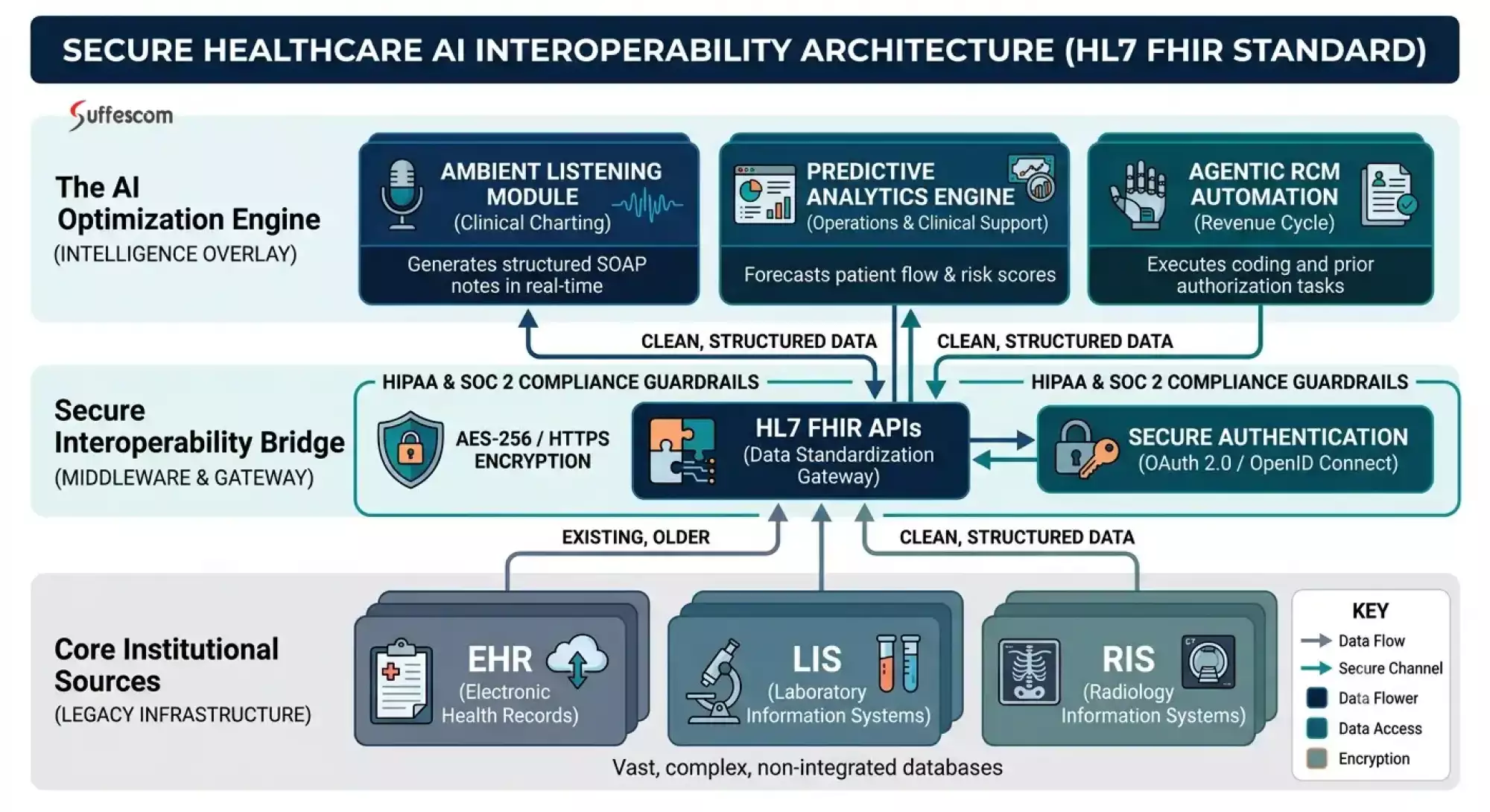
Phase 3: Integrate AI with Existing Healthcare Systems
Integrating advanced AI capabilities into your everyday clinical and administrative workflows without disrupting care.
Modern AI solutions are designed to integrate with:
- Electronic Health Records
- Hospital Information Systems
- Laboratory Information Systems
- Radiology Information Systems
- Practice Management Systems
- Revenue Cycle Management platforms
- Customer Relationship Management Solutions
Phase 4: Prepare the Workforce
Technology adoption depends as much on people as it does on software. Healthcare organizations should provide role-specific training, involve clinicians early in the implementation process, and communicate how AI will support the workforce.
A structured change management program can significantly improve adoption rates and reduce resistance.
Governance, Compliance, and Responsible AI
Healthcare is one of the most regulated industries, making governance a critical component of any AI initiative. To successfully deploy AI without creating operational, ethical or legal liabilities, healthcare executives must establish a robust framework centered on seven critical pillars:
Data Privacy & Patient Consent
Ensuring strict alignment with regulations (like HIPAA & GDPR) while maintaining absolute transparency in how patient data is utilized.
AI Model Transparency & Explainability
Moving away from black-box algorithms toward systems where clinicians can clearly understand how an AI reached a specific recommendation.
Human-in-the-Loop Oversight
Guaranteeing that AI acts strictly as an administrative or clinical co-pilot, leaving final diagnostic and treatment decisions entirely to human expertise.
Bias Detection & Mitigation
Continuously auditing algorithms to identify and eliminate socioeconomic, racial or gender biases in training data.
Robust Audit Trails
Maintaining verifiable time stamped logs of AI recommendations and subsequent human actions for legal and regulatory review.
Proactive Cybersecurity Monitoring
Securing AI pipelines against data poisoning, adversarial attacks and vulnerabilities unique to large language models.
Continuous Regulatory Compliance
Adapting dynamically to evolving local and international AI governance frameworks.
Responsible AI governance builds trust among clinicians, patients, regulators, and stakeholders while reducing operational and legal risks.
Measuring the ROI of AI Healthcare Workflow Optimization
One of the most common questions from healthcare executives is:
"How do we measure success?"
AI investments should be evaluated using both financial and operational performance indicators.
Financial KPIs
Track metrics such as:
- Cost per patient encounter
- Administrative cost reduction
- Revenue cycle efficiency
- Claims denial rate
- Cash collection cycle
- Return on AI investment (ROI)
- Operational margin improvement
Operational KPIs
Measure improvements in:
- Patient wait times
- Appointment utilization
- Average documentation time
- Staff productivity
- Bed occupancy efficiency
- Operating room utilization
- Average discharge time
Clinical KPIs
Evaluate outcomes including:
- Readmission rates
- Diagnostic turnaround time
- Medication error reduction
- Care coordination efficiency
- Patient safety indicators
- Treatment adherence
Patient Experience KPIs
Monitor:
- Patient satisfaction scores
- Net Promoter Score (NPS)
- Appointment no-show rates
- Response times
- Digital engagement
- Follow-up completion rates
By tracking these metrics, organizations can demonstrate the tangible value of AI-powered healthcare workflow automation and guide future investments.
Common Challenges and How to Overcome Them
While AI offers significant opportunities, implementation is not without challenges.
Legacy Systems
Older infrastructure may not integrate easily with modern AI platforms.
Recommendation: Use API-based integration strategies and prioritize interoperable solutions.
Data Silos
Fragmented data limits AI performance.
Recommendation: Invest in enterprise data integration and governance.
Workforce Resistance
Employees may fear job displacement or workflow disruption.
Recommendation: Position AI as a tool that augments human expertise and involves end users early.
Cybersecurity Risks
Healthcare organizations remain frequent targets for cyberattacks.
Recommendation: Adopt AI solutions with strong security features, continuous monitoring, and compliance certifications.
Budget Constraints
Large-scale transformation requires investment.
Recommendation: Begin with high-impact pilot projects that deliver measurable ROI before expanding across the organization.
The Future of AI in Healthcare Workflows
AI workflows in healthcare are evolving quickly, and the next generation of AI will move beyond task automation to support intelligent, adaptive healthcare operations.
Emerging innovations include:
Generative AI
Generative AI will assist with drafting clinical documentation, summarizing patient histories, generating discharge instructions, and supporting knowledge management.
Agentic AI
AI agents will coordinate complex workflows across departments, manage routine administrative tasks, and proactively recommend operational improvements.
Ambient Clinical Intelligence
Ambient AI will automatically capture conversations between clinicians and patients, reducing documentation burdens while maintaining accurate medical records.
Predictive Operations
AI will forecast patient demand, staffing requirements, supply chain needs, and operational bottlenecks before they occur.
Personalized Care Pathways
AI will combine clinical, behavioral, and population health data to recommend individualized treatment plans and improve long-term patient outcomes.
Organizations that invest early in these capabilities will be better positioned to improve efficiency, adapt to changing healthcare demands, and maintain a competitive advantage.
Build Smarter Healthcare Workflows with Suffescom
Turning AI strategy into results requires the right development partner. Suffescom Solutions helps hospitals and healthcare enterprises design and deploy AI workflows in healthcare, from clinical documentation automation and predictive analytics to revenue cycle optimization and intelligent scheduling. Every solution is built with HIPAA/GDPR-aligned data governance, seamless EHR and HIS integration, and measurable ROI in mind. Whether you're piloting your first AI use case or scaling enterprise-wide, our healthcare AI development team brings the technical depth and domain expertise to move from strategy to outcomes.
FAQS
Which healthcare workflows should organizations automate first?
Most organizations begin with high-impact areas such as clinical documentation, patient scheduling, revenue cycle management, claims processing, patient communication, and workforce scheduling because these functions often deliver the fastest and most measurable returns.
Can AI integrate with existing healthcare systems?
Yes. Modern AI platforms are designed to integrate with Electronic Health Records, Hospital Information Systems, Laboratory Information Systems, Radiology Information Systems, and other enterprise applications through APIs and interoperability standards.
How does AI improve operational efficiency?
AI automates repetitive tasks, reduces administrative burdens, optimizes resource allocation, improves scheduling, accelerates documentation, enhances financial processes, and provides predictive insights that enable more informed operational decisions.
Is AI secure enough for healthcare?
When implemented with strong governance, encryption, access controls, continuous monitoring, and regulatory compliance, AI can strengthen cybersecurity while supporting the secure handling of sensitive patient information.
How does generative AI streamline conversational patient intake workflows?
Generative AI conversational intake tools act as digital assistants that interact with patients prior to visits via SMS or web portals. The AI dynamically transcribes patient answers, structures unstructured health histories into formal medical records, automatically populates fields within the EHR, and pre-flags relevant billing and ICD-10 codes before the patient even enters the clinic.