+971-8000321216



Key takeaways:
- A MiCA-compliant white-label neobank combines digital banking infrastructure with crypto-asset services and applicable compliance controls.
- MiCA authorization does not automatically provide a traditional banking license; additional regulatory requirements may apply depending on the services offered.
- KYC, AML, transaction monitoring, custody, Travel Rule processes, and regulatory reporting should be considered during architecture planning rather than added after development.
- A modular, API-first architecture makes it easier to integrate banking providers, custodians, payment systems, blockchain networks, and compliance platforms.
- White-label development can reduce time to market, while custom development provides greater control over workflows, integrations, and product differentiation.
- The total investment depends on customization, custody, banking integrations, compliance infrastructure, supported assets, security requirements, and regulatory scope.
- MiCA readiness should be treated as an ongoing operational process, not a one-time software feature.
Want similar results? → Get a Free Quote
There comes a time when businesses simply cannot ignore their obligations regarding compliance in the crypto-asset market, which had already grown to €3.3 trillion in total capitalization by the end of 2024, thus more than doubling within the year, according to ESMA.
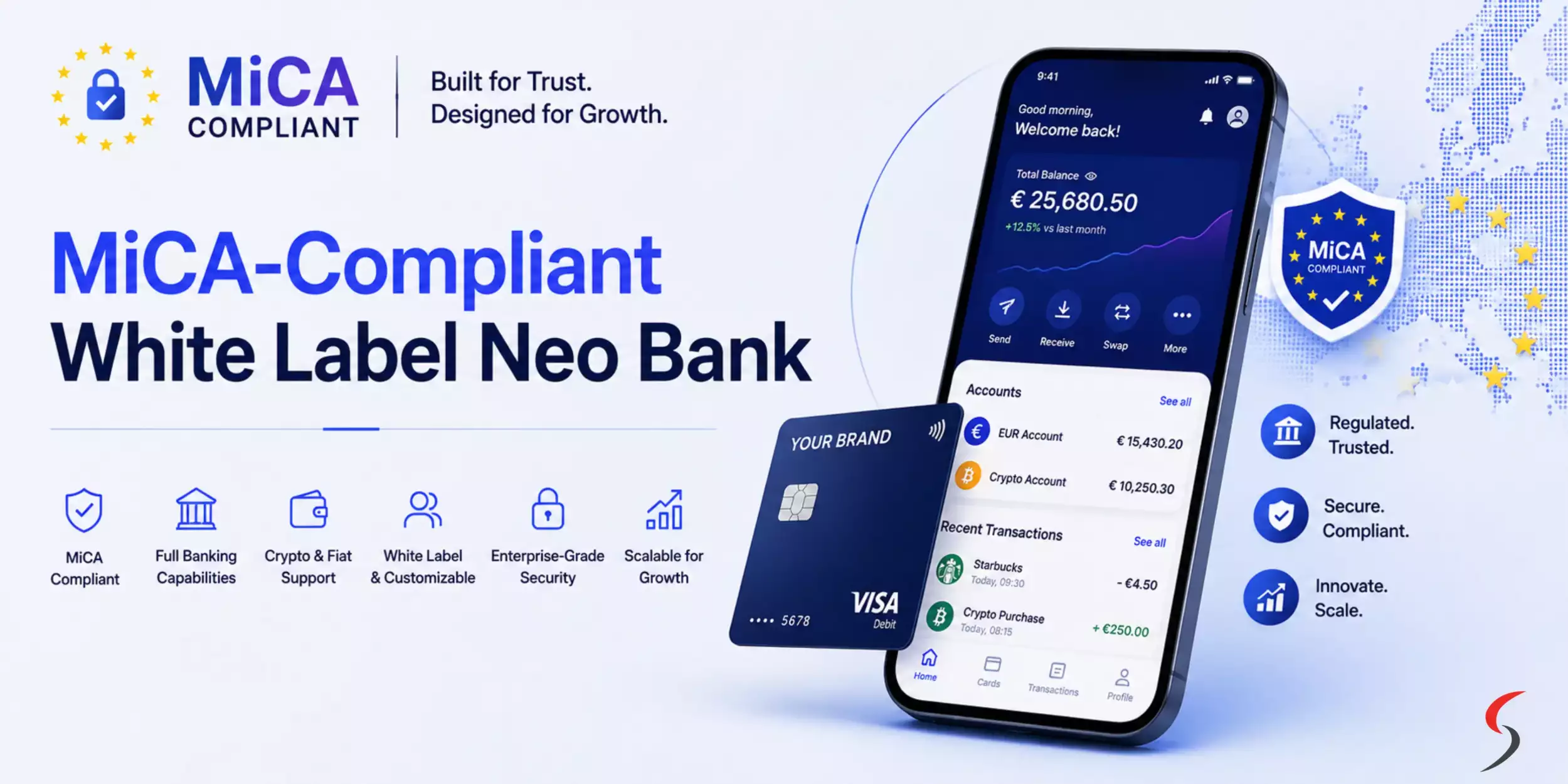
The MiCA-compliant white label neobank is a digital banking platform that also offers services related to crypto-assets and is integrated with the EU’s Markets in Crypto-Assets Regulation (MiCA) from the perspective of relevant business operations.
Businesses can use the ready-made solution and just customize their branding, accounts, wallets, payment systems, cards, and compliance processes instead of building the entire infrastructure themselves.
Nonetheless, a “white label” doesn’t imply being “compliance-ready out of the box.” The relevant authorization and regulations still have to be considered if the platform provides crypto-asset services that fall under MiCA.
What Is a MiCA-Compliant White Label Neobank?
A MiCA-compliant white-label neobank is a branded digital financial platform that uses pre-built or configurable banking and digital-asset infrastructure while incorporating controls relevant to MiCA-regulated crypto-asset activities.
The term combines three different concepts:
A white-label solution implies that the technology can be configured and re-branded for the use of another business. In that case, the company will provide the backbone technology, while the business will configure aspects such as the UI/UX, branding, product configuration, and customer experience.
A neobank typically implies a digital-first bank that offers banking services via web and mobile applications instead of physical branches. This may include the provision of accounts, payments, cards, money transfers, and financial management, among others.
"MiCA-compliant" implies that the activities of crypto-assets regulated under MiCA have been set up and are being operated according to the regulation. These may include the authorization of activities, governance, prudential measures, disclosures to customers, custody rules, complaints handling, and transaction monitoring, among others, depending on the specific activity and entity.
As a result, it is wrong to perceive a MiCA-compliant neo-bank as one software product. Instead, it can be viewed as a regulated digital asset financial infrastructure layer between customer-facing applications and banking rails, crypto-asset services, compliance systems, and reporting.
Why MiCA Compliance Matters for Neobanks
Before MiCA, firms operating in the European crypto markets operated under an inconsistent regulatory framework. Inconsistent national frameworks posed further challenges to the operations of firms that sought to expand beyond their borders.
With MiCA, there will be consistent regulation of the crypto-asset markets and the establishment of regulations relating to the issuance, offering, and trading of crypto assets and providing crypto asset services.
This significantly alters the technology needed by a neo-bank providing crypto services.
Instead of treating compliance as a separate department's responsibility, platforms increasingly need to support:
- Customer identification and verification
- KYC and AML workflows
- Transaction monitoring
- Risk scoring
- Travel Rule processes where applicable
- Custody controls
- Asset and reserve transparency
- Transaction records
- Regulatory reporting
- Customer disclosures
- Complaint management
- Access controls and audit trails
Technical standards and guidelines relating to MiCA have been issued by the European Securities and Markets Authority in relation to issues like authorization, governance, complaints handling, among others. This means that while implementing MiCA, consideration has to be made to both the regulation and level 2 technical standards.
Key MiCA Requirements for a White-Label Neobank
A compliance-ready platform has to map regulatory requirements to controls. In that case, topics such as compliance as code, automation of monitoring, immutable audit logs, and regulation through APIs come into consideration.
CASP Authorization and Regulatory Perimeter
In case the organization offers crypto-asset services under the MiCA regime, it will need to establish if the services fit the scope of a CASP and find out what kind of authorization is required.
The exact obligations depend on the services being offered.
For example, activities may include:
- Custody and administration of crypto-assets
- Operating a trading platform
- Exchange of crypto-assets for funds
- Exchange of crypto-assets for other crypto-assets
- Execution of orders
- Reception and transmission of orders
- Transfer services
- Placing of crypto-assets
- Portfolio management
- Providing advice on crypto-assets
The platform's feature set should therefore be mapped against the regulatory perimeter before development begins.
KYC and AML Controls
Identity verification is one of the foundational components of a regulated digital-asset platform.
A white-label neobank may integrate:
- Identity document verification
- Biometric verification
- Sanctions screening
- Politically exposed person screening
- Customer risk scoring
- Source-of-funds checks
- Transaction monitoring
- Suspicious activity workflows
Rather than creating these controls as isolated modules, they should connect with account creation, transaction processing, withdrawals, deposits, and ongoing customer monitoring.
Transaction Monitoring
Crypto transactions create a different monitoring environment because blockchain activity can be analyzed using on-chain data.
A compliance architecture can combine:
User identity → wallet address → transaction → blockchain data → risk engine → compliance decision → audit record
This enables suspicious transaction detection and risk-based intervention without requiring every transaction to be reviewed manually.
Asset Segregation and Custody
For businesses providing custody-related services, security and asset segregation become critical.
The infrastructure may incorporate:
- Hot and cold wallet management
- MPC-based key management
- Multi-signature controls
- Role-based access
- Withdrawal policies
- Transaction approval workflows
- Wallet whitelisting
- On-chain reconciliation
The exact custody architecture depends on whether the business operates its own custody infrastructure or integrates a regulated third-party custody provider.
Planning a MiCA-Ready Neobank?
Start with the regulatory scope, then build the technology around it. Map your crypto services, compliance requirements, and infrastructure needs before development begins.
Core Features of a MiCA-Compliant White Label Neobank
Once the regulatory perimeter is established, the product layer can be designed around the services customers actually need. A comprehensive platform may include:
Multi-Currency Accounts
It is possible for users to handle fiat and cryptocurrency balances in one place.
Digital Wallets
Digital wallets will enable users to receive, keep, transfer, and manage their supported cryptocurrencies.
Fiat On-ramp and Off-ramp
Payment gateways will enable users to switch between fiat money and supported cryptocurrencies, according to the relevant legal framework.
Crypto-to-Fiat Conversion
The system can include a conversion module to convert supported cryptocurrencies to fiat money within transaction limits and regulatory compliance considerations.
Card Infrastructure
The white-label neobank can also support virtual or physical card programs to enable spending of supported balances by the issuing partner.
Transaction Monitoring
All transactions will be monitored and analyzed for compliance before the transaction takes place, based on the model used.
Regulatory Compliance
Structured transaction records and customer information need to be maintained to support any relevant compliance.
Technical Architecture of a MiCA-Compliant White Label Neobank
The architecture should ideally be modular so that banking, crypto, compliance, and customer-facing components can evolve independently. A simplified architecture can include:
Customer Layer: Web/mobile applications, admin portal, and compliance dashboard.
API & Integration Layer: API gateway, authentication, banking, payment, blockchain, and compliance APIs.
Core Financial Layer: Account management, ledger, payments, currency conversion, wallets, and card management.
Compliance Layer: KYC, AML, sanctions screening, transaction monitoring, risk engine, Travel Rule, and regulatory reporting.
Digital Asset Layer: Blockchain networks, custody infrastructure, wallet services, smart contracts, and on-chain analytics.
Infrastructure Layer: Cloud infrastructure, databases, encryption, key management, logging, monitoring, and disaster recovery.
What Should Be Built Into the Architecture From Day One?
The usual problem that happens is designing the customer experience first and adding compliance as an afterthought. For any digital asset business under regulatory scrutiny, this can cause costly redesigns down the road.
However, regulatory compliance considerations need to be taken into account when designing:
- Data models
- Identity architecture
- Account life cycle
- Transaction states
- Permissions on wallets
- Reporting architecture
- Audit trails
- Access control mechanisms
- API contracts
- Data retention
- Monitoring systems
In other words, this is what is commonly known as the compliance-by-design approach.
How to Build a MiCA-Compliant White Label Neobank
Once the regulatory scope is clear, development can follow a structured architecture with compliance built in from the start rather than added later.
1. Define the Regulatory and Business Model
Commence with mapping out the intended crypto-asset services, target customer base, jurisdictions, asset types, custody model, and banking arrangements.
The requirements for a platform providing crypto custody, transfers, fiat on-ramp, and card payments will be completely different from those of a platform that is offering just wallet functionality.
This step will involve mapping out the following components:
- Intended crypto-asset services
- CASP’s duties
- Payment and bank partners
- Custody details
- Stablecoin/e-money token exposures
- Targeted EU markets
- Customer segments
- KYC/AML
- Third-party outsourcing of critical functions
- Data protection
The above regulatory mapping will form the basis of the product requirements documentation and technical architecture.
2. Design the Compliance Architecture
Compliance should be embedded into the transaction lifecycle.
For example:
Customer onboarding → KYC verification → Risk scoring → Account activation → Transaction screening → Risk decision → Settlement → Audit record
The same process can be applied to withdrawal transactions, wallet transfers, fiat conversions, and card purchases.
Such a process creates a traceable compliance workflow rather than a manual review that takes place after transaction occurs.
3. Build the Identity and KYC Layer
The onboarding framework needs to set up a validated link between the customer and the financial account or wallet.
In accordance with the nature of the business model, this layer can incorporate:
- Identification document validation
- Face/biometric validation
- Address validation
- Sanctions list checking
- PEP checking
- Classification of customers based on their risk profile
- Checking the source of funds
- Beneficial ownership validation for businesses
- Customer monitoring
The critical point here is that KYC cannot be considered a separate onboarding function. The information about the customer’s risk level should be accessible at the transaction monitoring and account management layers.
4. Implement Transaction Monitoring and Risk Scoring
Crypto transactions provide additional data points because blockchain activity is publicly verifiable on supported networks.
A risk engine can combine customer information with transaction characteristics and blockchain intelligence to assign a risk score.
For example:
Customer risk + transaction value + destination wallet + transaction history + blockchain exposure = transaction risk score
Depending on the score, the platform can automatically approve, hold, reject, or escalate the transaction for compliance review.
This creates a risk-based compliance workflow and reduces the need for manual intervention across routine transactions.
5. Integrate the Travel Rule Infrastructure
When needed, the transfer of crypto assets must take into consideration the information framework for transfers of funds and some crypto assets according to the EU. Hence, the technological development will have to incorporate Travel Rule-compliant service providers and systems that will facilitate the exchange of originator and beneficiary information.
The key design approach in this case will be modularity of the feature. This will allow the platform to integrate with different compliance providers based on evolving operational and regulatory needs.
6. Establish Custody and Wallet Infrastructure
In the case of custody, there should be stricter controls, as the platform may have custody of client cryptomaterials or the means through which clients can access their cryptomaterials.
The MiCA regulation specifies specific custody and administration rules, such as keeping client positions’ records and developing a custody policy to minimize risks like fraud and cyberattacks.
A technical custody layer may include:
- MPC wallet infrastructure
- Multi-signature authorization
- Hot and cold wallet separation
- Key-management systems
- Hardware security modules
- Withdrawal policies
- Wallet allowlisting
- Transaction approval workflows
- Automated reconciliation
- Blockchain monitoring
The custody architecture should also maintain a clear relationship between customer accounts, wallet addresses, transactions, and internal ledger positions.
MiCA Compliance Technology Stack for a White Label Neobank
The technology stack should be selected according to the platform's regulatory perimeter and operational complexity rather than following a fixed technology template.
A possible architecture can include:
| Layer | Potential Technologies |
| Frontend | React.js, Next.js, Flutter |
| Backend | Node.js, Go, Python |
| API Layer | REST, GraphQL, WebSockets |
| Database | PostgreSQL, MongoDB |
| Cache | Redis |
| Blockchain | Ethereum, Polygon, other supported networks |
| Smart Contracts | Solidity |
| Blockchain Data | The Graph, blockchain RPC providers |
| Compliance | KYC, AML, sanctions, Travel Rule APIs |
| Custody | MPC, HSM, multisig infrastructure |
| Cloud | AWS, Azure, Google Cloud |
| Security | OAuth 2.0, OpenID Connect, encryption |
| Monitoring | OpenTelemetry, Grafana, SIEM |
| DevOps | Docker, Kubernetes, CI/CD |
Business Models for a MiCA-Compliant Neobank
An appropriately regulated neobank compliant with MiCA can adopt several business models depending on the services provided.
Transaction Fees
Income may be earned through converting cryptocurrencies, making transfers, withdrawing, or executing other transactions.
Subscription-Based Models
Corporations may charge subscription plans with varying limitations, benefits, analytics, or support options.
FX and Currency Spread Revenue
A platform can earn through spreads applicable in currency conversions or crypto conversions under its pricing obligations.
Card Revenue
When the card program is offered through regulated partners, income may be earned through interchange revenue, subscriptions, or through other card programs.
B2B White-Label Licensing Models
Technology companies can license their infrastructure to corporations desiring to develop their own financial products using digital assets.
Enterprise Services
The larger enterprises may pay for bespoke infrastructure, advanced compliance features, custom integration services, or bespoke reporting services.
What Makes a White Label Neobank Truly MiCA-Ready?
It would be misleading to state that a platform has become "MiCA-ready" just because it has incorporated KYC and AML providers into its operations.
The true evaluation of compliance includes a thorough analysis of the extent to which compliance is built into the full operating model. An actual MiCA-oriented platform should deal with:
Regulatory Scope
The company has established the scope of its activities regulated by MiCA and other relevant EU financial legislation.
Governance
There are clear guidelines for responsibilities, policies, controls, and decision-making processes.
Protection of Customers
Customers get all necessary information about risk disclosures, price, etc., as well as effective complaint-handling mechanisms. MiCA prescribes an effective complaints handling mechanism, and technical EU standards offer additional guidance on what it should look like.
Protection of Assets
Funds and crypto-assets of customers are properly protected and segregated as per applicable rules.
Compliance Monitoring
KYC, AML, sanctions screening, transaction monitoring, and risk management systems operate 24/7 rather than just during onboarding.
Auditability
Significant financial, compliance, administrative, and security events can be tracked and audited.
Outsourcing
Dependencies on third parties are documented and monitored. MiCA requires that CASPs maintain proper control over outsourced functions and have outsourcing policies covering contingencies
Challenges in Building a MiCA-Compliant Neobank
Creating a white-label neo-bank that is MiCA-compliant comes with some challenges since regulation needs to coexist with intricate financial and blockchain infrastructures. Some of the challenges involved are:
Regulatory Complexity
MiCA is just one aspect of the European financial regulatory system. Businesses will have to look into AML requirements, Transfer of Funds Regulation, GDPR, DORA, PSD2, or other applicable frameworks based on the type of service provided.
Compliance in Multiple Jurisdictions
While MiCA introduces a harmonized framework, businesses will have to learn about the supervisory expectations and operational requirements in relation to the jurisdictions they are operating in.
Custodial Safety
Keeping customers' crypto assets safe calls for a solid wallet architecture, key management, access control, transaction authorization, and monitoring.
Dependencies on Third Parties
Banking providers, payment processors, custodians, KYC vendors, blockchain infrastructure providers, and Travel Rule solutions are among those third parties whose security, availability, and compliance posture will have to be checked.
Regulatory Readiness Continuously
Compliance is not a one-off implementation project. Rules, policies, controls, transaction monitoring rules, documentation, and reporting processes will have to be constantly reviewed and updated as regulatory and supervisory expectations change.
How Much Does It Cost to Build a MiCA-Compliant White Label Neobank?
The cost will be highly dependent on the scope of the platform, its regulatory model, integrations, custody architecture, assets that it will be dealing with, and level of customization required.
A simple white-label integration will be much less work-intensive than a completely custom platform with a custom custody solution, multi-blockchain compatibility, advanced compliance, cards, and banking integrations.
Key Cost Drivers for a MiCA-Compliant White Label Neobank
| Cost Component | Estimated Cost |
| White-label customization | $20,000–$40,000 |
| Custom application development | $40,000–$150,000+ |
| KYC/AML & compliance | $15,000–$60,000+ |
| Banking & payment integrations | $15,000–$60,000+ |
| Crypto custody & wallets | $20,000–$100,000+ |
| Multi-chain infrastructure | $10,000–$50,000+ |
| Card infrastructure | $15,000–$50,000+ |
| Security & audits | $15,000–$60,000+ |
| Cloud infrastructure | $2,000–$15,000+/month |
| Regulatory & legal costs | $50,000–$300,000+ |
Have a MiCA Neobank in Mind?
Get a clearer view of the features, integrations, and infrastructure your platform actually needs before estimating development costs.
Why Choose a MiCA-Compliant White Label Neobank Development Partner?
The choice of the development partner is a determining factor when it comes to the efficiency with which the platform will manage technical and regulatory complexity. Suffescom pays close attention to creating a modular digital asset infrastructure in which compliance, security, financial processes, and front-end capabilities interact. The strategy defines the platform design based on the regulatory framework, services offered, custody needs, and integrations required by the company.
Businesses should look for expertise in:
- Fintech and digital-asset architecture
- KYC and AML integration
- Blockchain and wallet infrastructure
- Secure API development
- Compliance automation
- Cloud infrastructure
- Smart contract integration
- Financial ledger systems
- Security and auditability
Final Thoughts
A white-label neobank that is compliant with MiCA is not just a cryptocurrency wallet with a bank interface; it is an integration of various technologies, including but not limited to digital asset infrastructure, financial ledgering, compliance automation, custodial solutions, identity solutions, transaction monitoring, and regulatory reporting.
The best solution in the long term would be to define the scope of regulations first and then develop the technological solution based on that. Using modularity and a compliance-by-design approach, businesses will build a more efficient and flexible platform.
FAQs
1. What is a MiCA-compliant white-label neobank?
It is a branded digital financial platform that uses configurable infrastructure to provide banking-style and crypto-asset services while incorporating controls required for applicable MiCA-regulated activities.
2. Is a crypto bank required to obtain a MiCA license?
Not necessarily. MiCA authorization applies to specific crypto-asset services performed by CASPs. Traditional banking activities may require separate authorization under applicable banking or payment regulations. The exact licensing requirements depend on the services and operating model.
3. What crypto services can a MiCA-compliant neobank offer?
Depending on its authorization and regulatory structure, a platform may support custody, crypto-to-fiat exchange, crypto-to-crypto exchange, transfers, order execution, portfolio management, advice, or other regulated crypto-asset services.
4. How does MiCA affect stablecoins and e-money tokens?
MiCA establishes specific requirements for asset-referenced tokens and e-money tokens, including requirements concerning authorization, disclosures, reserves, governance, and redemption. The applicable requirements depend on the token classification and issuer structure.
5. What KYC and AML features should a MiCA-compliant neobank include?
Common controls include identity verification, sanctions screening, PEP screening, customer risk scoring, transaction monitoring, source-of-funds checks, suspicious activity workflows, and applicable Travel Rule functionality.
6. How long does it take to launch a white-label neobank?
A white-label implementation can generally be launched faster than a fully custom platform. However, the timeline depends on customization, integrations, regulatory authorization, compliance setup, security testing, and banking or custody partnerships.
7. What is the difference between a white-label crypto bank and a traditional neobank?
A traditional neobank generally focuses on digital banking and payment services, while a crypto-focused white-label neobank may incorporate digital-asset wallets, crypto trading, custody, blockchain transfers, and related services. The regulatory requirements depend on the specific services offered.
8. How much does it cost to build a MiCA-compliant neobank?
There is no fixed cost because the scope varies considerably. White-label customization, compliance integrations, custody, banking APIs, multi-chain support, security requirements, and card infrastructure can all influence the final investment.
9. Can a white-label neobank support fiat and cryptocurrency accounts?
Yes. A platform can be designed to support both fiat and crypto balances, provided the relevant banking, payment, crypto-asset, custody, and regulatory arrangements are in place. A unified ledger and reconciliation layer can help manage these different asset types within one customer experience.