+971-8000321216



Key takeaways:
- With over 1.7 million pilgrims performing Hajj in 2026, digital platforms are becoming vital for managing complex journeys at scale.
- Serving 51+ million users across 190+ countries, Nusuk shows how one connected ecosystem can simplify access to 130+ digital services.
- From registration and package discovery to payments, documents, navigation, and support, Hajj apps can connect the entire pilgrim journey digitally.
- AI, GPS, cloud infrastructure, APIs, and real-time data are creating smarter, more responsive, and scalable pilgrimage experiences.
- The future of Hajj technology lies in secure, accessible, and intelligent platforms built to serve millions without losing the human focus of the journey.
Want similar results? → Get a Free Quote
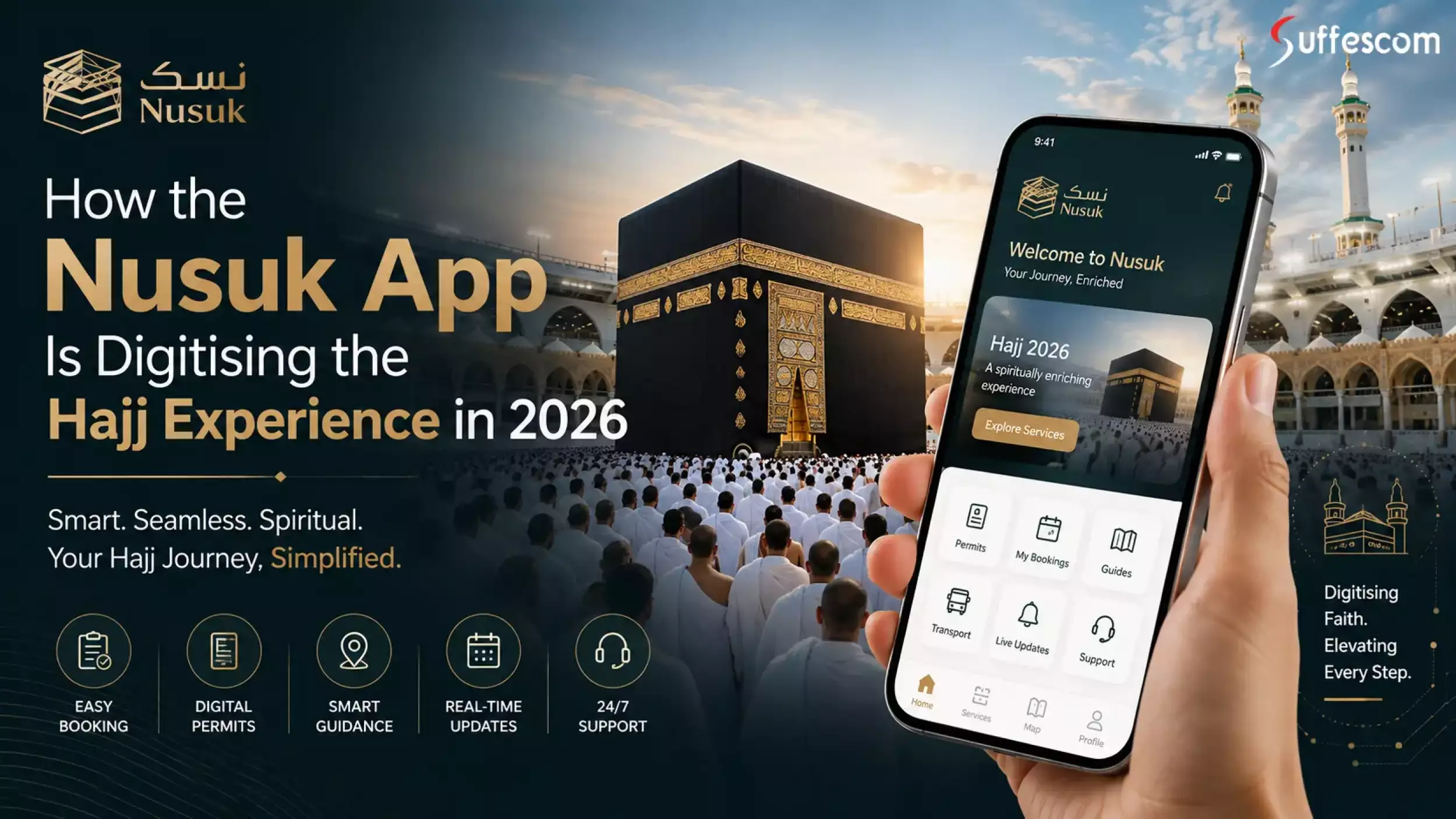
Hajj is one of the world's largest and most complicated annual pilgrimages, during which millions of Muslims journey to Saudi Arabia. In 2026, Saudi Arabia had a total of 1.7 million pilgrims, with more than 1.54 million of them being international pilgrims, according to the General Authority for Statistics. Such a trip requires well-coordinated planning, execution, and information. This is where the Nusuk App Hajj 2026 experience is transforming the pilgrimage journey.
Saudi Arabia's official Pilgrim Experience Program states that Nusuk now reaches more than 51 million users in more than 190 countries and provides 130+ digital services. The Nusuk-like app development is changing the way Hajj is carried out, from planning and booking to navigation and real-time directions. So, how is Nusuk reshaping Hajj in 2026?
Let's explore.
What Is the Nusuk App and How Is It Transforming Hajj?
Nusuk is the integrated digital platform for Saudi Arabia to assist pilgrims during their journey of Hajj and Umrah. It connects key services, information, guidance, and digital tools into a single coherent system. Nusuk is owned by Saudi Arabia's official Pilgrim Experience Program, and according to the source, it reaches more than 51 million customers in 190+ countries, with 130+ digital offerings.
Nusuk vs Nusuk Hajj: What's the Difference?
Nusuk is the bigger digital platform for all Hajj, Umrah, and visitor journeys. Nusuk Hajj is an initiative that emphasises Hajj, providing information to eligible pilgrims on available packages, requirements, and services.
They demonstrate how a Hajj booking platform can bring planning, booking, and support for pilgrims together.
Why Digital Transformation Matters for Hajj
Hajj involves millions of pilgrims coming together in a short period of time, which necessitates seamless coordination. Digital Hajj platforms have the potential to streamline information, ease access to services, enable real-time updates, and aid in hassle-free travel management.
The Nusuk is an example of how technology can enhance planning, navigation, guidance, and access to essential services while maintaining the spiritual emphasis of the pilgrimage.
How Nusuk Fits Into Saudi Arabia's Digital Vision
Nusuk is also part of Saudi Arabia's broader Vision 2030 and its commitment to enhancing the pilgrim experience through better infrastructure and digital services. The Pilgrim Experience Program is dedicated to the ideals of making the pilgrimage to Mecca and Medina more joyful, efficient, and enriching.
This is a bigger change and is echoed in the evolution of the platform. Initially, the digital services were limited to permits and pilgrimage management but have expanded to include a wider range of services and information, along with digital journey tools and service providers.
In fact, this is an important lesson for pilgrimage app developers. More than just an appealing user interface, a successful platform requires a host of other elements. It must have secure infrastructure, reliable integrations, real-time features, and a user experience that is suitable for people from across-the-board backgrounds from different countries.
From Traditional Pilgrimage Management to Digital Hajj
| Traditional Hajj Journey | Digitally Enabled Journey |
| Paper documentation | Digital documents |
| Manual information gathering | Centralised information |
| Multiple service touchpoints | Connected digital ecosystem |
| Physical confirmations | Digital updates |
| Agent-dependent discovery | Online package discovery |
| Manual communication | Push notifications/support |
Nusuk is a great example of a Hajj mobile app that can be useful for business owners looking to modernise their business and transform the Hajj experience into a more streamlined and tech-driven experience.
How the Nusuk App Digitises the Hajj Journey
There are a number of stages to the journey of the Hajj, such as preparation before the journey and coordination on the ground. Many of these touchpoints can be digitised using the Nusuk ecosystem and thus eliminate the need for managing information and services in unconnected ways.
Electronic Registration & User Sign-Up
Let's start with digital registration. Eligible pilgrims are able to register an account online and fill in the necessary details to avail themselves of Hajj services. A phased induction process can facilitate the linkage of users to services in accordance with their eligibility and country of origin.
Document Upload and Verification
Digital document management eliminates the reliance on paper. Pilgrims can submit the necessary information and documents online, which helps to streamline the verification process before embarking on their journey. This can help to keep document management more organised and decrease the possibility of having to carry around and manage multiple paper documents.
Hajj Package Discovery
Ease of package discovery is one of the crucial roles of a contemporary Hajj booking application. Nusuk Hajj helps eligible pilgrims to see available Hajj packages and compare the services included in each package. These services may cover accommodation, transport, catering, flights, visa processing, and ground services for Hajj. This allows pilgrims to have a more focused point of investigation.
Authorised Service Provider Selection
When one is travelling on a pilgrimage journey, trust is essential. The platform serves to link pilgrims to its authorised service providers and facilitates a more transparent and structured booking process. In addition to the unverifiable sources, users can visit providers within the official Hajj ecosystem.
Digital Payments and E-Wallet
The provision of digital payment options could streamline the processes, facilitating pilgrims in making eligible bookings and purchases via online payment methods. Additionally, a Hajj booking website that is connected can minimise the number of physical payment transactions. With the ongoing advancement of digital services, secure payment integration and e-wallets are becoming an integral part of the overall digital Hajj journey.
Digital Itinerary Management
The Hajj takes place in several places and consists of several services as well as fixed activities. Digital itinerary management can help consolidate these in a more easily accessible format. Pilgrims can be able to get the information on their journey and service details without relying completely on printed schedules. It can help to ensure that you have access to information at various points of the pilgrimage.
Notifications and Pilgrim Communication
In a huge pilgrimage, real-time communication is vital. Digital notification can ensure that important information is directly conveyed to the pilgrims, such as service information, guidance, changes in the service schedule, and other related announcements. This cuts down on the need for hand-to-hand interaction and enables users to get instant information when required.
Digital and Customer Support
Despite a well-planned platform, pilgrims could require support at various points in the trip. Digital support channels facilitate users getting guidance without having to go to a service location.
The value of digitisation should also be measured through operational outcomes. A Hajj platform can track booking completion rates, payment success rates, document verification turnaround time, notification delivery, and support response time to identify where the pilgrim journey needs improvement.
Key Features of a Hajj App Like Nusuk
Here are the essential Hajj app features businesses should consider before developing a Hajj mobile app:
User Registration and Authentication
Users should be able to sign up within a reasonable amount of time with their email address, phone number, or any of the available social login methods. Secure authentication, such as OTP or multi-factor authentication, ensures user account protection.
Digital Identity Verification
Identity verification can be used to confirm users' information and minimise bogus sign-ups. Depending on regulatory requirements, the app might include the ability to verify passports, scan documents, or be connected with a regulated digital identity system.
Multilingual Interface
It is an event that draws pilgrims from all over the world. The multilingual interface makes it easy to understand and use the app, as users can access important information in their preferred language.
Hajj Package Search and Filters
The pilgrims should be able to view the packages available according to their preferences. The filters might be based on price, duration, type of accommodation, departure city, services included, and more.
Package Comparison
A comparison feature enables users to compare two or more packages. They have the chance to make a comparison of price, inclusions, accommodation, transport, and other services before they make a decision.
Online Booking
The app should allow customers to pick a package and complete the booking process online. The easy booking process eliminates redundant steps and enhances the user experience.
Secure Payment Gateway
Payment gateways play a crucial role in online transactions and should be secure. The app needs to be compatible with the payment methods that are trusted by the user and ensure the security of financial information.
Digital Wallet
A digital wallet can enhance the ease with which payments and refunds can be handled on the platform. It can also enable users to see their balance and transaction history from a single place.
Document Management
Users can upload, store, and access important documents through the app. This can involve identification documents, booking confirmations, travel documents, and any other required information.
GPS and Navigation
Important locations and relevant routes can be indicated by navigation features. Maps with GPS information are very helpful for walking through new areas at various points in the pilgrimage.
Real-Time Notifications
Push notifications can be used to send users real-time information about bookings, travel times, service changes, key messages, and announcements.
AI Chatbot
An AI chatbot can offer immediate responses to frequently asked queries and direct users to various functions of the app. It can also provide round-the-clock first-level support and help alleviate the burden on customer support.
Customer Support
Users should be able to get reliable support from live chat, e-mail, phone, or in-app tickets. Manual intervention is still necessary if the users require assistance with complex problems. Support performance can be measured through first-response time, average resolution time, ticket backlog, and user satisfaction scores, helping teams identify recurring service issues.
Reviews and Ratings
Reviews and ratings can indicate the reliability of packages and service providers based on their known experiences. This will also help to promote more transparency in the Hajj booking system.
Booking and Payment History
A full history feature enables the display of previous and current bookings, invoices, payment history, and transactions from a single place.
Emergency Assistance
An emergency assistance feature can help to quickly reach out to essential contacts, support teams, medical information, or location sharing when applicable.
Offline/Low-Connectivity Functionality
The Internet connection can sometimes be a problem. Providing an offline-first app feature or access in low-connectivity situations for key documents, maps, booking information, and more can have a big impact on the user experience.
Hajj App Features for Different Types of Users
A successful Hajj app is for more than just pilgrims. It is linking many users throughout the ecosystem, ranging from service providers and administration to customer support teams. Different tools will be required for each group to effectively carry out their duties.
Features for Pilgrims
The pilgrims should have a simple and convenient experience. Registration, package discovery, booking, secure payments, access to documents, control of itineraries, notifications, navigation, and customer support are just some of the key features.
Features for Hajj Service Providers
Tools are needed on the service provider's side to manage service offerings and operations. A special dashboard enables them to add packages, update availability, make bookings, track payments, and send relevant information to pilgrims.
Features for Administrators
Administrators must have a full view and control over the platform. They can have user management, service provider verification, package monitoring, analytics, reporting, payment oversight, and content management on their dashboard.
Features for Customer Support Teams
Support teams need tools to help them with speedy resolution. Some of the key components are ticket management, live chat, user info, booking details, notifications, and issue tracking.
| User | Essential Features |
| Pilgrim | Registration, packages, booking, payments, itinerary |
| Service provider | Package management, booking management, availability |
| Admin | User management, analytics, verification, reporting |
| Support team | Tickets, live chat, notifications, issue resolution |
What Happens Behind a Hajj App Like Nusuk?
A modern Hajj mobile app might seem like a straightforward application to users, but it's actually a complex system of technologies. They handle users, bookings, payments, location information, notifications, and third-party integration, and maintain the security and scalability of the platform.
Mobile Application Layer
This is the client-user-side application. It is composed of the Android and iOS applications that pilgrims and other users use to register, search for packages, book packages, view itineraries, and get notifications.
Backend and API Layer
The backend is responsible for the business logic. APIs link the mobile application to services like bookings, payments, user accounts, document verification, external platforms, and more.
Database Layer
Information relating to user information, bookings, packages, payments, documents, and support history is securely stored and managed within the database. It is crucial that it is able to process a lot of activity during periods of peak demand.
Cloud Infrastructure
The platform is powered by cloud infrastructure, which delivers computing power and enables it to scale. It assists the application in dealing with shifting traffic levels, keeping accessibility, and providing reliable service delivery.
Payment Infrastructure
The platform is connected to the supported payment gateways and financial systems through a secure payment layer. It handles transactions and payment statuses and also aids in securing delicate monetary information.
Mapping and Location Services
Mapping APIs and GPS services can be used to navigate, provide location-based guidance, and give route information. These features can be beneficial, especially at this time of the year when the pilgrims visit the holy places and require assistance in navigating these places.
AI and Machine Learning Layer
AI can be used to help with chatbot support, personalised recommendations, automating responses, and more intelligent information delivery. Machine learning can also be used to analyse data from the platforms and enhance services as time goes on.
Analytics and Monitoring
A user can gauge the user behaviour, bookings, performance of the platform, and trends using analytics tools. Monitoring systems can be able to discover technical issues and assist teams in keeping platforms reliable.
Security Layer
Hajj pilgrim app development must include the OWASP Mobile Application Security Verification Standard (MASVS). These critical steps can involve data protection, secure authentication, access controls, fraud monitoring, regular security testing, and encryption.
The Hajj booking application's architecture would look something like this:
User → Mobile App → API Gateway → Backend Services → Database/Cloud → External APIs
This design can enable communication between various systems without impacting the core services and maintain efficient communication. These technologies could be different depending on the platform's functionality, anticipated user base, integration, and security needs.
Ready to turn your Hajj platform idea into a scalable digital product?
How to Develop a Hajj App Like Nusuk in 2026
Creating an app like Nusuk isn't just a booking interface. Here is a practical development process.
Step 1: Define the Hajj App's Business Model
First, determine the main function of the platform. Your model might be a Hajj booking marketplace, pilgrim management platform, service-provider marketplace, government or service ecosystem, travel management platform, or B2B Hajj management solution.
This choice will dictate your features, technology, revenue model, integrations, and development trajectory in pilgrim app development.
Step 2: User and Market Research
Inform yourselves about the needs of pilgrims and providers of services. Keep in mind the pilgrim's pain points, countries, languages supported, payment methods, and local regulations and requirements of the service providers.
This stage will help make sure you are solving problems, not building features.
Step 3: Define the MVP
Begin by listing the key components necessary to "validate" the platform. An MVP can include:
- User registration and authentication.
- User profiles
- Package listings
- Search and filters
- Booking functionality
- Payment integration
- Notifications
- Admin panel
If the key experience is validated, then you can enhance it with advanced features of the Hajj application.
Step 4: Design the UX/UI
The user experience should be simple, particularly with users of varying ages and digital literacy. Think about how to navigate, design for multiple languages, promote clear calls to action, keep touch targets large enough, limit mental processing, and provide quick access to emergency information.
The ideal Hajj mobile app should assist users with key tasks so that they do not need to look for key information.
Step 5: Create the Mobile Application
Next, the selection of the development approach is to be made. You can create individual native apps on both iOS and Android or code on a single platform using a cross-platform framework.
Both will work for you, depending on your budget, timeline, performance needs, and features you plan to include.
Step 6: Build the Backend
The backend is responsible for the main functions of the platform. It needs to handle APIs, authentication, user accounts, package management, a booking engine, payment processing, notifications, and other business logic.
The backend of a scalable Hajj booking platform should also be able to accommodate traffic surges during the peak booking periods.
Step 7: Integrate Third-Party APIs
Third-party integrations provide the platform with additional functionality and eliminate the need to develop all services.
| Integration | Purpose |
| Payment API | Transactions |
| Maps API | Navigation |
| SMS API | Verification |
| Email API | Communication |
| Cloud services | Scalability |
| AI API | Virtual assistance |
| Analytics | User insights |
| Identity verification | KYC/verification |
The exact integrations will depend on your business model, target market, and regulatory requirements.
Step 8: Create Admin Dashboard
An admin dashboard allows your in-house team to manage the platform. You can leverage it to manage users, service providers, packages, bookings, payments, documents, notifications, reports, and support requests.
As the platform expands, it can substantially cut down on manual handling tasks with a robust dashboard.
Step 9: Perform Security and QA Testing
Test the app on various devices, OS, and users before launch. Security testing should include sensitive data, access controls, APIs, payments, and authentication.
Performance testing is also crucial, especially for a platform that will be used by a lot of people during peak traffic.
Step 10: Launch, Monitor and Scale
Start with an MVP, track user actions and platform performance, and gather feedback from live users. Apply these learnings to solve problems and prioritise future features.
Continue to scale up infrastructure, enhance integrations, and implement additional features like AI support, customisation, live updates, and analytics.
Looking to create an online platform for planning Hajj, Umrah, or travel? Begin with an MVP design that is built around the needs of the target users, integrations, and scalability that are needed.
How Much Does It Cost to Develop a Hajj App Like Nusuk?
The Nusuk-like app development cost will depend on the complexity of the platform, its functionalities, the technology stack, integrations, and scalability needs. It isn't just a matter of one set price; in fact, it depends on several factors such as the platform's booking, payment integration, multiple service providers, real-time updates, and large user volumes.
The figures given below represent approximate industry figures and do not reflect the actual costs of developing Nusuk.
Hajj App Development Cost by Complexity
| App Type | Approximate Complexity | Indicative Development Range (AED) |
| Basic Hajj information app | Low | AED 25,000 – 75,000 |
| Hajj booking MVP | Medium | AED 75,000 – 220,000 |
| Advanced Hajj marketplace | High | AED 220,000 – 500,000+ |
| Large-scale Nusuk-like ecosystem | Enterprise | AED 500,000–1.1 million+ |
A basic app can be concerned with info, guides, and easy accounts for users. On the other hand, an enterprise-level platform might involve complex backend systems, multiple integrations, high-level security, AI features, real-time services, and infrastructure designed to handle high amounts of traffic.
What Factors Affect Hajj App Development Cost?
The final Nusuk-like app development cost can vary depending on several factors, such as:
- Platforms: Web, iOS, and Android will incur additional development and testing.
- Complexity of UI/UX: More time is required for the design and development of custom designs or complex user flows.
- Advanced features: The more advanced features expand the overall project scope and development.
- Backend architecture: The heavier-duty and more demanding the system, the more technical resources are needed.
- Third-party API integrations: Connecting payment, maps, SMS, and other services adds integration work.
- Collection of payments: It can be more complicated when dealing with a variety of payment options and protection.
- AI integration: Chatbots, recommendations, and AI support need further development and optimisation.
- Maps, navigation, and location: Technical complexity with GPS and navigation.
- Admin dashboard: Advanced tools for users, bookings, and reports will need to be developed separately.
- Security requirements: Authentication, encryption, access controls, and testing add to the project scope.
- Number of languages: If there are additional languages, they need to be localised and the interface translated.
- Cloud infrastructure: More sophisticated infrastructure may be needed for high scalability and traffic handling.
- Regulatory compliance: Development may require meeting data, payment, and identity-related regulations.
- Post-launch maintenance: Maintenance costs are incurred during the life of the product following launch, including updates, bug fixes, security patches, and new features.
The more connected and feature-rich the Hajj booking platform is, the higher the overall development effort is likely to be.
Hajj App Development Cost by Feature
Different features may impact development effort as described in the following table:
| Feature | Relative Development Effort |
| Registration | Low |
| Profile management | Low |
| Package listing | Medium |
| Booking engine | High |
| Payment integration | Medium–High |
| GPS/navigation | Medium |
| AI assistant | Medium–High |
| Real-time tracking | High |
| Admin dashboard | Medium–High |
| Multi-provider marketplace | High |
The complexity of the backend logic, integrations, testing, and maintenance of features can increase as the level of development effort increases. With multiple providers, there must be systems in place for provider onboarding, availability management, bookings, payments, and role-based access.
Get a tailored development estimate based on your app features, integrations, and scalability requirements.
How to Reduce Hajj App Development Costs
By adopting a phased and planned approach for the development of a Hajj application, businesses can control the Nusuk-like app development cost:
- Construct your MVP first: Focus on basic functionalities such as sign-up, package listings, booking, payments, and notifications.
- Go cross-platform: If applicable, develop using a common codebase for iOS and Android. This can decrease the development time and make sure that businesses can reach users on both sizeable mobile platforms.
- Invest in priority features: Make sure the first budget goes towards features that are relevant to the core user journey.
- Leverage trusted third-party APIs: Connect existing payment, mapping, SMS, notification, and verification services rather than building them all from the ground up.
- Ensure modular design: Structure the platform as separate modules for easy addition of new features and integrations in the future without major changes to the application.
- Adopt AI for later stages: Start with solid basic features. Advanced features such as AI chatbots, personalised recommendations, and more can be added if the business requires them.
- Scale cloud infrastructure gradually: on the basis of the traffic, gradually scale the computing resources according to the number of users, bookings, and platform requirements.
In this way, companies can manage their initial investment and develop a solid base for future expansion. In conclusion, it's essential to consider the Nusuk-like app development cost in light of your business model, target audience, integration needs, and scalability objectives, rather than taking a single price for granted.
How Long Does It Take to Build a Hajj App?
The sequence of the Hajj pilgrim app development timeline depends on the complexity of the platform, features, integrations, and regulations. An information app can be created in much less time than a marketplace or enterprise ecosystem. The above timelines are also approximate dates, as the integration with third parties, compliance rules, and custom features can impact the overall timeline.
Basic Hajj App Timeline
This is roughly the time it can take to create a basic Hajj app, including information, guides, user registration, and simple navigation.
Hajj Booking MVP Timeline
It will take approximately 4 to 6 months to create an MVP with booking functionality, package listings, search filters, booking, payment, notifications, and an admin panel.
Advanced Hajj Marketplace Timeline
The development of a multi-provider marketplace featuring advanced booking workflows, provider dashboards, multilingual support, payment integrations, and real-time features could take around 6 to 9 months.
Enterprise Hajj Ecosystem Timeline
Depending on the scope of a project, a large-scale ecosystem with multiple user roles, complex integrations, AI capabilities, real-time services, advanced security, and high scalability can take as long as 9 to 18 months.
| Development Stage | Typical Timeframe |
| Discovery | 2–4 weeks |
| UX/UI | 3–6 weeks |
| MVP development | 8–16 weeks |
| QA/testing | 3–5 weeks |
| Deployment | 1–2 weeks |
| Advanced features | Additional time based on scope |
Best Technology Stack for Hajj App Development
The following are options for technology and are not statements about Nusuk's real technology stack.
Frontend Technologies
When it comes to the mobile application, there are two options for businesses to consider: cross-platform or native development.
- Flutter: A tool for creating iOS and Android applications from the same codebase.
- React Native: A cross-platform solution that has a strong developer community.
- Swift: Native iOS app development.
- Kotlin: Commonly used for native Android application development.
Backend Technologies
The backend handles core functionality like user accounts, bookings, payments, APIs, and business logic. The following are options:
- Node.js: Appropriate for large-scale, event-driven applications.
- Python: Good for backend applications and AI functions.
- Java: Highly recommended for big applications and enterprise applications.
- .NET: It's fit for business applications that are secure and scalable.
Database
The database needs to be chosen depending on the sort and quantity of data the platform supports:
- PostgreSQL: Good for structured and transactional data.
- MySQL: A widely used relational database for web and mobile applications.
- MongoDB: Document-oriented and flexible database.
- Redis: Can support caching and improve application response times.
Cloud Infrastructure
Cloud platforms can offer the computing resources needed for scaling the application and handling traffic fluctuations:
- AWS: Provides various cloud computing solutions for applications, scaling, databases, storage, and computing.
- Microsoft Azure: Cloud services that integrate seamlessly with Microsoft's enterprise ecosystem.
- Google Cloud: Provides scalable infrastructure, data services, and AI capabilities.
When making the final decision, regional availability, security needs, integrations, price, and anticipated traffic are all factors that should be taken into account.
AI Technologies
Artificial Intelligence can be used to enhance the functionality of Hajj applications with smarter features and more responsiveness, especially for multilingual applications in large crowds. Possible technologies include:
- LLM APIs: Can provide conversational support and appropriately respond to user queries.
- Natural Language Processing (NLP): Enhances the platform's ability to comprehend and respond to user inputs in natural language.
- Recommendation engines: Can process users’ preferences and actions to recommend useful packages or services.
- AI chatbot frameworks: Can offer 24/7 first-tier support for common queries and support requests.
How AI Can Improve Hajj Apps in 2026
AI can enhance a Hajj mobile app to be more responsive, personalised, and efficient. When used responsibly, it can enable pilgrims to get information faster and enable service providers and administrators to use smarter automation and insights.
AI-Powered Hajj Assistant
An AI assistant can provide answers for bookings, packages, documents, itineraries, and app functions. It can offer immediate advice throughout the process and save users time looking for information.
Multilingual Conversational AI
Pilgrims come from various countries and have various languages. Multilingual conversational AI can enable users to interact with the app in their preferred language, thereby making information and support more accessible.
Personalised Recommendations
By understanding user preferences, search history, and the services they choose, AI can make informed recommendations for packages or travel-related features. AI app development can help to make the experience more personalised for the user, but without the need to go through all the options themselves.
AI-Powered Document Processing
AI and intelligent document processing can be used to extract data from documents that are uploaded and to detect any missing or incomplete information. This can help to decrease manual data entry and speed up verification processes under suitable conditions of human verification and regulatory obligations.
Intelligent Customer Support
AI can take care of repetitive customer support requests, classify tickets, and guide users to the proper information. More complex or sensitive issues may be escalated to human support teams, resulting in an efficient support process.
Predictive Analytics
Bookings, user interactions, and service demands can be analysed with AI to reveal patterns. The information can be used to predict demand, optimise resources, and make informed decisions for business operations.
Crowd and Transportation Intelligence
AI can assist in analysing people flow and transportation with reliable real-time data. This can help facilitate better operational planning, routing, and resource allocation. But these systems need to be built on accurate data, robust infrastructure, and good people.
AI-Based Fraud Detection
AI can assist in identifying unusual transactions, account activity, or potentially fraudulent booking behaviour. This identifies patterns that might need additional investigation, thereby enhancing the security of platforms and minimising risks.
In general, AI has the potential to make a meaningful impact in developing the Hajj app, but it needs to address tangible user needs or operational challenges, not just be a passing fad. It's best to use AI automation in tandem with trusted data, robust security, and human oversight when needed.
How GPS and Real-Time Location Can Improve the Hajj Experience
A Hajj app with GPS and real-time location features could be more helpful when travelling to various locations with large crowds and a fixed schedule. These can enable enhanced navigation, communication, and access to support if implemented with reliable data and appropriate privacy controls.
Location-Based Navigation
Maps based on information from GPS satellite systems are helpful for identifying key places and navigating the appropriate routes for pilgrims. Clear navigation on the website can help to minimise confusion, particularly for those who are new to the site and are unsure of what to do.
Nearby Services
Location services can enable users to find service points, lodging, transportation locations, medical assistance, or other services.
Transportation Tracking
If the transport company provides data in real time, the app can show the location of the vehicles, the expected arrival time, and pickup information. This can help pilgrims to get up to speed and minimise the concerns and uncertainty associated with the set transportation schedule.
Geofencing
Geofencing is a virtual fence that is set up around particular areas. This technology can be applied to an app designed for Hajj, which could show certain actions or information when the user enters or exits a specific location, as per their permissions and the rules of that location.
Location-Based Notifications
Based on the location of the pilgrims, the app can send them notifications that are relevant. For instance, when users are in a certain area, they can be provided with location-specific guidance, service information updates, or reminders.
Emergency Location Assistance
If a pilgrim consents to sharing their location for an emergency, it can help support teams to determine an approximate location. This feature should be accompanied by good consent, robust security, and suitable operational response.
Location Data Privacy Issues
The location information is personal information that is sensitive. There is a need for businesses to have a clear reason for collecting it, ensure that there is proper consent, minimise the collection of unnecessary data, ensure its security, and specify a period for data storage. Wherever feasible, users should also be able to have meaningful control over location permissions.
Security Requirements for Hajj App Development
Security is a fundamental aspect of Hajj app development, as these apps could contain personal data, identity documents, travel information, bookings, payments, and more. Security needs should be established early and checked along the way.
Data Encryption
The data should be encrypted in a secure manner when stored or sent. This can help minimise the chances of unauthorised access to personal and business data.
Secure Authentication and MFA
Secure authentication ensures that users' accounts cannot be accessed without permission. To add an extra layer of security, multi-factor authentication can be used for sensitive functions, especially by the administrator and the user.
Role-Based Access Control
Access control by role allows users to have access to the information and functions specific to their role. For instance, the administrators, service providers, support teams, and pilgrims should have varying levels of permissions.
API Security
Secure authentication, rate limiting, input validation, and monitoring should be applied to any API that is connected to the app to minimise potential security risks.
Payment Security
Trustworthy payment providers and security measures must be utilised to ensure payment workflows are secure. Card data should not routinely be placed in the application where it can be easily accessed and may be damaged or lost.
Secure Document Storage
It is important to store sensitive documents such as passports and identification documents securely and access them in a controlled manner. Businesses also need to have retention and deletion policies for these types of records.
Fraud Prevention
Platforms have the ability to implement transaction monitoring, identity verification, anomaly detection, and verification workflows to detect suspicious transactions and minimise bookings or payments from fraudsters.
Regular Security Audits
Security assessments, vulnerability testing, dependency updates, and penetration testing are all ways of identifying and fixing weaknesses in advance of them becoming serious incidents.
Data Privacy and Compliance
The platform should take into account relevant data protection, payment, identity, and other regulations in each of the markets it operates in. Any compliance needs should be assessed with qualified legal and security experts depending on the individual operations of the platform.
Build a secure, scalable Hajj platform designed for peak traffic and long-term growth.
How to Build a Scalable Hajj App for Millions of Users
The design of a large-scale platform for the Hajj must be able to meet the demand for a very large number of people. Scalable mobile app development is about developing systems that can accommodate growth in traffic and support it without degradation in performance or even service disruption.
Cloud-Native Architecture
In a cloud-native architecture, applications can utilise managed services and flexible resources offered in the cloud. This can facilitate the deployment, update, and scaling of various components of the platform as per the demand.
Load Balancing
The load balancers share incoming requests between instances of the application or multiple servers. This helps to ensure a more stable system performance and avoid overload.
Auto-Scaling
Auto-scaling can be enabled to dynamically scale up or down the amount of computing resources as needed. This can be very helpful for high-traffic pilgrim app development, where users' activity may spike at certain times.
CDN and Caching
By using a content delivery network, you can have the static content served from a location that's nearer to your users and use caching to minimise duplicated requests to the core systems. They can work together to enhance response times and decrease infrastructure workload.
Database Optimisation
The performance of the database is essential for handling users, bookings, payments, and up-to-the-minute information. With the growth of the platform, index, query optimisation, replication, and caching can help to enhance speed and reliability.
Microservices
A microservices architecture is based on breaking up large functions into independently managed services. For instance, operations such as booking, payments, notifications, and user management can be independent, allowing certain operations to scale when needed.
Real-Time Monitoring
Monitoring tools are used to monitor the application performance, infrastructure health, and errors, as well as traffic patterns. Real-time visibility allows technical teams to quickly detect issues and prioritise actions that prevent impact on more users.
Disaster Recovery
A disaster recovery plan is a plan to deal with a large-scale technical failure or data incident. Unexpected interruptions can be addressed with backups, recovery plans, and tested failover systems to restore critical services.
High Availability
High availability is concerned with minimising service outages by providing redundancy and failover. This is crucial for pilgrim app development, especially if users rely on the application for their time-sensitive services.
These practices make a more robust environment for developing cloud apps and big Hajj platforms. The purpose is not just to serve more users but to keep security, speed, and reliability intact when the number of users increases.
Hajj App Monetisation Models
Based on the target users, services, and business model, a well-designed Hajj platform can have various revenue models. However, there are some conditions regarding monetisation that should be satisfied in compliance with the rules and regulations concerning Hajj and licensing rules, as well as business rules for the specific platforms.
Commission-Based Booking
The platform will receive a commission on job bookings that are completed on the app. This model can be used for approved packages or other services that are authorised.
Service Provider Subscription
Recurring fees will be charged to the service providers for using the platform and management tools. Some subscription plans may be based on the number of listings, users, or features available.
Premium Features
The app can provide the user with premium features, which include superior planning tools, better assistance, or added electronic services. These features should add value without blocking access to needed services.
Featured Listings
For higher visibility on the platform, eligible service providers may be allowed to pay. Featured listings should be transparent and comply with the platform’s requirements and regulations.
B2B Licensing
The platform can be licensed for use by Hajj operators, travel companies, or any other licensed organisations. Core technology is available for each client for their own brand and setup.
SaaS Model
The cloud-based SaaS model lets service providers use the platform via ongoing subscription fees. This will allow for consistent revenue to be generated and prevent having to create a dedicated system for each client.
Government/Enterprise Partnerships
Partnerships are also a possibility with government organisations or enterprise organisations to build up large-scale platforms. These can include tailored integrations, dedicated infrastructure, and strategic technology contracts.
Note: It is important to review any monetisation strategy for the Hajj app in relation to the relevant regulations, licences, contractual requirements, and rules on the services provided.
Admin Panel Features for a Hajj Booking App
An admin panel provides tools to manage ongoing platform operations from one central location for internal teams. Specific features will be determined by the business model and user roles.
User Management
Administrators can see and control user accounts, update user account information, view user account status, and respond to requests for access.
Hajj Package Management
This enables the authorised teams to add, edit, publish, update, and delete Hajj packages. It can also help you control package specifics, pricing, availability, and services included.
Service Provider Management
Admins can control onboarding of providers, profiles, information submitted, and access to the platform. Verification workflows can ease the process of ensuring providers comply with the platform's needs.
Booking Management
A central booking dashboard can showcase booking status, customer info, booking cancellations, booking changes, and other pertinent transactional data.
Payment Management
This module allows teams to track payments, payment issues, payment records, and refunds. Financial information should not be shared inappropriately.
Document Verification
The submitted documents can be viewed by the administrators or authorised teams, who can handle the verification processes. Sensitive decisions might need to be checked by humans, and automated checks can help.
Notification Management
Teams can send specific bookings, schedules, service changes, or other important notifications. Segmentation can help to ensure that users are getting relevant updates.
Customer Support
The admin system integrates support tickets, live chat sessions, user information, and booked sessions. This provides the context to support teams in better solving issues.
Analytics and Reports
The dashboards can provide information related to user growth, bookings, revenue, cancellations, platform activity, and the performance of the service providers. These reports can assist in making improved business and operational decisions.
Role and Permission Management
Role-based controls will ensure that each team member has access to only the functions and information that they need for their role. This enhances not only security but also operating control.
Planning an AI-powered pilgrimage platform? Turn your idea into a practical roadmap.
Common Mistakes to Avoid When Developing a Hajj App
Having a great idea and a big list of features is not sufficient for the successful development of a Hajj app. There are a few pitfalls that businesses should steer clear of when planning and building the platform.
Trying to Build Every Feature in Version 1
The idea of ever adding everything to the first release may result in a higher cost, a delayed release, and a user experience that may be confusing. Begin with an MVP development and continue to grow from user needs.
Ignoring Accessibility
Pilgrims come in all ages, languages, and levels of digital experience. Limited text size, complex navigation, and hard-to-use forms can make it difficult for the user to access important services.
Localisation as Simple Translation
Localisation is more than just translation. Local languages, cultural context, date and number formats, layouts, and user expectations may have to be taken into account in the app.
Underestimating Backend Scalability
Even the best user interface cannot compensate for problems in the back-end when you are bound for failure. Scalability of infrastructure and databases should be discussed at the outset.
Using Too Many Third-Party Integrations
While integrations can provide valuable features, too many dependencies can lead to higher costs, maintenance requirements, and vulnerabilities. The points of integration should address a specific business or user problem.
Neglecting Security Testing
Security issues are not really considered until the end of the development process, which can lead to significant risks. Security testing should be done during the development lifecycle, especially when developing a platform that processes documents, payments, and personal information.
Creating Without True Pilgrim Feedback
The assumption of the user's needs might result in unneeded or confusing features. Research, usability testing, and actual feedback from real end-users should inform key product decisions.
Failing to Plan for Peak Traffic
Demand for Hajj may be very seasonal and time-sensitive. Companies should measure the peak load and make sure that the platform is scalable before its traffic increases.
By steering clear of these pitfalls, businesses can create a more successful and sustainable Hajj booking application that will be well equipped for future expansion.
Future of Hajj and Pilgrim App Development
The digitalisation of the pilgrimage is probably not going to stop with online bookings and mobile access. Not all of the technologies below are considered to be part of the current Nusuk capabilities. The following are digital technologies that can be introduced in the broader context of the possibility of Hajj technology and pilgrim app development, as Nusuk has already shown how digital platforms can bring pilgrims together with services and information.
AI Pilgrim Assistants
In the future, apps may feature more sophisticated AI assistants, giving users context-aware advice throughout the process. These assistants can be useful for explaining itineraries, providing relevant information, and providing support in the user's native language.
Wearable Technology
Hands-free alert, health information, location support, and emergency communication are potential hands-free alerts that could be provided by smartwatches or other connected wearables. These can be particularly beneficial when users require access to key information without their phones.
AR Navigation
Visual navigation guidance via a smartphone or comparable device may be provided as an augmented reality feature. AR can be used in the future to provide users with a more intuitive understanding of directions and to identify the relevant location.
IoT-Based Transportation
Real-time information on transportation systems could be exchanged with pilgrimage platforms. This can contribute to better vehicle positioning, expected arrival times, route management, and general transport management.
Predictive Crowd Management
AI and data analytics might be used to analyse past and live travel patterns to assist the planning of operations. Predictive systems can support authorities and service providers if they are implemented and used responsibly and have reliable data to help them predict demand.
Digital Health & Safety Functions
In the future, the pilgrimage apps could have more sophisticated safety features, like instant multi-location alerts, health integration, or more rapid response times to appropriate help services. Such functionalities would need robust protection of privacy and regulation.
Hyper-Personalised Pilgrim Journeys
User preferences and real-time data could be integrated into future platforms to provide more personalised guidance, recommendations, and notifications. But always remember the balance between personalisation and transparency, control of personal information, and responsible data use.
Conclusion
Nusuk is not just about digitising the booking of Hajj. It demonstrates how mobile applications, cloud infrastructure, AI, secure payments, geolocation, APIs, and data-driven systems can transform a complex real-world journey into a connected digital experience. App development can contribute to the streamlining of planning, communication, access to services, and voyage management as pilgrimage services evolve.
Ultimately, the challenge for businesses considering developing a Hajj app lies in creating a solution that is both user-centric and balanced in terms of its scalability, security, accessibility, and innovation. The potential of digital pilgrimage is to develop platforms that are connected to make things easier and provide a pilgrim with a more streamlined experience.
Have a Hajj or pilgrimage app idea? Build it with the right technology and strategy.
FAQs
What is the Nusuk app for Hajj 2026?
Nusuk App Hajj 2026 Experience is the digital environment for pilgrimage services and information in Saudi Arabia. Services may be available subject to user eligibility, location, and official requirements.
What is Nusuk Hajj?
The Nusuk Hajj is the Hajj-centric component of the broader Nusuk ecosystem. It facilitates eligible pilgrims in availing themselves of the information, services, and packages related to the Hajj.
How does Nusuk digitise the Hajj experience?
Connects multiple services and information touchpoints together into a connected digital ecosystem. This can involve the discovery of packages, digital communication, access to services, etc., and all processes related to the pilgrimage.
What are the features needed to have in a Hajj app?
Essential Hajj app features can include registration, identity verification, package listings, search filters, booking, payments, document management, notifications, navigation, customer support, and an admin panel.
How do I develop a Hajj booking app?
It is important to start with defining the business model and the target users. Next, do market research, create an MVP, sketch the UI/UX, develop the front-end and back-end, plug in the necessary APIs, security, and performance testing, and then go through the process of releasing in phases.
How much does it cost to develop a Hajj app?
The Nusuk-like app development cost can range from AED 25,000 to AED 500,000+, depending on its level of functionality and complexity, from simple guides to comprehensive enterprise solutions that include GPS and IoT integration.
How long does it take to develop a Hajj app?
A basic application is a 2-4 month process, and a booking MVP is a 4-6 month process. Complex markets and enterprise ecosystems can take 6–18 months or more, depending on the project size.
Which technology is best for the development of the Hajj application?
This can be done with Flutter/React Native for cross-platform apps, Swift and Kotlin for native apps, Node.js, Python, Java, or .NET for backend development, and PostgreSQL or MongoDB for data.
How can AI be integrated into a Hajj app?
Chatbots, multilingual support, recommender systems, document processing, customer service automation, predictive analytics, and fraud prevention are just a few examples of areas where AI can be applied to enhance customer service.
What are some uses of GPS in a Hajj application?
With proper permissions and privacy protections, GPS can be used for navigation and discovery of services that are nearby, transportation tracking, geofencing, sending out notifications, and emergency assistance.
How do you make a Hajj app scalable?
Build a scalable architecture with the help of cloud computing, load balancing, auto-scaling, caching, database optimisation, monitoring, disaster recovery, and high-availability systems.
Which APIs are necessary for Hajj app development?
Payment APIs, maps and location APIs, SMS and email APIs, push notification services, cloud services, analytics tools, AI APIs, and identity verification APIs are all potential common integrations to consider.
How can Hajj apps protect user data?
Platforms should leverage the following security features: encryption, secure authentication, multi-factor authentication (as appropriate), role-based access, API security, secure document storage, regular security testing, and applicable privacy controls.
What features should be added to a Hajj admin panel?
The features of a Hajj admin panel may consist of user management, package management, service provider management, booking and payment management, document verification, notifications, customer support, analytics, reporting, and role-based permissions.
How to monetise a Hajj booking app?
Ideas are commissions on eligible bookings, service provider subscriptions, premium features, featured listings, B2B licensing, SaaS subscriptions, and government or enterprise partnerships.
Should a Hajj app be built for iOS and Android?
If you're looking for reach, both iOS and Android may be better options for platforms intended for a global audience. Depending on the budget, time, and performance needs, businesses can opt for native or cross-platform development.
How do I choose a Hajj pilgrim app development company?
Search for a company that has experience with a platform capable of scaling mobile applications, secure payment integration, backend development, cloud infrastructure, multilingual applications, and complex third-party integration.