Key takeaways:
- Traditional OCR is no longer enough for healthcare. AI-powered IDP understands medical context, extracts clinical entities, and automates workflows beyond simple text recognition.
- Custom healthcare IDP significantly reduces administrative overhead by automating referral intake, prior authorizations, claims processing, EHR updates, and patient onboarding.
- Built-in medical NLP, confidence scoring, and human validation improve extraction accuracy while maintaining patient safety and regulatory compliance.
- Seamless integration with HL7, FHIR, Epic, Oracle Cerner, and other EHR systems enables structured data exchange without manual re-entry or workflow disruption.
- Healthcare organizations adopting custom IDP solutions can accelerate document processing, reduce manual errors, and improve RCM efficiency.
- Automating administrative workflows could save U.S. healthcare $21 billion annually.
Want similar results? → Get a Free Quote
Intelligent document processing for hospitals exists precisely because healthcare operations are so heavily affected by unstructured data. Without the right approach, intelligent document processing for unstructured patient data remains an afterthought, leaving valuable information trapped in administrative silos. Modern healthcare document processing helps organizations transform these fragmented records into structured, actionable clinical data.
Manual data extraction is a direct threat to operational efficiency and patient care timelines. This is driving a massive industry shift toward intelligent document healthcare workflow and processing built specifically for custom clinical environments.
The U.S. healthcare system faces a remaining $21 billion annual savings opportunity that can be unlocked by fully automating manual and partially manual administrative transactions.
Modern medical institutions are finally converting chaotic document workflows into structured, actionable insights by replacing rigid, outdated OCR with AI-driven intelligent document processing.
Why Healthcare Demands Custom-Engineered IDP
Even today's top-end, off-the-shelf intelligent document processing healthcare solutions frequently stumble when applied in clinical environments, proof that a generic tool is no substitute for a custom healthcare document parser built around your forms and terminology. proof that a generic tool is no substitute for a custom healthcare document parser built around your forms and terminology.
Standard intelligent document processing for healthcare models is trained on generalized datasets, leaving them ill-equipped to handle the immense medical vocabulary, shorthand and chaotic formatting inherent to clinical workflows.
When a basic IDP system encounters a complex medical document, its accuracy drops significantly due to a few critical factors:
Contextual Blindness
Off-the-shelf models struggle to differentiate between a patient's historical diagnoses and their current symptoms, often extracting data without proper clinical context.
Variety of Medical Nomenclature
The same condition or drug can be written in multiple ways, using acronyms, brand names, or chemical compositions that rigid systems fail to map correctly.
Varying Layout Formats
Every hospital, lab, and insurance provider uses a different layout. Standard templates break down when confronted with this lack of uniformity.
For healthcare organizations, a 90% accuracy rate is actually a 10% failure rate. In a field where a misplaced decimal point or a misread dosage can be fatal, standard enterprise IDP platforms simply cannot deliver the precision required for patient safety.
Stop Losing Hours to Manual Chart Entry
Get an IDP built around your EHR, clinical forms, and HIPAA requirements.
Types of Complex Healthcare Documents IDP Platform Process
To understand why standard intelligent document processing automation in healthcare fails, we have to look at the sheer variety and complexity of the documents that pass through a healthcare network every day.
Effective custom intelligent document processing for healthcare must be engineered to accurately extract and understand these specific document types:
Administrative & Intake Documents
Referral Letters
These documents contain a mix of conversational prose, medical history, and urgent requests that require deep contextual understanding to triage correctly.
Consent Forms
These, often containing physical signatures, checkboxes, and legal language, must be verified for absolute compliance.
Prior Authorizations
Packed with complex insurer codes and justification narratives, these are highly prone to delays if a single data point is missed.
Clinical and Diagnostic Records
Clinical and Nursing Notes
Usually written in a dense, highly summarized shorthand, these narratives contain vital patient timelines that traditional OCR completely mangles - which is why LLM clinical notes extraction has become the preferred approach for parsing free-text nursing documentation.
Discharge Summaries
These lengthy documents synthesize a patient’s entire hospital stay, requiring the extraction of follow-up care plans, medication changes, and final diagnoses.
Lab & Radiology Reports
Dominated by semi-structured tables, quantitative values, and imaging impressions, these documents require highly precise spatial data extraction.
Financial and Operational Papers
Insurance Forms
Structured but dense, these documents require flawless mapping of patient demographics to specific policy and billing codes.
Prescription Documents
Characterized by highly specific dosage instructions and frequency shorthand requiring 100% extraction accuracy — a key reason pharmacies and hospital networks invest in AI prescription reader software development rather than generic scanning tools.
Major Hurdle
Handwritten Notes
Scribbled physician orders and rapid bedside charting remain the toughest hurdles for any intelligent document-processing solutions. Without specialized handwriting recognition models trained on medical penmanship, standard engines return only unreadable text.
Custom IDP Platform Development Over OCR for Clinical Workflow Processing
While traditional OCR is an excellent tool for converting an image of text into digital characters, it is fundamentally inadequate for the complex world of healthcare, which is exactly why forward-looking hospital networks are investing in custom medical OCR software development instead of basic engines
To understand why healthcare administrative burdens persist despite decades of OCR usage, we have to look at the massive gap between seeing text and understanding it:
[ Traditional OCR ]
↓
Extracts Raw Text (Turns image pixels into digital letters)
↓
Doesn't Understand Meaning (Treats "Cancer" and "Aspirin" just as strings of characters)
↓
Cannot Identify Medical Entities (Fails to link symptoms, dosages, or ICD-10 codes)
↓
Cannot Understand Context (Cannot tell if a drug is an active prescription or a past allergy)
↓
Cannot Populate EHR Automatically (Requires manual data entry into electronic health records)
Traditional OCR acts merely as a digital photocopier. It drops an unorganized, flat string of text into a system, leaving healthcare staff to manually copy, paste, and interpret the data anyway. It fixes the paper problem, but it doesn't fix the workflow problem.
OCR vs Intelligent Document Processing
To completely eliminate administrative friction, healthcare systems must move past simple character recognition and implement intelligent document processing solutions.
The difference between these two technologies is the difference between reading words and understanding medicine
| Feature/Capability | Traditional OCR | Intelligent Document Processing |
| Data Processing | Reads text – Only digitizes the characters visible on the page. | Understands text – Comprehends the semantic meaning of the words. |
| Clinical Intelligence | No context – Cannot differentiate a lab value from a phone number. | Clinical context – Identifies medical entities, linkages, and patient history. |
| Adaptability | Static – Relies on rigid, hard-coded templates that break if a layout shifts. | AI-powered – Dynamically adapts to changing document formats and handwritten text. |
| Quality Control | Manual validation – Staff must double-check every output to ensure accuracy. | Confidence scoring – Routes low-confidence fields to humans while auto-approving accurate ones. |
| System Integration | No workflow – Outputs raw text dumps into a folder or a separate file. | End-to-end automation – Automatically parses, validates, and populates data directly into EHRs. |
Tired of OCR That Reads Text but Misses Meaning?
We build IDP platforms that understand clinical context: diagnoses, dosages, and provider intent, not just characters on a page.
Error-Free Workflow of Intelligent Document Processing in Healthcare
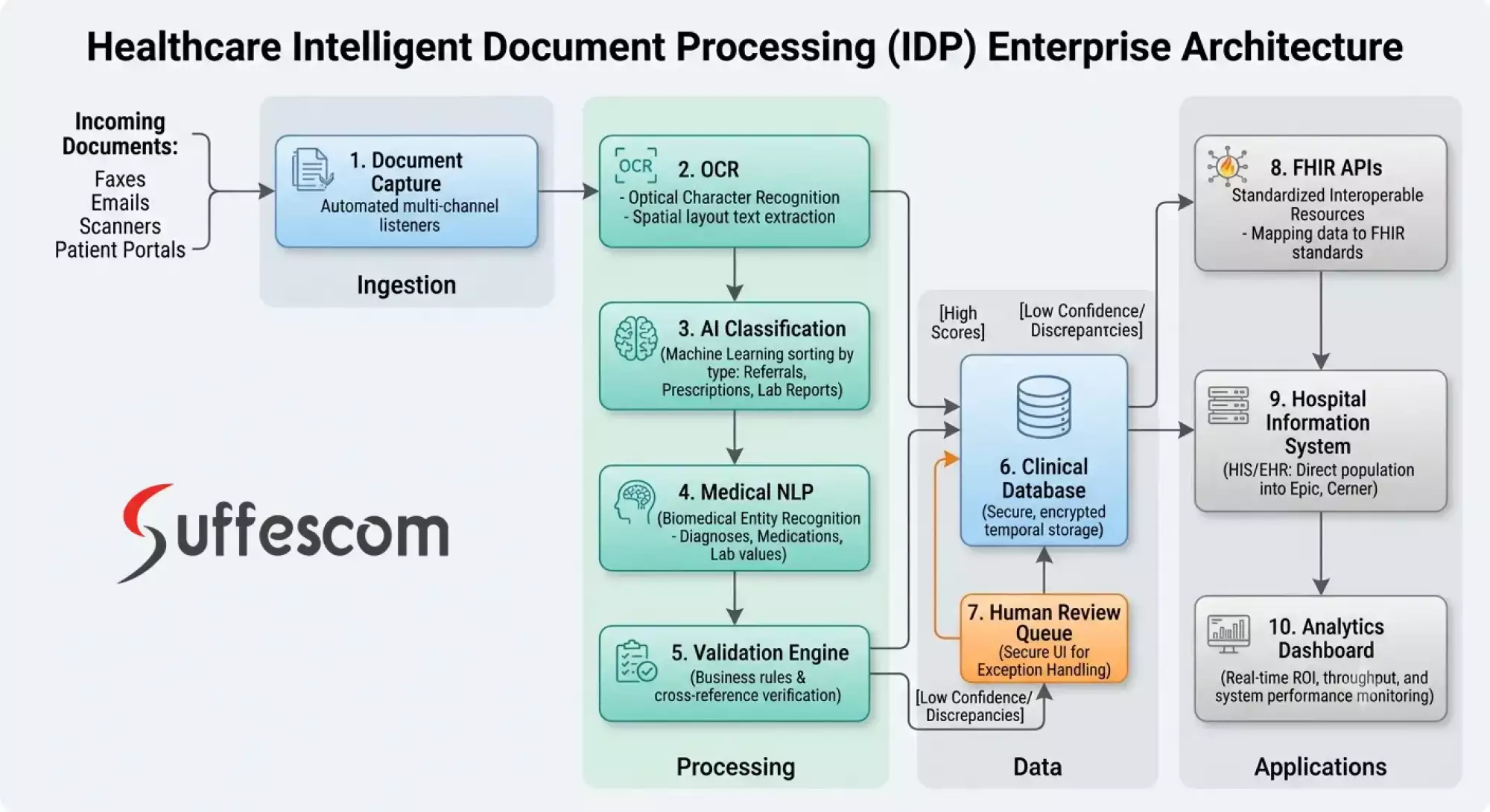
Building an automated pipeline that can safely process clinical data requires a sophisticated, multi-stage architecture. A robust healthcare intelligent document processing system ingests, sanitizes, classifies, understands, and validates data in a continuous, highly secure loop.
Here is the step-by-step blueprint of how modern intelligent document processing solutions transform messy inputs into structured clinical data:
[ Document Ingestion ] (Email, Fax, Scanners, Patient Portals, Mobile Uploads)
↓
[ Image Preprocessing ] (Noise removal, Deskewing, Rotation, Resolution enhancement)
↓
[ OCR ] (Extracting raw text strings from the cleaned document)
↓
[ Document Classification ] (Categorizing as Referral, Prescription, Lab Report, etc.)
↓
[ Medical NLP ] (Extracting Diagnoses, ICD/CPT codes, Dosages, Allergies, Values)
↓
[ Confidence Scoring ] (AI self-assesses the statistical accuracy of the extraction)
↓
[ Human-in-the-Loop ] (Low-confidence data routed to medical staff for quick review)
↓
[ Structured Output ] (Data converted into clean formats like JSON or FHIR)
↓
[EHR Integration] (Direct, automated injection into Epic, Cerner, etc.)
Multi-Channel Document Ingestion
Healthcare data originates from a chaotic mix of legacy and modern channels. Effective intelligent document ingestion in healthcare acts as a universal receiver, automatically pulling incoming files from emails, cloud-based patient portals, physical scanners, mobile uploads, and legacy digital fax networks without requiring manual sorting.
Advanced Image Preprocessing
Before the AI attempts to read a document, the system optimizes its visual quality. Raw documents, especially faxes and mobile photos, are often blurry, tilted, or stained. The system applies noise removal, deskewing (straightening lines), rotation correction, and resolution enhancement to maximize downstream extraction accuracy.
Core Text Digitization
The preprocessed, crystal clear image is run through an OCR engine to convert raw pixels into digital characters. This acts as the baseline layer, capturing all text strings, numbers and structural symbols present on the page.
Dynamic Document Classification
Once the text is extracted, the system identifies what the document actually is. Utilizing machine learning classifiers, it instantly categorizes the file into defined buckets such as a Referral, a Prescription, an Insurance form, or a Lab Report, ensuring it triggers the correct downstream extraction rules.
Medical Natural Language Processing
This is the cognitive heart of the pipeline. Using specialized biomedical NLP models, the system extracts critical medical entities and maps them to standard medical ontologies. Key data points extracted include:
Clinical Data: Diagnosis, Medications, Dosages, Allergies, Lab Values.
Administrative Details: Physician names, Dates of service.
Standardized Codes: Automapping narrative text directly to ICD codes (for diagnoses) and CPT codes (for procedures).
Confidence Scoring and Human Review
To ensure absolute patient safety, the system calculates a statistical confidence score for every extracted data point. If the score meets the high institutional threshold, it passes automatically. If a handwritten word or a smudged fax lowers the score, the document is flagged for a quick human review via a secure interface that combines AI speed with human oversight.
Structured Output and EHR Integration
Once validated, the unstructured text is transformed into a highly organized, clean format (such as JSON or HL7/FHIR). The system then pushes this clean data directly into the facility's Electronic Health Record, seamlessly updating patient charts in platforms like Epic or Cerner without a single manual keystroke.
Architecture of Intelligent Document Processing Platform Development
High-Impact Healthcare Use Cases for Custom IDP
Implementing custom intelligent document processing in healthcare delivers significant operational improvements across the organization, with the greatest impact on workflows traditionally slowed by paper-based processes and manual verification.
Medical institutions can fundamentally transform their daily operations by replacing slow, human-dependent data routing with custom-engineered intelligent document processing solutions.
These use cases demonstrate how healthcare document processing automates administrative workflows, reduces manual intervention, and accelerates patient care across hospitals and clinics.
Referral Intake
Current Workflow
Inbound patient referrals land via fax or email. Administrative staff must manually read the physician's narrative text, verify insurance details, check clinical history, and type the data into the internal booking system.
AI Workflow
Through medical referral document automation, the IDP engine instantly ingests the document, identifies the patient, extracts the clinical reason for the referral, and automatically checks for all required medical charts
Business Impact
Drastically reduces patient triage times from days to minutes, preventing patient leakage and ensuring critical cases are scheduled instantly.
Prior Authorization
Current Pain
Staff manually match a doctor's treatment plan against complex, shifting insurance rules. A single missing data point or misread chart leads to long delays, treatment cancellations, and immediate staff burnout.
Automation
Purpose-built prior authorization document processing AI extracts clinical justifications, diagnoses, and proposed treatment codes directly from physician notes, automatically compiling and verifying them against insurer requirements
Savings
Slashes administrative processing costs by up to 80% while accelerating time-to-treatment, directly improving patient satisfaction scores.
Claims Processing
Manual Coding
Staff must read through endless discharge summaries and surgical notes to manually apply billing codes, leading to frequent typographical errors and high denial rates.
AI-Assisted Coding
AI medical claims extraction software pre-scans clinical paperwork, extracting exact procedures and mapping them flawlessly to corresponding billing codes before submitting them to the payer
Faster Reimbursement
Minimizes claim rejections due to administrative errors, reducing Day Sales Outstanding and stabilizing institutional cash flow.
Revenue Cycle Management
Automated medical billing document processing sits at the core of enterprise RCM, which depends on matching patient records, insurance payouts, and clinical documentation without discrepancies. Custom IDP seamlessly reconciles remittance advices and explanation of benefits documents, automatically flagging underpayments or billing mismatches for immediate financial recovery.
Clinical Documentation & EHR Updates
Physicians spend hours every week updating Electronic Health Records. IDP tools act as an automated administrative assistant, reading unstructured nursing notes and diagnostic data to auto-populate patient charts, freeing clinicians to focus entirely on direct patient care. For health systems handling high patient volumes, custom medical chart abstraction software takes this further - pulling structured data points out of years of nursing notes and diagnostic records at scale.
Legacy Record Digitization
When modern health networks acquire smaller clinics or upgrade their existing systems, they face thousands of legacy paper records. Specialized IDP architectures can ingest large volumes of historical patient charts, using AI-powered medical record indexing to transform unsearchable scanned PDFs into highly organized, searchable digital profiles.
Patient Onboarding
Custom medical intake form automation and AI patient onboarding software for healthcare remove this bottleneck at the front desk. During intake, new patients fill out extensive registration packets, history forms, and insurance disclosures. An IDP pipeline processes these intake forms instantly from a digital tablet or scanner, updating the clinic's database before the patient even walks into the exam room
Medical Research and Clinical Trials
Extracting structured data for clinical research usually requires manual registry creation. Intelligent document processing solutions can scan millions of historical, unstructured clinical records to securely identify ideal trial candidates based on specific biomarkers, past medications, or diagnostic histories without violating data privacy boundaries.
Overcoming the Biggest Implementation Challenges in Healthcare IDP
Deploying an enterprise-grade intelligent document processing solution within a medical ecosystem is not as simple as plugging in an API. The intersection of strict medical requirements, legacy infrastructure, and erratic data inputs creates a highly complex environment.
To build resilient IDP solutions, engineering teams must proactively solve these major technical and operational friction points:
Data Ingestion & Input Anomalies
Poor Quality Scan
Low-resolution images, crumpled papers, and smudged faxes degrade character clarity. Overcoming this requires advanced computer vision filters such as binarization and localized thresholding to digitally clean and reconstruct the document before parsing.
Handwritten Notes
Physician scribbles and bedside charts remain the toughest challenge for standard text extractors. Advanced platforms utilize specialized Intelligent character recognition and handwriting recognition models fine-tuned specifically on medical penmanship to accurately map erratic handwriting.
Multiple Document Layouts
Healthcare forms have no universal standard. A custom intelligent document processing pipeline for healthcare uses layout-agnostic transformer models that analyze documents spatially, understanding the structural relationships among data points regardless of where they sit on the page.
Information Integrity & Data Hygiene
Missing Fields
Vital paperwork often arrives with incomplete text blocks or blank spaces. The IDP validation engine flags these empty spaces instantly, cross-referencing internal master patient indexes or automatically alerting administrative staff for immediate resolution.
Duplicate Records
Inbound files frequently contain repeated patient charts or overlapping lab orders. The architecture must include deduplication layers that evaluate timestamps, patient IDs, and semantic context to safely filter out redundant data entries before updating the clinical database.
Deep Clinical Context and Ambiguity
Clinical Abbreviations
Phrases like "q.d." (every day) or "b.i.d." (twice a day) requires specialized understanding. Standard AI models fail here, which is why clinical engines use localized medical NLP libraries to correctly decode shorthand into explicit clinical commands.
Context Ambiguity
A single medical term can mean entirely different things based on its placement. The processing pipeline must analyze surrounding prose semantically to determine if a condition is a current diagnosis, a past family history note, or an excluded allergy.
Enterprise Integration & Governance
Legacy EHRs
Many hospitals operate on heavily customized legacy EHR architectures that reject basic webhooks. Bridging this gap requires secure middleware, custom API connectors, and HL7 interface engines to seamlessly inject structured payloads into stubborn databases.
Regulatory Compliance
Medical data processing requires strict compliance with frameworks such as HIPAA, HITECH, and GDPR. The platform architecture must implement strict role-based access controls, complete digital audit trails, and end-to-end data encryption both at rest and in transit.
Human Validation Loops
Building a well-designed, secure exception-handling queue allows medical personnel to quickly audit low-confidence scores, providing a rapid feedback loop that continually trains the machine learning models.
End-to-End Automation with EHR Integration in Healthcare IDP
If structured data remains trapped inside a standalone automation tool, administrative staff are still forced to manually copy and paste information into patient charts. This is where dedicated EHR data extraction software development closes the loop - pushing validated clinical data straight into the patient record instead of leaving it stranded in a disconnected tool. This is where dedicated EHR data extraction software development closes the loop — pushing validated clinical data straight into the patient record instead of leaving it stranded in a disconnected tool.
To achieve true end-to-end automation, intelligent document processing solutions must seamlessly inject data directly into Electronic Health Records.
Market Giants or Localized Infrastructure
Whether a hospital network relies on market giants or localized infrastructure, a custom pipeline must interface natively with all major platforms:
Epic & Oracle Cerner
The backbones of large enterprise hospital systems. Connecting with them requires deep integration with their respective developer ecosystems (like Epic App Market and Oracle Cerner Central).
athenahealth & eClinicalWorks
Widely utilized in ambulatory care and private practices, demanding nimble, cloud-forward API connections.
Custom EHRs
Proprietary or legacy systems built for niche medical specializations that lack modern documentation, requiring custom middleware to bridge the gap.
Without this deep integration tier, an IDP system is simply another isolated software silos.
Technical Framework of Healthcare Interoperability
To securely push parsed data across the threshold of a hospital's EHR, HL7 FHIR document extraction forms the backbone of the system architecture, which must speak the language of modern healthcare compliance and data standards. This requires an orchestrated layer of protocols, translation mappings, and identity checks.
Data Communication Standards
HL7
The legacy standard used by the vast majority of existing hospital networks. It transmits data via strict, pipe-delimited text messages (such as an ADT message for patient registration). A robust IDP tool must be able to compile extracted text into these rigid formats.
FHIR
The modern, RESTful API-based standard is taking over the industry. FHIR breaks clinical data into modular, JSON-based Resources (e.g., Patient, Observation, MedicationRequest). Modern custom intelligent document processing for healthcare frameworks maps extracted data directly to FHIR standards to ensure plug-and-play compatibility with next-gen health tech.
Secure Web APIs
In line with healthcare protocols, a secure clinical document data extraction API — built on RESTful and GraphQL standards — facilitates rapid authentication and transmission of document metadata between the processing engine and internal hospital servers..
Semantic and Data Alignment
Data Mapping
Structural transformation is crucial. A date of birth extracted as "MM/DD/YYYY" must be programmatically mapped to the exact database schema fields required by the destination EHR (e.g., birthDate: "YYYY-MM-DD").
Terminology Mapping
Raw text descriptions must be normalized into universal medical codes. The IDP engine's NLP layer cross-references clinical narratives against centralized biomedical ontologies, automatically converting a phrase such as "High blood pressure" into the ICD-10 code I10 or a prescription for "Amoxicillin" into its corresponding RxNorm identifier.
Patient Identity Governance
Master Patient Index
A database used by healthcare organizations to maintain a consistent, accurate index of every patient across various clinical systems. The IDP system must query the hospital's MPI before uploading data to ensure it attaches records to the correct profile.
Identity Resolution
Documents regularly arrive with typos, missing middle names, or outdated addresses. The platform applies probabilistic matching algorithms (Identity Resolution) to analyze multiple data points such as Name, Date of Birth, Gender, and Social Security Number to definitively confirm a patient's identity, completely preventing the catastrophic error of merging two different patients' medical histories.
Build vs Buy vs Outsourcing HealthTech Specialists
Understanding intelligent document processing healthcare cost is often the deciding factor between buying off-the-shelf software, building in-house, or outsourcing to specialists - here's how the three approaches compare
| Evaluation Factor | Buying Off-the-Shelf | Building Internally | Outsourcing HealthTech Specialists |
| Upfront Cost | Medium ($15,000 – $30,000) – Fixed licensing or subscription fees, though hidden integration fees can escalate costs. | High ($250,000+) – Requires dedicated AI research, data science teams, and extensive infrastructure investment. | Flexible (• $30k - $50k (MVP/Basic) • $50k - $80k (Custom Deployment) • $80k - $150k+ (Advanced Enterprise) – Structured milestone-based investment tailored to project scope and specific institutional ROI goals. |
| Time to Market | Short – Immediate deployment, but can stall during complex configuration phases. | Long – Typically takes 12 to 18+ months to train medical NLP models and build secure EHR integrations. | Moderate – Usually 3 to 6 months to deliver a fully customized, deeply integrated production-grade pipeline. |
| Customization | Limited – Rigid templates and generic extraction parameters that break when encountering non-standard medical documents. | High – Completely tailored to your hospital's proprietary workflows, forms, and legacy data stacks. | High – Bespoke intelligent document processing solutions built precisely around your operational constraints. |
| Regulatory Compliance | Vendor Dependent – Relies entirely on the vendor's general security compliance certificates, which may lack specific edge-case coverage. | Internal Responsibility – The organization carries 100% of the risk for securing patient health information and meeting strict HIPAA/SOC 2 standards. | Shared Expertise – Collaborative engineering ensures deep, end-to-end alignment with clinical data security, audit logs, and regional governance rules. |
| Long-Term Maintenance | Vendor – Relies on standard software release cycles; custom feature requests are frequently deprioritized. | Internal – Requires ongoing engineering overhead to manage API updates, model drift, and system bugs. | Partner-supported – Managed service level agreements (SLAs) ensure proactive system monitoring, model tuning, and immediate tech support. |
| Best Suited For | Small clinics with entirely standard administrative layouts that do not handle complex clinical narratives. | Large health systems with massive, permanent software development divisions and proprietary data requirements. | Healthcare organizations needing scalable, compliant, and custom intelligent document processing for healthcare systems without the internal technical debt. |
For organizations choosing the internal route, an alternative strategy is to hire healthtech experts at an average rate of $40/hr to act as a technical extension team, filling critical development gaps without the overhead of permanent full-time hires.
Governance, Compliance, and Trust in Healthcare AI
Deploying a HIPAA-compliant IDP solution within clinical platforms requires an uncompromised commitment to data security and regulatory governance. A production-ready custom intelligent document processing pipeline for healthcare must be engineered with multi-layered trust protocols to protect patient health information:
Regulatory Frameworks
Complete alignment with HIPAA and HITECH regulations, backed by frameworks such as SOC 2 Type II and HITRUST certification, to validate institutional data security.
Data Security Architecture
Implementation of end-to-end encryption (AES-256 at rest and TLS 1.3 in transit), strict role-based access control, and immutable, digital audit trails tracking every document interaction.
Algorithmic Accountability
AI models must utilize clear versioning to prevent performance drift and provide explainability of AI outputs, giving clinicians visibility into why the model extracted specific medical entities.
Quality Assurance Guardrails
Automated confidence thresholds isolate low-scoring data into a secure, human-in-the-loop queue for manual validation. Once processed, strict data retention policies automatically purge temporary cache files to ensure permanent compliance.
Future Trends in Healthcare IDP Platform Development
Document processing is evolving from passive text extraction into cognitive, autonomous workflows. The next generation of custom intelligent document processing for healthcare focuses on platforms that think, adapt, and reason.
Medical networks are leveraging several key trends to redefine clinical operations:
Agentic AI Workflow Automation
Autonomous AI agents make complex operational decisions such as detecting an incomplete referral form and automatically messaging the referring physician to request missing data.
Multimodal Data Extraction
Next-generation intelligent document processing solutions analyze text, structured layouts, and diagnostic imagery (like X-rays or CT scans) within a single context window.
Ambient Clinical Documentation
Systems listen to real-time physician-patient conversations, automatically transcribing and parsing the speech into structured clinical notes inside the EHR.
Autonomous Document Routing
Advanced semantic models instantly prioritize incoming files by clinical urgency and route them to the appropriate specialist or department.
Interactive AI Coding Copilots
Real-time billing assistants guide coding specialists through complex ICD and CPT frameworks, flagging documentation discrepancies before submission.
Clinical Retrieval-Augmented Generation
Clinicians can query an incoming patient's massive, unstructured historical record using natural language to get instant, context-anchored summaries of past treatments.
Clinical Knowledge Graphs
Extracted data points across millions of disparate forms are mapped structurally to surface deep connections between symptoms, demographics, and clinical outcomes.
Measuring ROI of Investing in Healthcare IDP Platform Development
To evaluate the success of an intelligent document processing implementation, healthcare organizations must move beyond qualitative benefits and track concrete, data-driven operational KPIs.
Document Processing Time
Reduces the end-to-end file processing cycle by 60% to 70% down to a few seconds per file.
Manual Entry Reduction
Automates up to 70% of routine data entry tasks to minimize manual typing dependencies.
Error Rate
Slashes typo-driven mistakes by more than 50% through advanced machine learning verification layers.
Referral Turnaround Time
Accelerates patient record and referral triage by up to 50% to prevent patient leakage.
Prior Authorization Turnaround
Cuts insurance approval delays by 40% by automatically compiling precise clinical evidence.
Coding Productivity
Boosts overall medical coding efficiency by 60% through automated text extraction.
Claim Denial Rate
Drops financial rejection rates to protect cash flow by catching errors before submission.
Staff Hours Saved
Achieves up to a 90% reduction in manual documentation time, freeing clinicians for direct patient care.
Time to Patient Scheduling
Cuts medical record processing time down from weeks to days for significantly faster appointments.
Cost Per Processed Document
Saves an average of $20 to $30 per patient record by replacing manual data handling with automation.
Investing in advanced healthcare document processing enables providers to reduce operational costs, improve document accuracy, and achieve measurable efficiency gains across clinical and administrative teams.
Every Unprocessed Document Is A Delay In Patient Care And Revenue
HIPAA-compliant, FHIR/HL7-ready IDP platforms built for real hospital environments.
Partnering with Suffescom for Custom Intelligent Document Processing Development Success
Successfully deploying an enterprise-grade intelligent document processing platform requires deep knowledge of the healthcare domain and elite technical execution. As a trusted healthcare software development partner, Suffescom delivers end-to-end healthcare IDP integration services — engineering secure, compliant, and highly interoperable solutions tailored to your organization's precise clinical workflows.
We specialize in bridging the gap between legacy EHR systems and cutting-edge medical AI, ensuring your sensitive data flows securely while maximizing administrative efficiency. From automating complex prior authorizations to accelerating referral intakes, Suffescom helps you eliminate operational bottlenecks safely.
Frequently Asked Questions
What is the difference between legacy OCR and intelligent document processing in healthcare?
Traditional Optical Character Recognition only converts images of text into machine-readable characters but does not understand what the words mean. If a form layout changes, legacy OCR breaks. Intelligent Document Processing combines OCR with medical-specific Natural Language Processing and machine learning. This allows the system to semantically read and comprehend medical narratives, extract clinical intent, map terminology to frameworks like ICD-10, and handle unstructured text regardless of variations in document formatting.
How does an IDP platform ensure HIPAA compliance and protect sensitive patient health information?
Enterprise-grade healthcare IDP systems implement a multi-layered security architecture designed around data privacy regulations. This includes end-to-end data encryption using AES-256 at rest and TLS 1.3 in transit, role-based access controls, and immutable digital audit trails tracking document access.
To minimize data sprawl and exposure risks, the platform acts as a transient pipeline rather than a system of record. It enforces zero-retention data minimization policies, securely purging intermediate text caches as soon as the extracted data payload is successfully handed off to your HIPAA-compliant target system (where official long-term retention requirements are met).
Can intelligent document processing platforms accurately read handwritten physician notes and messy faxes?
Yes. Modern custom IDP platforms utilize specialized Intelligent Character Recognition (ICR) models alongside advanced computer vision preprocessing layers. Before text extraction even begins, the system applies image enhancement filters such as localized binarization, de-skewing, and noise reduction to clean up low-resolution or smudged faxes. The ICR engine, fine-tuned on vast libraries of medical penmanship and shorthand, can then map erratic physician handwriting with high baseline accuracy.
How do healthcare IDP systems handle missing fields or low-confidence data extractions?
To maintain absolute data integrity, the system relies on predefined confidence thresholds and a structured Human-in-the-Loop validation mechanism. When the platform encounters a low-confidence score, a missing mandatory field, or ambiguous context, it halts automatic insertion. Instead, the document is securely routed into an exception-handling queue where a medical coder or administrative staff member can rapidly review, correct, or approve the extraction, which also retrains the machine learning model.
What role do FHIR and HL7 protocols play in integrating document data with major EHRs like Epic or Cerner?
HL7 and FHIR are the critical interoperability languages used to transport extracted text into Electronic Health Records. Legacy systems rely on pipe-delimited HL7 messages to route administrative or clinical data. Modern architectures leverage FHIR, which utilizes RESTful secure APIs to transmit data in modular, structured JSON formats. Custom IDP engines transform extracted text chunks natively into these standardized JSON schemas for seamless, real-time ingestion into Epic, Oracle Cerner, or athenahealth.
How does identity resolution prevent an IDP platform from merging the wrong patient records?
Inbound clinical documents frequently contain typographical errors, missing middle initials, or outdated home addresses that confuse traditional lookup databases. The platform utilizes sophisticated identity resolution algorithms that apply probabilistic matching across a spectrum of unique parameters, including Full Name, Date of Birth, Gender, and Social Security Number. By cross-referencing these data points against the facility’s centralized Master Patient Index, the system ensures records are attached to the exact correct patient profile.
Why should a healthcare network choose a custom development partner over buying off-the-shelf IDP software?
Off-the-shelf software functions adequately for completely standardized documents but routinely fails when encountering complex, unstructured medical narratives, unique clinical abbreviations, and highly customized local EHR schemas. Partnering with a dedicated software development firm allows healthcare organizations to build a bespoke pipeline tailored precisely to their unique operational logic. A custom-engineered platform eliminates rigid per-document licensing fees, guarantees seamless API connections into stubborn legacy infrastructure, and scales perfectly alongside an institution's shifting workflow requirements.
What factors influence intelligent document processing software development cost?
The developing intelligent document processing software pricing depends on factors such as document complexity, EHR integration needs, and compliance requirements. Unlike fixed licensing fees, pricing for IDP software development of custom solutions typically follows a milestone-based model, allowing healthcare organizations to align spend directly with clinical ROI rather than paying rigid vendor rates.