The healthcare industry is an extensive landscape that facilitates top-notch services to patients. It is gaining immense popularity and garnering attention among individuals, be they healthcare professionals, patients, or businesses.
Various healthcare software like EHR, EMR, and medical billing have eased and outrightly modernized how hospitals perform operations, allowing patients to get details about their vitals. The software is subjected to necessary integrations to enhance efficiency and performance.
Speaking of the same, medical software integration with equipment has become a necessity among healthcare businesses. If you need assistance of a similar kind, then Suffescom is at your service. Partner with us, enjoy and leverage our medical device integration software services, and witness seamless data exchange between the patient and healthcare equipment.
Interpreting Medical Device Integration
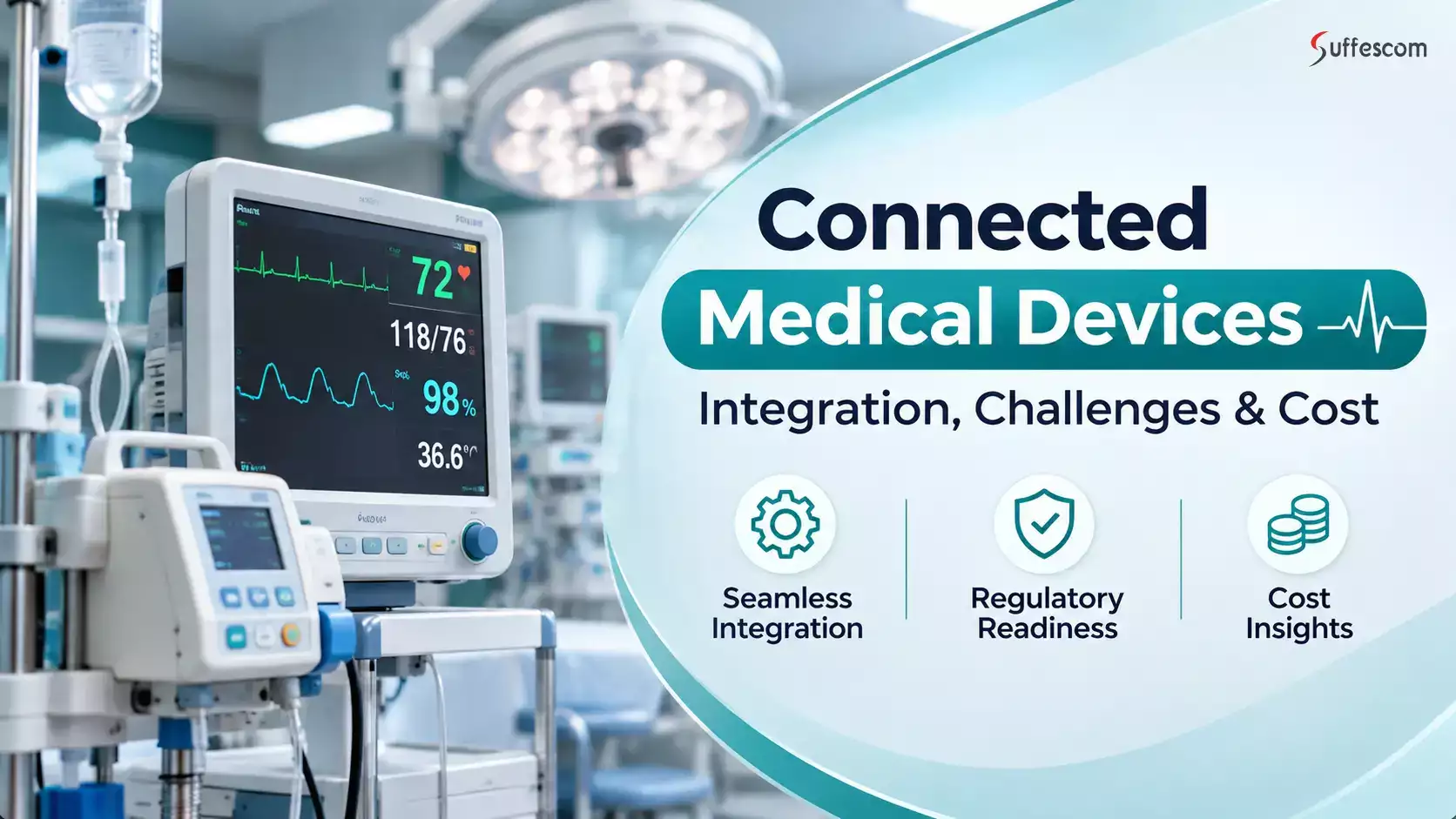
Medical device integration connects compatible equipment with hospital information systems, allowing authorized teams to access device data within clinical workflows. Reliable exchange depends on supported interfaces, accurate patient and device identification, data validation, monitoring for transmission failures, and documented recovery procedures.
Medical device integration has a wide scope. Broadly speaking, it helps in the most underrated but effective things, i.e., data collection and analysis. Medical equipment automatically captures information, removing manual errors and thereby saving time. Massive patient data is generated with the help of medical equipment.
Healthcare professionals access real-time patient data and provide quick responses to patients' conditions, eventually amplifying patient outcomes. Moreover, the interoperability offered is exceptional, allowing seamless data flow across multiple devices and systems, paving the way for unified patient care.
Medical Device Integration Service Company
Our professionals are adept at developing top-notch healthcare software and offering the best integration services to streamline workflows. Everything from EHR, EMR, HIS, and medical device software will seamlessly integrate within the existing systems.
Prime Elements Of Medical Device Integration Software
Medical device integration software supports coordinated patient care and clinical workflows through core capabilities. These components help devices communicate, protect patient information, standardize incoming data, and present information to healthcare professionals.
1. Device Connection
Device connectivity links supported equipment, including patient monitors, defibrillators, ventilators, and pulse oximeters, to receiving systems. Depending on device capabilities, data may travel through Bluetooth, Wi-Fi, cellular networks, wired interfaces, or gateways before reaching clinical software..
2. Data Security
Protect patient information with role-based access, strong authentication, encryption in transit and at rest, audit logging, and governed data masking to reduce unauthorized disclosure across connected medical devices and hospital information systems.
3. Data Normalization
Data normalization converts raw readings from medical devices into consistent, interpretable data. Because connected equipment may use different formats, units, timestamps, and identifiers, integration software maps these values to agreed data structures and validates them before exchange. This helps receiving clinical systems interpret measurements consistently and reduces errors caused by incompatible or incomplete data.
4. User Interface
The interface should present device status, validated readings, timestamps, and alerts in a clear clinical workflow. Role-based views help authorized professionals review relevant information, identify transmission issues, and access connected-system data efficiently within daily clinical care workflows.
Medical Device Software Integration Services We Offer
Experience the matchless set of services that enables the smooth flow of data from medical equipment to healthcare systems, accessing real-time insights and helping in data-driven decision making.
1. Medical Device Connectivity
Establishing connections within the devices to access the updated patient information and make quick decisions that speed up the treatment and accelerate outcomes.
2. EHR/EMT Integration
Connects device-generated clinical data with EHR/EMR records through structured exchange, mapping, reconciliation, and workflow synchronization.
3. IoT Device Integration
Entails devices' connection with other devices/platforms, cloud systems, and databases to fetch real-time data that helps make tailored treatment plans and increase patient safety.
4. Data Analytics Integration
Merges data from different sources and performs data extraction and transformation using advanced techniques that ensure enhanced accuracy and consistency and handle data access.
5. Regulatory Compliance Integration
Supports HIPAA safeguards across integration workflows through access controls, audit logging, authentication, transmission security, and documented risk management for ePHI.
6. Clinical Decision Support Integration
Enables clinicians to make accurate decisions based on evidence and upgrade the overall healthcare delivery through customized order sets, tailored reminders, diagnosis support, etc.
7. Medical Imaging System Integration
Connects imaging modalities and PACS/RIS platforms through DICOM-based workflows, enabling authorized clinicians to securely access, exchange, and review medical images within connected clinical systems.
8. Medical Device Software Validation
Involves rigorous testing and authentication, ensuring the software works as intended while detecting potential hazards and resolving those issues by executing the migration strategies.
9. Telemedicine App Integration
Provides real-time consultations, tracks patients' progress, shares medical reports electronically, and offers guidance related to specific procedures, including virtual home health care.
Accelerate Growth With Medical Software Integration Service
Start today and dominate the healthcare industry with our splendid range of services, taking your business one notch higher.
How to Resolve Software Integration Challenges in Medical Devices
Software integration in medical devices is complex because these systems must connect seamlessly with hospital IT infrastructure, maintain strict compliance, and operate without failure in life-critical environments. However, organizations can overcome these challenges with the right strategies, technologies, and planning.
1. Adopt Interoperability Standards Early
One of the biggest reasons integration fails is the lack of standardized communication between systems. Medical devices often use different data formats and protocols, making real-time data exchange difficult.
To solve this:
- Use HL7 v2 messaging, FHIR resources/APIs, and DICOM for medical imaging.
- Build flexible APIs that enable easy integration with EHRs and clinical platforms.
- Ensure future-ready architecture that can adapt to evolving hospital IT environments
Following standard protocols improves compatibility, reduces custom development effort, and ensures smooth communication between devices and healthcare software ecosystems.
2. Modernize Legacy Systems with Scalable Integration Architecture
Healthcare organizations often rely on outdated systems that were not designed for modern connectivity. These legacy platforms can cause data silos, integration delays, and workflow inefficiencies.
Best practices include:
- Introducing middleware or integration layers instead of replacing entire systems.
- Using microservices architecture to decouple core device functions.
- Implementing cloud-based integration platforms for scalability and performance.
An incremental modernization approach helps organizations improve interoperability while minimizing operational disruption and cost.
3. Strengthen Data Security and Risk Management Frameworks
Medical devices handle sensitive patient data, making cybersecurity a critical integration concern. Poorly secured integration channels can increase exposure to data breaches and system failures.
Effective solutions involve:
- End-to-end encryption for device communication and telemetry.
- Secure firmware update mechanisms and device authentication controls.
- Continuous monitoring and failover mechanisms during outages.
Embedding security practices from the design phase reduces vulnerabilities and improves system reliability in real-world healthcare settings.
4. Improve Testing with Real-World Simulation and Validation
Integration issues often appear under high workload or stress conditions rather than during routine testing. Without proper validation, devices may fail in critical clinical situations.
To mitigate risks:
- Perform load testing and simulation in controlled environments.
- Validate device behavior across different hospital workflows and usage scenarios.
- Conduct interoperability testing with third-party platforms and networks.
Proactive testing ensures stable performance, minimizes downtime, and enhances patient safety before full deployment.
5. Establish Robust Data Governance and Standardization Practices
Disconnected systems, undocumented proprietary formats, and inconsistent data structures are common barriers to medical software integration. These issues can slow innovation and impact clinical decision-making.
Organizations can address this by:
- Defining clear data governance policies and ownership frameworks.
- Implementing standardized data models across connected devices.
- Ensuring backward compatibility for smooth upgrades and integration expansion.
Consistent data management enables seamless analytics, better clinical insights, and improved patient outcomes.
6. Build Skilled Cross-Functional Integration Teams
Successful medical device integration is not just a technical challenge — it also requires collaboration across regulatory, engineering, and clinical domains.
Key actions include:
- Investing in training programs focused on interoperability standards and healthcare compliance.
- Partnering with experienced medical software integration providers.
- Encouraging collaboration between product teams, IT departments, and healthcare professionals.
A well-coordinated team ensures faster implementation, reduced integration errors, and better alignment with AI-powered healthcare workflows.
Considerable Challenges Involved In The Medical Device Integration Software Service
Beyond the technical issues covered above, device integration must account for how data is interpreted and acted on in clinical workflows. A connected medical device integration may transmit readings successfully, yet those readings can still be unusable if units, timestamps, patient identifiers, or measurement context are missing. Define clinical acceptance criteria and validate representative data before enabling routine use in each setting.
Implementation also depends on clear ownership across the device manufacturer, healthcare provider, integration vendor, and EHR team. Agree on interface responsibilities, escalation paths, change control, and support coverage before deployment. These arrangements help teams manage firmware changes, interface updates, maintenance windows, and incidents without leaving critical integration tasks unresolved during operations.
Finally, plan for user onboarding and ongoing monitoring. Clinicians need workflow training, while technical teams need procedures for investigating failed messages, delayed readings, and device connectivity issues.
How To Develop And Integrate Software In Medical Equipment?
Integrating medical equipment software requires more than connecting hardware to an application. Teams must define clinical workflows, device interfaces, data handling, cybersecurity controls, verification activities, and applicable regulatory obligations before deployment and throughout the software lifecycle.
1. Defining Requirements
The first and foremost thing is to understand the project requirements from the clinical point of view. The specifications related to the functional capabilities are defined and regulatory standards with respect to the device are comprehended.
2. Software Design and Architecture
Next, separating the system design, such as cloud architecture and embedded software, is pivotal, followed by modular design, like user interface and database management. Data integrity is maintained during this phase, ensuring precise data processing.
3. Regulatory Compliance
Another important thing is to build software that adheres to regulatory standards to avoid any legal issues later. These standards are responsible for defining every lifecycle and outlining the validation requirements applicable to an extensive set of medical devices.
4. Development
The necessary development tools are chosen for developing medical software. These include the latest programming languages and testing frameworks, which ensure quality coding while meeting reliability standards.
5. Integration With Existing Medical Devices
The seamless interaction between the hardware devices and the software ensures data exchange among different devices. Things surrounding interoperability need to be considered so that the flow of information is not restricted at any given point.
6. Quality Assurance
Testing methods, such as penetration, unit, usability, and functional, are adopted to authenticate the components and remove abnormalities. Quality is improved while testing the software in real-world scenarios and meeting the standards to prevent cyber threats.
7. Launch And Maintenance
The medical device software is then deployed on a dedicated server and released in various versions for public use. After that, nonstop maintenance services are provided to ensure safety and necessary updates.
Key Features Of Medical Device Software Integration
Discover the phenomenal attributes that help streamline business processes, maintain consistency, and offer security through data exchange.
1. Plug-and-Play Connectivity
Supports device onboarding through compatible interfaces, while allowing any required device-specific setup and validation before deployment.
2. Device Management
Enables the doctors to monitor the patient's health remotely via robust functionalities such as performance monitoring, remote configuration, etc.
3. Real-Time Data Streaming
Enables healthcare professionals to make timely clinical decisions and necessary interventions that enhance patient care outcomes and monitor patient data in real time.
Experience The Most Seamless Medical Device Integration Software Services
We aim to integrate advanced solutions into your healthcare software, enabling effective data exchange and streamlined workflows. Contact our team and get market-leading in just a few taps.
Medical Software Device Solutions Elevating the Healthcare Performance
Healthcare is the most important sector as it directly influences individual lives and contributes heavily to societal well-being. More than anything else, the involvement of the technologies and developing software helps ease access to better healthcare services and improve quality of life. Our team focuses on delivering innovative healthcare solutions that will take your business to the heights of success.
1. IoMT App Development
provides outstanding remote monitoring, upscaled healthcare delivery, improved patient outcomes, optimized patient engagement, accessibility among patients, and more. Real-time data is captured concerning the vital signs, helping doctors respond instantly to emergencies.
2. AI Healthcare Software
Harness the power of our software solutions, which help in better treatment planning and improve diagnostics by performing medical image analysis. The AI-powered chatbots help patients schedule appointments, ask questions, and transcribe patient conversations into organized clinical notes.
3. EHR Software Development
It provides incredible perks to healthcare providers, facilities, and patients. The doctors get updated information about the patient's health and, based on that, make appropriate decisions. It eliminates the risk of medical errors and streamlines administrative operations like appointment scheduling, billing, etc.
4. Patient Record Management App
Enjoy optimized patient care with our comprehensible solutions. These solutions lead to accurate diagnoses, in-depth patient histories, and seamless communication between patients and healthcare providers. They also help patients keep track of their appointments and medications to achieve better health outcomes.
5. Mental Health App Development
Encompasses a wide range of services like meditation, breathing, cognitive behaviour therapy, addiction recovery, mood tracking, and more. The patients get a platform to unwind themselves, become stress-free with self-monitoring tools, and participate in teletherapy sessions from their homes.
Benefits of Medical Software Integration Services
Explore the comprehensive advantages that make the healthcare workflow super smooth and tremendously elevate the patient care to the next level.
1. Enhanced Patient Care
The integration services allow timely intervention by healthcare professionals or authorized organizations that monitor the patient's activities 24/7 and provide personalized treatment care.
2. Data-Driven Insights
Advanced analytical tools help gain meaningful information regarding healthcare patterns and patient populations. All this is possible with integrating medical equipment within the software that drives positive outcomes in delivering healthcare services.
3. Cost Effective
Effective resource management, error reduction, and automated processes reduce the burden on the healthcare facilities. This directly impacts the operational costs, increases productivity, and results in massive cost savings.
4. Remote Monitoring
Medical device software integration services are helpful for patients suffering from chronic diseases. Doctors can monitor patients' health status without a physical checkup, due to the availability of monitoring devices like wearable trackers, glucometers, pulse oximeters, etc.
5. Personalized Care
The integrated systems offer a holistic review of the patient's health condition, which helps create tailored treatment plans. These include improving drug dosages and effective therapies while analyzing patient-specific data.
6. Mitigates Medical Errors
The involvement of the EHRs and CDSS helps streamline processes, optimize data accuracy, and offer real-time guidance. This helps with automatic data integration and gathering, which reduces manual errors and eliminates misinterpretations of any kind.
7. Enhanced Data Security
The use of encryption protocols, regular audits, security patches, and compliance with the regulatory industry standards protects the confidential data and ensures secure transmission of the sensitive patient details.
Estimating The Cost Of Medical Software Integration Service
Medical device integration costs vary based on device models, interface availability, data volume, EHR connectivity, middleware, security controls, and validation requirements. For many custom integration projects, the estimated cost can range from $30,000 to $150,000, depending on the complexity and scope. The final budget also accounts for testing, deployment, system compatibility, and ongoing maintenance.
Go through the following factors that can affect the budget;
- Privacy Concerns
- Scalability limitations
- Complexity
- Data mapping
- Compatibility Issues
- Custom-tailored integration software
Why Does Suffescom Excel In Medical Device Integration Software Services?
As a reputed healthcare software development company, we offer high-quality solutions and deliver best-in-class integration services with different systems.
- 13+ years of experience in software development
- Tech prowess in cutting-edge technologies
- Serving clients globally
- Awarded and recognized by the reputed organizations
- Successfully delivered 100+ web, mobile, and software
- Agile & DevOps development methodologies
- Continuous integration practices
- Product engineering
FAQs
How much does medical software device integration cost?
Medical device software integration typically costs $30,000–$150,000, depending on project scope, device count, interface complexity, EHR connectivity, security, and validation needs. Treat this as an indicative estimate, not a fixed quote. An assessment should confirm compatibility, data requirements, deployment scope, and support needs before budgeting.
How Much Time Does It Take To Integrate Medical Equipment In The Software?
A basic integration may take around 2–3 weeks when compatible medical devices and existing interfaces are available. Projects involving multiple device types, custom protocols, EHR connectivity, security reviews, or extensive validation generally require more time. The timeline depends on technical scope, testing requirements, and deployment readiness.
What are the applications linked with medical device software integration?
The use cases are remote care and telemedicine, patient self-service, diagnostic and treatment assistance, and Medication management.
How to choose the best partner among medical device software development companies?
Perform necessary research, review their profiles on reputed portals like Clutch and GoodFirms, verify their testimonials, analyze their portfolios, and validate the client's reviews before hiring the development firm.