Medical Device Integration Using Real-Time Data Pipelines for a Healthcare Provider to Improve Remote Monitoring

This case study outlines how a leading healthcare network improved chronic care management by integrating data from connected medical devices—such as blood pressure cuffs, glucose meters, and pulse oximeters—directly into its clinical workflows. By implementing a device-agnostic integration layer and FHIR-based data pipelines, we enabled real-time biometric data ingestion, automated alerts, and seamless EHR documentation to support proactive care delivery.

Project Overview

The client is a healthcare provider operating a remote patient monitoring (RPM) program for patients with chronic conditions. Their RPM program relied on patients manually entering health data into a portal, which led to incomplete data, patient frustration, and clinical teams receiving delayed or inaccurate information. Care coordinators could not monitor patients in real-time, limiting their ability to intervene early when vitals deviated from normal ranges.

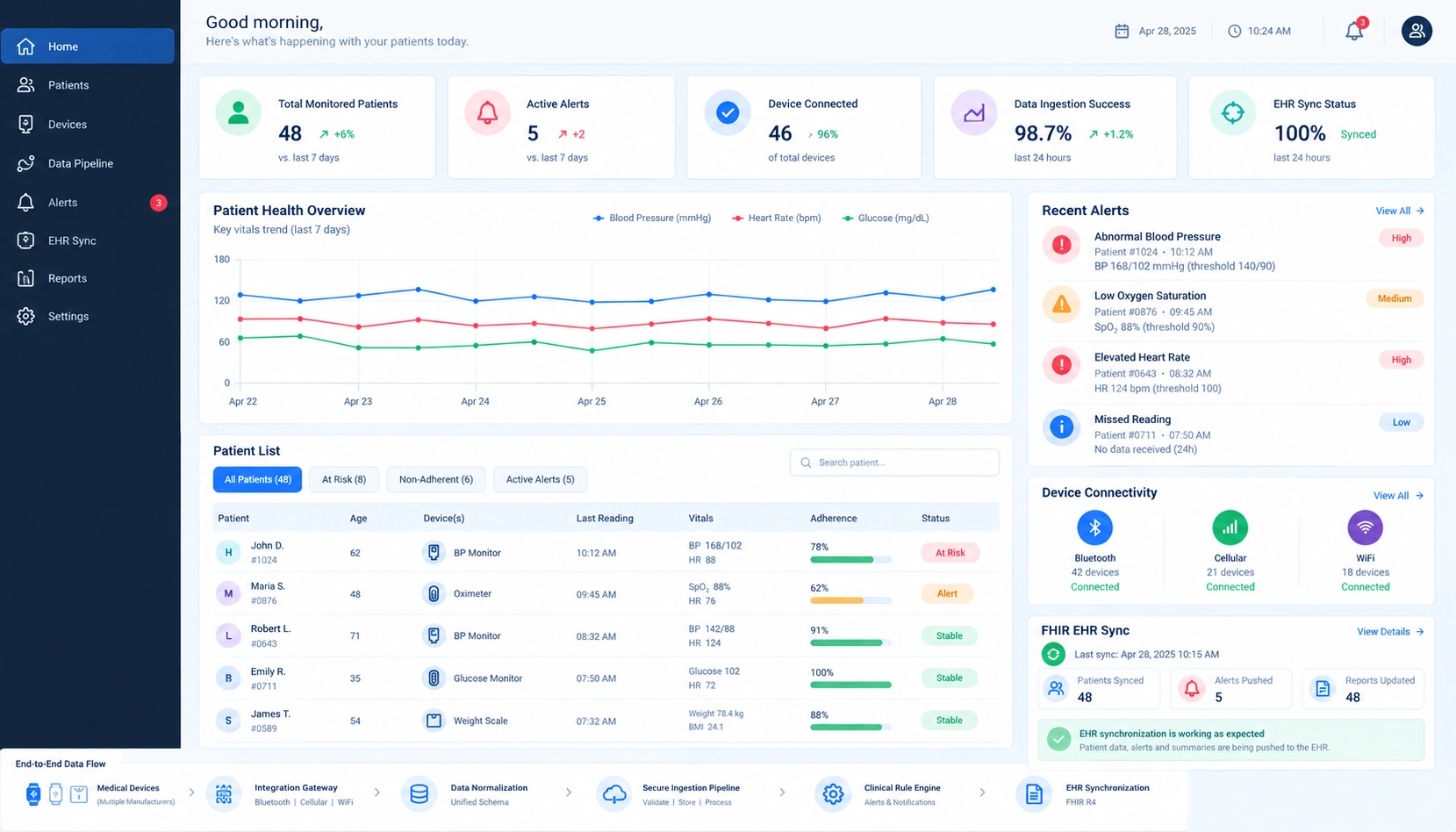
To address this, we implemented a medical device integration platform that connects diverse Bluetooth-enabled and cellular-connected devices—including blood pressure monitors, glucose meters, pulse oximeters, weight scales, and wearable activity trackers—to the provider's existing clinical systems. The solution ingests device data in real-time, applies clinical rules to generate alerts, and synchronizes summarized data to the patient's EHR via FHIR APIs, ensuring care teams have up-to-date information for decision-making.
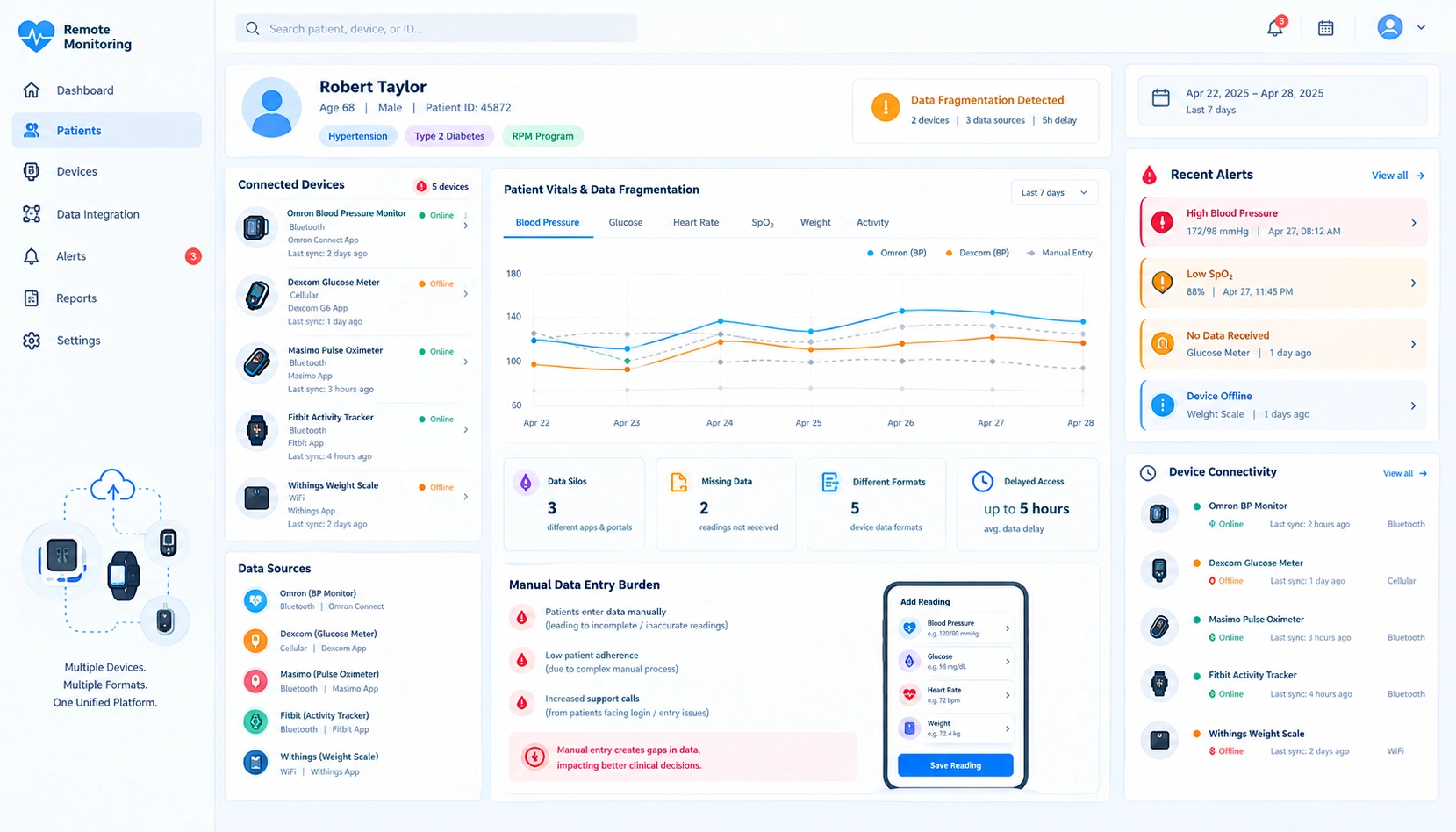
Challenges - Medical Device Integration Using Real-Time

Challenges

Challenges - Legacy Patient Portal Modernization
  • Device Data Fragmentation

    The provider's RPM program used devices from multiple manufacturers, each with its own data format, transmission protocol, and patient app. This created data silos and prevented a unified view of a patient's health status.

  • Manual Data Entry Burden

    Patients were required to manually log their vitals into a web portal. This led to inaccurate data, low patient adherence, and increased support calls from patients struggling with the manual process.

  • No Real-Time Monitoring

    The manual logging process introduced significant delays; care teams could not access data until the patient entered it, which could be hours or even days after a reading was taken. This latency prevented timely clinical intervention for dangerous vital signs.

  • Data Silos & Limited Clinical Context

    Device data was isolated in the RPM portal and was not integrated with the patient's EHR. Clinicians had to log into a separate system to view device data and manually document it in the patient's chart, creating an administrative burden and an incomplete clinical picture.

  • Scalability & Device Management

    The existing system was not built to handle a growing number of patients and diverse device types. Adding new devices or scaling the program to more patients required significant technical effort.

Solution Delivered

Device-Agnostic Integration Gateway

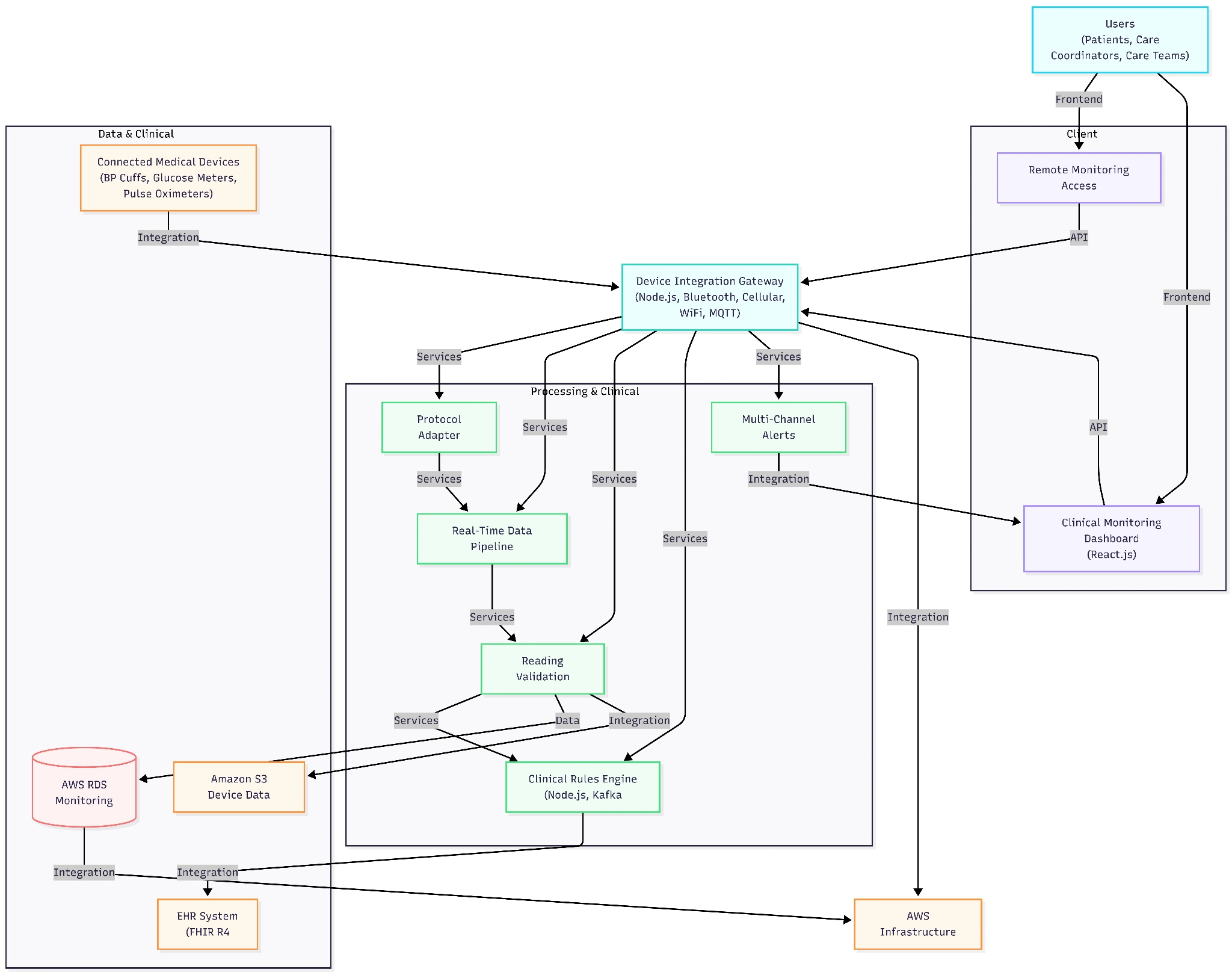
We built an integration gateway that supports multiple connectivity protocols (Bluetooth, Cellular, WiFi) and data formats. This gateway normalizes data from various medical devices—including those from different manufacturers—into a unified schema, enabling the platform to easily onboard new device types.

Automated Data Ingestion Pipelines

The solution automatically ingests patient-generated health data from connected devices as soon as a reading is taken. The pipeline ensures data is transmitted, validated, and stored in real-time, eliminating the need for manual patient entry.

Clinical Rule Engine & Alerting

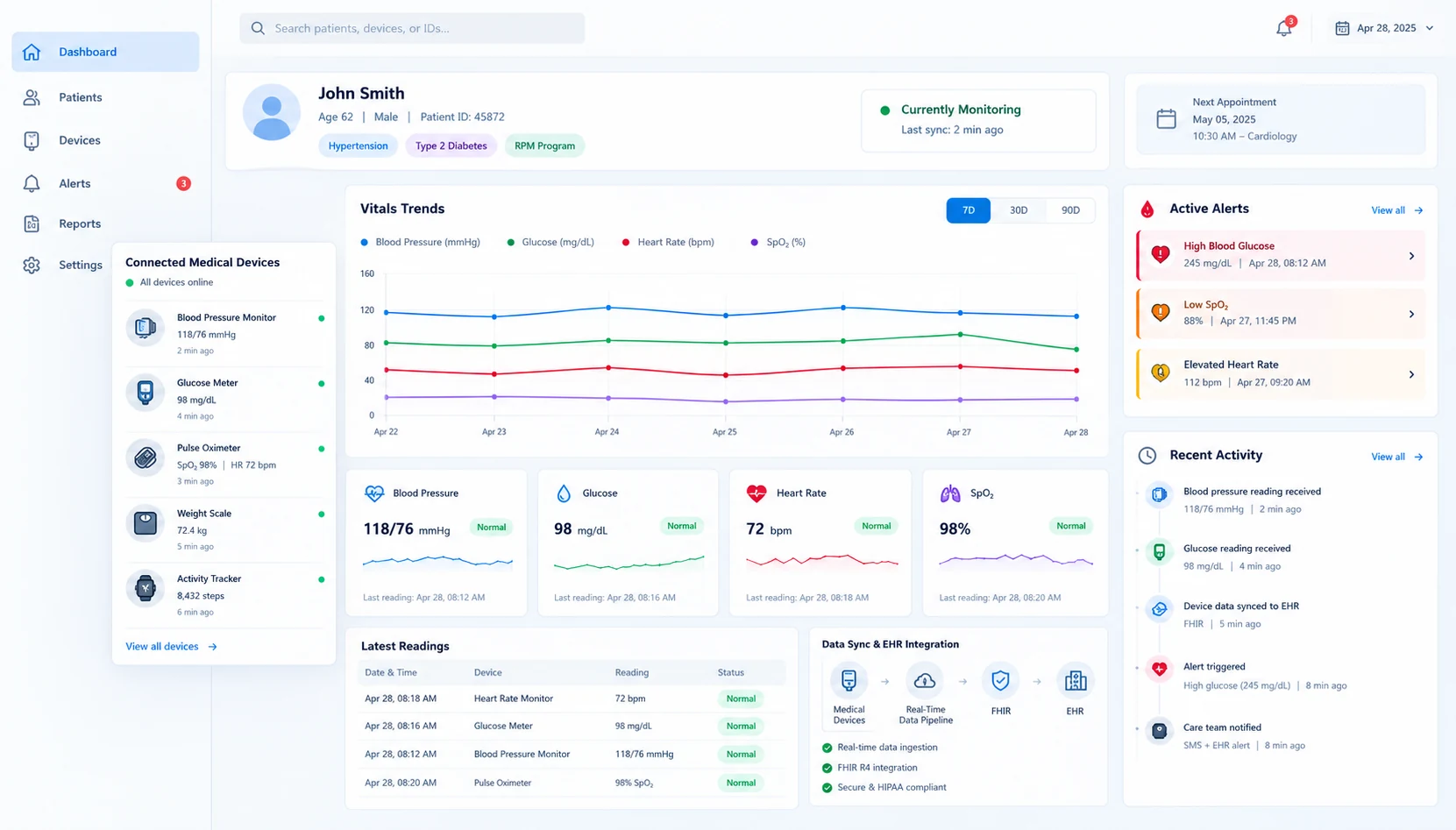
We implemented a clinical rules engine that evaluates incoming patient data against personalized thresholds. The engine sends automated alerts (via SMS, email, or EHR notification) to care teams when a patient's readings fall outside normal parameters, enabling timely intervention.

FHIR-Based EHR Synchronization

We integrated the RPM platform with the provider's EHR via FHIR R4 APIs. Key biometric trends, summarized readings, and alert notifications are automatically pushed to the patient's chart, giving clinicians a complete longitudinal view of the patient's condition within their primary workflow.

Patient & Care Team Dashboards

We developed role-based dashboards. Patients receive a simplified view of their own readings and progress, while care coordinators have a real-time view of all monitored patients, including active alerts, adherence status, and biometric trends.

AI Support Assistant

Outcomes

The integrated remote monitoring platform delivered measurable improvements in patient engagement and clinical efficiency:

100% elimination of manual patient

data entry, with vital signs automatically captured from connected devices.

60% reduction in clinical

alert response time, through automated, real-time notifications.

35% increase in patient

adherence to monitoring protocols, driven by the ease of automatic data capture..

Secure Document Management

replaced manual faxing with direct uploads, reducing processing delays by 60%.

50% reduction in patient

support calls related to data entry and device connectivity issues.

Achieved full HIPAA

compliance with all device data encrypted in transit and at rest.

Technology Stack

  • Integration Gateway:Node.js with custom protocol adapters (Bluetooth, API, MQTT)
  • Data Pipelines:Apache Kafka for real-time data ingestion
  • Rules Engine: Node.js/Kafka Streams for clinical rule evaluation
  • Frontend: React.js for web dashboards
  • EHR Integration: FHIR R4 APIs
  • Infrastructure: AWS (EC2, RDS, S3)
  • Security:OAuth 2.0, TLS 1.3, AES-256 encryption
  • Compliance:HIPAA, GDPR
Technology Stack
×

Key Capabilities of Delivered Solution

Discover how we helped a US-based healthcare provider modernize its legacy patient portal, transforming it into a modern digital ecosystem to boost patient engagement and operational efficiency.

  • Device-Agnostic Gateway

    Device-Agnostic Gateway

    Normalizes data from diverse Bluetooth and cellular devices into a unified format

  • Real-Time Data Ingestion

    Real-Time Data Ingestion

    Automatically captures and processes readings the moment they are taken

  • Clinical Rule Engine

    Clinical Rule Engine

    Evaluates vitals against personalized thresholds and generates automated alerts

Conclusion

The Medical Device & Remote Monitoring Integration project demonstrates how connecting diverse patient devices to clinical workflows can transform chronic care management. By implementing a device-agnostic gateway, real-time data pipelines, and FHIR-based EHR synchronization, we helped the healthcare provider eliminate manual data entry, reduce clinical response times, and increase patient adherence. The solution achieved full HIPAA compliance while creating a scalable foundation for remote patient monitoring programs.

Beware of Scams

Don't Get Lost in a Crowd by Clicking X

Your App is Just a Click Away!

Fret Not! We have Something to Offer.