+971-8000321216



Key Takeaways:
- AI legal document review platforms can automate repetitive tasks like clause extraction, contract comparison, risk detection, and document summarization.
- RAG, NLP, LLMs, OCR, semantic search, and explainability features form the core of a modern legal document review architecture.
- Development costs can range from $25,000 to $400,000+, depending on AI complexity, integrations, security requirements, document volume, and platform scope.
- Successful implementation also depends on integrating the platform with existing CLM, DMS, practice management, identity, and cloud storage systems.
- Continuous model evaluation is required after launch to manage changing legal language, review rules, document types, and model performance.
A lawyer can spend many hours checking a contract and still miss a clause that is very important. This issue becomes a lot harder when there are many agreements entering the legal queue every month. Manual review does not fit well when each document requires very careful attention.
The change and adoption of AI is already very visible in the legal industry. In 2026, 79% of legal professionals reportedly used AI, in comparison to 19% in 2023.
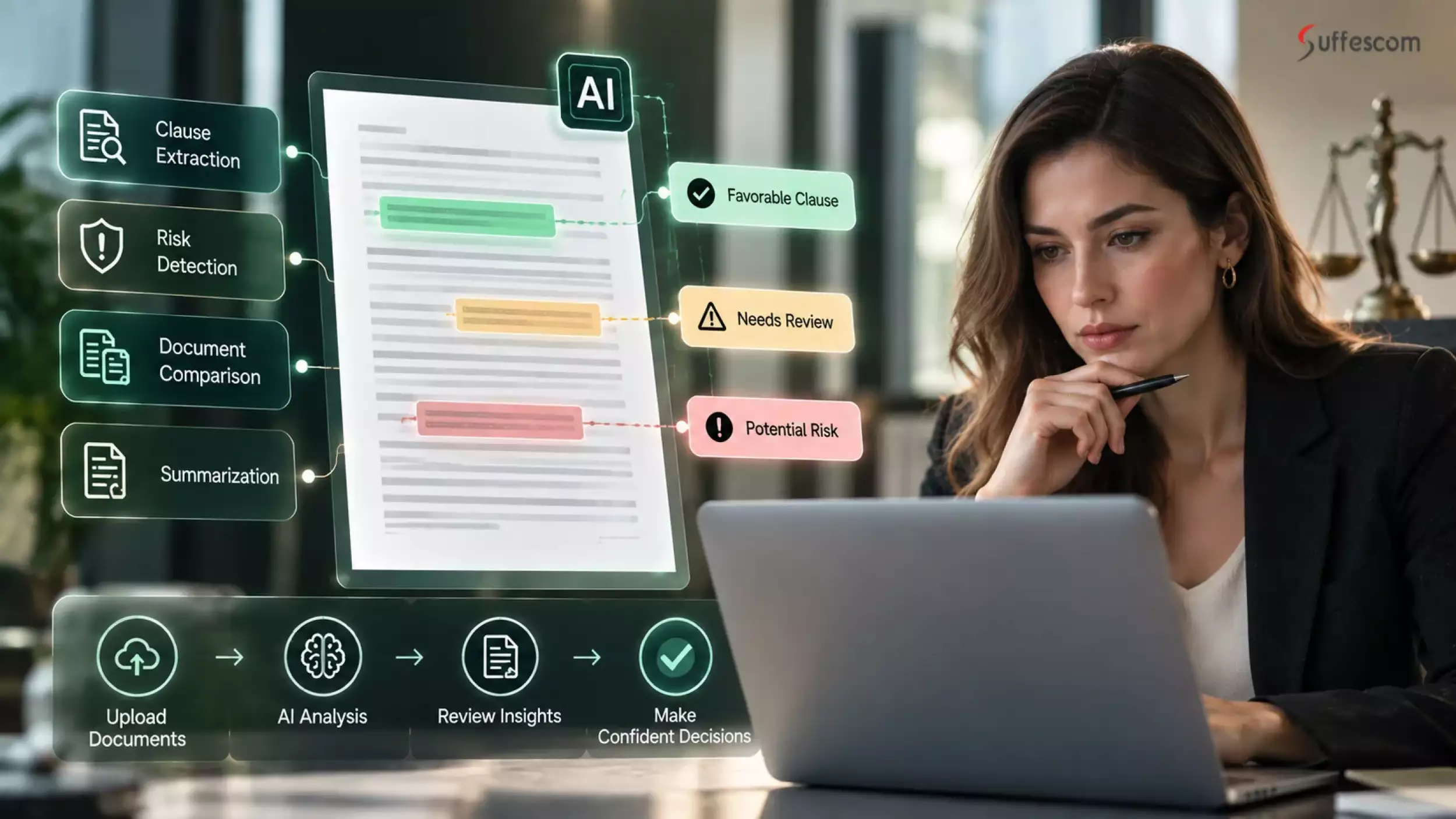
AI legal document review platform development addresses this issue by moving recurring review work into a software workflow. The platform can find clauses and show unusual terms. It can compare contract versions and mark provisions that need legal attention. Lawyers can then focus their time on interpretation and decisions rather than searching through every page manually.
But legal AI cannot be treated like a document-processing application. The system needs evidence for its findings. Confidential documents need access controls. Model outputs need human verification before they influence a legal decision.
This guide explains what it takes to build an AI legal document review platform. It covers all the main aspects to keep in mind before creating such a type of platform.
What Is an AI Legal Document Review Platform?
AI legal document review platform is software that uses artificial intelligence and language models to analyze legal documents and determine if the document contains information that a lawyer should review. A reviewer can upload a contract, and then the system will search for the clauses that are relevant.
The platform can identify clauses like indemnification, termination, liability, confidentiality, payment, and governing law. It can also compare two versions of an agreement and show the differences. More modern systems score risks that are determined by legal criteria or patterns within the document.
The technology does not replace legal judgment. Its role is to decrease the amount of manual searching and bring important findings into one review interface.
Core Capabilities of Legal Document AI Software
A typical platform can support several stages of the review workflow:
- Document ingestion: Supports PDF, DOCX and scanned documents.
- Clause extraction: Identifies and categorizes specific provisions by clause type.
- Risk identification: Flags language that falls outside approved standards or requires further review.
- Contract Comparison: Identifies changes between versions of a document.
- Semantic search: Allows users to discover relevant provisions without using exact words.
- Review assistance: Explains or provides supporting quotations for noted findings.
- Human verification: Provides a mechanism for lawyers to review, reject and edit AI-generated findings.
AI Legal Review vs. Rule-Based Legal Software vs. Manual Review
The difference is how each approach handles document analysis. Manual review depends completely on the reviewer. Rule-based software follows predefined conditions. AI-powered systems can interpret language patterns and adapt to different wording.
| Criteria | Manual Review | Rule-Based Software | AI-Powered Platform |
| Average review time | ~92 min | ~50–60 min | ~20–26 min |
| Clause identification | ~80% | ~85% | 94–97% |
| Scalability | Low | Moderate | High |
| New clause patterns | Reviewer dependent | Requires rule changes | Can adapt through model updates |
Why the Legal AI Market Is Scaling So Fast
Legal AI is no longer just a thing to try; it's becoming commonplace in legal practices. The Thomson Reuters 2025 Generative AI in Professional Services Report revealed that there is growing adoption of generative AI in professional services, especially within the legal space, where firms are employing the technology for areas like document review, legal research, and summarization.
The market is also attracting much investment. MarketsandMarkets forecasts the legal AI software market will expand from $3.11B in 2025 to $10.82B by 2030, at a 28.3% CAGR. This growth matters for companies considering legal software development because the opportunity extends beyond generic AI assistants. Contract analysis, document review, due diligence, legal research, and workflow automation can each become focused AI applications.
The Cost of Not Automating
Contract management is also a reason businesses are exploring automation. World Commerce & Contracting has published research on the financial impact of poor contracting and contract management that can support this section more credibly.
The business impact can show up through late approvals, non-disclosed commitments, poor contract terms, and extended review periods. These inefficiencies can be a tangible priority for an organization that has a lot of contracts to process.
Where Legal Teams Are Deploying AI First
Document review and legal research are the top drivers behind the practical applications shown in legal-industry AI research. For a custom platform, these workflows provide development opportunities. AI contract analysis tools can focus on clause identification and risk review, while legal research systems can help professionals find relevant information faster.
Automate Legal Document Review With AI
Build AI capabilities that can extract clauses, compare contracts, identify risks, and support legal reviewers.
Core Features of an AI Legal Document Review Platform
AI-Powered Clause Extraction and Classification
Legal teams should not have to search each page for important provisions. A clause based on indemnity, termination, liability, confidentiality, payment, and governing law can be identified with the help of an AI platform. Each provision can be coded to specific NLP models to help reviewers focus on the provision they want to review.
Example: A lawyer uploads 500 supplier agreements. The system detects all the termination clauses and sorts them by notice period. The reviewer can then focus on contracts that fall outside the company's terms.
Contract Risk Scoring and Anomaly Detection
The platform can evaluate contract language based on legal playbooks that have been predefined. It can identify provisions that are not part of an organization's preferred language. Anomaly detection can also surface unusual wording that deserves closer review.
Example: A company's liability cap is $1 million. The platform alerts an agreement with unlimited liability and passes it on to the legal team for review.
Automated Redlining and Contract Comparison
A new draft may be compared with an earlier draft or a standard template by reviewers. Artificial Intelligence can detect the changes in both documents and can generate suggested redlines according to the organization's review rules.
Example: A vendor provides a modified contract with 30 changes. The platform emphasizes changes in the conditions of compensation and termination, which removes the need to compare both documents manually.
Multi-Language and Multi-Jurisdiction Document Analysis
International legal teams require more than just translation. The system should be able to determine the language of the documents and use the appropriate jurisdiction-specific review rules.
Example: A company has employment agreements that are the same in the USA, France, and the United Kingdom. The system can automatically detect the clauses as well as the rules of review for every jurisdiction.
Semantic Search and Legal Document Summarization
Legal teams may need to find a concept even when the document uses some other terminology. Based on meaning, semantic search can recognize related language. This lets reviewers quickly get an overview of the agreement through an AI summary.
Example: When looking for "termination rights", you will likely find provisions in the terms with “right to terminate” or “early termination”
CLM, DMS, and Practice Management Integrations
Legal AI should integrate with existing processes and tools that teams are already using. Integrations with platforms like iManage can minimize duplications and guarantee review activity remains linked to existing workflows.
Example: A contract in a DMS may be forwarded to the AI review engine via an API. The results of the analysis can be fed back to the relevant matter or document record.
E-Discovery and Litigation Document Automation
In many litigations, there are thousands of emails, contracts, attachments and other records to be processed. AI can categorize documents and bring up possibly relevant documents for the lawyers to review.
Example: During a commercial dispute, the system can find documents related to a specific agreement or issue and prioritize them for the litigation team.
Human-in-the-Loop Review and Explainable AI
Legal AI should explain why a clause is highlighted. Before accepting an AI finding, a reviewer needs to be able to look at the source, the level of confidence and the evidence.
Example: Instead of simply marking a “high risk” limitation of liability clause, it should specify which of the review rules it has been found to be in violation of.
Audit Trails and Version Control
All findings should be traceable in case of an AI-generated finding. The system should keep track of document revisions, editing history, AI suggestions, and further edits.
Example: When a compliance team must determine the reason for a contract being approved, the audit trail can provide the original document, the decision made by the reviewers, and the final version.
Building the Explainability and Trust Layer for Legal AI Document Review Platform
A legal AI document review platform can't just provide the answer and let lawyers take it. Reviewers should be informed about the stimulus for a finding and the location of the supporting language in the document. Explainability should, therefore, be an integral aspect of a product's architecture and shouldn't be an afterthought, such as an interface feature after a model is developed.
Why Black-Box Models Struggle in Legal Workflows
Legal review has little room for unexplained AI decisions. A model can also identify a clause as risky, but that does not mean that the reviewer automatically concludes that it is risky and can take action accordingly. According to one industry report, 68% of legal professionals always inspect any contract output generated by AI before taking action.
This makes human verification an important product requirement. The platform ought to facilitate verification rapidly instead of making lawyers manually review the entire document.
For instance, if a termination clause is deemed to pose a high risk, the reviewer should have the ability to go to the terminating clause and display the reason for the alert. The workflow should provide an unambiguous answer (accept or reject).
Citation-Backed Outputs and Confidence Scoring
Every important AI finding should refer back to the text. This can be achieved in several ways, such as using retrieval pipelines that keep track of the references to the documents in the analysis.
A risk alert might display the extracted clause, as well as the location in the document. Another indication of model certainty may be a confidence score. These scores are not meant to be used as a guarantee of the accuracy of an AI result. They work better to guide reviewers on verification priorities.
For more complicated analysis, the system can also show which retrieved passages contributed to the outcome. This gives lawyers a way to check the model's reasoning against the underlying document.
Designing an Interface
The review screen should keep the AI finding and source document close together. A reviewer could select a flagged clause and instantly see the relevant passage shown in the original contract.
A useful interface in an AI legal document review platform can display:
- Flagged clause
- Risk category
- Supporting document text
- Confidence indicator
- Review rule or playbook reference
- Suggested action
- Reviewer decision
- Comment or override option
This approach turns explainability into part of the review workflow. Lawyers do not need to leave the platform to investigate why a finding appeared.
Turn Manual Review Into an AI Workflow
Design a legal document review workflow where AI handles repetitive analysis while lawyers remain in control of final decisions.
Step-by-Step AI Legal Document Review Platform Development
Building an AI legal document review platform starts with the review workflow. Collaborate with an AI development team that knows what legal professionals review and how they identify risk. Each stage should produce an output before the platform moves into the deployment stage.
Requirement Discovery and Legal Workflow Mapping
Start by studying the current document review process. Identify where lawyers spend time and which review tasks are suitable for AI automation.
Define:
- Contract types covered by the platform
- Clause categories that need extraction
- Risk rules and review criteria
- User roles and approval stages
- Target jurisdictions and languages
- CLM and DMS integrations
- Human review requirements
This stage establishes the functional and AI requirements for the platform.
Data Collection and Legal Corpus Preparation
The review engine needs representative legal documents for training and evaluation. The dataset should reflect the contracts the platform will encounter after launch.
Legal experts can annotate:
- Clause types
- Risk levels
- Missing provisions
- Non-standard language
- Obligations
- Key legal entities
The dataset should include complicated cases as well. Unusual clauses and conflicting provisions can expose model weaknesses before the system deployment.
Confidential documents should be handled within controlled environments. Access permissions should be defined for everyone involved in data preparation.
Model Selection, Fine-Tuning and RAG Pipeline Design
Select models according to the review tasks. Clause classification may require a different approach from contract summarization or complex risk analysis.
A RAG (Retrieval-Augmented Generation) pipeline can retrieve relevant content from approved legal playbooks and internal knowledge sources. Fine-tuning can be considered when the platform requires specialized model behavior.
Model evaluation should use legal documents that reflect the intended use case. General LLM benchmark scores are not enough to establish legal review accuracy.
UI/UX for Human-in-the-Loop Legal Review
The review interface should make AI findings easy to verify. Lawyers should be able to move from an alert to the relevant contract language without searching through the document again.
The interface can provide:
- Highlighted source clauses
- Risk categories
- Confidence indicators
- Supporting evidence
- AI-generated explanations
- Accept or reject actions
- Reviewer comments
This creates a clear handoff between automated analysis and legal judgment.
AI Legal Document Review Platform Development
This stage turns the architecture into a working platform. AI developers connect document processing with the AI analysis layer and the reviewer interface.
Main development work includes:
- Building document upload and processing workflows
- Connecting OCR with clause extraction
- Integrating the LLM with the RAG pipeline
- Developing risk detection and clause classification
- Adding contract comparison and redlining
- Building the legal review dashboard
- Implementing role-based access
- Adding audit logging
- Connecting CLM and DMS systems through APIs
The platform should keep each AI finding linked to its source clause. This allows reviewers to verify the result before accepting it.
Testing and Legal Accuracy Benchmarking
Testing should cover both the application and the AI review engine. Functional testing checks if the platform is working the way it should be. AI evaluation checks if its findings are actually reliable.
Test for:
- Clause extraction accuracy
- False positives and false negatives
- Hallucinated findings
- Risk classification accuracy
- Different contract types
- Different jurisdictions
- Poor-quality scanned documents
- Human reviewer agreement
Create a fixed evaluation dataset before launch. It can then be reused when the model or review rules are updated.
Deployment
After validation, deploy the platform within the selected cloud or private infrastructure. Connect it with the legal systems already used by the organization.
Production deployment should include:
- Model performance monitoring
- Application error tracking
- Access controls
- Audit logging
- Backup and recovery
- Model version management
The team should also establish a process for updating review rules and models when contract standards or legal requirements change.
Maintenance and Continuous Improvement
AI legal document review platforms require ongoing maintenance after launch. Legal language changes over time. Models can also behave differently as document types, review rules, and data patterns change.
Post-launch maintenance can include:
- Monitoring model accuracy and response quality
- Updating legal rules and review playbooks
- Retraining or fine-tuning models when required
- Fixing OCR and document parsing issues
- Applying security patches and dependency updates
- Monitoring AI infrastructure and API usage
- Reviewing feedback from legal professionals
- Updating integrations as connected systems change
- Revalidating models after significant changes
Development Timeline
| Phase | Estimated Duration |
| Discovery & Planning | 3–4 weeks |
| Data Preparation & Fine-Tuning | 6–10 weeks |
| Core Platform Development | 10–14 weeks |
| Testing & Compliance Validation | 4–6 weeks |
| Deployment & Integration | 2–4 weeks |
| Maintenance | Continuous |
Estimated total: 25–38 weeks. The actual timeline depends on data readiness, model complexity, integration scope, and compliance requirements.
Cost to Develop an AI Legal Document Review Platform
The cost to develop an AI legal document review platform typically ranges from $25,000 to $400,000+. An MVP with basic document analysis requires less app development effort. Enterprise platforms cost more because they involve more AI integrations and higher document volumes.
Cost by Platform Complexity
| Platform Type | Estimated Cost | Key Features | Timeline |
| MVP / Proof of Concept | $25,000–$50,000 | Document upload, user login, AI summaries, basic clause analysis, simple review dashboard | 6–8 weeks |
| Mid-Level Platform | $50,000–$180,000 | Clause extraction, contract analysis, RAG, citation-backed answers, risk detection, team workflows, cloud integrations | 12–20 weeks |
| Advanced Platform | $180,000–$300,000 | Advanced risk analysis, automated redlining, multilingual review, custom review playbooks, CLM/DMS integrations | 20–30 weeks |
| Enterprise Platform | $300,000–$400,000+ | Custom model development, high-volume document processing, private infrastructure, advanced RBAC, enterprise integrations, detailed audit controls | 30–40+ weeks |
These are indicative ranges. Actual pricing depends on the AI architecture, document complexity, security requirements, and integration depth.
Cost Breakdown by Development Phase
| Development Phase | Estimated Cost |
| Discovery and Planning | $5,000–$15,000 |
| UI/UX Design | $5,000–$15,000 |
| AI and Document Processing | $15,000–$80,000 |
| Platform Development | $25,000–$100,000 |
| Third-Party Integrations | $10,000–$50,000 |
| Security and Compliance | $10,000–$50,000 |
| Testing and Deployment | $10,000–$40,000 |
Phase-level estimates can overlap because some activities run in parallel. The final project cost depends on which phases and capabilities are required for the selected platform level.
Factors That Affect AI Legal Document Review Platform Cost
AI model and customization: LLM API costs differ from fine-tuning or deploying a specialized legal model.
Document volume: Higher processing volumes need more infrastructure and could lead to higher inference and storage costs for AI.
Review complexity: Basic clause identification costs less than risk analysis with legal playbooks and contextual reasoning.
Jurisdiction support: Each additional jurisdiction can require different rules and evaluation datasets.
Language support: Multilingual review requires language specific NLP capabilities and additional testing.
Integration requirements: CRM and enterprise identity integrations increase AI document review platform development effort.
Security: The deployment of a private cloud, the use of encryption, RBAC and audit trails, SSO and granular access policies all impact development and infrastructure.
Maintenance: Model updates, security patches, infrastructure monitoring, AI evaluation, and ongoing feature changes contribute to the long-term cost.
Technology Stack Used to Develop an AI Legal Document Review Platform
| Technology Layer | Tools / Frameworks | Purpose |
| NLP & LLM | Legal-BERT, Fine-tuned LLMs, spaCy, Hugging Face | Clause extraction, classification, entity recognition, legal text analysis, summarization |
| RAG & Retrieval | LangChain, LlamaIndex | Grounding AI responses in approved legal content and internal knowledge |
| Vector Database | Pinecone, Weaviate | Semantic indexing and similarity search across legal documents |
| Document Ingestion & OCR | Tesseract, AWS Textract, ABBYY | Processing PDFs, scanned contracts, images, and other document formats |
| Backend & APIs | Python, FastAPI, Django, Node.js | Platform logic, AI orchestration, workflow management, and API development |
| Database & Storage | PostgreSQL, MongoDB, Encrypted Object Storage | User data, metadata, review records, and document storage |
| Authentication & Access | OAuth 2.0, OpenID Connect, RBAC | Identity management and role-based access |
| Security | AES-256, TLS, Audit Logging, SOC 2 Controls | Data protection, secure transmission, activity tracking, and security governance |
| Cloud Infrastructure | AWS, Microsoft Azure, Google Cloud | Compute, storage, AI workloads, monitoring, and deployment |
Data Privacy, Security & Regulatory Compliance in Legal AI Document Review Platform
Legal documents can contain privileged communications and sensitive business terms. An AI legal document review platform needs security controls that safeguard this information during document upload and review.
Attorney-Client Privilege
Successful protection of attorney-client privilege requires the protection of confidentiality with respect to protected communications. The platform should limit document access by user role and matter-level permission.
Data should be encrypted both at rest and in transit. Document access, download, editing, and review capabilities can be recorded in audit logs. Data retention policies should also specify when documents and AI processing records are deleted.
AI providers also need careful evaluation. Legal teams need to be aware of the data used for processing, whether the data will be stored, and whether documents submitted will be used for model training.
GDPR, HIPAA, and Cross-Border Data Handling
GDPR applies when personal data falls within its territorial scope. Legal AI document review platforms handling such data need appropriate controls for access and data subject rights.
If the platform handles protected health information on behalf of a covered entity or business associate, then the HIPAA requirements may be applicable. The architecture should then address the applicable HIPAA safeguards and contractual requirements.
There is one other factor to consider: cross-border processing. Cloud regions, third-party AI services, document transfers and backups are all subject to data residency requirements. Addressing these requirements at the time of legal tech software development is preferable to addressing them after it has been deployed.
SOC 2, ISO 27001, and Legal-Industry Certifications
SOC 2 focuses on controls aligned with security and other trust service criteria. ISO/IEC 27001 provides a structure to build and maintain an information security management system.
These standards can support vendor due diligence and security governance. Certification alone does not make a legal AI document review platform compliant. The application's own controls and contractual obligations still need assessment.
On-Premise vs. Private Cloud for Sensitive Documents
On-premise deployment means maintaining infrastructure in the organization's controlled environment. It offers more control over where data is stored, how it is accessed, and more control over how network access is managed, but also demands internal infrastructure and security management.
Private cloud deployment provides dedicated or isolated cloud infrastructure that offers more operational flexibility. It can provide centralized security controls and give organizations the flexibility of selecting approved regions and access policies.
The appropriate model depends on data sensitivity and the organization's security operations.
AI Legal Document Review Use Cases Across Legal Workflows
Legal teams deal with volumes of contracts and other different documents that need very precise review. AI legal document review app development can automate recurring checks and also keep lawyers involved in decisions that require legal judgment.
Contract Review and Analysis
Contract analysis is one of the best direct applications of legal document AI. The system examines an agreement and brings terms or potential issues to the reviewer's attention.
- Extract key clauses and legal entities
- Identify missing or unusual provisions
- Detect terms that may increase contractual risk
- Compare provisions against approved standards
- Generate concise contract summaries
Contract Due Diligence
Large document sets can make due diligence time-taking. AI legal document review system aids in organizing these files and directs attention toward provisions that may impact the transaction.
- Classify contracts by type and relevance
- Extract rights, obligations, and key terms
- Detect change-of-control provisions
- Find non-standard contractual language
- Prioritize documents based on review criteria
Regulatory and Policy Review
Review teams can configure the platform around specific policies and legal requirements. The system then checks documents against those predefined criteria.
- Check for required clauses
- Detect missing policy language
- Flag provisions that fall outside defined rules
- Connect findings with supporting document text
- Record reviewer decisions for future audits
Litigation Document Review
Litigation usually produces large collections of documents that are required to be searched and classified. Semantic search and AI classification can decrease the time spent locating required material.
- Categorize documents by relevance
- Extract people, organizations, dates, and other entities
- Locate relevant passages across document collections
- Identify related documents and provisions
- Create review queues based on defined criteria
Vendor and Procurement Agreement Review
Procurement contracts usually have recurring terms that can be completely checked against company standards. Automated review gives legal teams a prior view of clauses that may require attention.
- Review payment and delivery conditions
- Check liability and indemnity provisions
- Identify renewal and termination terms
- Compare supplier language with approved clauses
- Route higher-risk findings for legal review
Lease and Commercial Agreement Review
Commercial agreements contain dates, financial terms, obligations, and conditions that legal teams may need to track after the initial review. These requirements should be considered during AI legal document review platform development.
- Capture renewal and expiration dates
- Extract payment obligations
- Identify termination conditions
- Track important contractual commitments
- Flag unusual commercial provisions
AI Legal Document Review Platform Integrations
Integrations connect an AI legal document review platform with the systems teams already use. They decrease duplicate data entry and keep documents and matter information connected.
Contract Lifecycle Management Integration
Integrate with CLM platforms to send contracts for AI review and receive feedback and review status. This maintains the AI analysis in the current contract workflow.
Document Management System Integration
With DMS integration, the platform can retrieve documents held in the contracts without requiring teams to manually transfer documents. Then, a document's metadata, permissions, and version history are kept linked.
Practice Management Integration
For law firms, integration with practice management systems can link reviewed documents to the correct client or matter. Review status and AI findings can then flow back into the matter record.
Identity and Access Management
SSO, OAuth 2.0, OpenID Connect, and RBAC help control access to sensitive legal documents. User roles and permissions can follow existing organizational policies.
Cloud Storage Integration
Connections with approved cloud storage allow teams to import contracts for review and store processed documents securely. Retention and access rules can also be applied.
Legal Research and Knowledge Sources
Legal research databases and internal knowledge repositories can strengthen RAG workflows. The platform can retrieve approved content to support document analysis and provide source backed findings.
API and Webhook Integration
REST APIs and webhooks allow the platform to exchange documents, metadata, review results, and status updates with other applications. This supports automated workflows without replacing existing legal systems.
Add AI to Your Contract Review Process
Connect LLMs, RAG, OCR, and clause analysis with your existing CLM or DMS to improve the document review workflow.
Challenges in AI Legal Document Review Development
Building an AI legal document review platform comes with several challenges. Legal documents use complex language and different rules may apply in different regions. The AI also needs to give clear results that lawyers can check before making decisions.
Ambiguous Legal Language and Jurisdictional Variance
Legal terms can have different meanings based on the contract and the laws that apply to it. An AI model may also give different results for documents from different jurisdictions.
Solution: Train and test the AI with legal documents from the required jurisdictions. Use RAG to connect the platform with approved legal content and company review rules.
Bias in Automated Risk Scoring
AI may mark some clauses as high risk because of patterns in its training data. This can lead to wrong or unfair risk scores.
Solution: Test the AI model with different types of contracts. Track false positives and false negatives and let lawyers review and change AI risk scores when needed.
Incorrect or Unsupported AI Findings
An LLM sometimes might be able to give you an answer that certainly sounds correct but isn't backed by the document. This may lead to issues when reviewing the contract.
Solution: Make the AI show the specific clause behind each finding. Use RAG and source citations to link the result with the original document and keep human review for important decisions.
Poor OCR and Complex Documents
The scanned contracts may have footnotes, images, tables or unusual formatting. Inaccurate text extraction may lead to inaccuracies in subsequent AI analysis.
Solution: Use reliable OCR tools and verify the text that was read before processing by the AI. Include page numbers and locations of clauses for reviewers to locate the original text.
Data Privacy and Confidentiality
Legal documents can contain confidential client information and privileged communications. Poor data controls can expose sensitive documents.
Solution: Use encryption and data retention controls. Private cloud or on-premise deployment can be considered for highly sensitive documents.
Model Drift and Changing Legal Rules
Legal language and company review rules can change over time. An AI model may become less accurate if it is not updated.
Solution: Track model performance after launch and keep model and rule versions separate. Update the system when legal requirements or internal review policies change.
Future of AI in Legal Document Review
AI legal document review platforms are moving beyond simple clause detection and document summaries. Future platforms will leverage AI to know the true intent of deals, assist legal teams in negotiations, and grow from past decisions about which to review.
Agentic AI Legal Assistants and Autonomous Negotiation
Agentic AI can process a series of review tasks, rather than responding to one prompt at a time. An AI agent might scan a contract, identify problematic clauses, compare the clauses with company policies, and draft a change that could be sent to a lawyer.
For instance, if a vendor agreement has a liability clause that is not in the company's scope, the agent may highlight that and offer a draft redline. The lawyer would still go over and endorse the change before it was sent.
Predictive Legal Analytics and Outcome Forecasting
Historical contract data can be analyzed to uncover patterns associated with potential disputes, delays, or unfavourable contracts on future platforms. This can enable legal teams to identify potential issues in a timely fashion.
For instance, the system could spot agreements with unusual end dates and flag them for closer review.
Continuous Learning From Legal Reviewers
Feedback from lawyers in a structured form can enhance AI systems. Accepted results can provide insights into the usefulness of the suggestions provided by the AI. A log of rejected findings can assist with the detection of false positives.
For instance, if the reviewers frequently update a risk type for a particular clause type, they can incorporate the reviews into a future model or rule update.
Multimodal Legal Document Analysis
Future AI legal review systems will handle more than plain text. They can combine text with signatures and other document elements.
For example, the platform could review a scanned agreement and also check key values shown in its tables.
AI-Powered Contract Lifecycle Monitoring
Document review may also extend beyond the signing stage. AI can monitor agreements for important dates and changes in risk.
For example, a platform could alert a legal team when a renewal deadline is approaching or when a contract contains an obligation that has not been completed.
Why Choose Suffescom for AI Legal Document Review Platform Development
Suffescom brings experience in AI and enterprise application development. Our teams can build the core review workflow and connect it with the systems used by legal teams.
AI and NLP Expertise
We work with LLMs and NLP technologies for document analysis. Our team develops a platform that can identify clauses and extract key information. RAG can also support source backed AI responses.
Secure Platform Architecture
Legal documents need strong protection. We build access controls into the platform architecture and encryption and audit logs which can help safeguard sensitive data and track user activity.
Integration Capabilities
Existing legal systems can remain part of the workflow. We can connect the platform with CLM and DMS systems through secure APIs. Identity systems and cloud storage can also be integrated.
Scalable AI Infrastructure
Document volumes can increase as the platform gains users. The architecture can support growing AI workloads without changing the complete system. New document types and review workflows can also be added over time.
Experience in Legal App Development
Our legal app development approach focuses on the actual workflow behind the application. We can connect document processing with AI review and user controls. This helps create a platform that fits the way legal teams work.
End-to-End Development Support
Suffescom can handle the complete development process. This includes planning and UI/UX design. It also covers AI integration and backend development. Testing and deployment are part of the process as well.
Our teams can continue supporting the platform after launch. This includes performance monitoring and feature updates. Model updates can also be managed as review requirements change.
Conclusion
AI is transforming how legal teams handle document review. AI legal document review platform development can decrease recurring work and help reviewers find important clauses quicker. Human oversight remains important when AI findings affect legal decisions.
Successful legal software development requires AI architecture and security controls. Reliable document processing is equally important, and the platform should also connect smoothly with existing legal systems.
If you are planning to build an AI legal document review platform, partnering with an experienced AI development company can help turn your requirements into a secure and scalable platform.
Book a 30-Minute Free Consultation
Discuss your AI legal document review platform idea with our experts. Get clarity on the right features, AI architecture, integrations, development timeline, and estimated cost for your project.
FAQs
1. What is an AI legal document review platform and how does it work?
An AI legal document review platform uses NLP and LLMs to analyze legal documents, identify important clauses, flag potential risks, compare contract terms, and generate summaries. RAG can also connect its findings with approved legal sources.
2. How accurate is AI in reviewing legal contracts compared to human lawyers?
AI-powered platforms can perform well on repetitive tasks such as clause extraction and classification, but their accuracy depends on the model and document type. Lawyers should still review important findings because AI may miss legal context.
3. How much does it cost to build an AI-powered legal document review platform?
Development typically costs $25,000 to $400,000+, depending on the AI capabilities, document volume, security requirements, integrations, and level of customization.
4. How long does it take to develop a legal document AI system?
A basic MVP can take around 6 to 8 weeks, while an advanced enterprise platform may require 30 to 40+ weeks because of complex AI workflows, integrations, testing, and security requirements.
5. Can AI legal review software handle multiple languages and jurisdictions?
Yes, an AI legal document review platform can support multiple languages and jurisdictions when it uses suitable language models and jurisdiction specific legal data.
Key requirements include:
- Language specific testing
- Jurisdiction based review rules
- Local legal terminology
- Relevant evaluation datasets
6. What data security measures are required for legal AI platforms?
Legal AI platforms should protect documents throughout ingestion, processing, storage, and review. Common security measures include:
- Encryption for data at rest and in transit
- Role based access control and SSO
- Audit logs for user activity
- Secure APIs and data retention controls
- Private cloud or on-premise deployment when required
7. How is attorney-client privilege protected in AI document review tools?
Privilege protection requires strict access controls and careful data handling throughout the review process. Organizations should also confirm how third party AI providers process, store, and retain submitted documents.
8. What's the difference between rule-based legal software and AI-powered review?
Rule based software follows predefined conditions, while AI powered review can understand language and context. Combining both approaches can provide flexible analysis while keeping important review rules under control.
9. Which AI models are best suited for legal document analysis?
The right model depends on the document type, review task, data sensitivity, and required accuracy. Common choices include:
- Legal language models for specialized analysis
- General LLMs supported by RAG
- Fine tuned LLMs for specific review tasks
- NLP models for clause classification
10. Can an AI legal review platform integrate with existing CLM or DMS software?
Yes, secure APIs can connect the platform with CLM and DMS systems so documents can be submitted for review and findings can return to the existing legal workflow.
11. What is human-in-the-loop review, and why does it matter for legal AI?
Human-in-the-loop review means lawyers verify AI findings before important action is taken. The platform can support this process by showing the flagged clause along with the evidence behind the finding.
12. How do you measure ROI from an AI legal document review platform?
ROI can be measured by comparing review performance before and after implementation. Useful metrics include:
- Review time per document
- Lawyer hours saved
- Documents processed
- Turnaround time
- Review accuracy
- Cost per document
13. What are the biggest risks or limitations of AI in legal document review?
AI legal document review can produce incorrect findings when the source document is unclear or the model lacks sufficient legal context. Key risks include:
- Hallucinated or unsupported findings
- Incorrect clause interpretation
- OCR errors in scanned documents
- Bias in risk scoring
- Exposure of confidential data
Regular testing and human review can help reduce these risks.
14. How often should a legal AI model be retrained after deployment?
There is no fixed retraining schedule because the need depends on model performance and changes in legal requirements. Teams should monitor:
- Model accuracy over time
- Reviewer corrections and feedback
- Changes in legal requirements
- New contract types or clauses
- False positive and false negative rates