+971-8000321216



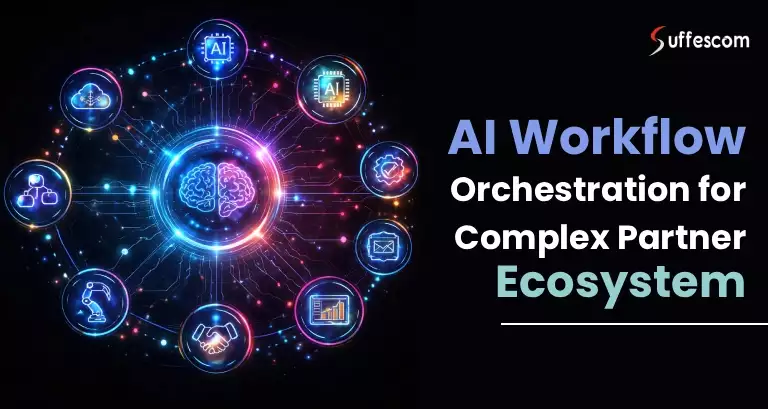
Partner ecosystems are getting more complex every year. More vendors. More resellers. More data. More compliance rules. More moving parts. And most companies are still managing all of it the same way they did ten years ago with emails, spreadsheets, and a lot of manual effort. That approach does not scale. It breaks down at exactly the moment you need it to work. AI workflow orchestration is the modern answer to this problem. It connects your systems, automates your processes, and keeps your entire partner network running smoothly without your team.
In this blog, we will explain what AI workflow orchestration is, how it works in complex partner ecosystems, and how businesses are using it to save time and money.
What Is AI Orchestration?
AI orchestration means using AI to manage and coordinate multiple tasks, tools, and systems at the same time. Think of it like a conductor in an orchestra. The conductor does not play any instrument. But the conductor makes sure every musician plays the right note at the right time.
So what does that mean in a business world? It means that AI orchestration does the same thing for your CRM systems, your partner systems, your billing systems, your communication systems, and it all works together seamlessly without any human intervention. Instead of a human being involved to manually move data from System A to System B, the AI does that for you.
In simple terms the AI orchestration is a smart system that connects all your tools and automates the steps in your business processes so your team does not have to do it all manually. It works across your CRM, your partner portals, your billing software, your communication tools, your compliance systems all of it. Everything talks to everything else. And AI keeps it all in sync.
What Is AI Agent Orchestration? And How Is It Different?
Regular AI orchestration follows rules. You set the rules. The system follows them. If X happens, do Y.
AI agent orchestration is the next level. Instead of just following fixed rules, it uses AI agents - small, intelligent programs that can observe a situation and make decisions on their own.
Think of each AI agent as a specialist on your team. One agent's job is to check incoming partner documents and verify they are complete. Another agent's job is to update partner records in your system. Another agent handles payment verification. Another one sends status updates to partners.
The system that manages all these agents is called the AI agent orchestration. The AI agent orchestration determines the order in which the agents will perform their actions. It is the system that transfers information from one agent to another. The AI agent orchestration is the system that will handle any situation in which the agent cannot perform the tasks given to it. Additionally, the AI agent orchestration has a complete record of everything that happened.
Here is a real example. A new partner applies to join your reseller program. Here is what happens with AI agent orchestration in place:
- Agent 1 receives the application and checks if all required fields are filled
- Agent 2 pulls the company's business registration details and verifies them
- Agent 3 runs a compliance check based on your internal rules
- Agent 4 sets up the partner account in your system with the right access levels
- Agent 5 sends the partner a welcome email with their login credentials and a getting-started guide
- Agent 6 notifies your partner success team that a new partner is ready to be contacted
All of this happens in minutes. No human had to touch it. And every step is logged. That is the power of AI agent orchestration.
What Does an AI Agent Orchestrator Actually Do?
People sometimes ask if the agents are doing all the work, what does the orchestrator actually do?
Great question. The orchestrator is not visible to the end user. But it is doing a lot behind the scenes.
Here is what the AI agent orchestrator is responsible for:
Deciding who does what: Not every agent should work on every task. The orchestrator reads the incoming request and routes it to the right agent or group of agents.
Managing the order of work: Some steps must happen before others. The orchestrator enforces this sequence. Agent 3 cannot run a compliance check before Agent 2 has verified the company details. The orchestrator makes sure steps happen in the right order.
Handling failures: What if an agent cannot complete its task because a partner portal is down? The orchestrator does not just crash. It can retry the task, wait for the system to come back up, or route the task to a human for manual review.
Sharing information between agents: Each agent needs input from the previous one. The orchestrator passes the right data to the right agent at the right time like a relay race baton.
Keeping a full audit trail: Every action taken by every agent is recorded. When did it happen? What data was used? This is critical for compliance, troubleshooting, and reporting.
Getting smarter over time: The more workflows the orchestrator processes, the better it gets at handling edge cases and exceptions. It learns patterns and improves its own performance.
Without a strong orchestrator, agents would work in isolation. They would repeat tasks. They would conflict with each other. Workflows would break. The orchestrator is what makes the whole system reliable.
Why Partner Ecosystems Are So Hard to Manage
Every business has workflows. But partner ecosystems are uniquely difficult for a few specific reasons.
Volume and variety: You might have hundreds of partners, each with their own systems, data formats, and operating procedures. The sheer variety makes manual coordination nearly impossible at scale.
Constant change: Partners come and go. Contracts change. Compliance rules get updated. Pricing models shift. Your orchestration system needs to handle change gracefully without breaking existing workflows.
Multiple stakeholders: A single partner transaction might touch your legal team, your finance team, your IT team, and your partner success team. Coordinating all of these people manually adds days to every process.
External dependencies: Unlike internal workflows where you control everything, partner workflows depend on systems and people outside your organization. External APIs go down. Partners send incomplete data. Third-party compliance databases have delays. AI orchestration handles these external dependencies much better than humans can.
Regulatory requirements: Depending on your industry, partner data must be handled in specific ways. GDPR, SOC 2, HIPAA, these are not optional. An AI orchestration system with built-in compliance rules makes it much easier to stay on the right side of regulations.
Companies that are still managing all of this with email, spreadsheets, and manual approvals are leaving a lot of time and money on the table. And as their partner network grows, the problem gets worse not better.
How AI Workflow Orchestration Solves These Problems
AI workflow orchestration was built exactly for this kind of complexity. Here is how it handles the chaos of partner ecosystems:
1. It Connects All Your Systems: AI orchestration sits on top of all your existing tools and connects them. You do not have to replace anything. It works with what you have and makes it all talk to each other. It also plays a key role in enabling automation in security operations by reducing manual intervention and improving threat response time.
2. It Handles Different Data Formats: AI can read, translate, and normalize data from different sources. Whether a partner sends a CSV, a PDF, or an API call the orchestration system understands it and puts it in the right place.
3. It Works 24/7 Without Breaks: Unlike a human team, AI does not stop working at 5pm. Partner workflows keep moving around the clock. No delays because someone is in a meeting or asleep in a different time zone.
4. It Handles Exceptions Automatically: What if a partner uploads incomplete documents? What if a billing amount does not match? AI orchestration can catch these problems, flag them, and either fix them automatically or route them to the right person for review.
5. It Scales Without Adding Headcount: As your partner network grows from 10 partners to 100 to 1000, the AI orchestration system scales with you. You do not need to hire 10x more people to manage 10x more partners.
How to Orchestrate AI Workflows Without Coding
The biggest myth in AI workflow orchestration is that you need a team of engineers to do the setup and the maintenance. And that was true a few years ago. Not true anymore.
Today, most modern orchestration platforms offer no-code and low-code options. Business users, operations managers, partner program managers, business analysts can build and manage workflows using a visual drag-and-drop interface.
Here is what that looks like in practice:
You open the workflow builder. You drag in a trigger for example, "new partner application received." Then you drag in the next step "send documents to compliance check agent." Then the next "if compliance passes, create a partner account." Then "send a welcome email." You connect the steps with arrows. You set your conditions. You click save. That is it. The AI handles everything from there.
You do not need to write a single line of code. And you don’t have to wait three months for an engineering sprint. You can have a working workflow in the afternoon and have it live the next morning. And if the process changes, which one changes, you simply go back in and change the one that changed and save again. No developer needed.
This accessibility is a big deal. It means the people who actually understand the partner process, not just the developers can own and improve the workflow.
Which AI Orchestration Platform Has the Highest Security?
When you are dealing with partner contracts, financial data, compliance documents, and API credentials security is not optional. It is the foundation. Here is what to look for when evaluating an AI orchestration platform from a security perspective:
End-to-end encryption: Every piece of data, whether it is sitting in storage or moving between systems should be encrypted. If a platform does not offer this, walk away.
Role-based access control: Not every person on your team should see every piece of partner data. Not every AI agent should have access to your entire system. Good orchestration platforms let you define exactly who and what can access which data.
Full audit logs: You need to know exactly what happened, when it happened, and who or what was responsible. A complete, tamper-proof audit log is essential for compliance and for investigating issues when they arise.
Compliance certifications: Look for platforms that hold recognized security certifications SOC 2 Type II, ISO 27001, and GDPR compliance are the main ones to look for. If you are in healthcare, HIPAA compliance matters too.
Data residency: If your partners are in different countries, you may need to store their data in specific geographic regions. Make sure your platform supports this.
The honest answer is that no single platform is automatically the most secure for every company. The security of your orchestration setup depends on how it is configured, how your team uses it, and whether your implementation partner knows what they are doing.
This is one of the key reasons companies choose to work with an experienced AI development company for AI integration projects. Getting the security architecture right from the start is much easier and cheaper than fixing it later.
Agentic AI Orchestration: The Next Big Step
We talked about AI agent orchestration. But there is a newer, more advanced concept worth knowing: Agentic AI orchestration
The difference is subtle but important. In regular AI agent orchestration, you define the workflows. You set the rules. The agents follow them. The orchestrator manages the process based on logic you created. In agentic AI orchestration, the AI has much more autonomy. It does not just follow your rules. It observes, reasons, and decides what to do next even in situations you did not explicitly plan for.
For example: say a key partner suddenly changes the format of their data uploads. A traditional orchestration system would break. A human would have to go in and fix the mapping manually.
An agentic system would notice that the format changed. It would reason through how to handle the new format. It would adapt the workflow on its own. And it might even flag the change to your team and suggest updating the standard process going forward.
How Suffescom Solutions Fits Into This Picture
Suffescom Solutions is a leading development company with hands-on experience building AI orchestration systems for complex, real-world business environments.
The team specializes in end-to-end development from designing multi-agent architectures to building the orchestration layers that make them work reliably at scale. Whether you need AI integration with your existing partner stack or want to build a new orchestration system from the ground up, Suffescom brings both technical depth and business understanding to every project.
If your partner operations are slowing you down, Suffescom can help you identify the right starting point, build a system that fits your needs, and scale it as your partner network grows.
Final Thoughts
Partner ecosystems are only going to get more complex. More partners. More data. More compliance requirements. More channels. More expectations.
Trying to manage all of that manually is not a strategy. It is a slow way to fall behind. AI workflow orchestration gives you a way out. It connects your systems, automates your processes, handles exceptions, and scales as your business grows.
It clears the roadblocks that slow your team down. It replaces slow, manual steps with fast and smart workflows. The technology exists today. The tools are available right now. All you need to do is make the decision to get started. And when you do, Suffescom Solutions is right there to help you do it the right way.
FAQs
Q1. What is AI agent orchestration?
It is the process of managing multiple AI agents so they work together on a complex workflow. Each agent handles one specific job, and the orchestrator makes sure they work in the right sequence and pass the right information to each other.
Q2. What is the function of the AI agent orchestrator?
The orchestrator acts as the manager of all agents. It assigns work, enforces the order of steps, handles failures, shares data between agents, and keeps a complete record of every action taken.
Q3. How do leading companies orchestrate AI-driven processes?
They build a central orchestration layer connected to all their partner systems. They use AI agents to monitor, act, and adapt in real time replacing slow manual processes with fast, reliable automated workflows.
Q4. How to orchestrate AI workflows without coding?
Modern platforms offer visual, drag-and-drop workflow builders. Business users can define triggers, connect tools, set rules, and activate automated workflows without writing any code at all.
Q5. Which AI orchestration platform has the highest security?
The most secure platforms include end-to-end encryption, role-based access control, audit logs, and certifications like SOC 2 or ISO 27001. The right choice depends on your industry, your data types, and your compliance requirements.