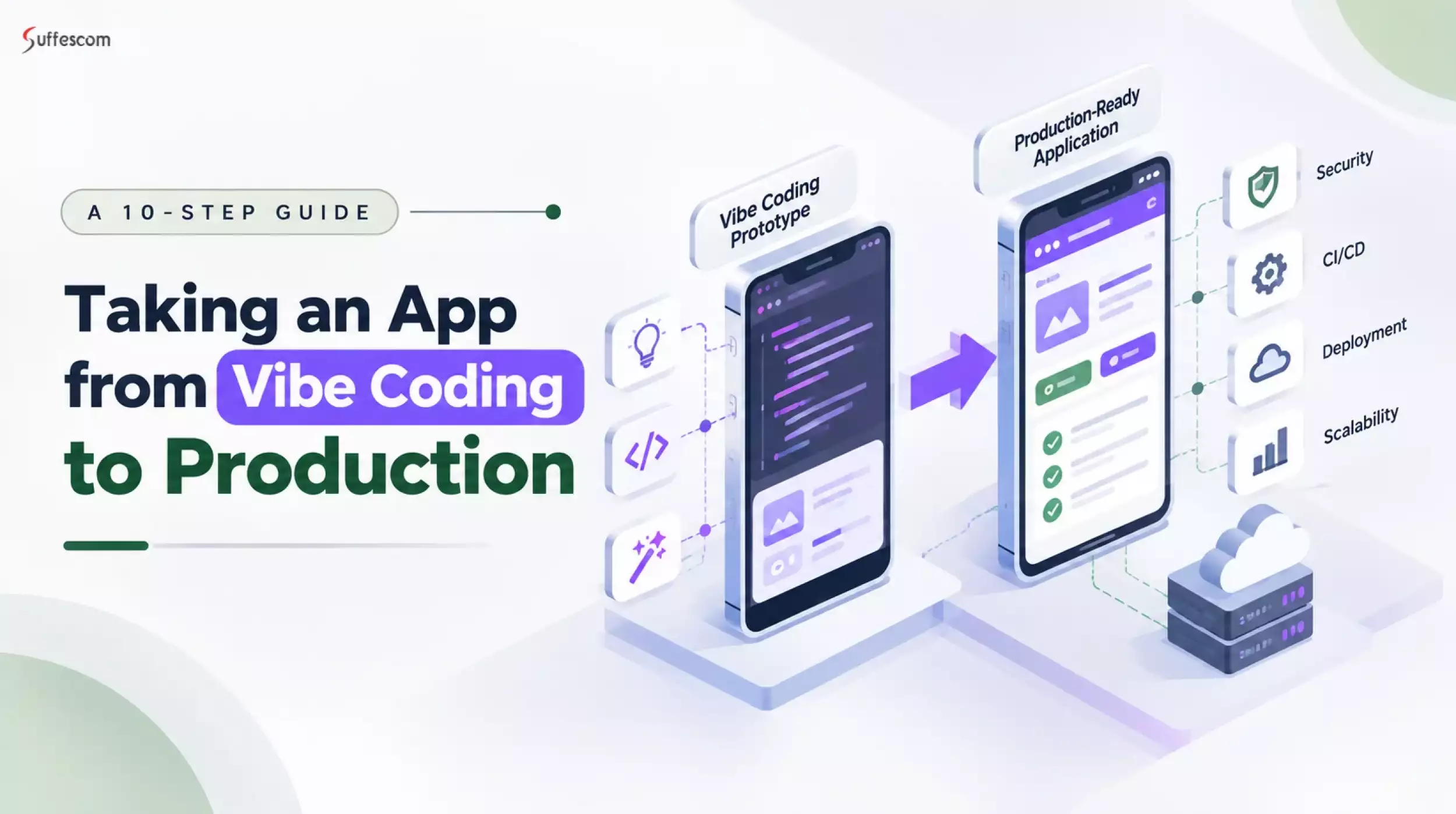
Key Takeaways:
- A working vibe-coded app is not automatically production-ready; it needs engineering validation for security, reliability, performance, and maintainability.
- Taking an AI-generated app to production requires 10 steps: code auditing, architecture validation, security hardening, refactoring, testing, performance optimization, CI/CD setup, monitoring, pre-launch validation, and ongoing maintenance.
- A production-readiness checklist ensures code quality, data protection, compliance, critical workflows, infrastructure, backups, and recovery procedures are in place before launch.
- Choose code cleanup, architectural restructuring, or rebuilding based on the app's actual technical limitations.
- Productionization costs and timelines depend on code quality, complexity, security needs, integrations, testing, and infrastructure. A technical assessment aids in budgeting.
- Engineering support identifies risks, boosts security, enhances scalability, and ensures reliable deployment, helping businesses turn AI prototypes into maintainable applications.
Vibe coding allows you to create a working app by simply describing your idea in plain language and using AI tools to generate and adjust the code. This approach is beneficial for startups, product teams, and businesses, as it speeds up prototyping and helps test ideas before investing in full development.
However, just because an app works doesn't mean it's ready for production. An AI-generated app might perform well in a demo but could have issues like fragile code, security risks, missing error handling, poorly organized databases, or compliance problems. These issues become critical when real users and sensitive data are involved.
Moving a vibe-coded app to production involves more than just fixing bugs and launching it online. You must review the code, enhance security, validate key processes, improve performance, and set up dependable deployment and monitoring systems. The right strategy for turning a vibe-coded MVP into a scalable, production-ready app depends on its design, intended use, and associated risks.
This guide outlines 10 straightforward steps to evaluate, enhance, test, and launch a vibe-coded app. You'll learn to differentiate between basic cleanup and major redesign, recognize when a complete rebuild is needed, and get your app ready for production with a solid engineering plan.
What Does It Mean to Make a Vibe-Coded App Production-Ready?
A production-ready vibe-coded app is an application that has been validated for its intended use, secured against relevant threats, tested under realistic conditions, and prepared for reliable deployment and maintenance. AI-generated code can accelerate development, but it still requires engineering review before the application handles real users, business operations, or sensitive data.
What Is Vibe Coding and How Does It Work?
Vibe coding involves using natural-language prompts and AI coding tools to generate, modify, and debug application code. It allows developers and non-technical founders to build functional prototypes quickly, often with less manual coding.
However, AI-generated implementations can contain incorrect assumptions, incomplete functionality, or dependencies that require further review. The quality of the result depends on the instructions, tools, testing, and human oversight involved.
Prototype vs. Production-Ready Application
A prototype demonstrates an idea; a production-ready application must operate reliably in its intended environment.
| Area | Prototype | Production-ready application |
| Code quality | May contain shortcuts and technical debt | Reviewed, maintainable, and appropriately structured |
| Security | Basic or unverified protections | Tested authentication, authorization, and data protection |
| Testing | Limited functional checks | Automated and manual testing of critical workflows |
| Performance | Tested under limited conditions | Evaluated against realistic workloads |
| Deployment | May rely on manual setup | Repeatable deployment and rollback procedures |
| Maintenance | Limited monitoring and documentation | Logging, monitoring, backups, and ongoing support |
The required level of readiness depends on the application's purpose, complexity, data sensitivity, and business impact.
Why Can a Working Demo Still Fail in Production?
A demo typically follows a limited set of expected interactions. Production introduces unpredictable user behavior, concurrent requests, invalid inputs, network failures, integration problems, and unexpected data volumes.
For example, an AI-generated booking app might work during a demonstration but create duplicate reservations when two users book the same slot simultaneously. Without appropriate concurrency controls, validation, and automated tests, a seemingly functional feature can fail under real-world conditions.
Common challenges include:
- Code quality: Duplicated logic, unnecessary dependencies, and fragile implementations can make changes harder to manage.
- Security: Exposed credentials, weak access controls, and insufficient input validation can put applications and user data at risk.
- Compliance: Inadequate consent management, data retention controls, or audit trails can create compliance gaps, depending on applicable requirements.
- Scalability: Inefficient database queries, architectural bottlenecks, and limited resource management can affect performance as usage grows.
- Testing: Limited automated testing leaves edge cases, integration failures, and regressions undetected.
- Maintainability: Poor documentation and tightly coupled components can make debugging, updates, and future development more difficult.
What Should You Validate Before Launching a Vibe-Coded App?
Before deployment, assess whether the application meets its functional, technical, security, and operational requirements.
- Functionality: Do critical user journeys work, including edge cases and failure scenarios?
- Code and architecture: Are dependencies, generated code, database structures, and integrations maintainable?
- Security and privacy: Are credentials protected, permissions appropriate, and sensitive data handled correctly?
- Compliance: Have applicable legal, regulatory, and contractual requirements been identified and addressed?
- Performance: Does the app meet defined response-time and workload expectations?
- Operations: Are deployment, monitoring, backups, recovery, and maintenance procedures in place?
An initial codebase assessment helps prioritize these checks based on actual risk rather than assuming every application needs a complete rewrite.
Turn Your AI-Built Prototype into a More Reliable Product
Prepare your application for real-world usage with targeted code improvements, stronger security controls, performance validation, and dependable deployment practices.
10 Steps to Take a Vibe-Coded App to Production
Taking a vibe-coded app to production requires a structured approach to identifying technical gaps, reducing risks, and preparing the application for real-world use. The goal is not to rewrite everything but to determine what works, what needs improvement, and what must be addressed before launch.
1. Audit the Existing Codebase
Start by reviewing the generated code, dependencies, integrations, and existing functionality. Identify incomplete features, duplicated logic, outdated packages, hardcoded credentials, and potential security vulnerabilities. Document findings and prioritize issues according to severity and business impact.
For example, if your app was built with Lovable, a focused Lovable code cleanup guide can help you identify common cleanup requirements before preparing the production application.
2. Validate the Architecture and Data Model
Review how the frontend, backend, APIs, and database interact. Check whether the architecture supports essential workflows, data relationships, and future requirements.
Validate database constraints, transaction handling, access patterns, and integration boundaries. When tightly coupled components or weak architectural boundaries make changes risky, restructuring a vibe-coded application helps address structural issues without automatically replacing the entire codebase.
3. Strengthen Application Security
Review authentication, authorization, input validation, and session management. Store API keys securely and evaluate third-party dependencies for vulnerabilities.
Security requirements should reflect the application's threat model and data sensitivity. Applications handling personal or regulated data also need appropriate privacy controls and compliance reviews. These safeguards are essential when developing secure vibe coding solutions for production-ready apps.
4. Refactor and Improve Code Quality
Eliminate code, streamline logic, enhance error handling, and enforce coding standards. Utilize linting, type checking, and static analysis tools to detect issues and boost maintainability.
Refactor incrementally and use automated tests to preserve existing functionality. A complete rewrite is not always necessary; the right approach depends on the codebase's condition, architectural limitations, and the cost of maintaining it.
5. Implement a Testing Strategy
Test the application at multiple levels. Unit tests validate individual components, integration tests check interactions between systems, and end-to-end tests verify complete user journeys.
Prioritize critical workflows, edge cases, invalid inputs, permission boundaries, and failure scenarios. For enterprise applications, include regression testing and integration validation across connected systems. A structured testing strategy helps ensure that vibe coding to enterprise production-ready software involves more than confirming that the interface works.
6. Optimize Performance and Scalability
Measure actual performance before making optimizations. Profile slow API endpoints, inspect database queries, identify unnecessary frontend processing, and assess resource consumption.
Run load tests that reflect expected usage. Evaluate bottlenecks such as connection limits, concurrent requests, and inefficient data retrieval. Define measurable performance targets based on business requirements, expected traffic, and the consequences of service disruption.
7. Set Up Production Infrastructure and CI/CD
Set up distinct development, staging, and production environments with proper access controls and settings. Implement CI/CD pipelines to automate builds, tests, and deployment processes.
Validate database migrations, secret management, configuration, and rollback procedures. For enterprise deployments, consider infrastructure policies, access governance, auditability, and integration with existing cloud environments. These capabilities help move from experimental AI-generated code toward reliable production deployment.
8. Implement Monitoring and Recovery
Configure centralized logging, error tracking, application health checks, and alerts for important failures. Monitor response times, error rates, resource usage, and critical business workflows.
Establish backup schedules and test restoration procedures. Document incident-response responsibilities and recovery objectives. Enterprise production-ready solutions for vibe-coded applications should also account for operational ownership, service dependencies, and recovery requirements appropriate to the business.
9. Complete the Pre-Launch Checklist
Before release, confirm that critical functionality, security controls, performance requirements, and operational procedures have been validated.
Verify production configuration, domain and TLS settings, access permissions, database migrations, backups, monitoring, and rollback readiness. Resolve launch-blocking defects and confirm that applicable privacy and compliance requirements have been addressed. Use explicit release acceptance criteria rather than relying on the fact that the application appears to work.
10. Maintain and Improve the App After Launch
Production readiness is an ongoing responsibility. Monitor real-world usage, investigate incidents, apply security updates, fix defects, and review performance as workloads and requirements change.
Maintain technical documentation, dependency records, and a prioritized backlog of improvements. Regularly reassess whether the existing architecture remains suitable as the application gains users, features, and integrations. Ongoing engineering support helps businesses evolve an initial prototype into a maintainable production application.
Production-Readiness Checklist for a Vibe-Coded App
Want to ship a production-ready app? Use this checklist to identify unresolved issues, prioritize fixes, and determine whether your application is ready for real-world use. Before launching your vibe-coded app, verify that its core functionality, security, and infrastructure meet production requirements.
Code and Architecture
- Remove unused dependencies, duplicated code, and hardcoded configuration.
- Verify API integrations, database relationships, and error handling.
- Identify architectural weaknesses and document critical technical debt.
Security and Data Protection
- Secure API keys, credentials, and environment variables.
- Test authentication, authorization, and input validation.
- Review dependency vulnerabilities and sensitive-data handling.
- Validate applicable privacy, compliance, and data-retention requirements.
Compliance and Privacy
- Identify regulations & standards: GDPR, CCPA, SOC Type II, HIPAA, PCI DSS, etc.
- Verify data access, correction, deletion, and retention processes where applicable.
- Review third-party APIs, AI services, analytics tools, and their data-processing terms.
- Maintain required audit logs, access records, and compliance documentation.
Testing and Performance
- Test critical user journeys, integrations, and edge cases.
- Run automated regression tests after significant changes.
- Evaluate response times, resource usage, and expected workloads.
- Resolve critical defects and performance bottlenecks.
Deployment and Monitoring
- Verify production configuration and database migration procedures.
- Validate CI/CD pipelines and rollback procedures.
- Configure application logs, error tracking, and actionable alerts.
- Test backups and data-recovery procedures.
Launch and Maintenance
- Resolve critical launch-blocking issues.
- Confirm release acceptance criteria and operational responsibilities.
- Document deployment and incident-response procedures.
- Establish a plan for security updates, bug fixes, and ongoing maintenance.
Completing this checklist helps you identify gaps that a successful demo might not reveal. However, checking every item does not automatically guarantee production readiness; requirements vary according to the application's complexity, data sensitivity, and business impact.
If you cannot confidently validate key areas, a professional codebase assessment helps determine whether your app needs targeted fixes, architectural restructuring, or a more substantial rebuild.
Should You Clean Up, Restructure, or Rebuild Your Vibe-Coded App?
Not every vibe-coded application needs a complete rewrite before launch. Some need targeted fixes, while others require bigger architectural changes to support security, scalability, and long-term maintenance. The right approach depends on the codebase's condition, the severity of its technical issues, and the application's business requirements.
When Is Code Cleanup Enough?
Code cleanup is usually appropriate when the application has a sound underlying architecture but contains isolated defects, redundant code, inconsistent coding practices, or minor performance issues.
Typical improvements include:
- Removing unused dependencies and duplicated logic.
- Fixing bugs and improving error handling.
- Updating vulnerable or outdated packages.
- Adding tests around critical functionality.
- Improving code readability and documentation.
This approach helps preserve working functionality while reducing technical debt. However, cleanup alone will not resolve fundamental architectural weaknesses or serious security flaws.
When Does Your App Need Architectural Restructuring?
Restructuring is necessary when the application works, but its internal design makes changes difficult, integrations unreliable, or future growth expensive.
Common warning signs include:
- Frontend, backend, and business logic are tightly coupled.
- Database relationships or transaction handling create inconsistent results.
- API integrations lack clear boundaries or reliable error handling.
- New features repeatedly break existing functionality.
- Testing, deployment, and maintenance have become difficult to manage.
In these situations, developers reorganize components, improve the data model, establish clearer API boundaries, or introduce more reliable testing and deployment practices. The objective is to address structural problems without replacing parts of the application that already work well.
When Is a Complete Rebuild the Better Option?
A rebuild is justified when the application's core architecture is unsuitable for its intended purpose, critical security problems cannot be addressed reliably within the existing design, or the technology stack no longer supports essential requirements.
It is also worth considering when repairing the existing codebase would require more effort and introduce more risk than rebuilding the affected components.
Before committing to a rebuild, evaluate the cost, timeline, migration requirements, and risk of losing existing functionality or data. A complete rewrite is not automatically safer or cheaper, and it can introduce new defects if existing workflows and requirements are not properly documented.
How Do You Decide Which Approach to Take?
A structured codebase assessment can help determine the most practical path forward.
| Assessment finding | Recommended approach |
| Isolated bugs, redundant code, or minor technical debt | Targeted code cleanup |
| Tightly coupled components, fragile integrations, or structural limitations | Architectural restructuring |
| Fundamental design flaws, unmanageable technical constraints, or unacceptable remediation risk | Consider a partial or complete rebuild |
These are starting points, not fixed rules. An application needs a combination of all three approaches, depending on the issues identified.
For businesses preparing an AI-generated application like Lovable for launch, an experienced Lovable AI development team assesses the codebase, prioritizes security and reliability risks, and recommends a remediation plan aligned with the product's requirements. This helps avoid unnecessary redevelopment while ensuring that critical issues are addressed before the application reaches production.
Does Your Vibe-Coded App Need Cleanup or Restructuring?
Suffescom helps businesses identify what to fix, what to improve, and what may need redevelopment to support production requirements.
How Much Does It Cost to Make a Vibe-Coded App Production-Ready?
The cost of taking a vibe-coded app to production depends on the condition of its existing codebase, the complexity of its architecture, its security requirements, and the testing and infrastructure work still needed. An app with a functional foundation may need targeted fixes, while one with significant structural or security issues may require extensive refactoring or redevelopment.
The following estimates provide an indicative starting point for different project scopes. Actual costs and timelines depend on the application's requirements and the findings of an initial technical assessment.
| Project Scope | Estimated Timeline | Indicative Investment | What's Included |
| Basic Cleanup and Validation | 2–4 weeks | $5,000–$8,000+ | Code review, removal of redundant code, dependency checks, essential bug fixes, basic security improvements, and testing of critical workflows. |
| Production Readiness and Stabilization | 4–8 weeks | $8,000–$15,000+ | Code refactoring, security hardening, database and API validation, broader automated testing, deployment setup, and monitoring configuration. |
| Complex or Enterprise-Grade Productionization | 8–16+ weeks | $15,000–$25,000+ | Deeper architectural restructuring, advanced security and compliance work where applicable, complex integrations, performance testing, CI/CD implementation, and operational readiness. |
What Influences the Cost of Productionizing a Vibe-Coded App?
Several factors can increase or reduce the investment required:
- Codebase quality: Duplicated logic, incomplete implementations, and tightly coupled components can increase cleanup and refactoring effort.
- Security and compliance requirements: Apps handling sensitive or regulated data may need additional security testing, privacy controls, documentation, and compliance validation.
- Architecture and integrations: Complex databases, third-party APIs, modernization of legacy systems, and enterprise workflows can require substantial engineering work.
- Testing requirements: Applications with payments, user accounts, business-critical workflows, or high availability requirements typically need more extensive validation.
- Infrastructure and scalability: Cloud configuration, deployment automation, monitoring, backup procedures, and load testing all affect the scope.
- Ongoing maintenance: Post-launch monitoring, security updates, bug fixes, and future enhancements may require a separate support budget.
How Can You Estimate Your App's Production-Readiness Cost?
Start with a technical assessment of the existing application. This helps identify launch-blocking defects, security gaps, architectural limitations, and missing operational controls before you commit to a budget.
Based on those findings, the work can be divided into three categories: issues that must be resolved before launch, improvements that can be prioritized for later releases, and components that need restructuring or replacement. This approach helps avoid unnecessary redevelopment while ensuring that critical risks are addressed.
For a more reliable estimate, define the application's intended use, expected user load, data sensitivity, required integrations, and launch requirements. A development team can then scope the work around the app's actual condition rather than relying on a generic cost range.
5 Signs You Need Expert Help to Make Your App Production-Ready
Bring in a professional mobile app development team when your vibe-coded app needs stronger security, reliable performance, maintainable code, or a scalable architecture before launch. If you cannot confidently deploy, test, or maintain the app, it is time to assess what needs fixing before real users depend on it. Here are five signs that you may need professional support.
1. Your App Works, but You Cannot Trust It in Production
The app may function during demos but still lack reliable error handling, adequate test coverage, or safeguards against unexpected inputs. A professional team can validate critical user flows, fix defects, and establish automated testing before real users depend on the application.
2. Security and Compliance Risks Are Difficult to Assess
Exposed credentials, overly broad database permissions, weak authentication, and insecure API endpoints can put user data at risk. If your app handles payments, personal information, or regulated data, an engineering team can assess its security controls and identify the additional safeguards required for your use case.
3. Every New Feature Makes the Code Harder to Maintain
AI-generated code can accumulate duplicated logic, inconsistent patterns, and tightly coupled components as the app evolves. If even small changes introduce unexpected bugs, targeted cleanup or architectural restructuring may be more effective than continuing to patch the codebase. Our vibe code cleanup services understand how technical debt can be addressed without automatically rebuilding everything.
4. Your Current Architecture Cannot Support Expected Growth
An app that works for a handful of test users may struggle with concurrent traffic, growing datasets, background processing, or complex integrations. A professional team can assess database design, API performance, caching, infrastructure, and deployment workflows to determine what needs to change before scaling.
5. You Need a Reliable Path to Launch and Ongoing Support
Production readiness extends beyond writing code. Your app needs a repeatable deployment process, environment configuration, monitoring, backups, rollback procedures, and a plan for fixing issues after launch. If these capabilities are missing, our experienced team helps establish the operational foundation required to release and maintain the product confidently.
Cleanup, Restructure, or Rebuild: Which Approach Do You Need?
Bringing in a professional team does not automatically mean starting over. The right approach depends on the condition of your existing application.
- Choose code cleanup when the core architecture is sound, but the code contains duplication, inconsistencies, or unnecessary complexity.
- Choose restructuring when the app's architecture, data flow, or component organization needs significant improvement.
- Consider selective redevelopment or a rebuild when fundamental design flaws, security limitations, or incompatible technologies make the existing foundation impractical to extend.
A technical assessment helps determine the most cost-effective path based on your app's current state, business requirements, and growth plans.
The objective is to preserve what works, resolve what creates risk, and build only what is necessary to make your vibe-coded app production-ready.
How Suffescom Solutions Can Help Take an AI-Built App Toward Production
Moving an AI-built app into production requires more than fixing bugs. It involves improving code quality, addressing security gaps, validating critical workflows, and establishing reliable deployment processes. Suffescom helps businesses prepare AI-generated applications for production through targeted engineering improvements based on their existing codebase and requirements.
- Code Cleanup and Refactoring: Remove redundant code, simplify complex logic, and resolve maintainability issues so the application is easier to update and extend.
- Architecture Restructuring: Improve component organization, database design, and API integrations to address structural weaknesses and support future development.
- Security Hardening: Address identified vulnerabilities, strengthen authentication and authorization, and improve secrets management and data protection.
- Testing and Performance Optimization: Validate critical workflows, detect regressions, and resolve performance bottlenecks to improve application reliability.
- Production Deployment and DevOps: Establish CI/CD pipelines, configure deployment environments, and implement monitoring and rollback procedures to support consistent releases.
Through AI vibe code cleanup services and DevOps services, we at Suffescom help businesses identify the engineering work required to move an AI-built app toward production.
Our quality-driven development strategy, supported by our ISO 9001:2015 certification, encompasses targeted cleanup, architectural restructuring, or selective redevelopment, tailored to the application's current state and business needs.
Ready to prepare your AI-built app for production?
Contact Suffescom to discuss your application's current limitations and identify the engineering improvements needed to move it toward production readiness.
Conclusion
Vibe coding can help turn an idea into a working application quickly, but getting it production-ready requires a more disciplined engineering approach. From code cleanup and architecture restructuring to security testing, performance optimization, and deployment readiness, each step helps reduce risks before the app reaches real users.
The goal is not to rebuild everything from scratch but to identify what works, fix what does not, and strengthen the application for long-term use. With the right engineering support, businesses can turn AI-generated prototypes into reliable, secure, and maintainable software.
If your AI-built app is ready for the next stage, at Suffescom, our vibe coding specialists help you assess its current state and identify the improvements needed to move toward production.
Frequently Asked Questions
What does it mean to productionize a vibe-coded app?
Productionizing a vibe-coded app means preparing it to operate reliably and securely in real-world conditions. This involves reviewing the code, addressing security gaps, testing critical workflows, establishing a reliable deployment process, and implementing monitoring and ongoing maintenance.
Can an app built with AI coding tools be production-ready?
Yes, an app built with AI coding tools can be production-ready if its architecture, security, functionality, and performance meet the requirements of its intended use. However, AI-assisted development does not replace engineering review, testing, or validation against defined acceptance criteria.
Do I need to rewrite my entire vibe-coded app?
No, a complete rewrite is not always necessary. A code audit and risk assessment can help determine whether targeted refactoring, replacing specific components, or rebuilding parts of the application is the most practical approach.
How do I check whether AI-generated code is secure?
Start with a code review and dependency assessment to identify vulnerabilities and outdated packages. Check secrets handling, server-side authorization, input validation, and data protection, then conduct security testing appropriate to the application's risk. Automated scanners can identify certain issues, but no single tool can guarantee complete security.
What should I test before launching a vibe-coded app?
Test the application's critical user journeys, authentication and permissions, invalid inputs, error handling, data consistency, and third-party integrations. Also evaluate performance under realistic workloads and verify that failures can be detected and handled without compromising data or essential functionality.
Is vibe coding suitable for building a production SaaS product?
Vibe coding can accelerate SaaS prototyping and development, but production readiness requires more than generating functional features. A SaaS product needs appropriate tenant isolation, access controls, secure data handling, reliable deployment, monitoring, customer support, and ongoing maintenance based on its business and risk requirements.
How do I deploy a vibe-coded app safely?
Separate development, testing, and production environments, and run automated checks before releasing changes. Manage secrets securely, plan database migrations, validate the deployment, and monitor application health after launch. Maintain a tested rollback or recovery strategy so you can respond quickly if a release causes problems.
How much does it cost to make a vibe-coded app production-ready?
The cost depends on the existing codebase, security risks, application complexity, required functionality, integrations, and quality requirements. A focused code audit and technical assessment can identify the work involved and provide a more credible estimate than pricing based on the app's visible features alone.