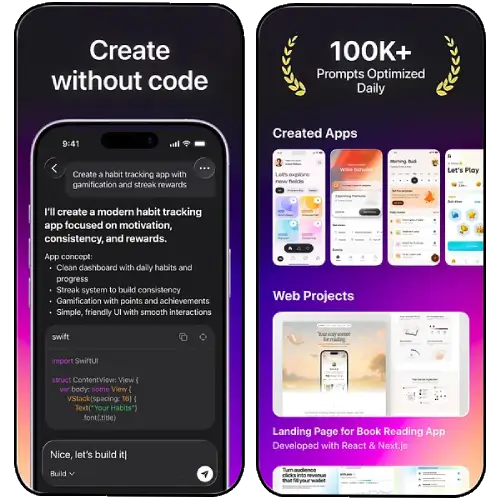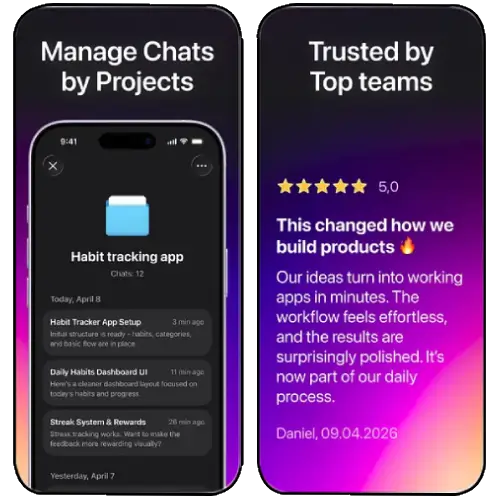






Vibe coding is a low-code/no-code app building approach that uses artificial intelligence in developing codes, creating features and user interface design through a natural language prompts approach.
The increasing popularity of vibe coding can be attributed to its ability to fasten software delivery, enhance productivity in software development, and create web applications, mobile applications, SaaS products, and enterprise-level software solutions with quality. This approach ensures quick prototyping, fast development of features, functionalities, and components, and continuous improvement in the process, which gives software developers room to concentrate on strategies, architecture, and problems.
With AI-powered software development, it becomes easier and faster for software engineers to build software with the help of automation that cuts down the time taken for repetitive code writing.
Turn ideas into functional software prototypes within a short span of time and get users' feedback, validation of the concept, and product improvement.
This helps cut down repetitive software development activities so as to enable developers to concentrate on complex functionalities and architecture.
Implementation of new features, enhancements, and upgrades in an efficient manner, facilitating the constant evolution of products as well as a quicker response to market dynamics.
With AI’s help, the process of development becomes quicker when adapting to any changes in business needs, thus allowing applications to incorporate any new functionality.
Optimize the use of available resources through minimizing the amount of time needed to implement standard functions in favor of innovation.
Develop scalable applications that can evolve and develop along with your business while coping with growing data amounts and new functionalities.
While AI facilitates a faster development process, it is important to note that the presence of an individual eye to go through the end results is also critical.
Even though traditional methods of software development can be considered to be one of the most effective ways of developing digital applications, there are several challenges that businesses face when using this technique. While businesses continue to look at ways to develop their products faster, traditional software development methods continue to act as barriers to their progress. The following section discusses some of these challenges.
The process of traditional software development requires extensive amounts of manual programming and coding as well as a number of stages in the software development lifecycle.
Building applications through conventional development methods typically requires larger teams, longer project durations, and substantial engineering effort. These factors increase development costs and make it challenging to optimize technology budgets.
Modern companies need to be ready to respond rapidly to new challenges in the marketplace and changing customer expectations. But it is always challenging to introduce new functions or make any adjustments in an environment of conventional software development.
It often takes a lot of time from developers to engage in routine activities related to coding and customizing different components and modules. Such time-wasting activities affect developer productivity negatively.
Long development cycles involve extensive planning, programming, testing, debugging, and deployment of the software application. Thus, the extended time-to-market creates a variety of issues.
As soon as a software application grows in complexity and popularity, there appear various problems connected with its scalability. Scaling traditional software efficiently often requires additional development effort and ongoing optimization.
Create a roadmap for developing AI-supported software through technical planning, feasibility study, technology choice, product ideation, and implementation strategy. This will ensure that areas that will benefit from vibe code in accelerating software development without compromising on scalability and security are clearly identified.
Transform concepts, requirements, and business logic into prototypes using AI-powered software development solutions. This enables idea validation, stakeholder alignment, usability tests, and feedback before building the actual solution.
Accelerate the development of minimum viable products by leveraging natural-language-driven development workflows. This includes core feature development, user interfaces, backend functionality, databases, integrations, and deployment-ready foundations for market validation.
Improve applications initially built with AI coding tools through code reviews, architecture improvements, performance optimization, maintainability enhancements, and technical refinements that align with production-grade standards.
Build custom web apps using vibe coding app development services. The capabilities include development of frontend and backend functionalities, API connectivity, authentication, workflows, database, cloud deployment, and other business specific functionalities.
Develop a vibe app for Android or iOS combined with professional software development practices. Solutions include customer-facing android or iPhone apps, business applications, marketplace platforms, payment integrations, notifications, and location-based services.
Build cloud-based software applications that have functionalities like subscription, multi-tenant capability, onboarding process of users, payment systems, analytics, automation, and more.
Foster faster development of software with AI-driven feature creation, workflow orchestration, integration with third-party APIs, enhanced user interface, and functional growth in accordance with business needs.
Upgrade your existing applications by employing methods such as code improvement, upgrading frameworks, optimizing application architecture, refining the user interface, performance improvements, and adding new functionalities via AI-driven development.
Design and develop custom enterprise-level software solutions for tasks related to automation, data management, company operations, reporting, workflow management, and integration needs.
The process of a vibe-code app development does not only involve manual coding but works hand in hand with AI to ease up the development process.
Project goals, business requirements, target users, workflows, and technical expectations are evaluated to define project scope, development priorities, and success criteria before implementation begins.
Architecture, technology stacks, database schema, integration points, and scalability considerations will be planned carefully in order to have a robust basis for efficient development.
Workflows driven by natural language and AI-powered coding techniques are used to expedite feature implementation, user interface design, component development, and rapid prototyping.
Generated code will be reviewed, improved, and optimized with respect to maintainability, performance, security, and other factors. Best architectural practices and engineering principles will be followed.
The applications are optimized with respect to functionality, performance, security, usability, and bug fixing.
Following thorough validation, applications will be deployed and improved using additional optimization techniques, adding more functionality for monitoring performance and improving scalability.
AI-assisted development greatly promotes software development; however, code generation alone is not enough to produce a ready-for-production application. Testing, architecture, security analysis, performance, and maintenance are integral components in developing software solutions.
The AI code should undergo validation and testing in order to be reliable and consistent with the project specifications.
Software that deals with personal data, transactions, or business processes requires security, access control, and risk management prior to launch.
Software that is being used in the production setting should also possess the capability to handle growing numbers of users, increased loads, and additional functionality.
There must be provision for the fact that there will need to be more development, debugging, and collaboration in the future.
Although the vibe coding accelerates software creation, human intervention by experienced developers is indispensable when it comes to quality assurance and performance optimization.
Whether developing a new SaaS product, refining an AI-generated Android or iOS application, or modernizing an existing website software, vibe coding development streamlines your workflow and it supports long-term business growth.
Vibe coding is an AI-driven methodology for development wherein developers make use of prompts through natural language to create code, features, user interfaces, among others, which will ultimately be used for building software applications. In this case, developers work together with the AI technology such that implementation becomes much faster.
Traditional software development involves the process of manually coding software, while vibe coding leverages AI tools to support the code generation, prototyping, documentation, and other tasks in the process of development.
The vibe code can be utilized in developing web applications, mobile applications, SaaS products, enterprise-level software, business applications, customer portals, marketplaces, and many others.
Yes, code produced by AI can be used during the development process but may require some code review and testing before becoming production-ready software.
Absolutely. AI-based development can help enhance the features, optimize the code, modernize the app, streamline the workflow processes, and continue to develop products by iterating on them.
Not at all. While AI technology can help to develop software, it is the developers themselves who must take care of the rest of the process.
Advantages of vibe coding development include faster development cycles, quick prototyping, minimized need for manual coding, increased efficiency in the SDLC, etc.
Yes. Vibe coding, when used in conjunction with good architecture design, testing, security measures, and engineering supervision, allows for the creation of enterprise software.
• SUFFESCOM SOLUTIONS
Build Smarter. Scale Faster. Grow More.
Have a Vision? Let’s Turn It Into a Digital Reality.
Get a quick response from our best experts in under 10 minutes.
Suffescom easily understood our main goal and delivered the best digital solution. Their team was very cooperative, and it was a very good experience working with them. I would highly recommend them.

Working with Suffescom was a really great experience. Their developers demonstrated technical knowledge and delivered our mobile app solution with all required functionalities on time.

Suffescom helped us build a logistics software solution that completely improved our fleet operations. Their professionalism and transparency are what make them a reliable technology partner.

Share Your Requirements. Our Experts Will Shape the Solution.
• SUFFESCOM SOLUTIONS
Build Smarter. Scale Faster. Grow More.
Have a Vision? Let’s Turn It Into a Digital Reality.
Get a quick response from our best experts in under 10 minutes.
Suffescom easily understood our main goal and delivered the best digital solution. Their team was very cooperative, and it was a very good experience working with them. I would highly recommend them.
Working with Suffescom was a really great experience. Their developers demonstrated technical knowledge and delivered our mobile app solution with all required functionalities on time.
Suffescom helped us build a logistics software solution that completely improved our fleet operations. Their professionalism and transparency are what make them a reliable technology partner.
Share Your Requirements. Our Experts Will Shape the Solution.
• SUFFESCOM SOLUTIONS
Build Smarter. Scale Faster. Grow More.
Have a Vision? Let’s Turn It Into a Digital Reality.
Get a quick response from our best experts in under 10 minutes.
Suffescom easily understood our main goal and delivered the best digital solution. Their team was very cooperative, and it was a very good experience working with them. I would highly recommend them.
Working with Suffescom was a really great experience. Their developers demonstrated technical knowledge and delivered our mobile app solution with all required functionalities on time.
Suffescom helped us build a logistics software solution that completely improved our fleet operations. Their professionalism and transparency are what make them a reliable technology partner.
Share Your Requirements. Our Experts Will Shape the Solution.
Fret Not! We have Something to Offer.