Key Takeaways:
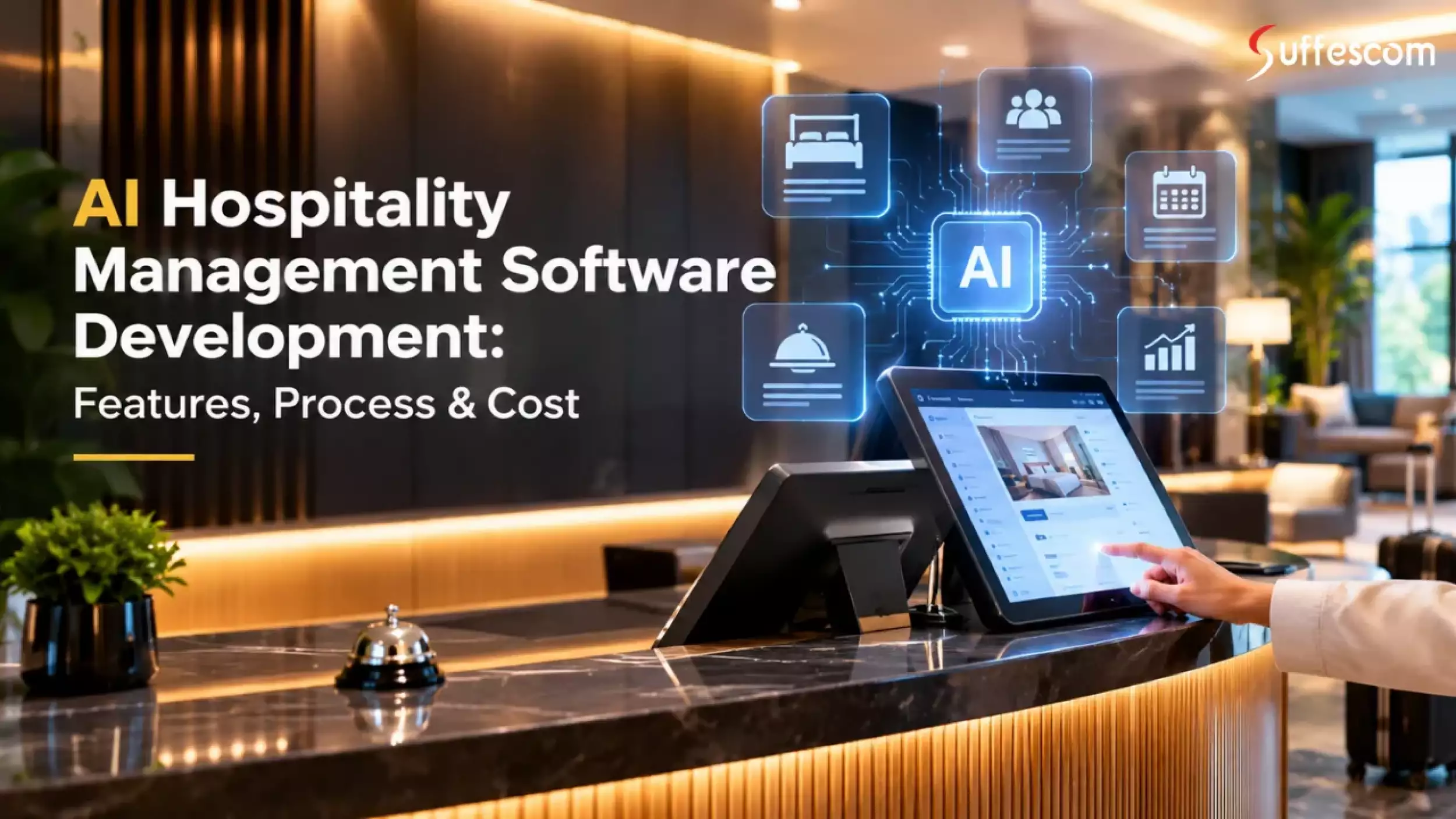
- AI hospitality management software connects reservations, guest services, housekeeping, revenue management, and reporting in one operational environment.
- AI can support guest communication, demand forecasting, personalized offers, staff coordination, and routine administrative workflows.
- Deploying AI agents in hospitality management requires reliable operational data, integrations with existing systems, defined permissions, and human oversight for sensitive actions.
- Hospitality software development should account for property management systems (PMS), booking engines, point-of-sale (POS) platforms, customer relationship management (CRM), and channel managers.
- Development costs depend on the software scope, AI capabilities, integrations, security requirements, and deployment model.
Introduction
Hospitality businesses manage a complex combination of reservations, guest requests, room availability, housekeeping schedules, payments, staff coordination, and revenue operations. When these activities run across disconnected systems, teams can face repetitive work, delayed responses, inconsistent guest information, and limited visibility into daily performance.
AI hospitality management software development brings these workflows together and adds intelligence to routine operational decisions. Instead of relying entirely on manual processes, hospitality operators can use AI to answer guest questions, predict demand, recommend relevant services, identify operational bottlenecks, and help employees complete tasks faster.
AI agents extend these capabilities by allowing software to perform defined, multi-step tasks using approved business systems and tools. For example, an agent could process a guest's request for a late checkout, check the property's rules and room schedule, and send the request to the appropriate team for approval.
The goal is not to automate every interaction. It is to reduce repetitive work, improve operational visibility, and give hospitality teams more time to deliver personalized service.
How AI Is Transforming the Hospitality Industry
AI in the hospitality industry is moving beyond content generation and basic chatbots toward operational decision support and connected workflows. Adoption, however, varies by business size, technology readiness, and implementation strategy.
PwC's 2025 Middle East study reported that 91% of surveyed tourism and hospitality leaders were piloting or using AI, while only 3% had achieved full-scale implementation. The report identified legacy systems, talent gaps, and data privacy as important barriers to scaling adoption.
This distinction matters: introducing an AI tool is different from integrating it reliably into everyday hotel operations.
1. Personalized Guest Experiences
AI can use permitted guest preferences, booking details, previous interactions, and service availability to help personalize a stay.
Examples include:
- Recommending suitable room categories or available upgrades.
- Suggesting dining, spa, or local activity options based on stated preferences.
- Answering questions about amenities, check-in policies, and hotel services.
- Supporting multilingual communication across digital channels.
- Helping staff prepare for special requests before guest arrival.
Personalization should respect consent, data minimization, and access restrictions. Sensitive guest information should not be exposed simply because an AI system can retrieve it.
2. Automated Guest Communication
Hospitality businesses can use AI chatbots for hospitality to handle routine guest questions, provide service information, and route requests to the right team while keeping human support available for complex issues.
They can provide information about breakfast hours, parking, Wi-Fi, cancellation policies, and available facilities. When a request requires a human decision, the system can transfer the conversation to the appropriate team with the relevant context.
The business benefit comes from faster responses and more consistent information—not from assuming every guest prefers automated service.
3. Smarter Housekeeping and Maintenance
AI can help housekeeping teams prioritize room cleaning based on occupancy, expected arrivals, departures, and service requirements.
A maintenance model can also analyze work-order history and equipment data to identify patterns that may indicate a developing problem.
For example, the platform may flag a recurring air-conditioning fault or recommend prioritizing rooms needed for incoming guests. Actual room-status changes and maintenance actions should still follow the property's operational rules.
4. Demand Forecasting and Revenue Support
Forecasting models can analyze historical bookings, seasonality, lead times, event calendars, cancellations, and other relevant signals to estimate demand.
These forecasts can help revenue teams evaluate pricing recommendations, staffing requirements, inventory allocation, and promotional opportunities.
AI recommendations should not be treated as guaranteed revenue improvements. Their quality depends on data accuracy, market conditions, and how the business evaluates and applies them.
5. Operational Reporting and Decision Support
Instead of manually combining reports from several systems, managers can use AI-assisted analytics to ask questions such as:
- Which room categories have the highest cancellation rates?
- What are the main reasons for guest complaints this month?
- Which shifts have experienced recurring housekeeping delays?
- How does occupancy compare with the forecast?
- Which service requests take the longest to resolve?
The system can generate summaries and identify patterns, while linking findings to the underlying records so managers can verify the results.
Hospitality Software Development Process
A successful hospitality platform needs a structured development process that accounts for both software requirements and real-world property operations.
1. Requirement Analysis
Identify the business model, property count, user roles, existing systems, operational bottlenecks, and measurable project goals.
Requirements for a single independent hotel differ considerably from those for a multi-property group with centralized revenue management and shared guest profiles.
2. Product and Architecture Design
Define the user experience, data model, system boundaries, integrations, permissions, and deployment approach.
Decide which capabilities will be built from scratch, which will use existing vendor APIs, and which can be delivered through third-party services.
3. UI/UX and Workflow Design
Design interfaces for front-desk staff, housekeeping teams, managers, administrators, and guests where relevant.
The software should make common tasks easy to complete, provide clear status information, and allow employees to intervene when automated workflows encounter exceptions.
4. Core Software Development
Build the required management modules, user authentication, APIs, dashboards, notifications, and integration layer.
For businesses that need a tailored platform rather than an off-the-shelf product, software development services can cover custom development and system integration.
5. AI Model and Agent Integration
Implement the selected AI capabilities, connect them to approved data sources, and establish tool permissions, evaluation processes, monitoring, and escalation.
Use AI where it solves a defined problem; conventional rules and deterministic workflows are often more suitable for tasks that require exact calculations or strict business logic.
6. Security and Quality Assurance
Test functionality, integration behavior, access controls, data protection, performance, and failure recovery.
Security requirements should cover sensitive guest data, payment-related information, employee access, auditability, and third-party service dependencies.
7. Deployment and Ongoing Optimization
Deploy the platform in stages, train employees, monitor adoption, and address issues revealed by real operational use.
AI systems need ongoing evaluation as hotel policies, guest behavior, data sources, and underlying models change.
Reliable hospitality software needs ongoing cloud operations, monitoring, and operational controls. Read about Suffescom's AWS Cloud Operations Competency to learn more about its cloud operations capabilities.
Essential Features of AI Hospitality Management Software
The feature set should reflect the property's operational needs, not simply the number of AI features that can be added.
1. Centralized Reservation and Property Management
A hospitality platform should provide a reliable view of reservations, room inventory, guest details, check-in and checkout status, and room availability.
Depending on the scope, it may integrate with an existing PMS rather than replace it. This distinction affects the architecture, implementation timeline, and cost.
2. AI-Powered Guest Support
A conversational assistant can answer questions using approved hotel information and, where authorized, retrieve relevant reservation or service data.
Useful capabilities include multilingual support, conversation history, request classification, escalation, and handoff to human employees.
The assistant should distinguish between providing information and making changes to a booking. Actions such as cancellations, refunds, and reservation modifications need appropriate identity checks and business-rule validation.
3. Housekeeping and Staff Task Management
The software can distribute tasks, update work queues, track completion, and alert supervisors to delays.
AI can help prioritize tasks using operational signals, but employees should be able to correct recommendations and handle exceptions such as accessibility requirements, urgent maintenance, or special guest requests.
4. Revenue Management and Forecasting
Forecasting and recommendation features can support occupancy planning, rate analysis, demand trends, and promotion evaluation.
Where automated pricing is considered, the platform should apply approved pricing limits, business rules, and review procedures rather than allowing an unconstrained model to change rates.
5. Guest Profiles and CRM Integration
A unified guest view can help authorized employees access relevant preferences, service history, loyalty information, and communication records.
The system should apply role-based permissions and data-retention policies. AI-generated guest summaries should be traceable to reliable source information and correctable when inaccurate.
6. AI Agent Orchestration
An AI agent layer can coordinate tasks across guest support, reservations, housekeeping, maintenance, and reporting systems.
For example, a guest-service agent might classify a request, retrieve the property's service policy, create a task, notify the relevant team, and communicate an update after the task status changes.
Each agent needs defined tools, permissions, approval rules, error handling, and audit logs. Access should be limited to the actions required for its assigned role.
7. Analytics and Management Dashboards
Dashboards can combine operational data into views of occupancy, cancellations, service response times, housekeeping progress, guest feedback, and revenue performance.
AI-generated summaries can make these metrics easier to interpret. Data analytics and reporting capabilities are particularly useful when managers need to compare performance across several properties.
8. Integrations and API Management
Hospitality platforms commonly need to exchange data with:
- Property management systems (PMS).
- Central reservation systems (CRS) and booking engines.
- Online travel agency (OTA) and channel-management platforms.
- Point-of-sale (POS) systems.
- CRM and loyalty platforms.
- Payment providers and accounting systems.
- Workforce scheduling, maintenance, and communication tools.
Integration planning is critical because disconnected or inconsistent data can undermine AI recommendations and agent actions.
Best Practices to Deploy AI Agents in Hospitality Management
Deploying AI agents requires more than connecting a language model to a chatbot. A reliable implementation starts with a specific operational workflow, gives the agent access to approved tools, and defines what it can do independently versus what requires human approval.
Step 1: Identify a High-Value Workflow
Start with a task that is frequent, measurable, and relatively low-risk.
Suitable first use cases include answering common guest questions, summarizing shift handovers, classifying service requests, or preparing daily operational reports.
Avoid starting with unrestricted control over refunds, pricing, room assignments, or sensitive guest records. These actions require stronger controls and clear accountability.
Step 2: Map the Existing Hospitality Systems
Document where the required data resides and which systems are authoritative for each workflow.
For example, reservation status may be controlled by the PMS, room availability by the property management or inventory system, and payment status by the payment provider.
The agent should retrieve current information from these systems rather than relying on outdated documents or model-generated assumptions.
Step 3: Prepare and Govern Operational Data
Connect the relevant data sources and address missing, duplicated, inconsistent, or outdated records.
Define which guest information the agent can access, how long it may be retained, and whether data can be used for analytics or model improvement.
A structured data foundation also supports forecasting and performance reporting. Businesses with complex data environments may benefit from dedicated data analytics services.
Step 4: Choose the Right AI Architecture
The architecture may combine several technologies:
- A large language model (LLM) for natural-language understanding and response generation.
- Retrieval-augmented generation (RAG) to ground answers in approved policies and hotel documentation.
- APIs and integration services to access live operational systems.
- Workflow orchestration to coordinate multi-step tasks.
- Predictive machine learning models for forecasting and prioritization.
- Authentication, permission checks, logging, and monitoring to govern agent activity.
Not every use case requires every component. A policy-answering assistant may need retrieval and escalation, while a housekeeping coordination agent may need workflow orchestration and operational APIs.
Step 5: Connect Agents to Approved Tools
An agent should use explicit, controlled tools rather than unrestricted access to the entire hospitality platform.
For example, a service-request agent might be allowed to:
- Read the relevant guest request.
- Check the property's service rules.
- Create a housekeeping or maintenance ticket.
- Read the ticket status.
- Send an approved status update.
It should not automatically issue refunds, change rates, or modify bookings unless the business has explicitly authorized those actions and implemented the required safeguards.
For multi-step operations, use validation, duplicate-request protection, timeouts, retries, and clear recovery paths. If a system fails midway, the agent must not report that a task has been completed when the operational record says otherwise.
Step 6: Establish Human Approval and Escalation
Define which actions can be completed automatically and which need employee confirmation.
Low-risk activities, such as answering a question from an approved FAQ, may be automated. Higher-impact actions, including exceptional refunds, disputed charges, sensitive guest requests, and significant booking changes, should follow an appropriate approval process.
Provide a clear handoff route whenever the agent is uncertain, lacks permission, encounters conflicting data, or cannot complete the task.
Step 7: Test in a Controlled Environment
Before deployment, test the agent with realistic workflows and edge cases.
Testing should cover:
- Incorrect or incomplete guest information.
- Conflicting booking and room-status records.
- Duplicate requests and repeated tool calls.
- Unauthorized access attempts.
- API failures, timeouts, and partial completion.
- Prompt injection and attempts to override system rules.
- Incorrect answers, unsupported claims, and escalation behavior.
Measure task completion, factual accuracy, escalation rates, response times, and the number of errors requiring employee correction.
Step 8: Deploy Gradually and Monitor Performance
Start with one property, department, or workflow. Compare performance with the existing process and collect feedback from both staff and guests.
Monitor operational errors, service quality, system availability, AI costs, and user satisfaction. Expand to additional workflows only after the pilot demonstrates acceptable reliability and a clear business benefit.
For teams that need custom agent architecture, integration, and deployment, AI agent development services can support the development of task-oriented AI workflows.
Technology Stack for AI Hospitality Management Software
The technology stack depends on the platform's scale, existing infrastructure, integration needs, and AI use cases. A typical implementation may include the following:
| Layer | Possible technologies |
| Web interface | React, Next.js, or Angular |
| Mobile applications | Flutter, React Native, Swift, or Kotlin |
| Backend services | Node.js, Python, Java, or .NET |
| AI and language models | Hosted LLM APIs or appropriately governed open-source models |
| Predictive analytics | Python, scikit-learn, or specialized forecasting tools |
| Data storage | PostgreSQL, MySQL, Redis, and suitable analytical storage |
| AI knowledge retrieval | Vector search with retrieval-augmented generation (RAG) |
| Integration | REST APIs, webhooks, event-driven services, and vendor-specific connectors |
| Cloud infrastructure | AWS, Microsoft Azure, or Google Cloud |
| Monitoring and security | Centralized logs, application monitoring, access controls, and secrets management |
This is a set of options, not a mandatory stack. Technology selection should follow the product requirements, the skills of the development team, integration constraints, and the organization's security and operational standards.
AI Hospitality Management Software Development Cost
The cost of AI hospitality management software depends on the scope of the product, the number of integrations, the AI capabilities, and the level of security and operational reliability required.
For early planning, the following ranges can be used as illustrative estimates rather than verified market averages or a formal quote.
| Project scope | Indicative development cost |
| Basic hospitality management platform with limited AI assistance | $30,000–$60,000 |
| Mid-level platform with multiple integrations, dashboards, and AI workflows | $60,000–$150,000 |
| Enterprise platform with multi-property operations, advanced AI agents, and complex integrations | $150,000–$300,000+ |
Actual costs may fall outside these ranges, particularly when the project replaces a core PMS, supports a large property portfolio, requires complex migrations, or includes extensive custom forecasting and agent orchestration.
Factors That Affect Development Cost
1. Software scope: Building a guest-support assistant is less complex than creating an end-to-end platform for reservations, housekeeping, revenue management, and multi-property administration.
2. AI capabilities: A knowledge-based assistant generally requires less orchestration than agents that execute multi-step workflows across operational systems.
3. Third-party integrations: PMS, POS, booking, payment, CRM, and channel-management integrations can add significant implementation and testing effort.
4. Data readiness: Cleaning legacy records, mapping inconsistent fields, and consolidating data from different properties can increase project effort.
5. Security and compliance: Access controls, audit logs, privacy requirements, payment security, and independent testing affect both development and ongoing operations.
6. Deployment and maintenance: Hosting, model usage, monitoring, support, software updates, and AI evaluation should be budgeted separately where they are not included in the initial development estimate.
A realistic project estimate should follow requirements discovery and an assessment of existing systems, integrations, data quality, and operational risk.
Challenges in AI Hospitality Software Development
Legacy System Integration
Many hospitality businesses depend on established property management, reservation, POS, and accounting systems. Some offer mature APIs, while others have limited documentation or inconsistent integration capabilities.
Approach: Evaluate each system early, identify the source of truth for each data field, and test critical workflows before committing to the final architecture.
Data Quality and Fragmentation
Guest records, room status, booking information, and service requests may be distributed across multiple tools. Inconsistent data can reduce forecast quality and lead agents to make incorrect recommendations.
Approach: Establish data ownership, validation rules, synchronization monitoring, and reconciliation processes.
Guest Privacy and Security
Hospitality software may process personal details, travel information, preferences, payment-related records, and staff data. Unnecessary access or retention increases risk.
Approach: Apply data minimization, encryption, role-based access, secure credential management, retention controls, and appropriate legal review for the markets where the platform operates.
AI Accuracy and Unpredictable Responses
Language models can generate incorrect information or misinterpret a request. This is particularly risky when the response affects reservations, charges, room availability, or service commitments.
Approach: Ground answers in approved sources, validate actions through business systems, constrain tool access, and provide human escalation for uncertain or high-impact cases.
Employee Adoption
Staff may resist systems that introduce extra steps or appear to remove control from their workflows.
Approach: Involve front-desk, housekeeping, maintenance, and management teams during design and testing. Train employees on the agent's capabilities, limitations, and escalation procedures.
Measuring Return on Investment
AI adoption does not automatically produce cost savings or higher revenue. Results depend on workflow design, adoption, integration quality, and ongoing maintenance.
Approach: Establish baseline metrics before deployment and measure changes in response time, manual handling, task completion, error rates, guest satisfaction, and operating cost.
How to Choose an AI-Powered Hospitality Software Development Partner
The development partner should understand both software architecture and the practical demands of hospitality operations.
Consider these criteria:
- Hospitality workflow understanding: Can the team map reservations, guest services, housekeeping, maintenance, and revenue operations?
- Integration expertise: Can it connect the required PMS, booking engine, POS, CRM, and other business systems?
- AI implementation capability: Can it demonstrate how models and agents will be evaluated, governed, monitored, and constrained?
- Security engineering: Does the proposed solution include access control, audit trails, privacy safeguards, and secure integration practices?
- Scalability and support: Can the architecture support additional properties, higher transaction volumes, and evolving operational needs?
- Transparent delivery: Does the proposal define scope, milestones, assumptions, ownership, maintenance, and acceptance criteria?
Why Work with Suffescom?
Businesses can evaluate Suffescom’s AI development and software development services to assess their requirements and plan custom software, AI capabilities, and agent-driven workflows around your business goals.
For an existing hospitality platform that is difficult to maintain or integrate, software modernization services may also be relevant. The right approach depends on whether the current system can be extended safely or requires deeper architectural changes.
Future Trends in AI Hospitality Management
AI Agents for Staff Operations
AI agents are gaining attention for reporting, task coordination, finance administration, and guest-service workflows. Their long-term value will depend on reliable integration, clear permissions, and measurable operational outcomes.
AI-Assisted Guest Discovery and Booking
As travelers increasingly use AI-powered tools to research options, hospitality businesses may need to make property information, amenities, policies, and booking availability accessible through suitable digital channels.
Predictive Operations
Forecasting models can support staffing, demand planning, maintenance prioritization, and inventory decisions. Reliable results depend on relevant data and ongoing validation.
Connected Multi-Property Intelligence
Hospitality groups can combine data from multiple properties to compare performance, identify patterns, and coordinate operations. Shared reporting must still respect property-level access restrictions and local data requirements.
Human-Centered Automation
The most useful systems will support staff rather than automate every interaction. Guests should have access to human assistance, particularly when handling complaints, accessibility needs, sensitive requests, or exceptional circumstances.
Conclusion
AI hospitality management software development can help hospitality businesses connect operational workflows, improve guest communication, support better decisions, and reduce repetitive administrative work. The most effective solutions begin with specific business problems rather than adding AI features without a clear purpose.
For successful deployment, businesses need reliable data, secure integrations, measurable outcomes, and defined limits on automated decisions. AI agents can extend these capabilities by coordinating tasks across approved systems, provided that high-impact actions remain governed by appropriate controls and human oversight.
The right software development approach depends on the existing technology environment, the business's operational priorities, and whether it needs a new platform, targeted AI capabilities, or modernization of its current software.
Frequently Asked Questions
1. What is hospitality software development?
Hospitality software development involves building or customizing digital systems that support hotel, resort, restaurant, and other hospitality operations. These systems may cover reservations, guest services, housekeeping, payments, reporting, and integrations with third-party platforms.
2. How is AI used in the hospitality industry?
AI can support guest communication, personalization, demand forecasting, revenue analysis, housekeeping prioritization, maintenance planning, and operational reporting. Its effectiveness depends on data quality, integration, workflow design, and appropriate human oversight.
3. How do you deploy AI agents in hospitality management?
Start with a measurable workflow, connect the agent to approved data and tools, define permissions and approval rules, test realistic scenarios, and deploy gradually. Monitor accuracy, task completion, exceptions, security, and business outcomes before expanding its responsibilities.
4. How much does AI hospitality management software development cost?
An illustrative planning range is $30,000–$60,000 for a relatively basic platform, $60,000–$150,000 for a more integrated solution, and $150,000–$300,000 or more for complex enterprise software. The actual cost depends on features, integrations, data readiness, AI architecture, and security requirements.
5. Can AI hospitality software integrate with an existing PMS?
Yes, when the existing PMS provides suitable APIs, connectors, or another supported integration method. The development team should evaluate API access, data synchronization, vendor restrictions, and system ownership before finalizing the design.
6. Can AI agents automatically manage hotel bookings and guest requests?
They can assist with selected booking and service workflows when authorized integrations and business rules are in place. High-impact actions should use identity checks, validation, approval controls, and clear recovery procedures.
7. How long does it take to develop AI hospitality management software?
The timeline depends on the scope, integration complexity, data readiness, and testing requirements. A limited AI assistant may be delivered much sooner than a complete multi-property management platform. A reliable estimate requires a defined feature list and technical discovery.
8. What is the difference between hospitality management software and AI hospitality management software?
Traditional hospitality management software organizes operational records and workflows. AI-enabled software adds capabilities such as natural-language interaction, forecasting, recommendations, and task-oriented agents. Both still need reliable operational systems and clear business rules.