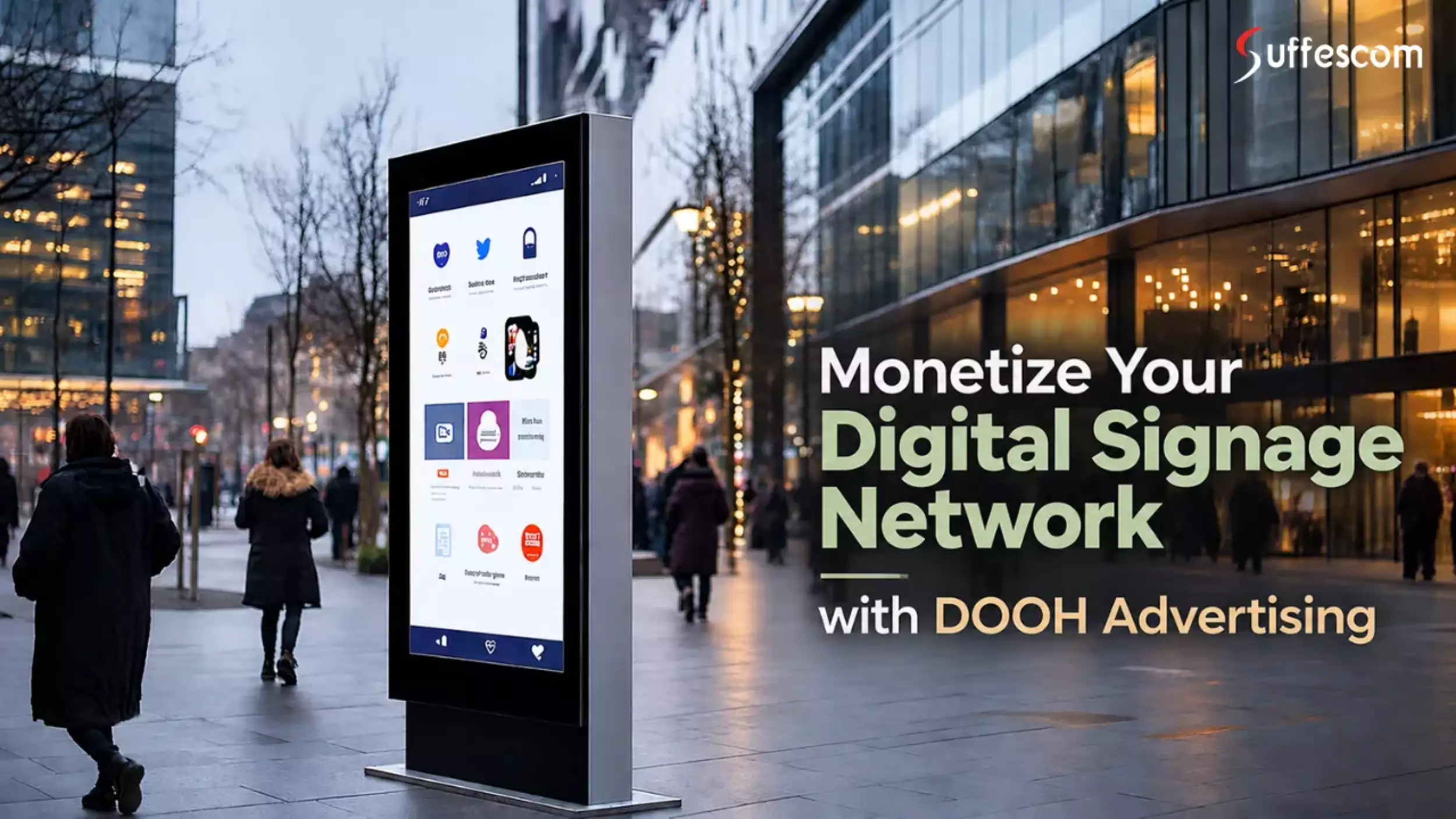
Digital signage has moved past simply promoting content through messages, announcements, and branding. For business owners that have screens in their retail stores, malls, restaurants, office spaces, transport terminals, and other commercial establishments, their screens can also be used as advertising tools that will earn money for them.
The key is to make money from the inventory of screens through digital outdoor or DOOH advertising. Rather than only using these screens for internal promotions or with the marketing budget of the one establishment, network owners can sell advertising space to local businesses, national brands, agencies, and qualified programmatic buyers.
But having screens does not necessarily mean you'll start making money from them. In making profits, some key elements should be considered, including the relevance of the target market, location, demand by the advertiser, availability of the inventory, pricing, delivery of the campaign, and operational costs.
There must be a clear business model, management of the inventory, delivery of the campaign, and reporting to the advertiser about what they have paid for to generate profits through the digital signage network.
This guide stresses the methods for monetization of the digital signage, their cost and estimation of their stock, research of the possibilities of programmatic advertising of the DOOH, and selection of the software.
What Is DOOH Advertising and How Can It Earn Money?
Digital Out-of-Home (DOOH) means the paid advertisements shown on digital displays in public and commercial places. Such media includes digital billboards, retail media, displays at shopping centers, gym screens, and digital signs in restaurants or office buildings.
The moment the owner of a digital signage network sells some portion of screen time or inventory to advertisers for payment, the digital signage network turns into an advertising business. Examples include digital billboards, retail media screens, displays in shopping centers, screens in gyms, and digital signage networks inside restaurants or office buildings.
A digital signage network becomes a potential advertising business when its owner makes some of the available screen time or advertising inventory available to paying advertisers.
The basic revenue process involves five steps:
- Build or Access Screen Inventory: Operate screens in commercially relevant locations and define which advertising slots are available.
- Identify Advertiser Demands: Identify companies and brands whose customers coincide with the location and context of the screens.
- Inventory Packaging and Pricing: Provide fixed-priced campaigns, sponsorships, CPM ads, or any other type of packaging.
- Campaign Delivery: Deliver ads according to the requirements of the campaign.
- Delivery Tracking and Reporting: Track and report the delivery performance of campaigns based on playback statistics.
As an example, the network that has screens in various fitness centers will provide campaigns to clothing brands manufacturing sportswear, nutrition businesses, or wellness businesses. The network with retail stores can offer advertising packages to the consumer brand to reach consumers who are close to point of sale.
The economic value lies in the audience and the advertising opportunity, not just the size of the screens' network. The smaller network, which has a clearly defined target audience, will appeal to some particular advertisers, while the bigger network may provide better reach or more varied campaign options.
Five Ways to Monetize Digital Signage Network
It is not possible to have one universal solution for monetizing DOOH networks; this decision will depend on location, the network’s connections, the inventory, technology, and available demand.
1. Selling Advertising to Businesses Directly
Direct advertising sales give the opportunity to do deals with advertisers without using programmatic technologies only.
The operator may approach various businesses locally, regional companies, marketing agencies, or large businesses having target customers matching the network screens' audience.
For instance, an operator owning screens in malls would suggest a monthly package deal for a restaurant chain or a promotional campaign for a brand of consumer electronics.
Some possible forms of direct selling include:
- Fixed-price advertising packages.
- Monthly or quarterly campaigns.
- Location-based advertising.
- Sponsorship advertising and promotional placements.
- Cross-screen advertising across chosen locations.
Direct sales allow for better management of pricing, campaign terms, and advertiser relationships. But this approach also requires selling efforts, negotiation, campaign planning, billing, and customer service.
Direct sales is an appropriate option for small-scale networks where network operators can establish connections with local advertisers first without additional complexities of programmatic integrations.
2. Use Programmatic DOOH Advertising
Programmatic DOOH advertising leverages appropriate technology and an automated buying process to make eligible digital screen inventory accessible to advertisers via participating advertising platforms.
Depending on what type of integration is used, there might be automated discovery and evaluation of opportunities for campaigns as well as a bidding and purchasing process for advertisers.
Some of the ecosystem components are as follows:
- Demand Side Platforms (DSP): Technology adopted by the advertisers or agencies to purchase advertisement space.
- Supply Side Platforms (SSP): Technology adopted by publishers and media companies for exposing their available space to potential buyers.
- Ad serving systems: Software used for campaign delivery or scheduling depending on the architecture of the system.
- Tools for measurement and reporting: Tools that help measure and report the performance of the campaign.
Programmatic buying will be used by networks to gain access to demand that goes beyond the traditional direct sales channel. The programmatic approach also helps automate campaigns and scale inventory management.
But programmatic access does not automatically come because of the presence of digital screens. There may be certain restrictions of providers with respect to the location, type of venue, screens, audience measurement, software compatibility, inventory format, and commercial terms.
Networks considering providers like Vistar Media, Place Exchange, or Hivestack need to clarify the availability and other details directly from these providers. Don’t make assumptions about all providers working with all markets or any CMS integration with all systems.
3. Monetize Unsold Advertising Inventory
Not every advertising slot will be sold through direct campaigns. Unbooked inventory can represent a missed revenue opportunity, particularly when screens operate for long hours or have substantial available advertising capacity.
Operators can use several approaches to improve inventory utilization:
- Offer selected unsold slots at negotiated or discounted rates.
- Develop packages for local advertisers with flexible schedule options.
- Book inventory for short-term campaigns.
- Make eligible inventory available through programmable platforms.
- Employ leftover inventory for promotional purposes of the network owner when there is no booking from paid campaigns.
It is necessary to be cautious with the use of the concept. The discount of all slots will lead to higher utilization but devaluation of the inventory and conflict with premium campaigns.
One of the possibilities could be the development of specific standards for differentiating between premium, standard, and remnant inventories, with different pricing depending on location, audience, campaign timing, and demand for each of the advertising options.
4. Sell Multi-Screen and Location-Based Advertising Packages
Screens can be bundled into advertising packages using such criteria as geographic location, venue, demographic characteristics, and goals of the campaigns.
For instance, an operator could offer the package that would include screens at several shopping centers, gyms, convenience stores, and restaurants. Then, advertisers could pick up those locations that are relevant to the particular audience.
Possible packages include:
- Single-location campaigns.
- City or neighborhood campaigns.
- Multi-venue advertising.
- Venue-category packages.
- Seasonal or event-based campaigns.
- Campaigns across a network's selected screens.
Such packages might make it easier for buyers to comprehend and buy into the inventory. The operator may use such packages to enhance the value of his advertising packages, as he is offering an integrated campaign and not isolated screen placements.
The package should be clearly defined by the operator beforehand on aspects such as number of screens, duration of the campaign, scheduling considerations, number of ad slots available, metrics, and also the audience estimate within the package.
5. Provide Sponsored Content and Branded Experiences
Not all commercial opportunities have to be packaged in traditional advertising slots. Advertisers may want to sponsor or integrate their content in some creative ways related to the venue and audience.
Some examples include the sponsorship of an information section at a gymnasium, a branded campaign in a retail display loop, or even a seasonal campaign on the screens in a hospitality venue.
Sponsored content can be sold as a fixed fee package, campaign contract, or other negotiated deal.
For the protection of the integrity of the screen network, it is imperative for the operator to set up content approval policies, creative policies, scheduling policies, and disclosure policies that suit the particular venue and market.
How to Price Digital Signage Advertising and Estimate Revenue
The price for digital signage advertising depends on the value of the media inventory for sale, delivery requirements of the advertising campaign, and cost of operation of the network.
Popular pricing strategies used are CPM, fixed-slot pricing, sponsorship, and revenue sharing agreements.
CPM-Based Pricing
CPM means cost per thousand impressions. It is a pricing model in which the advertiser pays a specified amount for every thousand billable impressions.
The basic calculation is:
Gross advertising revenue = Billable impressions ÷ 1,000 × CPM
For example, when a campaign garners 50,000 impressions, assuming a CPM cost of $8, the resulting gross advertising revenue will be:
50,000 ÷ 1,000 × $8 = $400
This is just for illustration purposes, not a suggested market rate. The CPM actually varies depending on the audience, location, demand of the campaign, method of measurement, and commercial terms of the deal.
Impressions must be defined by the operator, and every instance of ad play cannot be counted as an audience impression.
Fixed-Slot Pricing
Under fixed-slot pricing, an advertiser will pay a pre-agreed price for a specific placement of an advertisement or advertising campaign period.
The package may include any of these aspects: a specific screen, multiple screens, the campaign period, a specific slot period, or scheduled times.
Fixed pricing is easier to understand for local advertisers, as the price is set upfront. Nevertheless, the operator needs to make clear what is included in this price and not offer the delivery that cannot be guaranteed by the network.
Sponsorship and Revenue Sharing
In cases when an advertiser wants to get more connected to the venue, the program, or the feature being regularly aired, it is better to go with the sponsorship pricing.
On the contrary, revenue sharing means dividing revenues from the advertising equally between the players. The revenue sharing arrangement between the network operator and the venue operator in relation to the advertising shown at the venue is one such arrangement.
Contractual considerations need to cover revenue calculation, deduction of costs, reporting procedure, and payment schedule.
Learn about Fill Rate, Share of Voice, and Operating Expenses
The pricing policy needs to take into consideration not only the theoretical volume of advertising spaces.
- Share of Voice: It is the amount of available time for advertising, plays, or spots used up by the specific campaign in the reporting period.
- Operational Costs: It includes software costs, connectivity, hardware costs, sales commission, transaction fees, and revenue share for the venue and support.
It is important for the operators to determine the denominator when computing fill rates, as available inventory, booked inventory, and delivered inventory are different from each other.
How Much Can One Digital Signage Screen Earn Per Month?
The monthly advertising income depends on the screen’s location, audience, available inventory, booked inventory, pricing, and advertiser demand. There is no one answer that can be applied to all digital signage screens.
Consider a hypothetical screen with 20,000 eligible billable impressions per month. If the operator sells 50% of those impressions at an assumed CPM of $8, the calculation is:
Eligible billable impressions: 20,000.
Sold billable impressions: 10,000.
Assumed CPM: $8.
Gross advertising revenue: 10,000 ÷ 1,000 × $8 = $80 per month.
This is just to demonstrate how the calculation works; it is neither a standard practice for the industry nor does it project screen revenue. The outcome will depend on the underlying assumptions made, and the real amount of revenue could be more or less.
To calculate the profitability of the screen, one needs to deduct all relevant operating expenses from the total advertising revenue. A screen that generates revenue may still be unprofitable if its maintenance, software, venue, or sales costs exceed its contribution.
How to Calculate Sellable Digital Signage Inventory
When it comes to determining the price of digital billboard advertising, the operators should first compute the theoretical amount of inventory their screens can generate.
Let us assume that a particular screen employs a 60-second content cycle with six 10-second time slots, four of which are allocated for paid advertisements. With 60 cycles per hour and an operation of 12 hours daily, the theoretical inventory capacity will be:
- 60 loops/hour × 12 hours = 720 loops/day.
- 720 loops/day × 4 paid slots = 2,880 potential paid plays/day.
- 2,880 plays/day × 30 days = 86,400 potential paid plays.
The figures mentioned above are based on slot capacity theory and not the delivery of the campaigns, sold inventory, or impressions possible. Delivery depends on aspects such as screen time up, scheduling of the slots, competing campaigns, playbacks, and campaign settings.
A good inventory management system would recognize the difference between available slots, booked slots, delivered ad plays, and measured impressions or estimations thereof. This will assist the operator to estimate revenue and report the delivery of campaigns.
What Software Do You Need to Monetize a Digital Signage Network?
Monetization software for digital signage consists of much more than just content scheduling software. Monetization software needs to provide tools to help with the management of the process of managing the inventory, running campaigns, and making money.
This will depend upon the network size, monetization model, and whether the ads are sold through direct sales, programmatic ad sales, or both.
Content Management and Screen Operations
A content management system is useful for managing screens, scheduling content, managing playlists, and distributing updates.
Availability of screens and their monitoring, as well as device management, is critical since any downtime of the screens will lead to disruption of the scheduled campaigns. Operators should know about the way their system monitors outages and keeps records of playback/delivery failures.
Advertising Inventory and Campaign Management
DOOH inventory management systems help operators create advertising spots, manage packages of screens, manage bookings, and avoid overlapping of campaign schedules.
Some features that would be helpful are:
- Screen and venue grouping.
- Ad-slot configuration.
- Campaign booking and scheduling.
- Creative approval workflows.
- Availability tracking.
- Campaign delivery monitoring.
Such capabilities would allow turning screen capacity into advertising products that can be sold via presentations to the sales force.
Ad Serving & Programmatic Integration
Integration of the programmatic DOOH could be done by integrating a network with other advertising systems and campaigns’ activation, delivery, and reporting.
Each provider may require its own type of integration. The operators are advised to consider the types of interface, transaction formats, schedule, and creative and reporting requirements prior to choosing the integration type.
Reporting, Proof of Play, and Revenue Reporting
The advertisers require reliable reports on the delivery of their campaigns. The proof of play data could provide confirmation that the advertisement was shown in accordance with the system's recording rules. Impressions made upon the audience are different metrics and could require additional calculation.
The DOOH advertising platform should clarify the definitions and constraints of its reports. Dashboard, inventory usage report, billing details, and revenue sharing might be required depending on the adoption of a certain business model.
Billing and Commercial Workflow
With the increase in size of the network, the coordination of booking, delivery, invoicing, and payments becomes difficult.
Automation of the work process becomes necessary for the integration of the booking, delivery, invoicing, and revenue share.
It is necessary to provide for an effective mechanism for handling exception cases and delivery disputes.
How AI Can Be Helpful in Monetization of Digital Signage Advertising
The artificial intelligence may be employed to assist in the monetization of digital signage advertising through analysis of inventory, campaigns, scheduling, and business decision-making.
Some of those could be as follows:
- Demand Analysis: The analysis of booking patterns and campaign performance.
- Inventory Forecast: The prediction of inventory demand in the future considering schedules and bookings.
- Campaign Optimization: The help with decisions related to eligible placement, scheduling, and inventory management.
- Reporting Assistance: Generating reports on campaigns delivered and exceptions.
- Operational Monitoring: Helping detect patterns in device outages or playback failures when appropriate data is available.
AI should be used in line with the quality and permissions of the available data. Audience targeting and measurement also need to respect applicable privacy requirements and venue policies.
AI is not necessarily a solution that will increase ad revenues. The value of it will depend on how accurate the inputs of the system are, how proper the workflow is, and what kind of goals can be measured.
Existing DOOH Advertising Platform or Custom AdTech Software
If a company wants to use digital signage for generating money, it should consider the question about the choice between using an existing platform and creating custom AdTech software.
Whether the current platform would work for the given situation depends on whether the platform comes with the right feature set and integrations and also on the commercial terms. It may also make sense to look at custom development if there is a need for some special workflows, reporting, products, or integrations.
| Consideration | Existing platform | Custom platform |
| Initial implementation | Depends on configuration and onboarding | Depends on scope, architecture, and development |
| Core functionality | Limited to the provider's supported capabilities | Can be tailored to defined business requirements |
| Integrations | Depends on existing supported integrations | Can be developed around selected interfaces, subject to technical access |
| Pricing and commercial terms | Depends on subscription and usage terms | Requires development and ongoing operating budgets |
| Maintenance | Shared between the provider and customer, depending on the contract | Requires a defined internal or external maintenance model |
| Flexibility | Constrained by product capabilities and roadmap | Greater control, with corresponding responsibility for delivery |
How Much Does It Cost to Build a DOOH Advertising Platform?
The cost of developing a DOOH advertising platform depends on its features, integrations, and operational complexity. Here are three common platform types and their estimated development costs.
Basic DOOH Platform ($15,000–$30,000+)
Designed for businesses starting a digital signage network and selling ad placements directly.
- Screen and device management
- Content scheduling and ad-slot configuration
- Remote monitoring and playback logs
- Basic campaign scheduling
DOOH Monetization Platform ($30,000–$80,000+)
Suitable for growing networks that need to manage advertisers, bookings, and campaigns across multiple locations.
- Advertising inventory and campaign booking
- Advertiser self-service dashboards
- Multi-screen campaign management
- Proof-of-play reporting and analytics
- Billing and revenue tracking
Enterprise-Level DOOH Platform ($80,000–$150,000+)
Built for large-scale networks requiring programmatic advertising integrations and advanced automation.
- DSP and SSP integrations
- Automated ad serving and inventory allocation
- High-volume transaction processing
- Advanced analytics and audience measurement
- Automated billing and revenue sharing
- Enterprise security and scalability
Common Challenges in Digital Signage Monetization
While there is advertising inventory that exists, a network can experience difficulty monetizing their assets and making money. Knowing what problems often exist will help a network develop a more realistic monetization strategy.
Low Advertiser Demand
Advertisers require a compelling reason to purchase the inventory. The operator needs to know screen placements, venue types, audience details if available, the possibilities for campaigns, and delivery methods.
If there are few screens in a small network, a direct sales approach with relevant local companies may prove better than attempting programmatic demand only.
Unsold Inventory and Low Fill Rates
Any unutilized inventory for advertising can result in lost potential income. An operator may assess pricing, sales approaches, packaging for specific locations, and how remnant inventory can be distributed.
Discounting should happen in a manner that will not undervalue premium inventory and form unrealistic expectations on the part of the advertisers.
Inconsistent Measurement
Ads, audience perceptions, coverage, and involvement are all distinct key performance indicators. Confusing these measures could have negative effects on the credibility of advertisers.
The calculation technique should be identified along with the limitations of that measure for all campaigns alike.
Technical and Integration Issues
The existence of screens, scheduling problems, incompatibility of creatives, and integration issues can complicate the process of running the campaign.
Screen tracking, delivery tracking, procedures, and testing can help solve this problem.
Unclear Costs and Revenue Split
Software costs, platform commissions, venue costs, sales costs, and other factors can have an impact on profitability.
Keep track of revenues and costs at the screen level, venue level, campaign level, and network level whenever possible. This will help you find out which inventory and packages are more profitable.
A Practical Roadmap to Launch and Scale DOOH Monetization
Implementing this process will give you an opportunity to demonstrate yourself and spend big money on a difficult technology only after proving your case.
Step 1: Network audit. Prepare the list of locations, timing, venues at which screens are shown, capabilities of screens, and advertising capabilities of screens.
Step 2: Identify the target market and value proposition. Know the audience you are going to reach using these screens and what can be offered to local and national advertisers. Base your data on accurate data and explain your assumptions clearly.
Step 3: Choose an initial revenue model. Use direct sales, sponsorships, flat rate packages, CPM rates, or a mix of all these.
Step 4: Create a rate card and packages. Define slot lengths, campaign periods, screen groups, scheduling conditions, and reporting metrics. Keep theoretical capacity separate from guaranteed delivery.
Step 5: Validate advertiser demand. Conduct buyer interviews, run pricing tests, and analyze which locations and packages are attractive before further scaling the offer.
Step 6: Choose the right software. Analyze the following capabilities of the platform: content management, inventory booking, campaign delivery, proof of play, analytics, billing, and necessary integrations. Check the eligibility of third parties and commercial terms directly with the provider.
Step 7: Analyze performance and optimize. Analyze fill rate, number of delivered campaigns, revenues, costs, and advertiser retention. Use these insights to optimize packages, prices, operations, and sales activities.
Work with a reasonable number of screens and a well-structured commercial offer. Only scale once the data proves the need for this step.
Build a Scalable DOOH Advertising Platform with Suffescom Solutions
In order to monetize your digital signage network, you need to have the right combination of inventory strategy, advertising workflow, campaign delivery, and reporting. Scaling your network makes it more difficult to manage inventory booking, advertising demand integration, reconciliation, and proof of delivery.
At Suffescom, we offer AdTech development services for businesses exploring advertising technology solutions. Depending on the defined requirements, a development project may cover advertising workflows, platform integrations, campaign management, analytics, or other capabilities needed to support a digital advertising business.
If you're evaluating a custom DOOH advertising platform, begin by identifying the problems you need to solve, the integrations you require, and the commercial workflows your team needs to support. A clearly defined scope makes it easier to compare custom development with existing software and plan a practical implementation.
Conclusion
Learning how to monetize a digital signage network starts with understanding the advertising inventory, the audience it can reach, and the types of advertisers likely to value that opportunity.
Direct sales, programmatic DOOH advertising, unsold inventory packages, multi-screen campaigns, and sponsorships can each contribute to a monetization strategy. The right mix depends on network size, location, advertiser demand, operational costs, and technical capabilities.
Accurate inventory calculations, transparent pricing, reliable campaign delivery, and clear reporting help operators build advertiser confidence. Software can then support the workflows needed to manage bookings, integrations, billing, and network growth.
By validating demand, choosing an appropriate revenue model, and investing in technology that fits its requirements, a digital signage business can build a more structured and scalable approach to DOOH advertising monetization.
Frequently Asked Questions
1. How do I monetize a digital signage network?
You can monetize a digital signage network by selling advertising slots directly, offering sponsored content, creating multi-screen packages, or making eligible inventory available through programmatic DOOH platforms. The best approach depends on your screen locations, audience, advertiser demand, available inventory, and operating costs.
2. Can I monetize digital signage without programmatic advertising?
Yes. Direct advertiser sales, fixed-price campaigns, local business packages, sponsorships, and agency partnerships can generate advertising revenue without programmatic buying. Programmatic DOOH is an additional option, not a requirement for every network.
3. How much can one digital signage screen earn per month?
Revenue depends on location, audience, inventory utilization, pricing, and demand. Operators can estimate gross revenue using billable impressions divided by 1,000 and multiplied by CPM, or calculate the value of fixed-price packages. Earnings examples should be treated as scenarios rather than guaranteed results, and operating expenses must be deducted to estimate profitability.
4. How should I price digital billboard advertising?
Common approaches include CPM-based pricing, fixed-slot fees, sponsorship packages, and negotiated campaign rates. Consider location, audience, campaign duration, available inventory, delivery requirements, and reporting capabilities when setting prices.
5. What is the difference between an ad play and a DOOH impression?
An ad play records that an advertisement was played according to the system's playback rules. A DOOH impression is an audience-related metric measured or estimated under a defined methodology. One ad play does not automatically represent one person seeing the advertisement.
6. What software do I need to monetize digital signage?
Depending on the business model, you may need screen management, content scheduling, advertising inventory management, campaign booking, ad serving, proof-of-play reporting, analytics, and billing. Programmatic campaigns may require additional integrations and compliance with the relevant provider's requirements.
7. How much does it cost to build a DOOH advertising platform?
Building a DOOH advertising platform can cost approximately $15,000–$30,000 for a basic platform, $30,000–$80,000 for a monetization platform, and $80,000–$150,000+ for an advanced solution, depending on features, integrations, and scalability requirements. Platforms with extensive custom programmatic advertising infrastructure may cost significantly more.
8. What should I check before connecting my network to an SSP?
Verify the provider's supported markets and venue types, onboarding requirements, CMS and player compatibility, inventory specifications, audience measurement requirements, reporting capabilities, fees, and settlement terms. Confirm the current requirements with the provider before planning an integration.