Key Takeaways:
- Scope tools around the tasks your agent performs, not around every endpoint your API exposes. A small set of well-defined tools is easier for the model to use correctly and safer to operate.
- Build security in from the start. Use OAuth, least-privilege scopes, and audit logging, require human approval for high-risk actions, and treat anything a tool returns as untrusted input.
- Resolve tenant identity from the authenticated token, never from arguments the model supplies. This is what keeps one customer's agent away from another customer's data.
- Test with real agents as well as protocol tools. Schema checks won't catch an agent misreading a tool description or choosing the wrong tool, so include adversarial and cross-tenant tests.
- Keep servers thin and stateless. A light layer over your existing APIs is easier to scale, version, and maintain, and the self-hosted versus managed decision should follow your compliance needs and team capacity.
AI agents are only as useful as the systems they can reach. A model that can reason but can't read your CRM. It has no ability to query your database. And if you want it to, the Model Context Protocol (MCP) is the key to make that happen. It gives AI applications a standard way to connect to tools and data. It is a USB-C port for AI.
For many teams, though, building a proof-of-concept server is the easy part. The harder questions come next. How does MCP architecture fit into your existing stack? How do you design MCP servers that AI agents can use reliably? What happens when B2B customers, each with their own permissions and data boundaries, start sending thousands of requests? And should you run the infrastructure yourself or hand it to a managed provider?
In this post, we cover the full picture: how MCP architecture works, a practical methodology for MCP server development and integration. We also cover the challenges that arise at scale (security, latency, multi-tenancy, maintenance). We will walk you through the solutions that hold up in production. We also compare managed and self-hosted MCP infrastructure so you can choose based on your team's needs, not hype.
So, whether you're building an MCP server for your own product or integrating AI agents into your business workflows, this guide is just for you.
What Is Model Context Protocol (MCP) Architecture?
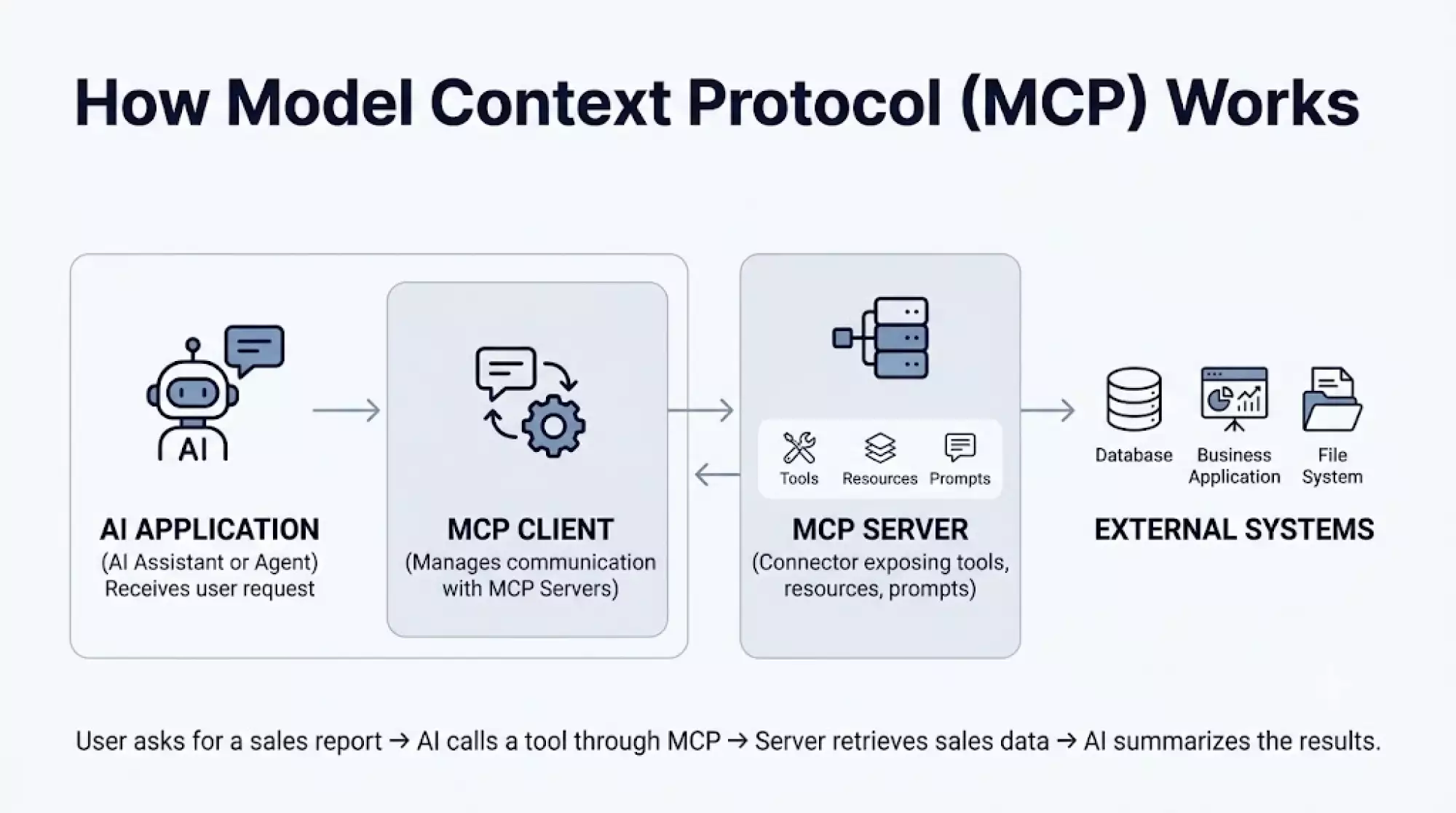
Model Context Protocol (MCP) is an open protocol that standardizes how AI applications connect with
- External tools
- Data sources
- Services
Instead of building a separate integration for every AI application and system, developers can use MCP to expose capabilities through a common interface.
For B2B AI applications, this makes it easier to connect AI agents with business software, internal databases, CRM platforms, and enterprise APIs. However, the actual capabilities depend on what each MCP server exposes and what permissions the AI application receives.
Key Components of MCP Architecture
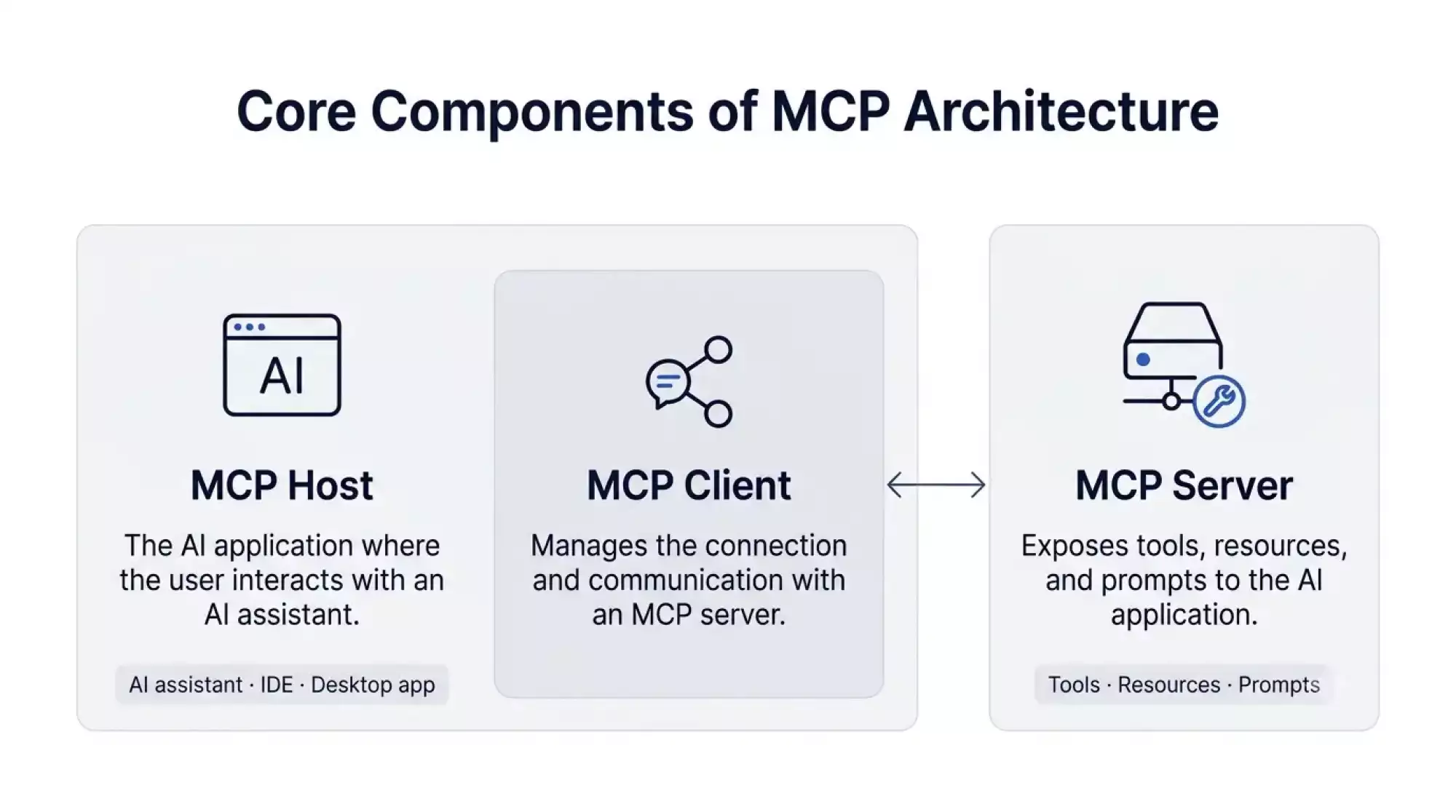
MCP architecture consists of three main components that work together to connect AI applications with external systems.
1. MCP Host
The host is the application on which the user interacts with the AI. It can be an AI assistant, a desktop application, or even a business application that uses AI. The host controls the AI experience and facilitates access to MCP.
2. MCP Client
The MCP client runs within the host application and creates a connection to an MCP server. The client manages the protocol communications and assists the application in utilizing the services provided by the server.
3. MCP Server
The MCP server will provide some special resources for the AI application. For instance, the MCP server can interface with any external APIs, databases, file system, and business applications in order to offer whatever the AI needs.
For instance, a customer support application of a B2B company can connect to an MCP server that provides some order lookup and delivery status resources. The AI agent may use these resources to check the current order details before replying to a customer.
How Does MCP Architecture Work?
The basic structure of interaction in an MCP framework is:
- The user makes a request. For instance, the user requests an AI assistant for the status of his order.
- The AI program recognizes the needed capability. It checks if there exists an MCP tool that can fetch the requested information.
- The MCP client contacts the server. The client sends a protocol request to the appropriate MCP server.
- The server fetches the needed system. It makes a call to the needed API or authorized data source.
- The server responds. The server sends the response to the client, who in turn forwards it to the AI program.
This way, the AI system can interface with the business systems without having the model integrate all of that.
In production, however, the programmer should also consider authentication, authorization, error handling, timeouts, and monitoring. This becomes even more critical where there are multiple AI agents and business systems using the same MCP.
Planning to Build an MCP-Powered Application?
Connect your AI applications with the tools, APIs, and business systems they need through custom MCP server development.
Understanding MCP Architecture
The MCP architecture outlines the process through which an AI application can identify its capabilities, connect to servers, and exchange information. Knowledge of these elements is essential for developing integration techniques that would operate effectively with different AI applications and enterprise systems.
1. Capability Discovery
Before the AI tool can utilize an MCP server, it requires some information about the services offered by the server.
At the time of initialization, there is negotiation between the client and the server regarding their protocol capabilities. The client will be able to discover the tools and resources that are available on the server.
For instance, a server linked to a CRM may have the capability to retrieve customer data and resources with approved account information.
2. Protocol Communication and the Transport Layer
For structuring messages, JSON-RPC is used by MCP in the client-server communication. The transport layer is what dictates how the messages are transferred between the client and server.
There are two transport mechanisms that are commonly employed by MCP:
- stdio - When the MCP client creates a local server as a sub-process.
- Streamable HTTP - When the connection is made to remotely hosted MCP servers via the HTTP protocol.
The selection of the transport mechanism is dependent on the location of the server, as well as the manner of connection that the clients use.
3. Request Handling and Session Management
Whenever an AI app makes a call to use a particular tool, the request is processed by the MCP server that interacts with the respective service and provides an answer or an error.
There are also such issues like timeout handling, processing of concurrent calls, broken connections, and errors from other services' APIs that should be handled on production systems.
For instance, when several AI agents make calls to one order management system, the developers have to take into account the issue of API rate limitations and concurrent calls.
4. Authentication and Access Control
MCP is just a standard for communication; however, developers will have to take care of the security of the systems connected via MCP.
An actual deployment will require the following components:
- Authentication in order to check whether the client or the user is real.
- Authorization in order to regulate access to certain tools and data.
- Input validation in order to filter out malformed or invalid input.
- Approval processes for important changes that need additional checks, like customer record modifications or refund issuing.
MCP servers used remotely will have to be protected as well regarding credentials, network access, and tokens. The applications will have to access only those capabilities that they actually require.
These four elements form the technical foundation of an MCP implementation. Choosing the right architecture, transport mechanism, and security controls depends on your application's requirements. AI consulting can help businesses evaluate these decisions and plan an MCP implementation that fits their technical and operational needs.
How is MCP different from RAG?
RAG (retrieval-augmented generation) assists AI in retrieving relevant information, while MCP ensures standardization in the way that AI applications interact with external components. The two work at different levels; hence, they are not interchangeable.
The scalability of RAG depends on aspects such as the architecture for retrieval, indexing, volume of data, and number of queries. On the other hand, the scalability of MCP depends on aspects such as server capacity, connection management, and requests made.
| Aspect | MCP | RAG |
| Primary purpose | Connect AI applications to external capabilities | Ground AI responses in retrieved information |
| How it works | Standardizes communication between clients and servers | Retrieves relevant content and supplies it to the AI model |
| Typical components | MCP clients, servers, tools, resources | Data sources, retrieval systems, embeddings or search indexes, language models |
| Common use cases | Calling APIs, querying systems, triggering approved actions | Answering questions using company documents, policies, and knowledge bases |
| Does it perform actions? | Can expose tools that perform actions | Primarily retrieves information; actions require additional functionality |
| Can it work with the other? | Yes | Yes |
Example: An AI assistant for a company
Consider the case where an employee queries an AI assistant, saying, "Retrieve our refund policy and issue a refund for order 123."
The RAG retrieves the right policy so that the AI assistant knows what conditions need to be fulfilled.
The MCP can give access to the tool that will retrieve the order information or initiate a refund.
Combined, both can help the AI assistant to retrieve the right policy, verify the order, and process the right refund subject to the business logic of the application.
However, one thing to note here is that neither the RAG nor the MCP will automatically retrieve the right information and allow business actions.
Benefits of MCP for B2B AI Applications
- Standardized integrations: Connect AI applications to external tools through a common protocol.
- Tool access: Let AI agents call supported functions in connected systems.
- Reusable connections: Make server capabilities available to compatible MCP clients.
- Flexible integration: Add or update connected tools without redesigning the entire AI application.
- Access control: Apply appropriate permissions to data and actions.
- Easier maintenance: Centralize integration logic within MCP servers where appropriate.
Is Your MCP Infrastructure Ready to Scale?
Build an MCP infrastructure that supports growing AI workloads, secure integrations, and reliable communication between AI agents and business systems.
How MCP-Powered Applications Are Built and Deployed
In developing generative AI for B2B use cases, developers have to be concerned about access to business tools and information by AI models. The standard MCP-based application includes three components: the host (the AI application or AI agent used by users), the MCP client embedded into the host, and one or several MCP servers exposing the tools and information. To proceed from a prototype to production, all these components should be carefully planned.
How do you scope an MCP server for your AI agents?
Instead of beginning from what your API can do, start by considering what your agent will need to do. Having everything exposed as a tool floods the model with choices and introduces the possibility of abuse.
Name three components:
- Tools: Things the agent is able to do (create a ticket, execute a query, issue an invoice)
- Resources: Read-only data that the agent can access (documents, records, logs)
- Prompts: Templates for common scenarios
The tools should be designed for user-level tasks (find overdue invoices for a customer), rather than direct database queries. A few carefully thought-out tools will beat a general-purpose set nearly every time.
How do you build an MCP server?
Base your implementation on the official SDKs (TypeScript and Python are currently the most popular). Each tool is declared by the server with a name, description, and input schema. Your model depends on this information to determine when and how to invoke the tool; thus they are as important as the actual tool code.
Best practices for development:
- Describe inputs like you would document a new colleague: precise, with examples of correct input values
- Validate all input values; never trust input values generated by the model
- Return concise results; excessive output wastes context and decreases accuracy
- Return informative error messages to allow the agent to recover and retry
Which transport should you use: stdio or Streamable HTTP?
Use stdio for cases where the server is run locally on the server as a sub-process, which works well for desktop applications and development. Streamable HTTP should be used for remote servers that serve multiple users; this is the typical option for B2B systems.
Remote HTTP is what transforms the MCP server from a local utility to production infrastructure. This is also where the issues of authentication, tenancy, and scaling discussed in the following steps come into play.
How do you authenticate and secure an MCP server?
When the server becomes remote, it requires true access controls. The MCP standard includes support for OAuth authorization, which enables the user to give the agent limited access.
Setup:
- Least privileged scopes: each tool will have minimum permissions
- Logging: log every invocation of the tool, the user that invoked the action, and any parameters
- Human confirmation: request human confirmation when the action is high risk (e.g., deletion, payment)
- Prompt injection resistance: consider any content generated by the tools (e.g., email, web page, document) untrusted because it could include instructions for the model.
How do you build a multi-tenant MCP server for B2B customers?
In B2B, many customers share the same server, so isolation has to be built in from the start. The core rule is that tenant identity comes from the authenticated token, never from arguments the model supplies. If the agent can pass a customer_id freely, it can be tricked into passing someone else's.
Practical steps:
- Resolve the tenant from the OAuth token on every request
- Apply tenant filters at the data layer, not just in tool logic
- Use per-tenant rate limits and quotas so one customer's agent cannot starve others
- Decide early whether you need separate deployments for customers with strict compliance requirements
How do you connect an MCP server to your existing systems?
Your MCP server is a thin layer over systems you already run: databases, CRMs, ticketing tools, internal APIs. Wrap existing services rather than rebuilding them, and reuse the permission checks and business rules they already enforce.
Prefer calling your own APIs over giving the server direct database access. That keeps validation, logging, and access rules in one place. Where you must query a database directly, use a read-only account scoped to the minimum tables required.
How do you test an MCP server before you ship?
Test in two levels.
- Protocol-level test: Use MCP Inspector to invoke tools directly and validate the schema, response, and error handling.
- Agent-level test: Run realistic prompts against an actual agent and ensure it uses the right tool, passing correct arguments and handling failures correctly. Models may not understand descriptions correctly, so faulty tool descriptions are more prevalent here.
Also include adversarial tests such as malformed requests, cross-tenant access, and injected instructions from tool results.
How do you deploy an MCP server to production?
Deployment looks much like any backend service, with a few MCP-specific concerns:
- Containerize the server with Docker and deploy to Kubernetes, a serverless platform, or a managed container service
- Put it behind HTTPS and a load balancer
- Add timeouts and rate limits so a runaway agent loop cannot overwhelm your backend
- Store secrets in a secrets manager, never in tool code or prompts
- Version carefully: Renaming a tool or changing its schema can break agents that depend on it, so deprecate gradually
How do you scale MCP infrastructure for B2B AI applications?
Scaling will be simplest in the case of a stateless server so that the requests are handled by all instances, and you can scale horizontally through a load balancer. If your app requires session state, use an external source (like Redis).
- With increased usage, you should consider:
- Observability – monitoring latency, error rate, tool usage, along with enough logging to monitor requests from agent to backend
- Caching for slow, frequently accessed data
- MCP gateway for handling authentication, routing, rate limiting, and logging for multiple servers
Should you self-host or use managed MCP infrastructure?
At this point, you find yourself having to make a build versus buy choice. While self-hosting will give you control over data management, networking, and compliance, you will be responsible for scaling, security updates, and uptime. Infrastructure as a managed service will place the responsibility of operation in someone else’s hands and will help you speed up the deployment process, but in this case, you will be placing the key to accessing your system into someone else’s hands.
The Build-to-Deploy Flow at a Glance
| Step | Key question | Typical output |
| 1. Scope | What should the agent do? | List of tools and resources |
| 2. Build | How will the model understand them? | Server with schemas and descriptions |
| 3. Transport | Local or remote? | stdio or Streamable HTTP |
| 4. Secure | Who can access what? | OAuth, scopes, audit logs |
| 5. Multi-tenancy | How do we isolate customers? | Token-based tenant resolution |
| 6. Integrate | What does it connect to? | Wrappers over existing APIs |
| 7. Test | Does the agent use it correctly? | Inspector and agent-level tests |
| 8. Deploy | How does it run in production? | Containerized, monitored service |
| 9. Scale | How does it handle growth? | Stateless design, gateway, observability |
| 10. Decide | Self-host or managed? | Hosting model |
Not Sure How to Deploy Your MCP Infrastructure?
Choose an MCP deployment approach that aligns with your application's security, maintenance, and scaling requirements.
Conclusion
MCP offers AI systems an easy way to connect to the systems that your organization already uses. Creating the prototype isn't the issue. What will make this integration work in production is everything else: tightly scoped utilities, OAuth with least-privilege access, resolving tenant identity from token, real agent testing, and monitoring once the traffic starts coming in.
Make the server stateless and simple, and treat it like any other production system. Whether it should be self-hosted or use managed infrastructure depends on your compliance requirements and your team's capabilities.
Take one specific workflow, build a minimal read-only MCP server for it, and then test it with a real agent. If you'd like a second opinion on architecture or hosting, our Generative AI consultant can help you break down the technical requirements, evaluate deployment options, and plan the right implementation approach.
FAQs
What is the difference between MCP and a regular REST API?
A REST API is built for developers who write code that calls specific endpoints. MCP is built for AI models, which discover available tools at runtime, read their descriptions, and decide for themselves when to call them. In most projects, MCP does not replace your REST API. It sits on top of it as a layer an AI agent can understand.
How is MCP different from function calling?
Function calling lets a model request that a function be run, but the function definitions are usually specific to one application and one model provider. MCP standardizes how tools are described and exposed, so a single MCP server can work with many AI applications without custom integration for each.
Do we need an MCP server if we already have an API?
Not always. If only your own developers consume the API, probably not. An MCP server becomes worthwhile when you want AI assistants or agents, yours or your customers’, to use your product directly without custom glue code for each one.
Which AI applications can connect to an MCP server?
Any MCP-compatible client can. This includes Claude, several coding assistants and IDEs, and a growing number of agent frameworks. Support changes quickly, so check the current client list before committing to a specific target.
How long does it take to build an MCP server?
It depends on scope. A prototype with a few read-only tools can take days. A production server with OAuth, multi-tenancy, audit logging, and integration with several internal systems usually takes weeks to a few months. The biggest variables are the number of tools, the state of the underlying APIs, and security or compliance review.
What does it cost to build and run one?
Costs fall into three parts: initial development, infrastructure (hosting, monitoring, secrets management), and ongoing maintenance as the spec, SDKs, and your own APIs change. Infrastructure cost is usually modest compared with development and security review. Any specific figure depends heavily on scope, so treat quotes without a scoping phase with caution.
Can an AI agent damage our data through an MCP server?
It can, if the server allows it. An agent can only do what your tools permit, so the main protections are read-only tools by default, least-privilege scopes, human approval for destructive actions, and audit logs. Designing tools around narrow tasks instead of open-ended access limits the damage from a mistake or a malicious prompt.
Should we build one large MCP server or several smaller ones?
Several focused servers are often easier to secure, version, and maintain, with each covering one domain such as billing or support. The trade-off is more infrastructure to manage, which is where a gateway helps. One server per domain is a common starting point.
Is MCP secure enough for regulated industries?
It can be, but the protocol alone does not make it so. Compliance depends on how you implement authentication, data access, logging, and hosting. Regulated teams usually favor self-hosting or private deployment, strict scoping, and a formal security review before launch.