+971-8000321216



Key takeaways:
- DTF platform development enables decentralized, blockchain-based investment funds with automated portfolio management and global accessibility.
- These platforms use smart contracts to handle fund creation, rebalancing, token issuance, and fee distribution without intermediaries.
- Unlike traditional ETFs, DTFs offer 24/7 trading, real-time transparency, and non-custodial asset control for investors.
- Multi-chain DeFi architecture improves liquidity, scalability, and cross-network fund execution efficiency.
- AI integration enhances portfolio rebalancing, risk scoring, and predictive investment strategies in modern DTF systems.
- ERC-4626 serves as the core standard for tokenized fund development and interoperable vault structures.
- Oracle networks like Chainlink and Pyth ensure accurate real-time NAV calculation and market data reliability.
- Compliance layers, including KYC/AML and regulatory frameworks (MiCA, VARA, SEC) support institutional-grade adoption.
- Cross-chain rebalancing systems and DeFi composability drive higher capital efficiency and yield opportunities.
- DTF platforms are emerging as the next-generation infrastructure for programmable, automated global asset management.
Want similar results? → Get a Free Quote
The global asset management industry is experiencing one of the most dramatic structural changes ever. With the advent of blockchain technology and as decentralized finance protocols lock billions of dollars worth of TVL, there is one more financial product being born at the junction of traditional finance and the blockchain world.
DTF platform development is no longer a niche concept in crypto forums; it is rapidly becoming the go-to model for investors seeking transparent, automated, and globally accessible Multi-Chain DeFi trading platforms for digital tokenized fund solutions. Whether you are a fintech entrepreneur exploring new product verticals or an established fund manager looking to migrate operations on-chain, understanding how to build a DTF platform from the ground up is critical knowledge for 2026 and beyond.
In this guide, Suffescom Solutions considers a leading blockchain development company with deep expertise in DeFi asset management software development. This walks you through every dimension of DTF platform development: from architecture and smart contracts to AI-powered portfolio rebalancing and regulatory compliance.
What Is a DTF Platform?
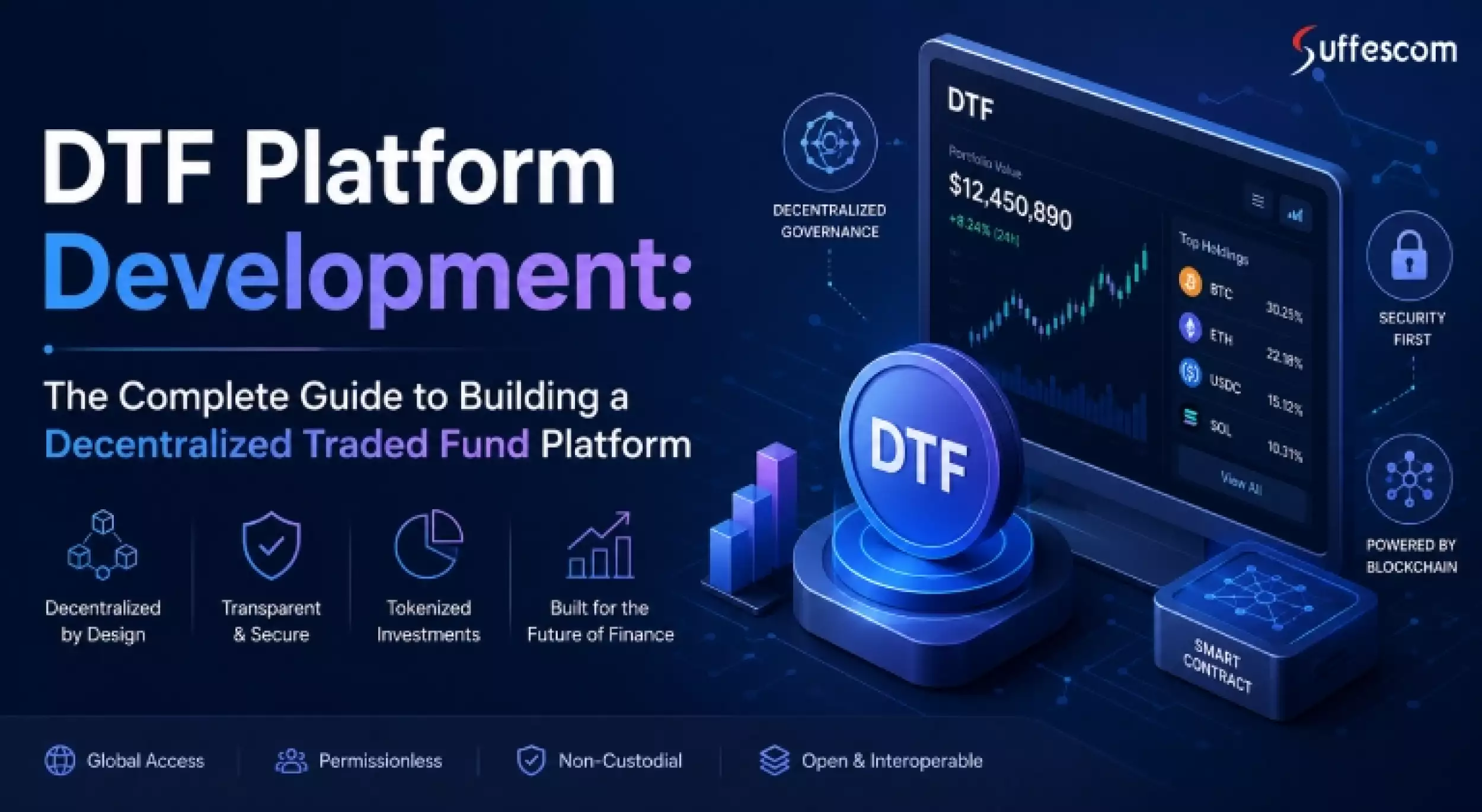
DTF (Digital Tokenized Fund) is a blockchain-based investment vehicle that enables the creation of tokenized funds, asset pooling, and portfolio management through smart contracts in a Multi-Asset Portfolio Management environment, allowing investors to gain exposure to diversified digital asset portfolios.
Decentralized Traded Funds Explained
A decentralized traded fund is a tokenized basket of crypto assets (or real-world assets represented on-chain) that:
- Automatically rebalances based on predefined rules or AI-driven triggers
- Issues fund tokens to investors representing proportional ownership
- Allows 24/7 trading without broker intermediaries
- Provides full on-chain transparency of holdings and NAV
- Charges management fees programmatically via smart contracts
- Automatically rebalances using Automated Cross-Chain Rebalancing System
- Allows 24/7 trading across a Multi-Chain DeFi Trading Platform for Digital Tokenized Funds
- Charges programmable fees via smart contracts
DTF vs Traditional ETF — A Structural Comparison
Before diving into DTF platform development specifics, understanding the structural differences between a DTF and a traditional ETF helps frame the development priorities.
| Attribute | Traditional ETF | Decentralized Traded Fund (DTF) |
| Custody | Centralized custodian | Smart contract-based self-custody |
| Trading Hours | Exchange hours only | 24/7/365 on-chain execution |
| Transparency | Periodic disclosures (quarterly/monthly reports) | Real-time on-chain data visibility |
| Rebalancing | Manually executed by fund managers | Automated via smart contracts |
| Access | Broker account required | Wallet-based, permissionless access |
| Settlement | T+2 settlement cycle | Near-instant blockchain confirmation |
| Geographic Reach | Restricted by jurisdiction | Global, borderless participation |
| Fees | Management fees + brokerage fees | Programmable protocol-defined fees |
| Auditability | Audit limited to financial reports | Fully verifiable on-chain transparency |
Build a Scalable Decentralized Fund Platform With Multi-chain Capabilities
Turn your DTF concept into a production-ready DeFi product with expert supp
Market Opportunity: Why DTF Platform Development Is a High-Growth Opportunity
The timing for decentralized fund management platform development has never been more strategic. Several macro and micro trends are converging to create significant market demand:
1. Institutional DeFi Adoption
Major financial institutions, including BlackRock, Fidelity, and Franklin Templeton, have begun tokenizing real-world assets. This institutional validation signals that on-chain asset management platform infrastructure is moving from experimental to essential.
2. Tokenization of Real-World Assets
The RWA tokenization market is projected to reach $16 trillion by 2030 (Boston Consulting Group). Tokenized fund development is the foundation of any DTF platform. It is the primary vehicle through which these assets will be accessed by retail and institutional investors alike.
3. DeFi Composability
DeFi asset management platform integrates seamlessly with liquidity pools, lending protocols, and Multi-DEX Integration & Swap Engine systems. It is creating compounding value that no traditional fund can replicate.
4. Demand for Transparent, Low-Fee Investing
Post-2022 crypto market events (FTX collapse, Celsius bankruptcy) have created enormous demand for non-custodial, transparent financial products. A blockchain investment platform development that puts control in users' hands directly addresses this trust deficit.
5. Regulatory Clarity Emerging
The EU's MiCA regulation, SEC guidance on digital assets, and Dubai's VARA framework are creating clearer compliance pathways. It reduces the regulatory uncertainty that previously slowed institutional DTF platform development.
Core Architecture of a Decentralized Traded Fund Platform
Building a robust DTF platform through professional DeFi Trading Platform Development Services requires a multi-layered architecture
Smart Contract Layer
The foundation of any on-chain asset management platform is its smart contract infrastructure. This layer handles:
- Fund creation and parameter configuration (asset allocation, rebalancing thresholds)
- Token minting and burning (fund share issuance and redemption)
- Fee distribution (management fees, performance fees)
- Automated rebalancing execution
- Governance voting mechanisms
Multi-DEX Integration & Swap Engine Layer
A production-grade DeFi asset management platform must integrate with multiple DeFi protocols to source liquidity and execute trades:
- DEX Aggregators: 1inch, Paraswap for best-price execution
- Liquidity Pools: Uniswap v3, Curve Finance for asset swaps
- Yield Protocols: Aave, Compound for idle asset deployment
- Oracle Networks: Chainlink, Pyth for real-time price feeds
- DEX aggregators (1inch, Paraswap) enabling Multi-DEX Integration & Swap Engine
- Cross-chain swaps powering Automated Cross-Chain Rebalancing System
Multi-Chain DeFi Trading Platform
A multi-chain DeFi platform development approach ensures maximum reach and liquidity. Suffescom builds DTF platforms that operate natively across:
- Ethereum mainnet (for institutional-grade security)
- Arbitrum / Optimism (for low-cost rebalancing operations)
- BNB Smart Chain (for retail user accessibility)
- Polygon (for high-frequency portfolio operations)
- Solana (for high-throughput trading requirements)
Frontend & User Interface Layer
The user-facing crypto investment platform development component includes:
- Portfolio dashboard with real-time NAV tracking
- Fund discovery and comparison interface
- One-click invest/redeem flows
- Mobile-responsive design with wallet integration (MetaMask, WalletConnect)
- Advanced analytics and performance visualization
Backend & Indexing Layer
Supporting infrastructure for the on-chain asset management platform:
- The Graph Protocol for blockchain data indexing
- IPFS / Arweave for decentralized metadata storage
- Node infrastructure (Alchemy, Infura, or self-hosted)
- Event listeners for real-time portfolio state updates
Key Features of a Multi-Chain DeFi Asset Management Platform
The feature set of a competitive DeFi asset management platform determines its positioning in Multi-Asset Portfolio Management and institutional adoption.
Fund Creation Engine
Allow fund managers to configure and deploy new funds in minutes. Parameters should include asset whitelists, allocation weights, rebalancing frequency, minimum investment thresholds, and fee structures that are all encoded in smart contracts.
Tokenized Fund Shares
Tokenized fund development means each fund issues ERC-20 (or equivalent) tokens representing fractional ownership. These fund tokens are fully transferable, composable with other DeFi protocols, and redeemable for underlying assets at any time.
Automated Portfolio Rebalancing
The crypto portfolio rebalancing platform functionality is central to DTF value creation. Smart contracts or AI-driven keepers monitor allocation drift and trigger rebalancing when predefined thresholds are breached, without manual intervention.
Real-Time NAV Calculation
Integrating with oracle networks enables continuous, manipulation-resistant Net Asset Value calculation, providing investors with transparent, up-to-the-second fund valuations.
Non-Custodial Architecture
Users maintain full control of their assets at all times. The DeFi portfolio management platform never holds user funds; all operations execute through audited smart contracts.
Advanced Features
AI-Driven Rebalancing & Risk Management
An AI-powered DeFi asset management platform uses machine learning models to optimize rebalancing triggers based on market volatility, correlation analysis, and momentum indicators that are significantly outperforming static rule-based systems.
Cross-Chain Portfolio Management
Multi-chain DeFi portfolio management system capabilities allow a single fund to hold assets across multiple blockchains, maximizing yield opportunities and diversification.
Social/Copy Trading
Allow retail investors to mirror the portfolio strategies of top-performing fund managers. It is a powerful user acquisition and retention mechanism for any crypto investment platform development.
Governance & DAO Integration
Token-based governance allows fund participants to vote on strategy changes, fee adjustments, and protocol upgrades, aligning with the decentralized ethos of DeFi asset management.
Institutional-Grade Reporting
Automated performance reports, tax documentation generation, and AUM dashboards cater to institutional and semi-professional investors within a decentralized finance management ecosystem.
Develop a Multi-Chain DeFi Trading Platform for Digital Tokenized Funds
Get custom architecture, smart contracts, and cross-chain automation built for your use case.
AI-Powered DeFi Asset Management Platform
The next competitive frontier in decentralized fund management platform development is artificial intelligence integrated with Multi-Asset Portfolio Management systems. An AI-powered DeFi asset management platform goes beyond simple rule-based rebalancing to deliver:
Predictive Rebalancing
Machine learning models trained on historical price data, on-chain volume metrics, and social sentiment signals predict optimal rebalancing windows. It reduces slippage costs and improves risk-adjusted returns compared to static threshold models.
Dynamic Risk Scoring
AI systems continuously score each asset in the fund universe for liquidity risk, smart contract risk, and market risk. It automatically reduces exposure to high-risk assets before stress events materialize.
Natural Language Fund Configuration
State-of-the-art DTFs can provide LLM-enabled interfaces in which the managers articulate their approach using natural language ("I want a momentum-based DeFi fund for large companies with maximum drawdown protection of 20%") and AI converts that language into smart contract parameters.
Anomaly Detection & Circuit Breakers
AI agents monitor any abnormal activity (e.g., flash loan attacks, oracle manipulation, excessive withdrawals) and trigger the deployment of safety measures by engaging circuit breakers.
Smart Contract-Based Fund Management Platform
A smart contract-based fund management platform replaces the legal and operational infrastructure of traditional fund management with code. Here is what that means in practice:
What Smart Contracts Automate in DTF Platforms
- Subscription processing: accept deposits and mint fund tokens automatically
- Redemption processing: burn fund tokens and return proportional assets
- Rebalancing execution: swap assets to maintain target allocation
- Fee collection: deduct and distribute management fees at configurable intervals
- Yield harvesting: collect and reinvest protocol rewards
- Governance execution: implement approved proposals automatically
Tokenized Fund Development: Technical Deep Dive
Tokenized fund development is the process of representing fund ownership as blockchain tokens in a Multi-Chain DeFi Trading Platform for Digital Tokenized Funds ecosystem.
ERC-4626 Standard — The Building Block
The ERC-4626 Tokenized Vault Standard is the industry standard for tokenized fund development in 2025. It defines:
- deposit/mint: functions for investing into the fund
- withdraw/redeem: functions for exiting the fund
- convertToShares / convertToAssets: NAV calculation functions
- totalAssets: reports total fund AUM
Multi-Asset Vault Extension
A standard ERC-4626 vault holds a single underlying asset. For a full DTF platform, Suffescom extends this to a multi-asset vault that:
- Accepts deposits in multiple input tokens (swapped to target allocation on entry)
- Calculates NAV as the aggregate value of all held positions
- Issues a single fund token representing proportional ownership of the whole portfolio
Oracle Integration for NAV Accuracy
This ensures accurate execution across Automated Cross-Chain Rebalancing System environments. Accurate, manipulation-resistant NAV calculation requires robust oracle integration. Suffescom implements:
- Primary oracle: Chainlink Data Feeds (TWAP-secured)
- Secondary oracle: Pyth Network (for assets not on Chainlink)
- Sanity checks: Circuit breakers that pause NAV updates if oracle deviation exceeds thresholds
Compliance, Security & Regulatory Framework for Decentralized Finance Asset Management Platforms
Building a blockchain investment platform that operates at scale requires robust compliance infrastructure. Suffescom integrates the following compliance mechanisms:
KYC/AML Integration
- On-chain identity verification using Worldcoin, Civic, or Fractal ID
- Geofencing smart contract modifiers blocking restricted jurisdictions
- Transaction monitoring integration with Chainalysis or Elliptic
Regulatory Considerations by Jurisdiction
| Jurisdiction | Key Regulatory Framework |
| European Union | MiCA (Markets in Crypto-Assets Regulation) |
| United States | SEC guidance on digital asset securities, CFTC oversight |
| UAE / Dubai | VARA (Virtual Assets Regulatory Authority) framework |
| Singapore | MAS Payment Services Act, Securities & Futures Act |
| Switzerland | FINMA DLT framework and collective investment scheme rules |
Technology Stack & Development Ecosystem
| Layer | Technologies |
| Smart Contracts | Solidity, Rust (Solana), Foundry, Hardhat, OpenZeppelin |
| Blockchain Networks | Ethereum, Arbitrum, Optimism, BNB Chain, Polygon, Solana |
| Oracle / Automation | Chainlink Data Feeds, Chainlink Automation, Pyth Network |
| Frontend | React.js, Next.js, ethers.js, viem, wagmi, TailwindCSS |
| Backend / Indexing | The Graph Protocol, Node.js, PostgreSQL |
| Infrastructure | IPFS, Arweave, Alchemy, Infura |
| AI / ML Layer | Python, TensorFlow, PyTorch, scikit-learn, on-chain data APIs |
| Security | Slither, Echidna, MythX, OpenZeppelin Defender |
| Monitoring | Tenderly, Forta, Grafana, Datadog |
Future of Decentralized Traded Fund (DTF) Platform Development
The future of DTF platform development is moving toward AI-powered, autonomous financial systems with cross-chain liquidity and real-time portfolio intelligence.
AI-Driven Fund Automation
DTF platforms will use AI to optimize allocation, risk, and yield in real time. This reduces manual control and improves decision accuracy.
Multi-Chain Liquidity Integration
Future systems will unify liquidity across multiple blockchains. This improves capital efficiency and reduces fragmentation.
Cross-Chain Rebalancing Systems
Automated Cross-Chain Rebalancing Systems will execute portfolio changes instantly across networks. This ensures faster and synchronized fund updates.
Institutional Tokenized Adoption
Enterprises will adopt DTF platforms for regulated tokenized fund operations. This improves compliance, reporting, and transparency.
Programmable Asset Management
Investment strategies will be coded into smart contracts. This enables fully automated and transparent fund execution without intermediaries.
Why Choose Suffescom Solutions for DTF Platform Development?
We specialize in building Multi-Asset Portfolio Management systems with advanced Multi-DEX Integration & Swap Engine capabilities for enterprise-grade DeFi platforms.
Proven DeFi Development Track Record
Suffescom has delivered 150+ blockchain projects, including DeFi exchanges, tokenization platforms, NFT marketplaces, and crypto payment gateways. Our team brings hands-on smart contract development experience from mainnet-deployed protocols.
Full-Stack DeFi Capability
From Solidity smart contracts and protocol integrations to AI-powered rebalancing systems and institutional-grade frontends, we cover the entire DeFi asset management software development stack in-house.
Multi-Chain Expertise
Our developers are certified and experienced across Ethereum, Solana, BNB Chain, Polygon, Arbitrum, and Optimism. It enables true multi-chain DeFi platform development without outsourcing to specialized subcontractors.
Security-First Development Process
Every DTF platform goes through rigorous internal security reviews, third-party audit coordination, and post-deployment monitoring setup because one security incident can destroy years of reputation building.
Compliance Integration
Suffescom's legal and technical teams work together to integrate KYC/AML, jurisdictional restrictions, and regulatory-compliant fund structures, making your blockchain investment platform development future-proof.
Post-Launch Support & Iteration
We do not disappear after deployment. Suffescom provides ongoing smart contract monitoring, feature development, protocol upgrade management, and community support infrastructure for all DTF platforms we build.
FAQs
1. What is a DTF platform in DeFi?
A DTF (Decentralized Traded Fund) platform is a blockchain-based infrastructure that enables the creation, management, and trading of tokenized investment funds without centralized intermediaries. It combines the diversification structure of ETFs with the transparency and automation of DeFi smart contracts.
2. How is a DTF different from a traditional ETF?
Unlike a traditional ETF, which is managed by a centralized fund manager and traded on stock exchanges, a DTF operates entirely on-chain through smart contracts. DTFs offer 24/7 trading, real-time transparency, non-custodial asset holding, and global accessibility without a broker.
3. How long does it take to build a DTF platform?
A minimum viable DTF platform (single-chain, core features) typically takes 3-5 months to develop, audit, and deploy. A full-featured multi-chain DTF platform with AI-powered rebalancing and institutional compliance features typically requires 8-14 months.
4. What blockchains are best for DTF platform development?
Ethereum is the preferred chain for security and institutional credibility. Arbitrum and Optimism offer low-cost environments ideal for frequent rebalancing operations. Polygon suits high-frequency portfolio management, while BNB Chain provides strong retail accessibility. Most production DTF platforms implement multi-chain DeFi platform development for maximum coverage.
5. What is tokenized fund development?
Tokenized fund development is the process of representing fund ownership as blockchain tokens (typically ERC-20 or ERC-4626 compliant). Each token represents a proportional share of the underlying fund assets, enabling fractional ownership, 24/7 transferability, and DeFi composability.
6. How does AI improve DeFi asset management platforms?
AI-powered DeFi asset management platforms use machine learning models to optimize rebalancing timing, predict market trends, score asset risks, detect anomalies, and automate portfolio adjustments, delivering measurably better risk-adjusted returns compared to static rule-based systems.
7. Is DTF platform development compliant with financial regulations?
Regulatory compliance depends on jurisdiction and fund structure. Suffescom integrates KYC/AML modules, geofencing, and jurisdiction-specific compliance frameworks (MiCA, SEC, VARA, MAS) into every DTF platform we develop. We work with legal advisors to ensure the platform structure aligns with applicable regulations.
8. What smart contract standard is used in DTF platform development?
The ERC-4626 Tokenized Vault Standard is the industry-recommended foundation for DTF platform smart contracts. It provides a standardized interface for deposits, withdrawals, and share calculations, ensuring composability with the broader DeFi ecosystem. It also enables seamless integration with other DeFi protocols and improves overall interoperability.
9. How much does it cost to build a DTF platform?
The cost of developing a DTF (Digital Tokenized Fund) platform typically ranges from $30,000 to $200,000+, depending on the platform's complexity, blockchain integrations, security requirements, and advanced features. Enterprise-grade solutions with multi-chain support and AI-powered automation generally require a higher investment.
10. What is a multi-chain DeFi portfolio management system?
A multi-chain DeFi portfolio management system allows a single fund to hold and manage assets across multiple blockchains simultaneously. It uses cross-chain messaging protocols to synchronize fund state and enables investors to access assets on the most capital-efficient chain for each operation.