Key takeaways:
- Building a VARA-compliant RWA tokenization platform in Dubai requires licensing, AML/KYC controls, secure custody, and continuous regulatory reporting.
- VARA regulates tokenization under VA Issuance and Investment Management categories, covering assets like real estate, commodities, and securities.
- The licensing journey typically takes 9–18 months, including IDQ preparation, regulatory review, and full VASP approval.
- Strong technical foundations such as ERC-3643, MPC custody, and automated compliance systems are essential for approval and scalability.
- Despite complexity, VARA compliance improves investor trust, institutional access, and long-term platform sustainability in Dubai’s regulated digital asset ecosystem.
Want similar results? → Get a Free Quote
Dubai is now the go-to spot for regulated digital assets. With more than 36 VARA-licensed firms as of early 2026, plus the Dubai Land Department testing real estate tokenization, things are getting really competitive. People are getting excited about turning world assets into digital tokens, like property, private equity and commodities. This is happening in areas, and businesses want to start platforms in the United Arab Emirates that follow the rules.
However, building a VARA-compliant RWA tokenization platform involves far more than deploying smart contracts or issuing digital tokens. Businesses have to get licenses, check who their customers are, keep their assets safe, and make sure they are following all the rules.
They also have to tell the government what they are doing. As institutional adoption grows, blockchain privacy for RWA assets has become a critical requirement for secure tokenization. It enables platforms to protect sensitive ownership data, investor information, and transaction details while maintaining transparency and regulatory compliance.
This guide will show you how to make a platform in Dubai that follows the rules. From understanding VARA regulations and selecting the right tokenization model to designing platform infrastructure, obtaining licenses, and maintaining compliance, you'll learn everything required to launch and scale a compliant tokenization business in 2026.
What is VARA Compliance in UAE Crypto Regulations?
The Virtual Assets Regulatory Authority, also known as VARA was set up in Dubai because of a law that was passed in 2022. This law is called Dubai Law No. 4 Of 2022. Because of this law, Dubai is now one of the places in the world to have a special group that only deals with Virtual Assets. However, the Virtual Assets Regulatory Authority, or VARA does not oversee the companies in the area because that area is overseen by a different group called the DFSA.
Core Mandate of VARA
- Licensing and supervising VASPs operating in or from Dubai
- Enforcing AML/CFT obligations aligned with FATF standards
- Preventing market abuse, insider trading, and conflicts of interest
- Protecting retail and institutional investors through disclosure requirements
- Promoting responsible innovation in the regulated DeFi infrastructure space
VARA's Regulatory Scope for Tokenization
For RWA tokenization specifically, VARA classifies activities under its Investment Management and VA Issuance (VAI) service categories. Platforms issuing tokenized real estate, commodities, or tokenized securities must comply with VARA's VA Issuance Rulebook, which sets out disclosure, custody, and governance standards.
Why VARA Compliance Matters for RWA Platforms
Operating without VARA authorization in Dubai exposes platforms to criminal liability, asset seizure, and reputational damage that can permanently undermine investor trust. Beyond enforcement risk, VARA compliance delivers concrete commercial advantages:
| Aspect | Impact / Benefit |
| Regulatory Risk Avoidance | Prevents criminal liability, asset seizure, and reputational damage that can erode investor trust |
| Institutional Access | Enables participation from institutional investors requiring regulated and compliant counterparties |
| Legal Protection | Ensures enforceability of token-holder rights under Dubai’s civil and commercial legal framework |
| Banking & Fiat Integration | Improves access to UAE-licensed banks and fiat on/off-ramp service providers |
| Cross-Border Recognition | Supports acceptance in jurisdictions with reciprocal regulatory frameworks |
| Government Participation | Increases eligibility for government-backed tokenization programs and pilot initiatives |
Ready to Build a VARA-Compliant Tokenization Platform?
Launch a secure and regulation-ready RWA platform with expert support for blockchain development, smart contracts, compliance automation, and digital asset custody.
Why Dubai is Emerging as a Global Hub for RWA Tokenization?
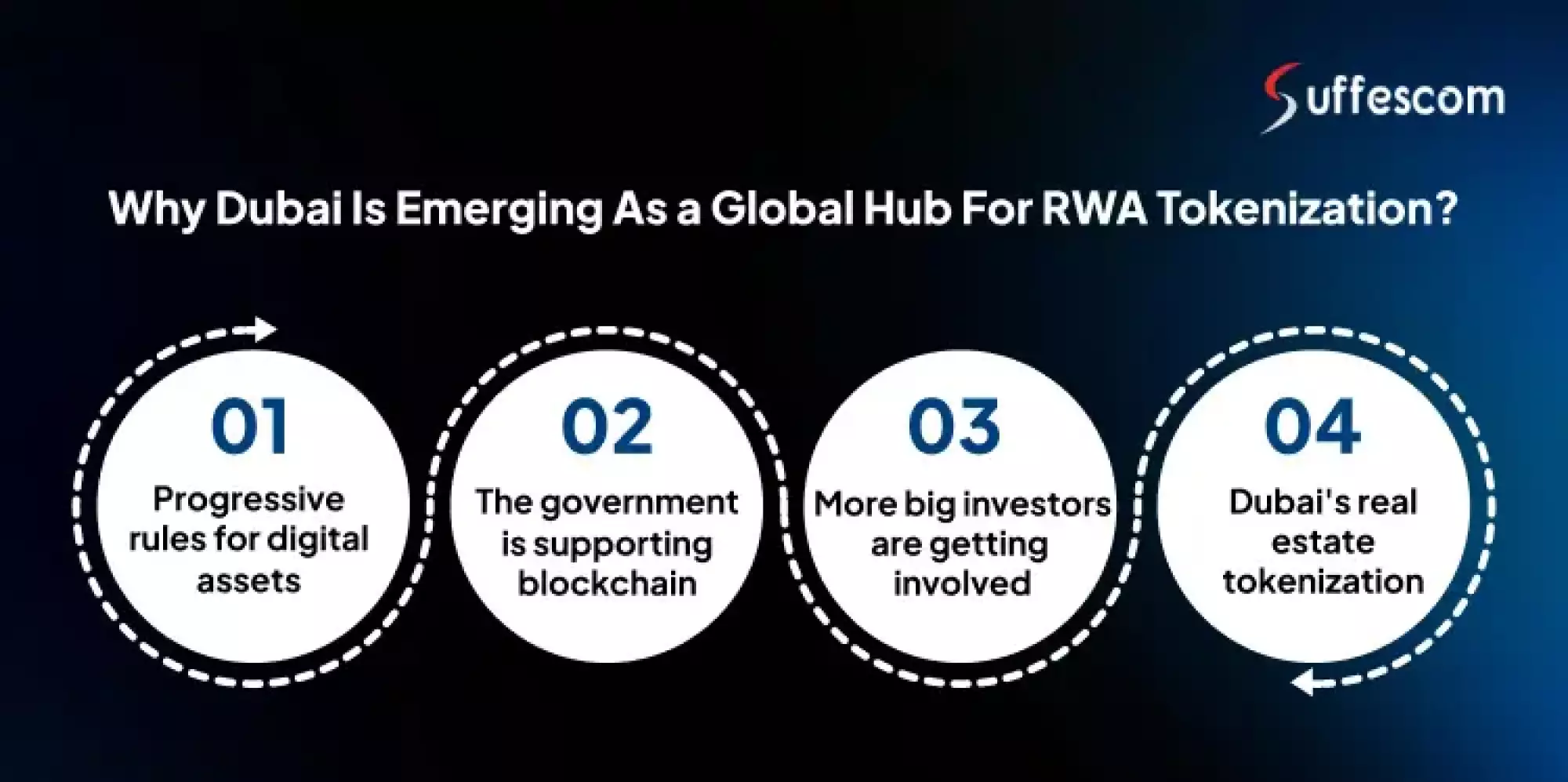
Progressive Rules for Digital Assets
Dubai has some of the rules for digital assets in the world. The Virtual Asset Regulatory Authority (VARA) and the UAE Securities and Commodities Authority (SCA) are making it easy for businesses to follow the rules. They have guidelines for companies that issue tokens: keep them safe trade them and help people buy and sell them. This helps businesses launch RWA tokenization platforms that follow the rules.
The Government Is Supporting Blockchain
The government of Dubai is behind blockchain projects. These include the Dubai Blockchain Strategy, fintech initiatives in the Dubai International Financial Centre (DIFC), and tokenization projects by the Dubai Land Department. These projects are helping to make blockchain technology widely used. They also support the creation of asset systems and tokenized ownership models that are regulated.
More Big Investors Are Getting Involved
Big investors are starting to look into real estate, private credit and investment funds. They want to make it easier to buy and sell these assets and to get people involved. This is creating a need for rule-following and high-quality tokenization systems.
Dubai's Real Estate Tokenization
Dubai has one of the real estate markets in the world. This makes it a great place for tokenizing assets. The use of blockchain to record ownership and ownership models is creating new ways for people to invest. It also makes sure that investments follow property rules.
The Dubai RWA Tokenization Competitive Landscape: Where Most Platforms Fall Short
Before building, understand where competitors are losing ground. An analysis of the current licensed VASP landscape in Dubai reveals the main persistent gaps that help to resolve the issues.
| Gap Area | What Competitors Do | What a Superior Platform Does |
| Compliance Architecture | Bolt-on compliance tools added post-development | Compliance-by-design: AML/KYC, audit trails, and sanctions screening embedded at the contract level |
| Smart Contract Standards | Generic ERC-20 or bespoke token contracts | ERC-3643 (T-REX) with on-chain transfer restrictions enforced by compliance registry |
| Custody Model | Third-party custodian dependency with no fallback | Hybrid MPC + qualified custodian with documented recovery procedures submitted to VARA |
| Investor Onboarding | Manual KYC with 3–7 day approval times | Automated orchestration: KYC → risk scoring → wallet whitelisting → token issuance in <24 hours |
| Regulatory Reporting | Periodic manual exports to compliance team | Real-time automated dashboards generating VARA-formatted reports on demand |
How to Start an RWA Tokenization Platform in Dubai
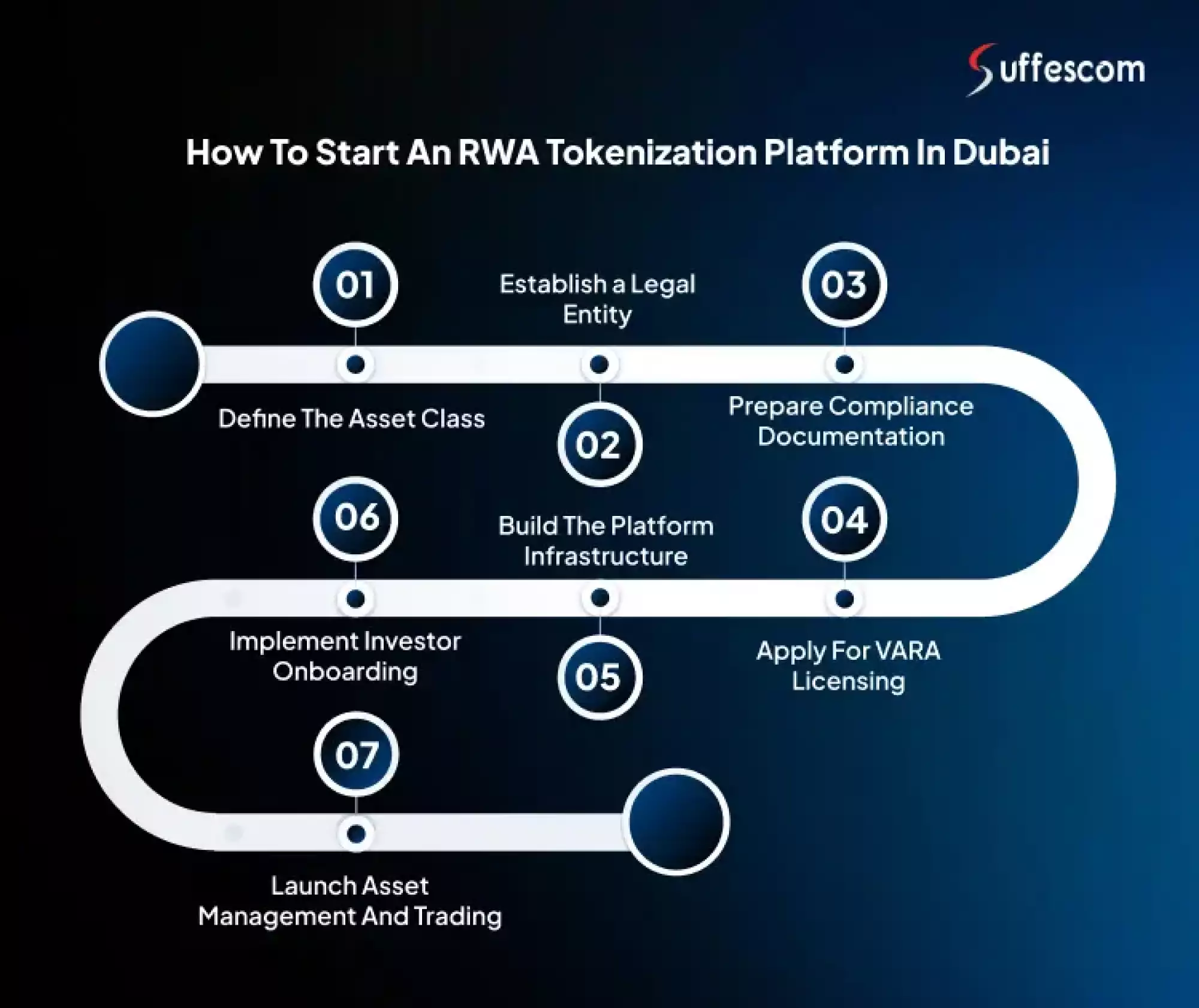
Building a VARA-compliant RWA tokenization platform requires careful planning across regulatory, technical, and operational areas. Follow these seven essential steps to launch a secure and compliant platform in Dubai.
Step 1: Define the Asset Class
You have to decide what kind of assets you want to tokenize, like estate or private equity.
The type of asset you choose will determine what kind of license you need, how you set up your business, and who can invest in your RWA tokenization platform.
Step 2: Establish a Legal Entity
You need to set up a business in the UAE in a place like the DIFC, DMCC or mainland Dubai.
Your business has to be set up in a way that allows you to own assets, issue tokens and follow the rules.
Step 3: Prepare Compliance Documentation
You have to make sure you have all the documents, like policies to prevent money laundering and terrorism financing plans for managing risk and procedures for keeping your business running smoothly.
You also need to have cybersecurity controls and a plan for what to do in case something goes wrong.
Step 4: Apply for VARA Licensing
You have to apply for a license from the VARA, which's the regulatory authority in Dubai.
You need to give them your business plan, compliance documents, financial projections and details about how your platform will work.
The VARA will check to make sure your platform is ready to follow the rules and that you have governance and the right people in charge.
Step 5: Build the Platform Infrastructure
You have to build the platform, which includes the blockchain architecture, smart contracts and systems for storing and managing tokens.
You also need to have tools to automate compliance and manage investors.
You have to do security audits to make sure everything is safe before you launch.
Step 6: Implement Investor Onboarding
You have to set up a system for onboarding investors, which includes verifying their identities, checking for money laundering and terrorism financing, and making sure they are accredited to invest in your RWA tokenization platform.
Step 7: Launch Asset Management and Trading
Finally, you can launch your platform. Start issuing tokens, trading and reporting to investors.
You also need to distribute revenue and keep track of compliance to make sure your platform keeps running
The RWA tokenization platform in Dubai has to keep following the rules and being secure to be successful.
Dubai Crypto Licensing for RWA Platforms
VARA has different license categories for stuff like token issuance, custody, brokerage, exchange operations, and asset management. Companies need to pick the ones that fit what they do.
If you're issuing tokens, you've got to show they have clear ownership, protect investors, follow all the rules, and be open about everything.
For custody, places handling investor assets need super secure systems. This includes secure wallets, proper key management, and ways to handle recoveries when needed.
Exchanges and brokers have extra things to think about too, such as maybe needing more approval for secondary trading and order matching.
In any case, applying for a license means handing over lots of paperwork. This includes plans for how they run their business, anti-money laundering strategies, details on their management structure, security steps they take, potential risks, and financial info.
VARA Licensing Timeline: From Application to Launch
The timeline for obtaining a VARA license depends on the platform's business model, compliance readiness, and technical infrastructure. While requirements vary, most RWA tokenization platforms progress through the following stages before becoming operational.
| Phase | Estimated Timeline |
| Entity Formation | 2–4 Weeks |
| Compliance Preparation | 4–8 Weeks |
| VARA Application Submission | 2–4 Weeks |
| Regulatory Review & Assessment | 2–6 Months |
| Technical Validation & Security Review | 1–3 Months |
| Final Approval & Platform Launch | 1–2 Months |
Need Help Navigating VARA Licensing and Development?
Our team helps businesses design, develop, and deploy compliant tokenization platforms aligned with Dubai's regulatory requirements.
Technical Infrastructure Required for a VARA-Compliant RWA Tokenization Platform
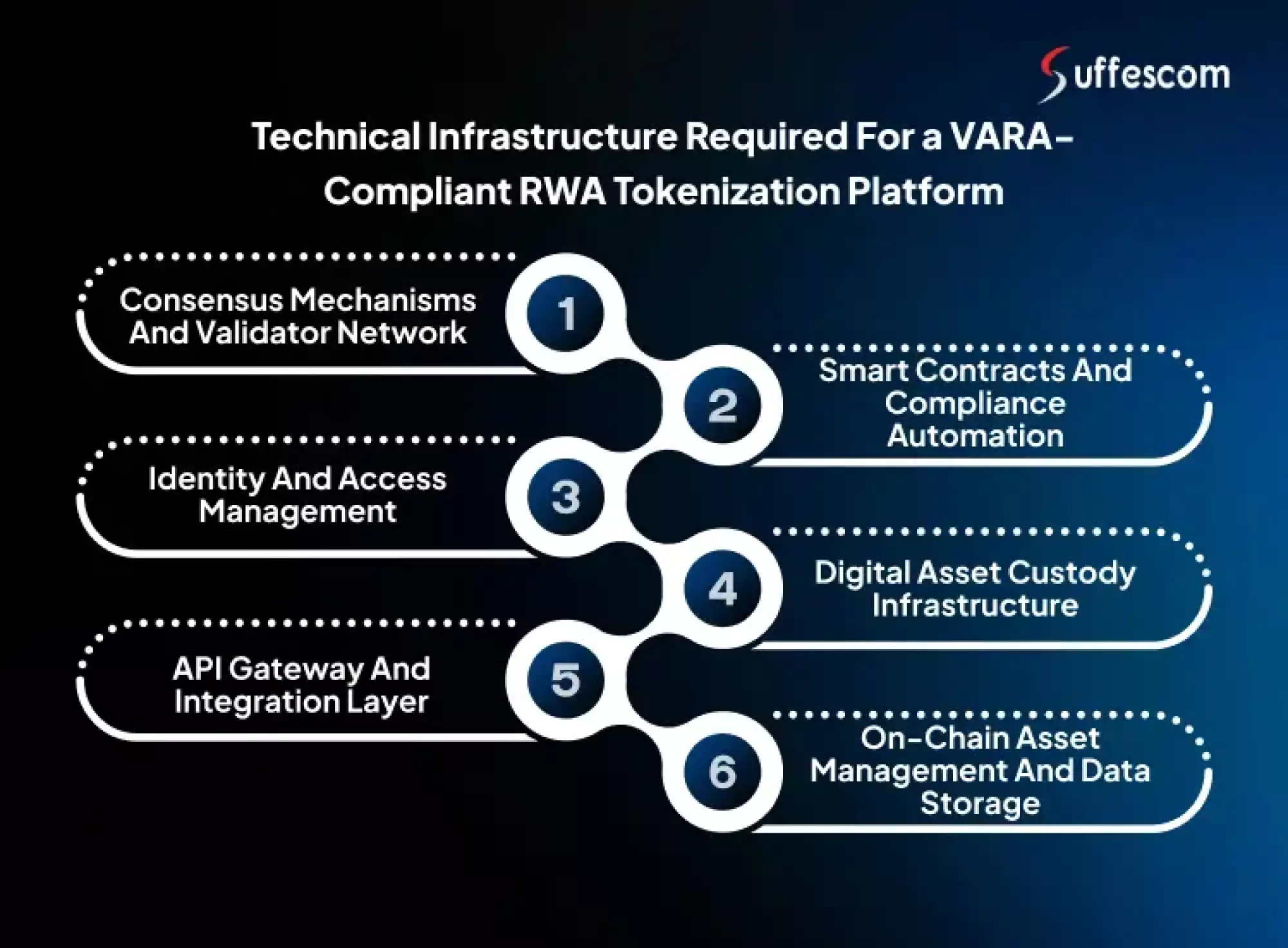
For a RWA tokenization platform to succeed, it needs more than just regulatory OKs. It must have a secure and scalable setup too. This handles things like asset tokenization, automated compliance, digital asset storage, and on-chain management while fitting Variable Rate Asset Rules' needs.
Consensus Mechanisms and Validator Network
The blockchain layer needs secure consensus mechanisms and validator nodes to keep transactions legit and the network safe. A good validator network makes sure that asset transfers are transparent, settlements happen when they should, and records aren't messed with.
Smart Contracts and Compliance Automation
Smart contracts take care of issuing assets, moving ownership, and enforcing rules. Putting AML and KYC checks, transfer limits, and sanction screenings right in these contracts means you get built-in compliance.
Identity and Access Management
For identity management, linking confirmed investor identities to blockchain actions is a must. These systems do KYC, manage credentials, whitelist wallets, and set up role-based controls to follow the VARA rules.
Digital Asset Custody Infrastructure
Keeping digital assets secure through stuff like MPC wallets, multi-signature stuff, key recovery methods, and proof-of-reserve practices is critical. This way, the platform guards both assets and investors' cash, boosting safety and reliability.
API Gateway and Integration Layer
API gateways link the blockchain to other systems, such as banks, compliance apps, payment handlers, and more. Plus, they handle auth, watch transactions, and offer validation services.
On-Chain Asset Management and Data Storage
When it comes to managing assets on the chain, there's a lot to track: who owns what, how tokens move around, revenue splits, and investor moves at all times. Though docs and records with private info stay protected off-chain.
ERC-3643 vs ERC-20: Choosing the Right Token Standard for RWA Platforms
Choosing the right token standard is key when building a compliant RWA tokenization platform. ERC-20 has been around forever for cryptocurrencies and utility tokens, but ERC-3643 was made with regulated assets and tokenized securities in mind.
ERC-20
ERC-20 gives you the basics for sending tokens around, but it doesn’t have any built-in way to do identity checks or stop unauthorized transfers. It just isn’t geared toward the strict rules that securities have.
ERC-3643
On the other hand, ERC-3643 is all about those institutional needs. It comes with identity verification and control over who can transfer what, and it’s set up to follow regulations right from the start.
Why ERC-3643 is Preferred for RWA Platforms
This is why ERC-3643 wins for VARA-compliant RWA platforms. It fits those Anti-Money Laundering and Know Your Customer rules perfectly, keeps transfers under control, and makes sure only eligible investors get in. That’s why it’s favored for tokenized securities and high-stakes assets.
AML/KYC Compliance: Core Pillars of VARA Compliance for Tokenization Platforms
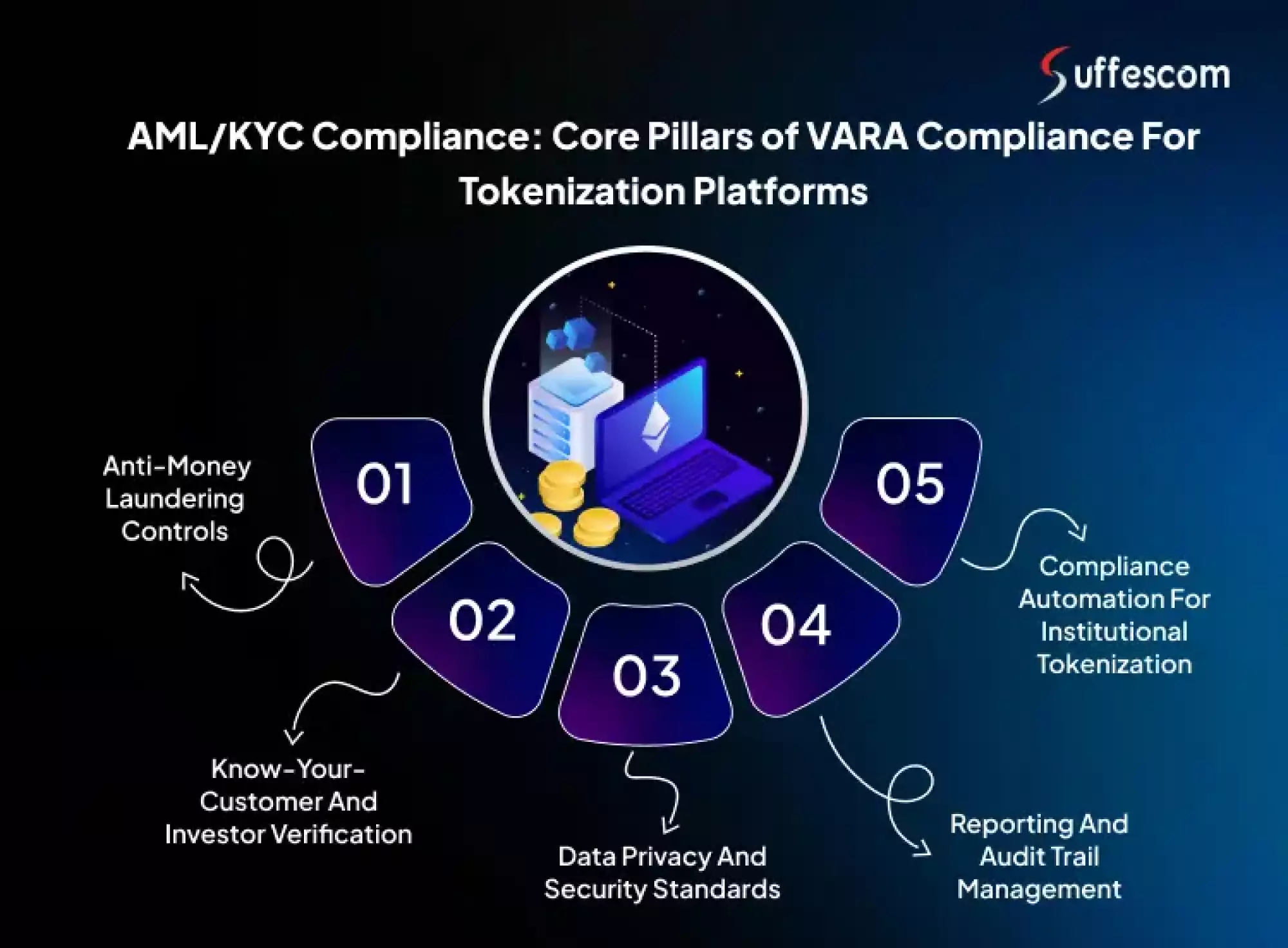
AML/KYC compliance forms the foundation of every VARA-compliant RWA tokenization platform, ensuring secure investor onboarding, transparent transactions, and continuous regulatory oversight.
Anti-Money Laundering Controls
VARA wants platforms to watch for transactions all the time. They need to catch things like wallet interactions and weird asset movements. These checks should be part of every transaction to make sure everything is compliant.
Know-Your-Customer and Investor Verification
Knowing your customers is not for when they first join. Tokenization platforms need to keep checking the risk of each investor verifying their identities and keep records of who is allowed to use their wallets. They also need to be able to show that they have done their diligence on each customer.
Data Privacy and Security Standards
A platform that follows VARA rules needs to be transparent but also keep information safe. While some records can be kept on the blockchain, sensitive information about investors should be. Kept off the blockchain to follow UAE data protection rules.
Reporting and Audit Trail Management
Regulators need to see records of what has happened and get reports automatically. Platforms should make reports about compliance, transaction history and investor activity from blockchain data. This makes everything transparent and ready for regulators.
Compliance Automation for Institutional Tokenization
As more institutions start using securities, making compliance automatic is crucial. Putting Anti-Money Laundering checks, Know-Your-Customer verification, transaction monitoring and reporting into contracts helps reduce risks and makes regulation more efficient. This is important for VARA compliance and for the growth of tokenization platforms in Dubai. Tokenization platforms must follow these rules to work well.
Common Mistakes During VARA Licensing and How to Avoid Them
Weak Compliance Documentation
Incomplete AML/KYC policies, risk assessments, and governance documents can delay or impact the licensing process.
Incomplete Custody Controls
Failing to implement secure digital asset custody measures, such as MPC wallets and key management procedures, can raise regulatory concerns.
Poor Governance Structures
Undefined roles, weak oversight mechanisms, and inadequate internal controls may affect VARA's assessment of operational readiness.
Inadequate Security Audits
Skipping comprehensive smart contract audits and security testing can expose the platform to vulnerabilities and compliance risks.
Underestimating Reporting Requirements
Many platforms overlook ongoing regulatory reporting obligations, which are essential for maintaining compliance after approval.
How to Start an RWA Tokenization Platform in Dubai: The VARA Licensing Roadmap
Follow this roadmap to navigate VARA regulations, secure the required approvals, and establish a compliant RWA tokenization platform in Dubai's rapidly evolving digital asset ecosystem.
Stage 1 — Commercial Trade License (Month 1–2)
Choose your free zone or mainland entity structure. For RWA tokenization, the top three options are:
- DMCC: Hosts multiple VARA-licensed entities. Strong for commodity and real estate-backed tokens. Good secondary market connectivity.
- IFZA: Most granular crypto activity classifications. Preferred by platforms with diverse service categories.
- DWTC: High institutional name recognition. Binance's regional HQ. Strong for platforms seeking large-ticket investor mandates.
- Relevant DET activity codes: virtual asset advisory, custody services, exchange operations, investment management.
Stage 2 — Initial Disclosure Questionnaire / IDQ (Month 2–5)
The IDQ is VARA's primary filter. It is an exhaustive technical and governance disclosure covering:
Regulatory business plan: revenue model, target market, technology stack specification
- Ownership structure: UBO chain, shareholding diagram, control map
- Governance framework: board composition, risk committee, compliance function org chart
- Senior management CVs, background checks, fit-and-proper declarations
- Financial projections (3-year), minimum capital proof, liquidity stress scenarios
- Smart contract architecture overview and planned audit methodology
- Custody model selection with supporting technical documentation
Stage 3 — Minimum Viable License / MVL (Month 5–10)
The MVL is a provisional operating license for controlled testing. VARA requires demonstrable proof of:
- Live AML/KYC workflows with end-to-end investor onboarding tested and documented
- Custody infrastructure deployed with signed qualified custodian agreement or MPC technical review
- Smart contract audit completed by a recognized security firm, report submitted to VARA
- Compliance automation modules live: transaction monitoring, sanctions screening, SAR filing
Stage 4 — Full VASP License (Month 10–18)
Full operational authorization follows a VARA supervisory assessment including technology audits, governance inspections, and live transaction monitoring reviews. Only at this stage can the platform onboard institutional investors and issue tokenized securities at commercial scale.
Technology Stack Required for a VARA-Compliant RWA Tokenization Platform
The success of an RWA tokenization platform depends on a carefully selected technology stack that supports secure asset issuance, compliance automation, investor onboarding, digital asset custody, and scalable on-chain asset management while meeting regulatory requirements.
| Technology Layer | Common Solutions | Purpose in RWA Tokenization Platforms |
| Blockchain Networks | Ethereum, Polygon, Avalanche, Hyperledger Fabric | Supports asset tokenization, transaction processing, ownership tracking, and on-chain asset management. |
| Smart Contract Frameworks | ERC-3643, ERC-1400, OpenZeppelin, Solidity | Enables token issuance, compliance automation, transfer restrictions, and investor eligibility controls. |
| KYC/AML Providers | Jumio, Sumsub, Onfido, Veriff | Facilitates investor onboarding, identity verification, sanctions screening, and AML/KYC compliance. |
| Digital Asset Custody Solutions | Fireblocks, BitGo, Copper, Anchorage Digital | Provides secure digital asset custody through MPC wallets, key management, and asset protection mechanisms. |
| Analytics & Monitoring Tools | Chainalysis, TRM Labs, Elliptic, Nansen | Supports transaction monitoring, risk assessment, blockchain analytics, and regulatory reporting. |
| API & Integration Layer | REST APIs, GraphQL, Webhooks | Connects blockchain infrastructure with banking systems, payment gateways, and third-party compliance tools. |
| Cloud & Infrastructure Services | AWS, Microsoft Azure, Google Cloud | Delivers scalable hosting, data storage, security monitoring, and disaster recovery capabilities. |
VARA Compliance for Tokenization Platforms: Ongoing Post-Licence Obligations
Post-licence obligations such as reporting, security audits, and compliance monitoring must be consistently followed under VARA crypto regulation in Dubai to ensure long-term regulatory approval and platform stability.
| Obligation | Frequency | Filed With |
| Annual Compliance Report (AML/KYC statistics, SAR counts, audit outcomes) | Annual | VARA |
| Financial Reporting (capital adequacy and liquidity positions) | Quarterly | VARA |
| Material Incident Reporting (security breaches, key personnel changes) | Within 24–48 hours | VARA |
| Platform Penetration Testing and Results Summary | Annual | Available to VARA upon request |
| Smart Contract Re-Audit After Material Upgrades | Post-upgrade | VARA |
| Proof-of-Reserve Attestations | Quarterly | Published on-chain and submitted to VARA |
| Business Continuity and Disaster Recovery Simulation Testing | Annual | Internal records and VARA upon request |
| Fit-and-Proper Review for Senior Management | Annual | VARA |
| Conflicts of Interest Register Review | Quarterly | Internal records |
Cost to Build a VARA-Compliant RWA Tokenization Platform
The cost of building a VARA-compliant RWA tokenization platform typically ranges from $30,000 to $300,000+, depending on the blockchain architecture, compliance infrastructure, digital asset custody requirements, smart contract complexity, and investor management features.
Blockchain Development Costs
Smart contract development, blockchain integration, and on-chain asset management infrastructure typically represent the largest single development cost component.
Compliance Infrastructure Costs
AML/KYC API integrations, blockchain analytics subscriptions, compliance automation systems, and the compliance monitoring platform represent ongoing and upfront costs.
Custody and Security Costs
MPC wallet infrastructure licensing, HSM deployment or cloud HSM subscriptions, and qualified custodian integration fees constitute the security cost base.
Licensing and Legal Expenses
VARA application fees, legal counsel for licensing and offering document preparation, regulatory advisory fees, and compliance documentation development represent the regulatory cost base.
Ongoing Operational Costs
Compliance personnel costs, ongoing security audits, blockchain infrastructure costs, and VARA reporting obligations represent the recurring annual cost of platform operations.
| Cost Category | One-Time Cost (USD) | Annual Recurring (USD) | Notes |
| Blockchain & Smart Contract Development | $15,000 – $100,000 | $5,000 – $25,000 | Depends on blockchain selection, token standards, and platform complexity |
| AML/KYC Compliance Infrastructure | $3,000 – $25,000 | $2,000 – $15,000 | KYC providers, sanctions screening, and compliance monitoring tools |
| Digital Asset Custody & Security | $5,000 – $40,000 | $3,000 – $20,000 | MPC wallets, multi-signature controls, and security management |
| VARA Licensing & Legal Support | $5,000 – $50,000 | $3,000 – $15,000 | Licensing assistance, legal consultation, and compliance advisory |
| Smart Contract Auditing | $2,000 – $20,000 | $2,000 – $10,000 | Initial security audit and periodic contract reviews |
| Investor Portal & Dashboard Development | $5,000 – $40,000 | $2,000 – $10,000 | Investor onboarding, reporting, and asset management features |
| Infrastructure & Cloud Services | $2,000 – $15,000 | $2,000 – $12,000 | Servers, API integrations, monitoring, and backups |
| Operations & Compliance Management | Setup dependent | $10,000 – $80,000 | Compliance officers, technical support, and platform maintenance |
| Total Estimated Range | $30,000 – $300,000+ | $29,000 – $187,000+ | Final cost depends on licensing scope, features, and compliance requirements |
ROI of Building a VARA-Compliant RWA Tokenization Platform
Building a tokenization platform costs money upfront, but it pays off in the long run. A good platform makes operations smoother, reduces risks and opens up ways to make money. This helps businesses grow steadily in Dubai's asset market.
Smoother Operations
Using contracts and automated systems reduces manual work. This makes things run faster and cheaper. It also helps manage investors
New Revenue Opportunities
Tokenization platforms make money in ways:
- Charging for issuing and trading assets
- Offering custody services
- Providing subscriptions and tokenization services to institutions
Reduced Regulatory Risk
A platform with built-in compliance and reporting features helps avoid fines and reputational damage. This is because it has:
- AML/KYC checks
- Audit trails
- Reporting
Scalability and Growth
A strong blockchain foundation allows platforms to handle more assets, investors and transactions. This is without making operations overly complex.
Enhanced Investor Confidence
Platforms with governance and regulatory compliance attract big investors. They also provide digital asset storage. This makes investors trust tokenized assets more.
Common Challenges in Building an RWA Tokenization Platform
Regulatory Complexity
Building a compliant platform is hard. It involves following rules like getting a license, keeping assets safe, running an exchange and protecting investors. You need to know UAE rules and global standards. This often needs experts in law and compliance.
Custody Management Challenges
Creating a system to hold digital assets is tough. It requires wallets, managing keys, having a plan for recovery, and showing that assets are secure. If the system is weak, it can put the platform at risk.
Liquidity Constraints
Making a market for assets where people can easily buy and sell is a big challenge. Platforms use market makers, pools of assets and partnerships with traders to make it easier for investors to participate and exit.
Security Risks
There are security risks like problems with smart contracts, manipulating data attacks on wallets and unfair trading practices. To protect investors, platforms need to check smart contracts, monitor transactions and have a plan for emergencies.
Investor Adoption Barriers
Many investors do not understand blockchain-based investments. To build trust, platforms need to communicate, educate investors and follow regulations strictly. This will help more people invest in assets.
FAQs
1. What is VARA compliance in UAE crypto regulations?
VARA compliance means meeting the full licensing, operational, AML/KYC, custody, and reporting requirements of the Virtual Assets Regulatory Authority under Dubai Law No. 4 of 2022. For RWA tokenization, this spans the entire lifecycle from asset origination and smart contract deployment through investor onboarding and ongoing supervisory reporting.
2. Can a foreign company offer a Dubai RWA tokenization platform without a VARA license?
No. VARA's jurisdiction extends to any platform marketing tokenized assets to UAE-based investors or conducting VASP activities in Dubai. Regardless of where the legal entity is incorporated. Offshore platforms with UAE-facing marketing have received formal VARA warnings.
3. Is smart contract auditing mandatory for VARA compliance?
Yes. Smart contract auditing by a recognized third-party security firm is required before deployment, with the audit report submitted to VARA as part of the technology infrastructure disclosure. Re-audits are required after any material contract upgrade.
4. What blockchain should I use for a VARA-compliant RWA tokenization platform?
VARA does not consider the main chain, but ERC-3643 (T-REX Protocol) on Ethereum is the institutional standard for tokenized securities due to its native on-chain compliance enforcement. Avalanche Subnets and Hyperledger Besu are used for private institutional deployments.
5. How much does it cost to build a VARA-compliant RWA tokenization platform?
The cost of building a VARA-compliant RWA tokenization platform typically ranges from $30,000 to $300,000+, depending on the platform's features, compliance requirements, custody infrastructure, and level of customization. More advanced platforms with trading, automation, and institutional-grade security generally require a higher investment.
6. How long does VARA licensing take for an RWA tokenization platform?
The VARA licensing process typically takes 9–18 months from Initial Disclosure Questionnaire (IDQ) submission to full VASP authorization. Complex platforms offering multiple services such as issuance, custody, and exchange usually fall toward the upper end of this timeline. The IDQ preparation phase itself generally requires 2–4 months for documentation, governance structuring, and technical readiness.