An emergency fuel delivery app is an on-demand mobile platform that allows users to request fuel delivery directly to their location, whether they are stranded on the road, at home, or managing fleet operations. These apps typically connect users with fuel providers who deliver petrol or diesel in certified containers, ensuring safety and compliance.
Unlike traditional fuel stations, these apps prioritize convenience, speed, and accessibility, making them highly valuable in urgent situations.
Why Fuel Delivery Apps Are Gaining Popularity
Fuel delivery apps are rapidly gaining traction due to changing consumer expectations and advancements in logistics technology. Modern users prefer on-demand services, and fuel delivery fits perfectly into this ecosystem.
Key reasons for growth include:
- Increased vehicle ownership globally
- Busy lifestyles demand convenience
- Growth in fleet and logistics businesses
- Expansion of digital payment ecosystems
- Rising demand for contactless services post-pandemic
Launch Your Fuel Delivery Startup Today
Market Growth of Fuel Delivery Services
The fuel delivery market has shown strong growth over the past few years, driven by urbanization and digital adoption.
- The global fuel delivery market is projected to grow at a CAGR of 6–8% over the next decade.
- On-demand delivery services (including fuel) are expected to surpass $335 billion globally.
- Fleet-based fuel delivery solutions are seeing significant adoption in n logistics and transportation sectors.
- Countries like India, the US, and the UAE are emerging as key markets.
This growth signals strong long-term potential for entrepreneurs entering this space.
Key Players in the Fuel Delivery App Market
Several companies have already established strong positions in the fuel delivery ecosystem. Their business models provide valuable insights into how this industry operates and scales profitably:
1. Booster (USA)
One of the pioneers in mobile fuel delivery, Booster primarily focuses on B2B services. It partners with corporate offices and fleet operators to provide scheduled fuel delivery, reducing downtime and improving operational efficiency. Its subscription-based and contract-driven model ensures recurring revenue.
2. CAFU (UAE)
CAFU operates a strong B2C model, delivering fuel directly to consumers’ vehicles at home or work. The company leverages convenience as its core value proposition and monetizes through delivery fees, premium services, and partnerships.
3. Yoshi Mobility (USA)
Yoshi Mobility offers more than just fuel delivery, including car maintenance services. Its diversified service model helps increase customer lifetime value and opens multiple revenue streams beyond fuel.
4. FuelBuddy (India)
FuelBuddy focuses heavily on B2B clients such as construction sites and logistics companies. Its strength lies in bulk fuel delivery and long-term contracts, ensuring stable and predictable income.
5. EzFill (USA)
EzFill targets both individual users and businesses with on-demand fuel delivery. It emphasizes technology-driven logistics and real-time tracking to enhance customer experience.
Overall, these platforms successfully combine B2B and B2C strategies, with a strong emphasis on fleet partnerships to generate consistent and scalable revenue streams.
Turn Fuel Demand Into a Profitable Business
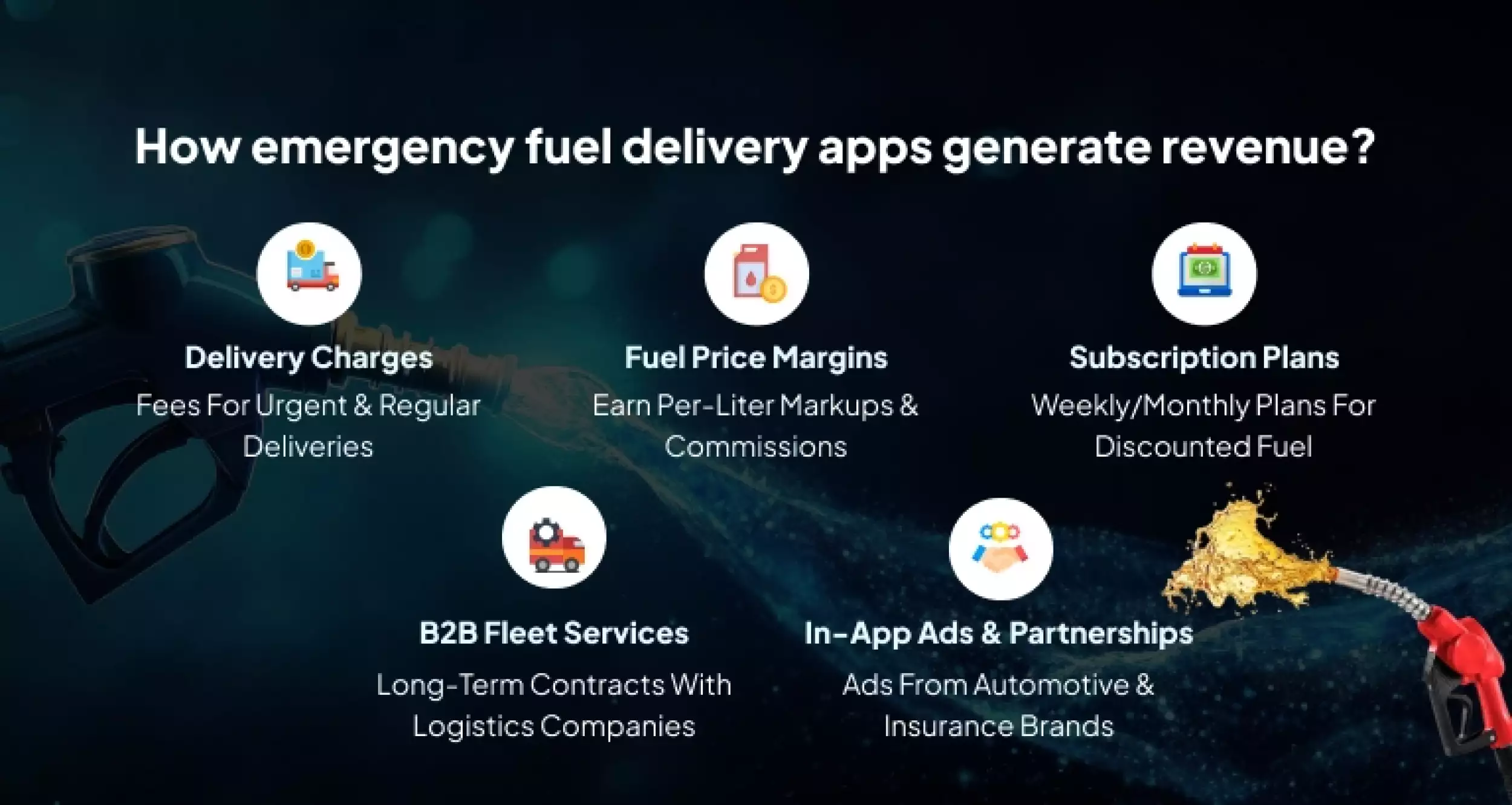
How Emergency Fuel Delivery Apps Generate Revenue
Understanding how a fuel delivery app makes money requires looking at multiple revenue streams rather than a single source.
1. Delivery Charges and Convenience Fees Explained
Most apps charge a fixed delivery fee or a distance-based convenience fee. This is the primary revenue stream.
- Emergency deliveries = higher charges
- Scheduled deliveries = lower fees
- Premium users may get discounted or free delivery
2. Fuel Pricing Margins and Commission Structure
Fuel delivery apps often earn through:
- Markup on fuel price (small per-liter margin)
- Commission from partnered fuel stations
- Bulk fuel purchase at discounted rates, then reselling
3. Subscription Plans
Some apps offer subscription models:
- Monthly or yearly plans
- Free deliveries or discounted fuel rates
- Priority service access
4. B2B Fleet Services
One of the most profitable segments:
- Delivery to logistics companies, cab fleets, and construction firms
- Long-term contracts ensure recurring revenue
5. In-App Advertising & Partnerships
- Promotions from automotive brands
- Ads for insurance, servicing, or accessories
- Cross-selling vehicle-related services
Fuel Delivery App Business Model
The Fuel Delivery App Business Model typically includes the following approaches:
1. Aggregator Model
Connects users with nearby fuel providers through a digital platform. The app earns revenue via commissions, service fees, or partnerships without owning inventory, making it asset-light and easier to scale.
2. Inventory-Based Model
The company owns fuel storage, vehicles, and delivery infrastructure. This model offers higher control over pricing and quality but involves significant investment, regulatory compliance, and operational management.
3. Hybrid Model
Combines aggregator and inventory-based approaches. It allows flexibility, better scalability, and diversified revenue streams by serving both direct customers and partner networks.
4. Impact on Business
Each model directly affects profitability, scalability, compliance requirements, and operational complexity.
Each model impacts profitability, compliance, and operational complexity.
Delivery Charges and Convenience Fees Explained
These charges vary depending on:
- Location and distance
- Fuel quantity
- Urgency of delivery
Typical pricing strategy:
- Base delivery fee
- Surge pricing during peak hours
- Emergency premium charges
This dynamic pricing ensures consistent revenue while managing demand.
In What Conditions Can a Fuel Delivery App Generate Huge Money: Best Opportunities
Fuel delivery apps can become highly profitable when they operate under the right market conditions and demand scenarios. Below are the key opportunities where revenue potential significantly increases:
1. Rural and Agricultural Demand
In remote areas where fuel stations are scarce, farmers and rural users rely heavily on doorstep delivery. This creates consistent and bulk demand, especially during harvesting seasons.
2. High Urban Vehicle Density
Cities with heavy traffic and a large number of vehicles offer strong demand for convenience-based services, allowing apps to charge premium delivery fees.
3. Frequent Fuel Price Fluctuations
Apps can leverage dynamic pricing strategies during price hikes or shortages, increasing margins and profitability.
4. Limited Access to Fuel Stations
Locations like highways, construction sites, and industrial zones create high-value emergency demand where users are willing to pay extra.
5. Subscription-Based Models
Offering monthly or yearly plans ensures recurring revenue and improves customer retention.
6. Government Regulations Supporting Doorstep Delivery
Favorable policies and legal frameworks can accelerate adoption and reduce operational barriers.
7. Expansion into EV Charging (Future Opportunity)
Integrating mobile EV charging services opens new revenue streams as electric vehicle adoption grows.
8. War Situation / Crisis Conditions
During emergencies or supply disruptions, demand spikes significantly, allowing platforms to generate high short-term revenue.
The biggest profits usually come from fleet fueling contracts, not individual users.
Profitability Challenges and Risk Factors
Despite the opportunity, there are several challenges:
- Strict government regulations on fuel transport
- High operational costs (vehicles, safety compliance)
- Thin profit margins on fuel pricing
- Logistics and last-mile delivery complexity
- Safety risks and liability concerns
These factors must be carefully managed to maintain profitability.
Tap Into the Booming Fuel Delivery Market
Fuel Delivery App Development: Key Features
To successfully build a fuel delivery app, focus on:
- Real-time location tracking
- Route optimization
- Secure payment integration
- Order scheduling
- Push notifications
- Admin dashboard
- Driver management system
If you plan to build a Fuel Station Finder App, you can integrate:
- Nearby fuel stations
- Price comparison
- Navigation support
How to Build a Profitable Fuel Delivery App
To ensure long-term success and sustainable revenue, focus on the following key strategies:
1. Start with a Target Market Niche
Identify whether you want to serve B2B clients (fleet owners, logistics companies) or urban consumers. A focused niche helps in building a strong value proposition and faster market penetration.
2. Ensure Regulatory Compliance
Fuel delivery is a highly regulated sector. Obtain necessary licenses, follow safety standards, and comply with local government norms to avoid legal issues.
3. Partner with Certified Fuel Suppliers
Collaborate with authorized fuel providers to ensure quality, trust, and uninterrupted supply, which directly impacts customer retention.
4. Focus on Logistics Optimization
Efficient route planning, delivery scheduling, and fleet management reduce operational costs and improve service speed.
5. Use Data Analytics for Pricing and Forecasting
Analyze user behavior, demand patterns, and fuel trends to implement dynamic pricing and accurate demand forecasting.
6. Build a Strong User Experience
Develop an intuitive app with real-time tracking, secure payments, and easy booking to enhance customer satisfaction and loyalty.
Tips to Maximize Revenue in Fuel Delivery Apps
- Offer subscription plans for recurring income
- Target fleet businesses for bulk orders
- Use dynamic pricing models
- Upsell additional services (car wash, oil change)
- Optimize delivery routes to reduce costs
- Implement loyalty and referral programs
Conclusion
Understanding how a fuel delivery app makes money reveals that success lies in diversified revenue streams, not just fuel sales. From delivery fees and subscriptions to fleet contracts and partnerships, the business model is robust but requires careful execution.
With rising demand for convenience and digital services, fuel delivery apps present a promising opportunity, especially for businesses that can navigate regulatory and operational complexities effectively.
FAQs
1. Is Investing in a Fuel Delivery App Worth It?
Yes, especially if you target B2B clients and high-demand urban areas. The recurring revenue model makes it a strong long-term investment.
2. How does an emergency fuel delivery app generate revenue?
They generate revenue through delivery fees, fuel margins, subscriptions, fleet contracts, and partnerships.
3. What is the biggest revenue source for fuel delivery apps?
Fleet services and bulk fuel delivery contracts typically generate the highest and most stable income.
4. What are the main challenges in fuel delivery app development?
Regulatory compliance, logistics management, safety standards, and operational costs are the biggest challenges.
5. How long does it take to develop a fuel delivery app?
It usually takes 3 to 6 months for a basic app and up to 9–12 months for a fully advanced platform.