Key Takeaways
- Marketplace app development in Saudi Arabia can cost anywhere from $20K to $300K+ (SAR 75K–SAR 1,125,000+), depending on complexity, features, technology stack, and scalability requirements.
- MVP development is a practical approach for startups to validate their marketplace idea, while businesses targeting large-scale growth should invest in custom, scalable solutions.
- The biggest cost factors include backend complexity, marketplace type, user roles, integrations, AI features, payment systems, and ongoing maintenance needs.
- Choosing between SaaS, white-label, open-source, and custom development depends on your budget, timeline, customization needs, and long-term business goals.
- Marketplace profitability depends on more than development cost. Factors like user acquisition, transaction volume, commission structure, and customer retention directly impact ROI.
- Saudi Arabia's growing digital economy and Vision 2030 initiatives create strong opportunities for businesses building marketplace platforms across industries such as B2B, healthcare, real estate, automotive, grocery, and services.
The digital economy of Saudi Arabia is witnessing explosive growth with significant possibilities for marketplace business in the retail, healthcare, real estate, automotive, logistics, and on-demand sectors. Backed by programs under Vision 2030 and an increase in smartphone users and preference for online shopping, marketplace businesses are now concentrating on creating platforms where buyers and sellers come together while generating steady income through commissions and subscriptions.
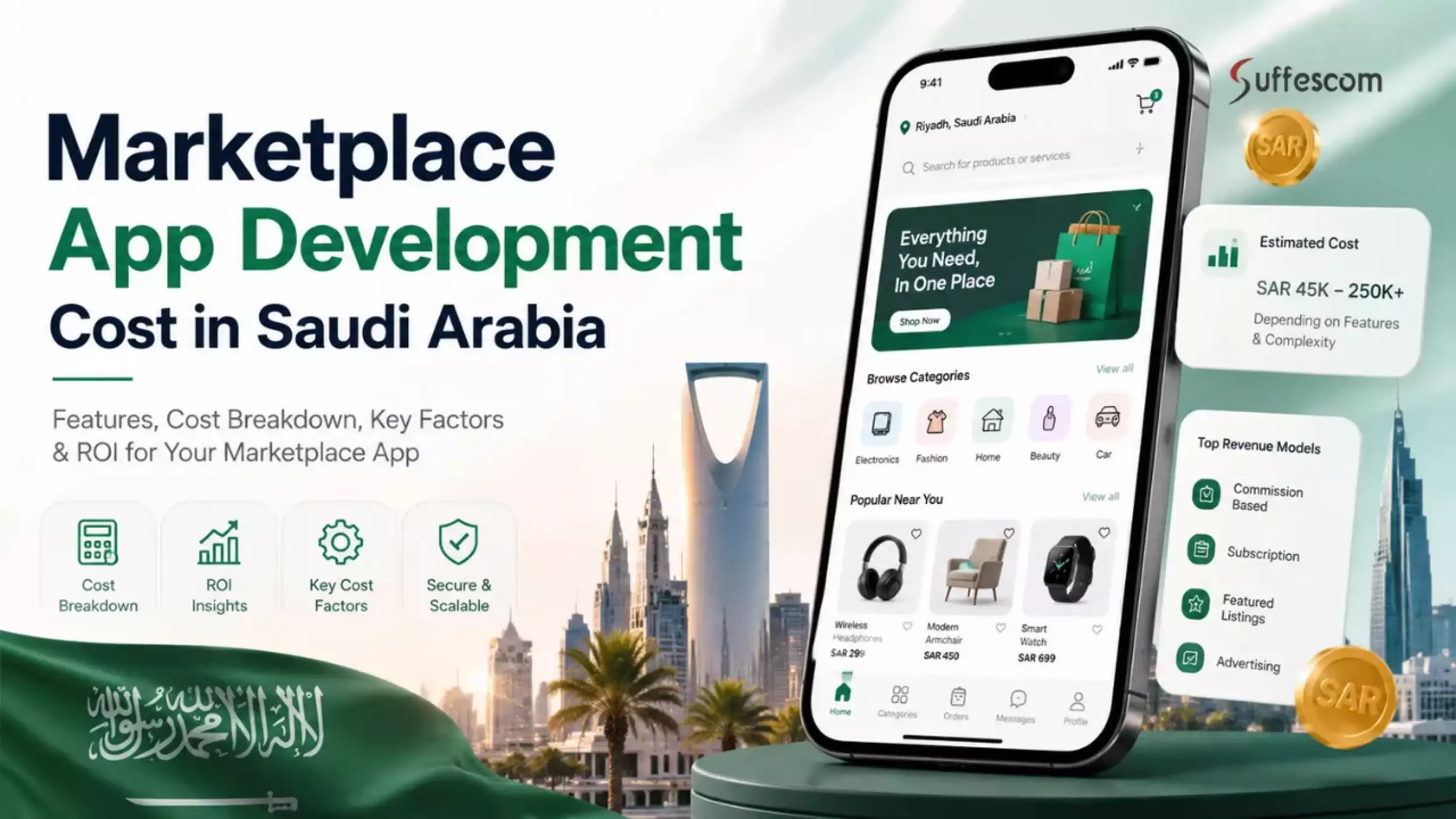
One of the key questions for many startups and companies is, "What is the cost of marketplace app development in Saudi Arabia?" It depends on such aspects as the complexity of the project, technology stack used, chosen platform, integration, security, and scalability. While a basic marketplace app might cost from $20,000 to $35,000 (SAR 75,000 to SAR 130,000), more advanced apps with AI support, complex analytics, and microservices architecture might cost over $300,000 (SAR 1,125,000).
This guide provides a thorough analysis of the cost of developing a marketplace app in Saudi Arabia for 2026. We explain what factors influence pricing in the process of marketplace app development and how the development costs can vary by sector, technology stack, operational costs, and possible return on investment.
Marketplace App Development: Quick Cost Overview
Depending on whether you need to test your startup concept, start a regional marketplace, build a national platform, or develop a powerful enterprise solution, the budget of your project should be set according to your business needs. Below you will find some information on the average budget and time needed, as well as the best development strategy.
| Business Goal | Estimated Budget (USD) | Estimated Budget (SAR) | Timeline | Recommended Approach |
| Validate Startup Idea | $20K–35K | SAR 75K–130K | 3 Month | MVP Development |
| Launch Regional Marketplace | $40K–80K | SAR 150K–300K | 5–7 Months | Cross-Platform Development |
| Build a National Marketplace | $80K–180K | SAR 300K–675K | 8–12 Months | Custom Marketplace Development |
| Enterprise Marketplace Platform | $180K–$300K | SAR 675K–1,125K | 12–18 Months | Native Apps + Microservices Architecture |
Why Marketplace Apps are Becoming Billion-Dollar Businesses in Saudi Arabia
Saudi Arabia is becoming a major online marketplace in the Middle East, fueled by government support for digital transformation, extensive internet access, high mobile usage, and secure payment systems. DataReportal's "Digital 2026" reveals that the country has 34.4 million internet users (99% penetration) and 48.7 million active mobile connections. Marketplace platforms connect buyers and sellers without requiring inventory, earning through commissions, subscriptions, and advertising.
Vision 2030 and Growth of Digital Commerce
Saudi Vision 2030 has boosted investment in Saudi Arabia's digital economy through smart infrastructure, fintech, cloud computing, AI, logistics, and e-government services. This improvement has strengthened marketplace platform operations, enhancing payment systems, logistics, and online transaction trust.
The eCommerce market in Saudi Arabia is projected to reach USD 31.3 billion by 2026 and nearly USD 54.9 billion by 2031. (GlobeNewswire)
Why Investors Prefer Marketplace Business Models
Marketplace companies generally grow faster than inventory-based businesses since they serve as transaction facilitators, requiring less capital and lower operating costs. Their business model benefits from strong network effects, where increasing customer numbers help both buyers and sellers.
With diverse revenue streams like commission fees, subscriptions, and ads, marketplaces often achieve better scalability and profitability. According to Statista, the Saudi Arabian eCommerce market is estimated to produce about USD 22.84 billion in 2026, making marketplace platforms an increasingly attractive investment.
Industries Transforming Through Marketplaces
Some of the sectors that are implementing the marketplace business model in Saudi Arabia include:
- Healthcare: Telemedicine services, appointment booking, pharmacies, and marketplace services for healthcare providers.
- Real estate: Buying, leasing properties, commercial properties, and virtual tours of real estate.
- Automotive: Car selling, renting, spare parts, servicing, and marketplace services.
- B2B Trade: Wholesaling, sourcing suppliers, and industrial procurement.
- Food Items: Buying from multiple vendors, delivery services, and rapid commerce solutions.
- Luxury Retail: Luxe fashion items, watches, jewelry, and resale markets for luxury items.
- Services Marketplace: Home services, cleaning services, beauty services, educational services, repair services, and consultancy services.
Saudi Arabia vs. UAE: Market Maturity
Compared to the UAE, the market maturity of Saudi Arabia in terms of a digital marketplace ecosystem is still relatively lower, although it has a much bigger population and a more advanced digital economy. Although the UAE has been enjoying a highly evolved digital transformation ecosystem, there are many more growth prospects in the case of Saudi Arabia.
According to IMARC Group's data, Saudi Arabia's eCommerce market size is predicted to reach US$54.9 billion by 2031, at a CAGR of about 11.2% in 2026-2031. While the UAE can be considered a mature marketplace, Saudi Arabia is currently in a high-growth stage.
In the case of businesses looking at GCC expansion, the UAE acts as a validating marketplace, whereas Saudi Arabia acts as a scale-up option and offers many growth opportunities.
Launch Your Marketplace App Solution Built with a Secure and Scalable Growth Strategy!
Marketplace App Development Cost in Saudi Arabia (2026 Pricing)
The cost of building a marketplace application in Saudi Arabia is dictated by a variety of factors such as the complexity of the platform, feature set, technology stack used, integration options required, security aspects, and scalability. Although building an MVP is a relatively cheaper option that helps startups validate their business idea, building enterprise-grade marketplaces requires much more resources and effort.
The following table reflects the estimated development cost of different types of marketplace apps in 2026.
| Complexity | Cost (USD) | Cost (SAR) | Team Size | Timeline |
| MVP | $20K–35K | SAR 75K–131K | 4-6 | 12 Weeks |
| Standard | $40K–80K | SAR 150K–300K | 6–8 | 5 Months |
| Advanced | $80K–150K | SAR 300K–560K | 8-12 | 8 Months |
| Enterprise | $150K–300K+ | SAR 560K–1.1M+ | 12+ | 12–18 Months |
How Marketplace App Development Cost Is Actually Calculated
Most of the cost estimates do not give any explanation as to how the costs are calculated. The truth of the matter is that the costs involved in developing marketplace apps depend on the resources, work, and technology involved in developing, launching, and maintaining the apps.
Cost Calculation Formula for Development
Development Costs = (People × Hours × Hourly Rate) + Infrastructure + Third-Party Services + Maintenance
This formula indicates the major components of costs in the development of market apps. It should be noted that the development costs make up the bulk of the investment involved.
| Cost Driver | Weight |
| Development Hours | 45% |
| Backend Complexity | 20% |
| UI/UX Design | 10% |
| Quality Assurance (QA) | 10% |
| Infrastructure | 8% |
| Project Management | 7% |
- Development Hours (45%) form the biggest cost driver, involving frontend and backend development of mobile applications, testing, and launching the platform.
- Backend Features Complexity (20%) depends on such functions as multi-vendor system support, payment systems, real-time communication, artificial intelligence recommendations, and integrations with other external services.
- UI/UX Design (10%) is aimed at making the process of navigation convenient for the users and developing a seamless user journey through the marketplace.
- Quality Assurance (10%) comprises functional testing, performance optimization, security testing, and bug fixing before the launch of the platform.
- Infrastructure (8%) implies providing cloud hosting, databases, storage, content delivery networks (CDNs), and other backend services necessary for the operation of the platform.
- Project Management (7%) ensures that projects are well-planned, coordinated, and delivered on time.
An understanding of how cost drivers influence the total budget will help businesses calculate development costs more accurately.
Cost Breakdown Across Every Development Phase
Marketplace application development is not only about programming. Each step from the beginning of the project till its deployment after launch requires specific competencies, which contribute to the development budget of the platform differently. Working on every stage of building a platform ensures less risk, better quality, and scalability of your solution.
Discovery
The discovery stage is the first stage when you determine the goals of your project, target audience, competitors, revenue model, and technical requirements. You will also develop the project scope and timeline and define the risks before starting the development.
Product Strategy
At this stage, you create the product roadmap when you prioritize features, define the minimum viable product, choose the technology stack, and develop the release plan. In addition, at this stage, the marketplace architecture is defined, and the way of scaling up your solution is discussed.
Wireframing
Wireframes are the visual representation of your marketplace application. They show user journey maps and navigation flows in them. It gives the stakeholders a chance to verify the product structure and increase its usability before entering the design and development stages.
UI Design
The UI designers turn wireframes into attractive, interactive interfaces with the help of visual design, layout, design systems, animation, and prototyping to deliver an experience that corresponds to the branding.
Backend Development
The backend development phase is the most resource-consuming phase as it results in the functionality of the platform. It includes the following activities: working with APIs, databases, authentication, vendor management, product catalogs, payments, orders, notifications, analysis, and third-party integration.
Mobile Development
The developers build the application for iOS, Android, or a cross-platform framework (such as Flutter or React Native). This phase involves the implementation and optimization of the features, which allows for the best user experience for the devices.
Testing
QA checks that the marketplace is stable, safe, and ready for launch. The testing process includes functional verification, UI testing, security, performance, and compatibility testing.
Deployment
The deployment phase covers cloud infrastructure configuration, publishing of the application on Google Play and Apple App Store, production environment setup, monitoring of performance, and post-launch support.
| Development Phase | Estimated Hours | Estimated Cost (USD)* |
| Discovery | 40 | $2,000–4,000 |
| Product Strategy | 60 | $3,000–6,000 |
| Wireframing & UI Design | 120 | $6,000–12,000 |
| Backend Development | 350 | $17,500–35,000 |
| Mobile Development | 450 | $22,500–45,000 |
| QA & Testing | 180 | $9,000–18,000 |
| Deployment | 30 | $1,500–3,000 |
Marketplace Features That Have the Biggest Impact on Budget
All the features do not play an equal role in increasing the development cost of the entire project. Basic functions of the marketplace, including user sign-up and product listing, are easier to implement compared to AI recommendations and multi-vendor wallets. However, prioritization of features according to their business value can help minimize the development cost of the project.
AI Recommendation Engine
The recommendation engines make use of knowledge about consumer behavior, purchase history, and website navigation to give personalized recommendations about products. Although it is essential to apply machine learning and deal with big data, these systems can significantly enhance user engagement, conversion, and loyalty.
Live Chat
The ability to instantly contact other people allows users to get assistance or feel more confident while purchasing products. Development cost depends on such functions as file transfer, notifications, and chat moderation.
Multi-Vendor Wallet
It is a tool for managing commission rates, payments to vendors, and refund requests. Given that it deals with money transactions and payment gateways, it is rather difficult to develop a multi-vendor wallet.
Product Search & Filters
The advanced search with filtering options, sorting, autocomplete function, and personalized results makes it easier to find products. The more complex a catalog is, the more effort it takes to implement such a search engine.
Dynamic Pricing
Dynamic pricing technology sets prices based on various factors such as demand, inventory, user behavior, and other parameters. It includes the implementation of pricing algorithms.
Analytics Dashboard
The analytics dashboard allows getting instant analytics on sales, user behavior, vendor performance, stock, and revenues. While cheaper than AI-based tools, it gives important information for making smart decisions for further development of your business.
Cost Comparison Depending on Marketplace Business Model
The choice of your marketplace business model directly affects its development costs, technical challenges, and potential revenue generation. Some models demand quite a simple workflow implementation, but there are also models that include more complicated transaction processes, several roles of users, scheduling, logistics, or even real-time communication possibilities.
| Marketplace Type | Difficulty Level | Estimated Cost (USD) | Estimated Cost (SAR) | Revenue Potential |
| B2C | Medium | $40K–80K | 150K–300K | High |
| B2B | High | $80K–180K | 300K–675K | Very High |
| C2C | Medium | $35K–70K | 131K–263K | Medium |
| Rental | High | $70K–150K | 263K–563K | High |
| Service | High | $60K–140K | 225K–525K | Very High |
| Hyperlocal | Very High | $120K–300K+ | 450K–1.1M+ | Very High |
B2C Marketplace
B2C marketplaces are designed to connect businesses with consumers. Features included in B2C marketplaces are catalogs, payments, tracking of orders, and reviews. B2C marketplaces are simple to develop and have a great revenue model in commissions and subscriptions.
Marketplace Examples: Amazon, Noon
B2B Marketplace
B2B marketplaces have complex features such as bulk ordering, custom pricing, supplier management, requests for quotes, and approvals, among others. The complexity involved makes development costs higher; however, B2B marketplaces generate high transactions and long-term relationships.
Marketplace Examples: Alibaba.com, Sary (Saudi Arabia)
C2C Marketplace
A C2C marketplace is a platform for buying and selling products and services between consumers. C2C features to be considered while developing include authentication, ratings and reviews, dispute resolution, and payment features.
Marketplace Examples: eBay, OpenSooq
Rental Marketplace
Rental marketplaces are used to make arrangements for the renting of items like vehicles, equipment, or real estate property. Rental marketplaces' development includes availability calendars, booking management, deposits, cancellations, and prices. A rental marketplace has high technical complexity.
Marketplace Examples: Airbnb, Keyper (UAE)
Service Marketplace
Service marketplaces are used to arrange services for activities including health care, education, consulting, etc. Real-time booking, scheduling, chats, location management, and payment management, among other factors, contribute to higher development costs.
Marketplace Examples: Upwork, Marn (Saudi Arabia)
Hyperlocal Marketplace
Hyperlocal marketplaces are characterized by connecting buyers and sellers who are located close by. The use of hyperlocal marketplaces can be found in the context of delivering groceries, ordering food, pharmacies, and local services. Hyperlocal marketplaces need to have capabilities like GPS tracking, route optimization, delivery management, and real-time notifications. This makes hyperlocal marketplaces some of the most complicated marketplaces to develop.
Marketplace Examples: HungerStation, Jahez, Talabat
Costs of Marketplace App Development by Industry
Different industries imply different development costs because each one has its specific characteristics, regulations, integrations, etc. The grocery marketplace app needs real-time inventory and delivery tracking, while the health care marketplace app needs data security and scheduling.
| Industry | Estimated Cost (USD) | Estimated Cost (SAR) |
| Grocery Marketplace | $80K–150K | SAR 300K–560K |
| Fashion Marketplace | $40K–80K | SAR 150K–300K |
| Healthcare Marketplace | $80K–180K | SAR 300K–675K |
| Real Estate Marketplace | $80K–150K | SAR 300K–560K |
| Food Delivery Marketplace | $150K–300K+ | SAR 560K–1.1M+ |
| Car Marketplace | $80K–150K | SAR 300K–560K |
| Job Marketplace | $40K–80K | SAR 150K–300K |
| Construction Marketplace | $80K–150K | SAR 300K–560K |
| Education Marketplace | $40K–80K | SAR 150K–300K |
Grocery Marketplace
Examples: Nana, Carrefour Online
Inventory synchronization, delivery management, route optimization, real-time order tracking, and multi-payment systems make it more complicated than a regular marketplace.
Fashion Marketplace
Examples: Ounass, Namshi
Includes product catalogs, personalization features, wishlists, user reviews, and secure payments. The expenses stay rather low as there are fewer complications involved.
Healthcare Marketplace
Examples: Vezeeta, Cura
Marketplaces for the healthcare industry have to include appointment scheduling, telemedicine services, patients' data security, integration with EHR, etc., which makes their development more expensive.
Real Estate Marketplace
Examples: Bayut, Property Finder
Real estate marketplaces have advanced property search, mapping, virtual tours, mortgage calculators, CRM integration, etc., thus increasing complexity at both backend and frontend levels.
Food Delivery Marketplace
Examples: Jahez, HungerStation, Talabat
Food delivery marketplaces have restaurants, customers, food delivery, order tracking in real time, dispatching, GPS integration, dynamic pricing, and other functionalities, thus making it the costliest among all.
Car Marketplace
Examples: CarSwitch, YallaMotor
The car marketplaces have advanced search, finance options, inspection reports, dealer management, and appointment scheduling features, thus increasing complexity at the workflow level.
Job Marketplace
Examples: Bayt.com, Naukrigulf
Job marketplaces have employer dashboards, resume management, candidate matching, messaging, interview scheduling, and artificial intelligence recommendation features, depending on the requirements of projects.
Construction Marketplace
Examples: MawadOnline (B2B construction procurement), BuildZoom (global)
The construction marketplace has contractors, suppliers, and client interaction, along with project bidding, quoting, procurement, and document management.
Education Marketplace
Examples: Noon Academy, Udemy
The education marketplaces allow for finding courses, onboarding instructors, streaming videos, tracking learning processes, taking tests and quizzes, getting certifications, and conducting secure payments, which makes them a good choice for companies wanting to launch into the emerging industry of EdTech.
Hidden Costs Which Usually Get Overlooked by Most Businesses
Businesses usually plan to spend money on creating the marketplace app, but do not consider how much money will be needed for its further operation. The regular costs usually comprise 15-25% of the original development cost per year.
| Expense | Estimated Annual Cost (USD) | Estimated Annual Cost (SAR) |
| AWS Servers & Cloud Hosting | $3,000–20,000+ | SAR 11K–75K+ |
| Push Notifications | $500–3,000 | SAR 1.9K–11K |
| Monitoring & Analytics | $1,000–5,000 | SAR 3.8K–19K |
| Content Delivery Network (CDN) | $1,000–6,000 | SAR 3.8K–23K |
| Payment Gateway Fees | 2–3% per transaction | Varies by transaction volume |
| SMS OTP Services | $500–5,000 | SAR 1.9K–19K |
| Security Audits | $3,000–10,000 | SAR 11K–38K |
| Apple App Store & Google Play Fees | $25–99/year + commissions | Varies |
AWS Servers & Cloud Hosting
Cloud-based hosting manages all of your marketplace's infrastructure, like servers, databases, storage, backup, and bandwidth needs. The more your website visitors and transactions grow, the higher your hosting costs will be.
Push Notifications
Push notification solutions ensure that users remain engaged through order updates, promotions, reminders of abandoned carts, and other customized push notifications. This depends on the number of users your app has and the number of notifications sent out.
Monitoring & Analytics
The monitoring tool monitors the app performance, server status, crashes, downtime, and user behavior. The analytics tool assists businesses in identifying bottlenecks and making informed decisions regarding improvements in the market.
Content Delivery Network (CDN)
A CDN stores and delivers the images, videos, and other static content stored at the server nearest to the user’s location.
Payment Gateway Fees
Each successful transaction brings fees charged by the payment gateway. This is one of the biggest expenses for running a marketplace. Costs vary depending on the provider, payment method, and transaction volume.
SMS OTP Services
SMS verification is widely used in the case of user registration and authentication for logging into a web application or service, as well as for the purposes of transaction verification. In most cases, the fees will be calculated according to the number of messages per month.
Security Audit
Regular penetration testing, vulnerability assessment, compliance, and security updates can ensure the protection of users' data and minimize the risk of cybersecurity issues, particularly for platforms conducting transactions.
App Store Fees
For publishing apps on the Apple App Store and Google Play, developers pay account fees, and in some cases, for in-app purchases and subscriptions, there will be platform commissions.
Marketplace App Development Cost Depending on Technology Stack
The technology stack not only affects the cost of development but also affects the performance, scalability, and maintenance of the application. Even though the use of cross-platform technologies can help to speed up the development process and reduce its cost, native technologies offer more flexibility and better performance. It all depends on your business needs and requirements.
| Technology | Initial Cost | Long-Term Cost | Performance |
| Flutter | Low–Medium | Low | High |
| React Native | Low–Medium | Medium | High |
| Native (iOS + Android) | High | Medium–High | Very High |
| Kotlin (Android) | Medium | Medium | Very High |
| Swift (iOS) | Medium | Medium | Very High |
Marketplace App Cost by Team Location
There are different rates for development, which are very much affected by the location of your development team. Rates are based on several criteria, including local salaries, level of expertise, talent pool availability, and the demand in the market, just to name a few. While outsourcing may help lower your development costs, there are other things you have to take into consideration as well.
| Location | Per Hour Cost (USD) | Per Hour Cost (SAR) |
| Saudi Arabia | $50–120 | SAR 188–450 |
| UAE | $60–150 | SAR 225–563 |
| USA | $120–250 | SAR 450–938 |
| UK | $90–180 | SAR 338–675 |
| Canada | $80–170 | SAR 300–638 |
| India | $25–60 | SAR 94–225 |
| Eastern Europe | $40–90 | SAR 150–338 |
Get A Personalized Marketplace App Tailored To Your Project Requirements
Build vs Buy vs White Label Marketplace
One of the most important choices that businesses have to make is whether to develop their own marketplaces, buy an off-the-shelf product, or modify an existing one. This can vary by the cost of implementation, the time required to implement, the extent of customization, ownership, and scalability.
| Option | Estimated Cost (USD) | Time to Launch | Scalability | Customization | Ownership | Best For |
| SaaS | $5K–20K/year | 2–6 Weeks | Medium | Low | No | Idea Validation & Small Businesses |
| White Label | $15K–50K | 1–3 Months | High | Medium | Partial | Businesses Seeking Faster Launch |
| Custom Development | $80K–300K+ | 8–18 Months | Very High | Very High | Yes | Growing Businesses & Enterprises |
| Open Source | $30K–100K+ | 4–8 Months | High | High | Yes | Companies with In-House Development Teams |
SaaS Marketplace
SaaS solutions offer an out-of-the-box marketplace with hosting, updates, and maintenance covered. They require the least investment at first and allow for fast deployment, which makes them ideal for business idea testing. Nevertheless, the customizations, integrations, and ownership options of businesses are usually limited.
White Label Marketplace
A white-label solution offers ready-made marketplace software that can be tailored according to your needs concerning the brand identity, design, and chosen features. They save development time and offer more flexibility compared to the SaaS option. That is why this solution can be considered by companies that wish to launch their marketplace in a short period of time without developing anything on their own.
Custom Marketplace Development
Custom development allows businesses to have full control over a platform's functionality, architecture, UX, and integrations. Although it requires the biggest upfront investment, it provides better scalability, security, full ownership of the source code, and flexibility for further development along with the company’s growth.
Open Source Marketplace
Open source frameworks do not require any licensing fees and offer a great level of customization options. However, businesses are responsible for implementation, hosting, maintenance, security, and ongoing updates, making this option best suited for organizations with experienced technical teams.
Decision Framework
| If your priority is... | Recommended Option |
| Launch as quickly as possible | SaaS |
| Minimize upfront investment | SaaS |
| Faster launch with branding flexibility | White Label |
| Build a scalable, long-term business | Custom Development |
| Complete ownership of the source code | Custom Development |
| Extensive customization and integrations | Custom Development |
| Full control with an in-house engineering team | Open Source |
In most cases, startups can validate their marketplace using SaaS or a white-label solution. However, businesses expecting significant user growth, complex workflows, or long-term expansion typically achieve better ROI with a custom marketplace, despite the higher upfront investment.
ROI Analysis of Marketplace App Development
Developing a marketplace app is a long-term investment rather than a one-time expense. While development costs can be high, a successful marketplace generates recurring revenue through commissions, subscriptions, featured listings, advertising, and other value-added services. Evaluating the expected return on investment (ROI) helps businesses determine how quickly they can recover development costs and achieve profitability.
ROI Formula
ROI = (Revenue − Development Cost) ÷ Development Cost × 100
A marketplace's revenue depends on factors such as Gross Merchandise Value (GMV), commission rates, active users, transaction frequency, and customer retention. Even small improvements in these metrics can significantly impact profitability over time.
| Monthly GMV | Commission Rate | Monthly Revenue |
| SAR 500K | 8% | SAR 40K |
| SAR 1M | 10% | SAR 100K |
| SAR 2M | 10% | SAR 200K |
| SAR 5M | 12% | SAR 600K |
Payback Period
The payback period measures how long it takes to recover the initial development investment. For example, a marketplace that costs SAR 750K to build and generates SAR 100K in monthly revenue could recover its investment in approximately 7–8 months, excluding operating expenses. Actual timelines vary based on marketing costs, customer acquisition, and platform adoption.
What Impacts Marketplace ROI?
Several factors influence how quickly a marketplace becomes profitable:
- User Growth: More active buyers and sellers increase transaction volume and platform value.
- Commission Rate: Even a 1–2% increase in commission can significantly boost revenue at scale.
- Customer Retention: Higher repeat usage reduces customer acquisition costs and improves lifetime value.
- Average Order Value (AOV): Larger transaction values directly increase commission earnings.
- Operational Efficiency: Optimized infrastructure and streamlined processes help reduce ongoing costs.
A well-planned marketplace with scalable architecture, the right monetization strategy, and consistent user growth can often deliver strong long-term returns, making custom marketplace development a strategic investment rather than just a development expense.
Cost Optimization Strategies Without Sacrificing Quality
Reducing development costs doesn't have to mean compromising quality or scalability. By prioritizing essential features, selecting the right technology, and following an iterative development approach, businesses can optimize their budget while delivering a reliable marketplace platform.
| Strategy | Potential Savings | How It Helps |
| MVP First | Up to 35% | Launch core features, validate demand, and expand based on user feedback. |
| Cross-Platform Development | Up to 30% | Build one codebase for iOS and Android to reduce development time and costs. |
| Agile Development | Up to 15% | Deliver features in phases, minimizing rework and improving resource utilization. |
| Feature Prioritization | Up to 25% | Focus on high-impact features first and defer non-essential functionality. |
Launch an MVP First
An MVP (Minimum Viable Product) includes only the essential features required to validate your marketplace idea. This approach reduces initial investment, accelerates time to market, and provides real user feedback before committing to advanced functionality.
Choose Cross-Platform Development
Frameworks like Flutter and React Native enable developers to build both iOS and Android apps using a shared codebase. This approach shortens development timelines, simplifies maintenance, and lowers overall development costs.
Follow an Agile Development Process
Agile development breaks the project into manageable iterations, allowing teams to release features incrementally, respond to user feedback quickly, and avoid expensive changes late in the development cycle.
Prioritize High-Impact Features
Instead of building every feature at launch, focus on capabilities that deliver the greatest business value, such as vendor onboarding, secure payments, product search, and order management. Advanced features like AI recommendations, dynamic pricing, and predictive analytics can be introduced in later releases as the platform grows.
Get a Custom Cost Estimate for Your Marketplace App Development Project Within 24 Hours!
How to Choose the Right Marketplace App Development Company in Saudi Arabia
Exploring the top app development companies in Saudi Arabia is just the beginning phase of determining your exact project budget. A company with proven marketplace experience can help you avoid costly mistakes, accelerate development, and build a scalable platform that supports long-term business growth. Instead of choosing solely based on price, evaluate vendors on their technical capabilities, industry expertise, communication, and post-launch support.
| Evaluation Criteria | Weight |
| Portfolio & Case Studies | 20% |
| Technical Expertise | 20% |
| Industry Experience | 20% |
| Communication & Project Management | 15% |
| Post-Launch Support | 15% |
| Pricing Transparency | 10% |
Portfolio & Case Studies
Review the company's previous marketplace projects to assess its experience with similar business models, industries, and technologies. Case studies can provide insights into the team's ability to deliver scalable and user-friendly solutions.
Technical Expertise
Ensure the development team you choose has expertise in technologies such as Flutter, React Native, Swift, Kotlin, Node.js, cloud platforms, APIs, and payment gateway integrations. Moreover, you can explore companies with AI development capabilities that are essential for building next-gen, secure, high-performance marketplace applications.
Industry Experience
A partner familiar with your industry understands common workflows, compliance requirements, and user expectations, helping reduce development time and avoid unnecessary rework.
Communication & Project Management
Transparent communication, regular progress updates, agile workflows, and dedicated project management contribute to smoother collaboration and timely delivery.
Post-Launch Support
Marketplace apps require continuous maintenance, security updates, performance monitoring, and feature enhancements. Choose a company that offers reliable long-term support after launch.
Pricing Transparency
Request a detailed proposal that clearly outlines project scope, deliverables, timelines, payment milestones, and any additional costs. Transparent pricing helps prevent unexpected expenses during development.
Marketplace App Cost Calculator
To estimate your marketplace app development cost, consider the checklist below by defining your project requirements, including target platforms, estimating your expected vendors and users, and choosing the features and integrations your marketplace requires. Once you've filled in these details, compare your project with the pricing tiers below to identify the budget range that best matches your requirements.
| Question | Your Input | Why It Matters |
| Number of Platforms | iOS / Android / Both | Identify the platforms your marketplace will support at launch. |
| Estimated Number of Vendors | _____ | Estimate the number of vendors you expect during the first phase. |
| Expected Active Users | _____ | Forecast your expected monthly active user base. |
| AI Features Required? | Yes / No | List any AI capabilities you want to include, such as recommendations or chatbots. |
| Live Chat Required? | Yes / No | Decide whether buyers and sellers should communicate within the app. |
| Payment Gateway Integration | Mada / Apple Pay / STC Pay / Stripe / Other | Shortlist the payment gateways based on your target market. |
| Delivery or Logistics Integration | Yes / No | Determine whether delivery management or third-party logistics is part of your business model. |
| Estimated Budget | Based on your selections | Review your requirements to define a realistic budget range. |
How to Estimate Your Budget
Use the following framework to determine which pricing tier best fits your marketplace project:
| Project Scope | Estimated Budget (USD | Estimated Budget (SAR) |
| MVP with Essential Features | $20K–35K | SAR 75K–131K |
| Standard Marketplace | $40K–80K | SAR 150K–300K |
| Advanced Marketplace | $80K–150K | SAR 300K–560K |
| Enterprise Marketplace | $150K–300K+ | SAR 560K–1.1M+ |
If your marketplace includes AI-powered recommendations, real-time chat, multiple user roles, delivery management, advanced analytics, or custom integrations, your budget will likely fall into the Advanced or Enterprise category.
Case Study: Estimated Budget for a Saudi Multi-Vendor Marketplace
Rakeez is a digital investment marketplace developed by Suffescom for the Saudi market. The platform enables users to discover, evaluate, and invest in curated real estate opportunities through a secure, user-friendly ecosystem. It combines investor onboarding, investment listings, payment workflows, portfolio management, and administrative controls into a single scalable platform.
Project Highlights
- Secure investor onboarding and profile management
- Curated investment opportunity listings
- Digital payment and transaction management
- Investment portfolio tracking
- Admin dashboard and analytics
- Arabic and English language support
- Scalable cloud infrastructure
Estimated Development Scope
| Category | Estimate |
| Development Timeline | 8–10 Months |
| Team Size | 8–10 Specialists |
| Project Complexity | Enterprise Marketplace |
| Estimated Investment | SAR 560K–940K (USD 150K–250K) |
Estimated Cost Distribution
| Development Area | Estimated Cost (USD) | Estimated Cost (SAR) |
| Product Discovery & UI/UX | USD 20K–30K | SAR 75K–113K |
| Backend Development | USD 55K–80K | SAR 206K–300K |
| Mobile & Web Development | USD 60K–100K | SAR 225K–375K |
| QA, Security & Deployment | USD 15K–40K | SAR 56K–150K |
Business Impact
The Rakeez project demonstrates how a custom marketplace can support secure digital transactions, streamline investment workflows, and scale with growing user demand. For marketplace businesses in Saudi Arabia, investing in a tailored platform creates long-term value by improving operational efficiency, user experience, and revenue opportunities.
Ready to Explore What a Successful Marketplace App Looks Like
Final Thoughts
The cost of marketplace app development in Saudi Arabia depends on far more than the features you choose. Your business model, target audience, integrations, scalability requirements, and long-term growth strategy all influence the final investment. While an MVP can help you launch faster with a lower budget, a custom, enterprise-grade marketplace delivers greater flexibility, stronger performance, and higher ROI as your business grows.
Industry cost estimates provide a useful starting point, but every marketplace has unique technical and business requirements. A tailored cost assessment gives you a more accurate understanding of the development timeline, feature priorities, and overall budget.
If you're planning to build a marketplace app, partnering with an experienced marketplace app development company like Suffescom Solutions can help you define the right scope, optimize development costs, and build a scalable platform aligned with your business goals.
Frequently Asked Questions (FAQs)
How much does marketplace app development cost in Saudi Arabia?
The cost of marketplace app development in Saudi Arabia typically ranges from $20,000 to $300,000+ (SAR 75,000–1.1M+), depending on the app's complexity, features, technology stack, integrations, and scalability requirements. An MVP generally costs $20K–35K, while enterprise-grade marketplace platforms require significantly higher investments.
What is the average hourly rate for marketplace app developers in Saudi Arabia?
Marketplace app developers in Saudi Arabia generally charge $50–120 per hour (SAR 188–450/hour). Rates vary based on the developer's experience, project complexity, and the development company's expertise.
What is the cost difference between native and cross-platform marketplace apps?
Cross-platform development using frameworks like Flutter or React Native typically reduces development costs by 20–30% because a single codebase supports both iOS and Android. Native development requires separate applications for each platform, resulting in higher upfront costs but offering better performance and scalability.
How much does it cost to build a multi-vendor marketplace?
A custom multi-vendor marketplace typically costs between $80,000 and $180,000 (SAR 300,000–675,000). Enterprise platforms with AI features, advanced analytics, custom integrations, and microservices architecture can exceed $300,000 (SAR 1.1M+).
Which features increase marketplace app development costs the most?
Features such as AI recommendation engines, multi-vendor wallets, dynamic pricing, real-time chat, advanced analytics, and third-party integrations have the greatest impact on development costs due to their technical complexity and backend requirements.
How much should startups budget for an MVP marketplace app?
Startups should typically budget $20,000–35,000 (SAR 75,000–131,000) for an MVP that includes core features such as user registration, vendor onboarding, product listings, search, payments, and order management.
How long does it take to build a marketplace app?
At Suffescom, app development timelines vary based on project scope, complexity, and feature integrations. An MVP development generally takes around 3 months, a standard marketplace 5–7 months, an advanced platform approximately 8 months, and an enterprise solution 12–18 months.
What are the annual maintenance costs for a marketplace app?
Annual maintenance typically costs 15–25% of the initial development budget. This includes cloud hosting, security updates, bug fixes, feature enhancements, infrastructure monitoring, and third-party service subscriptions.
Is Flutter a good choice for marketplace app development?
Yes. Flutter is an excellent option for startups and growing businesses because it enables cross-platform development from a single codebase, reducing development time and costs while maintaining strong performance.
How can businesses reduce marketplace app development costs?
Businesses can optimize costs by launching an MVP first, prioritizing essential features, adopting cross-platform development, following an agile development process, and introducing advanced functionality in later phases based on user feedback.
Should I hire a Saudi-based or offshore development team?
The right choice depends on your priorities. Saudi-based teams provide stronger local market knowledge, regulatory familiarity, and easier collaboration, while hiring an offshore mobile app development team can offer cost advantages. Businesses should evaluate technical expertise, communication, portfolio, and long-term support rather than hourly rates alone.
How do I estimate the ROI of a marketplace app investment?
Estimate ROI by comparing your expected revenue from commissions, subscriptions, advertising, and premium services against your total development and operational costs. Key metrics to monitor include Gross Merchandise Value (GMV), commission rate, customer acquisition cost (CAC), customer lifetime value (LTV), and payback period to measure long-term profitability.