Key Takeaways
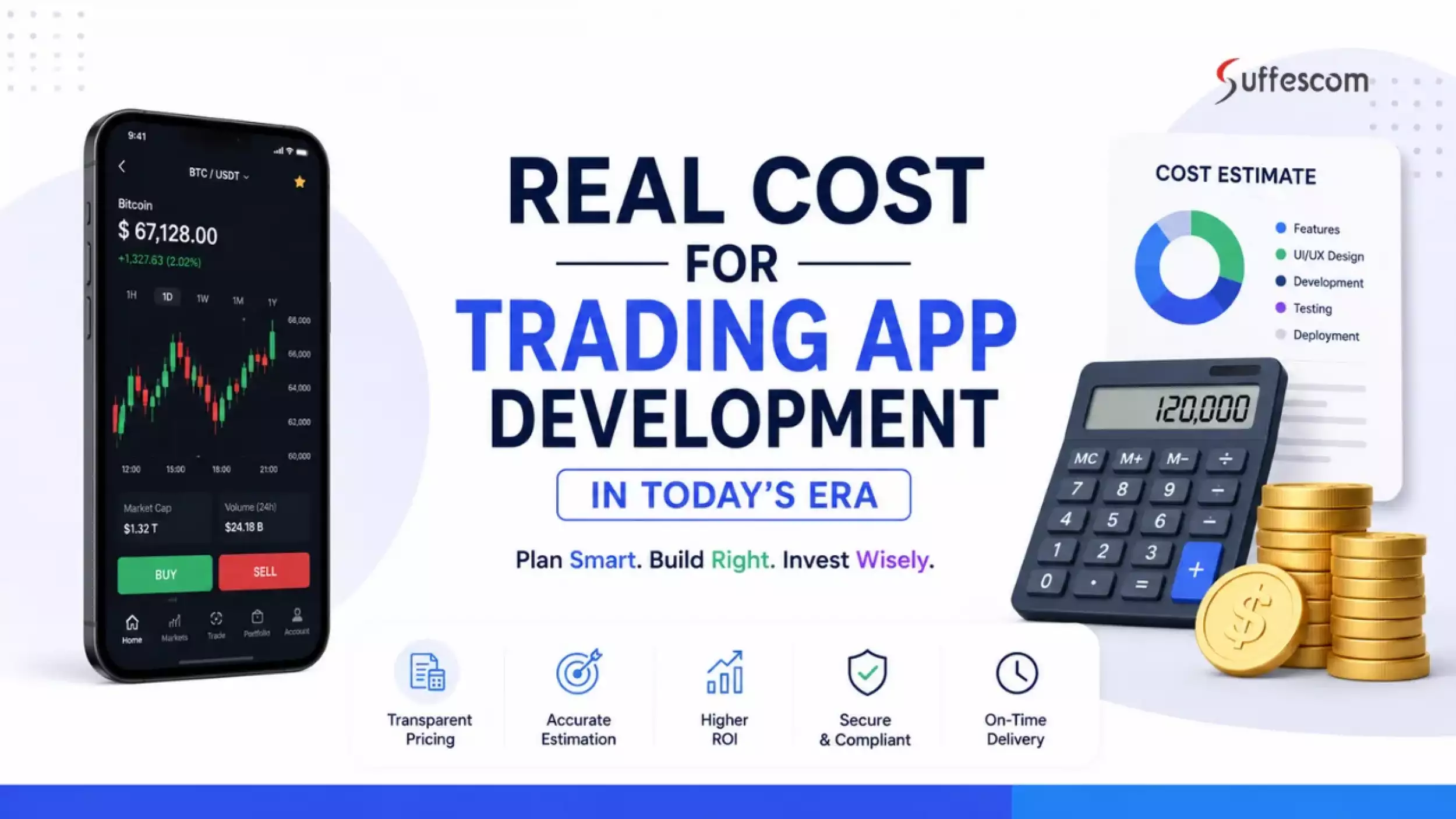
- The cost of developing a trading app in Saudi Arabia ranges from SAR 115,000 to 565,000+ ($30,000-$150,000+). It depends on the complexity of the solution and its functionality.
- Requirements concerning CMA, PDPL, AML/KYC, and cybersecurity have to be considered during the budget planning stage.
- Maintenance expenses, cloud hosting, market data, and other expenses are critical for the project's sustainability.
- Developing an MVP is one of the ways of reducing the initial investment while validating your business idea.
- An early start provides businesses with an opportunity to create their position in the market, evolve along with changing customer needs, and scale up as necessary.
Saudi Arabia's financial industry moves towards online investments, which means that there appear to be opportunities for startups, banks, brokerage houses, and FinTech companies to create advanced trading solutions. Investors' demand for fast access, up-to-date information, and convenient mobile interfaces makes trading apps a necessity.
However, the process of developing a trading application is not limited to creating a mobile interface. There are factors such as real-time data feeds, security, KYC, portfolio management, regulatory requirements, and AI capabilities, which affect the development cost.
The actual cost for developing a trading application in Saudi Arabia in 2026 will be influenced by multiple aspects, such as the complexity of the app, functionality, technological stack, security demands, integration capabilities, and other issues. For instance, the cost for developing a minimalistic investment application will be lower than the cost for creating a full-fledged brokerage or AI-based trading solution.
In this article, you will find a detailed description of the trading app development cost in Saudi Arabia, as well as cost factors, required features, technologies, compliance expenses, and trends.
Why Trading Apps Are Booming in Saudi Arabia in 2026
Saudi Arabia’s investment landscape is becoming increasingly digital, driven by rising investor participation, financial innovation, and strong government support for the FinTech sector. Trading apps are playing a major role in this transformation by making market access faster, easier, and more accessible for individuals and institutions.
The combination of increasing digitization, the Vision 2030 program, and increasing demand for self-managing investments is helping the adoption of mobile trading apps throughout the Kingdom.
Digital Investing Growth in Saudi Arabia
Digital investing is on the rise in Saudi Arabia as investors are becoming more inclined toward mobile applications for the management of their portfolios, market monitoring, and making transactions. The Saudi Exchange (Tadawul) is continuing its efforts to make the markets more accessible through digital means.
FinTech Expansion in Saudi Arabia under Vision 2030
The development of FinTech is one of the primary areas of concentration within the framework of Saudi Vision 2030, aimed at developing the digital economy. The government efforts in support of financial innovations, digital services, and investment solutions include the work done by SAMA and CMA. This growth is increasing demand for:
- CMA-compliant trading platforms.
- Digital brokerage applications.
- AI-powered investment tools.
- Automated wealth management solutions.
Rising Demand for Mobile Trading Platforms
The mobile trading industry has emerged as one of the fastest-growing industries in financial technology due to the advancements in smartphones and connectivity. The factors that are considered by companies that offer trading application development services in 2026 include:
- Real-time stock and market data.
- AI-based investment recommendations.
- Automated alerts and notifications.
- Arabic and English language support.
- Secure digital onboarding and KYC verification.
- Advanced portfolio analytics.
Nevertheless, the development of such trading applications requires a considerable amount of investment in backend technologies, security systems, financial APIs, etc. That is why it is important to know about the trading app development cost in Saudi Arabia.
Who Should Read This Pricing Guide?
This complete pricing guide is designed for businesses planning to build financial trading solutions in Saudi Arabia, including:
- Startups: Looking to launch MVP trading platforms or FinTech investment applications.
- Brokerage Firms: Planning to develop custom trading systems with advanced market functionality.
- Banks: Building digital investment platforms to improve customer experience.
- Wealth Management Companies: Creating automated investment and portfolio management solutions.
- FinTech Companies: Exploring opportunities in Saudi Arabia’s growing digital finance ecosystem.
Understanding market demand is only the first step. The next challenge is determining the actual investment required to build these platforms. The sections below detail the real cost of trading app development in Saudi Arabia in 2026, covering such aspects as features, technologies, regulations, and maintenance costs.
Turn Your Trading App Idea Into a High-Performance Digital Investment Platform
What Is the Real Cost of Trading App Development in Saudi Arabia in 2026?
The cost of developing a trading app in Saudi Arabia is subject to the platform's complexity, feature set, available types of assets, regulations, and technologies used. Depending on whether you are creating a Minimum Viable Product (MVP) in order to test it on the market or an enterprise-level broker platform, defining the project scope beforehand will help you estimate its real cost and save you from excessive development expenses.
Average Cost Range
The average development cost of a trading application in Saudi Arabia is SAR 112,500 - SAR 562,500+, or approximately $30,000 - $150,000+. The specific price will be determined by the desired functionality, scalability, integration capabilities, and security of the software. Although startups that are going to build a minimum viable product (MVP) can start their project at the lower price point, enterprise-grade software requires bigger investments.
Development Cost Depending on App Complexity
There is a wide variety of complexities of the trading application depending on the audience, supported assets, and objectives of the startup. Selecting the right complexity of the application means investing in useful features that meet your current needs and ensure future growth.
| Project Type | Estimated Cost (SAR) | Estimated Cost (USD) |
| MVP Trading App | SAR 115,000–170,000 | $30,000–45,000 |
| Basic Trading App | SAR 170,000–265,000 | $45,000–70,000 |
| Mid-Level Trading Platform | SAR 265,000–340,000 | $70,000–90,000 |
| Enterprise Brokerage Platform | SAR 340,000–490,000 | $90,000–130,000 |
| AI-Powered Trading App | SAR 490,000–565,000+ | $130,000–150,000+ |
Timeline vs Development Cost
Project timelines affect the total cost of a project. As new integrations and features, as well as compliance issues, pile up, the projects require bigger teams, long development time frames, and more comprehensive testing.
| Project Type | Estimated Timeline | Typical Cost Impact |
| MVP | 2–3 Months | Lower |
| Basic | 3–5 Months | Moderate |
| Mid-Level | 5–8 Months | High |
| Enterprise | 8–12 Months | Very High |
| AI | 10–15 Months | Premium |
Major Factors That Influence Trading App Development Cost
The cost of developing a trading application depends on multiple technical and business considerations. Each decision regarding the type of trading platform, its functionality, integration, compliance, etc. affects the development process, its timeline, and budget.
App Type
One of the main cost considerations is the type of trading application since the development of each type has a different set of features and technical and compliance requirements. For instance, a stock trading application is much simpler than a multi-asset or algorithmic trading platform that needs to handle huge amounts of data.
| Trading App Type | Example Apps | Complexity Level | Development Time | Estimated Development Cost (SAR) |
| Stock Trading App | Robinhood, E*TRADE | Medium | 4–7 Months | SAR 220,000–340,000 |
| Forex Trading App | MetaTrader 5, OANDA | High | 6–9 Months | SAR 300,000–450,000 |
| Cryptocurrency Trading App | Binance, Coinbase | High | 7–10 Months | SAR 340,000–490,000 |
| Commodity Trading App | IG, Plus500 | Medium–High | 5–8 Months | SAR 265,000–415,000 |
| ETF & Mutual Fund Investment App | Vanguard, Fidelity | Medium | 4–6 Months | SAR 225,000–340,000 |
| Brokerage Trading App | Charles Schwab, Interactive Brokers | Very High | 8–12 Months | SAR 375,000–565,000 |
| Multi-Asset Trading Platform | SaxoTraderGO | Very High | 10–15 Months | SAR 450,000–640,000+ |
| Robo-Advisory App | Betterment, Wealthfront | High | 6–9 Months | SAR 300,000–470,000 |
| Algorithmic Trading App | QuantConnect, TradeStation | Enterprise | 9–15 Months | SAR 490,000–675,000+ |
| Social Trading App | eToro | High | 7–10 Months | SAR 340,000–525,000 |
Number of Features
The number and complexity of the features will have a direct effect on the cost of the development process. As mentioned above, the MVP contains only the essential functions, which makes the app development less costly. But integrating advanced AI capabilities takes additional development hours, integrations, testing, and maintenance of the trading app.
Complexity of UI/UX
Good UI/UX helps to engage users, facilitates navigation through the app, and adds the necessary layer of trust that is extremely important for trading applications. Such features as interactive charts, customizable dashboards, dark mode, data visualization, and trading execution are going to be incorporated at an additional cost.
Development for Android, iOS or Cross-Platform
Also, the choice of the platform is very significant in relation to the cost of the development process. The development of separate mobile applications for Android and iOS will provide maximum performance but, at the same time, requires separate coding and its time and cost consumption. Frameworks like Flutter or React Native can save money spent on the development process due to the common code used for both platforms while keeping a similar user experience.
Backend Infrastructure
A backend is an essential part of every trading application because of all the processes that are performed there, such as user authentication, order management, transactions, portfolio management, and data synchronization. Creating a highly scalable backend that is able to perform the above operations fast and with no downtime is costly.
Cloud Hosting Expenses
Cloud infrastructure is important as it guarantees the reliability, scalability, and high availability of the system. It becomes important to estimate cloud hosting costs considering servers, storage capacity, database management, bandwidth consumption, backups, and disaster recovery. The larger the user base, the more costs for hosting are going to be incurred in order to guarantee good application performance.
Security & Data Encryption
Financial and private information is traded on the application; hence, security becomes the key cost factor. End-to-end encryption, multi-factor authentication (MFA), biometrics, secure APIs, fraud detection, and security audits become the additional features that complicate the development process but guarantee the safety of users' data and legal requirements.
Third-Party API Integrations
Trading applications use third-party APIs to get market data, make payments, verify users' identity, carry out KYC/AML, send push notifications, analyze users' behavior, and so on. While the integration saves time in developing the product, it complicates the development process and adds additional licensing and maintenance costs.
Real-Time Market Data
Up-to-date stock prices, charts, order books, and market news are features every modern trading app should have. Integration with third-party market data suppliers requires special APIs, low-latency infrastructure, and data licensing, all of which contribute to higher development and operational costs.
Team Size
The project budget is influenced by the number and skill level of the developers. The usual composition of the trading app development project team includes UI/UX designers, frontend and backend developers, mobile developers, QA engineers, DevOps engineers, business analysts, and project managers. More complicated platforms may also need such specialists as AI engineers, cybersecurity experts, and compliance specialists.
Trading App Features That Will Impact Your Budget
The features that you implement in your trading app determine its development budget. Whereas certain functionalities will be necessary for developing a safe and functioning platform, other features are used to make users' experience better, automate decision-making processes, and distinguish your business from competitors.
User Registration & KYC
The user registration and KYC (Know Your Customer) verification allow you to onboard users in a secure manner and comply with all the legal requirements. This functionality is not only responsible for the security of your application and protecting you from any fraudulent activities but is also necessary for meeting the AML requirements. Implementation of biometric verification, document scanning, or third-party KYC services will cost you more during development but also ensure better security and trust.
Portfolio Dashboard
It gives you an opportunity to see your investment portfolio, account balances, asset allocation, and performance of your portfolio. Development of interactive portfolios that will track profits and losses and analyze performance would cost you more because it requires more backend work.
Live Market Data
With live market data functionality, you will be able to watch stock prices, charts, market trends, and trading volumes in real time. To implement this functionality, you will need third-party vendors for market data and low-latency infrastructure. It is one of the most important and expensive parts of your trading app.
Watchlists
By adding watchlists, you will get an option to save all your favorite stocks, ETFs, cryptocurrencies, or any assets that you want to keep an eye on without having to search for them over and over again. The main benefit of watchlists is their ability to increase user engagement.
Buy & Sell Orders
The order management system is the core functionality of any trading app. It enables users to place, modify, and cancel market or limit orders while ensuring accurate trade execution. Building a secure and high-performance order engine requires advanced backend development and extensive testing.
Wallet Integration
The wallet integration feature enables users to control account balances, deposits, withdrawals, and available funds. It could be a fiat wallet, a digital wallet, or a crypto wallet depending on the platform, thus requiring security during transactions.
Payment Gateway
The payment gateway feature is an important one for integrating cross-border payment capabilities for funding trading accounts and withdrawing profits from them. Users need access to multiple options like bank transfers, credit card payments, and digital wallets for funding.
Push Notification
The push notifications feature informs users about trade confirmations, price alerts, portfolio updates, news, and other security-related issues. It makes the user experience engaging and guarantees that there will be timely communication with users.
AI-based Investment Suggestions
The AI-based investment suggestions for investments analyze the trends in the markets, the behavior of the user, and portfolio performance to provide personalized recommendations to users. It needs some additional development efforts but will improve user engagement and decision-making.
Risk Analysis
Risk analysis tools help investors evaluate portfolio exposure, asset volatility, and potential losses before making investment decisions. Features such as diversification analysis, risk scoring, and scenario simulations improve investment planning while adding to development complexity.
Reports & Analytics
Analyses and reporting give users analysis about their trading history, portfolio performance, profit made, tax information, and market trends. Interactive reports, report downloads, and analytics make the system transparent and assist in making more informed decisions.
Multi-language Support (Arabic & English)
Having the two languages available means more reach and an improved user experience for Saudi Arabia’s diverse range of investors. This involves localization of the content, RTL support, language switch, and testing, among others, that add to the development cost.
Feature Cost Table
| Feature | Business Importance | Cost Impact |
| User Registration & KYC | Regulatory compliance and secure onboarding | High |
| Portfolio Dashboard | User engagement and investment tracking | Medium |
| Live Market Data | Core trading functionality | High |
| Watchlists | Personalized user experience | Low |
| Buy & Sell Orders | Core trading operations | High |
| Wallet Integration | Secure fund management | Medium |
| Payment Gateway | Deposits and withdrawals | Medium |
| Push Notifications | User engagement and alerts | Low |
| AI-Based Investment Suggestions | Personalized investing | High |
| Risk Analysis | Better investment decisions | Medium–High |
| Reports & Analytics | Performance tracking and compliance | Medium |
| Multi-Language Support | Localized user experience | Medium |
Cost Breakdown by Development Stage
Each phase of the development process adds to the cost of the entire project. There is a variance in cost based on the amount of work involved, the technicality of the work, and the experience needed in each phase of the development process.
| Development Stage | Estimated Share of Total Budget |
| Market Research | 5–8% |
| Business Analysis | 8–10% |
| UI/UX Design | 10–15% |
| Frontend Development | 18–22% |
| Backend Development | 25–30% |
| API Development & Integrations | 8–12% |
| QA Testing | 10–15% |
| Deployment | 2–5% |
| Annual Maintenance | 15–20% of initial development cost |
Saudi Arabia Regulatory & Compliance Costs
In Saudi Arabia, developing a trading application not only consists of feature development but also includes compliance with rules regarding finance, data protection, cybersecurity, and transactions via the internet. Complying with such requirements usually raises the cost of development owing to increased security and verification procedures, audit and report generation capabilities, and legal compliance procedures.
Compliance with CMA Regulations
If the platform provides services related to securities, it must comply with regulations published by the Capital Market Authority (CMA). The set of regulations depends on the type of service provided by the platform.
Capital Market Law
Official framework: Capital Market Law (Royal Decree No. M/30).
The Capital Market Law is the main regulatory act applicable to the stock market of Saudi Arabia. This law lays out the legal basis of securities activities, licensing, investor protection, and disclosure. Compliance for trading applications can be achieved through secure transaction records, investor protection, reporting, and auditing tools.
Securities Business Regulations
Official framework: Securities Business Regulations issued by CMA.
These regulations define securities activities that require CMA authorization, including dealing, arranging, managing investments, advising, and custody services. Trading apps providing these services often require order management systems, portfolio management, compliance reporting, and authorization workflows.
Market Conduct Regulations
Official framework: Market Conduct Regulations issued by CMA.
These regulations promote fair and transparent market practices by addressing insider trading, market manipulation, misleading activities, and investor protection. Trading platforms may need trade surveillance, transaction monitoring, suspicious activity detection, and reporting mechanisms to support compliance.
Saudi Data Protection Regulations
Trading apps process highly sensitive personal and financial information. Saudi Arabia's data protection laws require businesses to collect, process, store, and transfer personal data securely.
Personal Data Protection Law (PDPL)
Official framework: Personal Data Protection Law (PDPL).
PDPL regulates how organizations handle personal data, including user consent, data processing, privacy rights, security measures, and breach management. For trading apps, compliance typically requires consent management, encryption, access controls, secure storage, and privacy management features.
Regulation on Personal Data Transfer Outside the Kingdom
Official framework: Regulation on Personal Data Transfer Outside the Kingdom.
This regulation governs cross-border data transfers and specifies safeguards for organizations using overseas cloud infrastructure or third-party service providers. Trading platforms relying on international cloud services or analytics tools may require additional compliance controls.
KYC & AML Compliance
Trading platforms must verify customer identities and monitor financial transactions to prevent fraud, money laundering, and terrorist financing. These requirements often increase development costs through identity verification integrations and compliance monitoring systems.
Anti-Money Laundering Law
Official framework: Anti-Money Laundering Law of Saudi Arabia.
The law requires regulated entities to implement customer identification, transaction monitoring, suspicious activity reporting, record retention, and risk-based compliance procedures. Trading apps typically integrate AML monitoring, fraud detection, and reporting capabilities to meet these obligations.
Know Your Customer (KYC) Requirements
Official framework: KYC requirements implemented under the Anti-Money Laundering Law and applicable CMA regulations.
KYC procedures require businesses to verify customer identities before providing financial services. Trading apps usually integrate document verification, biometric authentication, sanctions screening, and customer due diligence solutions, which add to implementation costs.
Cybersecurity Standards
Financial trading applications must implement robust cybersecurity controls to protect customer information and financial transactions from cyber threats.
Essential Cybersecurity Controls (ECC)
Official framework: Essential Cybersecurity Controls (ECC) issued by the National Cybersecurity Authority (NCA).
ECC establishes baseline cybersecurity requirements covering governance, identity and access management, data protection, incident response, and business continuity. Compliance often requires encryption, multi-factor authentication (MFA), vulnerability management, and security monitoring.
Data Cybersecurity Controls (DCC)
Official framework: Data Cybersecurity Controls (DCC) issued by the NCA.
DCC focuses on protecting sensitive data throughout its lifecycle by establishing requirements for data classification, secure storage, access control, and data sharing. For trading apps, this affects database security, encryption strategies, and information access management.
Electronic Transactions Law
Digital trading platforms rely on electronic contracts, user approvals, digital records, and secure authentication. Saudi Arabia legally recognizes these activities through its electronic transactions legislation.
Electronic Transactions Law
Official framework: Electronic Transactions Law (Royal Decree No. M/18).
The law provides legal recognition for electronic records, electronic signatures, and digital transactions while defining authentication requirements and responsibilities for certification service providers. For trading apps, compliance impacts digital onboarding, electronic agreements, user authentication, transaction confirmations, and audit trail management.
Compliance Cost Breakdown
| Compliance Area | Typical Cost (SAR) | Typical Cost (USD) | Cost Impact |
| CMA Compliance (Licensing, legal consultation & reporting setup) | SAR 20,000–75,000 | $5,000–20,000 | High |
| PDPL Compliance | SAR 15,000–40,000 | $4,000–10,500 | Medium–High |
| KYC & AML Integration | SAR 20,000–55,000 | $5,000–15,000 | High |
| Cybersecurity Compliance (ECC/DCC, audits & penetration testing) | SAR 30,000–95,000 | $8,000–25,000 | High |
| Electronic Transactions Compliance | SAR 8,000–30,000 | $2,000–8,000 | Medium |
Hidden Costs Most Businesses Ignore
The initial development budget is only part of the total investment required to launch and operate a trading app. Many businesses underestimate ongoing operational, licensing, and compliance expenses, which can significantly increase the overall cost over time. Planning for these hidden costs helps avoid unexpected financial challenges after launch.
| Hidden Cost | Estimated Cost (SAR) | Estimated Cost (USD) | Frequency |
| Market Data Licensing Fees | SAR 7,500–75,000+/year | $2,000–20,000+/year | Annual |
| Cloud Scaling Costs | SAR 1,900–18,800/month | $500–5,000/month | Monthly |
| Third-Party API Pricing | SAR 750–11,300/month | $200–3,000/month | Monthly |
| Security Audits | SAR 11,300–37,500/audit | $3,000–10,000/audit | Annual/As Needed |
| Annual Penetration Testing | SAR 18,800–56,300/year | $5,000–15,000/year | Annual |
| App Store Fees | SAR 375/year (Apple), SAR 95 one-time (Google) | $99/year (Apple), $25 one-time (Google) | Annual/One-Time |
| Customer Support Infrastructure | SAR 3,800–30,000/month | $1,000–8,000/month | Monthly |
| Continuous Compliance Updates | SAR 18,800–75,000/year | $5,000–20,000/year | Annual |
Market Data Licensing Fees
Budget for market data licensing because both live and historical market feeds are important in providing accurate trading information. The cost of licensing varies from one exchange, data vendor, and user volume, and it is an ongoing operational cost.
Cloud Scalability Cost
When your number of users and trades increases, it will require additional computing resources. Cloud scalability will enable your system to perform without any surprise costs in the infrastructure.
Third-Party API Fees
APIs are used in trading platforms to provide market data, KYC verification, payment processing, notifications, and banking connections. In most cases, third-party APIs have monthly recurring fees based on usage volume.
Security Audits
Performing regular security audits will ensure that you are identifying any vulnerabilities that might arise. Security audits will ensure that there is no risk of cybersecurity issues in your trading platform.
Annual Penetration Test
Performing penetration tests in your systems is important since it helps you identify security issues through simulation of attacks in a similar environment. Budgeting for annual testing helps protect sensitive financial data and maintain user trust.
App Store Fees
Developer fees are involved in the publishing and upkeep of the apps in the Apple App Store and Google Play Store. More expenses may be encountered when upgrading the app, when in-app purchases are made, and when managing subscriptions.
Support Infrastructure for Your Platform
To be able to answer any customer questions and take care of technical issues and account management concerns, you will need certain support structures. This is where you can invest for better service.
Budget for Compliance Upgrades
Both finance regulations and cybersecurity standards are continually changing. Thus, allocating funds for compliance upgrades will ensure that the trading platform is always safe and legal.
Get an Accurate Cost Estimate for Your Trading App Development Project
Trading App Development Costs by Type of Business
The cost of building a trading app depends on the type of business, target customers, regulatory issues, and the functionalities that are needed. Startups usually need a minimum viable product, while financial institutions want an enterprise-level trading app.
| Business Type | Typical App Features | Estimated Cost (SAR) | Estimated Cost (USD) |
| Startup | MVP trading, portfolio dashboard, watchlists, notifications | SAR 115,000–170,000 | $30,000–45,000 |
| Brokerage Firm | Advanced trading, real-time market data, KYC/AML, multi-asset support | SAR 265,000–490,000 | $70,000–130,000 |
| Bank | Enterprise security, banking integrations, compliance automation | SAR 375,000–565,000+ | $100,000–150,000+ |
| Wealth Management Company | Portfolio management, AI insights, analytics, reporting | SAR 265,000–415,000 | $70,000–110,000 |
| Investment Advisory Firm | Robo-advisory, financial planning, client management | SAR 225,000–375,000 | $60,000–100,000 |
Startup
Startups usually begin with an MVP that includes core trading features, user registration, portfolio management, and basic market data. The focus is on validating the product quickly while keeping development costs under control.
Real-life examples: Robinhood (early version), Stake, Public.
Brokerage Firm
Brokerage firms require feature-rich platforms capable of executing trades, managing client portfolios, supporting multiple asset classes, and meeting CMA compliance requirements. These projects generally involve higher security, scalability, and regulatory investments.
Real-life examples: Al Rajhi Capital, Derayah Financial.
Bank
Banks typically integrate trading services with existing digital banking ecosystems. They require enterprise-grade security, core banking integrations, identity management, compliance automation, and high system availability.
Real-life examples: SNB Capital, Riyad Capital, SAB Invest.
Wealth Management Company
Wealth management firms prioritize portfolio analytics, financial planning, personalized investment recommendations, and client relationship management. Many platforms also integrate AI-driven insights and reporting tools.
Real-life examples: Goldman Sachs Private Wealth Management, UBS Wealth Management.
Investment Advisory Firm
Investment advisory firms focus on research, portfolio recommendations, client communication, and regulatory reporting. Their platforms commonly include robo-advisory features, investment planning tools, and performance analytics.
Real-life examples: Betterment, Wealthfront.
Best Technology Stack for Trading Apps in 2026
Selecting the right technology stack is essential for building a secure, scalable, and high-performance trading platform. The technologies below are widely used for developing modern trading applications in 2026.
Frontend Technologies
- Flutter
- React Native
- Swift (iOS)
- Kotlin (Android)
- React.js
- Next.js
Backend Technologies
- Node.js
- Java (Spring Boot)
- .NET Core
- Python (Django/FastAPI)
- Go (Golang)
Database
- PostgreSQL
- MySQL
- MongoDB
- Redis
- TimescaleDB
Cloud Infrastructure
- Amazon Web Services (AWS)
- Microsoft Azure
- Google Cloud Platform (GCP)
- Kubernetes
- Docker
AI & Machine Learning
- TensorFlow
- PyTorch
- OpenAI APIs
- Azure AI
- Google Vertex AI
- Scikit-learn
Real-Time Streaming Technologies
- Apache Kafka
- RabbitMQ
- Redis Streams
- WebSockets
- Socket.IO
DevOps Tools
- GitHub Actions
- GitLab CI/CD
- Jenkins
- Terraform
- Ansible
- Prometheus
- Grafana
Security Stack
- OAuth 2.0
- OpenID Connect (OIDC)
- JWT
- TLS/SSL
- AES-256 Encryption
- HashiCorp Vault
- AWS KMS
- Azure Key Vault
- Multi-Factor Authentication (MFA)
- OWASP ASVS
AI, Automation & Predictive Analytics: How They Impact Development Costs
Artificial intelligence is transforming trading platforms by improving investment decision-making, automating routine tasks, and delivering personalized user experiences. However, implementing AI features requires additional development model training, data infrastructure, and ongoing optimization, increasing the overall project budget. Therefore, businesses often work with specialized AI development companies to build and integrate these advanced capabilities effectively.
AI-Based Portfolio Recommendations
AI analyzes user preferences, investment goals, and portfolio performance to recommend suitable investment opportunities. Building personalized recommendation engines requires machine learning models, historical market data, and continuous model refinement, making it one of the more expensive AI features.
Predictive Market Trend Analysis
Predictive analytics uses historical and real-time market data to forecast potential price movements and market trends. Developing these capabilities requires advanced AI models, large datasets, and real-time processing infrastructure, resulting in higher development costs.
AI Chatbots for Customer Support
AI-powered chatbots provide instant assistance for account management, FAQs, trading guidance, and customer support. They help reduce operational costs while improving response times and customer satisfaction.
Fraud Detection Using Machine Learning
Machine learning algorithms monitor user behavior and transaction patterns to detect suspicious activities and reduce fraud. These systems strengthen platform security but require additional AI development, data analysis, and continuous monitoring.
Personalized Investment Insights
AI can generate customized market insights, portfolio performance summaries, and investment suggestions based on each user's financial profile and trading history. This enhances user engagement but increases implementation complexity.
Cost vs ROI of AI Features
Although AI features increase initial development costs, they can improve user retention, operational efficiency, trading accuracy, and customer satisfaction. Businesses should prioritize AI capabilities based on their target audience, product roadmap, and expected return on investment.
AI Feature Cost vs Business Value
| AI Feature | Estimated Cost (SAR) | Estimated Cost (USD) | Business Value |
| AI Portfolio Recommendations | SAR 45,000–75,000 | $12,000–20,000 | High |
| Predictive Market Trend Analysis | SAR 75,000–150,000 | $20,000–40,000 | Very High |
| AI Chatbots | SAR 18,500–45,000 | $5,000–12,000 | Medium–High |
| Fraud Detection (ML) | SAR 56,000–113,000 | $15,000–30,000 | Very High |
| Personalized Investment Insights | SAR 37,500–75,000 | $10,000–20,000 | High |
Monetization Models for Trading Apps in Saudi Arabia
Choosing the right monetization strategy is essential for maximizing the return on investment (ROI) of a trading app. Most successful platforms combine multiple revenue streams to generate recurring income while delivering value to users. The ideal monetization model depends on your target audience, supported asset classes, and business objectives.
| Revenue Model | Best For | Revenue Potential | Recurring Revenue |
| Brokerage Commission | Brokerage Firms | Very High | No |
| Premium Subscription Plans | Investment & Trading Apps | High | Yes |
| Robo-Advisory Services | Wealth Management Platforms | High | Yes |
| Margin Trading Fees | Brokerage Platforms | Very High | Yes |
| Advertisement Revenue | Free Trading Apps | Medium | Yes |
| Data Analytics Services | Institutional Platforms | High | Yes |
| White Label Licensing | FinTech & Software Providers | Very High | Yes |
| Enterprise SaaS Model | B2B Trading Platform Providers | Very High | Yes |
Brokerage Commission
This is one of the most common revenue models for trading platforms. Businesses earn income by charging transaction fees or commissions whenever users execute trades through the app.
Premium Subscription Plans
Apps can offer paid plans that unlock advanced features such as professional charting, market insights, AI recommendations, research tools, and portfolio analytics, creating predictable recurring revenue.
Robo-Advisory Services
Platforms can generate revenue by offering automated investment management, portfolio optimization, and personalized recommendations through advisory fees or assets-under-management (AUM) charges.
Margin Trading Fees
Brokerage platforms offering leveraged trading can generate revenue through interest or financing charges on borrowed funds used for trading activities.
Advertisement Revenue
Free trading apps may monetize through targeted advertisements, sponsored financial products, or partnerships. This model works best when maintaining a large user base while protecting user experience.
Data Analytics Services
Institutional platforms can monetize aggregated market insights, analytics dashboards, and reporting solutions for professional investors and financial organizations.
White Label Licensing
FinTech providers can license their existing trading infrastructure to banks, brokerages, and financial companies that want to launch branded platforms without building technology from scratch.
Enterprise SaaS Model
Trading technology providers can offer their platforms as subscription-based solutions, generating recurring revenue through licensing, infrastructure access, compliance tools, and support services.
Cost Optimization Strategies Without Sacrificing Quality
Building a high-quality trading app doesn't always require the largest budget. By prioritizing essential features, choosing the right technology stack, and adopting efficient development practices, businesses can reduce costs while maintaining security, performance, and scalability.
Build MVP First
Start with a Minimum Viable Product (MVP) that includes core features such as user registration, portfolio management, watchlists, and trade execution. Launching an MVP helps validate market demand, gather user feedback, and reduce upfront development costs before investing in advanced functionality.
Cross-Platform Development
Using frameworks like Flutter or React Native enables businesses to build a single codebase for both Android and iOS. This approach reduces development time, simplifies maintenance, and lowers overall development costs compared to building separate native applications.
Modular Architecture
A modular architecture allows features to be developed and deployed independently. It simplifies future upgrades, improves scalability, and reduces the cost of adding new trading instruments, payment methods, or AI capabilities.
Agile Development
Adopting an Agile development methodology enables teams to deliver features in iterative releases, identify issues early, and respond quickly to changing business requirements. This minimizes costly rework and improves project efficiency.
Cloud Optimization
Selecting the right cloud infrastructure and using auto-scaling, serverless services, and resource monitoring helps control infrastructure expenses while ensuring consistent platform performance during periods of high trading activity.
API Reusability
Reusing existing APIs for market data, payment gateways, identity verification, and notifications reduces custom development effort, accelerates project delivery, and lowers integration costs.
Outsourcing vs In-House Team
Choosing between an in-house team and an experienced trading app development company depends on your budget, project scope, and long-term goals. While in-house development provides greater control, outsourcing can significantly reduce hiring, infrastructure, and operational costs while giving access to specialized FinTech expertise.
How to Choose the Right Trading App Development Company in Saudi Arabia
Choosing the right development partner is just as important as defining your budget and feature requirements. An experienced trading app development company can help you navigate regulatory compliance, implement secure trading infrastructure, and build a scalable platform that supports long-term business growth. At Suffescom Solutions, we help startups, brokerages, banks, and FinTech companies transform their trading app ideas into secure, scalable, and market-ready solutions.
FinTech Experience
Look for a company with proven experience in developing FinTech, trading, and investment applications. A strong portfolio demonstrates expertise in real-time trading systems, payment integrations, portfolio management, and financial regulations, with extensive experience delivering FinTech app development services tailored to diverse business requirements.
Security Expertise
Security should be a top priority when selecting a development partner. We follow secure coding standards and implement end-to-end encryption, multi-factor authentication (MFA), secure APIs, and industry best practices to protect sensitive financial data and transactions.
Regulatory Knowledge
Your development partner should understand Saudi Arabia's regulatory landscape, including CMA requirements, PDPL, AML/KYC obligations, and NCA standards. We integrate compliance considerations throughout the development lifecycle to reduce regulatory risks and avoid costly post-launch changes.
Transparent Pricing
Choose a company that provides a detailed project estimate with a clear breakdown of development, third-party integrations, infrastructure, maintenance, and post-launch support costs. We believe transparent pricing helps businesses plan confidently and avoid unexpected expenses.
Post-Launch Support
Launching the app is only the beginning. We provide ongoing maintenance, performance optimization, security updates, feature enhancements, and technical support to ensure your trading platform continues to perform reliably as your business grows.
Portfolio Evaluation
Review the company's previous FinTech projects, client testimonials, technical expertise, and case studies. A strong portfolio demonstrates the ability to build secure, scalable, and user-friendly trading applications. Suffescom Solutions has delivered software solutions across multiple industries, helping businesses launch innovative digital products with confidence.
Questions to Ask Before Hiring
Before choosing a trading app development company, asking the right questions can help you assess their technical expertise, regulatory knowledge, and ability to deliver a secure, scalable solution that aligns with your business goals.
Have you developed trading or FinTech applications before?
A company with hands-on FinTech experience understands trading workflows, real-time market data integration, and the unique challenges of financial application development, reducing project risks.
Can you build a CMA-compliant trading app for Saudi Arabia?
This helps you verify whether the development team is familiar with Saudi regulations, including CMA requirements, PDPL, and AML/KYC compliance, minimizing the chances of costly compliance issues later.
What security measures do you implement to protect user data?
Look for expertise in end-to-end encryption, multi-factor authentication (MFA), secure APIs, penetration testing, and OWASP best practices to safeguard sensitive financial information.
Which technology stack do you recommend and why?
The right technology stack should support scalability, real-time performance, high availability, and future feature expansion without requiring major redevelopment.
What is included in your pricing estimate?
A transparent estimate should clearly outline development costs, third-party integrations, testing, deployment, maintenance, and post-launch support to help you avoid hidden expenses.
Do you provide post-launch maintenance and support?
Ongoing support is essential for fixing bugs, releasing feature updates, maintaining security, and ensuring continued compliance with evolving regulations.
Can the platform scale as my business grows?
Your development partner should explain how the application can support additional users, asset classes, AI capabilities, and new integrations without affecting performance.
Can you share relevant case studies or client references?
Reviewing previous projects and client feedback helps validate the company's experience in delivering secure, high-performance trading platforms and gives you confidence in their ability to execute your project successfully.
Future Trends Affecting Trading App Development Costs Beyond 2026
The next generation of trading apps will be shaped by AI, blockchain, embedded finance, and stricter cybersecurity requirements. These technologies are expected to increase development costs due to more sophisticated infrastructure, regulatory compliance, and advanced feature implementation. According to McKinsey, the global fintech industry generated approximately $650 billion in revenue in 2025, growing 21% year over year, with AI and digital assets emerging as two of its biggest growth drivers.
AI Trading Agents
AI trading agents are evolving beyond basic automation by analyzing market conditions, executing trades, and continuously optimizing investment strategies. As AI models become more sophisticated, businesses will need to invest in model training, real-time data pipelines, and high-performance computing, increasing development costs.
Blockchain-Based Trading
Blockchain is expected to play a larger role in trading platforms by enabling transparent transactions, faster settlements, and improved asset security. Integrating distributed ledger technology, smart contracts, and digital asset custody requires specialized blockchain development expertise, adding to project costs.
Tokenized Assets
Tokenization is transforming how assets such as equities, bonds, real estate, and commodities are traded by converting them into digital tokens. As financial institutions increasingly explore tokenized investments, trading platforms will require blockchain infrastructure, compliance controls, and secure digital asset management.
Open Banking Integration
Open banking is becoming a key part of Saudi Arabia's fintech ecosystem, enabling customers to securely share financial data with authorized third-party providers. In 2026, the Saudi Central Bank (SAMA) began licensing fintech companies to provide Open Banking services after completing the regulatory sandbox phase, accelerating innovation across the financial sector. Trading platforms integrating Open Banking APIs can offer seamless account connectivity, faster fund transfers, and personalized financial services, although these integrations also increase development complexity.
Embedded Finance
Embedded finance enables investment and trading services to be integrated directly into banking apps, digital wallets, eCommerce platforms, and super apps. As businesses increasingly adopt this model, trading applications will require scalable APIs, secure payment infrastructure, and seamless third-party integrations.
Quantum-Ready Security
Financial institutions are beginning to prepare for the long-term impact of quantum computing by exploring quantum-resistant cryptography. Although adoption is still in its early stages, implementing future-ready encryption standards will become an important consideration for trading platforms handling sensitive financial data.
Hyper-Personalization
AI-powered hyper-personalization is enabling trading apps to deliver customized investment recommendations, intelligent alerts, and personalized portfolio insights. As AI adoption accelerates, businesses will need more advanced analytics capabilities and data infrastructure to provide tailored user experiences.
Looking for a Reliable Estimate for Your Trading App Development Cost?
Conclusion
Building a trading app in Saudi Arabia requires more than estimating development costs. Factors such as app complexity, regulatory compliance, security, third-party integrations, cloud infrastructure, and AI capabilities all influence the final budget. Understanding these cost drivers helps businesses plan effectively and build a scalable trading platform.
Saudi Arabia's fintech ecosystem is rapidly expanding, and there is strong support for digital innovation, making this an ideal time to invest in a trading platform. By consulting with an experienced trading app development company in Saudi Arabia, you can identify the essential features, technology stack, and compliance requirements necessary to obtain an accurate project estimate.
At Suffescom, we help businesses build secure, scalable, and CMA-ready trading applications with transparent pricing tailored to their specific needs.
Frequently Asked Questions
1. What is the average trading app development cost in Saudi Arabia in 2026?
The average trading app development cost in Saudi Arabia ranges from SAR 115,000 to SAR 565,000+. An MVP trading app typically costs SAR 115,000–170,000, a basic trading app SAR 170,000–265,000, a mid-level trading platform SAR 265,000–340,000, and an enterprise brokerage platform SAR 340,000–490,000, while an AI-powered trading app starts from SAR 490,000. The final cost depends on the app's complexity, features, integrations, compliance requirements, and technology stack.
2. How long does it take to build a trading app?
A basic MVP can be developed in 2–3 months, while a feature-rich trading platform typically takes 5–8 months. Enterprise-grade brokerage or AI-powered trading apps may require 10–15 months.
3. Which factors influence trading app development costs the most?
Key cost factors include app complexity, UI/UX design, supported platforms, backend infrastructure, cloud hosting, security features, third-party integrations, AI implementation, and compliance with Saudi regulations.
4. How much does an AI-powered trading app cost?
An AI-powered trading app generally costs SAR 490,000–565,000+ ($130,000–$150,000+). Advanced AI features such as predictive analytics, portfolio recommendations, and fraud detection can further increase the budget.
5. Is CMA compliance mandatory for trading apps in Saudi Arabia?
If your app provides regulated securities-related services, compliance with the CMA regulations is generally required. The exact requirements depend on your business model and the financial services you offer.
6. What technologies are commonly used for trading app development?
Popular technologies include Flutter, React Native, Swift, Kotlin, Node.js, Java, Python, PostgreSQL, AWS, Azure, Kafka, and AI frameworks like TensorFlow and PyTorch.
7. Can startups build a trading app on a limited budget?
Yes. Many startups begin with an MVP that includes essential features such as user registration, portfolio management, watchlists, and order execution. This approach reduces upfront costs while validating the product before scaling.
8. What are the ongoing maintenance costs of a trading app?
Annual maintenance typically costs 15–20% of the initial development cost. This includes bug fixes, security updates, infrastructure management, performance optimization, feature enhancements, and compliance updates.
9. How much does real-time market data integration cost?
The cost depends on the exchange or market data provider. Licensing fees can range from SAR 7,500 to SAR 75,000+ per year, depending on the markets covered and the number of users.
10. Is cross-platform development cheaper than native app development?
Yes. Cross-platform frameworks like Flutter and React Native allow developers to maintain a single codebase for Android and iOS, reducing both development time and overall project costs.
11. How can businesses reduce trading app development costs?
Businesses can lower costs by launching an MVP first, adopting cross-platform development, using reusable APIs, choosing a modular architecture, and following an Agile development approach.
12. Which monetization model generates the highest ROI?
The best model depends on your business goals. Brokerage commissions, premium subscriptions, robo-advisory services, and enterprise SaaS licensing are among the most profitable monetization strategies for trading platforms.
13. What security features are essential for a trading application?
Essential security features include end-to-end encryption, multi-factor authentication (MFA), secure APIs, KYC/AML verification, fraud detection, role-based access control, and regular security testing.
14. How much does cloud infrastructure cost for a trading platform?
Cloud hosting costs typically range from SAR 1,900 to SAR 18,800 per month ($500–$5,000), depending on the number of users, storage requirements, real-time data processing, and infrastructure configuration.
15. How do I choose the best trading app development company in Saudi Arabia?
Choose a company with proven FinTech experience, expertise in CMA compliance, strong security practices, transparent pricing, and reliable post-launch support. At Suffescom, we combine industry expertise with scalable technologies to help businesses build secure, high-performance mobile app solutions tailored to their requirements.