Key Takeaways
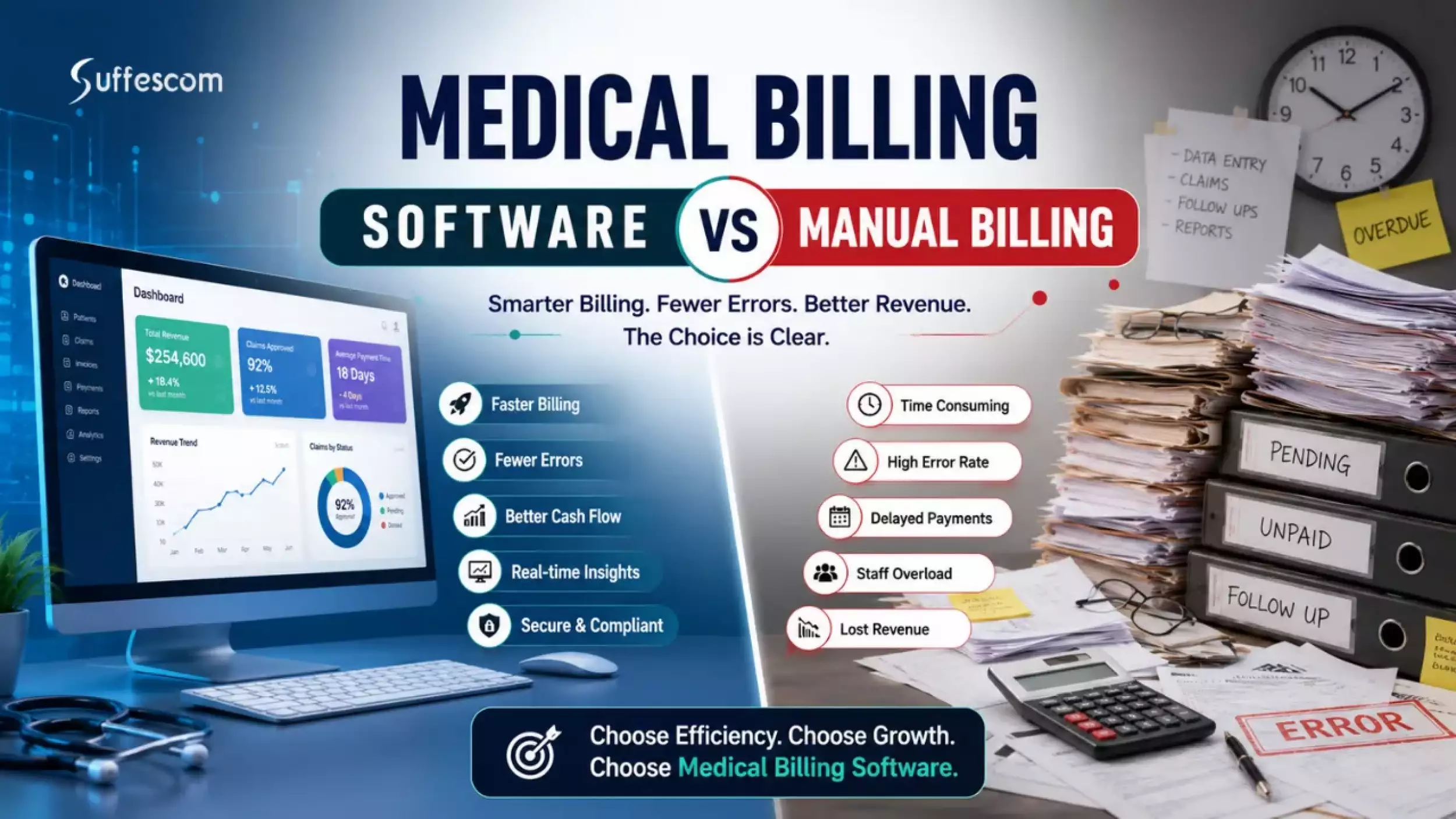
- Medical billing software optimizes healthcare services through automation of billing tasks, reduction of human errors, and optimization of insurance claims and payments processing.
- Manual billing becomes complicated for healthcare institutions because of numerous documents, delays in receiving money, human errors, and poor visibility of the financial results of work.
- Billing automation systems improve revenue cycle management (RCM) via faster claims processing, effective denial management, real-time reporting, and better cash flows.
- Medical billing software helps Saudi healthcare digital transformation through workflow compliance, integration with the healthcare system, and improvement of financial operations.
- Cost of development is determined by business needs, such as functionality, integration, customization, security, AI abilities, and scalability.
- It is important to select the right medical billing app development company to create the required software.
In Saudi Arabia, the healthcare industry's investment in billing automation continues to rise, with the global medical billing software market reaching $67.54 billion in 2025 and exceeding growth to $122.89 billion in 2030 at a CAGR of 12.3%. This growth reflects the increasing need for efficient revenue cycle management and insurance processing. Healthcare providers are adopting digital technologies to modernize billing operations, reduce administrative complexity, and improve overall financial performance.
Traditional manual medical billing processes tend to be inefficient due to the paperwork and tedious nature of the process. This is because of the manual and repetitive nature of the task. However, medical billing software will enable medical practitioners and other stakeholders to streamline their billing processes and make the process more effective and efficient.
In this article, we take a look at the difference between medical billing software and manual billing systems. We explore the various aspects of each system, such as cost, benefits, differences, and automation of billing processes through medical software. As healthcare providers look to move beyond traditional billing methods, exploring medical billing app development in Saudi Arabia can help them understand the process, requirements, and considerations involved in building a customized solution.
What Is Medical Billing Software?
Medical billing software helps with efficient processing of medical billing, insurance claims, billing management, and revenue cycle management for health care organizations. This will make it easier for hospitals and clinics in Saudi Arabia to reduce paperwork and manual entry of information, thus minimizing errors. Centralizing patient information enhances financial operations.
Definition and How It Works
A medical billing system manages the complete billing process, from patient registration and service recording to insurance claim submission and payment tracking. The typical workflow includes:
- Capturing patient and insurance information
- Recording medical services and charges
- Verifying insurance eligibility
- Generating and submitting claims
- Tracking payments and rejected claims
- Creating financial reports and billing insights
Core Components of a Medical Billing System
A comprehensive medical billing solution incorporates several modules that help healthcare organizations conduct their financial activities effectively. Although there can be variations in what these solutions offer, the following is an example of typical features found in such systems:
- Patient Registration & Billing Management: Stores patients' information, their insurance information, invoices, appointments, and payments in a single module.
- Insurance Claim Management: Automatically generates, sends, tracks, and follows up on insurance claims to speed up the process and minimize the number of rejected claims.
- Medical Coding Assistance: Assists medical professionals in assigning proper ICD & CPT codes for accurate invoicing.
- Revenue Cycle Management (RCM): Monitors the entire billing cycle, which includes claim, payment, denial management, and accounts receivable.
- Medical Invoicing & Payment Processing: Generates electronic invoices and receipts along with recording payments through different means.
- Reporting & Analytics Dashboard: Billing revenue reports, claims status reports, payables reports, and billing processes reports.
- Compliance & Security Management: It provides support for audit trails, access control, and security of sensitive information and also complies with health care regulations.
Types of Medical Billing Software Employed by Clinics and Hospitals
Various types of medical billing software are employed in health care organizations depending on their scale of operations, specialization, and other factors.
- Clinic Billing Software: Software that is designed specifically for smaller or mid-size clinics in order to manage invoices, payments, and claims.
- Hospital Billing Software: More complex solutions that enable multidepartmental billing, inpatient services, and advanced reporting capabilities.
- Cloud-Based Medical Billing Software: Allows for remote access, easy software updates, and less need for infrastructure.
- Custom Medical Billing Software: Solutions developed based on special requirements of healthcare processes, integration, and compliance.
Integration with Electronic Medical Records (EMR), EHR, and Hospital Information System (HIS)
The software may be integrated into EMR, EHR, and HIS in order to combine clinical and financial processes. Thus, it would allow the moving of patient information, medical services provided, medical treatments, and billing information without manual re-entering. Key benefits of integration include:
- Faster and more accurate claim processing
- Reduced billing and coding errors
- Better coordination between healthcare and administrative teams
- Real-time access to patient and financial data
- Improved revenue cycle management
Integration of EMR and HIS for Saudi healthcare providers will enable a more integrated system of electronic health and enhance the efficiency of their billing process and control.
What Is Manual Medical Billing?
Manual medical billing involves the use of a classic billing system whereby medical service providers handle the bills, insurance claims, payments, and accounting using paper processes or rudimentary spreadsheets as opposed to software that streamlines the billing process.
Traditional Medical Billing Process
The traditional medical billing process typically involves:
- Collecting patient and insurance information
- Recording medical services provided
- Preparing invoices manually
- Creating and submitting insurance claims
- Following up on claim approvals and payments
- Maintaining financial records and reports
How Manual Billing Works in Small Clinics
In smaller clinics, however, billing personnel typically handle patients' records, billing statements, and insurance papers manually. They might do it using spreadsheets, files, and simple accounting software.
Yet, when the volume of transactions is higher in bigger health care facilities, manual handling of these transactions might prove to be more complicated and time-consuming.
Common Manual Documentation Methods
Healthcare providers using manual billing often rely on:
- Paper invoices and receipts
- Physical patient files
- Spreadsheet-based billing records
- Manual insurance claim forms
- Separate payment tracking documents
Challenges Healthcare Providers Face
Manual medical billing creates several operational challenges, including:
- Higher risk of billing and coding errors
- Delayed insurance claim processing
- Increased administrative workload
- Difficulty tracking payments and outstanding balances
- Limited reporting and financial insights
- Greater compliance and audit challenges
As healthcare organizations transition into the world of digital transformation, more healthcare providers are transitioning from their manual medical billing systems to an automated medical billing system for higher efficiency, speed, and scale.
Medical Billing Software vs Manual Billing: Side-by-Side Comparison
The medical billing software system and manual billing system both help healthcare practitioners manage their patient invoices and insurance claims. However, these two systems have very distinct differences when compared in terms of effectiveness and performance.
| Feature | Medical Billing Software | Manual Billing |
| Billing Speed | Faster | Slow |
| Accuracy | High | Moderate to Low |
| Insurance Claim Processing | Automated | Manual |
| Error Rate | Low | High |
| Compliance | Easier to manage | More challenging |
| Revenue Cycle | Optimized | Often delayed |
| Reporting | Real-time dashboards | Limited reporting |
| Audit Readiness | Digital audit trails | Manual documentation |
| Data Security | Advanced security controls | Depends on record management |
| Cost Over Time | Lower long-term operational cost | Higher administrative cost |
| Scalability | Supports business growth | Limited scalability |
| Patient Experience | Digital billing and faster updates | Slower billing communication |
Build a Custom Medical Billing App That Simplifies Healthcare Revenue Management
Benefits of Medical Billing Software Over Manual Billing
Medical billing software aids in making the financial operation easier, as it is used to automate routine processes, eliminate medical billing mistakes, and enhance the revenue cycle management process. In contrast with manual billing, it allows for quicker processing of claims, increased financial transparency, and a more efficient billing process. All these factors allow healthcare organizations to increase their operational efficiency and offer a good working environment for staff members and patients.
Quicker Billing and Claims Processing
Medical billing software makes the billing process faster as it automates the creation of invoices and claims and the claim-submission process. Instead of doing all these things manually, staff members have an opportunity to manage claims much more efficiently and consistently.
Key benefits include:
- Creation of invoices: It creates correct invoices based on patient and treatment information.
- Claim submission: Submits insurance claims through the internet, hence reducing the processing time.
- Reducing administrative delays: It removes repetitive manual activities and paperwork.
- Faster reimbursement process: It improves claim submission to ensure a faster reimbursement process.
By improving the billing and claim submission process, healthcare facilities are able to enhance their cash flow, reduce backlogs of claims, and increase efficiency in general.
Major Reduction of Human Errors
Human errors in medical billing are due to the repetitive nature of manual data entry, which causes errors such as wrong patient information, coding errors, duplicate claims, and lack of documentation. These are avoided when using medical billing software because they automate validation and standardization.
Key benefits include:
- Validation of data: It identifies any incomplete or wrong data before submitting claims.
- Reduction in coding errors: Facilitates correct ICD and CPT codes to minimize rejection of claims.
- Elimination of duplicate claims: It identifies any duplicity of billing claims.
- Accuracy in billing: Ensures accuracy in billing through the whole revenue cycle process.
As a result of minimizing human mistakes, providers will be able to increase claim approval rates and avoid rework, thereby ensuring better record-keeping and accuracy of financial transactions.
Revenue Cycle Management Improvement (RCM)
By implementing the medical billing software, the process of revenue cycle management (RCM) will be improved through automating the financial flow between the patient registration stage and the finalization of the payment process.
Key benefits include:
- End-to-end billing automation: Improving the billing process within the revenue cycle.
- Fast collections: Faster payments from insurers and patients.
- Lower claim denials: Identification of problems before submission of claims.
- Higher visibility of the finances: Getting real-time insight on claims, revenue, and payments.
An effective RCM system allows you to get the most out of cash flow, financial efficiency, and management of billing processes.
Better Cash Flow and Faster Reimbursements
Timely billing and claims management play a key role in cash flow maintenance. Faster reimbursement processes by means of medical billing software are caused by the automation of the process of claims submissions and payments tracking, as well as by avoiding delays related to inaccurate or wrong billing data.
Key benefits include:
- Rapid insurance approval: Validates claims before their submission to speed up the processing procedure.
- Faster payments from patients: Creates electronic invoices; provides various payment options.
- Effective accounts receivable management: Monitors outstanding charges and overdue payments.
- Decreasing outstanding balances: Follow-ups and reminders speed up the collections process.
By means of faster reimbursement and payment tracking, hospitals will have the opportunity to keep their finances stable.
Increased Staff Efficiency and Decreased Administrative Burden
Medical billing software automates standard billing processes, which allows the administrative staff to avoid spending extra time on filling out paperwork. By streamlining daily workflows, healthcare organizations can improve operational efficiency without increasing administrative burden.
Key benefits include:
- Less manual paperwork: Reduces repetitive data entry and paper-based documentation.
- Automated reminders: Sends payment and follow-up notifications automatically.
- Workflow automation: Simplifies billing, claim tracking, and payment management.
- More time for patient care: Frees administrative and clinical staff to focus on delivering quality healthcare.
Reducing administrative workload helps clinics and hospitals improve productivity, minimize repetitive tasks, and manage billing operations more efficiently.
Easier Insurance Verification and Claims Management
Medical billing software simplifies insurance-related processes by automating eligibility checks, claim submission, and claim tracking. This reduces manual effort and helps healthcare providers manage reimbursements more efficiently.
Key benefits include:
- Verification of eligibility in real time: Checks for patients' health insurance before any service is provided.
- Claim submission: Submits claims automatically to insurance providers in an electronic format.
- Tracking claim status: Tracks claims through the whole reimbursement process.
- Denial management: Recognizes denials and helps in correcting them and resubmitting claims.
Insurance verification and claims management will help healthcare providers to save time on administration and increase acceptance and reimbursement rates of claims.
Accuracy in Medical Coding
Proper coding is crucial for the success of insurance claims and proper payments. The medical billing software helps the billing staff by ensuring proper coding methods are applied and proper code validation before submitting insurance claims, which helps avoid errors causing denied claims.
Key benefits include:
- ICD coding assistance: Supports accurate diagnosis coding based on standardized classifications.
- CPT code validation: Helps ensure procedures are billed using appropriate procedure codes.
- Reduced coding errors: Flags missing or inconsistent coding information before submission.
- Increased payment accuracy: Claims that are properly coded have more chances to be properly processed without any resubmission and correction.
Accuracy of coding is a great way to make sure claims will be processed properly, and no resubmissions or corrections will be needed.
Real-time Reports & Financial Analysis
Medical billing solutions provide real-time reporting tools and analysis options to assist healthcare facilities in managing their finances and making sound business decisions based on the obtained data. Instead of manually compiling the records, administrators can get immediate insight by using centralized dashboards.
Key benefits include:
- Dashboard on revenues: Analyze revenue flow, income, and financial performance.
- Metrics on billing performance: Control the percentage of successfully submitted claims, billing efficiency, etc.
- Unpaid bills report: Find out which claims are yet to be paid off.
- Custom financial reports: Generate custom financial reports to be used for budgeting, auditing, and planning purposes.
By leveraging real-time financial information, clinics and hospitals will be able to make well-informed decisions, manage their revenue cycle, and resolve any issues regarding billing.
Improved Compliance with Saudi Healthcare Standards
Medical billing software is designed to ensure consistency of the billing process and to help healthcare providers comply with regulatory standards and meet financial needs.
Key benefits include:
- Help with complying with the healthcare standards: Allows clinics and hospitals to sustain billing procedures according to Saudi healthcare and insurance regulations.
- VAT-compliant invoice generation: Generates invoices that help clinics comply with Saudi VAT regulations when needed.
- Audit trails: Creates logs of billing activities and transactions.
- Documentation: Provides a way to store digital records of billing.
- Regulatory reporting: Generates reports of financial and operational activities.
By ensuring better documentation and consistency of the billing process, medical billing software will enable clinics and hospitals to minimize potential risks associated with supporting regulatory compliance.
Stronger Data Security and Patient Privacy
The billing software has various security measures that make sure the patient data and other financial information are safe from any unauthorized access or loss. As compared to paper records or unconnected systems, digital platforms provide better means for controlling healthcare information.
Key benefits include:
- Access control by role: This is determined by the roles of different users within the organization.
- Encryption of data: Makes sure the billing and patient information remain safe both while storing and transferring.
- Cloud storage: Makes sure the data is safe through the use of reliable cloud technology.
- Backup and recovery services: Help in recovering the information in case of any losses.
- Activity logs: They keep track of user activity for better accountability and auditing.
These security tools assist healthcare providers in ensuring that patients’ personal data is secured, governance of data is enhanced, and their billing process remains reliable.
Seamless Integration with Healthcare Systems
Medical billing software works along with healthcare systems to have an integrated process within both the clinical and administrative activities. Through exchange of information, healthcare organizations benefit from reduced duplication of data entry and accurate billing.
Key benefits include:
- EMR and EHR integration: Synchronizes patient records with billing information.
- HIS Connectivity: Links billing procedures to hospital management systems.
- Lab and Pharmacy Integration: Automatic collection of billable service and drug records.
- APIs of Insurance Providers: Quick eligibility checks, submission, and status updates on claims.
This leads to improved efficiency, reduction in the amount of manual work, and guaranteed accuracy of the billing information in the healthcare industry.
Enhanced Patient Experience and Billing Clarity
The use of medical billing software can improve the patient’s billing experience owing to increased availability and awareness of the billing information. Better communication will help to avoid misunderstandings and foster trust between the patients and the healthcare facility.
Key benefits include:
- Digital invoices: Delivers accurate invoices electronically for quick access.
- Online payment options: Enables secure and convenient payment methods.
- Transparent billing: Offers detailed information regarding medical bills and payments.
- Texts and e-mail alerts: Alerts patients for invoicing, bill payments, and claims.
- Easier billing disputes: Facilitates the process of reviewing medical billing data.
An efficient and clear billing process is beneficial for patients and enables better payment collection in healthcare organizations.
Scalability of Billing Software in Growing Healthcare Practices
When the number of practices grows, the requirements for billing become more complex too. The medical billing software can easily meet the growing needs of healthcare organizations without putting additional strain on them.
Key benefits include:
- Multi-clinic capabilities: Provides billing services for multiple clinics from one platform.
- Multi-location billing: Centralizes financial operations for healthcare organizations with several branches.
- Centralized management: Makes possible centralized access to all billing-related information, including reporting and user administration.
- Support for several users: Facilitates the possibility for several departments (such as billing, finance, and administrative) to operate at the same time.
- Expandability of features: Helps integrate various additional modules as needed.
Scalable billing software is capable of providing healthcare organizations with the means to keep billing operations consistent and improve in the process of their development.
Reduced Operational Costs in the Long Run
Even though medical billing software entails an upfront cost, it may help cut expenses due to automation of processes and elimination of billing inefficiencies. Thus, it allows efficient resource allocation and enhances financial performance.
Key benefits include:
- Reduction of administrative expenses: Allows for less time to be spent on manual billing and processing of documents.
- Decrease in paper usage: Substitution of paper-based information with digital documents.
- Decreased billing adjustments: Helps avoid mistakes and ensures better accuracy of the process.
- Saving time on manual monitoring: Enables automated reminders and claim processing.
- Increased efficiency of operations: Allows for a more effective billing process.
Medical billing software provides a great deal of savings due to lower administrative costs and an efficient billing process.
AI and Automation Features for Future-Ready Healthcare
Artificial intelligence (AI) and automation are transforming medical billing by making financial workflows faster, more accurate, and more efficient. Modern medical billing solutions integrate AI-powered agents into workflows to reduce claim errors, automate repetitive tasks, and optimize revenue cycle management.
Key benefits include:
- AI-based claim verification: Verifies claims before their submission to avoid any issues with missing or conflicting data.
- Claim rejection prediction: Identifies claims that have a greater chance of being rejected, thus allowing you to make adjustments.
- Recommendations for intelligent billing: Helps you to decide what should be done with a particular claim.
- Automated follow-up activities: Provides reminders for any claims pending, outstanding bills, and reimbursements.
- Efficient workflow management: Automates repetitive activities in billing to improve operational efficiency.
The use of artificial intelligence in conjunction with billing automation in the healthcare industry will help them to optimize their financial processes, improve claim processing, and establish an efficient billing system.
Limitations of Manual Medical Billing
Manual medical billing works well for small healthcare facilities that have basic billing systems. However, in larger organizations with more patients, insurance claims, and administrative duties, there may be several drawbacks to this type of medical billing system.
Time-Consuming Administrative Tasks
Manual billing involves performing tasks related to data entry, invoice generation, claims filing, payment tracking, and updating records manually. This leads to an increase in administrative tasks and may hamper the entire process of billing.
Increase in Billing Errors
Entering patient information and medical codes manually will lead to mistakes. Such mistakes could cause problems like rejection of claims, delay in payments, and correction of such mistakes.
Delay in Payment
It takes more time to prepare claims and check on pending payments manually compared to automating the whole process. This would mean that healthcare facilities would suffer from delayed payments.
Increase in Operational Cost
Doing the manual process entails more effort and paperwork and more follow-up work. Such activities may lead to high costs of operation over a period of time.
Compliance Risks
Keeping accurate records and compliance with health care and financial reporting regulations is difficult with manual record-keeping methods. The absence of records or discrepancies in them could lead to problems with compliance and audits.
Challenges in Record Keeping
It is difficult to keep track of records when using paper-based systems or disjointed spreadsheet methods. As health care organizations become larger, it becomes more difficult to keep track of financial records.
Key Features to Look for in Medical Billing Software
Selecting an ideal medical billing system entails analyzing its various features that will enhance billing accuracy, ease of processing insurance claims, and effective revenue cycle management. The appropriate set of features will enable the healthcare facility to minimize administrative tasks, maintain proper financial records, and provide the best billing experience to the client.
Automated Claim Submission
Automatically create and send insurance claims to avoid repetitive manual activities as well as speeding up the claim process. The automatic validation checks will be used to ensure that the claims do not have missing or wrong information.
Eligibility Verification
Confirm whether the patient is insured at the time of the treatment to avoid any claim denials arising from an invalid or expired policy. It enables the healthcare organization to become more certain during the patient registration without having any financial disagreements.
ICD & CPT Coding Support
Facilitate proper coding accuracy using ICD and CPT coding validations to ensure that the diagnosis and procedures are coded properly. It ensures a proper billing and claim process since it minimizes claim denials as well as errors in the claims.
Revenue Cycle Analytics
Monitor claims, collection, payment, and outstanding balances by means of real-time dashboards and reports. These will help identify revenue bottlenecks, evaluate billing, and make sound business decisions to improve financial management.
Appointment & Billing Synchronization
Automatically link appointment and billing entries to record medical services in invoices and insurance claims. It will help to reduce the need for duplicate data entry, standardize the billing process, and optimize the administrative procedures in a healthcare organization.
Multiclinic/Healthcare Facility Billing Management
Conduct billing management across multiple clinics and healthcare facilities using a single platform. Standardized reporting, standardized billing, and consolidated financial data will facilitate effective monitoring of activities and further development.
VAT Compliance
Generate VAT invoices and keep VAT-compliant financial documents in order to meet the Saudi tax requirements. Automating tax calculation and organizing your tax documentation will help you with tax compliance.
Cloud-Based Accessibility
Access billing information securely from any authorized location using cloud-based technology. Automatic software updates, regular data backups, and centralized data storage improve system reliability while enabling healthcare teams to collaborate more efficiently across multiple facilities.
Cost Comparison: Medical Billing Software vs Manual Billing
While billing manually might be inexpensive initially, it results in high costs in the long run as more work is done manually and there is room for billing mistakes as well as delayed reimbursement. There will be some cost incurred in medical billing software at the beginning, but this could offer more advantages in the long run.
Cost Analysis Table
| Expense | Medical Billing Software | Manual Billing |
| Initial Investment | Moderate | Low |
| Staff Requirement | Lower | Higher |
| Error Correction Cost | Minimal | High |
| Paperwork | Minimal | Extensive |
| Long-Term Cost | Lower | Higher |
| Maintenance | Software updates and support | Ongoing administrative effort |
| ROI | High | Low |
Medical billing software reduces recurring costs through automation of repetitive tasks, minimizes errors during the billing process, and makes the entire claims process more efficient. In the future, the use of medical billing software will allow the organization to become more productive and help maximize ROI.
How Medical Billing Software Supports Saudi Vision 2030 Healthcare Digital Transformation
The healthcare sector in Saudi Arabia is undergoing a revolution in terms of digital transformation owing to Saudi Vision 2030. One of the primary goals of this program is to enhance healthcare quality and efficiency while increasing the effectiveness of patient outcomes. Medical billing software will help reach this goal through the digitalization of financial processes, improved insurance claim submission and management, and enhanced connectivity between clinics and hospitals.
Initiatives Related to the Healthcare Digitalization
These initiatives include:
- Health Sector Transformation Program (HSTP): This initiative focuses on the modernization of the healthcare system by improving quality and digitalization of healthcare services.
- NPHIES (National Platform for Health and Insurance Exchange Services): This platform standardizes electronic transactions related to insurance services, including eligibility determination, pre-authorizations, claims, and payments.
- Sehhaty Platform: Allows accessing digital healthcare services, including appointment scheduling, prescriptions, telehealth visits, and personal health records.
- Seha Virtual Hospital: Connects healthcare facilities nationwide to expand access to specialized virtual healthcare services.
Benefits for Private Clinics
As Vision 2030 expands private sector participation in healthcare, clinics need efficient systems to manage growing patient volumes and insurance transactions. Medical billing software helps private clinics by:
- Automating billing and claims to reduce manual work.
- Speeding up reimbursements through faster claim processing.
- Improving cash flow with efficient payment tracking.
- Reducing billing errors using automated validation and coding support.
- Providing real-time financial insights for better revenue management.
- Supporting business growth with scalable billing workflows.
Benefits for Hospitals
Hospitals handle high patient volumes, multiple departments, and complex insurance workflows, making efficient billing essential. Medical billing software helps hospitals by:
- Centralizing billing operations across departments and facilities.
- Automating insurance claims to reduce processing time and denials.
- Integrating with EMR, EHR, and HIS for seamless data exchange.
- Improving revenue cycle management with real-time financial tracking.
- Enhancing billing accuracy through automated validation and coding support.
- Providing detailed financial reports for better operational planning.
Role in Insurance Digitization
The National Program for Health Insurance Electronic Services (NPHIES) in Saudi Arabia is driving the country’s health insurance ecosystem towards digitization. Medical billing software assists in this process in the following ways:
- Verifying insurance eligibility before treatment.
- Submitting claims electronically through standardized workflows.
- Tracking claim status from submission to reimbursement.
- Reducing claim denials with automated validation checks.
- Simplifying payment reconciliation through digital records and reporting.
Future of Smart Healthcare Billing
As Saudi Arabia progresses in incorporating AI, cloud computing, and digital healthcare solutions into Vision 2030, medical billing has become smarter and faster. Future-oriented medical billing software will assist healthcare organizations in the following ways:
- Using AI to validate claims and reduce billing errors.
- Predicting claim denials before submission.
- Automating repetitive billing tasks to improve productivity.
- Providing real-time financial insights for better decision-making.
- Supporting scalable cloud-based operations across multiple healthcare facilities.
Turn Manual Billing Challenges Into Automated Healthcare Financial Workflows
Revenue Cycle Management (RCM): Why Automation Makes the Difference
An effective Revenue Cycle Management (RCM) process aids healthcare providers in ensuring smooth cash flow, lowering revenue leakage, and improving their financial status. The use of medical billing software to optimize RCM enables automation of financial processes, greater accuracy, and enhanced visibility of the billing process.
Patient Registration
Use of medical billing software allows providers to avoid any mistakes in the manual process of entering patient data by keeping all information, from the patient's details to the type of service, in one place.
Insurance Verification
Automated insurance verification makes it possible for providers to have knowledge about the insurance details even before the patients are under treatment. With automated insurance verification, claim denials, clarity in the billing process, and reduction in manual interventions become possible.
Claims Submission
An automated claims submission process validates the billing process and finds any missing data before the submission of claims. This ensures there are fewer claim denials, faster reimbursements, and better claim acceptance rates.
Payments Collection
The billing system keeps track of invoices, balances, and payments on a real-time basis. Reminders as well as digital payment options can assist the providers in collecting their payments.
Denial Management
Automated denial management identifies rejected claims and highlights issues that require correction. This helps healthcare providers recover lost revenue, reduce repeated errors, and improve claim performance.
Financial Reporting
Real-time analytics offer information on revenues, collections, claims trends, and payment cycles. This information can assist healthcare managers in understanding their gaps and making informed decisions about billing and finances.
Common Medical Billing Errors and How Software Avoids Them
Human errors during the medical billing process may delay claim processing and result in lower revenues. The medical billing software can assist in avoiding such mistakes with the help of automated validation and verification.
| Manual Billing Error | Software Solution |
| Duplicate Claims | Automated validation detects duplicate entries before submission. |
| Missing Codes | Smart coding support identifies incomplete or incorrect coding information. |
| Wrong Patient Details | Data verification ensures accurate patient and insurance information. |
| Missed Follow-ups | Automated alerts remind teams about pending claims and payments. |
| Insurance Rejections | Eligibility checks help prevent coverage-related claim issues. |
| Billing Delays | Automated workflows speed up invoicing, claims, and payment tracking. |
ROI Calculator Framework: When Does Medical Billing Software Pay for Itself?
Medical billing software is an investment that healthcare providers can evaluate by comparing the cost of implementation with the financial benefits gained through automation. The ROI depends on factors such as reduced administrative expenses, improved claim recovery, increased staff efficiency, and faster payment cycles.
A simple ROI formula is:
ROI (%) = [(Total Financial Benefits − Software Investment Cost) ÷ Software Investment Cost] × 100
The total financial benefits can be measured through the following components:
Cost Savings from Reduced Administrative Work
The medical billing software reduces the amount of time and effort that are required for the manual medical billing process, including entering the information, invoice creation, claim processing, and collection activities. It becomes easy for healthcare organizations to save costs and increase efficiency through this process.
Revenue Recovery Through Fewer Claims Denials
The delays in making payments as well as lost revenues can occur due to claim denials. The medical billing software helps in identifying gaps in the information, coding errors, and other mistakes in the claims before their submission to ensure a higher approval rate and help in recouping any lost revenue for the healthcare facilities.
Increased Staff Productivity
Through automation, the billing department of the healthcare organizations is able to perform many more activities than what could have been possible without automation. This increases the overall efficiency of healthcare organizations.
Decreased Cycle Times
Automated medical billing software enables quick processing of claim submissions and faster payments. Faster payment cycles improve cash flow, reduce outstanding balances, and provide healthcare organizations with better financial stability.
Example ROI Scenario for a Saudi Clinic
A real example of healthcare billing automation in Saudi Arabia is the Saudi Ministry of Health’s Revenue Cycle Management transformation across 27 hospitals in 12 regions. The initiative focused on automating billing workflows, insurance processes, eligibility checks, and revenue management operations while integrating with systems such as NPHIES, payer portals, and hospital information systems.
By implementing an automated RCM solution, the healthcare network was able to create a more unified billing process, improve visibility into revenue operations, and reduce dependency on manual financial workflows.
The ROI impact of such a transformation can be measured through:
- Reduced administrative costs by automating billing and insurance tasks.
- Improved revenue recovery through better claim accuracy and fewer processing issues.
- Faster reimbursements through streamlined claim workflows.
- Better financial visibility through centralized reporting and analytics.
This is an illustration of the way through which medical billing software can add value in terms of improved claim processing, effective revenue cycle management, and increased control over finances.
Is Medical Billing Software Suitable for Small Clinics or Big Hospitals?
Medical billing software can be useful to different healthcare organizations depending on the improvement in billing accuracy, reduced amount of paperwork, and effective revenue cycle management. The right solution depends on factors such as patient volume, operational complexity, and growth requirements.
Solo Practices
Medical billing software can help small organizations simplify the process of generating invoices, insurance claims, and payment tracking. In doing so, it enables small organizations to perform billing activities effectively without increasing paperwork and avoiding mistakes.
Examples: Small specialty clinics and hospitals located throughout Saudi Arabia, such as individual dermatology, dental, and outpatient clinics.
Multi-Specialty Clinics
Multi-specialty clinics need software systems that can handle multiple departments and processes for insurance claims. Medical billing software provides centralized management of finance activities.
Examples: Hayat National Hospitals Group runs a vast chain of clinics and healthcare organizations providing healthcare services.
Diagnostic Centers
Diagnostic centers handle large volumes of tests, reports, and insurance transactions. Billing software helps automate service-based billing, reduce claim errors, and improve coordination between diagnostic systems and financial workflows.
Examples: FutureLab Medical Laboratories and other private laboratory networks across Saudi Arabia.
Hospitals
Hospitals require sophisticated billing software to handle several departments, insurance processing, and large patient management operations. Medical billing software enables automatic claims, EMR/HIS integration, reporting, and centralized revenue management.
Examples: Mouwasat Medical Services offers services in hospitals located in major cities of Saudi Arabia with the help of integrated healthcare technologies.
Healthcare Groups
Healthcare groups will need a system that allows for managing their multiple facilities and locations and their complex financial processes. Medical billing software will provide the ability to centrally manage all operations and use analytics.
Examples: Dr. Sulaiman Al Habib Medical Services Group and other healthcare groups in Saudi Arabia operate large healthcare operations that require sophisticated software solutions.
Medical Billing Software Development Cost: What Healthcare Providers Should Expect
The cost of medical billing software development depends on the degree of customization, features needed, integrations, and compliance with regulations. Small clinics will not need a costly billing solution, but hospitals will need a more sophisticated platform.
Key Factors That Influence Development Cost
Some of the elements that will determine the total cost of developing the medical billing software include the following:
- Scope of the Project: The number of functionalities, modules, and flows needed in the development process.
- Roles of the Users: Different types of users, including doctors, managers, billing team members, and the insurers.
- Custom Flows and Approvals: Custom flows and approvals, billing logic, and reporting needed in the development process.
- Insurance Platform Integration: Integration with the insurance platform for eligibility checks and claims processing.
- Integration of EMR/HIS System: Secure integration of the medical billing software to the existing healthcare system.
- Reporting and Analytics: Advanced dashboards and financial insights increase development requirements.
- App Development Requirements: Any patient and staff mobile application increases costs for design and development.
- AI-Driven Automation: Any AI automation features like claim validation, code suggestions, and predictions increase technology costs.
- Hosting Infrastructure: Hosting infrastructure, security, and performance affect infrastructure costs.
- Security and Compliance: Healthcare solutions need data security and other compliance features.
Cost Breakdown by Project Complexity
| Project Type | Estimated Timeline | Typical Cost Range |
| MVP for Small Clinic | 2–4 months | SAR 95,000 – SAR 150,000 ($25,000 – $40,000) |
| Custom Clinic Billing Platform | 4–6 months | SAR 150,000 – SAR 250,000 ($40,000 – $65,000) |
| Multi-Clinic Billing Solution | 6–9 months | SAR 250,000 – SAR 350,000 ($65,000 – $95,000) |
| Enterprise Hospital Billing System | 9–15+ months | SAR 350,000 – SAR 450,000+ ($95,000 – $120,000+) |
Find Out How Much Your Medical Billing App Will Cost to Build
How to Choose the Right Medical Billing Software Development Company
Choosing the right medical billing software development company is essential for building a secure, scalable, and compliant solution. Healthcare providers should look beyond development costs and evaluate a partner’s healthcare expertise, regulatory knowledge, technical capabilities, security practices, and long-term support.
Evaluate Healthcare Domain Experience and Industry Expertise
Healthcare software development requires specialized knowledge of clinical workflows, insurance processes, and financial operations to better understand the challenges involved in medical billing and create solutions that match real-world requirements.
When evaluating a development partner, consider:
- Experience Building Healthcare Software: Look for companies that have developed healthcare solutions such as medical billing systems, hospital management platforms, claims management software, or practice management solutions.
- Understanding of Medical Billing Workflows: The partner should understand processes such as patient billing, insurance claims, coding, payment tracking, and revenue cycle management.
- Portfolio of Healthcare Projects: Reviewing previous healthcare projects helps assess their industry experience, technical capabilities, and ability to handle complex healthcare requirements.
A reliable healthcare app development partner can reduce implementation challenges and build software aligned with provider needs.
Verify Knowledge of Saudi Healthcare Regulations
Medical billing software in Saudi Arabia must support healthcare regulations, insurance requirements, and financial compliance standards. A reliable development partner should understand the local regulatory environment to build a solution that meets operational and legal requirements.
Important areas to evaluate include:
- Council of Health Insurance (CHI) Compliance: Ensures the software supports insurance-related processes such as eligibility verification, claims submission, and payer communication.
- Saudi Ministry of Health (MOH) Standards: Helps ensure the platform aligns with healthcare service and operational requirements.
- Data Privacy and Security Requirements: The company should understand healthcare data protection practices to safeguard patient and financial information.
- VAT and Healthcare Billing Regulations: The software should support accurate invoicing and tax-compliant billing processes.
Regulatory knowledge helps healthcare organizations avoid compliance issues and ensures smoother software adoption.
Assess Technical Expertise and Development Capabilities
A medical billing system should be built with scalable technology that supports current operations and future growth. The development company should have expertise in creating secure, flexible, and high-performing healthcare platforms.
Key technical capabilities include:
- Custom Medical Billing Software Development: Ability to create workflows, features, and modules based on specific clinic or hospital requirements.
- Cloud-Based Architecture: Enables secure access, scalability, reliability, and easier system maintenance.
- Mobile Application Development: Supports mobile solutions for healthcare staff, administrators, and patients.
- API Integrations: Allows seamless connection with healthcare systems, insurance platforms, and third-party services.
- AI and Automation Capabilities: Helps improve claim validation, coding accuracy, billing workflows, and operational efficiency.
Strong technical expertise ensures the software can adapt as healthcare organizations expand.
Check Integration Experience with Existing Healthcare Systems
Medical billing software should integrate smoothly with existing healthcare infrastructure to create connected workflows. Poor integration can lead to duplicate data entry, errors, and inefficient operations.
Evaluate the company’s experience with:
- Electronic Medical Records (EMR): Connecting billing workflows with patient clinical records for accurate invoicing.
- Electronic Health Records (EHR): Supporting complete patient information exchange across healthcare processes.
- Hospital Information Systems (HIS): Enabling centralized management of hospital operations and financial workflows.
- Laboratory Information Systems (LIS): Supporting automated billing for diagnostic services and test procedures.
- Pharmacy Management Systems: Connecting medication-related transactions with billing processes.
- Insurance Provider APIs: Enabling automated eligibility checks, claims submission, and insurance communication.
Strong integration capabilities improve accuracy, efficiency, and overall healthcare workflow automation.
Review Security Standards and Compliance Practices
Medical billing platforms handle sensitive patient records, insurance details, and financial information, making security a critical requirement. Healthcare providers should select a development partner that follows strong security practices throughout the software lifecycle.
Important security measures include:
- HIPAA Best Practices (Where Applicable): Ensures the software complies with HIPAA guidelines to protect patient data and maintain confidentiality.
- ISO 27001 Compliance: Demonstrates a structured approach to the information security management standard (ISO 27001), risk assessment, and data protection.
- Role-Based Access Control: Limits system access based on user responsibilities and prevents unauthorized data exposure.
- Data Encryption: Protects sensitive information during storage and transmission.
- Audit Logs: Tracks user activities and system changes to improve transparency and support compliance reviews.
- Backup and Disaster Recovery: Ensures data availability and business continuity during unexpected failures.
A security-focused development partner helps healthcare organizations protect sensitive information and maintain regulatory compliance.
Evaluate UI/UX and User Adoption Strategy
A medical billing system should simplify workflows rather than create additional complexity. User-friendly design improves adoption among doctors, administrators, and billing teams.
Consider whether the development company provides:
- Simple Billing Workflows: Easy navigation and efficient processes that reduce training requirements.
- Arabic and English Interfaces: Supports healthcare users and patients in Saudi Arabia with localized experiences.
- Mobile Responsiveness: Allows users to access billing information across different devices.
- Training and Onboarding Support: Helps teams understand system features and adopt the platform effectively.
Better usability improves productivity and ensures healthcare staff can use the software efficiently.
Understand Their Development Process
A structured development process helps ensure the final medical billing solution meets business requirements and quality expectations.
A reliable development partner should follow:
- Requirement Gathering: Understanding existing billing workflows, challenges, and business goals.
- Discovery Workshops: Identifying system requirements, integrations, and customization needs.
- UI/UX Design: Creating interfaces based on user needs and operational workflows.
- Agile Development: Building and improving features through an iterative approach.
- Quality Assurance: Testing functionality, security, performance, and reliability.
- Deployment: Implementing the software smoothly with minimal disruption.
- Post-Launch Maintenance: Providing updates, improvements, and ongoing technical support.
A transparent process improves collaboration and increases project success.
Analyze Support, Maintenance, and SLA Commitments
Healthcare software requires continuous monitoring and updates after deployment. A development partner should provide reliable support to maintain system performance and security.
Evaluate services such as:
- 24/7 Support: Ensures quick assistance when technical issues occur.
- Bug Fixes: Resolves software issues and maintains reliability.
- Feature Enhancements: Allows the system to evolve with changing business needs.
- Security Updates: Protects against emerging security risks.
- Performance Monitoring: Ensures the platform remains stable and efficient.
Long-term support helps healthcare providers maintain smooth billing operations.
Compare Pricing Models and Total Cost of Ownership
Cost is an important factor when selecting a custom software development agency, but healthcare providers should evaluate long-term value rather than only the initial investment.
Common pricing models include:
- Fixed-Price Projects: Suitable for clearly defined requirements with a fixed scope.
- Dedicated Development Teams: Provide ongoing access to developers for continuous improvements.
- Time and Material Model: Flexible approach for projects where requirements may evolve.
Also consider long-term costs such as maintenance, infrastructure, updates, security improvements, and future scalability.
Future Trends in Medical Billing Software
Medical billing software is evolving with automation, artificial intelligence, and connected healthcare technologies. These advancements help providers reduce manual tasks, improve claim accuracy, and optimize revenue cycle management.
AI-Powered Claims Processing
Healthcare organizations can enhance their billing platforms by incorporating AI development expertise to create smarter claim validation, error detection, and automation capabilities. This reduces claim denials, speeds up reimbursements, and improves overall billing accuracy.
Predictive Revenue Analytics
Advanced analytics help providers monitor revenue trends, identify payment delays, and predict potential financial issues. This enables better decision-making and improves revenue cycle performance.
Robotic Process Automation (RPA)
RPA in healthcare automates repetitive billing activities such as data entry, claim tracking, payment reminders, and report generation. It reduces administrative workload and allows billing teams to focus on higher-value tasks.
Cloud Healthcare Platforms
Cloud-based billing solutions provide secure access, easier scalability, and simplified maintenance. Healthcare organizations can manage billing operations remotely while benefiting from improved data availability and system reliability.
Machine Learning for Fraud Detection
Machine learning helps identify unusual billing patterns, duplicate claims, and potential fraud risks. It improves payment accuracy and supports stronger compliance monitoring.
Mobile Billing Solutions
Mobile billing applications allow healthcare providers and patients to access invoices, payments, and billing updates anytime. They improve convenience, transparency, and faster financial communication.
Final Verdict: Should You Switch from Manual Billing to Medical Billing Software?
Manual billing may work for small healthcare practices with limited transactions, but it becomes challenging as patient volumes, insurance claims, and financial workflows become more complex. Medical billing software provides a more efficient approach by automating billing processes, reducing errors, and improving revenue cycle performance.
Healthcare providers can evaluate the need for medical billing software based on the size and complexity of the healthcare organization.
| Healthcare Organization | Recommendation |
| Solo Practices | Suitable for improving billing accuracy, reducing paperwork, and managing insurance claims efficiently. |
| Multi-Specialty Clinics | Recommended for handling multiple departments, services, and growing patient volumes. |
| Diagnostic Centers | Beneficial for managing high-volume testing, billing, and insurance workflows. |
| Hospitals | Essential for complex revenue cycle management, integrations, and financial reporting. |
| Healthcare Groups | Required for centralized billing management across multiple locations. |
Moving from manual billing to an automated system helps healthcare providers achieve long-term operational improvements, including:
- Faster claim processing and reimbursements.
- Reduced billing errors and claim denials.
- Lower administrative workload.
- Better financial visibility through analytics.
- Improved compliance and data security.
- Easier scalability as healthcare operations grow.
For healthcare providers in Saudi Arabia, adopting medical billing software is becoming increasingly important as the healthcare sector moves toward digital transformation. Whether you operate a small clinic or a large hospital network, investing in healthcare billing automation can improve efficiency, strengthen revenue cycle management, and create a better experience for both staff and patients.
Partner With Healthcare Technology Experts to Develop Your Medical Billing Application
Conclusion
Billing manually can become difficult as healthcare organizations grow and handle more patients, insurance claims, and financial transactions. Medical billing software helps solve these problems by automating workflows, reducing mistakes, speeding up claim processing, and improving revenue cycle management.
For healthcare providers in Saudi Arabia, using billing automation helps with digital transformation and increases efficiency, compliance, and patient billing experience. It is essential to select a solution that fits the organization's size, workflow needs, and growth plans.
If you are ready to modernize your healthcare billing process, consider working with a skilled healthcare app development company like Suffescom to create a secure, scalable, and automated billing solution tailored to your organization's needs.
Frequently Asked Questions
What is the difference between medical billing software and manual billing?
Medical billing software automates processes such as invoice generation, insurance claim submission, payment tracking, and reporting. Manual billing relies on paperwork and human effort for these tasks, which can increase processing time, errors, and administrative workload.
Is medical billing software suitable for small clinics in Saudi Arabia?
Yes, medical billing software can benefit small clinics by reducing paperwork, simplifying insurance claims, improving payment tracking, and helping limited staff manage billing operations more efficiently.
How does automated medical billing reduce claim denials?
Automated medical billing systems validate billing information, check missing details, support accurate coding, and identify potential issues before claims are submitted. This helps reduce rejection rates and improves reimbursement speed.
Can medical billing software integrate with EMR systems?
Yes, medical billing software can integrate with Electronic Medical Record (EMR) software to synchronize patient information, treatment details, and billing data. This reduces duplicate data entry and improves workflow accuracy.
What features should I look for in healthcare billing software?
Important features include automated claim submission, insurance eligibility verification, ICD and CPT coding support, revenue cycle analytics, EMR/HIS integration, reporting dashboards, VAT-compliant invoicing, and cloud-based accessibility.
Does medical billing software improve revenue cycle management?
Yes, medical billing software improves revenue cycle management by automating billing workflows, reducing claim delays, improving payment tracking, and providing better visibility into financial performance.
Is cloud-based medical billing software secure?
Cloud-based medical billing software can be secure when built with proper security measures such as encryption, role-based access control, audit logs, secure backups, and compliance-focused practices.
How much does medical billing software cost?
The cost depends on the software complexity, customization requirements, integrations, and features. A custom medical billing solution may range from approximately SAR 95,000 to SAR 450,000+ ($25,000 to $120,000+) depending on the project scope.
Can billing software reduce administrative workload?
Yes, automation reduces repetitive tasks such as data entry, invoice creation, claim follow-ups, and payment reminders. This allows healthcare staff to focus on more important operational activities.
Does medical billing software support insurance claims in Saudi Arabia?
Yes, healthcare billing software can support insurance-related workflows, including eligibility verification, claim preparation, submission tracking, and integration with relevant payer systems.
How long does it take to implement billing software?
Implementation time depends on the solution complexity. A basic clinic billing system may take a few months, while enterprise hospital billing platforms with integrations and customization may require several months or more.
What are the biggest risks of manual medical billing?
Common risks include billing errors, delayed claims, missed follow-ups, compliance challenges, increased paperwork, limited reporting, and higher administrative costs.
Is medical billing software compliant with Saudi healthcare regulations?
Medical billing software can support Saudi healthcare compliance requirements when developed according to relevant standards, including insurance workflow requirements, data protection practices, and financial regulations.
Can hospitals customize medical billing software?
Yes, hospitals can customize billing software based on their workflows, departments, insurance processes, reporting needs, user roles, and integration requirements.
What ROI can healthcare providers expect after adopting billing software?
ROI depends on factors such as claim volume, operational efficiency, and existing billing challenges. Healthcare providers typically achieve value through reduced administrative costs, fewer claim denials, faster reimbursements, and improved revenue visibility.
Which healthcare facilities benefit most from medical billing software?
Medical billing software benefits a wide range of healthcare organizations, including small clinics, multi-specialty centers, diagnostic laboratories, hospitals, and healthcare groups that want to improve billing efficiency and revenue management.