Key Takeaways
- When developing applications for trading in Saudi Arabia, there is a need to focus on security, compliance, scalability, and usability for building a safe financial application.
- Some of the main features that have to be included in a financial trading application are KYC, multi-factor authentication, real-time market information, portfolio management, and advanced trading capabilities.
- Technologies such as AI insights, robo-advice, predictive analysis, copy trading, and automation can help organizations to develop competitive investment applications.
- There should be compliance with regulations such as CMA, SAMA, AML/KYC, PDPL, and cybersecurity.
- The typical cost of developing a trading application in Saudi Arabia can vary between SAR 115,000 and 565,000+ ($30,000-$150,000+), based on the complexity of the project.
- Having a well-planned roadmap for the development of the trading application can ensure success.
With more investors seeking advanced digital trading platforms in the Kingdom of Saudi Arabia, the demand for technology-oriented trading applications is growing among individuals and financial institutions. Modern trading apps have become an indispensable tool in the process of gaining access to the market, managing one's portfolio, and making well-informed decisions about investments.
In accordance with the vision of Saudi Arabia for 2030 and the emergence of the FinTech market, banks, brokers, and investment companies are trying to create their own trading platforms, which will allow for enhancing the customer experience and providing new financial services.
However, developing a trading platform is not as simple as adding the trading function. The development of the trading platform requires focusing on such crucial factors as security, regulatory compliance, real-time data, scalability, and UX. An appropriate feature set contributes to building a reliable platform in accordance with market expectations.
This article will highlight important features of a trading application and all necessary requirements for developing one in the Kingdom of Saudi Arabia.
Why Trading App Development Is Booming in Saudi Arabia
Saudi Arabia has been emerging quickly into the FinTech ecosystem in the Middle East region, thanks to regulations, the development of digital banking, and investments in technology-based finance. The FinTech ecosystem is currently developing in Saudi Arabia, with startups and financial institutions coming up with new technologies in the fields of trading, payment systems, wealth management, and investments. Brokerage firms and investment companies can take advantage of this and develop new platforms for users to easily access financial markets.
Digital Financial Transformation and Vision 2030
Based on the Saudi Vision 2030 initiative, digital transformation is among the key components that would contribute to economic diversification in the country. The FSDP is mainly focused on improving financial innovation, digitalization, and the technological components of financial services. In the process of digital transformation, modern trading platforms that provide automated services, real-time market access, and a personal investment experience have been adopted by businesses.
Vision 2030 and Digital Financial Transformation
Digitization is one of the core pillars of Saudi Arabia's Vision 2030 that is meant to diversify the country's economy. The main objective of the Financial Sector Development Program (FSDP) includes improvement of financial innovations, digital adoption, and integration of technology in the finance sector. As part of such a digital transformation, companies are implementing digital trading platforms to enable automated services, direct market access, and a personalized investment experience.
Growing Demand for Online Trading Platforms
As the name suggests, Saudi Arabia's traders are becoming interested in convenient solutions that will enable them to trade through their mobile phones. This is a change from the traditional process of investing, as people are becoming more digitally oriented now. Digital trading apps can provide real-time data, security of transactions, and analytics among other features.
Opportunities for Brokerage Firms and Investment Businesses
Trading applications give an edge to brokerage firms, banks, and investment companies because of the possibilities to attract new customers and create scalable digital solutions. A company can distinguish itself by having a number of advanced functions such as AI insights, automated portfolio management, multi-asset trading, and integration into financial services. Having an advanced and safe trading platform will enhance its competitive advantage while fitting into the digital financial landscape of Saudi Arabia.
Build a Future-Ready Trading Platform That Scales with Your Business
Must-Have Features Every Trading App Should Have
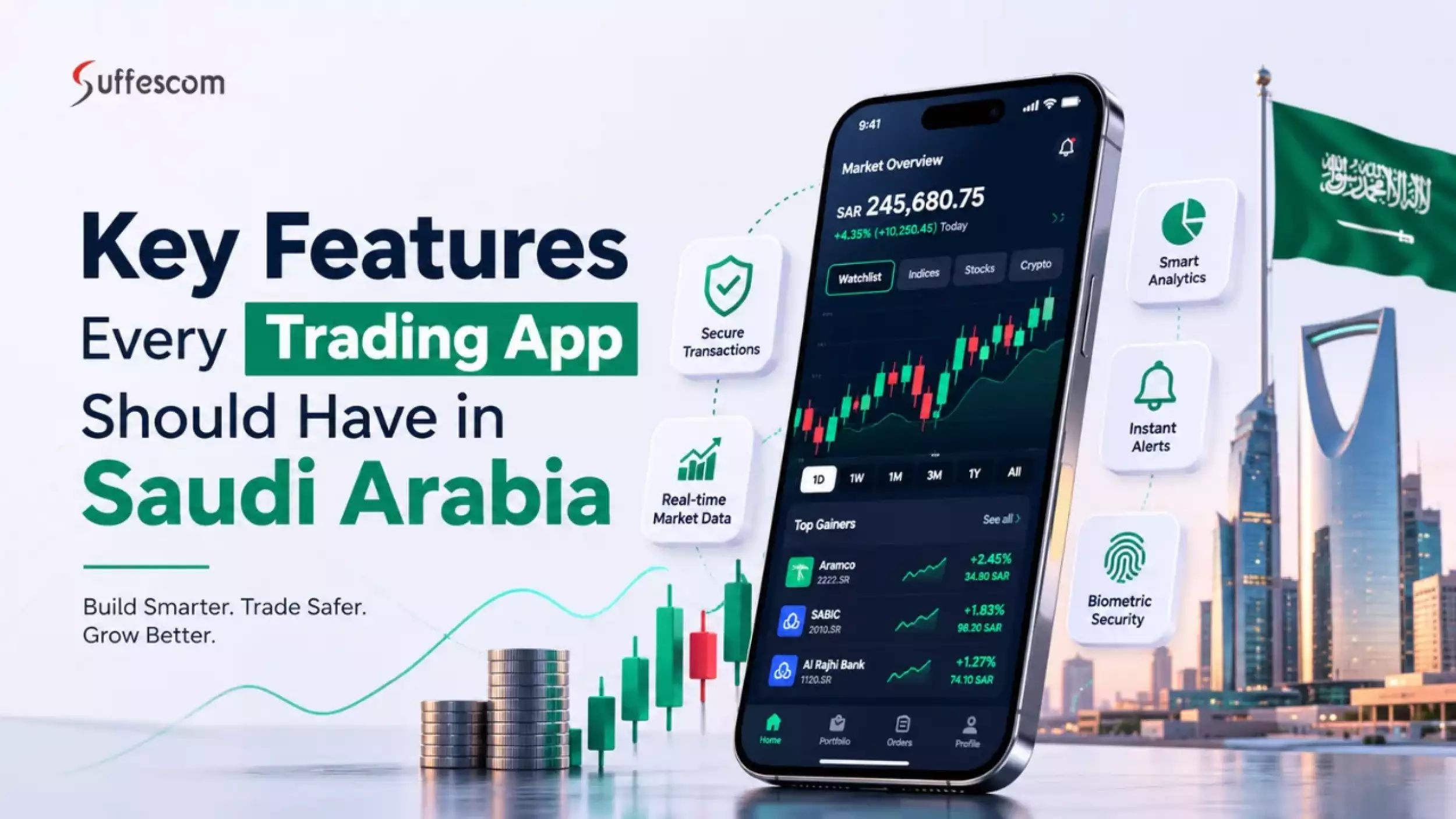
To be a successful trading application, the program needs to have an easy-to-use interface, trading tools, security, and compliance with regulations. The following aspects are those that business organizations need to consider when developing trading applications in Saudi Arabia.
The following are the essential features that help create a reliable and competitive trading application.
Secure User Registration and Digital Onboarding
A streamlined registration process of registering is the first step towards increasing user adoption. Trading applications must give users the ability to have an easy onboarding experience where they can create accounts, complete the process of identification, and use the trading services. Elements such as automatic document verification and digital account creation are some ways through which this can be achieved.
KYC and AML Verification
Know Your Customer (KYC) and Anti-Money Laundering (AML) verification are essential for financial applications. Trading platforms must verify user identities, assess risks, and prevent fraudulent activities before allowing access to investment services. Implementation of automated solutions for identity verification would help companies in ensuring compliance, automating processes, and creating a safer trading space.
Multi-Factor Authentication (MFA)
The security aspect is crucial when talking about applications that involve handling financial information. MFA makes the user authenticate via different mechanisms such as passwords, OTPs, biometrics, or trusted devices. MFA makes sure that nobody can access the account illegally and protects the user from typical cyber threats.
Real-Time Market Data and Live Price Feeds
Access to accurate and up-to-date market data is probably the most crucial component of any trading application. It allows for receiving up-to-date market prices, trends, volumes, and other financial indicators. Integration with reliable market data APIs enables traders to make faster decisions based on current market conditions.
Advanced Trading Dashboard
An effective trading dashboard allows the user to get a full view of all the investments that he or she makes. The dashboard needs to show account balances, market trends, watch list, portfolio performance, and trading opportunities in a manner that is easily understandable. Customizable dashboards make the user experience easier.
Interactive Charts and Technical Indicators
Professional traders depend on charts to make judgments about market trends. Trading applications need to have interactive charts with such features as:
- Candlestick patterns
- Price movement analysis
- Technical indicators
- Historical data comparison
- Custom timeframes
These will assist users in analyzing their assets and making better trading decisions.
Watchlists and Market Watch
Users are allowed to watch selected stocks, assets, or financial securities without looking for them all the time. Through this, users can watch their prices, any developments in the market, and news from their customized watchlist. This increases user engagement and will encourage users to come back to the platform frequently.
Portfolio Management
A portfolio management function will allow users to check their portfolios in one place. The portfolio management should have information on how the user’s money is being allocated, profit or losses, investment performance, and transaction history. In terms of businesses, good portfolio management is helpful in increasing transparency.
Multiple Order Types (Market, Limit, and Stop-Loss Orders)
Trading apps should support different order types to meet the needs of various investors. Common order options include:
- Market Orders: Execute trades immediately at the current market price.
- Limit Orders: Allow users to set a specific buying or selling price.
- Stop-Loss Orders: Help minimize losses by automatically selling an asset when it reaches a defined price.
The ability to place multiple order types gives traders more freedom when devising their trading strategy.
Instant Push Notifications
Push notifications play an important role in today’s dynamic trading world. The notifications can be used to give users information on prices, trades made, updates in the markets, actions related to accounts, and other significant news.
Transaction History and Reporting
Trading applications must have good transaction history and reporting capabilities. People will be able to see their previous trades, deposits, withdrawals, fees, and performance of investments. With better reporting, you increase the level of transparency and gain trust from customers.
Multi-Currency and Multi-Language Capability
As Saudi Arabia has various customers and many international investment possibilities, it would be a good idea to develop the multi-language and multi-currency capability in an application. Especially Arabic and English languages are critical for trading applications in Saudi Arabia, while multiple currencies allow for better investment.
Advanced Features That Differentiate Modern Trading Apps
Speaking about the core features of a trading app, it can be noted that the company creates a functional product; while speaking about advanced features, one can mention that it can be an innovative trading app in FinTech. With the help of AI, automation, and personalization capabilities, businesses will be able to offer smart investing experiences and increase user engagement.
AI-Based Trading Insights
With the help of AI technologies, platforms can analyze market data to generate useful insights. AI-powered systems can recognize patterns, analyze market trends, and offer data-based recommendations. For businesses, AI integration means the improvement of user experience by providing personalized insights without the need for users to conduct complex market analysis on their own.
Robo-Advisory Services
The algorithms and automated models used by robo-advisors help users make investments based on users' objectives, preferences, and risk tolerance. This feature can help investment platforms reach out to users who are interested in automated portfolio management solutions. Robo-advisory capabilities can help businesses expand their services by offering automated investment guidance alongside traditional trading options.
Copy Trading
Copy trading enables users to automatically replicate the trading styles of seasoned investors. This is especially helpful for novice traders since it enables them to learn from those who have been successful in the market. The addition of social and automated trading tools will help businesses to recruit more users.
Social Trading Community
The social trading tools help investors to engage and interact, exchange market knowledge and strategies, and follow seasoned traders. An embedded community helps in retaining users since it creates an engaging investment atmosphere. Social trading tools can be used by businesses to establish a closer connection with their users.
Algorithmic Trading Support
Algorithmic trading enables automated execution of trades based on predefined rules and market conditions. It helps experienced traders execute strategies faster while reducing manual intervention. For advanced trading platforms, algorithmic capabilities can improve execution efficiency and support professional investment requirements.
Predictive Analytics
The predictive analytics technique uses previous data, market trends, and machine learning models to predict possible movements in the market. The trading application can benefit from such predictions by showing users potential opportunities and risks and providing more analysis of the market. This function will enable the conversion of market data to useful information.
Smart Portfolio Recommendations
AI portfolio recommendations will analyze user behavior, investment objectives, and current market situations and recommend a suitable asset allocation strategy for users. Such recommendations will assist users in making well-diversified portfolios according to their preferences. This function will make the business experience more personalized for customers.
Voice Search and Voice Commands
Voice capabilities will allow users to search markets and check the status of their portfolios and other trading information using voice commands. As voice technology continues to advance, voice features can become an important part of next-generation financial applications.
AI Chatbot for Customer Assistance
AI chatbots provide instant support for common user queries related to accounts, transactions, platform navigation, and trading services. They help businesses reduce response times while providing 24/7 customer assistance. Advanced AI chatbots can also guide users through onboarding, explain platform features, and improve overall customer experience.
Launch a High-Performance Trading Platform with Advanced AI Capabilities
Core Modules Required for Trading App Development
A successful trading application requires a strong technical foundation built around multiple interconnected modules. These modules manage user activities, trading operations, financial transactions, security controls, and administrative processes.
For businesses in Saudi Arabia, a well-structured architecture helps ensure the platform remains secure, scalable, and capable of handling growing user and transaction volumes.
User Management Module
The user management module takes care of all user-related operations such as registration, user profiles, account settings, ID verification status, and preferences. Some functionalities include:
- User account creation and management
- Profile updates
- KYC status tracking
- Account verification
- Role and permission management
A good user management system enhances security while giving users a smooth account experience.
Trading Engine
The trading engine is the main component of any trading application. It deals with the processing of buy/sell orders, trade execution, and transactions. A good trading engine must have the following features:
- Fast order processing
- Multiple order types
- Real-time execution
- Market data synchronization
- Error handling and transaction validation
Latency and reliability are key considerations for professional trading platforms since they have an impact on user experience.
Portfolio & Asset Management Module
This portfolio management module lets you keep track of your investments through one dashboard by monitoring asset allocation, performance, P&L, and investment history. Important capabilities include:
- Real-time portfolio valuation
- Asset tracking
- Performance reports
- Investment analysis
- Portfolio diversification insights
This module helps users make informed decisions about their investments.
Wallet and Fund Management Module
A secure wallet and fund management system enables users to deposit, withdraw, and manage their trading funds. It should provide accurate transaction processing while maintaining strong security controls. Key features include:
- Deposit and withdrawal management
- Balance tracking
- Transaction verification
- Payment integration
- Fund security controls
For Saudi-based trading platforms, secure financial transaction handling is essential for building user trust.
Admin Panel
The admin panel gives full control over management to the organization. Administrators are able to monitor users, handle transactions, change settings, and track system performance. Common admin functionalities include:
- User management
- Transaction monitoring
- Compliance reporting
- Content management
- System analytics
- Risk monitoring
A powerful admin panel helps businesses operate the platform efficiently.
CRM Module
The customer relationship management (CRM) module is used for managing customer contacts. It allows storing user data, monitoring contacts with users, and conducting customer contact activities. Customer relationship management helps the company:
- Manage customer requests
- Track user behavior
- Improve retention strategies
- Provide personalized services
Notification System
The notification module keeps users aware of all the essential account and market-related notifications. This module takes care of notifications through various mediums like push notifications, SMS, and email. Common notifications include:
- Trade execution updates
- Price alerts
- Account activity alerts
- Security notifications
- Market updates
Real-time communication improves user engagement and platform reliability.
Frontend Analytics Dashboard
The analytics dashboard presents important trading and business insights through visual reports and interactive data displays. For users, it can show:
- Portfolio performance
- Market trends
- Trading history
- Investment insights
For businesses, analytics dashboards help monitor:
- User activity
- Trading volume
- Platform performance
- Customer behavior
Customer Support Module
The customer support module is another important element that helps the business deliver instant customer support to the users. It can be made up of live chat facilities, ticketing systems, FAQs, and AI-based customer support systems. Efficient customer support improves user satisfaction and helps resolve account, transaction, and technical issues quickly.
Technology Stack for Trading App Development
| Technology Stack Category | Recommended Technologies | Business Benefit |
| Frontend Development | React Native, Flutter, Swift, Kotlin, React.js, Angular | Deliver seamless cross-platform trading experiences |
| Backend Development | Node.js, Java (Spring Boot), Python (Django/FastAPI), .NET Core, Go | Ensure secure, scalable, and high-performance processing |
| Cloud Infrastructure | AWS, Azure, GCP, Docker, Kubernetes | Support scalability, reliability, and high availability |
| Database Management | PostgreSQL, MySQL, MongoDB, Redis, Apache Cassandra | Manage large volumes of trading and user data |
| AI & Machine Learning | TensorFlow, PyTorch, Scikit-learn, OpenAI APIs | Enable predictive analytics and personalized trading insights |
| Blockchain Integration | Ethereum, Hyperledger Fabric, Smart Contracts, Web3 APIs | Improve transparency and support digital asset trading |
| Real-Time Data Processing | WebSocket, Socket.IO, SignalR, FIX Protocol | Enable low-latency trade execution and live market updates |
| Third-Party Integrations | Bloomberg, Refinitiv, HyperPay, Moyasar, SAMA Open Banking, Sumsub, Onfido, Salesforce, HubSpot, Mixpanel, Twilio | Connect essential market data, banking, payment, identity, CRM, analytics, and communication services |
Choosing The Correct Blockchain Game Development Engine
Security Features Every Trading Platform Must Have
Security is one of the basic needs for any trading platform since this application deals with confidential and sensitive data. The development of a secure trading application allows companies to ensure their customers' protection against any cyber attacks and build their confidence.
End-to-End Encryption
Encryption is a technology that makes information that requires special confidentiality not readable by other devices or individuals except those for which this information is designed. Encryption is required in order to add an extra layer of protection to such things as credentials, financial information, and users' transactions.
Biometric Authentication
Biometric authentication is another security technology that allows users to prove their identities using biometrics such as fingerprints or facial recognition. Trading apps benefit from biometric logins since they ensure a higher level of security without requiring traditional passwords and protecting accounts from being used by other people.
Fraud Detection System
An advanced fraud detection system is another must-have feature of trading apps, which allows for recognizing any suspicious activity that may affect the safety of user accounts. This technology, based on artificial intelligence, detects transactions and any other signs of fraud and eliminates all potential threats. Fraud detection allows companies to reduce their financial risks and build a safer trading environment.
Payment Processing Security
Trading applications should guarantee secure payment processing for deposits, withdrawals, and any other transactions. Cooperation with reliable payment gateways and banking services is one way to keep money safe and make sure of the reliability of transactions. Secure payment processing should comprise transaction validation, data encryption, fraud detection, and compliance with financial security regulations.
Session Management
Session management is a great tool to increase protection of user accounts from any unauthorized access. Session management includes features such as automatic sign-out, session expiration, token authentication, and active session monitoring. Proper session management is especially vital for mobile trading applications.
Device Verification
Device verification helps the trading platform distinguish and verify devices used by the account owners. This technique helps reduce any unauthorized access attempts from unknown devices. Popular techniques used here include device identification, verification codes, and alerts for new device access.
Role-Based Access Control (RBAC)
Role-based access control guarantees that users and employees have access only to those functionalities for which they are authorized. For trading platforms, RBAC helps secure sensitive operations by controlling access to:
- User information
- Transaction management
- Compliance records
- Administrative functions
This improves internal security and reduces the risk of unauthorized system changes.
Audit Logs
Audit logs record important activities performed within the trading platform, including user actions, transactions, system changes, and administrative activities. Detailed logging helps businesses:
- Monitor suspicious behavior
- Support regulatory reporting
- Investigate security incidents
- Maintain operational transparency
A comprehensive audit trail is essential for building a secure and accountable trading ecosystem.
Saudi Arabia Compliance Requirements for Trading App Development
Saudi Arabia's trading applications are conducted within the financial regulatory framework where security, transparency, investor protection, and privacy of personal data are key considerations. The businesses that develop trading applications must take into account various regulations promulgated by financial regulators, including CMA and SAMA, as well as the country’s data protection and cybersecurity legislation.
Regulations of the Capital Market Authority (CMA)
The Capital Market Authority (CMA) is the regulator of securities activities and investment services, including brokerage in Saudi Arabia. The trading applications that conduct securities trades or investment services should adhere to the regulations of the Capital Market Authority depending on their business models and licenses.
Key CMA regulations and frameworks include:
Capital Market Law (Royal Decree No. M/30)
Establishes the legal framework for Saudi Arabia’s capital market and defines CMA’s authority over securities activities, market participants, and investor protection.
Authorized Persons Regulations (APR)
Defines requirements for entities providing securities-related services, including brokerage and investment services.
Market Conduct Regulations
Establish standards for fair dealing, preventing market manipulation, ensuring transparency, and protecting investors.
Investment Accounts Instructions
Provides requirements related to managing investment accounts and client relationships.
Trading platforms shall adopt compliance capabilities, such as verification, transaction monitoring, reporting, and audit trails, to facilitate the CMA guidelines.
Saudi Central Bank (SAMA) Cybersecurity and Financial Regulations
Traded applications that interact with banking or financial services must adhere to SAMA frameworks.
Important SAMA compliance requirements include:
SAMA Cyber Security Framework (CSF): Provides cybersecurity controls for financial institutions, covering areas such as risk management, access control, incident management, and security monitoring.
SAMA Open Banking Framework: Defines requirements for secure API-based financial data sharing and payment services between financial institutions and third-party providers.
Payment Services Provider Regulations (PSP Regulations): Set standards for organizations engaging in payment services, including security, governance, and operations control.
These standards assist trading platforms in ensuring that the transactions conducted are secure and safe, and risks are managed.
Know Your Customer (KYC) & Anti-Money Laundering (AML)
Systems for identity verification and monitoring transactions must be employed by trading applications to prevent financial crimes.
Some regulations that must be considered are as follows:
Anti-Money Laundering Law (Royal Decree No. M/20)
Laws that outline methods of preventing money laundering activities and suspicious transactions.
Terrorist Financing Law (Royal Decree No. M/21)
Regulates how to prevent terrorist financing activities and financial controls.
Required platform features include:
- Digital identity verification
- Customer risk assessment
- Transaction monitoring
- Suspicious activity reporting
- Record retention
Data Protection and Privacy Compliance
Trading apps collect sensitive personal and financial information, making data privacy compliance essential. Key regulation:
Personal Data Protection Law (PDPL) – Royal Decree No. M/19
Saudi Arabia’s primary data privacy law, administered by the Saudi Data & AI Authority (SDAIA), establishes requirements for collecting, processing, storing, and protecting personal data.
Trading platforms should implement:
- User consent management
- Data encryption
- Access controls
- Privacy policies
- Secure data storage
- Data breach management procedures
Electronic Transactions Compliance
Digital trading platforms rely on electronic agreements, digital records, and online transactions. Businesses should consider:
Electronic Transactions Law (Royal Decree No. M/18)
This law provides legal recognition for electronic transactions, electronic records, and electronic signatures in Saudi Arabia.
- For trading applications, this supports:
- Digital account opening agreements
- Electronic approvals
- Online contracts
- Digital transaction records
Cybersecurity and Operational Compliance
For companies in Saudi Arabia dealing with financial information that is considered sensitive, the NCA ECC (National Cybersecurity Authority Essential Cybersecurity Controls) model is used to guide security processes.
- Identity and access management
- Network security
- Data protection
- Vulnerability management
- Incident response
- Business continuity
Audit and Reporting Requirements
A compliant trading platform should include built-in reporting and monitoring capabilities to support regulatory obligations. Important capabilities include:
- Transaction history tracking
- Audit logs
- Regulatory reporting
- User activity monitoring
- Risk management reports
By integrating CMA regulations, SAMA frameworks, AML requirements, PDPL, Electronic Transactions Law, and cybersecurity controls during development, businesses can build secure and compliant trading platforms suitable for the Saudi financial market.
Third-Party Integrations Required for a Trading Application
Integrations with third-party services are necessary to create a truly effective trading application. Rather than trying to design each service themselves, businesses can integrate their platforms with external applications that can help them perform such functions as real-time market access, transaction security, identity authentication, analysis, and efficient finance management.
With the proper integration, trading applications can enhance their performance and user experience.
Market Data APIs
A market data API provides real-time and historical financial data that is needed for the trading process. Such integrations help users obtain stock quotes, market data, volume of trades, graphs, and financial indicators. Common data sources include:
- Stock market data APIs
- Exchange connectivity APIs
- Real-time price feeds
- Historical market data providers
Reliable market data integration is essential for accurate analysis and timely trading decisions.
Payment Gateway Integration
The payment gateway API allows users to easily transfer money into and out of their trading accounts. This helps facilitate secure financial transactions and also includes authentication and anti-fraud features. Key capabilities include:
- Secure payment processing
- Transaction verification
- Multiple payment methods
- Deposit and withdrawal management
For Saudi-based trading apps, payment integrations should support local financial systems and security requirements.
Identity Verification APIs
Identity verification APIs make the process of Know Your Customer easier through automation of user authentication and document verification. These integrations help businesses onboard users faster while maintaining regulatory compliance. Common features include:
- Digital identity verification
- Document scanning
- Face recognition
- Identity validation
Banking APIs
Banking APIs offer a means for trading applications and financial institutions to establish safe connections. Banking APIs give users an option of using an application to move money, verify their accounts, and access other banking services. Banking integrations can support:
- Account verification
- Fund transfers
- Payment processing
- Open banking services
CRM Software
CRM integrations assist in managing customer relationships and user engagement. They offer an opportunity for tracking how users interact, offering personalized support, and analyzing their behavior. CRM capabilities include:
- Customer data management
- Support ticket tracking
- Marketing automation
- User engagement analytics
Analytics Platforms
Analytics integrations give useful information on the behavior of users, their trading activities, and the functioning of platforms. Businesses can leverage this information to optimize their features. Analytics tools help monitor:
- User engagement
- Trading patterns
- Conversion rates
- Application performance
Notification Services
Notification service integrations enable real-time communication with users through multiple channels, including push notifications, SMS, and email. They support alerts such as:
- Price movements
- Trade confirmations
- Security notifications
- Account updates
Cloud Services
Cloud service integrations provide the infrastructure required for scalability, reliability, and high-performance trading operations. Cloud platforms support:
- Data storage
- Application hosting
- Load balancing
- Security management
- Disaster recovery
Having scalable cloud architecture helps traders deal with the increasing number of users, deals, and market data more effectively.
Cost of Development of Trading Application in Saudi Arabia
On average, the cost of development of a trading application in Saudi Arabia is from SAR 115,000 to 565,000+ ($30,000-$150,000+), depending on the level of complexity of the platform, its features, security, compliance issues, and scalability needs. The development of a simple MVP trading application with the necessary set of functions implies the allocation of fewer resources, and a professional platform with AI and other features costs much more.
Factors Affecting Trading App Development Cost
Several factors influence the overall investment required to build a trading platform:
Feature Complexity
The number and complexity of features directly impact development costs. Simple features such as registration of users, tracking of portfolios, and trades consume less time to develop, while complex features such as AI analysis, robo-advisors, copy trading, and algo trading require more.
Number of Platforms (iOS, Android, Web)
Development of a trading application on multiple platforms affects the budget and time planning. The native trading app needs separate development for iOS and Android, and cross-platform technology may help to save on development costs.
Integration with Third-Party Solutions
Third-party integration with the stock market, payment gateways, banks, identity verification tools, and analytics platforms adds complexity to the development process. The number and type of integrations required influence both development time and overall cost.
Security Requirements
Given that trading applications deal with financial transactions and user information, the implementation of robust security features becomes imperative. Security features like encryption, biometric authentication, fraud detection, and security monitoring need more development effort.
Compliance Implementation
Trading applications operating in Saudi Arabia should take into account compliance regulations relating to CMA, SAMA, AML/KYC, and data protection. The implementation of compliance workflow, reporting, and audit functionalities may affect development expenditure.
AI and Automation Features
Sophisticated features such as AI market insights, predictive analytics, robo-advisory, and automated portfolio recommendation require specific technology and knowledge, thereby raising development expenditure.
Development Team Location
The development team’s location and expertise level influence project costs. Options available include choosing from a local development team based in Saudi Arabia, an offshore development team, or a combination of both according to the budget, communication, and technical requirements.
Ongoing Maintenance
Maintenance after launching the platform is a critical component of the overall investment. Maintenance includes updating the trading platform with security patches, compliance updates, bug fixing, and optimization.
Development Cost by Complexity
Trading app costs vary based on the level of functionality, scalability, and customization required.
| App Complexity | Features Included | Estimated Cost (SAR) | Estimated Cost (USD) |
| MVP Trading App | User Registration, KYC Verification, Portfolio Management, Basic Trading, Push Notifications | SAR 115,000–170,000 | $30,000–45,000 |
| Basic Trading App | Real-Time Market Data, Interactive Charts, Wallet Integration, Transaction Reports, Multi-Order Support | SAR 170,000–265,000 | $45,000–70,000 |
| Mid-Level Trading Platform | Advanced Analytics, Third-Party API Integrations, Multi-Asset Trading, Admin Panel, Enhanced Security | SAR 265,000–340,000 | $70,000–90,000 |
| Enterprise Brokerage Platform | Algorithmic Trading, CRM Integration, Advanced Compliance, High Scalability, Custom APIs | SAR 340,000–490,000 | $90,000–130,000 |
| AI-Powered Trading App | AI Trading Insights, Robo-Advisory, Predictive Analytics, Smart Portfolio Recommendations, AI Chatbot | SAR 490,000–565,000+ | $130,000–150,000+ |
Ultimately, the price will depend on the type of business model used, regulations involved, technologies employed, and the degree of customization required. Strategic planning of the development process will enable businesses to combine features, budget, and scalability when developing a competitive trading platform for Saudi Arabia.
Factors Driving Up Costs in Trading App Development
There are several technical and business aspects that affect the cost of developing a trading app. Each particular component influences the total costs according to its complexity and significance for the platform.
| Component | Cost Impact | Priority |
| UI/UX Design | Medium | High |
| Trading Engine | Very High | Essential |
| Market Data Integration | High | Essential |
| AI Features | High | Optional |
| Cloud Infrastructure | Medium | High |
| Security Implementation | Very High | Essential |
| Compliance | High | Essential |
| QA & Performance Testing | Medium | Essential |
| Maintenance & Updates | Medium | Essential |
Common Challenges in Trading App Development
Developing a trading system comes with its own set of technical, security, and regulatory challenges that businesses have to resolve to build an effective trading platform that offers speedy trade execution, consistent performance, and a secure environment.
Speedy and Real-Time Trade Execution
A trading platform should be able to execute orders with no delay at all because even slight latency issues may disrupt performance. To make sure of speedy execution, businesses have to implement high-performance trading engines and proper backend architecture.
Handling High Trading Volumes
With growing adoption, a trading platform will receive an increased number of transactions, requests for market data, and users. For this reason, scalability, load balancing, and proper management of databases are necessary for the stability of the trading platform.
Data Accuracy
Trade execution is based on real-time and accurate financial information. Any error, lag, or inconsistency in market data could have dire consequences for its users. Market data APIs, validation techniques, and monitoring become an absolute necessity in terms of ensuring data accuracy.
Avoiding Cybersecurity Threats
The risk of being hacked is always present when it comes to trading platforms because of the financial information and transactions they contain. There needs to be security from hacks, fraud, and breaches. Encryption, two-factor authentication, fraud detection systems, and testing of the platform come in handy.
Regulatory Compliance
Every financial app faces varying rules and regulations that regulate the processes of user identification, data security, transaction monitoring, and reporting. It is important to meet all of the requirements, which include CMA compliance, SAMA, AML/KYC regulations, and Saudi data protection laws.
Scalability of the Platform
The trading app needs to be scalable in the future in terms of an increased number of users, added financial instruments, and extra features. The use of scalable technologies, cloud infrastructure, and efficient development practices allows the company to grow its platform without major changes to it.
Development Roadmap for Launching a Trading App
A successful launch of a trading app involves a specific roadmap for the planning, designing, developing, testing, and deployment of the software. The roadmap allows companies to decrease risks and control costs when building a trading app.
Discovery and Business Analysis
First, there is a need to understand the business goals, target audience, trading needs, and regulations. The analysis of the platform, its scope of features, integrations, and technical specifications will allow the development of an efficient strategy.
UI/UX Design
At this step, designers develop user flow, wireframes, and UI design, paying special attention to the usability and simplicity of the interface. The interface of the trading application should be understandable in terms of the financial information and provide access to the most important tools.
MVP Development
This phase implies the creation of the basic functionality needed for testing on the market. The MVP includes the functionality of user registration, KYC, portfolio management, trading, notifications, and account management. MVP development allows companies to gather user feedback and improve the platform by adding more features after that.
Integration with API and Market Data
This stage involves integration of the application with various third-party services such as market data services, payment systems, bank APIs, identity verification services, and analytical platforms. Proper integration ensures proper market data and financial processes.
Security and Compliance Tests
Before the launch, security and compliance tests are carried out to detect any vulnerabilities.
Testing includes:
- Data security checks
- Authentication testing
- Transaction validation
- KYC/AML workflow testing
- Performance monitoring
User Acceptance Testing (UAT)
This stage permits business owners and chosen users to use the software under practical conditions. The comments obtained at this stage can be used to determine usability problems, optimize processes, and make sure that the platform meets the requirements of the business owner.
Deployment and App Store Release
Once the testing stage is completed successfully, the trading app is released to the production environment and app stores. This stage involves server setup and performance monitoring.
Continuous Support and Feature Updates
Support is vital for the safety and competitiveness of the trading platform. The maintenance activities include:
- Security updates
- Bug fixes
- Performance improvements
- Regulatory updates
- New feature enhancements
Continuous improvement enables companies to adjust their strategies in line with user expectations and changes in the financial technology landscape.
How to Choose the Right Trading App Development Company in Saudi Arabia
Picking the right company is a crucial step for organizations intending to develop a trading application. A reliable development company should understand financial technology requirements, security standards, Saudi regulations, and the technical complexity involved in creating scalable trading solutions.
Experience in FinTech Projects
A company with experience in FinTech app development understands the challenges of building financial applications, including secure transactions, real-time data processing, compliance requirements, and complex integrations. Reviewing previous FinTech projects can help businesses evaluate the company's technical expertise and ability to deliver reliable trading solutions.
Knowledge of Saudi Financial Regulations
Trading platforms in Saudi Arabia must consider requirements related to CMA regulations, SAMA guidelines, KYC/AML processes, and data protection laws. A development partner like Suffescom with knowledge of the Saudi financial ecosystem can help businesses build platforms that align with local compliance expectations.
Expertise in High-Security Applications
Security is a core requirement for trading applications. The right development company should have expertise in implementing encryption, authentication systems, fraud prevention, secure APIs, and cybersecurity best practices. This ensures the platform can protect sensitive financial and user data.
Ability to Build Custom Trading Solutions
Every business has different goals, target users, and operational requirements. A capable development partner should provide customized solutions instead of relying only on generic templates. Custom development allows businesses to build unique features, integrations, and workflows based on their specific needs.
Transparent Development Process
The company developing trading software must have a proper and clear process for project planning, communication, milestones, testing, and delivery. Constant updates, documentation, and proper cost estimation allow companies to have better control over the project.
Support and Maintenance
Trading software needs regular updates and maintenance, as the platform requires constant updates, security improvements, and technical assistance once the platform is launched. It allows keeping the trading app safe, scalable, and up-to-date in accordance with market changes.
Future Trends in Trading App Development
There is a rapid evolution of the trading industry due to new technologies that change the way users invest money and operate on financial platforms. Businesses creating trading applications in Saudi Arabia are increasingly using modern technologies to develop smart and fast investment applications.
AI-Fueled Investment Applications
Artificial intelligence is becoming an integral part of modern trading applications. AI-fueled investment applications are able to analyze market data and give investment insights and personal recommendations. As AI technology advances, trading apps are expected to offer more intelligent decision-support features and automated investment solutions.
Embedded Finance
Embedded finance enables financial services to be integrated directly into non-financial platforms and digital ecosystems. Trading businesses can use embedded finance capabilities to provide smoother investment experiences, faster transactions, and connected financial services.
Open Banking Integration
Through the use of open banking, financial data exchange between different financial institutions and third-party applications is enabled through API integration. Trading applications may take advantage of open banking to make transactions easy and provide personalized services.
Tokenized Assets
Tokenization gives a chance for physical assets such as securities, commodities, and other kinds of investments to be represented in the form of a digital one on the blockchain network. Trading applications could use tokenized assets in order to increase access, transparency, and efficiency of transactions.
Trading Processes in the Blockchain Platform
The blockchain platform provides numerous opportunities that can be used to make the trading process more efficient, transparent, and secure. Such opportunities include, but are not limited to, the following ones: trading of digital assets, smart contracts, transaction verification, and improved record-keeping.
Hyper-Personalized User Experiences
Current trading applications are developing into more personalized experiences based on users’ behavior, investing objectives, and risk tolerance. Personalized experience is achieved by means of recommendations, customized dashboards, and alerts.
Cloud-Native Trading Platform
A cloud-native approach allows trading platforms to scale efficiently, provide for high transaction volumes, and improve reliability. Companies are now able to build flexible systems using cloud technologies, which will be able to address future scalability issues and advanced analytics as well as real-time trading needs.
Ready to Build a Secure, Feature-Rich Trading App for the Saudi Market?
Conclusion
The success of a trading application in Saudi Arabia will be possible through the correct balancing of security, scalability, compliance, advanced features, and usability. Businesses need to provide more than trading capabilities when building their trading platforms; they should be able to provide real-time market access, security, a personalized investment experience, and all required regulations.
Given the developing FinTech environment and the digital transformation in Saudi Arabia, a custom trading app will allow brokerage firms, banks, and investment companies to build competitive financial solutions for their users.
Suffescom Solutions is a professional trading app development company in Saudi Arabia that will enable businesses to build a secure and scalable platform to address the changing requirements of the Saudi financial market.
Frequently Asked Questions
How much does it cost to develop a trading app in Saudi Arabia?
The cost to develop a trading app in Saudi Arabia typically ranges from SAR 115,000 to 565,000+ ($30,000-$150,000+). The final cost depends on factors such as app complexity, features, security requirements, integrations, compliance needs, and scalability requirements.
What are the essential features of a trading app?
Essential trading app features include secure registration, KYC verification, multi-factor authentication, real-time market data, trading dashboards, portfolio management, multiple order types, notifications, transaction history, and reporting tools.
How long does trading app development take?
Trading app development usually takes between 3 and 18 months, depending on complexity. An MVP may take around 3–5 months, while advanced enterprise-level platforms with AI, automation, and custom integrations may require 12–18 months.
Which technologies are best for trading platform development?
Popular technologies for trading platforms include Flutter and React Native for mobile app development, Node.js, Java, Python, and .NET for backend systems, cloud platforms such as AWS and Azure, WebSocket for real-time data, and AI/ML frameworks for intelligent features.
Is CMA compliance required for trading apps in Saudi Arabia?
Trading apps that provide regulated investment or securities services may need to comply with Capital Market Authority (CMA) requirements. Compliance needs depend on the business model, services offered, and licensing requirements.
What security measures should a trading app include?
A secure trading app should include encryption, biometric authentication, multi-factor authentication, fraud detection systems, secure payment processing, device verification, access controls, and audit logs to protect user data and transactions.
Can a trading app support stocks, forex, ETFs, and cryptocurrencies?
Yes, trading apps can support multiple asset classes, including stocks, forex, ETFs, and digital assets. However, the supported instruments depend on business requirements, market integrations, and applicable regulations.
What APIs are required for a trading application?
Trading applications commonly require market data APIs, payment gateway APIs, banking APIs, identity verification APIs, analytics APIs, notification APIs, and CRM integrations.
How does AI improve trading platforms?
Integrating AI capabilities improves trading platforms by enabling features such as market insights, predictive analytics, personalized recommendations, robo-advisory services, fraud detection, and automated customer assistance.
What is the difference between a trading app and a brokerage platform?
A trading app is a user-facing application that allows users to monitor markets and execute trades, while a brokerage platform includes broader infrastructure such as trading engines, account management, compliance systems, and operational tools.
Can a trading app integrate with Saudi banking systems?
Yes, trading apps can integrate with banking systems through secure APIs to support account verification, deposits, withdrawals, and payment-related services while following applicable financial security requirements.
What factors influence trading app development costs?
Development costs are influenced by feature complexity, supported platforms, third-party integrations, security implementation, compliance requirements, AI capabilities, development team expertise, and ongoing maintenance.
Should businesses choose custom or white-label trading app development?
Custom development provides greater flexibility, scalability, and control over features and integrations. White-label solutions may offer faster deployment but usually provide limited customization options.
How do trading apps handle real-time market data?
Trading apps use market data APIs, exchange integrations, and real-time communication technologies such as WebSocket to deliver live prices, market updates, and trading information.
What ongoing maintenance is required after launch?
Post-launch maintenance includes security updates, bug fixes, performance optimization, compliance updates, server monitoring, feature enhancements, and technical support.
How do I choose the right trading app development company in Saudi Arabia?
Businesses should evaluate a company’s FinTech experience, knowledge of Saudi regulations, security expertise, custom development capabilities, communication process, and long-term support services before selecting a development partner.