+971-8000321216



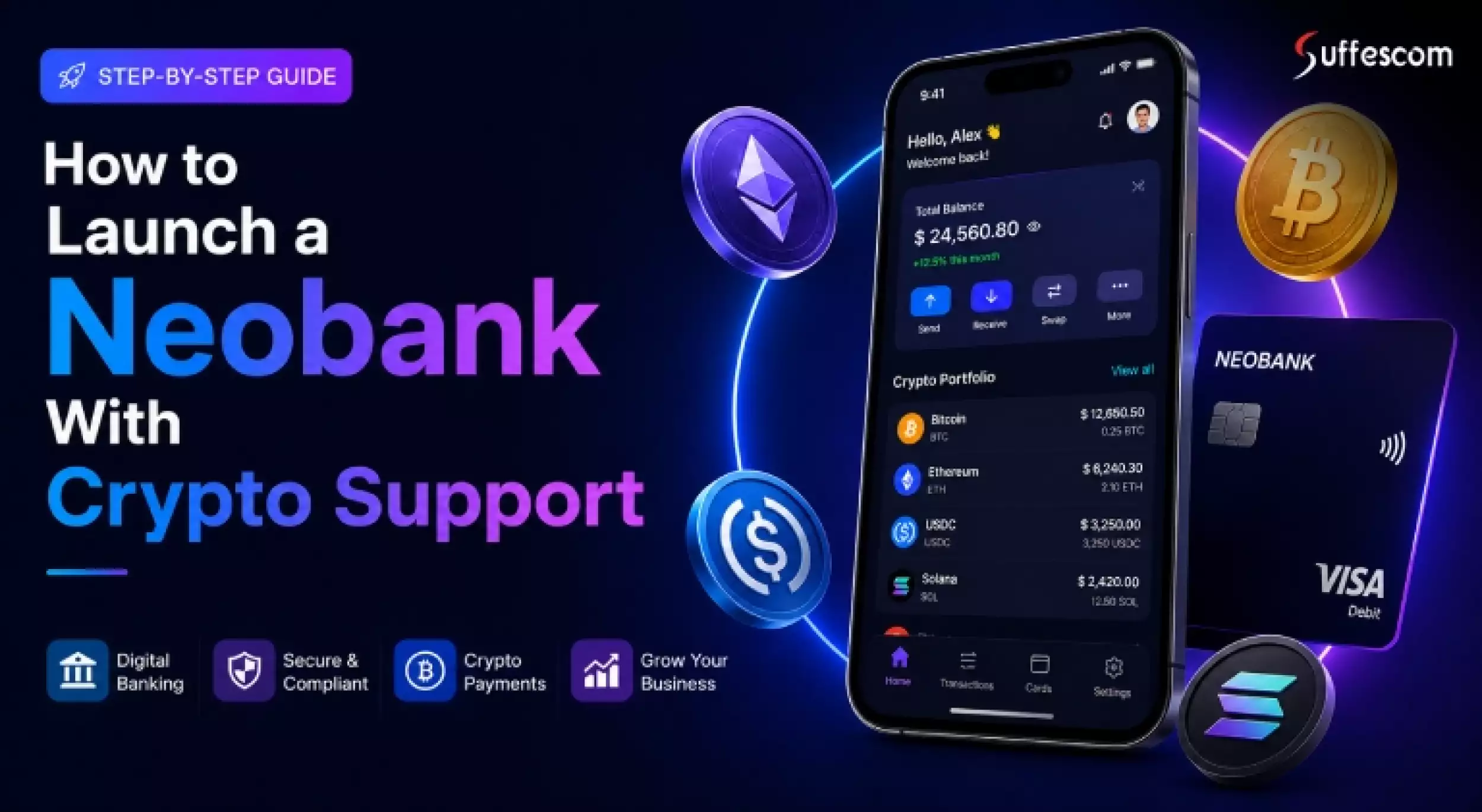
The neobanking ecosystem has completely reshaped consumers' and businesses' experience of accessing financial products. Neobanks initially emerged as mobile-only substitutes for conventional banks that provide immediate onboarding, real-time payments, financial AI management, and cross-border transactions.
According to the Fortune Business Insights, the global neobanking market size was valued at USD 210.16 billion in 2025. The market is projected to grow from USD 310.15 billion in 2026 to USD 7,661.57 billion by 2034, exhibiting a CAGR of 49.30% during the forecast period.
With consumer needs becoming ever more demanding, cryptocurrency capabilities become the next competitive tool in the hands of neobanks. More and more consumers desire to have the capability to hold their digital assets, pay using stablecoins, exchange cryptocurrency, and manage both fiat and cryptocurrencies from one application.
This guide walks through what a crypto-enabled neobank actually is, the realistic paths to launching one, and the step-by-step build process from licensing scope to post-launch scaling to make an informed decision.
What Is a Crypto-Enabled Neobank?
A crypto-enabled neobank is a digital-only banking platform that combines traditional banking services such as checking accounts, debit cards, direct deposit, and payments along with regulated cryptocurrency functionality such as custody, buy/sell conversion, and crypto-to-fiat spending all inside a single, compliant application.
Unlike a standalone crypto exchange or wallet app, a crypto neobank is built around a banking relationship so that a customer's fiat balance, crypto holdings, and card spending all live in one account, governed by banking-grade compliance rather than exchange-only regulation.
Why 2026 is the Turning Point for Crypto Neobanks?
As digital banking and blockchain continue to converge, businesses launching a digital bank with crypto support have a unique opportunity to deliver integrated financial services while meeting the growing demand for digital assets and seamless payment experiences.
Stablecoins Drive Payment Innovation
Stablecoins are reinventing payments across the globe. Companies are exploring stablecoin-based settlements to perform cross-border transactions faster and cheaper; therefore, the rise of new opportunities for crypto-enabled banking apps appears.
Banking Infrastructure Is Evolving
Development costs also depend on whether you build proprietary banking infrastructure or integrate with a banking-as-a-service provider for neobank, which can significantly reduce upfront investment and time to market.
Regulations Are Becoming Clearer
Regulatory standards are becoming clearer. Regulations of digital assets, KYC/AML, and crypto service providers are paving the way for companies to launch crypto-enabled products in a more structured way.
Customer Expectations Are Changing
Users' demands go beyond cryptocurrency transactions. They require the ability to perform transactions with their fiat accounts, crypto wallets, savings, payments, and investments from one app instead of different financial apps.
Early Adoption Creates Advantage
Launching a product now gives a competitive advantage. Companies that develop the crypto-enabled banking infrastructure now will be able to integrate any future services, like tokenized assets, programmable payments, and embedded finance, faster without any significant changes in the platform.
Build Your Future-Ready Crypto Neobank Infrastructure
Launch a secure, scalable banking platform designed for digital assets, payments, and next-generation financial services.
Essential Features Every Crypto Neobank Should Include
From seamless banking experiences to blockchain-powered financial services, these are the core features every crypto-enabled neobank should incorporate to deliver security, compliance, and long-term scalability.
1. Digital Banking & Account Management
Provide users with digital current and savings accounts, virtual IBANs, multi-currency support, and real-time transaction management for everyday banking operations.
2. Multi-Asset Crypto Wallet
Enable users to securely store, send, receive, and manage cryptocurrencies alongside fiat balances through custodial or non-custodial wallet infrastructure.
3. Crypto Payments & Fiat On/Off Ramps
Support seamless crypto payments, merchant transactions, and instant conversion between fiat currencies and digital assets through integrated payment rails.
4. Stablecoin Transactions
Facilitate low-cost domestic and cross-border payments using stablecoins while improving settlement speed and reducing currency volatility.
5. Card Issuance & Payment Processing
Issue virtual and physical debit cards that allow users to spend fiat and supported cryptocurrencies across global payment networks.
6. Advanced Security Framework
Protect customer accounts through biometric authentication, multi-factor authentication (MFA), end-to-end encryption, secure key management, and fraud detection mechanisms.
7. Compliance & Risk Management
Simplify regulatory compliance with integrated KYC, AML, transaction monitoring, sanctions screening, and automated reporting capabilities.
8. Admin & Business Intelligence
Equip administrators with dashboards for customer management, transaction analytics, compliance monitoring, revenue tracking, and operational reporting.
Which Businesses Can Benefit Most From a Crypto Neobank?
As digital banking adoption continues to grow, organizations across these industries are increasingly investing in neobank app development services to deliver secure, compliant, and blockchain-enabled financial experiences.
FinTech Startups
Create novel digital banking products incorporating crypto wallets, stablecoin transactions, and embedded finance without delaying time-to-market due to modern banking infrastructure.
Legacy Banks and Financial Institutions
Revamp outdated banking systems through integration of cryptocurrency services, digital asset management, and multi-currency banking without altering current workflows.
Payment Service Providers (PSPs)
Extend payment functionalities by facilitating cryptocurrency payments, fiat on-off ramps, and cross-border payments with cost-effective and efficient transaction processing.
Cryptocurrency Exchanges and Web3 Enterprises
Improve user engagement through neobanks with crypto wallet development, enabling secure crypto storage, exchange capabilities, debit card services, and traditional banking experiences within a single platform.
Remittance and Cross-Border Payment Organizations
Utilize stablecoins and blockchain platforms to facilitate low-cost settlements and quick international money transfers to multiple countries.
Investment and Wealth Management Companies
Provide your clients with the facility to invest in tokenized assets, crypto portfolios, digital custodianship, and diversified investment products.
Enterprises and Corporate Treasury Teams
Manage treasuries through multi-currency account management, stablecoin settlements, automated payouts, and liquidity management.
Which Crypto Neobank Model Fits Your Business?
Every business has different goals, budgets, and compliance requirements. Understanding the available launch models helps you choose the right approach for crypto-enabled neobank development, aligning your business strategy with time-to-market, scalability, and regulatory objectives.
1. Custom Crypto Neobank Development
Best for: Banks, large enterprises, regulated financial institutions
In case you want to develop a completely personalized banking platform, where you will have full control over its architecture, user experience, and blockchain infrastructure, custom development gives you the greatest degree of flexibility. Of course, it is more expensive and will take more time for implementation, but it allows businesses to introduce proprietary features and complicated financial services and operate without the restrictions of the platform itself.
2. White-Label Crypto Neobank
Best for: Startups, fintech founders, MVPs
A white label solution is a pre-developed banking platform, which can be personalized by your branding and requirements. Such a type of implementation takes significantly less time and investment from the side of the business, and that is why it is an optimal choice for businesses that want to validate their idea or enter the market fast enough.
3. Banking-as-a-Service (BaaS) Integration
Best for: FinTech companies and digital-first businesses
Banking-as-a-Service lets businesses integrate important banking services like account management, card issuance, payments, and compliance using APIs, and at the same time implement blockchain-related services like crypto custody, wallets, and fiat on-ramps. So it represents a good balance between flexibility, scalability, and fast deployment.
4. Licensed Banking Partnership
Best for: Businesses entering regulated markets
Partnering with a certified financial institution will enable the business to offer banking products without having to obtain a license as a bank. This will take care of most of the regulatory framework, while the business concentrates on the client experience and product development.
Step-by-Step Process to Build a Crypto Neobank
Understanding how to build a neobank with crypto features requires more than developing a mobile banking application. It involves selecting the right banking infrastructure, integrating blockchain services, implementing regulatory compliance, and building a secure, scalable financial ecosystem.
Step 1: Define Your Business Model and Target Market
First of all, clarify your target audience and what type of revenue model your platform will follow. Additionally, think about the financial services your platform will provide because they help define what kind of banking, regulatory, and cryptocurrency solutions will be necessary at the initial stages.
Step 2: Choose the Right Launch Model
The decision about how to build a digital banking platform will depend on the budget, the launch timing, and the need for customization of the platform. You may use a white-label solution, custom development, or Banking as a Service or get the services of a licensed banking company.
Step 3: Build the Core Banking Infrastructure
Develop the system that is responsible for account management, payment processing, issuing of cards, transaction tracking, multi-currency banking, and other key functionalities. For this purpose, you will need to integrate some reliable banking APIs and use cloud-native banking infrastructure.
Step 4: Integrate Blockchain and Crypto Services
Integrate blockchain infrastructure to support crypto wallets, stablecoin payments, digital asset custody, and fiat on/off ramps. A robust crypto wallet API integration for neobank enables secure wallet connectivity, real-time asset transfers, and seamless blockchain interoperability.
Step 5: Implement Security and Regulatory Compliance
Make sure that your platform incorporates such features as KYC, AML, MFA, encryption, transaction tracking, and fraud prevention systems. Also, take into account financial regulations and license your platform for digital assets in your target market countries.
Step 6: Design an Intuitive User Experience
Design your platform with a focus on developing a seamless experience for digital bank customers, including simplified onboarding, real-time transaction tracking, and portfolio management. A customer-focused interface enhances customer satisfaction and the adoption rate of your platform.
Step 7: Test, Deploy, and Scale
Before launching your platform, make sure to test it thoroughly in terms of functionality, security, performance, and compliance. After launching, monitor the performance of your platform and implement new services.
Modernize Financial Services With Crypto-Ready Banking Infrastructure
Enable digital asset management, seamless payments, and future-ready banking experiences through custom development.
Accelerating Crypto Banking With a White-Label Crypto Card Platform
What Was Needed
- A branded crypto card platform with secure wallet integration and instant crypto-to-fiat payments.
- Regulatory-compliant infrastructure for seamless global card transactions.
What Suffescom Delivered
- A white-label crypto card platform with wallet integration, card issuance, KYC/AML compliance, and real-time payment processing.
- Secure, scalable infrastructure supporting multi-currency transactions and fraud prevention.
Impact
- 6-week MVP launch.
- 50K+ crypto cards issued.
- 40% lower transaction costs.
- 99.9% platform uptime.
Technology Stack for Crypto Neobank Development
A robust neobank tech stack with crypto support is essential for building secure wallet infrastructure, enabling blockchain interoperability, powering scalable banking APIs, and delivering enterprise-grade security.
| Technology Layer | Technologies |
| Frontend | React.js, Next.js, Angular, Flutter, Swift (iOS), Kotlin (Android) |
| Backend | Node.js (NestJS), Java (Spring Boot), Go (Golang), Python (FastAPI), .NET Core |
| Blockchain | Ethereum, Polygon, Solana, Stellar, Hyperledger Fabric, BNB Chain |
| Cloud & Infrastructure | AWS, Microsoft Azure, Google Cloud Platform (GCP), Kubernetes, Docker |
| AI & Analytics | OpenAI APIs, TensorFlow, PyTorch, LangChain, Apache Kafka |
| Security & Compliance | MPC Wallets, HSM, OAuth 2.0, OpenID Connect, AES-256 Encryption, JWT, Chainalysis, TRM Labs |
| Database & Storage | PostgreSQL, MongoDB, Redis, Amazon RDS, Elasticsearch |
| DevOps & CI/CD | GitHub Actions, GitLab CI/CD, Jenkins, Terraform, Prometheus, Grafana |
What Compliance and Licensing Requirements Apply to Crypto Neobanks?
Achieving crypto neobank regulatory compliance is essential before launching a crypto-enabled banking platform. As regulatory requirements vary by jurisdiction, businesses should develop a market-specific compliance strategy rather than relying on a universal framework.
Banking License vs. EMI/BaaS Partnership Routes
A full banking license offers the most independence but the longest and most expensive approval process. An Electronic Money Institution (EMI) license or a BaaS partnership route can shorten this significantly, since core banking compliance obligations are partially carried by the licensed partner.
Crypto-Specific Regulatory Considerations
- VASP (Virtual Asset Service Provider) registration where required
- Travel rule compliance for crypto transfers above regulatory thresholds
- Asset-specific restrictions; not all jurisdictions permit the same range of supported crypto assets
- Custody and asset segregation requirements to protect customer holdings
Compliance requirements referenced here are directional and evolve frequently across jurisdictions; confirm current requirements with legal counsel and your target market's regulator before finalizing scope.
Compliance Checklist Before Launching a Crypto Neobank
A secure core banking platform for neobank operations should combine multi-layered cybersecurity, blockchain security, and continuous risk monitoring to protect digital assets, customer data, and financial transactions against evolving cyber threats.
- KYC
- AML
- KYB
- Travel Rule
- PCI DSS
- PSD2
- MiCA
- GDPR
- ISO
- Pen Testing
Security Best Practices for Crypto Neobanks
Businesses planning to integrate a crypto wallet into a neobank app should implement multiple layers of security to protect customer assets, wallet infrastructure, and sensitive financial data.
- MPC Wallets
- HSM
- Zero Trust
- API Security
- Key Rotation
- DDoS Protection
- Fraud Detection
- Pen Testing
Common Challenges Businesses Face When Launching a Crypto Neobank
Launching a crypto-enabled neobank involves more than application development. Businesses must overcome regulatory, operational, and technical challenges while ensuring security, scalability, and a seamless user experience.
| Challenge | How Suffescom Solves It |
| Banking Partnerships | Integrates with Banking-as-a-Service (BaaS) providers and licensed banking partners to accelerate account issuance, payment processing, and financial operations. |
| Liquidity Management | Connects reliable liquidity providers, crypto exchanges, and payment rails to ensure seamless fiat-to-crypto conversions and efficient transaction settlement. |
| Regulatory Licensing | Helps businesses build platforms aligned with regional regulations while supporting KYC, AML, and identity verification workflows. |
| Compliance Complexity | Implements compliance-first architecture with transaction monitoring, sanctions screening, audit trails, and automated reporting. |
| Platform Scalability | Develops cloud-native, microservices-based infrastructure capable of supporting growing user bases and transaction volumes. |
| Wallet Security | Builds secure custodial and non-custodial wallets using MPC, encryption, multi-signature security, and multi-factor authentication. |
| User Adoption | Delivers intuitive UI/UX, simplified onboarding, and seamless banking experiences that reduce friction and improve customer retention. |
| Changing Regulations | Designs modular compliance frameworks that can adapt to evolving financial regulations and digital asset policies across multiple jurisdictions. |
Cost to Launch a Crypto Neobank
The cost of launching a crypto-enabled neobank typically ranges from $40,000 to $300,000+, varying according to the level of customization, core banking infrastructure, crypto wallet development, compliance implementation, and third-party service integrations required.
Several factors influence the overall development cost, including the chosen launch model, complexity of banking infrastructure, blockchain and wallet integrations, security requirements, regulatory compliance, supported features, and scalability needs. Businesses opting for a white-label or BaaS-based approach can reduce initial investment, while fully custom crypto neobank platforms require higher budgets due to advanced customization and proprietary infrastructure.
| Project Type | Estimated Cost |
| MVP (White-Label/BaaS) | $40,000 – $80,000 |
| Custom Mid-Scale Crypto Neobank | $80,000 – $180,000 |
| Enterprise Crypto Neobank Platform | $180,000 – $300,000+ |
Emerging Trends Defining the Next Generation of Crypto Neobanks
The next generation of crypto neobanks will extend beyond digital banking by combining artificial intelligence, blockchain infrastructure, programmable finance, and tokenized assets into a unified financial ecosystem.
AI-Powered Financial Advisors
AI-powered financial assistants provide customized budgeting, insights about spending, investment advice, and portfolio management based on the real-time analysis of blockchain and financial data.
Autonomous Finance
Autonomous finance leverages artificial intelligence and smart contracts to automate recurring payments, saving, investing, and portfolio rebalancing with minimal user involvement.
Tokenization of Real World Assets (RWAs)
Crypto neobanks are now facilitating investments into tokenized real estate, bonds, commodities, and other real-world assets via blockchain-enabled fractional ownership.
Embedded Cryptocurrency Services
Instead of offering crypto wallets as a separate product, neobanks are now incorporating crypto payments, trading, and custodial solutions into their banking products.
Central Bank Digital Currencies (CBDCs)
With more governments working on developing CBDCs, crypto neobanks are getting prepared to integrate digital sovereign currencies with traditional fiat banking.
Programmable Payments
Programmable payments involve using smart contracts to automate payment transactions based on certain predetermined criteria.
Decentralized Physical Infrastructure Networks (DePIN)
DePIN brings in new decentralized infrastructure models that can increase data sharing and verification and reduce the reliance on centralized infrastructure.
Intent-Based Payments
Intent-based payments use AI to understand user intent and choose the best way to enable a payment transaction.
Stablecoin Treasury Management
Businesses are increasingly adopting stablecoins to optimize treasury operations, manage liquidity, reduce settlement costs, and simplify international fund transfers.
Cross-Chain Banking
Cross-chain interoperability enables users to manage assets, payments, and financial services across multiple blockchain networks without relying on isolated ecosystems.
Conclusion
In the ongoing development of digital banking, the integration of cryptocurrency functions is not an option but an essential element. Those who are considering launching their neobank project with cryptocurrency functions should take into account many factors such as launch approach, banking solution, blockchain integration, security system, and regulatory compliance.
If you want to develop a neobank or any other fintech project, collaborating with a professional cryptocurrency wallet development company will be of great help to integrate the cryptocurrency wallet function into your banking ecosystem. With the proper strategy for technology and its development, you will easily implement a ready-to-use cryptocurrency-powered neobank project.
FAQs
1. What is the difference between a neobank and a crypto-enabled neobank?
A traditional neobank provides digital banking services such as payments, savings, and account management. A crypto-enabled neobank extends these capabilities by allowing users to buy, sell, store, and spend cryptocurrencies alongside fiat currencies within a single regulated platform.
2. Do you need a banking license to launch a crypto neobank?
Not necessarily. Businesses can launch through a Banking-as-a-Service (BaaS) provider or partner with a licensed financial institution instead of obtaining a full banking license. The best approach depends on your target market and regulatory requirements.
3. How long does it take to build a crypto neobank?
The timeline varies based on the development approach. A white-label solution can typically be deployed within a few months, while a fully custom crypto neobank may take considerably longer due to custom engineering, integrations, and compliance requirements.
4. How much does it cost to develop a crypto neobank?
Development costs depend on factors such as platform complexity, blockchain integrations, compliance requirements, security features, third-party APIs, and whether you choose a custom or white-label solution.
5. Which blockchain is best for a crypto neobank?
There isn't a single best blockchain. Ethereum, Polygon, Solana, Stellar, and Hyperledger are commonly used based on factors such as transaction speed, scalability, ecosystem maturity, interoperability, and business requirements.
6. Can a crypto neobank support both fiat and cryptocurrency?
Yes. Modern crypto neobanks are designed to manage fiat accounts, cryptocurrency wallets, stablecoins, crypto payments, and fiat-to-crypto conversions within a unified banking experience.
7. What compliance standards should a crypto neobank follow?
Depending on the jurisdiction, crypto neobanks may need to comply with KYC, AML, KYB, PCI DSS, GDPR, PSD2, MiCA, the FATF Travel Rule, and local licensing requirements. Compliance obligations vary by country and the services offered.
8. What are the key features users expect from a crypto neobank?
Users typically expect digital banking, multi-currency accounts, crypto wallets, stablecoin payments, debit cards, instant transfers, strong security, biometric authentication, and seamless fiat-to-crypto conversion in a single application.
9. What license is required to launch a crypto-enabled neobank?
The required license depends on your business model and jurisdiction. Neobank banking license requirements may include a banking license, an Electronic Money Institution (EMI) license, or a Banking-as-a-Service (BaaS) partnership. If the platform offers crypto services, a Virtual Asset Service Provider (VASP) license or equivalent regulatory approval may also be required.
10. Do Crypto-Enabled Neobanks Need a Separate Crypto License?
In many jurisdictions, yes. If your neobank provides services such as crypto custody, trading, wallet management, or digital asset transfers, you may need a separate VASP license or equivalent crypto authorization. Requirements vary depending on local regulations such as MiCA or MSB frameworks.