+971-8000321216



Key takeaways:
- Integrating a crypto wallet involves varying costs dependent on the architecture of the wallet, supported blockchains, custody models, security levels, regulatory and compliance needs, and additional third-party integrations.
- Since there are 650+ million users globally participating in the crypto economy and more institutions joining, the demand for banking and crypto experiences are quickly rising, and wallet integration presents a lucrative opportunity for neobanks.
- Integrating a crypto wallet allows neobanks to generate new revenue streams, offer rapid cross-border transactions, increase customer retention, and provide a unified platform for managing fiat accounts and digital assets.
- A strong and scalable wallet requires more than API connectivity. It means defining the correct custody type, implementing KYC/AML compliance, securely storing private keys, building a robust infrastructure, and thorough testing.
Want similar results? → Get a Free Quote
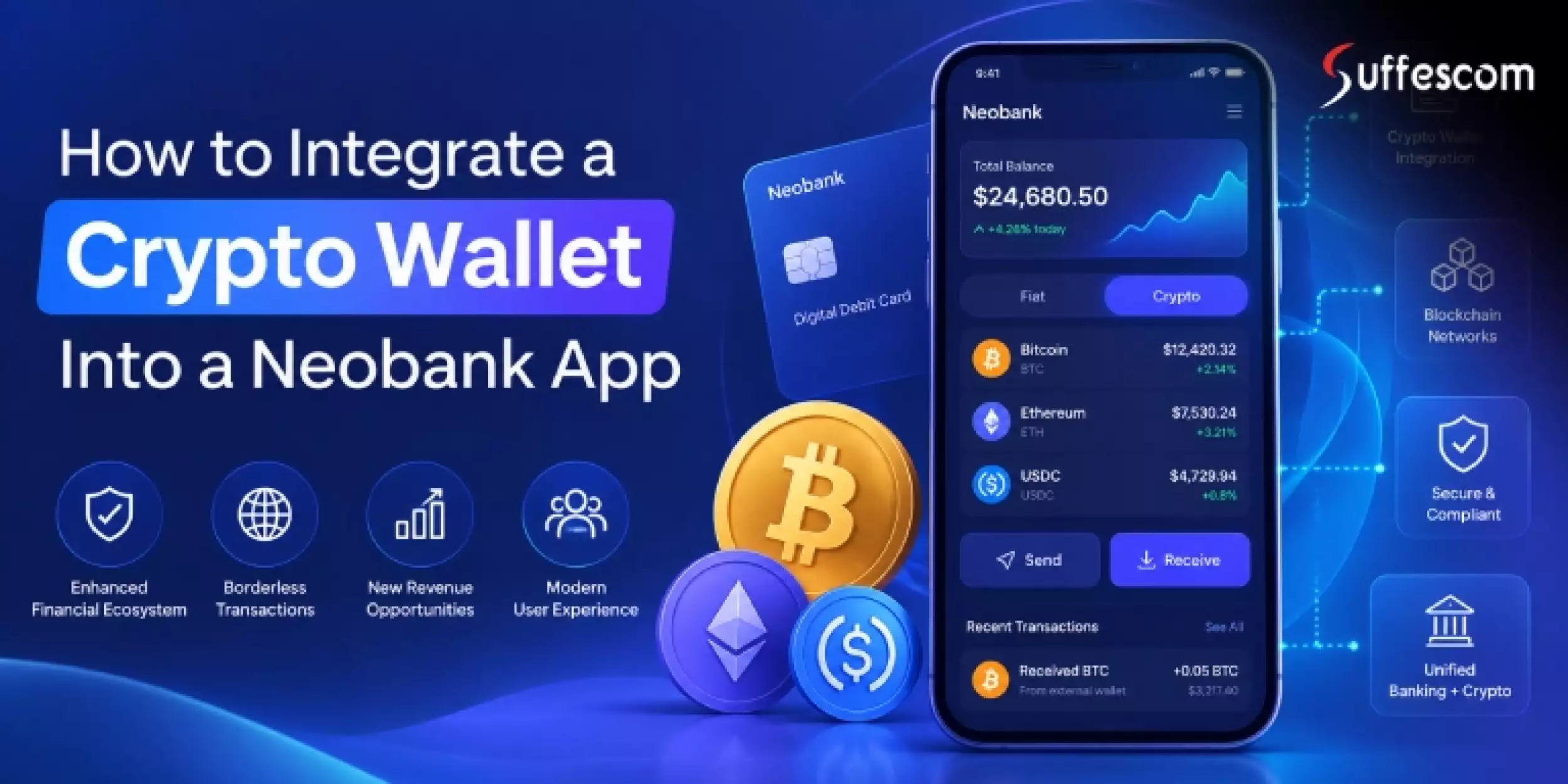
As digital banking continues its rapid advancement, neobank customers have expectations that are broadening far beyond traditional banking services. As crypto gains popularity, a secure and straightforward way to manage digital assets through the neobank app is also anticipated. Embedding crypto wallet functions into an existing neobank app allows customers to securely store, buy, sell, transfer, and hold their crypto assets together with their banking functions in one simple application.
It is essential to note, however, that this integration is about more than just add-on blockchain capability. It demands significant attention to legal and regulatory requirements, robust security protocol, architecture design, liquidity management and an intuitive, simplified user experience. If you're wondering how to integrate a crypto wallet into a neobank app, the process involves much more than blockchain connectivity; it requires compliance, secure infrastructure, and seamless banking integration.
What Wallet Integration Actually Means in a Neobank Stack (vs. Standalone Crypto Apps)
Crypto wallet integration for neobank platforms focuses on creating a unified financial ecosystem where users can manage both fiat and digital assets without switching between applications. It is fundamentally different than the existing wallet applications which are only concentrated on digital assets management; for a neobank, crypto function is embedded within the bank infrastructure to allow customers to access savings, payments, investments, fiat currencies, digital assets and transfers all from within one, uniform interface that both complies and remains secure for the bank.
| Neobank Wallet Integration | Standalone Crypto Wallet Apps |
| Combines fiat banking and cryptocurrency management within one application. | Primarily designed for storing, sending, and receiving cryptocurrencies. |
| Connected with core banking systems, payment gateways, KYC/AML, and user accounts. | Operates independently with limited banking integrations. |
| Supports seamless crypto-to-fiat conversions and vice versa. | Often requires external exchanges for fiat transactions. |
| Includes banking-grade security, fraud monitoring, and regulatory compliance. | Security mainly focuses on private key protection and wallet access. |
| Enables users to manage cards, bank transfers, crypto assets, and investments from one dashboard. | Focuses primarily on blockchain transactions and digital asset management. |
| Integrates transaction history, portfolio tracking, and banking analytics into a unified financial overview. | Provides crypto transaction history with limited financial management features. |
| Supports additional financial services such as lending, staking, rewards, and wealth management. | Typically offers crypto-specific features with fewer traditional banking services. |
Embedding crypto wallets in digital banking app architecture enables customers to access banking, payments, and crypto services through a single secure interface. They are in a position to have banking and digital assets managed in one single, secure interface.
Why Are Neobanks Adding Crypto Wallets?
Businesses looking to add a crypto wallet to banking app infrastructure can improve customer engagement while expanding revenue opportunities through digital asset services. Integrating a cryptocurrency wallet is expanding the traditional offering from purely digital banking to a comprehensive financial service, as the usage of cryptocurrencies grows. By having a crypto wallet, users will be able to manage both fiat and digital assets in the same application while providing neobanks with the opportunity to improve their user experience, new revenue streams and stay competitive in this evolving fintech industry.
1. Meet Growing Customer Demand
Users increasingly demand an integrated crypto function on their digital banking platform, in addition to traditional banking services. An integrated wallet offers users a unified experience for buying, storing, sending, and receiving digital assets without using multiple third-party apps.
2. Create New Revenue Opportunities
A crypto wallet will enable a wide range of new income streams to come in, such as through trading commission, transaction fees, services such as staking, swapping, premium subscription accounts and asset management options, complementing what is now the traditional banking product.
3. Enable Faster and Cost-Effective Global Payments
A blockchain wallet would simplify international transactions through fewer intermediaries, cheaper transfer costs, and quicker settlements. These advantages will help neobanks provide competitive international payment solutions to individuals, companies and freelancers in remote locations.
4. Strengthen Competitive Advantage
With more fintech firms turning to digital assets, integrating a crypto wallet service has become a strategic differentiation. Offering a crypto functionality will enable neobanks to attract the new user base and provide them with higher retention rates, positioning it as the premier fintech solution.
5. Future-Proof Digital Banking Services
The financial industry is gradually embracing blockchains, stablecoins, tokenized assets and DeFi. By integrating a crypto wallet service, neobanks will be better prepared to manage this technology alongside user demands and the next financial frontier.
Which custody model your neobank will choose is influenced by factors such as target audience, regulation, risk appetite, customer control or who is responsible for the private keys, customer assets' safety and the level of custody.
Custody Models: Choosing Who Holds the Keys
Choosing between a custodial vs non-custodial wallet for a neobank depends on regulatory obligations, customer preferences, and the level of control the institution wants to maintain. Hybrid solutions are also increasingly popular, combining a level of control and security for the end-users using Multi-Party Computation (MPC).
Choose Between Custodial, Non-Custodial, and Hybrid (MPC) Models
Custodial models typically demand the strictest licensing, compliance and safety standards for the organization's customer's assets. Non-custodial wallets demand less custody responsibilities from the institution but shifts those responsibilities in terms of the security and recovery of the private keys to the customer.
Understand Regulatory and Liability Implications
Retail-oriented neobanks would potentially opt for a custodial or hybrid wallet, offering the lowest barriers to entry and account recovery. However, crypto-centric institutions and B2B providers would lean towards a non-custodial solution to provide customers with more independence over their assets.
Match the Custody Model to Your Business Use Case
Digital asset regulations can differ significantly per jurisdiction. Some countries demand regulated custodians managing their customer's assets while others allow self-custody under a specified framework and level of compliance. Regardless of the chosen solution, the custody framework must be compliant in any of the markets a neobank operates in.
Consider Regional Regulatory Requirements
The best custody solution for transactions should be both seamless and secure. Hybrid MPC has been adopted increasingly to avoid single points of failure and offer a user-friendliness matching traditional banking apps.
Balance User Experience with Security and Control
The choice of blockchains and digital assets that the neobank can support will impact transaction speeds, scalability, cost of operations, and customer adoption. An appropriate asset strategy should balance user interest, regulatory compliance, and future infrastructure flexibility.
Selecting Supported Blockchains and Assets
The choice of blockchains and digital assets that the neobank can support will impact transaction speeds, scalability, cost of operations, and customer adoption. An appropriate asset strategy should balance user interest, regulatory compliance, and future infrastructure flexibility.
Evaluate Blockchains Using Technical and Business Criteria
Choose the blockchain networks based on factors like the liquidity, finality, fee stability, robustness of the ecosystem, security, development tooling available and enterprise adoption rate. All of these will affect transaction reliability and the overall user experience.
Decide Between Single-Chain and Multi-Chain Support
Adding only one blockchain would increase simplicity of development, testing and compliance. However, the introduction of many chains will increase asset reach and user flexibility but also increase complexity of the needed infrastructure, wallet management and cross-chain monitoring.
Support Industry-Standard Token Protocols
Ensure compliance with commonly used token standards, including ERC-20, ERC-721, ERC-1155, BEP-20 and SPL. Support for a list of accepted token standards will be needed for integration with common wallets, exchanges and decentralized applications.
Establish Asset Listing and Governance Policies
Establish clear criteria for when to add or delist a cryptocurrency from the offering list (market liquidity, regulatory position, security audit, trading volume, user demand and so on). An organized governance procedure will minimize operational and regulatory risks.
Plan for Future Blockchain Expansion
Build wallet infrastructure with modular APIs, a scalable architecture, and easy upgradability to accommodate the introduction of new blockchain networks and digital assets without the need for a system redesign or interruptions in service.
Stablecoin Settlement and Treasury Design
Stablecoins are now the settlement layer of choice for neobanks, enabling faster settlements while maintaining predictable prices of fiat-pegged tokens. A solid treasury strategy will include rules on how funds will flow, liquidity will be managed and how fiat and crypto assets will be settled between themselves.
Use Stablecoins as the Bridge Between Crypto and Fiat
Stablecoins make it possible to make faster and cheaper settlements while mitigating price volatility of cryptocurrencies. Payments to other countries, treasury operations or asset transfers between blockchain networks and traditional payment systems become much simpler.
Design Secure On-Ramp and Off-Ramp Infrastructure
Engage compliant payment service providers and banking partners who will enable customers to acquire stablecoins with fiat currency, and to redeem them into fiat again. User access ramps are necessary to ease entry and eliminate friction.
Optimise Settlement Timing and Transaction Flows
Determine the specific schedules of settlements based on transaction volumes, blockchain confirmation times, fiat processing cut-off times from banks, and liquidity available at settlement providers. A sound process for settlements is crucial for minimizing any latency and ensuring accurate reconciliations.
Manage Treasury Reserves and Liquidity Risk
Maintain adequate and stablecoin reserves to meet customer withdrawals, facilitate trades and settle transactions at settlement partners. Constant monitoring of liquidity helps to preempt potential funding gaps due to sudden spikes in transaction activity.
Establish Redemption and Liquidity Provider Strategies
Select experienced issuers, traders and liquidity providers to ensure stablecoin redemption and market liquidity. A diverse ecosystem of counterparties lowers operational risks and the likelihood of service disruption for settlement purposes.
KYC/AML Layering for Wallet Transactions
Meeting KYC/AML requirements for crypto wallet in neobank operations is essential for preventing financial crime and complying with regional regulations. Risk-based compliance framework to identify suspicious activity, comply with regulatory requirements, and protect users and the financial system.
Extend KYC to On-Chain Wallet Activity
Use current customer identity verification procedures on crypto wallet customers, connecting verified identities with blockchain addresses. This provides a compliant framework on which to oversee digital asset transactions during the customer lifecycle.
Implement Continuous Transaction Monitoring
Track the activity on the blockchain to spot signs of suspicious activity, such as transfers of excessive size, funds moving quickly from account to account, transactions to and from high risk wallet addresses, or common elements of money laundering and fraud schemes.
Ensure Travel Rule and Sanctions Compliance
When necessary, include following elements of travel rules applicable data sharing. Ensure that the wallet address is checked against comprehensive sanction list, PEPs, and watchlists along with blacklist referencing.
Adopt Risk-Based Verification Tiers
Set transaction limits and wallet features according to customers' verification levels. Heavier transactions can be implemented for more verified customers, while less verified can only handle x amount of transaction and get more checks.
Maintain Comprehensive Audit Trails and Reporting
Store recorded KYC data, blockchain transactions, risk profile decisions and compliance decisions within secured audit logs. Having thorough details will ease regulatory reporting, facilitate internal investigations as well as prove to be helpful during audits.
Connecting the Wallet to Card Issuance
Having a crypto wallet connected to a payment card allows access for the users to spend cryptocurrency anywhere a classic card is accepted. This automatic payments system comprises concurrent crypto converture, integrated card processing and appropriate controls for price and settlement risks.
Enable Real-Time Crypto-to-Fiat Conversion
Easily convert digital assets to fiat immediately at the point of purchase prior to authorizing cards. The merchant will receive payment in local currency, while the user will spend the remaining balance of their crypto.
Coordinate Card Networks, Issuers, and Processors
Setup your wallet infrastructure with card issuers/acquirers, payment processors, and card networks to enable transaction authorization, settlement, fraud verification and reconciliation on the blockchain as well as traditional payment rails.
Manage Exchange Rates, Spread, and Slippage
Use live market quotes and liquidity providers to reduce the effect of exchange rate volatility, trading spreads and slippage when converting crypto. Transparent pricing enhances customer confidence and minimizes surprises in transaction costs.
Handle Failed Authorisations Gracefully
Create alternative workflows for circumstances like congestion of the blockchain network, lack of crypto balance, expiration of exchange quote and issues with payment gateway. Proper user dialogues and retry processes offer a seamless paying experience.
Synchronise Wallet Balances and Card Transactions
Update wallet balances instantly when a card transaction completes successfully and reconciles the blockchain's settlements with the record kept by the card network. Real-time updates will avoid discord between the two balances.
API and Infrastructure Choices
A reliable neobank crypto wallet API integration ensures secure communication between blockchain networks, banking systems, payment gateways, and compliance services. Building your own wallet stack or choosing a wallet-as-a-service platform, the architecture must ensure secure keys handling, high availability and uninterrupted transaction flow.
Evaluate Build vs. Buy Based on Business Goals
Choose between building wallet infrastructure internally or outsourcing to a WaaS provider. Developing your own infrastructure allows you to have more control and customization ability, whereas WaaS offers faster implementation and works well if infrastructure complexity is low.
Compare Wallet-as-a-Service Providers
Selecting the right crypto wallet SDK for neobank can accelerate development while reducing the complexity of blockchain infrastructure management. Suitable for faster time-to-market and organizations with no dedicated blockchain infrastructure team.
Deploy Self-Hosted Blockchain Nodes When Needed
Hosting your own blockchain nodes allows for more control over how transactions are processed and who has access for privacy and network dependability issues. This method is desirable for enterprise neobanks that need to establish custom integrations for regulatory compliance purposes.
Build Secure Key Management Infrastructure
Secure cryptographic keys using High Security Modules (HSMs) or Multi-Party Computation (MPC). Protects keys from being compromised while allowing them to sign secure transactions.
Design High-Availability Infrastructure
Set up high-availability API gateways, blockchain nodes, and server backends across multiple regions or availability zones. The redundant infrastructure allows the wallets to still function properly even if some server goes down for maintenance.
Implement Automatic Failover Mechanisms
Set up automatic failover capabilities that immediately reroute transactions when the primary system fails to a backup location/seconder hardware/running node.
Optimise API Performance and Scalability
Implement load balancing, caching, async transaction processing, and rate limiting in order to ensure steady API performance in case of increased volume of transactions.
Monitor Infrastructure Continuously
Monitor track node health, API latency, transaction success rate, infrastructure utilization, and other KPI via automation and real time monitoring. Enables proactive control by warning of bottlenecks before they disturb end users.
Security Architecture and Audit Practices
Crypto wallet integration within a neobank demands a security-oriented architecture that ensures the safeguarding of digital assets, user credentials and transactional integrity. Key security practices involve periodic audits of wallets and smart contracts, secure storage of assets and incident handling procedures.
Conduct Smart Contract Security Audits
If the neobank will be on-chain, then each smart contract should be evaluated by an independent security audit and automated vulnerability testing. Regularly reviewing code for exploits such as reentrancy attacks, privilege escalation, and logic flaws can address potential issues before deployment.
Audit Wallet Infrastructure Regularly
Wallet management, key storage, APIs, and transaction flows should be regularly audited. Penetration tests and continuous security assessment will identify weaknesses incurred by updates or third-party integration.
Implement Cold and Hot Wallet Balancing
Only transactional liquidity needed for everyday use should be stored in hot wallets, while the larger volume of digital assets should reside offline in cold wallets. This minimizes a threat of cyberattacks while keeping transactions available.
Secure Private Key Management
Protect keys using Hardware Security Modules (HSM), Multi-Party Computation (MPC), or encrypted Key Vaults. Control access to sensitive data with role based permissions and Multi Factor Authentication for admins.
Create a Comprehensive Incident Response Plan
In case of a security incident, fraudulent activity, compromised wallet or outaged service, have documented processes for each. Specify each duty, escalation path, communication method and resolution timelines, to minimize operational impact.
Enable Continuous Threat Monitoring
Wallet behavior, API traffic and blockchain transactions must be monitored in real-time to identify unusual activity patterns. Automatic alerts and anomaly detection mechanisms can inform security team members to react early on detected threats.
Maintain Regulatory and Compliance Readiness
Provide detailed audit logs, transaction history and security docs as a part of compliance with AML, KYC, GDPR, PCI DSS and specific regulatory requirements concerning digital assets, in each region of operation. Regular audits will improve security and governance.
Regulatory Landscape by Region
To launch a crypto wallet solution, neobanks should also be familiar with financial regulation required in particular countries. Before launching any crypto services, understand all necessary licensing procedures, custody requirements and partnerships to successfully deploy in each market.
Understand Regional Regulatory Frameworks
Regulations are inconsistent between countries. The EU implements the Markets in Crypto-Assets (MiCA) regulation, the United Kingdom is regulated by the Financial Conduct Authority (FCA), and the United States relies on federal guidelines and state level Money Transmitter Licenses (MTLs).
Identify the Right Licensing Pathway
Depending on the business model of the bank, neobanks may require licenses for virtual asset services, money transmitting, payment services, or digital asset custody. These licenses are necessary if a neobank is storing the customer assets, selling or enabling purchase transactions and selling or processing transactions, or merely provide access to a wallet only.
Partner with Licensed Custodians and Service Providers
Neobanks should cooperate with regulated custodians, wallet infrastructure providers and exchanges to reduce regulatory complexity when launching their crypto wallets on the market quickly. This partnership provides secure custody, settlement and transactions.
Adapt Compliance to Local Jurisdictions
AML, KYC, consumer protection, tax reporting and data privacy compliance varies among countries. The bank's compliance structure must be adaptive to region-specific rules without modifying the infrastructure to a large extent.
Prepare for Regulatory Changes
Global digital asset regulation is a moving target. Stay aware of current developments, periodic assessments of your compliance, and scalable governance structures are essential to adapt the infrastructure to new legal and operative requirements.
Testing, Rollout, and Monitoring
Teams that understand how to integrate a crypto wallet into a neobank app typically validate wallet functionality on sandbox environments before production deployment. The launch of a crypto wallet is not complete without thorough testing and controlled implementation to be able to constantly monitor for issues and manage risks while maintaining the expected level of performance and regulatory adherence through a staged rollout approach.
Validate Wallet Functionality in Sandbox and Testnet Environments
Test creation of the wallets, transactions and smart contract interactions, API integrations and security controls in sandbox and testnet environments prior to launching them to the mainnet, in order to protect customer funds.
Adopt a Phased Rollout Strategy
Release the wallet incrementally using waitlists, pilot groups, transaction limits, or feature flags. A staggered release allows for learning, monitoring, and fixes to be implemented as more users are onboarded.
Monitor Transactions and Infrastructure in Real Time
Monitor the wallet activity, blockchain confirmation levels, API availability and performance, node health and transaction rates and volumes. Use Automated Alerts to monitor for failures, security threats or unusual activity before the end-user experiences it.
Perform Continuous Reconciliation
Reconcile against blockchain transactions, internal ledgers, and fiat settlements. Proactive reconciliations ensure balance accuracy and highlight any mismatches early to mitigate and resolve financial errors. This reconciliation activity also helps in supporting financial reporting efforts.
Measure Performance and Optimise Post-Launch
Monitor core wallet metrics including transaction processing time, conversion success rates, adoption trends, transaction failed rates, and support inquiry trends. With constant analysis and optimizations, the reliability, scalability and overall customer experience of the wallet can be continually improved.
Common Pitfalls and Lessons from Real Implementations
Many organizations underestimate how to integrate a crypto wallet into a neobank app, leading to reconciliation issues, compliance gaps, and infrastructure bottlenecks. Early identification of the lessons from industry-wide crashes is important in helping neo-banks build scalable wallet infrastructure that does not buckle under pressure.
Inaccurate Reconciliation Between Blockchain and Banking Systems
In instances where there is a failure to reconcile blockchain transactions with internal ledgers and fiat settlements, a transaction discrepancy may result due to off-syncs. The use of Automated Reconciliation processes and instantaneous ledgers verification to avoid such mismatches is critical in ensuring complete balance accuracy.
Ignoring Blockchain Network Events
Challenges like chain reorganization, delayed confirmations, congestion and transaction failures should be factored into the architecture to prevent imbalances from appearing on account statements. If not correctly built, these issues should trigger automatic revalidation of transactions, depending on the confirmation levels established.
Compliance Controls Added Too Late
Lack of adequate KYC procedures, weak Anti-money laundering (AML) monitoring, and failure to perform proper sanctions screenings is an issue caused when new financial institutions give product rollout precedent over regulatory requirements. This, unfortunately, makes the wallet vulnerable.
Overlooking Scalability and Infrastructure Resilience
Many implementations underestimate growth, making the API infrastructure brittle, nodes unreliable or the wallets extremely slow. Designing a resilient system through redundancies and balanced load ensures the transaction capacities continue to scale reliably.
Learn from Industry Post-Mortems and Operational Incidents
Integrating crypto wallets into a neobank’s offering isn’t just about connecting to blockchains. A well-executed crypto wallet demands solid security, effective compliance, resilient infrastructure and slick customer experiences from custodianship and KYC protocols to stablecoin settlement and smart contract-powered functionalities.
Learning how to integrate a crypto wallet into a neobank app requires balancing security, compliance, scalability, and user experience from the earliest development stages.
Conclusion: Building a Compliant, Scalable Wallet Layer
Financial institutions planning to Launch a Neobank With Crypto Support should prioritize secure architecture, regulatory readiness, and scalable wallet infrastructure. From custody models and KYC controls to stablecoin settlement and card integration, every component must work together to support long-term scalability. At Suffescom, we help financial institutions design and develop secure, compliant crypto wallet solutions tailored to evolving business and regulatory requirements. Whether you're launching a new digital banking platform or expanding existing services, our team delivers future-ready wallet infrastructure built for growth.
FAQs
1. How much does it cost to integrate a crypto wallet into a neobank app?
The crypto wallet integration cost of the neobank app depends on supported blockchains, custody architecture, compliance requirements, security features, and third-party integrations. The overall cost to build a crypto neobank increases as businesses add multi-chain support, card issuance, advanced security, and enterprise-grade compliance. A simple integration, for instance, is cheaper to implement than an enterprise grade one with card issuing functionality, regulatory features and multi-chain support.
2. Should a neobank choose a custodial or non-custodial wallet?
A decision must be made between custodial and non-custodial wallets based on Business Objectives and regulatory guidelines. Custodial wallets enhance ease of access and recovery, while non-custodial ones place ownership of private keys in the hands of the customer. Hybrid MPC-based models offer a compromise between security, compliance, and ease of use.
3. Which compliance requirements apply to crypto wallet integration?
Neobanks are required to develop KYC, AML, transaction monitoring and Sanctions screening capabilities and comply with Travel Rule regulations wherever mandatory. Additionally, depending on the jurisdiction some licensing requirements such as MiCA, FCA regulations and money transmitter licenses will come into play.
4. How long does it take to integrate a crypto wallet into a neobank app?
The duration of implementation is based on wallet architecture, support for various blockchains, regulations of the relevant jurisdictions and third-party integrations. A simple integration could be anywhere from a few months, while an enterprise grade one with custody, card issuing capabilities and multi-chain support is significantly longer to develop.
5. Can a neobank support multiple blockchains in one wallet?
Yes, in as much as modern wallet infrastructure makes possible support for multiple blockchain protocols through a uniform interface. However, multi-chain deployment brings along additional operational considerations in terms of Node management, security measures and regulatory controls as well as transaction monitoring and governance.