Robotic Process Automation (RPA) in Healthcare

At Suffescom, we build RPA-powered healthcare automation solutions that connect fragmented workflows across different processes like patient management and administration. Our RPA implementations help healthcare organizations automate tasks like patient onboarding and EHR data synchronization, which allows faster service delivery and more efficient care management.

  • Custom Healthcare RPA Solutions
  • Agentic Automation Services
  • HIPAA-Compliant Development
  • 24/7 Technical Support
Robotic Process Automation (RPA) in Healthcare
Caterpillar Chevron Patagonia Levi’s Subaru Yum! Brands Rivian Duke Energy Taco Bell Johnson & Johnson Harley-Davidson

RPA in Healthcare Market Insights and Growth Statistics

The adoption of RPA in healthcare is increasing as organizations increasingly focus on decreasing administrative processes and improving patient care through automated workflows.

RPA in Healthcare
  • 58%

    Healthcare organizations are using RPA and AI automation to simplify administrative processes and decrease manual workloads.

  • $22.56 Billion

    is the projected global RPA healthcare market size by 2034, which is driven by increasing adoption of automation.

  • 44.83% CAGR

    is the expected growth rate of the healthcare agentic AI market from 2025 to 2030, as healthcare providers adopt autonomous AI systems for workflow optimization.

  • 70%–99%

    reduction in errors and time spent on rework and review can be achieved through RPA and cognitive automation by automating repetitive, rule-based processes.

Agentic Automation and RPA Use Cases in Healthcare

Discover how robotic process automation in healthcare and agentic AI simplify clinical and operational workflows. Discover RPA use cases in healthcare and why it is important for businesses to implement.

01

Appointment Scheduling

Robotic process automation in healthcare helps providers automate patient scheduling processes by incorporating appointment requests with EHR and practice management systems. A combination of agentic AI and RPA bots optimizes provider calendars and improves patient access to care.

  • Capture appointment requests made in patient portals, websites, chatbots, emails, and contact centers' software.
  • Verify the availability of the physician and the eligibility of insurance coverage before confirming schedules.
  • Schedule or cancel appointments based on the provider's availability and the patient's preferences.
  • Send appointment confirmations and follow ups via SMS or applications.
02

Patient Registration & Onboarding

Healthcare process automation enables simplification of the patient onboarding process by minimizing repetitive registration procedures and eliminating manual data entry. Using RPA bots for validation of patients' information, digitalization of intake documents and synchronization of records with clinical systems will allow providing a quick and accurate patient experience.

  • Capture demographic data, information about insurance and medical history from electronic registration forms.
  • Check and verify patient identity and eligibility for insurance before creating clinical records.
  • Create or update patient profiles within Hospital Information Systems (HIS).
  • Notify patients about incomplete forms or missing documentation before scheduled appointments.
03

Insurance Verification & Prior Authorization

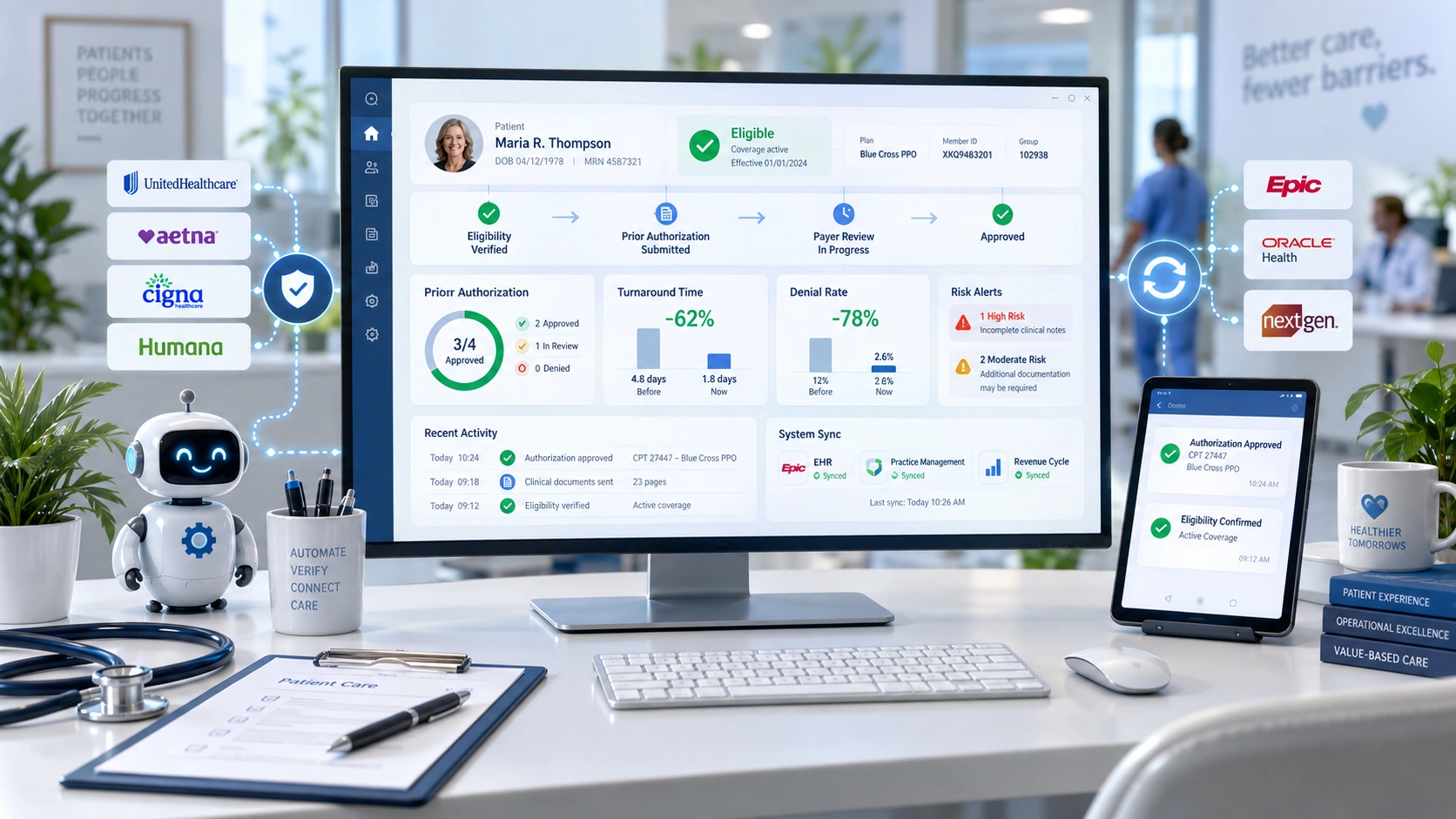
Robotic process automation for healthcare increases the efficiency of insurance verification and prior authorization through automation of communication and validation of insurance coverage criteria. Healthcare organizations can decrease time spent on authorization approvals and claim rejections and simplify their revenue cycle management process.

  • Check insurance eligibility and coverage via payer portals and APIs.
  • Request authorization and monitor the status of the request automatically.
  • Alert providers and patients about approval status, additional documentation, or denial of authorization.
  • Update EHR and Revenue Cycle Management systems with authorization details in real time.
04

Medical Billing & Claims Processing

Healthcare organizations can incorporate RPA to simplify the medical billing process by automating revenue cycle activities and boosting the reimbursement process. RPA automation bots integrate with billing systems and EHR platforms to improve the claims accuracy rate and optimize operations.

  • Automate the extraction of billing data from the EHR systems and verify the patient's demographic data prior to the submission of the claim.
  • Validate the ICD-10, CPT, and HCPCS codes to ensure that there are no coding errors or claim denials.
  • Check the status of the claim and initiate the process of resubmitting the denied claims.
  • Update billing dashboards and notify revenue cycle teams about payment status and progress.
05

EHR & EMR Data Management

Robotic process automation in healthcare increases data quality by automating the flow of information in healthcare organizations from the EHR, EMR, laboratories, billing, and clinical departments. RPA bots guarantee there is no duplication of data entry through the interoperability capabilities of healthcare data standards like HL7 and FHIR.

  • Sync patient records between EHR, EMR, and Hospital Information Systems in real time.
  • Transfer clinical data between healthcare applications using HL7 and FHIR standards.
  • Detect duplication or missing patient records and execute data validation processes.
  • Automate updating of laboratory tests, discharge summaries, prescriptions, and clinical notes.
06

Clinical Documentation Automation

RPA and AI in healthcare help automate the process of documenting clinical information through the extraction, storage, and updating of patient information within the healthcare system. This automation decreases the workload for clinicians regarding documentation, enhances the accuracy of information and guarantees that the information is available on time for diagnostics and treatments.

  • Extract patient information from consultation notes, forms, and clinical documents using OCR and Intelligent Document Processing (IDP).
  • Send clinical documents to physicians, specialists, and healthcare teams for approval.
  • Mark any missing information in the documents and notify healthcare professionals about it.
  • Maintain version history and audit logs to support regulatory compliance and medical record integrity.
07

Prescription & Pharmacy Management

Healthcare robotic process automation helps providers and pharmacies handle prescription workflows a lot more efficiently by decreasing the actual manual processing and improving medication accuracy. RPA bots coordinate prescription requests and pharmacy communications and also minimize delays in delivery.

  • Process electronic prescription requests and validate patient and provider details.
  • Check the availability of medications and interact with pharmacy management systems.
  • Automate prescription refill requests based on physician’s approval and prescribed treatment plan.
  • Inform patients regarding prescription status, refill notifications, and pick-up dates.
08

Laboratory & Diagnostic Workflow Automation

Robotic process automation in healthcare allows laboratories to streamline their diagnostics processes, shorten turnaround time, and eliminate manual handling of data. RPA bots connect Laboratory Information Systems (LIS), Radiology Information Systems (RIS), PACS, and EHR systems for easy data flow.

  • Register laboratory orders generated by physicians and healthcare providers.
  • Monitor specimen collection, testing progress, and reporting stages in the process.
  • Automatically send laboratory and imaging reports to physicians and patients.
  • Alert physicians on critical test results that require immediate medical attention.
09

Patient Follow Up & Care Coordination

Business process automation in healthcare increases the rate of patient engagement by automating post treatment communication and care coordination processes. These bots help providers maintain continuity of care and also help in decreasing administrative workload for clinical teams.

  • Schedule automated appointments for follow ups after treatment completion.
  • Send reminders and care instructions through patient communication channels.
  • Collect patient feedback and recovery updates using digital surveys and questionnaires.
  • Escalate risky responses or missed follow-ups to physicians and care coordinators.
10

Healthcare Compliance & Audit Reporting

With healthcare robotic process automation, compliance with regulations becomes much easier because of the automated documentation, monitoring, and audit reporting. Automation guarantees that healthcare organizations have precise documentation and comply with HIPAA and other regulations.

  • Monitor access to Protected Health Information (PHI) and create audit trails automatically.
  • Monitor compliance with HIPAA policies and security measures.
  • Generate reports based on the information obtained from operational and clinical data in different healthcare environments.
  • Find missing compliance documentation and alert the relevant departments.
11

Inventory & Medical Supply Management

Hospitals and clinics integrating RPA can optimize inventory management by automating procurement workflows, stock monitoring and supplier coordination. RPA based automation decreases the chances of supply shortages and also improves efficiency in all healthcare facilities.

  • Track inventory for medical equipment, pharmaceuticals, and other consumables in real-time.
  • Create purchase requests based on predefined thresholds of inventory availability.
  • Track delivery of suppliers and automatically update inventory logs.
  • Check expiration dates for pharmaceutical products and other medical supplies.
12

Staff & Workforce Management

Robotic process automation for healthcare can enhance workforce management by automating the processes associated with Human Resources, scheduling, and credential management. Healthcare facilities can reduce administrative work and also guarantee staff availability and compliance with all standards.

  • Onboard employees and perform credential and license validation.
  • Create workforce schedules according to the needs of each department and shift availability.
  • Perform payroll processing, attendance tracking, overtime, and absence management.
  • Keep track of mandatory compliance training and certification renewals.
Robotic Process Automation

Our Range of Robotic Automation Services in Healthcare

At Suffescom, we provide integration of Robotic Process Automation in healthcare software solutions to automate recurring workflows and simplify clinical and administrative operations.

Consulting

Consulting

We help healthcare organizations identify all possible automation opportunities by analyzing current workflows and business goals. Our experts define the best RPA strategy and implementation approach to guarantee successful deployment.

Implementation

Implementation

Integrate robotic process automation in healthcare solutions to automate workflows, including patient onboarding, claims processing, and administrative tasks. We handle the complete implementation process, from selecting RPA tools to performance optimization.

Agentic Automation

Agentic Automation

We integrate agentic automation capabilities with RPA solutions to help healthcare organizations automate complicated workflows that require intelligent decision making. These AI agents can analyze information and support processes like patient communication.

Integration

Integration

We integrate RPA solutions with healthcare systems like EHR and clinical applications to allow smooth data exchange and reliable workflow automation. This helps decrease manual data processes that are time consuming and improves operational accuracy.

Automation Support

Automation Support

We provide constant monitoring and optimization services to guarantee your automation solutions continue to perform efficiently. Our team helps resolve issues and improve performance as business needs evolve.

Compliance

Compliance

Our RPA services for healthcare are completely aligned with industry requirements. This includes HIPAA compliance and all data security standards. Our approach guarantees that automated workflows maintain patient data privacy while improving operational efficiency.

Move from Manual Processes to Automated Healthcare Workflows

Simplify complex operations with Robotic Process Automation in healthcare industry.

Routine Healthcare Operations You Can Automate with RPA

Healthcare organizations rely on numerous administrative and operational activities to keep patient care running smoothly. Healthcare process automation removes manual effort by executing these daily staff tasks.

Protection Symbol

Access healthcare applications

Protection Symbol

Transfer data across healthcare systems

Protection Symbol

Generate and populate healthcare documents

Protection Symbol

Manage healthcare files and records

Protection Symbol

Validate financial and insurance information

Protection Symbol

Trigger automated communications

Protection Symbol

Follow 'if/then' decisions/rules

Protection Symbol

Scrape data from the web

Protection Symbol

Deliver files to third parties

Our Portfolio of Successful Projects

Top Tools for Implementation of Robotic Process Automation in Healthcare

We use a range of RPA and agentic automation platforms to build intelligent workflows, integrate with healthcare systems, and automate repetitive clinical and administrative operations. Below are some of the leading platforms used for developing automation solutions across healthcare environments.

UiPath
Microsoft Power
Automation Anywhere
SS&C Blue Prism
WorkFusion
IBM watsonx

UiPath

UiPath is an enterprise grade RPA and agentic automation platform that allows you to build software bots and AI agents to automate workflows in EHR and other healthcare applications.

01

Patient appointment scheduling and automated reminders

02

Patient registration and demographic data validation

03

Insurance eligibility verification and prior authorization workflows

04

Medical billing automation and claims status tracking

05

Clinical documentation processing and data extraction

06

Laboratory order validation and diagnostic report routing

07

Patient communication and follow-up workflow automation

08

Healthcare document processing using AI powered OCR

Microsoft Power Automate

Microsoft Power Automate is a low-code automation platform that helps to create workflows using cloud automation, AI Builder, Copilot, and Microsoft ecosystem integrations.

01

Automated patient scheduling, confirmations, and notifications

02

EHR and EMR data synchronization workflows

03

Healthcare document extraction from forms and scanned records

04

Patient feedback collection and follow-up automation

05

Clinical workflow approvals and task routing

06

Insurance document processing and validation

07

Secure integration with Microsoft Cloud and healthcare applications

08

Data processing from connected devices and RPM systems

Automation Anywhere

Automation Anywhere provides enterprise RPA and intelligent automation capabilities that help automate complicated workflows and also aid in maintaining security, scalability, and compliance requirements.

01

Patient eligibility verification and insurance validation

02

Healthcare data extraction and consolidation

03

EHR record updates and administrative data processing

04

Patient intake form and medical document automation

05

Claims preparation, submission, and status monitoring

06

Prior authorization workflow management

07

Revenue cycle management automation

08

Healthcare reporting and operational analytics

SS&C Blue Prism

SS&C Blue Prism delivers robotic process automation in healthcare industry to help create required secure and governed automation processes in all clinical and administrative processes.

01

Appointment scheduling and patient communication automation

02

Patient data capture from forms and integration with EHR platforms

03

Insurance claims processing and reimbursement workflows

04

Prior submission for authorization and approval tracking

05

Medical billing statement generation and reminders for payments

06

Healthcare compliance reporting and audit documentation

07

Claims validation and anomaly detection

08

Automated workflow routing in different healthcare departments

WorkFusion

WorkFusion combines RPA, artificial intelligence, and machine learning capabilities to automate document intensive healthcare processes and improve efficiency in all types of administrative workflows.

01

Document processing for medical records and claims

02

Data extraction from unstructured healthcare documents

03

Insurance verification and claims review automation

04

Healthcare compliance monitoring

05

Patient data validation and record management

06

Administrative workflow automation

07

Exception handling and human-in-the-loop workflows

08

AI-powered process optimization

IBM watsonx Orchestrate

IBM watsonx Orchestrate allows healthcare organizations to create AI agents that automate very complicated workflows and coordinate tasks in multiple enterprise applications.

01

AI-assisted patient service workflows

02

Healthcare staff task automation

03

Appointment coordination and scheduling support

04

Clinical and administrative workflow orchestration

05

Data retrieval from healthcare applications

06

Automated communication management

07

Decision support workflow automation

08

Integration with healthcare systems

Best Practices for Implementing RPA and Agentic Automation in Healthcare

01

Analyze Healthcare Processes Before Automation

Before implementing RPA solutions, organizations must determine the robotic process automation healthcare benefits through measurable improvement. The best-suited processes usually involve a lot of repetition, many different applications, and lots of data handling.

It is important to review processes and administrative systems to find issues that happen manually. Workshops with healthcare employees will reveal processes like data reconciliation, document processing, eligibility determination, and record updates that take too much time.

02

Implement Human Oversight for Critical Workflows

The Human-in-the-Loop (HITL) method enables healthcare personnel to monitor the process of automation and to step in when human expertise is needed. Although bots powered by RPA and AI agents are able to perform repetitive tasks, human validation is still crucial for processes in healthcare.

HITL frameworks are especially useful for automations associated with clinical documentation, communication with patients, prior authorizations, and exception handling. Human verification helps identify errors and hallucinations in output and ensures that automated decisions meet healthcare criteria.

03

Define Guardrails for AI-Powered Automation

Agentic automation solutions require governance tools to regulate how AI agents collect information, understand data and carry out operations. Automation guardrails set the limits to make sure that automated systems work appropriately.

Healthcare organizations should incorporate proper access control, workflow permissions, logging and audits, validation rules, and continuous monitoring. These controls improve reliability and increase confidence in AI automation.

04

Ensure Healthcare Data Quality and Integration

RPA and agentic automation rely on good quality, accessible, and structured healthcare data. Before implementing automation tools, organizations need to assess their current data infrastructure and ensure that automation tools can effectively communicate with different healthcare software.

Healthcare organizations can review current integrations of the EHR, EMR, HIS, LIS, billing software, and payer systems to enable smooth data exchange. It is recommended to use interoperability standards like HL7 to guarantee that automated processes have constant access to patient information.

05

Establish Security and Compliance Controls

Healthcare automation solutions handle sensitive patient information, which makes compliance an important aspect of implementation planning. Organizations should establish controls that safeguard data throughout automated workflows.

These controls include role-based access management, bot security and credentials, and automation activity monitoring. Such practices will help healthcare organizations stay compliant with HIPAA regulations and secure PHI.

Ready to Implement RPA in Healthcare?

Automate repetitive healthcare workflows and build secure automation solutions according to your organization's needs. We provide RPA services for healthcare industry that help providers automate various daily tasks.

Our Process to Implement RPA in Healthcare

At Suffescom, our team follows a transparent process for RPA implementation to help businesses get the best outcomes and improvements.

Explore the Cost of RPA and Agentic Automation in Healthcare

The cost to implement RPA and agentic automation in healthcare ranges from $15,000 to $150,000+. is an estimated cost breakdown based on automation complexity:

Basic Solution
$15,000 – $40,000
  • Automation of repetitive administrative workflows
  • Data entry and document processing
  • Basic integration with existing healthcare applications
  • Rule-based RPA bots for predefined workflows
  • HIPAA-compliant security configuration
  • Up to 3 months of monitoring and support

  • Implementation timeline: 2 to 4 months
MOST CHOSEN
Mid-Level Solution
$40,000 – $100,000
  • Multi-step workflow automation across healthcare systems
  • EHR, EMR, billing, and payer system integrations
  • Intelligent document processing using AI capabilities
  • Prior authorization and patient administration automation
  • Analytics dashboards and workflow monitoring
  • 4 to 6 months of optimization and support

  • Implementation timeline: 4 to 8 months
Advanced Solution
$100,000 – $150,000+
  • AI agents for complex healthcare workflow orchestration
  • Integration with multiple enterprise healthcare platforms
  • Natural language processing and intelligent decision support

  • Automation governance and Human-in-the-Loop workflows
  • HL7 and FHIR-based healthcare interoperability
  • High security and 6 months continuous optimization
  • Implementation timeline: 8 to 12+ months

Key Challenges of Implementing RPA and Agentic Automation in Healthcare

G2 logo Design Rush 2025 Clutch 2025 Top App Development Companies

  • Data Privacy Risks

    Data Privacy Risks

    Challenge:

    RPA bots and AI agents work with confidential information. Poorly managed automation can lead to major gaps related to security.

    Solution:

    Healthcare providers need safe automation systems with encryption and best data governance practices.

  • Integration With Existing Systems

    Integration With Existing Systems

    Challenge:

    A lot of healthcare organizations use legacy systems that may not connect with modern automation platforms.

    Solution:

    Using solutions that support healthcare standards like FHIR and APIs helps create smoother connections between systems.

  • High Implementation Costs

    High Implementation Costs

    Challenge:

    The cost of automation tools and deployment can slow adoption for some healthcare organizations.

    Solution:

    Organizations should begin with processes that have high manual effort and clear business value to achieve faster returns.

  • Employee Resistance

    Employee Resistance

    Challenge:

    Healthcare staff may face issues using automation due to concerns about changing roles and unfamiliarity with the platform.

    Solution:

    Training programs and transparent communication can help employees know how automation supports their daily work.

  • Complex Healthcare Workflows

    Complex Healthcare Workflows

    Challenge:

    Healthcare processes usually include different steps and exceptions that cannot be fully automated.

    Solution:

    A combination of AI automation and human review can manage complicated cases and help improve efficiency.

  • Compliance Requirements

    Compliance Requirements

    Challenge:

    Healthcare automation must follow strict regulations for patient data protection and operational security.

    Solution:

    Automation systems should include compliance checks and regular reviews to maintain regulatory standards.

See What Our Clients Have Been Saying About Us

Identify Automation Opportunities in Your Healthcare Workflow Today!

Automate More. Deliver Better Care.

Key Robotic Process Automation Healthcare Benefits

Let's discuss the main benefits of RPA in healthcare industry.

01

Cost Savings

RPA bots handle repetitive tasks that require high manual effort. This helps healthcare organizations decrease operational costs and allocate resources a lot more efficiently.

02

Faster Process Execution

Automation speeds up time consuming workflows like appointment management and patient data updates. Healthcare teams can complete tasks quicker without increasing workload.

03

Improved Data Accuracy

RPA and AI in healthcare decrease errors caused by manual data entry in areas like patient registration and EHR management. This helps maintain consistent and reliable healthcare data.

04

Higher Staff Productivity

By handling routine tasks in an administrative capacity, automation allows healthcare experts to work on more important activities that require critical thinking.

05

Better Patient Experience

With fewer administrative responsibilities, healthcare staff can spend more time addressing patient needs. This leads to better interactions and improved service quality.

06

Reduced Employee Burnout

Automation minimizes repetitive workloads that contribute to staff fatigue. Healthcare employees can focus on more meaningful tasks while maintaining better work satisfaction.

Why Choose Suffescom for Healthcare RPA and Agentic Automation?

13+ Years of Experience

13+ Years of Experience

Delivering RPA services in healthcare software and digital transformation solutions since 2013.

13+ Years of Experience

Healthcare Automation Expertise

Successful delivery of AI, RPA, EHR, telemedicine, and hospital management solutions.

13+ Years of Experience

Compliance Ready

Experience building solutions aligned with HIPAA, GDPR, HL7, and FHIR standards.

13+ Years of Experience

Automation Expertise

Every solution is designed around real business processes instead of generic automation templates.

13+ Years of Experience

Security Standards

Patient privacy remains a top priority throughout RPA implementation and deployment.

13+ Years of Experience

Business-Driven Approach

Each implementation starts with finding all business outcomes rather than automating every process.

13+ Years of Experience

Future-Ready Platforms

The solution can grow alongside your organization as new departments and workflows are introduced.

13+ Years of Experience

NDA Compliant

Every healthcare automation project is protected by a non-disclosure agreement to safeguard confidential business information.

Book a 30-Minute Free Strategy Call to Discuss Your Automation Needs

Awards That Showcase Our Excellence

Tech Stack We Use

Automation Anywhere Automation Anywhere Microsoft Power Automate Microsoft Power Automate UiPath UiPath Blue Prism Blue Prism

OpenAI OpenAI LangChain LangChain CrewAI CrewAI AutoGen AutoGen LangGraph LangGraph
TensorFlow TensorFlow PyTorch PyTorch Scikit-learn Scikit-learn Hugging Face Hugging Face
Python Python Node.js Node.js Java Java .NET .NET
React React Angular Angular Vue.js Vue.js Next.js Next.js
HL7 HL7 FHIR FHIR SMART on FHIR SMART on FHIR DICOM DICOM


PostgreSQL PostgreSQL MySQL MySQL MongoDB MongoDB Microsoft SQL Server Microsoft SQL Server

AWS AWS Microsoft Azure Microsoft Azure Google Cloud Platform Google Cloud Platform

Docker Docker Kubernetes Kubernetes Jenkins Jenkins GitHub Actions GitHub Actions


OAuth 2.0 OAuth 2.0 OpenID Connect OpenID Connect JWT JWT AES 256 Encryption AES 256 Encryption

FAQs

Robotic process automation (RPA) in healthcare uses software bots to automate repetitive administrative tasks. It includes:

  • Patient registration
  • Appointment scheduling
  • Billing
  • Claims processing
  • Data entry

RPA follows predefined rules to automate repetitive tasks, while AI analyzes data, learns patterns, and supports decision-making. Together, RPA and AI in healthcare automate workflows and enable insights for better outcomes.

Yes. Hospitals, clinics, diagnostic labs, pharmacies, insurers, and healthcare networks can use RPA to automate routine workflows and improve operational efficiency regardless of organization size.

Yes. Healthcare organizations often achieve:

  • Faster operations
  • Reduced administrative costs
  • Improved compliance
  • Fewer manual errors
  • Higher staff productivity

Most healthcare RPA projects take 2–12 weeks for a single workflow, while larger enterprise implementations may take several months.

Healthcare RPA projects typically cost $15,000 to $150,000+ per workflow. It depends on complexity, integrations, and compliance requirements.

Yes. RPA reduces administrative costs, minimizes manual errors, and improves operational efficiency, delivering measurable ROI over time.

Costs depend on the number of workflows, system integrations, bot licenses, customization, security needs, and ongoing support.

Yes. To protect sensitive patient information throughout automated workflows, RPA platforms use:

  • Encryption
  • Role-based access controls
  • Secure authentication
  • Audit logs
  • Credential management

RPA helps healthcare organizations maintain HIPAA compliance by reducing manual handling of protected health information (PHI), maintaining audit trails, enforcing standardized workflows, and minimizing human errors.

Yes. By automating documentation, reporting, and regulatory workflows, healthcare process automation reduces inconsistencies, improves record accuracy, and helps organizations comply with healthcare regulations and internal policies.

No. RPA is designed to automate repetitive administrative work, which allows healthcare professionals to spend more time on patient care and higher-value responsibilities rather than routine manual tasks.

x

Beware of Scams

Don't Get Lost in a Crowd by Clicking X

Your App is Just a Click Away!

Fret Not! We have Something to Offer.