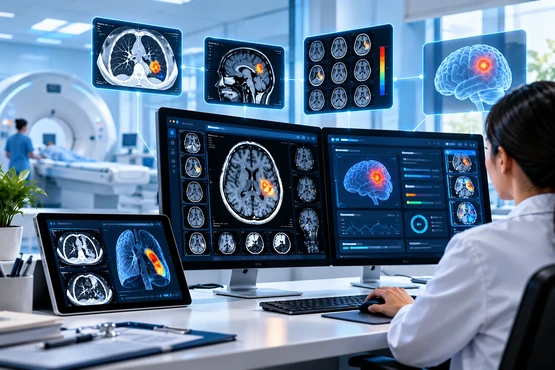
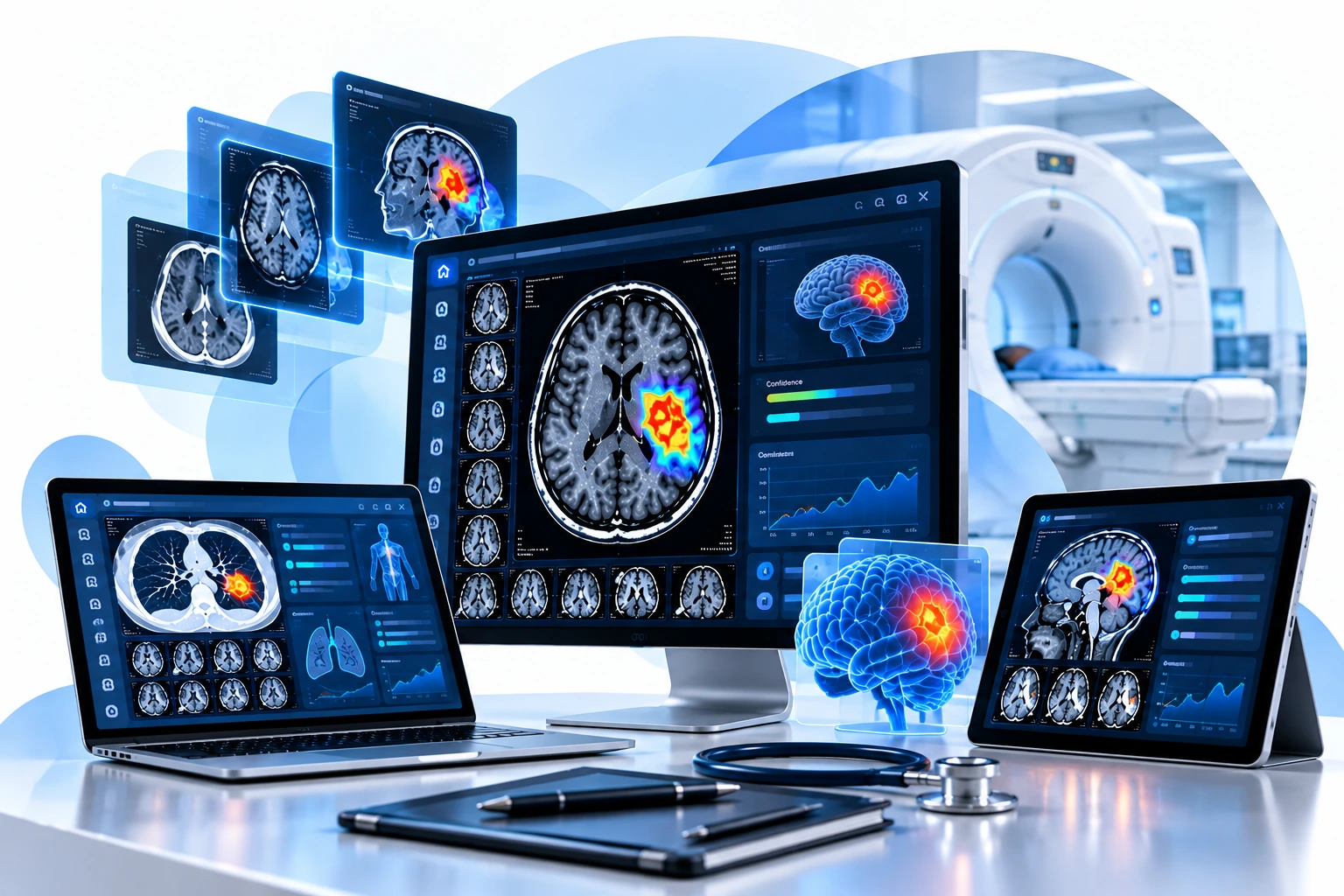
A diagnostic imaging network was facing rising imaging volumes and a shortage of subspecialty radiologists. Clinicians were spending excessive time reviewing studies, cross-referencing patient history, and documenting findings. Diagnostic accuracy varied between readers, and critical findings were sometimes missed during high-volume periods.
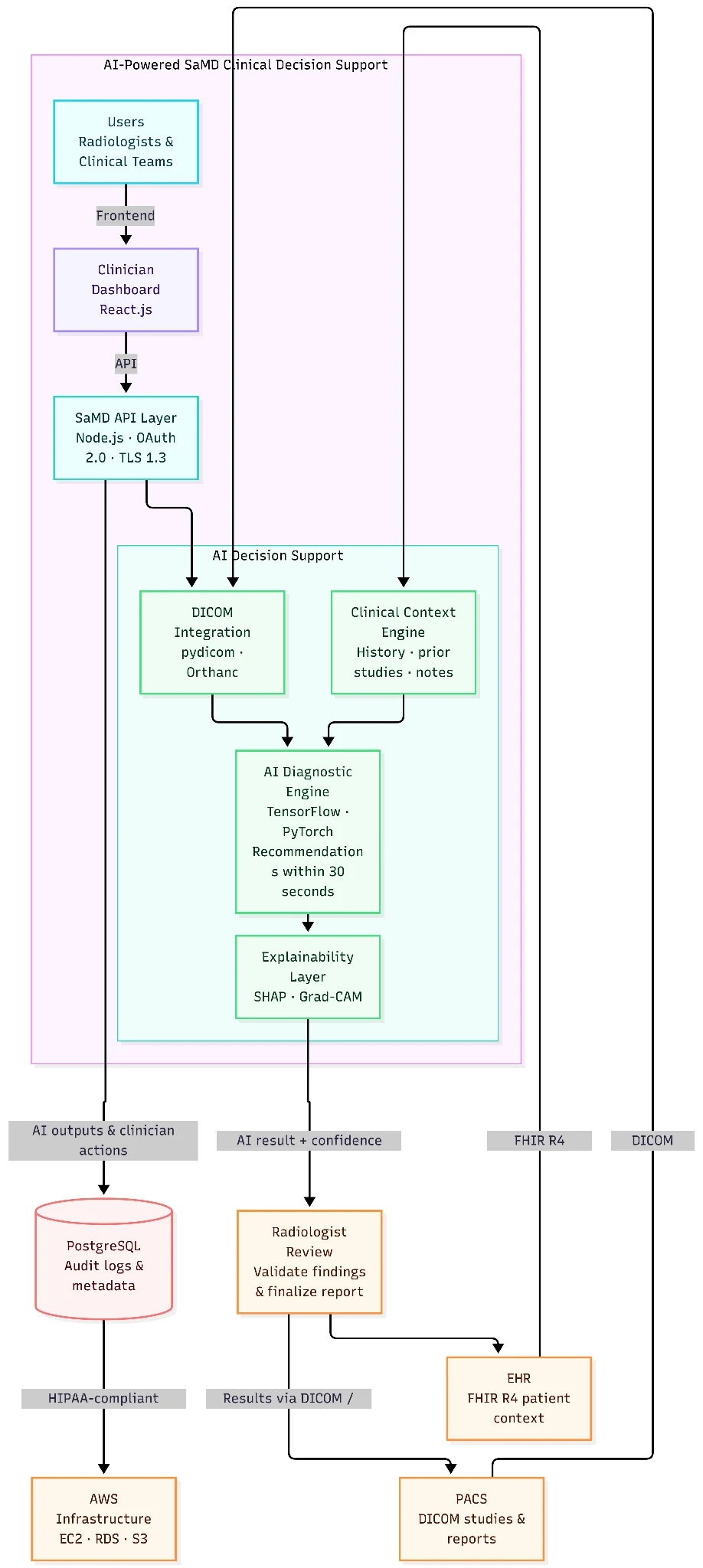
We built an AI-powered SaMD platform from scratch that analyzes medical imaging studies, generates diagnostic recommendations with confidence scores, and surfaces actionable insights within the radiologist's workflow. The platform integrates with PACS and EHR systems via DICOM and FHIR standards, providing real-time decision support without disrupting existing workflows.
Unlike general healthcare software, SaMD is regulated as a medical device. We built the platform to comply with IEC 62304 (medical device software lifecycle), ISO 14971 (risk management), and FDA guidance for AI/ML-based SaMD. Every algorithm change required validation against clinical ground truth.
Radiologists don't trust black-box AI. We built explainability features that show which imaging features contributed to each recommendation, enabling clinicians to validate AI outputs against their own clinical judgment.
The platform needed to query PACS, retrieve DICOM studies, process images, and return results without disrupting radiologist workflow. We built DICOM-aware APIs that handle metadata extraction, image processing, and result routing.
During peak hours, radiologists review 50+ studies per shift. The platform needed to deliver AI recommendations within 30 seconds per study to maintain workflow efficiency.
Diagnostic accuracy varied between readers, with miss rates higher during high-volume periods. The platform needed AI-powered decision support to standardize accuracy across readers.
Radiologists spent excessive time cross-referencing patient history, prior studies, and clinical notes. The platform needed to aggregate relevant context and surface it within the reading workflow.
PACS systems use DICOM standards with complex metadata. The platform needed to query PACS, retrieve studies, and return results without disrupting existing workflows.
The platform needed to comply with IEC 62304, ISO 14971, and FDA guidance for AI/ML-based SaMD. Every algorithm change required validation against clinical ground truth.
Built deep learning models trained on annotated imaging datasets to detect abnormalities, classify findings, and generate diagnostic recommendations with confidence scores. Models are validated against clinical ground truth.
Built explainability features that show which imaging features contributed to each recommendation. Radiologists can validate AI outputs against their own clinical judgment.
Built DICOM-aware APIs that query PACS, retrieve studies, process images, and return results without disrupting radiologist workflow. Results are routed to PACS and EHR via DICOM and FHIR.
Built a context engine that aggregates patient history, prior studies, and clinical notes from EHR, surfacing relevant context within the reading workflow.
Built a low-latency inference pipeline that delivers AI recommendations within 30 seconds per study, maintaining workflow efficiency during high-volume periods.
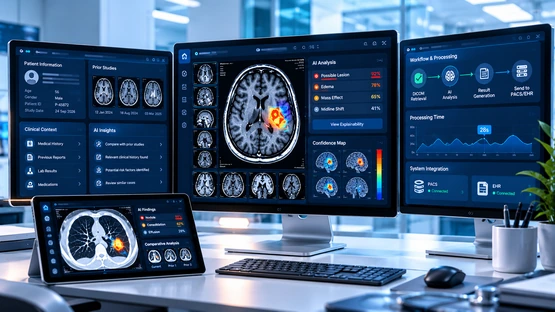
When a radiologist opens a study in PACS, the SaMD platform automatically retrieves the DICOM images, runs AI inference, and generates diagnostic recommendations with confidence scores. The explainability layer shows which imaging features contributed to each recommendation. The context engine surfaces relevant patient history, prior studies, and clinical notes. The radiologist reviews AI outputs alongside their own clinical judgment, documents findings, and finalizes the report. All AI outputs and clinician actions are logged for audit and continuous learning.
Deep learning models for abnormality detection and diagnostic recommendations.
Feature attribution showing which imaging features contributed to recommendations.
Query, retrieve, process, and route results without workflow disruption.
Patient history, prior studies, and clinical notes surfaced in workflow.
AI recommendations delivered within 30 seconds per study.
SaMD-based clinical decision support can transform diagnostic imaging by improving accuracy, reducing cognitive load, and standardizing care across readers. By building an AI-powered SaMD platform with explainability, DICOM-aware PACS integration, and low-latency inference, we helped the imaging network improve diagnostic accuracy by 30% and reduce clinician cognitive load by 40%. The solution achieved regulatory compliance while creating a scalable foundation for AI-driven diagnostics.
• SUFFESCOM SOLUTIONS
Build Smarter. Scale Faster. Grow More.
Have a Vision? Let’s Turn It Into a Digital Reality.
Get a quick response from our best experts in under 10 minutes.
Share Your Requirements. Our Experts Will Shape the Solution.
• SUFFESCOM SOLUTIONS
Build Smarter. Scale Faster. Grow More.
Have a Vision? Let’s Turn It Into a Digital Reality.
Get a quick response from our best experts in under 10 minutes.
Share Your Requirements. Our Experts Will Shape the Solution.
Fret Not! We have Something to Offer.