+971-8000321216



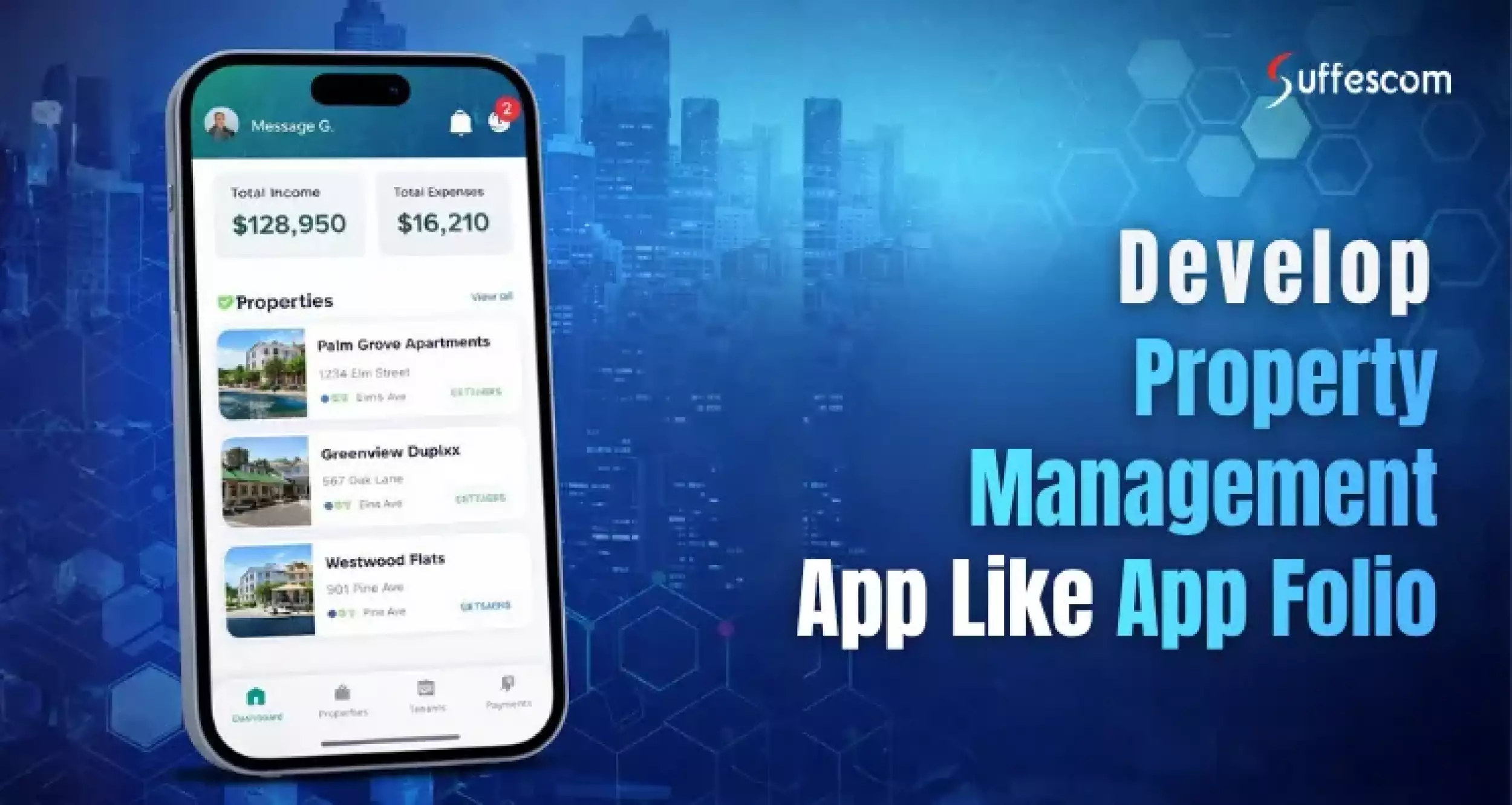
The real estate industry is undergoing a significant digital transformation, where efficiency, automation, and real-time accessibility have become essential rather than optional. A property management app like AppFolio acts as a centralized digital ecosystem that allows property managers, landlords, and real estate companies to handle operations seamlessly.
From tenant onboarding and lease tracking to rent collection and financial reporting, these applications replace outdated manual processes with structured, automated workflows that enhance productivity and reduce operational friction across all levels.
Businesses are increasingly investing in AppFolio like app development to simplify complex property operations, reduce human errors, and improve tenant engagement.
With the growing demand for mobile-first platforms and cloud-based accessibility, developing an app similar to AppFolio has become a strategic necessity. It not only enables organizations to scale efficiently but also ensures consistent service delivery, better decision-making, and long-term operational sustainability in a competitive real estate environment.
Note - Product & Trademark Notice
Product names, trademarks, and registered trademarks belong to their respective owners and are used only for identification purposes to better explain the development vision.
Market Statistics and Industry Growth of Property Management App
The property management software market is expanding at a consistent pace, driven by rapid urbanization, increasing rental properties, and the widespread adoption of digital tools in real estate. Businesses are actively shifting toward automated solutions that can handle complex property operations while offering flexibility, scalability, and improved user experience. This growth reflects a clear transition from traditional management practices to modern, technology-driven ecosystems.
Key market insights include:
1. The global property management software market is expected to exceed $30 billion by 2030, reflecting strong demand for digital transformation across residential and commercial real estate sectors.
2. More than 60% of property managers now rely on cloud-based platforms, as they provide remote access, scalability, and reduced infrastructure costs compared to traditional systems.
3. Mobile adoption in property management has increased by over 70%, indicating a strong preference for applications that offer real-time updates and accessibility on the go.
4. SaaS-based property management solutions are growing at a CAGR of 8–10%, making them a preferred model for businesses seeking predictable revenue streams and scalable operations.
5. Integration of AI and automation technologies is projected to improve operational efficiency by up to 40%, enabling predictive maintenance, smarter tenant management, and data-driven decision-making.
These statistics clearly demonstrate that investing in app development similar to AppFolio is aligned with current industry trends and future growth opportunities.
Why Property Management Apps Are Thriving in 2026
In 2026, the real estate industry embarked on another level of digital transformation, and one of the most emerging aspects is PropTech. The high momentum is due to a combination of urban expansion and the inefficiencies of outdated systems still in use across many markets.
Landlords and agencies are not only opting for digital property management to enhance their services, but also to stay competitive since transparency is important in the real estate sector. The transition from offline to online is an expected requirement for both tenants and stakeholders.
Shift from Manual to Automated Systems
Conventional property management was based on the usage of spreadsheets, paperwork, and slow communication. Conversely, new technology in property management applications provides fully automated platforms that eliminate fragmented processes.
Furthermore, recurring tasks, such as rent notices, lease renewals, maintenance bookings, and payment confirmations, are now handled by the system. This eliminates human error and makes the response time faster.
Key Features of a Successful Property Management App like AppFolio
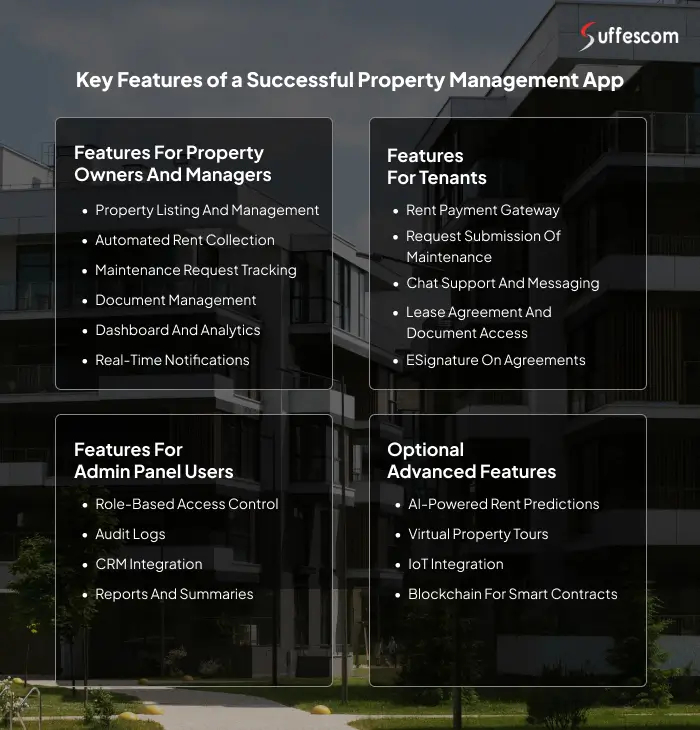
A robust property management application must combine functionality, usability, and scalability to effectively address real-world challenges faced by property managers and tenants. The right set of features ensures smooth daily operations, minimizes manual effort, and delivers a seamless experience for all users involved. So, let’s delve into the most important features that would provide the best outcome if you are planning to build property management software:
Features for Property Owners and Managers
- Property Listing and Management: This feature lets owners add, update, and organize all property details in one place. It helps keep track of units, leases, and tenant status with complete visibility.
- Automated Rent Collection: This feature gives landlords an opportunity to have auto reminders of monthly rents and the option for tenants to make payments online, which further helps in decreasing delays and makes the cash flow pattern uniform.
- Maintenance Request Tracking: Using this feature, the owners will be able to get repair requests, assign them to the contractor, and follow their progress through the stages till the end of the app.
- Document Management: It will assist in keeping contracts of rent, identification evidence, and all such documents in one place, where they can always be extracted at any given time.
- Dashboard and Analytics: The feature provides owners with key performance indicators of the property in terms of rent income, overdue payments, and occupancy trends of the properties to facilitate faster business decisions.
- Real-Time Notifications: The owners are immediately alerted about received rent, a lease expiring, or a new repair request in the app. This assists them in working without delays.
Features for Tenants
- Rent Payment Gateway: This feature allows tenants to pay rent online via cards or wallets. The transactions are instant, safe, and real-time, reflected in the system of the app.
- Request Submission of Maintenance: The tenants are able to complain of broken appliances, plumbing faults, and add photographs to them, and are able to follow up on repairs without having to contact the landlord.
- Chat Support and Messaging: This feature will assist the tenants to talk directly to the property managers or support teams within the app, which makes communication easier and more organized.
- Lease Agreement and Document Access: The notices, lease, and receipt of rent can be seen by the tenants at any time.
- eSignature on Agreements: An eSignature feature enables the tenants to sign the rental contracts or renew deals electronically, eliminating paperwork and wasting time on both sides.
Features for Admin Panel Users
- Role-Based Access Control: Admins have the possibility to provide various members of the team with access to certain features of the app. As an example, accountants have access to finances, whereas leasing agents are in charge of listings.
- Audit Logs: This aspect follows all steps that have been taken in the application, recording who has done what and when. It makes it transparent and less likely to cause errors or misuse.
- CRM Integration: This functionality links the app to already used customer management or accounting tools, enabling teams to work with information without the need to make additional efforts and transfer to a new platform.
- Reports and Summaries: The admins can make reports regarding the rent collection, open maintenance tickets, or tenant activity. Such summaries facilitate the proper management of property portfolios.
Optional Advanced Features
- AI-Powered Rent Predictions: This feature utilizes Artificial Intelligence to anticipate market trends and location data, providing accurate rent prices. It assists in pricing at the level of demand and competition.
- Virtual Property Tours: The rental units are advertised online, so a feature where tenants can take 3D tours or videos would be beneficial.
- IoT Integration: The app can be linked to such smart lock and thermostat devices. This feature promotes security and the ability of the tenants to use the appliances remotely.
- Blockchain for Smart Contracts: The lease agreements can be stored using blockchain to make the agreements tamper-proof, secure, and legally acknowledged. This introduces honesty and transparency in leasing.
Types of Property Management Software
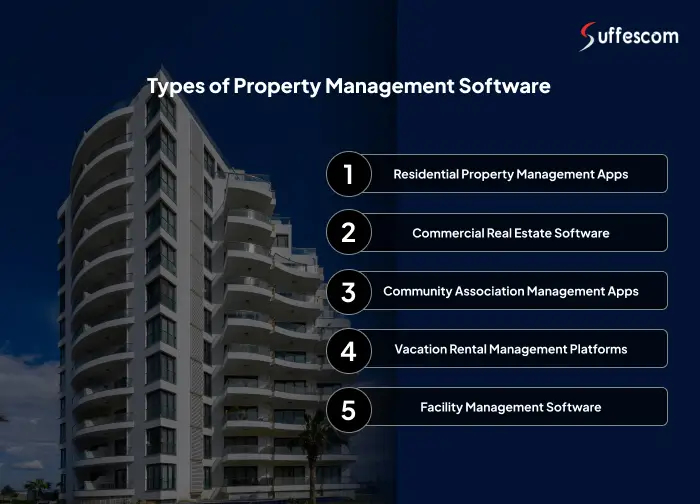
Not all property management apps are developed in the same way. Depending on the type of property you manage and the audience you serve, different property software management platforms are developed. The following are the most common types of property management software used today.
Residential Property Management Apps
These apps are designed for landlords and property managers who deal with apartments, villas, duplexes, or single-family houses. The software normally has the rental collection, tracking leases, maintenance requests, and communicating with the tenants tools. It enables landlords to control all processes of a tenant, such as contract hiring to renewals of leases, at the same time. These apps are most applicable when it comes to long-term renting and small to medium-sized property portfolios.
Commercial Real Estate Software
Commercial property software focuses on the needs of those managing office buildings, retail spaces, industrial warehouses, or mixed-use developments. These platforms provide lease customisation modules, unit-based billing, utility tracking, and contract management for numerous tenants in the same property. They also manage more term leases and complicated billing cycles that are so prevalent in commercial leasing.
Community Association Management Apps
This software is designed to run residential estates like gated societies, multi-unit complexes, or even housing associations. It facilitates communications among the members, community, facility reservations, security records, and the maintenance of the common areas. It also keeps the board members and community managers organised with all the documents of meetings, payments, and notices stored in a single electronic place.
Vacation Rental Management Platforms
They are most suitable for property owners or agents renting out houses, apartments, and the like on short-term leases, just like Airbnb. Functionalities typically provided in the software are booking calendars, a payment gateway, guest communication, and interconnections with travel platforms. It eases the process of automation in check-ins and reviews on visitors to handle high turnover and seasonal pressure.
Facility Management Software
Facility management software deals with the day-to-day operations of buildings and infrastructure. Organisations use it to monitor all things, including HVAC systems, electrical maintenance, safety inspections, and energy expenditure. Such software is more applicable in bigger commercial premises, hospitals, universities, or government buildings because it is in these places that equipment maintenance and inspection are continuous and strictly controlled.
These types of rental software are designed to address various issues. The selection depends on the type of property you have, the number of units you need to list, the frequency of tenant turnover, and the type of experience you wish to provide. Whether you manage a vacation house or a multi-story office building, it is always easier to manage it with a specialised tool and provide more qualified service.
Ready to Bring Your Property App Idea to Life?
Contact our app development company today and turn your concept into a powerful management solution.
Steps to Build a Property Manager Mobile App with No-Code Builders
Developing a property management app using no-code platforms follows a structured visual development approach that focuses on database design, workflows, and interface building. This method enables faster deployment while maintaining flexibility, scalability, and performance.
Step 1: Application Planning and Page Structuring
Start by defining the overall architecture of the application, including key screens such as dashboards, property listings, tenant panels, and admin controls. A clear structure ensures smooth navigation and logical flow across the app.
Step 2: Data Modeling and Database Setup
Create structured data types for properties, tenants, leases, payments, and maintenance requests. Proper data relationships are essential to ensure seamless data flow, accurate tracking, and efficient system performance.
Step 3: Visual UI/UX Design Creation
Use drag-and-drop builders to design responsive and intuitive interfaces. Focus on consistency, accessibility, and user-friendly layouts that enhance engagement and simplify navigation for all user roles.
Step 4: Workflow and Logic Configuration
Define how the app behaves by setting up workflows for actions such as user registration, rent payments, maintenance requests, and notifications. This replaces traditional coding with visual logic automation.
Step 5: User Roles and Access Control Setup
Configure role-based access for property managers, tenants, and property owners. Ensure each user type has access only to relevant features and data, improving security and usability.
Step 6: Integration of External Services and APIs
Connect the app with third-party tools such as payment gateways, email services, and analytics platforms. These integrations enhance functionality and provide a more comprehensive user experience.
Step 7: Testing, Debugging, and Performance Optimization
Test the application in real-time to identify errors, fix workflow issues, and optimize performance. Ensuring smooth functionality across devices is critical before launching the app.
Step 8: Deployment and Continuous Improvement
Launch the application on your chosen platform and monitor user behavior and performance metrics. Regular updates, feature enhancements, and optimizations are essential to maintaining competitiveness and user satisfaction.
How Our Property Management App Similar to AppFolio Works
A property management app like AppFolio operates as a centralized platform that connects property managers, tenants, and owners within a single, efficient system. The process begins with user onboarding, where each user creates a profile and accesses a personalized dashboard tailored to their role.
Property managers can list and manage properties through a unified interface, giving them full control over operations such as leases, maintenance, and finances. Tenants can easily pay rent, raise service requests, and communicate directly within the app, ensuring faster interactions and improved convenience.
Automated payment processing ensures timely transactions, while built-in analytics provide real-time insights into performance and operations. This streamlined workflow simplifies management tasks, enhances transparency, and improves overall productivity.
What Are The Benefits of a Property Management App Like AppFolio
Implementing a property management app offers significant benefits that directly impact operational efficiency, cost management, and user satisfaction. These applications streamline processes and provide a centralized platform for managing all aspects of property operations.
Key benefits include:
- Centralized data management that allows easy access to property, tenant, and financial information in one place, improving organization and decision-making
- Reduced operational costs through automation of repetitive tasks, minimizing the need for manual intervention and additional resources
- Faster and more reliable rent collection, ensuring consistent cash flow and reducing delays or payment-related issues
- Enhanced tenant satisfaction through improved communication, quick response to maintenance requests, and seamless user experience
- Scalability that allows businesses to manage expanding property portfolios without increasing complexity or operational burden
These advantages make AppFolio like app development a strategic investment for businesses aiming for long-term growth and efficiency.
Top Technologies Used in Property Management App Development
Developing a powerful property management app in 2026 will require the successful selection of a combination of technologies. Below is an overview of the most important technologies that are usually employed to develop modern PropTech solutions.
Mobile Technologies
The selection of a mobile framework has a direct influence on the property management app. Let’s discuss the key technologies used in it.
- Flutter and React Native are used to build apps for both Android and iOS using a single codebase.
- Swift is employed in native iOS development, where a high level of performance and integration with Apple devices is demanded.
- Kotlin is preferred for native Android apps, offering improved security features and compatibility with older Java-based systems.
Backend Frameworks
The back end of a property management application relies on a backend. It handles data processing and authentication with external APIs. Let’s discuss key technologies used in the backend of the app:
- Django is employed because of its security features, and it is most applicable in creating elaborate applications that involve user privileges and document transactions.
- Laravel also has clean architecture, and thus it is widely used to create a secure and scalable web backend.
- Node.js is very common because it is very high-performing and accommodates a large amount of data.
Database
Selecting the correct database will ensure that the app can deal with vast amounts of information. Let’s discuss the key technologies used for the database.
- PostgreSQL is strong, and it is helpful for structured data, becoming preferable in reporting and analytics.
- MongoDB is a versatile, document-oriented database that is popular when there is a need to have fast iterations of apps or unstructured data.
- Firebase is a combination of real-time synchronization and cloud storage, making it applicable to push notifications and mobile applications.
APIs / Integrations
The property apps are dependent on third-party services to increase their functions. These integrations prevent time waste, and extra features are introduced without remaking everything on their own. Let’s discuss the key APIs:
- Twilio allows SMS, voice calls, and two-factor verification inside the app, enhancing contact with tenants and work providers.
- Stripe facilitates safe Internet transactions, thus making rent, deposits, or service cost collection less cumbersome.
- Google Maps integration gives an opportunity to see the location of the property, verify distances, and activate the pre-formed functions, such as the ability to use GPS to see directions or check-ins.
- AWS S3 can be employed in cases of large file storage, like high-resolution images and PDFs.
Security Technologies
PropTech apps are very sensitive in terms of security since they handle important tenant information, money transactions, and sensitive documents. Let’s discuss some of the technologies used for the security of the property management app.
- SSL encryption also provides security for all data being exchanged between the app and the servers.
- OAuth 2.0 is a safe login system that helps the user log in by means of some trusted external services, such as Google or Microsoft.
- The end-to-end encryption secures the chat messages and document sharing among tenants, landlords, and administrators.
AI & ML for Property Insights
Artificial Intelligence is becoming a major part of PropTech innovation. Let’s discuss how AI & ML help in changing the property management sector.
- AI-driven rent estimators use local market data to suggest the best rental price for a unit.
- Machine learning algorithms help identify maintenance issues early by analyzing patterns and feedback.
- AI chatbots can answer tenant questions, guide them through payments, or assist with form submissions 24/7, reducing the need for live support.
Cost Estimation of Property Management App Development Like AppFolio
The cost of developing a property management app depends on various factors, including feature complexity, design requirements, and development approach. On average, a basic application can cost between $15,000 and $25,000, making it a viable investment for startups and mid-sized businesses looking to digitize their operations.
Cost Breakdown Table
| Development Component | Estimated Cost Range |
| UI/UX Design | $2,000 – $4,000 |
| Frontend Development | $3,000 – $6,000 |
| Backend Development | $4,000 – $8,000 |
| Third-Party Integrations | $2,000 – $4,000 |
| Testing & Quality Assurance | $1,500 – $3,000 |
| Deployment & Maintenance | $1,500 – $2,000 |
The final cost may vary depending on customization needs, additional features, and long-term maintenance requirements.
How Much Does It Cost to Build a Property Management App in 2026?
The cost to build a property management app in 2026 is based on the features, team organisation, and solution scope. Knowing the exact property management software development cost will help you decide on everything. Let’s explore the cost by key development stages:
- Discovery & Research: It takes approximately $1,000 to $3,000 on discovery and research that covers business analysis, user research, competitive analysis, benchmarking, and feature set.
- UI/UX Design: This phase costs around $2000-$5000, depending on the requirement. For instance, if you want the app to be compatible with all types of devices, it would cost more.
- Development: The development cost is between $4,000 and $8,000, depending on the feature set integration, frontend, backend, and third-party integrations like maps and payment gateways.
- QA and Launch: The costs of testing and quality assurance ideally fall between $1,000 and $4,000 and will involve functional testing, compatibility testing with other devices, and security-based audits alongside performance testing.
- Maintenance & Post-Launch Support: Post-launch maintenance begins at $1,000 per month, covering updates, bug fixes, cloud server costs, and new features introduced to the user base.
Factors That Impact The Cost of Property Management App Like AppFolio
Several factors influence the overall development cost, and understanding these elements helps businesses plan their budgets more effectively while avoiding unexpected expenses during the development process.
- Feature Complexity and Customization: The inclusion of advanced features such as AI analytics, automation, and custom integrations increases development time and cost, especially when tailored to specific business requirements.
- UI/UX Design Requirements: A high-quality design requires more effort and expertise, directly impacting the budget while significantly improving user engagement and retention rates.
- Platform Selection (iOS, Android, Web): Developing for multiple platforms increases overall costs due to additional development and testing efforts, but it also expands the app’s reach and accessibility.
- Third-Party Integrations: Integrating external tools such as payment gateways, analytics platforms, and communication APIs adds to the cost but enhances functionality and user experience.
- Development Approach (No-Code vs Custom Development): No-code solutions are cost-effective for basic applications, while custom development provides greater flexibility and scalability at a higher cost.
- Maintenance and Updates: Continuous maintenance, updates, and performance optimization are essential for long-term success and must be included in the overall budget planning.
Recommended Technology Stack for Property Management App Development
Choosing the right technology stack is crucial for ensuring scalability, performance, and long-term sustainability of the application. A well-structured tech stack supports efficient development and seamless user experience.
| Layer | Technologies | Purpose |
| Frontend | React, Flutter | Builds responsive and user-friendly interfaces across devices |
| Backend | Node.js, Django | Handles business logic, data processing, and server-side operations efficiently |
| Database | PostgreSQL, MongoDB | Manages structured and unstructured data securely and efficiently |
| Cloud Services | AWS, Google Cloud | Provides scalable infrastructure, storage, and hosting solutions |
| Payment Systems | Stripe, PayPal | Enables secure, fast, and reliable online transactions |
A strong technology foundation ensures that the application performs efficiently and scales as the business grows.
Monetization Strategies for Property Management Platforms
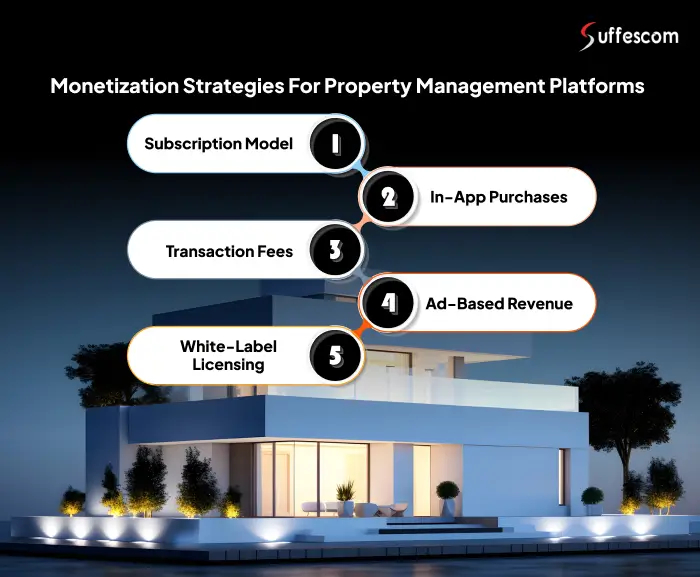
After developing your property management app, you will need to apply effective monetization strategies that will generate income and boost ROI. So, let’s discuss some of the major monetization strategies that you use in the property management app in 2026:
Subscription Model: In this type of model, the users will be charged monthly or annually, in order to keep using the platform. It is effective for landlords, agencies, and property managers who prefer to have predictable costs. It is possible to make various pricing levels according to the number of properties, features, or user roles.
In-app purchases: The freemium models allow basic features to be used freely, while the advanced tools are paid additions. As an example, its rent collection and maintenance log may be free, but signing a lease digitally or more analytics will be behind a paywall. This model is perfect to increase the number of users.
Transaction Fees: In case your app takes payments, you may charge a small transaction fee on any rent or service payment. This payment may be a rate, and sometimes a percentage, or may be paid by the landlord or tenant. It is particularly good in applications with high financial or billing capabilities.
Ad-based Revenue: In this monetization model, you can generate revenue by showing ads in your property management app. Applications with high user engagement may earn a lot of revenue. Ads that relate to property, such as the moving service, insurance, or home repairs, may be included in an unobtrusive manner.
White-Label Licensing: When your app is versatile and well developed, you will have the chance to sell it to other companies as a white-labeled product. You can keep the backend, and clients can rebrand it to their logo and colours. The license may involve one-time setup, customization, and recurring subscription prices, which intensify it to be a robust business growth.
Security and Compliance in Property Management Applications
Security is a fundamental component of property management applications, as they manage highly sensitive data, including financial transactions and personal user information. Implementing robust security measures is essential not only for data protection but also for building user trust and maintaining platform credibility.
End-to-end data encryption ensures that information remains secure during both storage and transmission. Secure payment gateway integrations protect against fraud and unauthorized transactions, ensuring safe financial operations.
Compliance with global data protection regulations, such as GDPR, ensures responsible handling and storage of user data. Additionally, role-based access control restricts data visibility based on user roles, adding an extra layer of protection and minimizing the risk of unauthorized access.
Challenges in App Development Like AppFolio and How to Overcome Them
- Managing Large Volumes of Data: Handling extensive property, tenant, and financial data can become complex as the platform scales. This challenge can be addressed by using scalable databases, cloud infrastructure, and efficient data management practices to ensure smooth performance.
- Ensuring Cross-Platform Performance: Delivering a seamless experience across web, mobile, and tablet devices requires continuous optimization and rigorous testing. Using responsive frameworks and cross-platform technologies helps maintain consistency and performance.
- Integration with Legacy Systems: Many real estate businesses rely on outdated systems that may not integrate easily with modern applications. This can be resolved by using APIs, middleware solutions, and gradual system migration strategies to ensure compatibility.
- Maintaining High Security Standards: Protecting sensitive financial and user data is a critical concern. Implementing encryption, secure authentication, and regular security audits helps maintain strong protection against potential threats.
- Handling System Scalability and Performance: As the number of users and properties increases, maintaining performance becomes challenging. Adopting cloud-based infrastructure and modular architecture ensures the app can scale efficiently without performance issues.
- Continuous Testing and Maintenance Requirements: Regular updates, bug fixes, and performance improvements are necessary to keep the app reliable. A structured testing strategy combined with ongoing maintenance ensures long-term stability and user satisfaction.
Future Trends in Property Management Software Development 2026
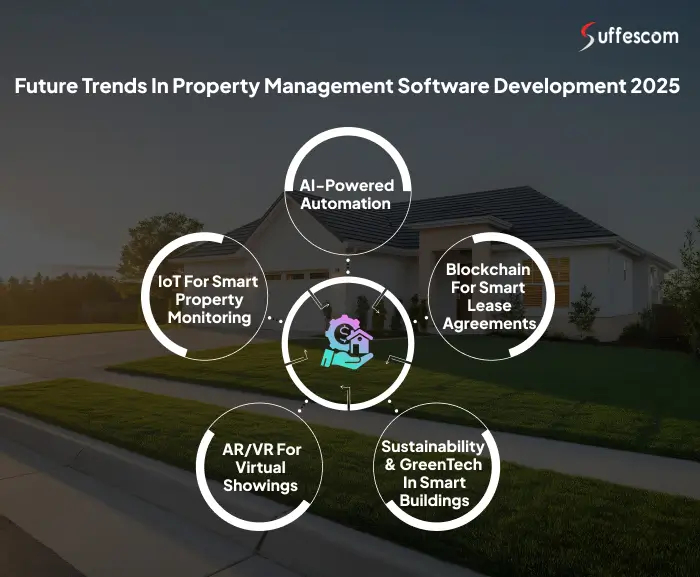
As this PropTech sector is rising quickly, it is clear that it has a lot of potential in the future as well. So, let’s discover some of the future real estate tech trends in real estate software development:
1. AI-Powered Automation
AI in real estate apps is significantly helping in automating tasks and decision-making.
- AI-powered chatbots are used to provide answers to tenant questions, set up viewings, and provide initial assistance around the clock.
- Predictive analytics can make forecasts of rent prices based on surrounding market trends, living capacity, and seasonal temperature patterns.
2. Blockchain for Smart Lease Agreements
Blockchain technology is bringing transparency and security to transactions through the utilisation of smart contracts and digital document management.
- Smart leases can be signed, verified, and incorporated automatically without human intervention.
- Blockchain-based systems can store payment histories, identity verification, and agreement renewals securely.
3. IoT for Smart Property Monitoring
The Internet of Things (IoT) is changing physical buildings into connected environments.
- Smart locks enable tenants or staff to access buildings with digital keys.
- Motion sensors help keep an eye on properties, and instant alerts are sent to prevent losses.
4. AR/VR for Virtual Showings
Augmented reality and virtual reality are transforming the rental experience of tenants who do not need to go anywhere since everything is virtually available.
- Potential clients will have the opportunity to look at the properties via the VR goggles or phones, regardless of their location across the globe.
- The staging tools would allow imagining where the furniture might be placed and how layouts should be changed to increase the conversion rate of those who rent the place.
5. Sustainability & GreenTech in Smart Buildings
With the current rise in awareness of climate change, commercial tenants, landlords, and property owners demand sustainable advantages embedded into the actual property as well as the software of the application.
- Real-time electricity, water, and gas usage can be displayed on energy efficiency dashboards in order to increase conservation.
- Smart scheduling systems can automate everything based on occupancy patterns.
Why Choose Suffescom to Build App Like AppFolio?
Suffescom stands out as a trusted development partner for businesses looking to build scalable, secure, and high-performing property management applications. With deep industry expertise and hands-on experience in delivering AppFolio clone solutions, the team ensures customized outcomes aligned with specific business goals and user expectations. Their development approach focuses on innovation, reliability, and long-term scalability.
From initial consultation and planning to deployment and post-launch support, Suffescom provides end-to-end services that streamline the entire development journey. Their strong emphasis on performance optimization, data security, and seamless user experience ensures that the final product is not only functional but also competitive in the evolving real estate technology landscape.
Key Reasons to Choose Suffescom
Instant Launch: Pre-built modules and agile processes enable faster deployment without compromising quality standards.
100+ Client Ideas Delivered: Extensive experience handling diverse business ideas across real estate and digital platforms.
24/7 Availability: Dedicated support team ensures continuous assistance, quick issue resolution, and smooth operations.
Experienced Delivery Team: Skilled professionals with proven expertise in building scalable and secure applications.
Custom-Tailored Solutions: Applications are designed according to unique business needs, ensuring better flexibility and performance.
Scalable Architecture: Robust backend infrastructure supports future growth and efficiently meets growing user demand.
Advanced Security Implementation: Strong security protocols protect sensitive data and ensure compliance with industry standards.
End-to-End Development Support: Complete lifecycle services from ideation to maintenance ensure a hassle-free development process.
Conclusion
Developing a property management app like AppFolio is a forward-thinking investment that helps real estate businesses transition toward more efficient, data-driven operations. By integrating essential features, scalable technology, and a well-defined monetization strategy, companies can build a reliable platform that simplifies management processes while enhancing user experience.
As the real estate landscape continues to evolve, adopting AppFolio like app development enables businesses to stay competitive, streamline workflows, and adapt to changing market demands. It also opens the door to long-term growth, improved operational control, and stronger relationships with tenants and property owners in an increasingly digital ecosystem.
Book a Free Consultation with Our App Development Team
Discuss your project needs and explore our property management development services, which are designed to fit your business model.
FAQs
1. Can small property owners benefit from an AppFolio-like app?
Yes, small property owners can streamline tenant communication, automate rent tracking, and manage multiple properties efficiently without needing large teams or complex systems.
2. Can these apps handle multiple property types?
Yes, modern property management apps are designed to manage residential, commercial, and mixed-use properties, offering flexible configurations for different property categories.
3. Are property management apps suitable for global use?
Yes, these applications can be configured for multiple currencies, languages, and regional regulations, making them suitable for international property management operations.
4. Can I scale the app as my business grows?
Yes, scalable architecture allows the app to handle increasing users, properties, and data without compromising performance, making it ideal for growing real estate businesses.
5. Do these apps support automated notifications?
Yes, automated notifications help remind tenants about rent payments, lease renewals, and maintenance updates, improving communication and reducing manual follow-ups.
6. Is training required to use a property management app?
Most modern apps are designed with intuitive interfaces, requiring minimal training. However, onboarding support can help users understand advanced features more effectively.
7. Are these apps suitable for startups in real estate?
Startups can leverage these apps to manage operations efficiently from the beginning, reducing costs and establishing a strong digital foundation for future growth.
8. What kind of user support should be included in the app?
Effective apps include in-app support, chat assistance, FAQs, and help centers to ensure users can quickly resolve issues and navigate the platform smoothly.
9. Can property management apps work offline?
Some apps offer limited offline functionality, allowing users to access certain features without internet connectivity, with data syncing automatically once connected.
10. What makes a property management app successful in the market?
A successful app combines user-friendly design, reliable performance, strong security, and continuous innovation to meet evolving user needs and industry standards.