
Key takeaways:
- Revolut has evolved from a digital foreign exchange app into a broad financial ecosystem offering cards, payments, subscriptions, wealth products, lending, business finance, and other services across supported markets.
- Its business model relies on multiple revenue streams, with card payments, interest income, subscriptions, wealth products, and foreign exchange contributing significantly to its reported revenue.
- In 2026, Revolut generated approximately £4.5 billion in revenue, up 46% year-over-year, while profit before tax reached £1.7 billion and its retail customer base grew to 68.3 million.
- Revolut's success is driven by its freemium acquisition model, cross-selling strategy, high customer engagement, digital-first scalability, and expansion into business financial services.
- Building a Revolut-like fintech platform can cost approximately $40,000 to $250,000+, depending on the product scope, financial integrations, security infrastructure, compliance requirements, and target markets.
- The key lesson for businesses is that building a successful fintech app requires more than a polished interface. It needs a scalable technology foundation, strong security, appropriate compliance infrastructure, and a well-designed ecosystem that creates opportunities to grow revenue from multiple financial products.
The financial sector is going through a shift to provide greater convenience to customers. People don't need to wait in long queues to open an account or resolve their concerns. Traditional banks require a lot of paperwork and huge fees.
Neobanks like Revolut make it hassle-free to choose from a wide range of banking services. Revolut is a smarter way to manage money without the need to visit a physical branch. The users can keep an eye on spending and make international money transfers through the app.
An app like Revolut has innovative features for a seamless user experience. It allows users to get cost-effective services from anywhere around the world. Everything comes at their fingertips, whether it’s applying for a loan or investing money.
In 2026, Revolut generated £4.5 billion in revenue, up 46% from £3.1 billion in 2024. Its profit before tax reached £1.7 billion, while its retail customer base grew to 68.3 million.
There are different ways to make money from an app like Revolut. It can be through subscription plans and transaction fees. Neobank app solutions can help your business to win the users’ trust. It allows you to build a strong position among the other FinTech players. Let’s get started to know how Revolut works.
Learn about Revolut business model and how it earns revenue. Find out how this app is painting a bright picture for the financial sector.
Revolut Business Model 2026: Key Numbers
Before exploring how the business works, here is a snapshot of Revolut's latest reported performance:
| Metric | 2026 Performance |
| Group revenue | £4.5 billion |
| Revenue growth | 46% YoY |
| Profit before tax | £1.7 billion |
| Retail customers | 68.3 million |
| Retail customer growth | 30% YoY |
| Business customers | 767,000 |
| Business customer growth | 33% YoY |
| Total customer balances | £50.2 billion |
| Retail transaction volume | £986 billion |
| Business revenue contribution | 16% |
| Lending portfolio | £2.2 billion |
What Is Revolut?
Revolut is a digital financial platform founded in 2015. It provides personal and business financial services through mobile and web-based products, with available services varying by market.
Its ecosystem includes products and services such as:
- Personal accounts
- Multi-currency functionality
- International payments
- Physical and virtual cards
- Foreign exchange
- Paid subscription plans
- Savings products
- Investment and wealth services
- Personal lending and credit products in supported markets
- Merchant and checkout solutions
- Business accounts
- Corporate cards
- Business payments
The important point is that Revolut is no longer simply an app for exchanging currencies. Its model is increasingly based on becoming a customer's primary financial relationship and offering multiple products within one connected digital ecosystem.
How Does Revolut Work and Earn?
At a high level, Revolut brings different financial services together through a digital platform. The exact services available depend on the user's country, local regulations, and the relevant Revolut entity.
Here is a simplified view of how the ecosystem works.
Digital User Onboarding
A customer begins by creating an account through the app or other supported channels. The onboarding process collects the information required to establish and manage the customer relationship. This digital-first approach removes much of the friction traditionally associated with visiting a branch and completing manual paperwork.
Identity Verification and Compliance Checks
Financial platforms must carry out identity and compliance processes according to applicable regulations.
Depending on the customer and product, this can involve:
- Identity verification
- Customer due diligence
- Business verification for companies
- Screening and risk assessment
- Ongoing compliance monitoring
For businesses, the requirements can extend to verifying the company and relevant individuals connected with it.
Account and Financial Infrastructure
Once an account is established, customers can access the products available in their market. The platform then acts as the digital layer through which customers can view balances, make payments, manage cards, exchange currencies and use other eligible services.
Card Payments
Customers can use Revolut cards for eligible purchases. Card activity is important to the company's business model because card payments represented its largest reported revenue category in 2026. Revenue can be generated through payment and card-related economics associated with customer transactions. In 2026, card payments generated approximately £1 billion, representing 45% of group revenue.
Payments and Money Transfers
Customers can send and receive money through the products available to them. Revolut earns from certain payment-related services and product features. The exact fees and charges depend on the product, customer plan, transaction type, and market.
Foreign Exchange
Foreign exchange was one of Revolut's original core products and remains an important revenue stream. Customers can exchange supported currencies within the platform, subject to applicable pricing, limits and product terms. FX generated approximately £606 million in 2026.
Lending and Interest-Generating Products
Revolut has expanded into lending and other banking activities in supported markets. Its lending portfolio reached approximately £2.2 billion in 2026. Interest income across the group reached approximately £974 million, making it one of the company's largest revenue sources.
Wealth Products
The platform also provides selected investment and wealth products, depending on location and eligibility. These may include investment-related services and other wealth products. Revolut reported approximately £663 million in wealth revenue during 2026.
Paid Subscription Plans
Revolut uses a freemium model. Customers can access an entry-level offering and choose paid plans with additional benefits and features where available. This gives the company a recurring revenue stream that is not directly dependent on transaction volume. Subscription turnover reached approximately £708 million in 2026.
How Does Revolut Make it Effortless for Users to Take Control of Money?
Revolut was founded in 2015. This leading company provides banking and investment services around the world. It is making way for a bright road ahead.
The app allows users to exchange their currency faster and securely.
The app interface enables users to explore the banking services with ease. This is how Revolut goes one mile ahead in providing value to the users:
Easier Opening of Accounts
The users don't need to do any paperwork while using the Revolut app. This makes it easier and stress-free for users to open their accounts online. No need to wait for reaching out to the bank staff. This saves time and money that is often exhausted in traditional banks.
Tools for Managing Money
Revolut business model allows the users to keep a watch on how much they are spending and saving. They can classify their spending in the app. This helps to create a list of the electricity, grocery and education expenses.
The app provides suggestions to develop the right spending habits. They can exchange their currency at competitive exchange rates.
Protects the User’s Details
The app utilizes artificial intelligence to keep the user’s information safer. The users can adjust the security of the app as per their preferences.
They can add their location and protect their card details. Virtual cards and single use cards enable users to make secure payments from anywhere.
Provides Cost-Effective Services
The users can pay a low or no fees on the transfers to another country. This provides a better option than traditional banks that require users to pay for a huge cost.
Revolut offers a fair exchange rate. The app allows its users to quickly send and receive money.
Can Revolut Safeguard Users from the Risk of Frauds?
Revolut utilizes artificial intelligence to protect the users from any loss of money. Revolut business strategy keeps the user’s details secure when they make a payment. AI can go through the data to warn the users about any activities that are noticed. Custom AI app development for fintech companies can prevent fraud in these ways: 
Keeps a Check in Real-Time
This app allows users to keep a close watch on their money. They can get the detailed information in real-time. AI can examine the user’s details. It can point out if there is any other person trying to misuse the information. This helps in protecting the users from frauds.
Protects from Card Thefts
Revolut is built with API Integration services and security features. This protects users from card thefts. AI gives an alert to the users before they make payments. The users can purchase online through virtual cards. These cards are only used once to keep user details secure. The app ensures that the payment takes place from the user’s location. The user can control the card even when it’s stolen.
Examines the Spending Habits
The neobank app can understand how the user is spending money over time. It can go through their payments in past. This provides clear information about how the user usually spends. It enables AI to find out if any other person is making payments. The app prevents these payments and ensures complete security.
Personalized Support
The users can get expert advice to keep their money safe. They can get personalized support and guidance at any time. The online platform has educational videos to help users learn how to identify frauds.
Adopt a Flexible Business Model for Your Fintech Company
Transform banking experience and drive earnings with a Revolut-like app.
What is the Business Model of Revolut’s Neobank App?
Business model of Revolut provides convenience and peace of mind to everyone. It allows users to get the benefit of services from the comfort of their home. The app is growing its reach to users around the world. People are turning their heads to this modern banking solution. Want to know why? Let’s see how the Neobank app development works for an effortless user experience:
Solves the Problems of Traditional Banks
This app helps users manage their money easily. They don’t need to go through the pain of visiting traditional banks. The users can do the currency exchange online by paying lower fees. Revolut has advanced features to make payments and manage money. It provides complete control and security to the users.
Meets the Needs of Every User
Individuals and businesses can use the app for their needs. Revolut is for one and all. It is suitable for those who want to manage their study or travel expenses. A newly setup business can use the app to take control of its operations. They can open their accounts in different currencies.
Revolut Business Strategy
Revolut business strategy enhances the user experience. The fintech company has added new features and services. It is entering the markets in different regions. The app analyzes data to ensure secure and faster payments. It engages the users through personalized advice for managing money.
Revolut Cost Structure
Revolut spends money on maintaining the technologies, mainly on cloud services. A cloud-based app can handle the increasing number of users or vast data. The company provides benefits and salaries to employees. Another cost is for doing marketing to bring new customers. Revolut also pays for the cost of meeting the financial regulations.
Why Is Revolut's Business Model Successful?
Revolut's growth cannot be attributed to a single product. Several elements work together.
Freemium Customer Acquisition
An accessible entry point can help reduce friction for potential customers. Instead of requiring every customer to start with a premium product, a fintech platform can attract users with a core offering and create opportunities for future upgrades.
Multiple Revenue Streams
Revolut generated meaningful revenue from several major categories in 2026. Card payments, interest, subscriptions, wealth, and FX all contributed significant income. This diversification can make a financial platform more resilient than a business dependent on one fee source.
Cross-Selling
A customer who joins for one service may eventually use several. For example:
FX → Card → Account → Subscription → Savings → Investments → Lending
Not every customer follows this path, but a connected ecosystem creates opportunities to increase the value of an existing customer relationship.
Higher Engagement
Financial products can become part of a customer's daily activity. Payments, cards, and account management can create frequent interactions. Once a customer uses the platform regularly, it becomes easier to introduce relevant additional services.
Expansion Into Business Finance
Revolut Business creates a second major growth engine. The company is not limited to consumer finance. Business customers increased by 33% in 2026, while the segment contributed 16% of total revenue.
Digital Scalability
A digital-first model allows a company to develop and distribute products without relying on a traditional branch network. However, scaling financial services still requires significant investment in technology, compliance, security, licensing, risk management, and customer support.
Revolut Business Model vs Traditional Banks
| Factor | Traditional Banking Model | Revolut's Digital-First Model |
| Product access | Branch, phone, and digital channels | Primarily app and digital channels |
| Account onboarding | Can involve branch or manual processes | Designed for digital onboarding |
| Product ecosystem | Often organized across separate systems | Focus on a connected digital experience |
| Customer acquisition | Physical and digital distribution | Primarily digital acquisition |
| International features | Varies significantly by bank and market | FX and international functionality are core parts of the ecosystem |
| Subscriptions | Less central to many traditional models | Important recurring revenue stream |
| Product expansion | Often dependent on legacy infrastructure | Digital product launches can be integrated into the app ecosystem |
| Business finance | Established banking category | Fast-growing strategic segment |
This comparison is not intended to suggest that every traditional bank works the same way. Many banks are also investing heavily in digital transformation.
The difference is primarily in the operating philosophy. Revolut was built as a digital financial platform and has expanded its product ecosystem around that foundation.
Revenue Model: How Does Revolut Make Money?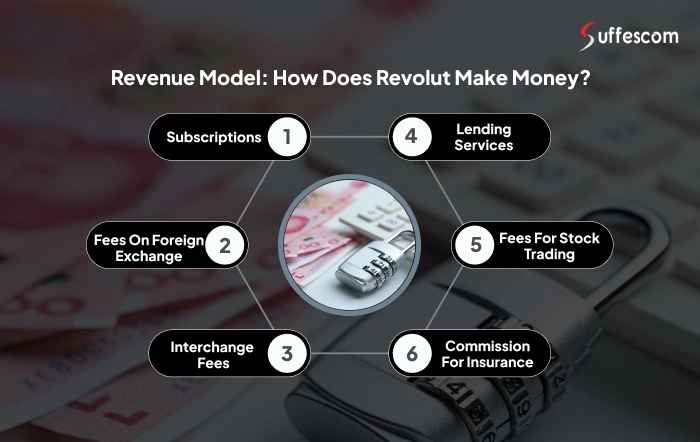
The customers of Revolut are expected to be more than 68 million by December, 2026. The increasing user base allows it to earn higher profits. The banking app provides a wide range of financial services. It earns revenue through different sources like:
Subscriptions
Revolut allows users to choose from different subscription plans. Every plan comes with features and benefits for the users. The free plan allows users to convert their money into foreign currency. They don’t need to pay any fees for this plan. Premium and metal plans enable users to exchange currency without any limits. These plans also offer insurance on travel, cashback and enhanced money withdrawal from ATM.
Fees on Money Transfers
The user needs to pay fees for sending money to a person in another country. The fees is calculated in real-time based on the currency. Those with a premium or metal plan don’t need to pay fees on the transfer of money in foreign currency. But the users need to pay if they go above their plan limit.
Interchange Fees
Revolut earns money through a commission on card payments. This is the interchange fees. Merchants pay this amount to Revolut for every transaction. The revenue increases when there are more users paying through a card.
Lending Services
This banking app offers personal loans and other types of loans to the users. The users need to pay interest on loans. The interest will depend on the loan amount and the user's credit score.
Fees for Stock Trading
Revolut provides expert advice for trading in stocks and cryptocurrency like Bitcoin. The app earns through fees on stock trading. The members of the premium plan can do the monthly trading for free. But they need to pay for any extra stocks that are traded.
Commission for Insurance
The users can get insurance for device and medical expenses during travel. Revolut joins hands with the insurance providers. These insurance companies pay a commission to Revolut.
How Much Does It Cost to Build an App Like Revolut?
The cost to build an app like Revolut typically ranges from $40,000 for a basic fintech MVP to $250,000+ for an enterprise-scale financial ecosystem. An advanced fintech or neobank platform generally costs between $100,000 and $250,000. The final price depends on the number and complexity of features, payment and banking integrations, KYC/AML compliance requirements, security infrastructure, multi-currency support, and the markets the platform will serve.
As a broad software development estimate:
| Platform Type | Estimated Development Cost | Estimated Development Time |
| Basic fintech MVP | $40,000–$80,000 | 4–8 months |
| Advanced fintech or neobank platform | $100,000–$250,000 | 9–18 months |
| Enterprise-scale financial ecosystem | $250,000+ | 18 months–3+ years |
Create a Neobank App like Revolut for Low-Cost Banking
Build a banking app that provides personalized insights and cost-effective services.
Make Your Revenue Model Successful with Suffescom Solutions
Revolut is solving the challenges for users of the modern world. It allows the users to keep an eye on their money. Revolut business model analysis can help your business to meet the needs of global users.
It allows you to earn money through subscriptions and fees on foreign exchange. If you are running a FinTech business, Suffescom Solutions is your partner.
Suffescom Solutions offers fintech software development services to create a smart banking app like Revolut. We create an online platform that provides insights in real-time.
Our team ensures a smooth integration with your systems. Build an app like Revolut that enhances efficiency and user satisfaction. Contact our expert team to get started.
FAQs
1. How does Revolut make money?
Revolut generates revenue from multiple sources, including card payments, interest income, subscriptions, wealth products, foreign exchange, and other financial services. In 2026, card payments were its largest reported revenue category, followed by interest income, subscriptions, wealth, and FX.
2. What is Revolut's main source of revenue?
Based on Revolut's reported 2026 results, card payments were the company's largest revenue category, generating approximately £1 billion and accounting for around 22.2% of total revenue.
3. How much revenue did Revolut generate in 2026?
Revolut reported approximately £4.5 billion in group revenue for 2026, representing 46% growth from £3.1 billion in 2024.
4. How much profit did Revolut make in 2026?
Revolut reported approximately £1.7 billion in profit before tax for 2026, up 57% from approximately £1.1 billion in 2024.
5. How many customers does Revolut have?
Revolut ended 2026 with 68.3 million retail customers. The company later announced that it had surpassed 70 million customers globally in 2026.
6. How does Revolut make money from free users?
Free users can still generate value through eligible transaction-related, payment-related, and other financial activities. Revolut also uses its broader ecosystem to create opportunities for customers to adopt paid plans and additional products.
7. How does Revolut make money from subscriptions?
Revolut offers paid plans with additional features and benefits. Customers pay recurring fees for eligible subscription plans, creating a recurring revenue stream. Subscription turnover reached approximately £708 million in 2026.
8. Does Revolut make money from card transactions?
Yes. Card payments were Revolut's largest reported revenue category in 2026, generating approximately £1 billion.
9. How does Revolut Business make money?
Revolut Business generates revenue from financial services offered to business customers, which can include paid plans, payments, cards, FX, and other business products. Business customers contributed approximately 16% of Revolut's total revenue in 2026.
10. How many Revolut Business customers are there?
Revolut ended 2026 with approximately 767,000 business customers, up 33% from 578,000 in 2024.
11. What is Revolut's Business Model Canvas?
Revolut's model focuses on serving consumers and businesses through a digital financial ecosystem. Its key revenue streams include card payments, interest, subscriptions, wealth and FX, while its major resources include technology, financial infrastructure, regulatory capabilities and its customer base.
12. Is Revolut a bank or a neobank?
The answer depends on the market and the specific Revolut entity or product involved. Revolut operates as a licensed bank in certain countries and also provides financial services through different regulated entities and licenses. Customers should check the terms applicable in their location.
13. What are Revolut's main competitors?
Companies with overlapping products include Wise, Airwallex, N26, and Monzo, among others. However, these companies have different market focuses, customer segments, and product strategies.
14. How much does it cost to build an app like Revolut?
A focused fintech MVP may cost approximately $40,000–$80,000, while a more advanced platform may cost $100,000–$250,000 or more. A large enterprise-scale ecosystem can exceed $250,000. The actual budget depends on features, regulations, integrations, security, and the target market.
15. How long does it take to develop a Revolut-like fintech app?
A focused MVP may take around 4–8 months. A more advanced fintech platform can require 9–18 months or longer. Large multi-market financial ecosystems are typically developed and expanded over several years.
16. What technology is needed to build a neobank or fintech app?
A modern fintech platform may require mobile applications, secure backend services, transactional databases, cloud infrastructure, APIs, payment integrations, KYC/KYB services, fraud and risk systems, encryption, monitoring and analytics. The final technology stack should be selected based on the product and regulatory requirements.