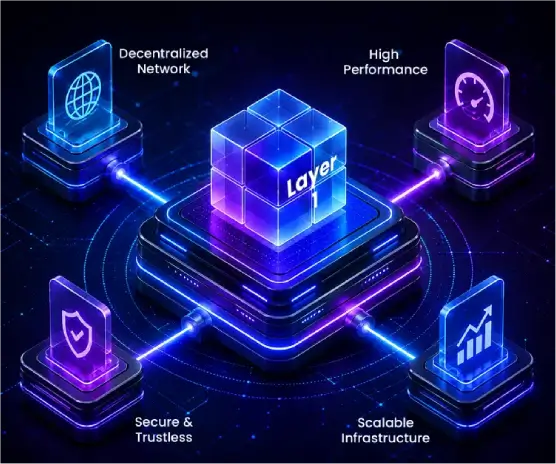






Layer 1 (L1) blockchain development involves the creation of the base layer network of a blockchain environment. It works entirely independently, managing its own transactions, consensus mechanism, security and settlement without depending on another blockchain network. Bitcoin, Ethereum, and Solana are popular examples of such blockchain networks, although L1 blockchains tailored to meet unique business and Web3 requirements are gaining prominence.
The process of creating a layer 1 blockchain involves:







| Parameter | Build a Custom L1 | Deploy on Existing L1 (Ethereum / Solana) | Build a Rollup (L2 / L3) |
|---|---|---|---|
| Best for | Sovereign protocols, appchains, enterprise private networks, and custom consensus use cases | dApps, DeFi platforms, NFT marketplaces needing existing liquidity and user base | High-performance apps requiring Ethereum-grade security with lower fees and higher throughput |
| Protocol Control | Full control over consensus, tokenomics, governance, and upgrades | No control over base protocol; dependent on chain governance and gas dynamics | Partial control; execution layer is customizable while settlement relies on base L1 |
| Time to Mainnet | 4–12 months (depending on complexity) | 2–8 weeks (smart contract deployment) | 8–16 weeks (ZK or optimistic rollup setup) |
| Cost Range | $150K – $300K+ (framework-based setups scale higher) | $20K – $150K | $80K – $300K (can scale up to ~$300K+ for advanced ZK systems) |
| Native Token | Yes — fully customizable tokenomics | No — uses ETH / SOL for gas | Optional — can include custom gas token |
| Ideal Stack | Cosmos SDK, Substrate, custom EVM fork, Move | Solidity, Anchor, Move | zkSync Stack, OP Stack, Polygon CDK |
There are several types of Layer 1 blockchain networks that have different characteristics, including their access control mechanism, governance systems, and ways of participation in operations. The choice depends on use cases because some scenarios require certain transparency and scalability levels.

Public blockchains are permissionless systems where everyone can become members and be involved in transaction validation and ledger storage. Due to the global distribution of the network nodes, they ensure decentralization and high transparency of all operations, which makes them perfect for various DeFi, NFTs, and Web3-related projects.

Private blockchains are opposite to public ones since only authorized entities have access to them, but they are more appropriate for business use cases that require a certain level of data protection, regulation compliance, and restricted operation validation.

Hybrid blockchains combine properties of the two previous types, allowing enterprises to selectively share their data with others while keeping some operations private.
The Layer 1 blockchain is at the core of any decentralized system, ensuring safety, transparency, and scalability to enable today’s Web3 development solutions, digital assets, and enterprise use cases.
Through Suffescom Solutions, companies can create a unique Layer 1 blockchain network that has control over its governance, infrastructure, consensus, and ecosystem, thus setting the foundations for successful blockchain expansion.
Discuss your requirements with blockchain architects and receive a tailored roadmap covering protocol design, consensus mechanisms, tokenomics, and deployment strategy.
We offer end-to-end Layer 1 blockchain development services to help businesses build secure, scalable, and independent blockchain ecosystems.

Build a custom Layer 1 blockchain tailored to your business goals, scalability needs, and ecosystem requirements. Gain full control over protocol architecture, governance, and network performance for DeFi, enterprise, gaming, and Web3 applications.
Key Capabilities:
• Custom blockchain architecture design
• Native token development and tokenomics implementation
• EVM-compatible and custom execution environments
• Mainnet, testnet, and devnet deployment
• Blockchain governance framework development
Blockchain protocol is the core component of each blockchain network. Blockchain protocol development centers on creating a framework that governs blockchain network processes.
Key Capabilities:
• Peer-to-peer network architecture
• Transaction validation and block creation logic
• Fee market and gas optimization models
• Consensus integration and network governance
• Protocol upgrades and performance optimization

Build governance models that enable transparent decision-making, protocol upgrades, and community participation. It defines voting systems, stakeholder roles, and on-chain governance to ensure long-term ecosystem sustainability.
Key Capabilities:
• On-chain and off-chain governance model design
• DAO architecture and community governance frameworks
• Proposal creation, voting, and execution mechanisms
• Validator and stakeholder participation models
• Treasury management and governance execution

Enterprise blockchain networks require enhanced security, privacy controls, regulatory compliance, and seamless integration with existing business systems. Enterprise Layer 1 solutions are designed to support large-scale organizational operations while maintaining transparency and efficiency.
Key Capabilities:
• Permissioned and hybrid blockchain networks
• Role-based access management
• Enterprise system integration
• Identity and access control frameworks
• Compliance-focused blockchain architecture

A thriving blockchain ecosystem depends on secure smart contracts and programmable digital assets. Tokenization and smart contract development services help businesses launch secure and efficient blockchain applications.
Key Capabilities:
• Native token creation
• Staking and delegation contracts
• Smart contract development and deployment
• DeFi protocol integration
• NFT and asset tokenization solutions

Security remains one of the most critical aspects of Layer 1 blockchain development. Comprehensive security assessments help identify vulnerabilities before deployment and strengthen overall network resilience.
Key Capabilities:
• Smart contract audits
• Consensus mechanism validation
• Penetration testing
• Security risk assessments
• Economic attack analysis
Our team will develop the smart contract execution environment to fit your Layer 1 chain, be it EVM-compatible, CosmWasm-based, or custom VM, as well as implement and test the foundation-level smart contracts that enable your L1 chain to function.
Key Capabilities:
• Token contracts
• Staking contracts
• Bridge contracts
• Protocol governance contracts
• Smart contract testing and auditing

Validator network plays a crucial role in every L1 chain. We will configure genesis validators, validator onboarding tools, monitoring dashboards for nodes, APIs/RPCs, blockchain explorer, cloud native architecture for AWS/GCP and even bare-metal nodes.
Key Capabilities:
• Genesis validator setup
• Validator onboarding tooling
• Node monitoring and dashboards
• RPC/API endpoints
• Block explorer deployment
• Cloud-native infrastructure
Our blockchain developers will create a completely new Layer 1 blockchain, which will be fully compatible with the Ethereum Virtual Machine. Such compatibility implies that you won't need Ethereum infrastructure, but your blockchain will allow the execution of Ethereum-based Dapps.
Key Capabilities:
• Solidity smart contract support
• MetaMask and wallet integration
• Hardhat/Foundry tooling
• DeFi and gaming ecosystem support
• Sovereign chain infrastructure
The consensus mechanism is the single most important architectural decision in L1 blockchain development. It defines your chain's security model, transaction finality speed, validator economics, and energy consumption. Here is how Suffescom's architects recommend each mechanism based on use case.
| Mechanism | Best For | Finality | Energy | TPS Range | Examples |
|---|---|---|---|---|---|
| Proof of Stake (PoS) | Public DeFi chains, general-purpose L1s | ~2–6 seconds | Low | 1,000–10,000+ | Ethereum 2.0, Cardano |
| Delegated PoS (DPoS) | High-throughput public chains | < 1 second | Very low | 3,000–20,000+ | EOS, TRON, BNB Chain |
| Nominated PoS (NPoS) | Polkadot-style chains with parachain security | ~6–12 seconds | Low | 1,000–5,000 | Polkadot, Kusama |
| Proof of Authority (PoA) | Enterprise / private / consortium chains | < 1 second | Minimal | 1,000–30,000+ | Hyperledger Besu, VeChain |
| Tendermint BFT | Cosmos-based sovereign chains | ~1–3 seconds | Low | 4,000–10,000 | Cosmos Hub, Osmosis, Injective |
| HotStuff BFT | High-performance sovereign chains | < 1 second | Low | 5,000–20,000+ | Aptos, Diem |
| Proof of History (PoH) | Ultra-high-frequency chains | ~400ms | Low | 50,000–65,000 | Solana |
| Hybrid (PoS + BFT) | Chains needing both finality speed and decentralisation | ~1–2 seconds | Low | 5,000–15,000 | Avalanche (Snowflake) |
Design secure, incentive-driven token economies with balanced supply, rewards, fees, and governance structures to ensure long-term network stability and growth.
Design of fixed or inflationary token supply models, including maximum supply limits, burn mechanisms, and deflationary pressure strategies tailored to projected network growth and validator participation.

Allocation of tokens across team members (with vesting), investors (with cliff and vesting schedules), ecosystem funds, validator reward pools, community airdrops, and public offerings benchmarked against comparable Layer 1 projects.

Definition of target annual percentage yield (APY), dynamic validator rewards based on staked token ratios, minimum stake requirements, penalties for misconduct, and unbonding periods.

Design of transaction fee structures, including base fees, fee-burning mechanisms (EIP-1559 style), fee market strategies, and fees denominated in the native gas token.

Setup of voting weight, proposal thresholds, quorum requirements, voting period lock-ins, and emergency governance procedures.

Management of on-chain treasury accumulation, grant program mechanics, spending proposal workflows, and diversification strategies for the protocol treasury.
Our Layer 1 blockchain architectures are designed to address the blockchain trilemma through carefully engineered consensus mechanisms, validator networks, and scalability frameworks.

We architect node incentive structures and validator set sizing to distribute power appropriately, from thousands of permissionless validators to curated enterprise consortiums.
Cryptographic hardening, BFT consensus tolerances, economic staking requirements, and formal verification ensure adversarial resilience from day one.

Parallel execution, sharding, and optimized block parameters push throughput without sacrificing the other two pillars.
A custom Layer 1 blockchain empowers organizations to build independent ecosystems with complete control over network governance, transaction economics, scalability, and long-term innovation.
In contrast to other blockchain technologies, where developers work on top of an existing protocol and infrastructure, a Layer 1 protocol allows you to gain full control over all aspects of the blockchain, including its evolution and governance.
Layer 1 protocols include their own specialized features for consensus, validators, and cryptographic security that minimize the need for using third-party blockchain networks while increasing security.
The scalability of Layer 1 is much higher since you can create a custom architecture with certain performance metrics. Sharding and other advanced features can allow further scaling up.
The whole architecture, from consensus algorithms and token economics to governance mechanisms and smart contract functionality, can be tailored to meet all organizational needs.
Developers can create their own governance system based on certain participation conditions set by themselves. In that way, you will have full independence in managing the protocol upgrade process.
Modern Layer 1 protocols can interact with multiple blockchain ecosystems simultaneously, enabling asset transfers and other cross-chain actions.
Create a future-proof Layer 1 blockchain framework leveraging state-of-the-art frameworks and blockchain ecosystems. Our expertise includes building blockchain technologies in public, private, and enterprise blockchain categories.
Modular blockchain framework for developing sovereign Layer 1 blockchains offering flexible governance, customizable consensus, and interoperability within the Cosmos blockchain ecosystem.
Blockchain development framework allowing for the creation of a fully customizable Layer 1 blockchain with flexible configurations of runtime, governance, and consensus mechanisms.
Create highly scalable Layer 1 blockchain ecosystems providing high-throughput performance, instant finality, low transaction fees, and customizable validator nodes.
Design EVM-compliant Layer 1 blockchains capable of supporting smart contract development, decentralized finance, tokenized assets, and enterprise-level blockchain networks.
Interoperable blockchain network framework using the parachains approach and features such as shared security and cross-chain communication.
Enterprise-oriented blockchain framework featuring advanced privacy and data sharing capabilities based on permissioned and distributed blockchain technology.
Enterprise-grade Ethereum node implementation supporting both public and permissioned blockchains while being EVM compliant.
Create unique Layer 1 blockchain protocols with proprietary consensus algorithms, governance models, execution environments, and validators.
From protocol architecture and validator infrastructure to governance design and mainnet deployment, get expert guidance to build a secure, scalable, and future-ready Layer 1 blockchain.
The technology stack is optimized to build Layer 1 blockchains from scratch, supporting custom consensus mechanisms, validator infrastructure, smart contracts, and enterprise-grade network operations.


























Our proven methodology ensures every scalable Layer 1 blockchain platform is built with the right foundation for security, performance, decentralization, and long-term growth.
We begin with a structured discovery workshop to understand your target users, ecosystem vision, tokenomics requirements, and competitive landscape. Deliverable: a Layer 1 Architecture Blueprint document.
Our protocol architects design the consensus mechanism, block structure, networking layer, and execution environment. Proof-of-stake configurations, validator economics, and slashing conditions are finalized here. Scalability planning also includes provisions to architect Layer 2 networks and cross-chain infrastructure as ecosystem adoption increases.
We evaluate and configure the base development framework such as Cosmos SDK, Substrate, Avalanche Subnets, or a fully custom stack based on interoperability, EVM compatibility, and deployment timeline requirements.
Software developers implement node code, P2P communication protocols, mempool, block creation logic, and state machines. Unit tests, integration tests, and performance tests accompany development.
Developers implement a programmability layer along with developer tools such as wallet software development kits, RESTful APIs, block explorers, faucets, and other testing utilities.
An independent third-party security audit takes place to verify the correctness of the consensus mechanism, smart contracts, and attack vectors for the entire system.
The chain launches on testnet. Developers join the validator pool, conduct stress tests, and begin working on applications on top of the chain.
A genesis block is created to launch the mainnet. Suffescom maintains continuous monitoring, upgrades, and support service post-deployment.
Each vertical has its own requirements for data sovereignty, throughput, and compliance. Our Layer 1 Blockchain Solutions are specifically designed for each sector based on generic code.
High-throughput PoS networks with built-in DEXs, MEV-resistant infrastructure, and full EVM compatibility for DeFi protocol development.
Permissioned or permissioned/public Layer 1 infrastructure with role-based permissions, off-chain transactions, and ERP integration connections.
Low-latency networks with near-zero latency, a gas-free transaction model, and NFT-based token standards for in-game economies.
HIPAA-compliant Layer 1 networks with in-built privacy, consent management for patients' data, and auditability of their medical records.
Blockchain networks for sovereign countries with identity layers built-in, voting protocols, and document notarization or real estate registration use cases.
Tokenization chains with verifiable computation, federated learning incentive layers, and AI models' provenance tracking.
Validator staking thresholds determine the economic commitment required to participate in block validation. The objective is to establish a barrier that discourages Sybil attacks while keeping validator participation accessible and decentralized.
Slashing conditions are designed to penalize malicious behavior, including double-signing, consensus violations, and extended downtime. Properly calibrated penalties strengthen network security while maintaining validator stability.
Delegation frameworks allow token holders to participate in network security without operating validator infrastructure. Liquid staking mechanisms can further enhance capital efficiency by enabling staked assets to remain usable across DeFi applications.
The number of validators in operation and the validator set rotation strategy affect decentralization, efficiency, and robustness. Getting the balance right is key to achieving both high performance and high security.
Rewards are a function of the reward systems used to motivate and protect the network. These can include staking yield, token emission schemes, transaction fee allocation, validator commission structure, and token issuance over time.
Transaction finality determines how fast transactions become final and irreversible. Based on specific needs, different architectures employ immediate finality, epoch finality, or even probability-based confirmation solutions.
Build a blockchain network designed around your performance, governance, and scalability requirements rather than adapting to third-party limitations.

Green Meme Coin blends eco-conscious goals with viral crypto culture, promoting sustainability through community-driven blockchain innovation.


Witness the impressive fusion of tradition and technology with a comprehensive set of tools and frameworks, making trading simple and seamless.


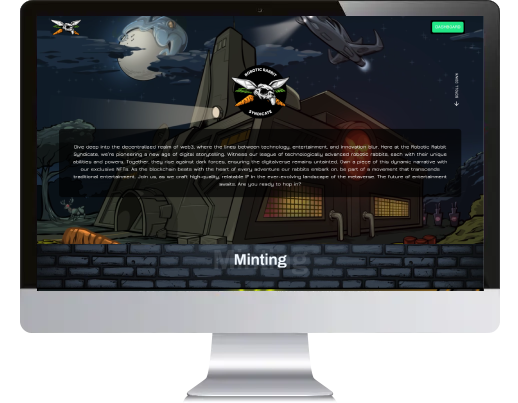
Robotic Rabbit offers their users anime series, toys, merchandise, games on the Unity engine, and decentralized IP ownership with the exchange of crypto.
As a trusted blockchain development company, Suffescom combines protocol engineering expertise, advanced consensus design, and enterprise-grade security to build scalable Layer 1 blockchain ecosystems.
Our engineers have deep roots in distributed systems, cryptography, and formal verification, not just Solidity development. We build the protocol, not just the dApps on top.
From protocol architecture and validator nodes to wallets, block explorers, bridges, and staking platforms, every component required for a production-ready Layer 1 ecosystem is covered.
Every client receives weekly technical updates, milestone-based billing, and access to the development repository throughout the project. No black boxes.
The support post-launch entails the onboarding of validators, protocol updates, establishment of the governance system, and growth of the ecosystem.
Security has been integrated into the entire process of development with protocol reviews, smart contract audits, attack simulations, and testing.
We have certified our engineering process against ISO 27001 information security standards that ensure compliance for our corporate customers.

Suffescom helped us design and launch a custom Layer 1 blockchain tailored to our ecosystem requirements. Their understanding of consensus mechanisms, validator architecture, and tokenomics was evident throughout the project. The network launched successfully and continues to perform beyond our expectations.

Developing a Layer 1 blockchain requires deep technical expertise, and Suffescom delivered exactly that. From protocol architecture and staking economics to security testing and deployment, every milestone was handled with precision and transparency.

The team engineered a highly scalable blockchain network capable of supporting significant transaction volumes while maintaining strong security and decentralization. Their approach to protocol optimization and validator management was particularly impressive.
A Layer 1 blockchain development company specializes in building the core infrastructure of a blockchain network from scratch. This includes protocol architecture, consensus mechanisms, validator networks, token economics, governance frameworks, and smart contract functionality. The goal is to create an independent blockchain ecosystem tailored to specific business and technical requirements.
It usually takes around 6 to 12 months to build a Layer 1 blockchain that's ready for use. However, this time can vary depending on factors. These include how complex the consensus mechanism is, whether it needs to be compatible with the Ethereum Virtual Machine, how thorough the security audit is, and how long the testnet lasts. If a company uses a framework like Cosmos SDK, it can take around 4 to 6 months. If they are building a completely custom blockchain with new consensus mechanisms, it can take 12 to 18 months.
Layer 1 blockchain development is about building the base-layer protocol of the blockchain. This is the foundation of the network. Includes things like consensus, networking, and execution environment. On the other hand, Layer 2 development is about building solutions on top of an existing Layer 1 blockchain to make it more scalable or to add specific applications. Layer 2 solutions, like rollups or channels, get their security from the Layer 1 blockchain rather than having their own consensus mechanism.
The consensus mechanism you should use depends on what you need in terms of security, decentralization, and performance. It also depends on the context of your ecosystem. Proof of Stake is a choice for new blockchain networks because it is energy-efficient and provides good economic security. Delegated Proof of Stake is good for networks that are governed by their communities. Proof of Authority is more suitable for enterprise blockchain networks. The best consensus mechanism for you will depend on your situation and needs.
The cost of developing a Layer 1 blockchain can vary widely. It can range from $50,000 to over $3,00,000. The cost depends on how complex the project is, what framework is used, how thorough the security audit needs to be, and what kind of support is needed after the launch. A company like Suffescom can provide a proposal with clear costs after a free initial consultation.
Yes, you can build Layer 2 networks on a custom Layer 1 blockchain. In fact, a designed Layer 1 blockchain is made to support the deployment of Layer 2 networks. This allows your blockchain ecosystem to scale as it grows. A company like Suffescom designs Layer 1 protocols with features like rollup data availability support, making it easier to build Layer 2 solutions on top.
Suffescom works with blockchain frameworks, including Cosmos SDK, Substrate, Avalanche Subnets, and fully custom stacks built with Go or Rust. The choice of framework depends on the needs of the project, such as interoperability requirements, the need for Ethereum Virtual Machine compatibility, and how quickly the project needs to be completed. Suffescom recommends frameworks based on the best technical fit for the project.
In a Proof of Stake system, validators put up the token of the blockchain as collateral to participate in the validation of transactions and the creation of new blocks. The validators are chosen based on how they have staked, and they earn rewards for participating honestly. If a validator behaves dishonestly, they can lose some or all of their tokens.
Yes, it is possible to build a Layer 1 blockchain that can run Ethereum contracts and support development with Solidity or Vyper. This makes it easier for developers to build on your blockchain and allows projects that're already on Ethereum to migrate more easily. Suffescom can help with this by using custom execution environments or modules within frameworks like Cosmos SDK or Substrate.
After a Layer 1 blockchain is launched, Suffescom provides support. This includes help with upgrading the protocol supporting validator operations, monitoring security, and assisting with the development of the ecosystem. The support can last from a short warranty period of 90 days to long-term partnerships that last several years. Include dedicated engineering resources.
• SUFFESCOM SOLUTIONS
Build Smarter. Scale Faster. Grow More.
Have a Vision? Let’s Turn It Into a Digital Reality.
Get a quick response from our best experts in under 10 minutes.
Suffescom easily understood our main goal and delivered the best digital solution. Their team was very cooperative, and it was a very good experience working with them. I would highly recommend them.

Working with Suffescom was a really great experience. Their developers demonstrated technical knowledge and delivered our mobile app solution with all required functionalities on time.

Suffescom helped us build a logistics software solution that completely improved our fleet operations. Their professionalism and transparency are what make them a reliable technology partner.

Share Your Requirements. Our Experts Will Shape the Solution.
• SUFFESCOM SOLUTIONS
Build Smarter. Scale Faster. Grow More.
Have a Vision? Let’s Turn It Into a Digital Reality.
Get a quick response from our best experts in under 10 minutes.
Suffescom easily understood our main goal and delivered the best digital solution. Their team was very cooperative, and it was a very good experience working with them. I would highly recommend them.
Working with Suffescom was a really great experience. Their developers demonstrated technical knowledge and delivered our mobile app solution with all required functionalities on time.
Suffescom helped us build a logistics software solution that completely improved our fleet operations. Their professionalism and transparency are what make them a reliable technology partner.
Share Your Requirements. Our Experts Will Shape the Solution.
• SUFFESCOM SOLUTIONS
Build Smarter. Scale Faster. Grow More.
Have a Vision? Let’s Turn It Into a Digital Reality.
Get a quick response from our best experts in under 10 minutes.
Suffescom easily understood our main goal and delivered the best digital solution. Their team was very cooperative, and it was a very good experience working with them. I would highly recommend them.
Working with Suffescom was a really great experience. Their developers demonstrated technical knowledge and delivered our mobile app solution with all required functionalities on time.
Suffescom helped us build a logistics software solution that completely improved our fleet operations. Their professionalism and transparency are what make them a reliable technology partner.
Share Your Requirements. Our Experts Will Shape the Solution.
Fret Not! We have Something to Offer.