+971-8000321216



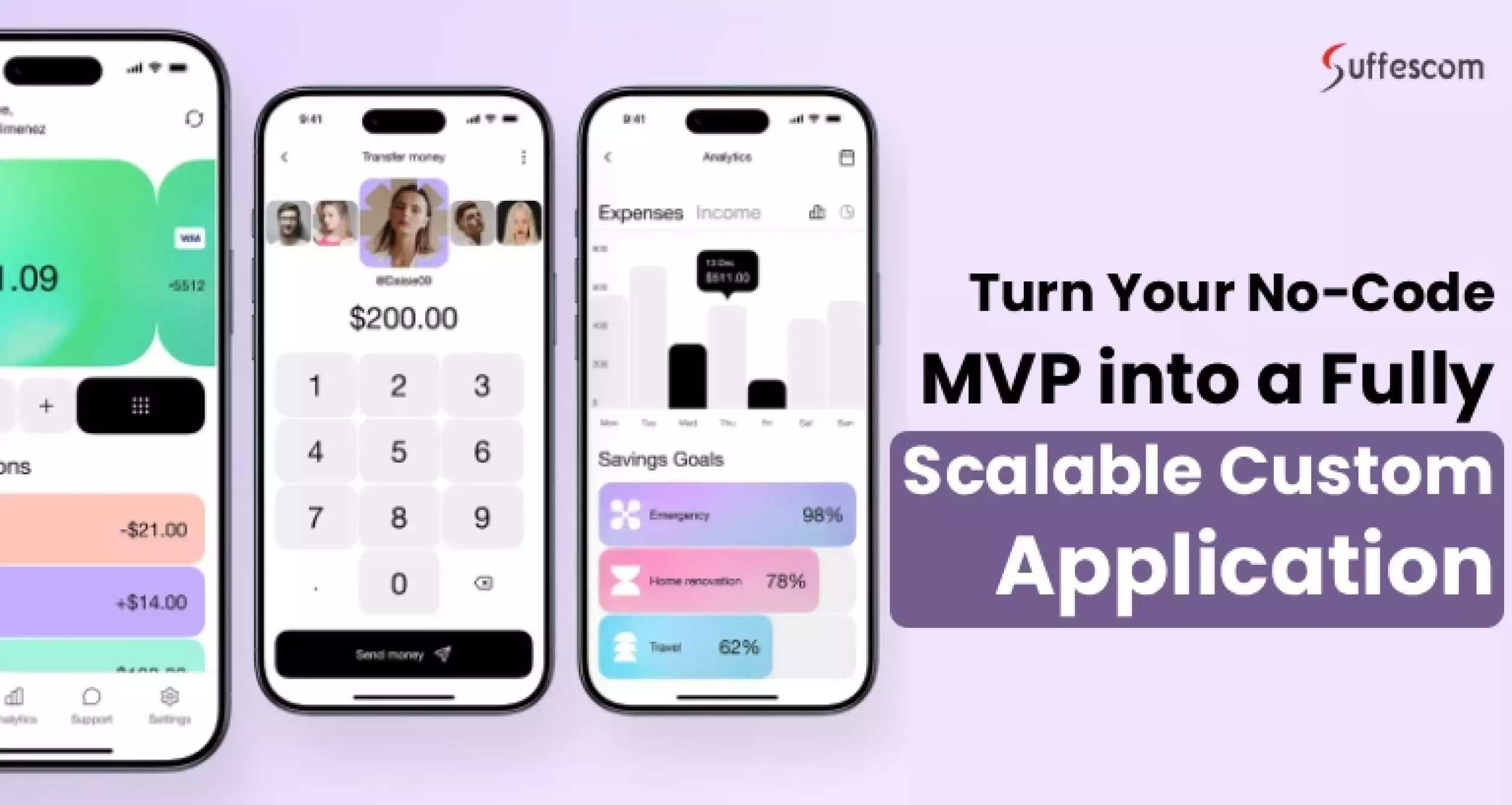
Building a no-code MVP is a smart move. It helps you validate your idea quickly, launch faster & test market demand without heavy investment. But once your product starts gaining traction, the same MVP that helped you start can begin to slow you down.
There is no doubt that numerous businesses reach a stage where their users grow, expectations rise & their products need to do more than they were originally designed for. This is where upgrading your builder-based app to an enterprise solution has become necessary.
If you are facing the same challenges, you are at the right place. Experts at Suffescom help you migrate your MVP solutions into a fully customized app within a few weeks. So, stay tuned!
Take Control of Your Product with a Fully Scalable Custom Solution!
When Your MVP Starts Holding You Back: Top Reasons Explained
Here is one thing that everybody should understand: an MVP is built for speed, not scale. While no-code platforms are excellent for early-stage validation, but they often come with limitations that become more visible as your business grows.
Explore the following signs that show your MVP needs upgrades to match the market standards:
1. Performance under load: Your application slows down, lags, or even crashes as user traffic increases. No-code platforms often struggle with:
- high concurrency (leading to poor response times)
- An unreliable user experience
2. Limited customization: You are unable to build advanced or business-specific features beyond what the platform allows. As your product evolves, these limitations prevent you from implementing:
- Unique workflows
- Differentiated functionality
3. Restricted integrations: Integrations with third-party tools are limited or inefficient. While basic connectors may exist, deeper integrations are difficult or impossible to achieve. These are:
- Custom APIs
- Real-time data sync
- Complex workflows
4. Inconsistent user experience: The interface feels basic, rigid, or disconnected across different features.
- Impacts usability
- Overcome customer engagement (especially when users expect a seamless & polished product experience)
5. Platform dependency: You are heavily reliant on the no-code platform's capabilities, pricing, as well as roadmap. Any limitation, change, or downtime from the platform directly affects:
- Business operations
- Performance optimization
6. Security concerns: Data handling, compliance, along with security controls become major risks as you grow. The system may lack support for enterprise requirements like:
- Role-based access
- Audit logs
- Regulatory compliance
Overall, if you are facing even a few of these issues, it's a clear signal that your MVP is struggling to scale.
From MVP to Market Leader: How Our Team Transforms Your MVP into a Scalable Enterprise App
MVP solutions are ideal for launching your idea into the market, but they may fall short if you aim to scale your product & handle growing user demand. Thus, you have to switch to a fully customized approach for long-term success. Look at how experienced mobile app developers help you get the benefit of custom app development after a no-code MVP failed:
1. Business & MVP Discovery
The team of experts begins by understanding your product from both a business as well as technical perspective. At this stage, they deeply analyze your business goals:
- What problem does your product solve?
- Which features are driving the most value?
- Where are users dropping off?
- What are your growth targets for the next 6 to 12 months?
At the same time, the team also audits your current MVP product, along with a proper understanding of:
- Platform limitations
- Performance issues
- Data structure
- Integration gaps
Here, the main target of experts is to prepare a clear roadmap that aligns with your future goals, not just technical assumptions.
2. Scalable Architecture Planning
Once you understand the key areas lacking in your MVP product, along with business goals, the DevOps Engineers begin by discussing how to convert the MVP architecture into a fully customized enterprise-grade architecture. To do so, the experts perform profound research where:
- Define backend structure based on expected user growth
- Choose the right tech stack (based on your use case)
- Plan database scalability & performance
- Design API-first architecture for flexibility
Expert developers believe that a solid foundation eliminates future rework, plus supports long-term scalability.
3. Feature Mapping & Product Evolution
The team of expert developers does not just rebuild your MVP; they enhance it strategically by mapping existing features and advanced enterprise-grade capabilities your product needs. Here, engineers:
- Identify must-have vs. scalable features
- Redefine workflows for efficiency
- Plan advanced functionalities that your MVP could not support
- Align features with user expectations & market demand
The main goal is to create a product with basic functionality but also a full-fledged enterprise-grade solution built for scalability, performance & long-term growth.
4. UI/UX Redesign for Growth
Your MVP was built to function, so it's clear you did not pay attention to its user interface. But now it needs to perform & convert. So, a no-code to full-stack development service provider comes in to:
- Improve user journeys & navigation
- Optimize onboarding experience
- Enhance visual design & consistency
- Focus on engagement and retention
Here, the aim is to build a product that delivers a better user experience, higher retention, along with stronger business impact.
5. Custom Development & System Rebuild
At this stage, a team of skilled developers transforms your product at its core. The process includes:
Develop a custom backend tailored to your workflows
- Build a scalable frontend architecture
- Replace no-code limitations with full control
- Ensure modular development for easy future updates
This is the brain of your enterprise-grade product. Thus, engineers code perfectly to attract a high-performance, flexible application built specifically for your business.
6. Advanced Integrations & Ecosystem Setup
As your business scales, your product needs to work seamlessly with other systems. Here, experts integrate the system with third-party APIs or systems, consists of:
- Payment gateways
- CRMs and ERPs
- Analytics and reporting tools
- Third-party APIs
The main purpose is to connect the ecosystem to improve efficiency as well as decision-making.
7. Secure Data Migration & Continuity
This is an important step in which the data from your no-code MVP app migrates to an enterprise-grade app. This data includes existing user information that experts handle without compromise. Here, skilled experts:
- Clean & structure your current data
- Migrate securely to the new system
- Ensure no data loss or downtime
- Maintain business continuity during transition
The main motive is to smooth transition of data without disrupting your operations.
8. Performance Testing & Quality Assurance
Once the MVP system is fully migrated to an enterprise-grade solution, it’s sent for testing by a team of skilled quality analysts, who test its functionality. The system is evaluated under real-world conditions:
- Load testing for high traffic
- Security testing & compliance checks
- Bug fixing and optimization
- Cross-device and platform testing
This performance evaluation helps to create a stable, secure, as well as reliable application.
9. Deployment, Scaling & Ongoing Support
An experienced developer's job does not end even after the system is launched. To fulfill the evolving needs of your business in the future, these experts:
- Smooth deployment with minimal downtime
- Continuous monitoring & performance tuning
- Feature upgrades based on user feedback
- Long-term scaling support
A future-ready product that grows with your business.
No-Code MVP vs. Custom Enterprise System: A Direct Comparison
Look at what you will achieve when turning your basic-level MVP system into an enterprise-grade system:
| Capability | No-Code MVP | Custom Enterprise System |
| Performance at scale | Limited: Shared infrastructure, no custom indexing | Full control: Optimized queries, CDN, caching layers |
| Security & compliance | Generic: Platform-level controls only | Enterprise-grade: SOC 2, ISO 27001, GDPR, HIPAA ready |
| Custom API integrations | Connector-limited: Depends on plugin availability | Unlimited: Native API to any system |
| Data ownership | Vendor-dependent: Data lives on their servers | Fully owned: Your cloud, your rules, your residency |
| SSO / Identity management | Limited or no | SAML, OAuth, LDAP: Enterprise auth standards |
| Multi-tenancy | Approximated: Hard to achieve true isolation | Architected: Isolated tenant environments by design |
| Infrastructure cost trajectory | Steep: Platform fees scale with usage exponentially | Controllable: Optimize your own cloud spend |
| Ownership | Platform-dependent (vendor lock-in risk) | Full ownership of code, infrastructure & data |
Hidden Mistakes That May Slow Down Your Product Growth
Several businesses fail when it comes to custom app development after a no-code MVP; thus, the following are the most common mistakes that, if you avoid, your simple MVP will easily migrate to a fully customized and enterprise-grade platform. Let's explore these big blunders:
1. Rebuilding without proper planning: Many technology partners start the process without a proper plan or roadmap that may take your product in the wrong direction. So, plan everything before executing on the ground.
2. Ignoring data migration complexities: Data migration is a critical step in turning an MVP into an enterprise-grade system. Thus, proper planning is required to protect the data from loss, messiness, or damage, which can cause errors, downtime & poor system performance.
3. Choosing the wrong tech stack: This is a common mistake that developers often repeat. Selecting an ideal technology stack is essential to avoid system vulnerabilities.
4. Overengineering too early: Avoid building overly complex systems, features, or architectures beyond current needs, which increase costs, delay development, plus decrease flexibility without delivering immediate business value.
5. Not prioritizing user experience: Ignoring user experience during MVP migration means improving backend systems while neglecting usability, leading to complex navigation, poor engagement, reduced adoption & dissatisfied users despite better performance.
These are the pitfalls experts may overlook when performing custom app development after a no-code MVP. Managing these parameters is important for a smoother transition, along with better ROI.
Stuck with No-Code App Development? We Help You Scale Beyond Platform Limitations!
Unlock Scalability with the Right Tech Stack for Custom App Development After a No-Code MVP
When it comes to turning your no-code MVP into a fully scalable custom application, choosing the right tech stack is essential. It determines the performance & scalability of your enterprise-grade system. The following are the main technologies that come into action for custom app development after a no-code MVP:
| Layer/Component | Technologies |
| Frontend Development | React.js, Next.js, Angular, Vue.js |
| Backend Development | Node.js, Django, Ruby on Rails, Spring Boot (.NET optional) |
| Mobile App Development (if needed) | Flutter, React Native, Swift (iOS), Kotlin (Android) |
| Database Management | PostgreSQL, MySQL, MongoDB, Redis |
| Cloud Infrastructure | AWS, Google Cloud, Microsoft Azure |
| API & Integration Layer | REST APIs, GraphQL, gRPC |
| Authentication & Security | OAuth 2.0, JWT, SAML, Firebase Auth |
| DevOps & CI/CD | Docker, Kubernetes, Jenkins, GitHub Actions |
| Caching & Performance Optimization | Redis, CDN (Cloudflare, Akamai) |
| Search & Indexing | Elasticsearch, Algolia |
| Analytics & Monitoring | Google Analytics, Mixpanel, Datadog, New Relic |
| Payment Integration | Stripe, PayPal, Razorpay |
| Messaging & Notifications | Firebase Cloud Messaging, Twilio, SendGrid |
| Enterprise Integrations | Salesforce, HubSpot, SAP, Zoho |
| AI/Automation (Optional) | OpenAI APIs, TensorFlow, custom ML models |
How Much Does It Cost to Transform an MVP into an Enterprise Application?
The cost of mobile app development after a no-code MVP depends on numerous factors such as product complexity, number of features, third-party integrations, data migration requirements, tech stack selection, and so on. However, if talking about the general cost ideas, it is shown below:
| Cost Component | Estimated Cost Range | Description |
| Discovery & Planning | $1,000 to $2,000 |
|
| UI/UX Redesign | $2,000 to $4,000 |
|
| Backend Development | $8,000 to $10,000 |
|
| Frontend Development | $3,000 to $5,000 |
|
| Third-Party Integrations | $1,500 to $3,000 |
|
| Data Migration | $800 to $2,000 |
|
| Testing & QA | $1,000 to $2,000 |
|
| Deployment & DevOps | $700 to $1,500 |
|
| Ongoing Support (Monthly) | $500 to $1,000/month |
|
Furthermore, while the upfront investment may seem higher, it significantly offsets long-term operational costs, along with scalability limitations.
Why Partner with Suffescom to Upgrade Your Builder-Based App into an Enterprise Solution?
Suffescom is a leading full scale no code app development company in the USA. Consult for no-code app migration and make your system fully scalable, high-performing, as well as enterprise-ready with complete control over features, data & future growth.
1. Proven Expertise in MVP-to-Enterprise Transformation
Our no code expert team specializes in converting no-code & builder-based apps into fully scalable & enterprise-grade systems. This mitigates risks, plus makes sure a smoother transition.
Strong Focus on Performance & Optimization
Suffescom experts make sure your upgraded system:
- Fast under high load
- Optimized for scalability
- Reliable across devices
This is how we built robust systems that not only scale but also help to improve user experience & retention.
2. Business-First, Not Just Tech-First Approach
Instead of rushing into coding, we focus on your business goals, user needs, along with growth strategy. This ensures the final product drives real ROI.
3. End-to-End Migration Support
Once your system comes into our engineers' hands, everything is handled under one roof, from discovery to deployment. Our team performs:
- MVP audit
- UI/UX redesign
- Development
- Data migration
- Testing
This eliminates coordination gaps, along with delays.
4. Flexible Engagement & Cost-Effective Solutions
We believe in building on scalable development models that align with your budget, helping you move from MVP to enterprise without unnecessary overhead costs.
5. Ongoing Support and Future Scaling
We support our clients even after the enterprise-grade system is deployed, providing ongoing assistance. To keep the system running in the long run, we deliver performance improvements, continuous monitoring & feature upgrades to keep your product evolving as your business grows.
Ready to Outgrow Your MVP?
We help organizations to migrate from no-code platforms to production-grade custom systems, without disrupting existing customers. Let's map out your migration roadmap.
FAQs
1. How long does it take to move from a basic MVP to an enterprise migration?
A structured migration makes sure efficiency & minimal disruption:
- Discovery & Planning: 1–2 weeks
- Development Phase: 4–12 weeks
- Testing & QA: 1–3 weeks
- Deployment: 1 week
The timeline may vary depending on the complexity of your system.
2. What is the MVP for an Enterprise system migration cost?
Estimated Cost Range
| Basic applications | $10,000 to $25,000 |
| Mid-level platforms | $25,000 to $60,000 |
| Advanced enterprise systems | $60,000+ |
3. Can I scale my no-code app without rebuilding?
In most cases, partial scaling is possible, but long-term growth requires a custom rebuild. So, contact our experts to get a free quote.
4. Will I lose data during migration?
Absolutely not! Our data engineers come with proper planning & execution that keeps your data secure as well as seamless.
5. How do I know it’s the right time to migrate?
Well, it depends on your future business goals and your systems’ performance or life. The right time is when your system starts to encounter performance issues, or when user growth or feature limitations begin to affect your business.
6. Is custom development worth the investment?
Absolutely! It provides long-term scalability, flexibility, as well as cost efficiency. Furthermore, everything is designed or developed as per your requirements to meet your specific business goals.
7. What are the key challenges in migrating from no-code to custom development?
When it comes to no-code MVP app migration to an enterprise-grade app, the major challenges consist of data migration, feature parity, maintaining uptime, and aligning business logic. A vibe coding cleanup specialist helps navigate these challenges by ensuring the existing codebase is stable and well-structured before the transition.
8. Is it better to hire MVP developers or enterprise developers for migration?
If you want to achieve the best results, you need a combination of teams with years of experience in MVP understanding, along with enterprise-grade system architecture.
9. How do you choose the right development partner for MVP scaling?
It has become a challenging task these days, but before selecting the right development partner, you should make sure to evaluate their expertise by identifying:
- Strong technical expertise
- Proven case studies
- Scalability knowledge
- Clear communication processes
10. What happens if my no-code platform shuts down or changes pricing?
That’s a key risk. Migrating to a custom solution removes platform dependency, plus gives you full control over your product.