+971-8000321216



Key takeaways:
- Algorithmic trading relies on automated systems that execute trades based on predefined strategies with high speed and precision.
- A full-scale trading platform includes market data engines, strategy logic, OMS/EMS, risk controls, and backtesting modules.
- Institutional trading systems depend on FIX protocols, smart order routing, and low-latency execution pipelines.
- Risk management, including drawdown controls and kill switches, is essential for capital protection.
- Backtesting and paper trading are critical before deploying real capital in live markets.
- Modern platforms increasingly integrate crypto, DeFi, and multi-exchange trading capabilities.
- Regulatory compliance must be embedded into the system from the design stage.
- Development cost and timeline vary based on whether the platform is MVP, mid-market, or institutional-grade.
Want similar results? → Get a Free Quote
In modern financial markets, trading is rapidly shifting toward automation, where execution speed, data processing, and algorithm-driven decision-making play a critical role in market participation. This shift is completely changing how trading firms and institutions function worldwide.
The Algo Trading Software Development industry is also experiencing strong expansion. According to Grandview Research, the global algorithmic trading market was valued at USD 21.06 billion in 2024 and is projected to reach USD 42.99 billion by 2030, growing at a CAGR of 12.9%. This growth is driven by increasing demand for automation, real-time analytics, and low-latency execution systems in modern trading environments.
To keep up with this trend, firms are pumping money into algorithmic trading tools. Whether you’re starting a fintech business or expanding trading ops in an existing financial firm, the goal remains the same: speed up trades, cut risks, and boost decision accuracy through this blog.
What Is Algorithmic Trading Software?
Algorithmic trading software is a computer program that monitors financial markets in real time, identifies trading opportunities based on a defined strategy, and automatically places buy or sell orders on exchanges without a human pressing a button. The system operates continuously, applying consistent logic across thousands of instruments simultaneously.
To understand what separates algo trading software from a manual trading setup, consider these dimensions:
Core components of algorithmic trading software include:
- Strategy engine for signal generation
- Order management system (OMS) for trade execution
- Market data processing layer for real-time inputs
- Risk management module for exposure control
- Backtesting engine for strategy validation
Manual Trading vs. Algorithmic Trading Software
| Dimension | Manual Trading | Algorithmic Trading Software |
| Execution Speed | Seconds to minutes per order | Microseconds to milliseconds per order |
| Consistency | Affected by emotion, fatigue, and distraction | Applies identical logic to every signal with deterministic execution |
| Scale | One trader handles one instrument at a time | Executes across thousands of instruments and multiple strategies simultaneously |
| Operating Hours | Limited by human availability | 24/7/365 execution — essential for crypto and global forex markets |
| Risk Controls | Manual monitoring with delayed reaction time | Hard-coded kill switches, real-time drawdown limits, automated risk engines |
How Does Algorithmic Trading Software Work?
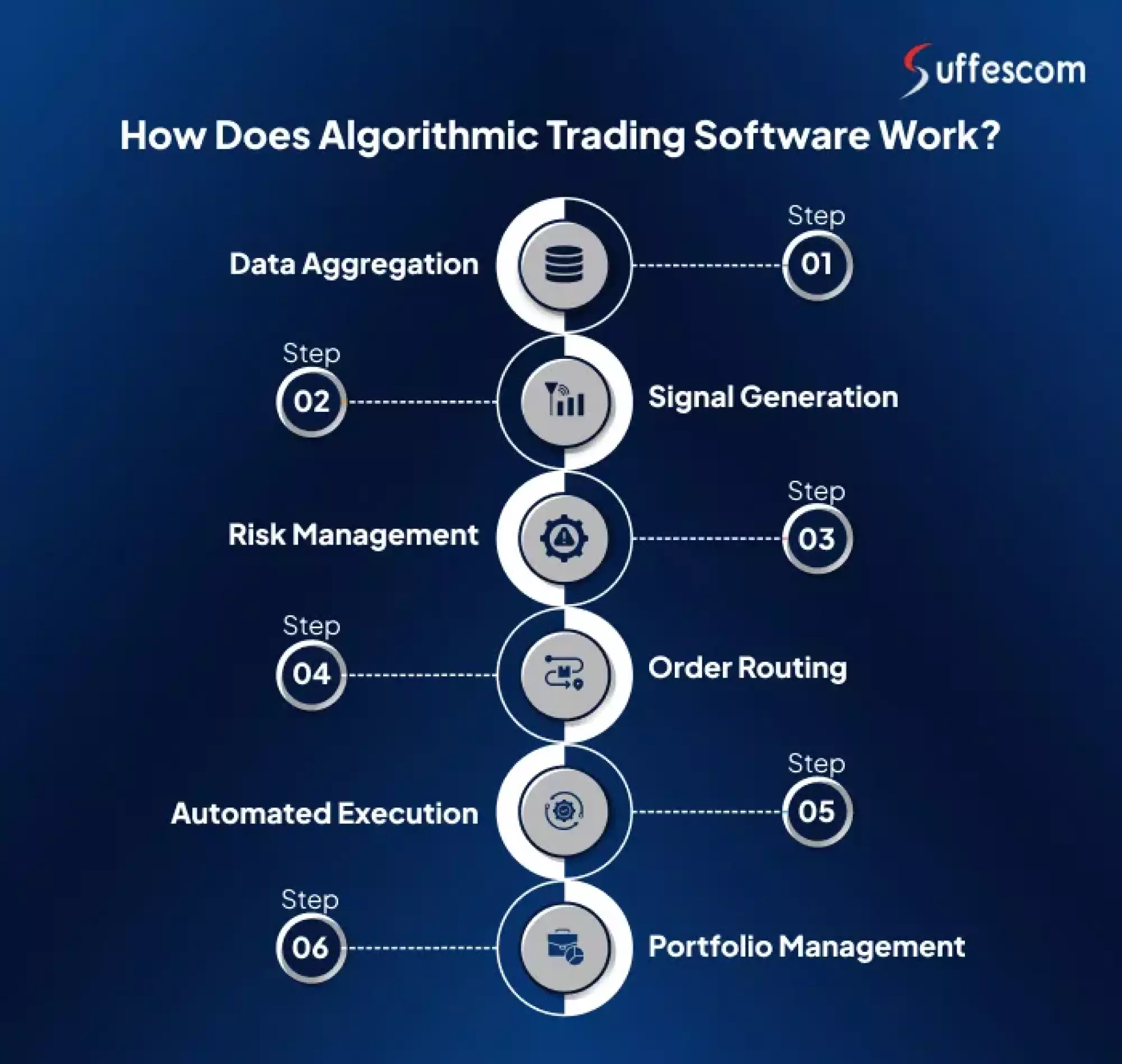
Step 1: Data Aggregation
Collects market data using WebSocket, FIX or REST APIs; tick-level and OHLCV data are stored in a time-series database.
Step 2: Signal Generation
The strategy engine uses quantitative models, machine learning models, and technical indicators to generate trading signals.
Step 3: Risk Management
Risk management module performs pre-trade risk management, such as order validation and drawdown control.
Step 4: Order Routing
Selects the best venues through the Smart Order Routing (SOR) module; OMS/EMS converts the signal into orders for exchanges.
Step 5: Automated Execution
Order execution occurs in an automated fashion through low-latency technology, partial fills, and order confirmation recording.
Step 6: Portfolio Management
Monitors portfolio on a real-time basis through dashboards and applications available on smartphones.
Why Are Businesses Investing in Automated Trading Platforms?
Businesses are using automated trading platforms because they want to do trades better than others. They also want to reduce the time it takes to make a trade and be able to trade different things at the same time. The main reasons for this are:
- Making trades in a few microseconds to stay ahead of the competition
- Getting the market information and using it to make decisions right away
- Being able to trade on many different exchanges and with many different assets
- Using intelligence to make the best trading plans
- Having systems in place to manage risk and keep portfolios balanced
Ready to Build Your Own Algo Trading Software?
Start high-performance algorithmic trading software development with expert guidance and scalable architecture built for real markets.
Algorithmic Trading Strategy Types and Architecture Considerations
The choice of trading strategy is the most critical architectural decision in Algo Trading Software Development, as it directly defines system latency requirements, data ingestion pipelines, infrastructure complexity, and overall development cost.
Algorithmic Trading Strategy Types
| Strategy | How It Works | Best For |
| Trend Following | Buys on upward momentum and sells on downward trends using indicators like moving averages, MACD, RSI, and breakout signals | Equities, forex, commodities |
| Statistical Arbitrage | Exploits temporary price divergence between correlated assets using cointegration and mean reversion models | Pairs trading, ETF arbitrage, crypto |
| Market Making | Continuously places bid and ask orders to capture spread while managing real-time inventory risk | Crypto exchanges (CEX/DEX), forex liquidity providers |
| Cross-Exchange Arbitrage | Buys on one exchange and sells on another when price inefficiencies exceed transaction costs | Multi-exchange crypto and equities |
| High-Frequency Trading (HFT) | Executes thousands of micro-orders per second to capture extremely small price inefficiencies at scale | Institutional trading desks, proprietary trading firms |
| ML / AI-Based Trading | Uses machine learning models (LSTM, reinforcement learning, random forests) trained on historical and real-time data for prediction | Quant funds, AI-driven fintech platforms |
| VWAP / TWAP Execution | Splits large orders into smaller executions over time to reduce market impact | Asset managers, institutional traders |
Key Features of Custom Algo Trading Software
A successful custom algo trading software development approach requires modular architecture, real-time data processing, and strong risk management systems.
1. Real-Time Market Data Engine
Your algorithm executes based on what it sees. A weak data layer means stale signals, missed opportunities, and incorrect risk calculations. Suffescom's market data engine integrates with premium providers and exchange WebSocket feeds to deliver tick-by-tick price updates with microsecond timestamps.
- Supported providers: Bloomberg B-PIPE, Refinitiv (LSEG), Polygon.io, CoinAPI, Kaiko (crypto), Alpha Vantage
- Data types: Trade ticks, order book depth (L1/L2/L3), OHLCV bars, funding rates, open interest, options chain data
- Storage architecture: TimescaleDB or InfluxDB for time-series storage; Redis for real-time in-memory cache of hot data
- Feed redundancy: Dual-feed architecture with automatic failover prevents data gaps from causing erroneous signals
2. Strategy Engine and Signal Generator
This is where trading logic lives. The strategy engine ingests normalized market data, applies your models, and outputs trading signals along with full audit logging of every signal generated.
- Rule-based strategies: Configurable via YAML or JSON parameter files; adjust thresholds without redeploying code
- Quantitative models: Factor models, Kalman filters, cointegration tests, Bayesian inference engines built in Python
- ML model serving: TensorFlow/PyTorch models packaged as FastAPI microservices and called by the strategy engine via REST
- Multi-strategy support: Run multiple independent strategies simultaneously with isolated capital allocation per strategy
3. Order Management and Execution System (OMS / EMS)
The OMS tracks every order and position across all exchanges. The EMS translates signals into exchange-ready orders and manages the full order lifecycle, from submission to fill confirmation.
- FIX protocol support: Industry-standard Financial Information eXchange (FIX 4.2 / 4.4 / 5.0) for broker and exchange connectivity
- Smart Order Routing (SOR): Automatically routes to the exchange or venue offering the best available price and deepest liquidity.
- Order types supported: Market, limit, stop-loss, stop-limit, iceberg, TWAP, VWAP, and custom composite order types.
- Partial fill handling: Automatic management of partial fills, cancel-replace logic, and order state reconciliation.
4. Backtesting and Paper Trading Module
We should test every strategy extensively using history before risking real money. A good backtesting system simulates actual market conditions, accounting for things like slippage, costs, and latency. This way, we get a real-world strategy evaluation and know what to expect before live trading.
- Event-driven simulation: Processes historical tick data in chronological order, simulating realistic order submission and fill logic
- Transaction cost modeling: Includes exchange fees, bid-ask spread costs, slippage estimation based on order size vs. average volume
- Walk-forward analysis: Tests strategy on rolling out-of-sample windows to detect and prevent overfitting to historical data
- Paper trading mode: Runs strategy logic against live market data with simulated order execution that requires a minimum of 4 weeks before live capital deployment
5. Risk Management Engine
This is the module that separates a prototype from a platform you would trust with real money. Risk controls are enforced at three levels: individual order, strategy, and total portfolio.
- Pre-trade risk checks: Maximum order size, notional exposure limits, and instrument blacklist enforcement before every order
- Real-time drawdown monitoring: Continuously tracks P&L against configured drawdown limits; triggers automatic kill switch if breached
- Position sizing algorithms: Kelly criterion, fixed fractional, and volatility-adjusted ATR-based sizing available out of the box
- Kill switch: One-click (or automatic threshold-based) cancellation of all open orders and halt of all strategy execution
6. Mobile Algo Trading App Development
A trading system that only runs on a desktop terminal is a liability the moment a portfolio manager steps away from their desk. Suffescom builds native-feel mobile algo trading apps (iOS and Android, React Native) that give traders and fund managers full remote visibility and control — without compromising on the security a financial application demands.
- Live P&L dashboard: Real-time profit and loss per strategy, per instrument, and at portfolio level, refreshed every second.
- Position monitor: Active positions, unrealized P&L, margin utilization, and exposure broken down by asset class.
- Remote strategy controls: Start, pause, or stop individual strategies from the app; adjust risk parameters without touching a terminal.
- Alert system: Instant notifications for kill-switch triggers, drawdown threshold breaches, order fills, and system health events.
- Biometric-secured access: Face ID / fingerprint authentication layered on top of 2FA and session encryption — critical given the app controls live capital.
- Offline-safe design: The app reflects system state but never becomes the single point of failure; strategies keep running server-side even if a device loses connectivity.
7. Algo Trading Software Exchange Integration Layer
A unified exchange adapter layer abstracts the protocol and format differences between venues. You write your strategy logic once as the adapter handles the translation to each exchange's specific API format.
- Equity venues: NYSE, NASDAQ, LSE, NSE, BSE via FIX protocol and prime broker connectivity
- Crypto exchanges: 50+ venues including Binance, Coinbase Advanced, Kraken, OKX, Bybit, Bitfinex via REST + WebSocket
- DeFi protocols: Uniswap V3/V4, dYdX, GMX, Curve via on-chain interaction through Web3.py or ethers.js
- Forex brokers: OANDA, Interactive Brokers, FXCM via REST and FIX session management
8. Smart Order Routing (SOR)
Smart Order Routing automatically selects the optimal execution venue to maximize trade efficiency and reduce execution cost.
- Liquidity optimization: Analyzes order book depth across exchanges to route trades where sufficient liquidity is available for minimal market impact
- Price improvement: Scans multiple venues simultaneously to secure the best available bid/ask spread and improve execution price
- Latency-based routing: Factors in exchange response times and network latency to prioritize faster execution paths
Core Architecture of Algorithmic Trading Software
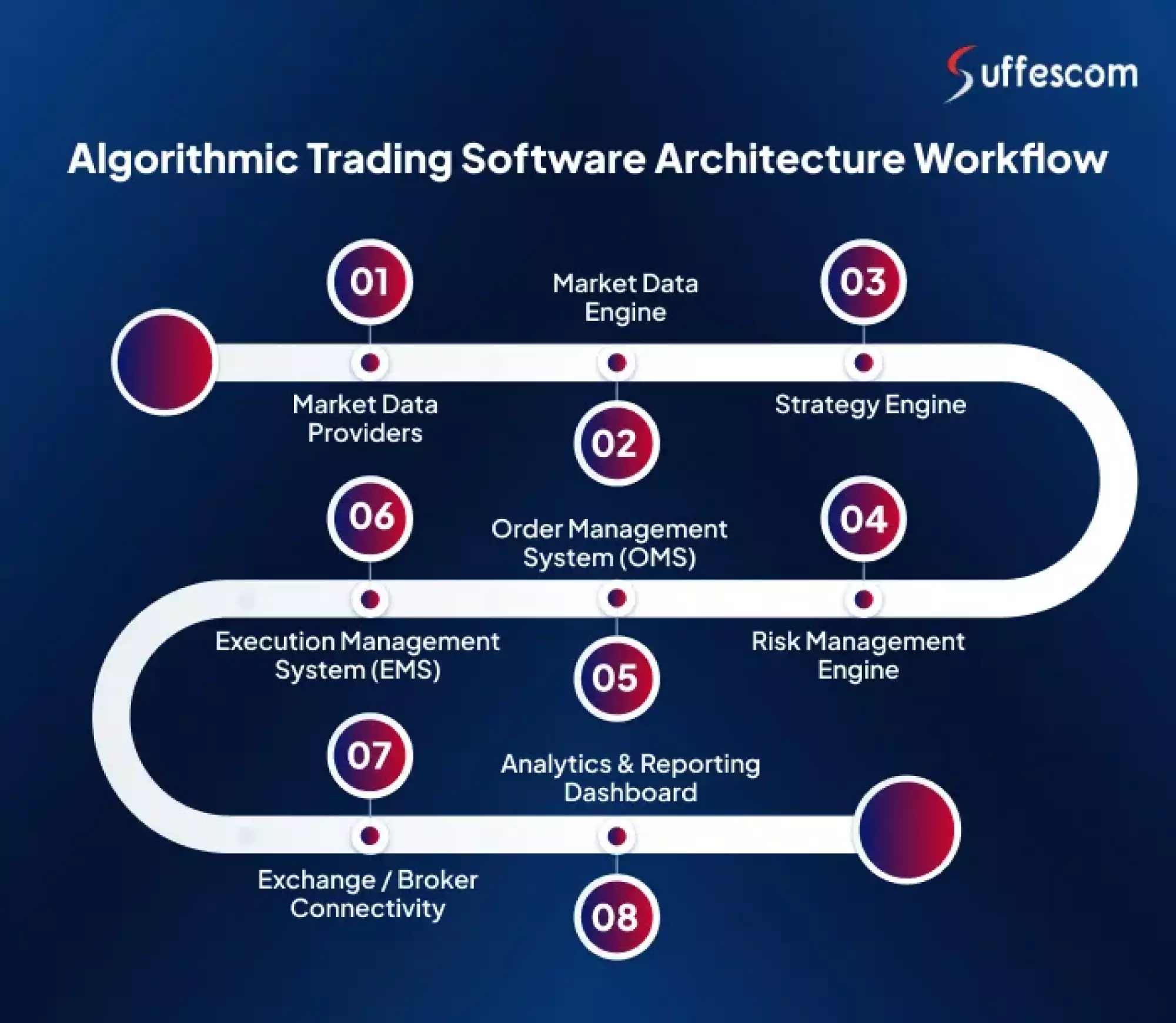
The architecture of an algorithmic trading platform directly impacts its performance, scalability, security, and profitability. Even advanced strategies can fail without fast data processing, reliable execution, and effective risk control.
Modern systems use a modular, event-driven architecture where components communicate via low-latency messaging systems like Apache Kafka, Redis Streams, or RabbitMQ. This enables high scalability, fault tolerance, and efficient upgrades without affecting the entire platform.
Advantages of Algorithmic Trading Software Development
Algorithmic trading software is a way to make financial decisions using technology. It helps people trade faster and more accurately. This software can handle a lot of trades at the time. It is very useful for people who trade stocks and other financial things.
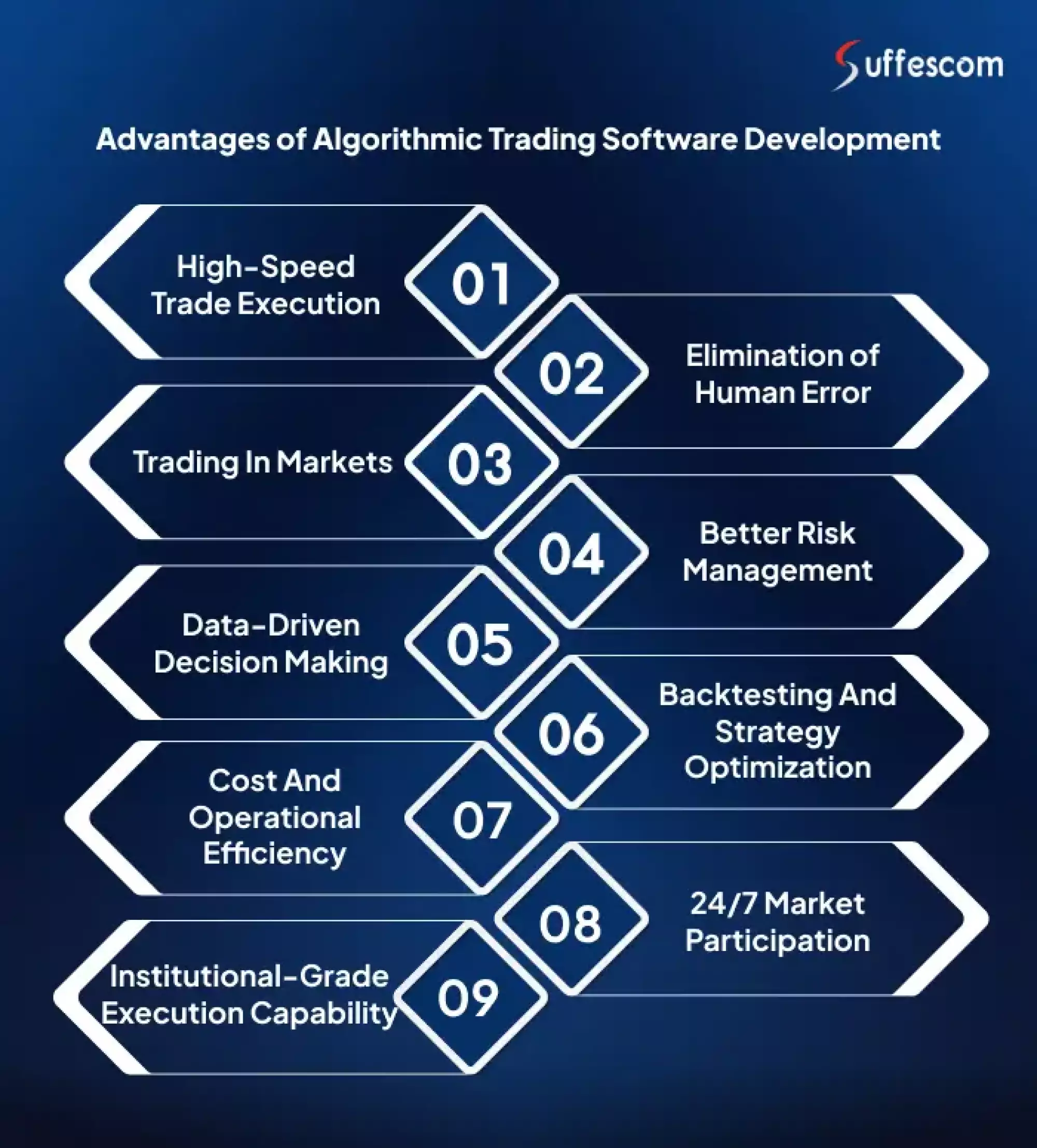
High-Speed Trade Execution
Algorithmic trading software enables extremely fast trade execution in milliseconds or microseconds. This speed is critical in highly volatile markets where timing directly impacts profitability. Faster execution can lead to better trading outcomes and improved efficiency
Elimination of Human Error
When people use algorithmic trading software, they do not have to worry about making mistakes. The software makes all the trades automatically. It does not get emotional. Make mistakes as people do. Every trade is made using a set of rules.
Trading in Markets
Algorithmic trading software can trade in many different markets at the same time. It can trade stocks, bonds, and other things. It can even trade in countries. This helps people who want to trade in different markets.
Better Risk Management
Algorithmic trading software can help people manage risk. It can automatically stop trades if they are not going well. It can also make sure that people do not trade too much money at one time. This helps protect their capital.
Data-Driven Decision Making
Algorithmic trading software uses a lot of data to make decisions. It looks at what has happened in the past and what is happening now. It uses this data to make trades. This is better than guessing what will happen.
Backtesting and Strategy Optimization
People can test their trading strategies using trading software. They can see how well their strategies would have worked in the past. This helps them improve their strategies and make money.
Cost and Operational Efficiency
Algorithmic trading software can save people money and time. They do not need to hire a lot of people to make trades. The software can do it all automatically. This makes it cheaper and more efficient.
24/7 Market Participation
Algorithmic trading software can trade all the time. It does not need to take breaks like people do. This is very useful for markets that're open all the time, like the crypto and forex markets.
Institutional-Grade Execution Capability
Some algorithmic trading software is very advanced. It can do things like big institutions do. It can trade quickly and efficiently. It can even use protocols to make trades faster. This helps people trade like institutions.
How to Build Custom Algorithm Trading Software: Step-by-Step
Building custom algo trading software is a multi-phase engineering and financial engineering process. Here is the proven development methodology that has delivered 50+ trading platforms since 2013.
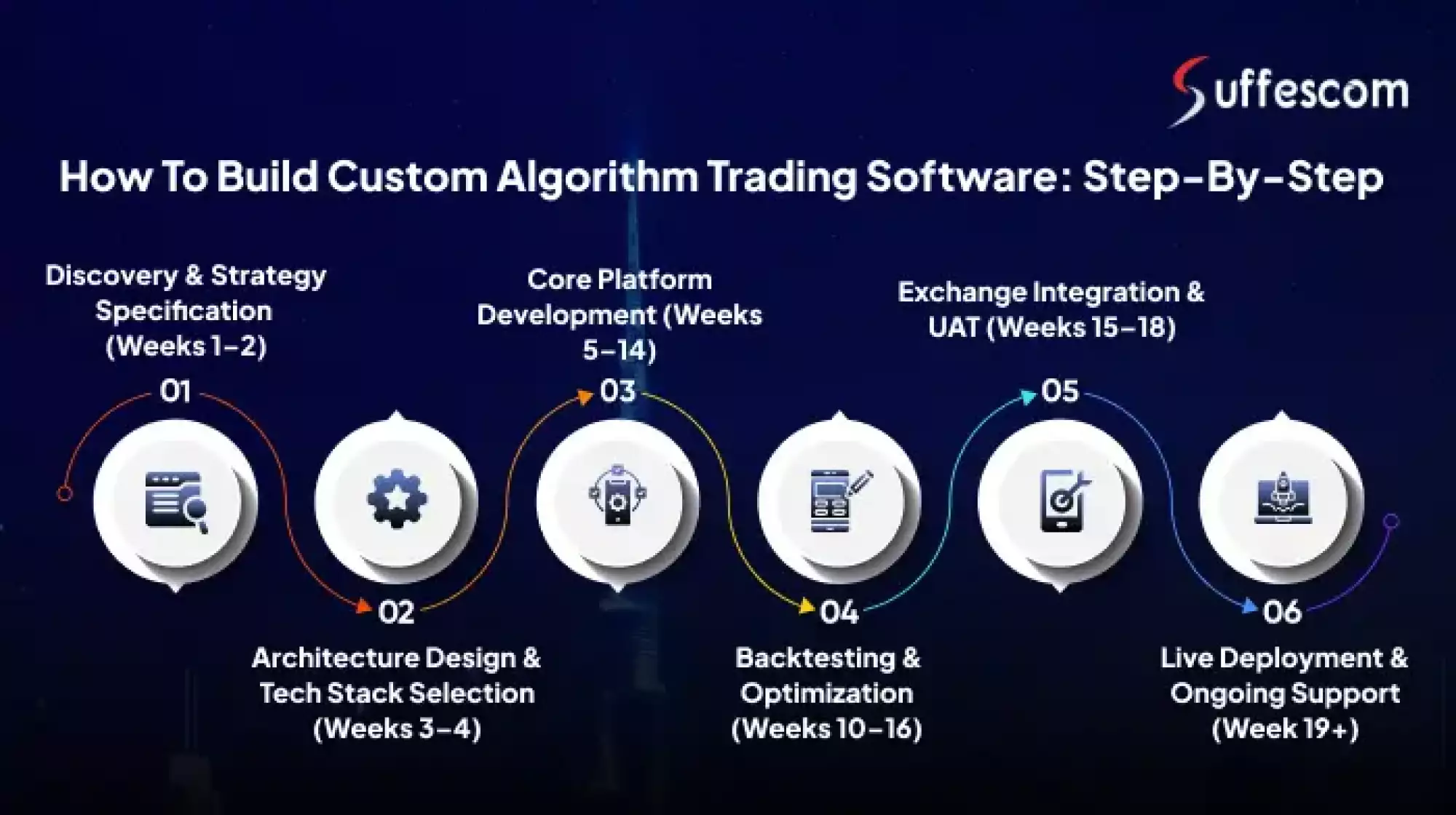
Phase 1: Discovery & Strategy Specification (Weeks 1–2)
We begin with structured workshops to understand your trading strategy, target markets, regulatory environment, and performance requirements. Key deliverables:
- Business Requirements Document (BRD)
- Strategy hypothesis document with expected edge and risk parameters
- Regulatory compliance checklist (MiFID II, SEC, FINRA, SEBI as applicable)
- Technical feasibility assessment and infrastructure sizing
Phase 2: Architecture Design & Tech Stack Selection (Weeks 3–4)
Our architects design the system topology: data flow diagrams, microservice boundaries, database schemas, and latency budgets. HFT systems require co-location planning at this stage.
- System architecture diagram and API contract definitions
- Data model design for tick data, orders, positions, and risk limits
- Exchange connectivity strategy and FIX session configuration
- Security architecture review and threat modeling
Phase 3: Core Platform Development (Weeks 5–14)
Parallel development sprints build the core modules. Suffescom follows agile delivery with 2-week sprints, daily standups, and weekly client demos.
- Market data ingestion engine with normalization layer
- Strategy engine SDK with event-driven framework
- Order management system (OMS) and execution management system (EMS)
- Risk engine with configurable kill-switch logic
- Admin dashboard and algo trading app (mobile)
Phase 4: Backtesting & Optimization (Weeks 10–16)
Strategy validation runs in parallel with development. We backtest across 5+ years of historical data, optimize parameters, and conduct walk-forward analysis.
- Minimum 3-year backtesting period with realistic transaction cost modeling
- Sharpe ratio, Sortino ratio, and Calmar ratio benchmarking
- Monte Carlo simulation for drawdown analysis
- Paper trading phase (2–4 weeks minimum) before live deployment
Phase 5: Exchange Integration & UAT (Weeks 15–18)
We integrate with your target exchanges in sandbox/testnet environments, execute end-to-end test scenarios, and conduct user acceptance testing (UAT) with your trading team.
- FIX connectivity testing with broker or exchange test environment
- Order lifecycle testing: submission, partial fill, cancellation, expiry
- Latency benchmarking and performance profiling
- Penetration testing and security audit by third-party firm
Phase 6: Live Deployment & Ongoing Support (Week 19+)
We deploy to production with a gradual capital ramp-up strategy that starts with minimal position sizes and scaling as confidence builds. Post-launch support includes:
- 24/7 system monitoring with PagerDuty alerting
- Monthly strategy performance review and optimization sprints
- Exchange API upgrade management and regulatory update patches
- Optional: SLA-backed managed services for infrastructure and strategy ops
Technology Stack for Algo Trading Software Development
| Layer | Technologies |
| Market Data Ingestion | Apache Kafka, Redis Streams, WebSocket handlers, FIX feed handlers |
| Strategy Engine | Python (primary), C++ / Rust (HFT), Java (FIX-heavy institutional systems) |
| Execution Engine | FIX Protocol (4.2/4.4/5.0), REST APIs, CCXT library (crypto), Web3.py / ethers.js (DeFi integrations) |
| Time-Series Database | TimescaleDB (PostgreSQL extension), InfluxDB, kdb+ (high-frequency trading systems) |
| Relational Database | PostgreSQL |
| ML / AI Pipeline | TensorFlow, PyTorch, scikit-learn, MLflow (model tracking), FastAPI (model serving layer) |
| Backend API Layer | FastAPI (Python), Go, Node.js |
| Frontend Dashboard | React.js, Next.js, TradingView charting library |
| Mobile Algo Trading App | React Native (iOS & Android), Flutter |
| Infrastructure Layer | AWS, GCP, Azure, Docker, Kubernetes, Terraform, co-location at Equinix NY4 / LD4 / TY3 for low-latency trading |
| Security Layer | OAuth 2.0, JWT authentication, HSM key storage, TLS 1.3 encryption, WAF protection, 2FA, IP whitelisting |
Cost to Develop Algorithmic Trading Software
The cost to develop custom algo trading software typically ranges from $25,000 for a basic MVP to $300,000+ for a fully featured institutional platform, depending on strategy complexity, exchange connectivity, and compliance requirements.
Cost Breakdown by Platform Tier
| Platform Tier | Typical Features | Timeline | Estimated Investment |
| Starter / MVP | 1 strategy, 1 exchange, basic dashboard, backtester, paper trading | 8–12 weeks | $25,000 – $60,000 |
| Mid-Market Platform | 3–5 strategies, 5–10 exchange connections, risk engine, mobile app, ML signals | 14–22 weeks | $70,000 – $150,000 |
| Institutional / HFT | Custom strategies, 20+ exchanges, C++ execution, co-location, regulatory compliance, white-label | 24–40 weeks | $180,000 – $300,000 |
| Crypto-Native DeFi Platform | On-chain execution, DEX integration, wallet + payment gateway, cross-chain support | 16–28 weeks | $90,000 – $220,000 |
Cost Comparison: Build vs. Buy vs. Partner
| Dimension | Build In-House | Buy Off-the-Shelf | Partner with Suffescom |
| Time to Market | 18–36 months | Immediate, but limited | 8–40 weeks |
| IP Ownership | Full | None / Licensed | Full transfer |
| Customization | Full | Very limited | Full custom |
| Initial Cost | $300K–$1.5M | $10K–$50K/yr | $25K–$300K |
| Ongoing Cost | Full team salary | Subscription + limits | Flexible SLA-based |
| Risk | High (talent, time) | Medium (vendor lock-in) | Low (proven delivery process) |
Exchange Integration: What You Need to Know
Exchange integration is one of the most underestimated complexity sources in Algorithmic trading software development. Every exchange has its own API format, rate limits, authentication method, order types, and WebSocket behavior. Poor integration means dropped orders, missed fills, and compliance failures. Here is how Suffescom builds exchange connectivity that actually holds up under production load.
| Protocol | How It Works | Latency Profile | Best Use Case |
| REST API | Uses a standard HTTP request-response model where the trading application polls market data and submits orders through API endpoints. | 50–500 ms average round-trip latency. | Suitable for order placement, portfolio management, account monitoring, and strategies where ultra-low latency is not critical. |
| WebSocket | Maintains a persistent two-way connection between the trading platform and exchange, enabling real-time data streaming without repeated requests. | 5–50 ms typical latency, significantly faster than REST APIs. | Ideal for live market data feeds, order book monitoring, trade execution alerts, and real-time strategy execution. |
| FIX Protocol | Financial Information exchange (FIX) protocol provides direct institutional-grade connectivity through structured message exchanges over TCP networks. | Sub-1 ms latency achievable with optimized infrastructure and co-location services. | Best for institutional trading desks, broker integrations, direct market access (DMA), and regulatory-compliant order routing. |
| Co-location + FPGA | Trading servers are physically hosted within exchange data centers, while FPGA hardware accelerates signal processing and order execution. | Nanosecond-level latency, enabling ultra-fast trade execution. | Designed for high-frequency trading (HFT), market-making strategies, latency arbitrage, and other ultra-low-latency trading operations where speed creates a competitive advantage. |
Crypto-Native Trading: Wallets, Payment Gateways & DeFi Integration
Algo trading software for crypto markets requires capabilities far beyond what traditional fintech development covers. On-chain execution, self-custodied wallets, and fiat on/off-ramp integration are now table stakes features for any serious crypto trading platform. Here is how Suffescom builds these natively.
| Wallet Type | How It Works | Security Model | Best For |
| Custodial Wallet | Platform holds private keys in HSM-secured infrastructure; user trusts the platform for custody. | Platform-controlled; HSM key storage; SOC 2 audit trail. | Centralized exchange platforms and institutional accounts requiring platform custody. |
| Non-Custodial (MetaMask / WalletConnect) | User retains private keys; platform interacts through wallet connection requests. | User-controlled; platform never accesses private keys. | DeFi trading platforms and Web3-native users preferring self-custody. |
| MPC Wallet | Private key is split across multiple parties; no single party holds the complete key. | No single point of failure; institutional-grade security. | Institutional platforms, family offices, and custody-sensitive clients. |
| HD Wallet (BIP32/44/49) | Hierarchical deterministic key derivation from a single seed phrase generates unique addresses per user or account. | Seed-phrase-based; user-controlled or platform-managed. | Platforms requiring unique deposit addresses without managing individual private keys. |
Regulatory Framework for Algo Trading Software Development
Regulatory compliance in algorithmic trading software development must be built into the system architecture from the start to meet trading, reporting, and risk control requirements across jurisdictions. Non-compliance can lead to penalties, restrictions, or legal consequences.
| Framework | Jurisdiction | Key Requirements That Affect Platform Architecture |
| MiFID II | European Union | Algorithm registration, kill-switch, and trade reporting |
| SEC Rule 15c3-5 | United States | System-level pre-trade risk controls and exposure limits |
| FINRA Rule 3110 / 5310 | United States | Best execution, smart order routing, and audit trails |
| SEBI Algo Trading Circular | India | Regulatory approval, co-location policies, and order audit logs |
| FCA SYSC / MAR | United Kingdom | Algorithm accountability and market abuse detection controls |
| FATF / VASP Regulations | Global | KYC/AML compliance and transaction monitoring systems |
Industry Use Cases: Who Benefits from Custom Algo Trading Software?
Custom algo trading software solutions are not limited to Wall Street hedge funds. Different market participants use bespoke trading systems based on execution needs, scalability, and market structure.
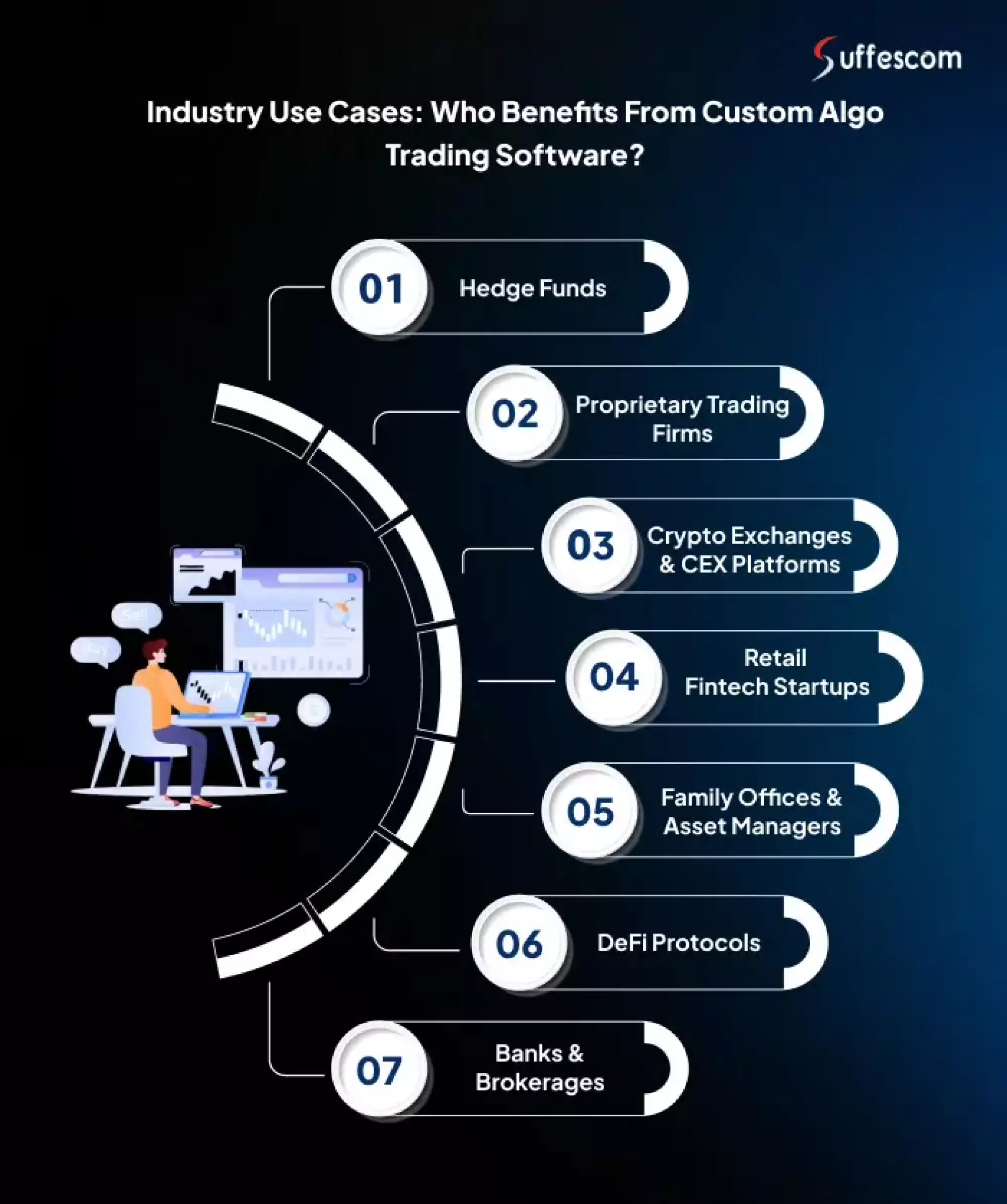
Hedge Funds
Hedge funds face delays between signal generation and execution along with manual position sizing errors. Algorithmic systems automate execution logic and enable microsecond-level trade placement, improving alpha capture and consistency.
Proprietary Trading Firms
Prop trading firms need to run strategies across multiple markets simultaneously. Algo trading platforms support multi-venue smart order routing (SOR) and parallel execution, enabling scalable multi-asset trading operations.
Crypto Exchanges & CEX Platforms
Crypto exchanges require strong liquidity infrastructure to maintain stable order books. White-label algo trading exchange solutions provide automated market-making tools to liquidity providers, improving spreads and market depth.
Retail Fintech Startups
Retail trading platforms use automation to offer copy trading, robo-advisory, and signal-based investing. Platforms like Robinhood have set the benchmark for simplifying trading experiences through intuitive design and algorithm-driven investing models. Custom algo trading apps help replicate and extend such capabilities with advanced strategy control and scalability.
Family Offices & Asset Managers
Large institutional investors focus on reducing execution costs for bulk orders. VWAP and TWAP execution algorithms help minimize market impact and slippage during large trades.
DeFi Protocols
DeFi platforms require automated liquidity management and arbitrage execution. On-chain trading bots connected to smart contracts help rebalance liquidity and capture cross-protocol inefficiencies.
Banks & Brokerages
Banks and brokers are integrating automated portfolio systems to meet client demand. Robo-advisory engines handle portfolio rebalancing and risk-aligned asset allocation automatically.
Build Smarter, Faster Trading Systems
Leverage advanced market data engines, OMS/EMS, and AI-driven strategies to stay ahead in modern financial markets.
Key Future Trends in Algorithmic Trading Systems
The world of trading is changing really fast. This is because of Artificial Intelligence, blockchain, and advanced computing technologies. Here is what we can expect to happen in the coming years:
AI-Powered Trading Agents
Artificial Intelligence-powered trading agents will be able to change trading strategies quickly. They will do this across different types of assets. This will help us make trades, and we will not have to do as much work.
Generative AI for Market Simulation
Generative Artificial Intelligence for Market Simulation will help us make models of the market. It will also help us make datasets and test our strategies. This will make our strategies better and more accurate.
Quantum Computing
Quantum Computing for Ultra-Low Latency Execution will help us make our portfolios better. It will also help us understand the risks and find trading opportunities. This means that big traders will be able to make trades really quickly.
Decentralized Finance (DeFi) Automation
Decentralized Finance Automation will use contracts to automate some tasks. These tasks include managing money and finding trading opportunities. This means that people will be able to trade all the time without working.
Autonomous Trading Systems
Autonomous Trading Systems will be able to make strategies, execute trades, manage risks, and monitor performance. This means that we will not have to do much work and we will still be able to follow the rules.
High-Frequency & Edge Computing
High-Frequency and Edge Computing will use servers and computers to make trading really fast. This will support fast trading and will help us make good trades.
Why Choose Suffescom as Your Algo Trading Software Development Company
As a leading provider of algo trading software development services, Suffescom delivers scalable and secure trading systems designed for institutional and fintech use cases.
Proven Fintech Engineering Expertise
With 13+ years in fintech delivery, we specialize in building algorithmic trading platforms, crypto exchange systems, and real-time financial applications. Our engineers bring expertise in quantitative systems, market data processing, and execution engine design.
Full-Stack Trading System Development
We deliver end-to-end trading ecosystems, including strategy engines, order management systems (OMS), execution layers, and risk modules. As a trading software development company, we ensure seamless integration across frontend dashboards, APIs, and backend trading infrastructure.
Low-Latency & Scalable Architecture
Our systems are built on an event-driven architecture, microservices, and high-throughput message queues to enable real-time order execution. We optimize for sub-second trade routing, exchange connectivity, and multi-asset scalability across equity, forex, and crypto markets.
Advanced Crypto & Financial Integrations
We enable integration with crypto payment gateways, institutional-grade wallets, and multi-exchange APIs for unified liquidity access. This supports both centralized and decentralized trading workflows.
Secure & Compliant Trading Infrastructure
Security is embedded at every layer with HSM-based key management, encrypted APIs, and role-based access control. We align systems with financial compliance standards, including audit logging and transaction traceability.
Modular IP-Owned Delivery Model
All systems are built on modular microservices with full source code ownership transfer. No vendor lock-in ensures complete control over your trading platform architecture and deployment environment.
Agile Execution with Sprint-Based Delivery
We follow a CI/CD-driven agile model with 2-week sprints, production demos, and milestone-based validation to ensure predictable delivery and faster go-to-market timelines.
FAQs
1. What is the cost to develop an algo-trading software?
The cost of Algo Trading Software Development ranges from $25,000 for a basic MVP to $300,000 for a fully featured institutional platform with multi-exchange connectivity, advanced execution engines, and compliance modules. Most mid-level systems with multiple strategies, risk controls, and dashboards typically fall between $70,000–$150,000.
2. How long does it take to build algorithmic trading software?
A basic MVP with one strategy and one exchange integration takes 8–12 weeks. A full-scale platform with AI modules, multi-exchange support, and mobile applications generally requires 24–40 weeks of development.
3. What programming languages are used in algo trading software?
Python is used for strategy development and quantitative modeling. C++ and Rust are preferred for low-latency and high-frequency execution systems. Java is widely used in institutional environments with FIX protocol integration. The choice depends on system performance and latency requirements.
4. Can algo trading software be built for crypto and DeFi markets?
Yes. Modern systems support CEX and DEX integration, smart contract execution, multi-chain wallets, and crypto payment gateway connectivity, enabling trading across centralized exchanges and DeFi protocols such as Uniswap, dYdX, and GMX.
5. Is algorithmic trading legal?
Yes, algorithmic trading is legal in most jurisdictions but regulated.
- EU: MiFID II compliance
- US: SEC Rule 15c3-5 risk controls
- India: SEBI approval requirements
- Crypto: VASP and AML regulations
Compliance must be embedded in system design from the beginning.
6. What is backtesting in algo trading?
Backtesting is the process of evaluating trading strategies using historical market data before live deployment. It accounts for slippage, transaction costs, and market conditions to validate strategy performance and reduce live trading risk.
7. Do I get full ownership of the source code?
Yes. Full source code, documentation, and deployment assets are transferred after project completion. There are no licensing restrictions or platform lock-ins.
8. What is the difference between OMS and EMS?
An Order Management System (OMS) tracks order lifecycle, positions, and portfolio state. An Execution Management System (EMS) handles trade routing and execution logic across exchanges. Both systems work together in a complete trading architecture.