![How to Build an Institutional RWA Platform on Canton Network [2026 Guide]](https://common-blog-suffes.s3.us-east-2.amazonaws.com/images/17810029996a27f2f7b526d_medium.webp)
Key takeaways:
- Canton Network is a permissioned, privacy-preserving blockchain designed for regulated financial institutions, enabling secure and compliant real-world asset tokenization.
- Canton’s primary advantage for RWAs is its ability to support atomic, multi-ledger workflows including asset issuance, payments, compliance, and secondary trading without broadcasting sensitive data to unauthorized parties.
- The Canton ecosystem supports diverse institutional use cases, from real estate, bonds, and private credit tokenization to programmable settlement, DvP transactions, and cross-institutional collateral flows.
- Real-world adoption highlights include Broadridge and DTCC tokenizing U.S. Treasuries, Franklin Templeton’s digital fund initiatives, and multiple pilot programs for private equity and cross-border settlement on Canton
- Canton is critical for institutional RWA adoption because it provides the exact infrastructure needed: sub-transaction privacy, regulated interoperability, atomic settlement, and formal compliance enforcement via Daml smart contracts.
Want similar results? → Get a Free Quote
Tokenizing real-world assets (RWA) is quickly emerging as the next great frontier of institutional finance. According to research by Boston Consulting Group, tokenized assets are estimated to be worth $14 trillion by 2030. Traditional financial firms such as custodians, asset management companies, etc. are actively exploring an Institutional RWA Platform to meet compliance, privacy, and interoperability requirements that existing systems cannot support.
A Canton Network RWA Platform provides the institutional-grade infrastructure required for regulated financial ecosystems. Unlike traditional blockchain systems, a Real World Asset Tokenization Platform built on Canton Network is designed specifically for permissioned financial environments.
Canton Network, the brainchild of Digital Asset, is designed to address this requirement precisely. Combining the Daml language for smart contracts with a privacy-enhancing, interoperable design optimized for regulated markets, this Canton-Based Platform enforces data partitioning where only authorized participants can access transaction data.
This guide explains how to build an RWA Platform on Canton Network, covering architecture, compliance design, and RWA Platform Development for institutional use cases.
Understanding Canton Network for Real-World Tokenization
Canton Network for Real-World Tokenization is a decentralized interoperability infrastructure designed for regulated financial institutions, enabling secure issuance and settlement of digital assets across institutional-grade networks. It connects independent ledgers (synchronization domains) into a unified financial ecosystem while maintaining strict data privacy.
At its core, Canton enables “need-to-know” data visibility, ensuring that transaction data is only accessible to authorized participants. This approach works as a dedicated privacy layer for tokenized assets, allowing financial institutions to tokenize real-world assets while protecting confidential information across multiple parties and interconnected financial networks.
Canton is powered by Daml (Digital Asset Modeling Language), a functional smart contract language designed for legal and financial agreements with deterministic execution and formal verification guarantees.
Unlike traditional blockchain systems, Canton does not replicate global state. Instead, it synchronizes only relevant contract states across permissioned participants, which reduces risk exposure and improves compliance alignment.
How It Works: Canton Network for Real-World Asset Tokenization
Canton Network serves as a multi-ledger platform that enables regulated institutions to tokenize assets in a private way without having to share critical information across the entire network. This section explains how an RWA Tokenization Platform Built on Canton Network operates across multi-ledger environments with atomic settlement capabilities.
1. Participants' Integration
Regulated financial institutions such as banks, custodians, and asset managers deploy a participant node into the Canton network. In turn, each institution will control its own ledger and connect with Canton’s synchronization component.
2. Modeling of Real-World Assets
Real-world assets such as bonds, funds, or real estate will be represented via Daml smart contracts that establish the rules of ownership, compliance enforcement, transfer requirements, etc.
3. Private Transaction Execution
When a new transaction comes, only the involved participants will see it. In contrast to other blockchain technologies, there is no need to broadcast any information across the whole network.
4. Multi-Ledger Synchronization
Synchronization of the state of transactions across various ledgers happens via synchronization domains of the Canton protocol.
5. Atomic Transactions
Transactions such as delivery versus payment are executed atomically—i.e., asset and money transfer occurs with no settlement risk.
6. Compliance Enforcement
Compliance rules (KYC/AML, jurisdiction limits, and investor eligibility) are enforced directly inside Daml contracts, ensuring regulatory constraints are applied at the execution level.
Why Institutions Choose the Canton Network for RWA Tokenization?
As an Institutional Blockchain Platform, Canton Network addresses critical requirements such as privacy, compliance, interoperability, and synchronized settlement that traditional blockchain networks often struggle to provide. While Hyperledger Fabric is widely used in enterprise deployments, Canton’s Daml-powered, privacy-first architecture is optimized for regulated RWA tokenization.
| Requirement | Public Chains | Private Chains | Canton Network |
| Data Privacy | None, fully transparent | Limited (network-wide visibility) | Sub-transaction privacy by design |
| Regulatory Compliance | Difficult, immutable public data | Moderate, custom rules needed | Native compliance hooks in Daml |
| Cross-Institution Settlement | Bridge risks and delays | Manual reconciliation | Atomic multi-ledger transactions |
| Smart Contract Auditability | Solidity, complex to audit | Proprietary, limited tooling | Daml, designed for legal audit |
| Institutional Trust | Low, pseudonymous participants | High, but siloed | High, permissioned + interoperable |
Bring Real-World Assets On-Chain with Confidence
Develop a secure Canton-based platform for asset issuance, investor onboarding, compliance, and settlement.
Core Components Required to Build an Institutional RWA Platform
Building a secure RWA Platform requires a modular architecture that supports compliance, asset lifecycle management, and secure financial operations. These components form the foundation of enterprise-grade RWA Platform Development.
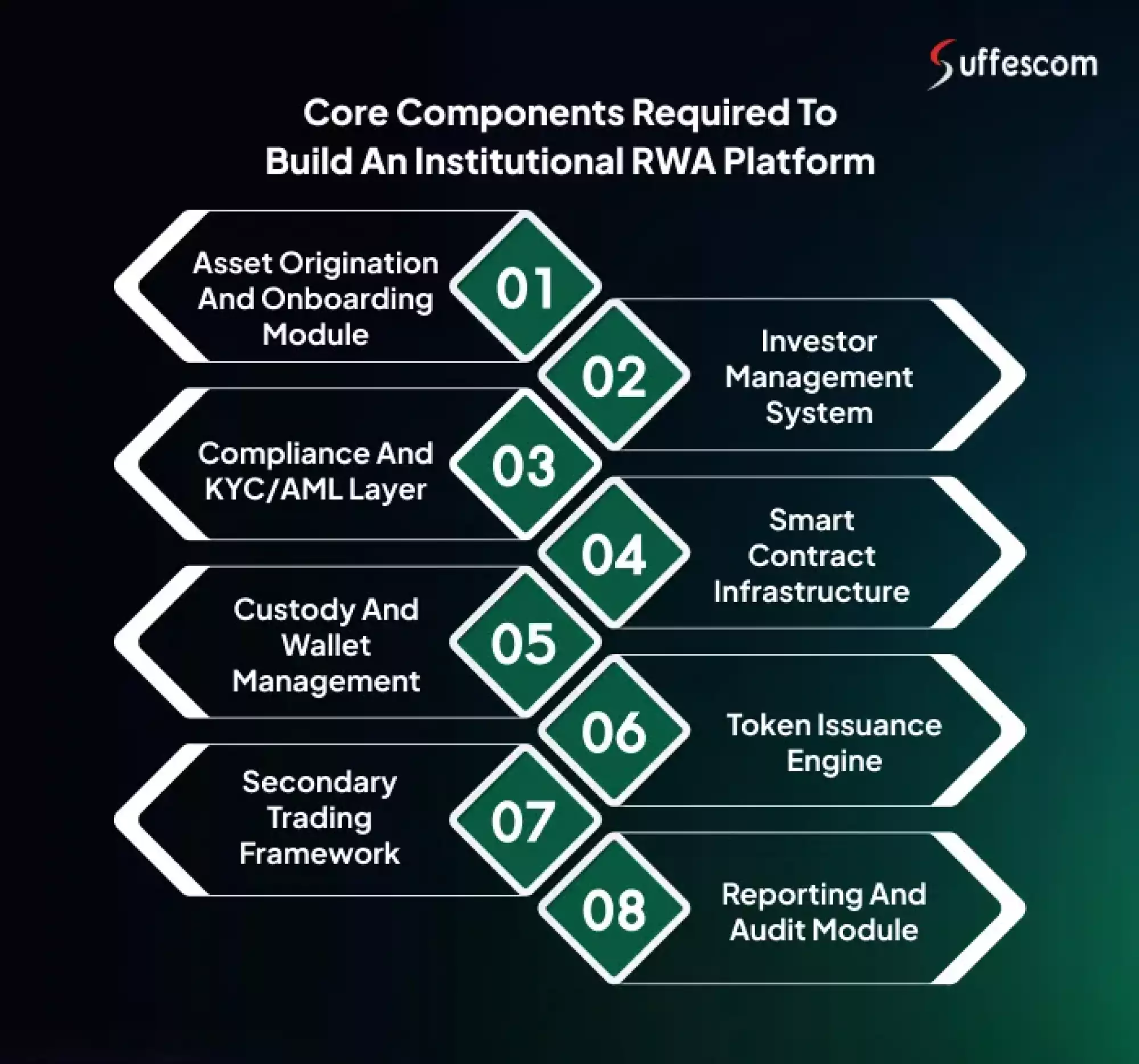
1. Asset Origination and Onboarding Module
Handles asset creation, verification, and structuring before token issuance.
2. Investor Management System
Responsible for managing investor accounts, privileges, and eligibility for joining tokenized offerings.
3. Compliance and KYC/AML Layer
Enforces regulatory compliance and anti-money laundering rules.
4. Smart Contract Infrastructure
Defines asset logic, ownership rules, and lifecycle events using secure programmable contracts.
5. Custody and Wallet Management
Handles secure storage of digital assets with advanced key management systems.
6. Token Issuance Engine
Facilitates creation, distribution, and lifecycle control of tokenized assets.
7. Secondary Trading Framework
Enables regulated trading and transfer of tokenized assets in secondary markets.
8. Reporting and Audit Module
Provides real-time transparency, compliance reporting, and regulatory audit trails.
Types of Assets That Can Be Tokenized on a Canton Network RWA Platform
A Real World Asset Tokenization Platform built on Canton Network supports a wide range of institutional asset classes. These assets can be digitized into a Tokenized Asset Platform structure, enabling fractional ownership, liquidity, and programmable settlement.
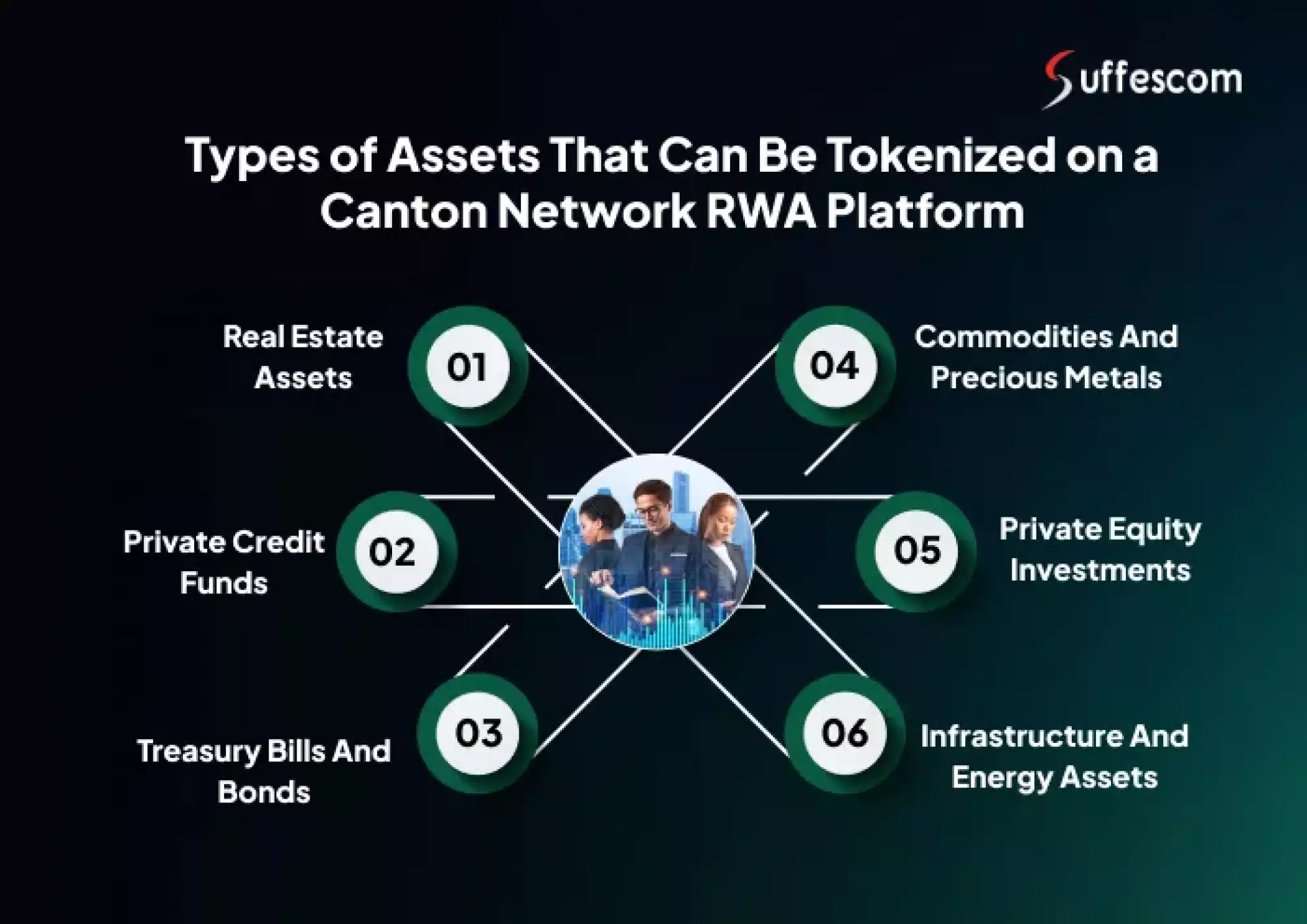
1. Real Estate Assets
Commercial and residential properties can be tokenized to enable fractional ownership and improved liquidity.
2. Private Credit Funds
Debt instruments and private lending portfolios can be represented as tokenized financial products with structured payouts.
3. Treasury Bills and Bonds
Government securities and fixed-income instruments can be issued and managed as on-chain assets with automated settlement.
4. Commodities and Precious Metals
Physical assets such as gold, oil, and other commodities can be digitized for efficient trading and custody management.
5. Private Equity Investments
Private market holdings can be tokenized to improve transferability and investor access.
6. Infrastructure and Energy Assets
Large-scale infrastructure projects and energy assets can be structured into investment-grade digital tokens for institutional participation.
Step-by-Step Guide To Build an Institutional RWA Platform on Canton Network
Step 1: Environment Setup and Canton Node Deployment
The first phase of building your RWA Tokenization Platform involves Canton Network Development, including deploying participant nodes, configuring synchronization domains, and preparing the Daml development environment.
Technical Prerequisites
- Java JDK 17+ (Canton nodes run on the JVM)
- Daml SDK 2.x (latest stable release from Digital Asset's release portal)
- Docker and Docker Compose (for local Canton domain simulation)
- PostgreSQL 14+ (Canton's participant node uses it as the ledger store)
- Node.js 18+ and TypeScript (for JSON API and application layer)
Access credentials for Canton Network (enterprise license from Digital Asset or via a certified implementation partner)
Canton Node Initialization Sequence
- Download and unpack the Canton binary from Digital Asset's enterprise distribution portal.
- Configure the participant node: set the participant ID (a unique X.509 identity), database connection string, and synchronization domain endpoint.
- Generate participant identity keys: Canton uses X.509 certificates for participant identity and Ed25519 keys for transaction signing.
- Bootstrap the domain connection: the participant sends a handshake to the domain mediator and sequencer, receives topology transactions, and syncs the ledger state.
- Deploy the Daml archive (.dar file) to your participant node; this makes your smart contract templates available for instantiation.
- Start the HTTP JSON API server to expose Canton's gRPC ledger API as REST endpoints for your application layer.
Performance Metrics for Canton Network
Canton Network supports institutional-scale tokenization with high throughput and low settlement latency. Typical performance includes:
- Transaction throughput (TPS): hundreds of transactions per second across multiple ledgers
- Settlement latency: atomic delivery-versus-payment in seconds
- Institutional throughput: simultaneous multi-party execution without compromising privacy or compliance
Step 2: Daml Smart Contract Development for RWA Lifecycle
The Daml smart contract layer is the heart of your RWA Tokenization Platform. Every asset class, every investor right, every compliance rule, and every corporate action must be expressed as a Daml template. This is not an optional abstraction — Canton's execution model enforces that all ledger state changes happen through Daml contract exercises.
Core Daml Templates for an RWA Platform
- AssetIssuance Template: Defines the asset class (ISIN, denomination, maturity, coupon schedule), issuer identity, and initial supply. Includes choices for minting, burning, and transferring asset units.
- Investor Account Template: Represents an investor's position in an asset. Linked to KYC status, jurisdiction restrictions, and transfer eligibility flags. Supports exercise choices for subscription, redemption, and secondary transfer.
- Transfer Proposal Template: Encodes a proposed transfer of asset units between two parties, requiring both parties to authorize before atomic settlement is triggered on Canton.
- Coupon Payment Template: Automates periodic interest or dividend distribution. The issuer creates a CouponPayment contract; eligible InvestorAccount holders exercise a Claim choice to receive their allocation.
- Compliance Check Template: An interface template that wraps KYC/AML status flags, investor eligibility rules, and transfer restrictions. All TransferProposal exercises must reference a valid ComplianceCheck contract.
- Settlement Instruction Template: Coordinates the payment leg of a DvP transaction. Links to the cash token (CBDC or stablecoin) contract and the asset transfer, ensuring atomicity across both legs.
DAML PATTERN
- Use interface templates (Daml's abstract contract type) to define standard RWA behaviors that multiple asset templates can implement. This enables cross-asset composability without tight coupling — a critical design principle for a multi-asset RWA platform.
Daml Development Best Practices
- Use Daml's built-in assertion and abort mechanisms to enforce business invariants at the contract level, not the application layer.
- Leverage Daml scenarios and Daml Script for automated contract-level testing before deploying to a Canton node.
- Model all parties explicitly: every Daml contract must declare its signatories and observers. Incorrect party assignments are the most common source of Canton privacy breaches.
- Use divulgence sparingly: Canton's sub-transaction privacy is powerful, but accidental divulgence of contract state to unintended observers is a real risk. Review divulgence graphs as part of code review.
- Version your Daml templates carefully: Canton supports live package upgrades, but breaking changes in template interfaces require a formal upgrade path.
Step 3: Compliance and KYC/AML Integration
No RWA Platform can go to market without a robust compliance framework. Canton's architecture makes compliance integration natural: compliance logic is encoded in Daml templates, while external KYC/AML data providers are integrated through your application layer.
KYC/AML Integration Architecture
Your platform connects to one or more KYC/AML providers (e.g., Refinitiv World-Check, ComplyAdvantage, Jumio, Onfido) through a compliance service layer. When an investor completes onboarding, the compliance service:
- Receives investor identity documents and PII data.
- Calls the KYC/AML provider's API to screen against sanctions lists, PEP databases, and adverse media.
- Records the compliance verdict in a ComplianceCheck Daml contract on the investor's participant node.
- Issues a Daml disclosure that makes the ComplianceCheck contract visible to asset issuers and transfer agents who need to validate investor eligibility.
- Monitors ongoing compliance status: re-screening triggers on a schedule or on material events, and the ComplianceCheck contract is updated accordingly.
Regulatory Rule Encoding in Daml
- Transfer restrictions: Daml template guards enforce that transfers only occur between investors in permitted jurisdictions. Example: a US-regulated security enforces that the counterparty holds a valid AccreditedInvestor certificate.
- Maximum holder limits: Rule 506(b) offerings with up to 35 non-accredited investors can be enforced via a global contract that tracks holder counts and rejects transfers that would breach the limit.
- Lock-up periods: Post-issuance transfer restrictions are modeled as time-locked choices in the InvestorAccount template, as investors cannot exercise Transfer until the lock-up timestamp has passed.
- FATF Travel Rule: For transactions above the $1,000 threshold, the TransferProposal template can require that both parties submit originator and beneficiary VASP data as a precondition for settlement.
Step 4: Payment Rail Integration and DvP Settlement
An RWA platform without a payment rail is an incomplete financial system. Canton's atomic multi-ledger transaction capability enables genuine delivery-versus-payment: the simultaneous, irrevocable exchange of asset tokens against cash tokens in a single atomic transaction, with no settlement risk.
Canton Network supports atomic DvP settlement across institutions, complementing or replacing traditional settlement rails like SWIFT for faster, programmable asset transfer.
Supported Payment Rail Options
- Canton-native cash tokens: Canton Network’s atomic DvP capability can complement or partially replace traditional settlement rails such as SWIFT, reducing reconciliation delays and improving cross-institution settlement efficiency. Issue a USD or EUR cash token on Canton that represents bank-guaranteed commercial bank money. Participating banks hold the reserve; Canton enforces atomic DvP.
- CBDC integration: Several central banks are piloting Canton-based CBDC issuance. If your target market's central bank operates a Canton node, CBDC settlement is available natively.
- Tokenized deposit integration: Integrate with bank-issued tokenized deposits (e.g., JPM Coin, citi Token Services) if counterparties operate on Canton-compatible infrastructure.
- Off-chain payment with on-chain proof: For jurisdictions where digital cash tokens are not yet available, integrate traditional RTGS or ACH payment with a payment confirmation oracle that triggers on-chain settlement once the fiat payment is confirmed.
Step 5: Platform Application Layer Development
The application layer is the set of backend services that orchestrate interactions between your users, the Canton node, compliance systems, payment rails, and external integrations. This layer is built in standard enterprise software technologies and communicates with Canton via the HTTP JSON API or the gRPC Ledger API.
Core Backend Services
- Issuance Service: Handles the end-to-end workflow of creating a new tokenized asset — ingesting asset parameters, generating ISIN/LEI identifiers, creating Daml contracts, and coordinating with the asset registry.
- Investor Management Service: Onboarding orchestration, KYC status polling, accreditation management, and investor portal APIs.
- Trading Service: Order management, matching engine (if building an internal ATS), transfer proposal creation, and secondary market connectivity.
- Corporate Actions Service: Automates coupon payment schedules, redemption workflows, and voting right enforcement by creating Daml contracts at the appropriate time.
- Reporting Service: Aggregates ledger events from Canton's event stream API, transforms them into regulatory report formats, and submits to trade repositories or regulatory portals.
- Notification Service: Real-time event-driven notifications to investors and issuers via webhook, email, or push notification when contract state changes occur on the ledger.
Step 6 — User Interface and Portal Development
The user-facing layer of your RWA platform serves multiple distinct user types, each with different permissions, information needs, and interaction patterns. A well-designed portal structure is essential for adoption and regulatory approval.
Issuer Portal
- Asset creation wizard: guided workflow for defining asset parameters, compliance rules, and issuance schedule.
- Investor dashboard: real-time view of current holders, transfer history, and corporate action status.
- Compliance console: KYC status monitoring, override capabilities, and regulatory reporting submission.
- Secondary market monitoring: transfer volumes, price discovery data, and liquidity metrics.
Investor Portal
- KYC onboarding flow: document upload, identity verification, and accreditation certification.
- Portfolio view: current holdings, accrued income, upcoming corporate actions.
- Subscription and redemption: primary market participation with payment integration.
- Secondary market access: peer-to-peer transfer initiation with counterparty search.
- Document vault: prospectus, subscription agreements, tax certificates — linked to on-chain records.
Launch Your RWA Tokenization Platform on Canton in Weeks
Work with experienced blockchain engineers to build a compliance-ready, institutional-grade RWA platform tailored to your business goals.
Technology Stack for Canton Network RWA Platform Development
| Layer | Technology | Purpose |
| Blockchain Layer | Canton Network, Participant Nodes | Core infrastructure for privacy-preserving institutional asset tokenization |
| Smart Contracts | Daml | Defines asset logic, compliance rules, and lifecycle management for Institutional RWA Platform |
| Backend Layer | Java (Spring Boot), Node.js | Handles APIs, business logic, and integration with external systems |
| Frontend Layer | React.js, Next.js | Builds investor dashboards and asset management interfaces |
| Data Layer | PostgreSQL, Redis | Manages transactional data and high-speed caching |
| Cloud Infrastructure | AWS / Azure | Hosts secure RWA Platform deployments |
| DevOps Layer | Kubernetes, Docker | Containerization and orchestration for enterprise-grade deployment |
| Security & Compliance | HSM, KYC/AML APIs | Ensures custody security, identity verification, and regulatory compliance |
Cost to Build an Institutional RWA Platform on Canton Network
A lean but production-ready Canton Network RWA Platform Development can be achieved within a structured budget of up to $300,000 when the scope is focused on core tokenization, compliance, and institutional onboarding capabilities without over-engineering advanced trading or multi-market features.
Cost Breakdown for Building an Institutional RWA Platform on Canton Network
| Cost Component | Scope Included | Estimated Cost (USD) |
| Canton Network Integration | Participant setup, network configuration, basic interoperability setup | $20,000 – $40,000 |
| Smart Contract Development | Daml-based contracts for asset issuance, ownership, and lifecycle rules | $30,000 – $60,000 |
| Backend Development | APIs, transaction processing, and system orchestration | $25,000 – $50,000 |
| Frontend Development | Investor dashboard, admin panel, asset management UI | $20,000 – $40,000 |
| Compliance Integration | KYC/AML, identity verification, regulatory workflows | $20,000 – $45,000 |
| Custody & Wallet Integration | Secure asset storage, wallet setup, key management | $20,000 – $40,000 |
| Cloud & Infrastructure | AWS/Azure hosting, CI/CD, deployment setup | $15,000 – $30,000 |
| Security & Testing | Audits, penetration testing, vulnerability checks | $20,000 – $35,000 |
Custom Development vs White-Label Canton Network RWA Platform
| Factor | Custom Development | White-Label RWA Platform |
| Time to Market | Longer development cycle (6–12+ months depending on scope) | Faster deployment (weeks to a few months) |
| Initial Cost | Higher due to full system engineering and architecture design | Lower upfront investment with pre-built modules |
| Customization Level | Fully customizable across compliance, workflows, and asset types | Limited to predefined features and configurations |
| Compliance Integration | Built from scratch based on jurisdictional requirements | Pre-integrated compliance frameworks with limited flexibility |
| Scalability | Designed for institutional expansion | Scalable within platform constraints |
| Smart Contract Flexibility | Full control over Daml-based contract design and lifecycle logic | Restricted customization of contract templates |
| Integration Capability | Deep integration with banking, custody, and payment rails | Standard integrations available, limited extensibility |
| Security Architecture | Custom-designed enterprise-grade security model | Standardized security framework maintained by provider |
| Maintenance & Upgrades | Managed internally or via dedicated development partner | Handled by platform provider |
| Best Suited For | Large financial institutions, banks, and enterprise-grade builds | Startups, pilots, or quick market entry for Tokenized Asset Platform solutions |
Use Cases in Real Life: Examples of Financial Institutions Using Canton Network
With the rising trend of institutions using tokenized assets, the Canton Network platform is becoming increasingly popular for deploying digital asset ecosystems with higher levels of security, privacy, and interactivity.
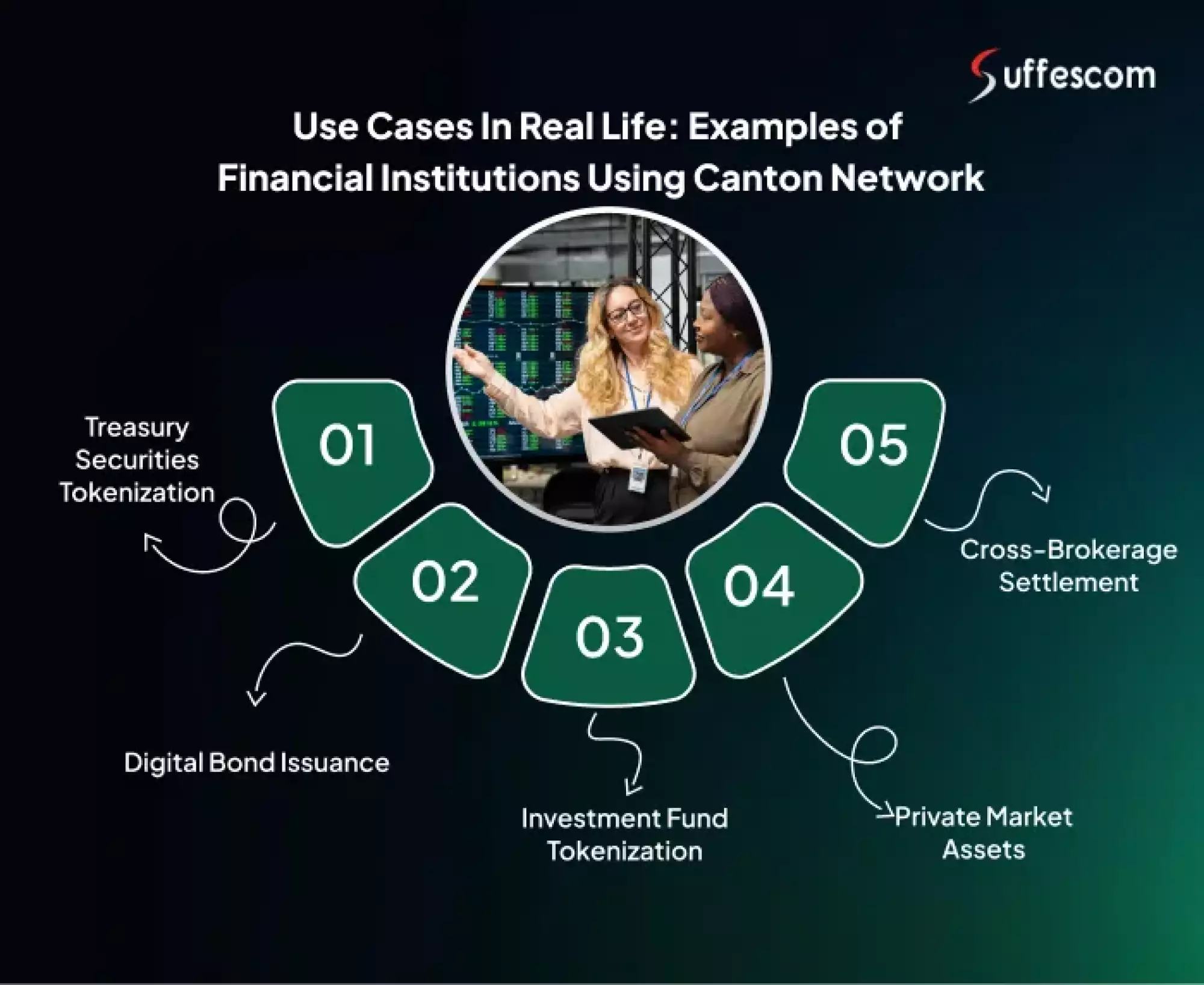
Treasury Securities Tokenization
Financial institutions like Broadridge Financial Solutions have demonstrated tokenized U.S. Treasury workflows to improve settlement speed and reduce reconciliation effort across custodians and brokers.
Digital Bond Issuance
Initiatives such as Euroclear’s digital bond infrastructure projects show how blockchain-based systems can streamline coupon payments, maturity tracking, and redemption processes in fixed-income markets.
Investment Fund Tokenization
Franklin Templeton’s tokenized money market fund (FOBXX) is an example of how fund shares can be represented digitally to automate subscriptions and redemptions.
Private Market Assets
Firms like Hamilton Lane are actively digitizing private equity and private credit structures to improve access, fractional ownership, and operational efficiency.
Cross-Brokerage Settlement
Industry initiatives such as DTCC’s Project Ion highlight the shift toward synchronized settlement systems that reduce post-trade delays across financial intermediaries.
Comparison: Traditional vs Tokenized Financial Systems
Traditional financial infrastructure relies on fragmented databases, manual reconciliation, and delayed settlement cycles, while tokenized systems built on blockchain enable real-time, programmable, and interoperable asset workflows.
| Factor | Traditional Financial Systems | Tokenized Financial Systems |
| Settlement Time | T+1 to T+3 cycles | Near real-time settlement |
| Data Visibility | Centralized, siloed records | Shared but permission-controlled ledger |
| Reconciliation | Manual and error-prone | Automated via smart contracts |
| Asset Ownership | Paper-based / database entries | Digitally represented on-chain |
| Liquidity | Limited to market hours | 24/7 programmable liquidity |
| Compliance | External/manual verification | Embedded compliance logic |
| Cross-Institution Coordination | Slow, fragmented workflows | Synchronized multi-party execution |
Unlock the Full Potential of Real-World Asset Tokenization
Transform illiquid assets into scalable digital investment opportunities with enterprise-grade infrastructure.
Compliance, Legal, and Regulatory Framework for Institutional RWA Platforms
A well-structured regulatory foundation is not just a legal requirement. It is the operational backbone that determines whether an RWA platform can achieve institutional-grade trust and global market interoperability.
| Jurisdiction | Key Regulation | Tokenization Stance | Canton Applicability |
| United States | SEC Reg D / Reg S / Investment Company Act | Security tokens treated as securities; ATS license required for secondary trading | Canton’s compliance hooks support Reg D eligibility restrictions natively |
| European Union | MiCA, DLT Pilot Regime, MiFID II | DLT Pilot provides a regulated sandbox for tokenized securities | Daml auditability and Canton's permissioned architecture align with DLT Pilot requirements |
| Singapore | MAS Project Guardian, SFA | Progressive regulatory environment: MAS actively pilots RWA tokenization with major financial institutions | Canton’s privacy-preserving model aligns with MAS data sovereignty and institutional requirements |
| UAE / DIFC | DFSA Token Framework, ADGM Regulations | Favorable jurisdiction with dedicated investment token frameworks | Canton’s permissioned participant model aligns with DFSA licensing and controlled access frameworks |
How Suffescom Solutions Deliver Your Canton Network RWA Platform?
Suffescom Solutions builds end-to-end Canton Network RWA platforms designed for institutional use cases. Our expertise covers solution architecture, Daml-based smart contract development, compliance integration, and secure tokenization workflows.
We work across multiple asset classes, including real estate, fixed income, funds, and trade finance, ensuring each platform is engineered for regulatory alignment, scalability, and production-grade performance.
What We Deliver
- End-to-end Canton Network RWA platform development: from whiteboarding to production deployment.
- Daml smart contract development with formal testing and audit support.
- KYC/AML compliance integration with leading providers.
- Payment rail integration: tokenized cash, CBDC, and off-chain payment oracle architectures.
- Regulatory strategy and documentation support for US, EU, Singapore, and UAE regulatory frameworks.
- Institutional portal development: issuer console, investor dashboard, compliance monitoring.
- Post-launch support: node operations, smart contract upgrades, feature expansion.
Final Words!
Building a RWA Platform on the Canton Network requires deep expertise across distributed ledger architecture, regulatory systems, smart contract engineering, and financial infrastructure design. The combination of Canton's privacy-first architecture, Daml's formal correctness, and growing institutional adoption positions it as a leading Institutional Blockchain Platform for regulated real-world asset tokenization.
Success requires deep expertise across multiple disciplines: Daml smart contract engineering, institutional compliance systems, payment rail integration, regulatory strategy, and institutional UX design. It also requires a development partner who has navigated this complexity before.
Suffescom Solutions operates as a RWA Tokenization Platform Development Company, building compliance-ready and production-grade tokenization systems designed for institutional adoption. Whether defining your architecture or accelerating an existing roadmap, we help translate real-world asset strategies into secure digital platforms built for long-term growth.
FAQs
1. What is an Institutional RWA Platform?
An Institutional RWA Platform is a system that helps with the creation, management, and transfer of real-world assets like real estate, bonds, and investment funds. This platform is different from others because it has controls in place to make sure everything is done correctly and legally. It also has features that help with verification, custody, and reporting, which are important for financial institutions.
2. Why is Canton Network good for tokenizing real-world assets?
Canton Network is designed for institutions that have to follow a lot of rules. It allows for transactions working with other institutions and creating smart contracts that follow the rules. These features make it a great foundation for building an RWA Platform where keeping things private, being able to audit, and settling assets securely are very important.
3. What kinds of assets can be tokenized on Canton Network?
A platform using Canton Network can handle types of assets including real estate, treasury products, corporate bonds, and private equity investments. This flexibility helps financial institutions make hard-to-sell assets more accessible and easier to work with.
4. How much does it cost to build an RWA platform on Canton Network?
The cost of building a platform depends on how complex it's, what rules it has to follow, and what assets it supports. A basic version may not cost much, but a full-featured platform will likely cost more because it needs things like custody solutions, security checks, and systems to prevent money laundering.
5. How long does it take to build a RWA Platform?
The time it takes to build a platform varies based on what it can do. What rules it has to follow. A simple version can be built in a month, but a full-featured platform with many features like investor onboarding and compliance automation will take longer.
6. What is Daml? How does it help with institutional asset tokenization?
Daml is a language used to create contracts that can model complex financial agreements. It helps developers put rules and logic directly into asset workflows, which reduces complexity and risk.
7. How is Canton Network different from Ethereum for tokenizing real-world assets?
Ethereum is often used for public blockchain applications, but Canton Network is designed for institutions. It provides privacy, easier interaction with other systems, and is set up to follow rules, making it better for tokenizing assets in a regulated environment.
8. What integrations are needed for a Canton Network RWA Platform to be ready for use?
A platform needs to integrate with systems that verify identities, check for money laundering, provide custody solutions, and handle payments and reporting. These integrations ensure the platform is secure and follows the rules. Provides a good experience for users.
9. Can existing financial institutions use Canton Network?
Yes, banks and other financial institutions can use Canton Network with their existing systems to support the creation and settlement of assets. This allows them to modernize without replacing everything they already have.
10. What are the biggest challenges in building a RWA Platform?
The biggest challenges are following the rules, verifying assets, managing custody, onboarding investors, and working across borders. To overcome these challenges organizations need technology, legal expertise, and clear governance, which helps ensure the platform can grow and be adopted by institutions in the long term.