+971-8000321216



Key takeaways:
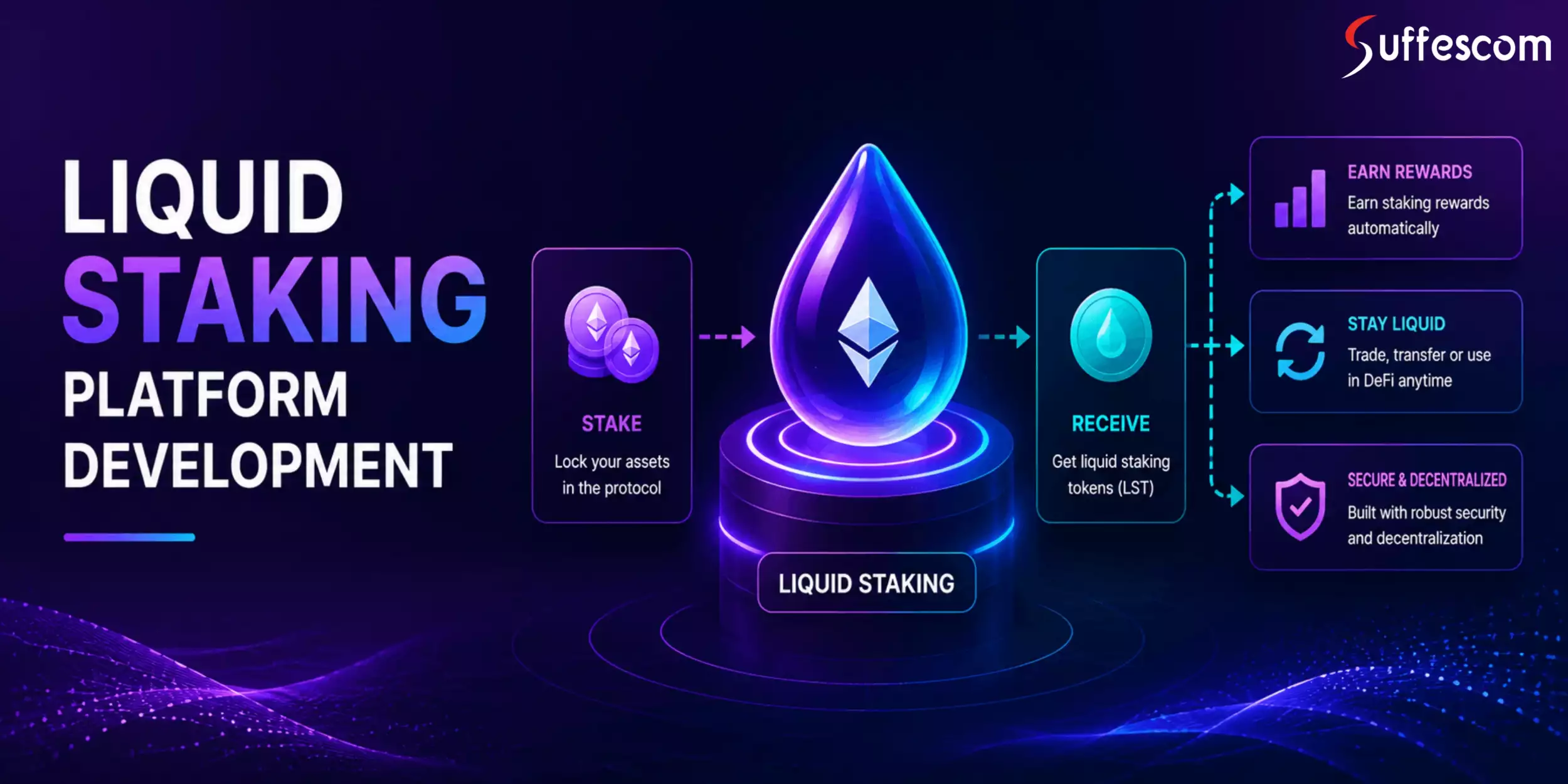
- A liquid staking platform issues users a liquid staking token (LST) in exchange for staked assets, so they keep earning rewards without losing liquidity.
- Non-custodial (smart-contract-governed) architecture is the stronger default for most new builds. Custodial fits mainly exchanges bolting staking onto an already-trusted brand.
- Restaking, redeploying an LST into actively validated services (AVSs) for a second layer of yield, is the main growth driver in this category right now and should be built in from day one, not retrofitted later.
- Development cost runs $20,000 to $100,000+, driven mainly by chain count, cross-chain bridging, validator distribution depth, and restaking integration, not surface features.
- Roughly two-thirds of build time sits in the smart contract layer: staking logic, LST issuance, validator selection, slashing protection, and third-party audits.
- A single-chain MVP typically takes 3 to 5 months from architecture through audited mainnet launch.
Want similar results? → Get a Free Quote
A liquid staking platform lets users stake crypto assets like ETH or SOL and receive a liquid staking token (LST) in return, a tradable receipt that represents the staked asset plus accrued rewards. The user keeps earning staking yield while still being able to trade, lend, or use that LST across other DeFi (decentralized finance) protocols. That single feature, liquidity without giving up yield, is why liquid staking has pulled billions of dollars in total value locked (TVL, the total dollar value of assets deposited in a protocol) away from plain staking over the past three years.
If you are evaluating whether to build one, this page covers the architecture choices, the real cost range by scope, where liquid staking is heading with restaking, and what we actually build for clients. No filler DeFi primer.
Who Actually Builds a Liquid Staking Platform, and Why
Three groups typically come to this decision for different reasons, and the right architecture depends on which one you are.
Exchanges and custodial platforms want to offer staking without losing user assets to a competitor's staking product. For them, liquid staking is a retention feature bolted onto an existing platform, and speed to market usually matters more than protocol purity.
New DeFi protocols and DAOs (decentralized autonomous organizations) want to launch an LST as their core product, competing directly with Lido or Rocket Pool on a specific chain or a specific niche (a single L2, a restaking-focused LST, an institutional-grade compliant LST). For them, the smart contract architecture and validator strategy is the product.
Institutional and fintech platforms need staking with compliance controls, custody options, and audit trails on top of the DeFi mechanics. For them, the LST is a wrapper around infrastructure that has to satisfy KYC (know your customer) and AML (anti-money laundering) requirements before it satisfies DeFi composability.
Suffescom builds for all three, but the architecture, the validator distribution model, and the smart contract audit scope differ meaningfully between them. That scoping conversation is where a real cost estimate starts, not the feature list.
Build A Next-Gen Liquid Staking Platform Today!
Empower your business with a well-crafted, secure and scalable platform embedded with outstanding functionalities. Hire our developers and transform the staking in the crypto realm.
How a Liquid Staking Platform Works
The mechanics are consistent across most implementations, with variation in custody and validator strategy:
1. A user deposits a supported cryptocurrency into the platform's staking contract.
2. The platform mints an LST at (or close to) a 1:1 ratio with the deposited asset.
3. The deposited asset is distributed across a set of validators, the network participants who validate transactions on a proof-of-stake blockchain in exchange for rewards.
4. Staking rewards accrue over time, reflected in the LST's exchange rate or in a rebasing balance, depending on the token model chosen.
5. The user can trade, lend, or deploy the LST in other DeFi protocols while the original asset stays staked and earning.
6. On unstaking, the user burns the LST to redeem the underlying asset, either instantly through a liquidity pool or after the network's native unbonding period.
What We'd Recommend Building in 2026
Most new entrants ask for a centralized, custodial model because it is faster to launch. We would not default there. A non-custodial (smart-contract-governed, no single party holding user funds) architecture with slashing protection (safeguards against validator penalties for downtime or misbehavior) and multi-validator distribution takes longer to build and audit, but it is what lets a platform integrate with the rest of DeFi without asking users to trust a custodian, and it is what makes the LST composable enough to matter past launch. Custodial makes sense for exchanges bolting staking onto an existing trusted brand. It is the wrong call for anyone trying to build an LST that other protocols will actually accept as collateral.
Restaking: Why This Isn't Optional Anymore
Restaking lets holders of an LST redeploy that already-staked asset into additional protocols, called actively validated services (AVSs), to earn a second layer of yield on top of base staking rewards. EigenLayer popularized this on Ethereum, and Symbiotic and other restaking protocols have extended the model to additional chains. This is the dominant growth story in the liquid staking category right now, and it changes what "done" looks like for a new platform.
An LST built without restaking compatibility in mind is a 2023-era product launching into a 2026 market. Practically, this means your smart contracts need clean integration points for AVS registration, your token standard needs to be compatible with the restaking protocols relevant to your target chain, and your risk model needs to account for slashing conditions that can now originate from more than one layer. We scope this in from the architecture phase rather than retrofitting it after launch, because retrofitting restaking support into an LST already in production usually means a second audit cycle.
Platform Types Compared
The platform can be categorized depending on the algorithm used, no. of pools, and supporting assets. We have mentioned the types; check them out below;
| Type | How it works | Best fit | Trade-off |
| Centralized (custodial) | A single entity holds staked assets and issues LSTs | Exchanges adding staking to an existing trusted brand | Fastest to launch, but users trust a custodian, and regulatory exposure is higher |
| Decentralized (non-custodial) | Smart contracts distribute assets across validators, no single custodian | New protocols competing on trust-minimization and DeFi composability | Higher build and audit cost, but the LST is more widely accepted as collateral |
| Natively integrated | LSTs are issued as a base-layer primitive of the protocol itself, no wrapping needed | Chains or L2s building staking into their core design (Lido on Ethereum is the reference example) | Deepest integration and lowest friction, but only viable if you control or deeply partner with the underlying chain |
| Single-pool vs. multi-pool | Single pool stakes one asset, multi-pool spreads staking across several assets or validator sets | Single pool for a focused launch, multi-pool for platforms diversifying risk or supporting several chains | Multi-pool adds smart contract complexity and a wider audit surface |
Top-Rated Liquid Staking Platform Development Services We Offer
Steer your business towards success with our quality services & develop an innovative and fully loaded platform that is easily scalable and manageable. As a trusted services provider, we help businesses of every size to get assistance in different ways.

Consulting and Architecture
Choosing custodial versus non-custodial, validator strategy, chain selection, and restaking compatibility before a line of code gets written.
LST Issuance and Tokenomics
Designing the token model (rebasing versus exchange-rate-based), mint and burn logic, and the peg mechanism that keeps the LST tracking the underlying asset.
Staking Portal
The user-facing application for depositing, tracking rewards, and unstaking, built for clarity since this is where user trust either holds or breaks.
Validator Distribution and Slashing Protection
Spreading stake across vetted validators and building in mechanisms that limit user losses if a validator is penalized.
Governance Token Development
For platforms that want protocol decisions (fee changes, validator whitelisting, treasury use) put to token-holder votes.
Cross-chain Bridge Development
For platforms that need staked assets on one chain to mint LSTs usable on another.
Reward and Yield Tooling
APY (annual percentage yield) and APR (annual percentage rate) calculation, which is a common enough need that we build it as a standalone offering too, our staking reward calculator development service covers this for platforms that want it decoupled from the core build.
Cost Breakdown
Liquid staking platform development runs from roughly $20,000 to $100,000+, and the honest answer to "why the range" is scope, not padding. Here is how that breaks down:
| Tier | Range | What's included |
| MVP, single chain | $20,000 to $40,000 | Single-pool staking, basic LST issuance, non-custodial or lightweight custodial model, single validator set, one smart contract audit |
| Mid-scope, multi-asset | $40,000 to $70,000 | Multi-pool staking, governance token, slashing protection, restaking compatibility, expanded audit scope |
| Enterprise, cross-chain | $70,000 to $100,000+ | Cross-chain bridge, institutional compliance layer (KYC/AML), multi-validator distribution, restaking integration across chains, multiple audit rounds |
Variables that move a project between tiers: number of supported chains, whether you need a cross-chain bridge, the depth of validator distribution, restaking integration, and how many audit rounds your risk tolerance requires. We scope this against your actual requirements rather than quoting off a feature checklist, because the difference between a $25,000 build and a $90,000 build is almost always architecture decisions, not surface features.
Accelerate Your Crypto Venture Business And Gain High ROI
Integrate innovative solutions like smart contracts, DeFi innovations, and cross-chain interoperability to deliver profitability and maximize returns to the optimum level.
Why Are Businesses Keen On Investing In Liquidity Stacking Platform Development?
Liquid staking tokens form the fundamental of increased liquidity that makes sure the users are completely engrossed with multiple DeFi protocols without unstacking the assets. LSTs are gaining momentum with time as they integrate staking rewards with liquidity, ensuring users are actively using their assets. For businesses, it acts as a high-end platform for trading, yield farming, and lending.
1. Increased User Engagement
With an intuitive platform, the users are expected to participate in the staking process, as there is no confusion or stress about the accessibility of the assets. It results in active participation and boosted engagement, leading to booming business growth.
2. Extensive Market Reach
Liquid staking helps in driving massive user traction as it also includes the ones who feel reluctant to lock their assets. Offering liquid staking solutions captivates a much bigger market across geographical boundaries. The target audience is expanded, featuring contemporary investors and those entrepreneurs who want to rank their businesses in this competitive market.
3. Massive revenue streams
Liquid staking platform helps businesses to earn revenue from diverse sources. Users are able to utilize their liquid tokens in different DeFi protocols, and along with that, the liquid staking itself receives a proportional amount of LSTs that can be traded. Therefore, it acts as the most profitable opportunity for businesses to gain high returns on investments.
4. Unlock Flexibility
Unlike traditional staking platforms, this allows the users to retain the liquidity of the tokens, making them trade freely, reinvest, and be used in DeFi apps. This uniqueness allows businesses to invest in such platforms and gain amplified popularity.
Sequential Steps Link With Liquid Staking Platform Development
Hire Suffescom, which will help you launch the platform seamlessly and with the utmost ease. Our developers will take care of the DeFi protocols and facilitate efforts to aid in liquid staking protocol development. Explore the key steps below to understand the intricacies and technical aspects.
1. Define Objectives
Initially, it's pivotal to clearly understand the objectives and the reasons behind developing a liquid staking platform. A clear roadmap needs to be created to incorporate the user's pain points and how they will benefit the users and the businesses. This will even involve deciding the features and tech stacks that need to be integrated, offering a dynamic experience and enhancing engagement.
2. Competitor Analysis
In this phase, the competitors are analyzed in terms of their strategies and what their platform offers. Whatever gaps are present in the market, they are identified and addressed, and the focus is on building a platform that resonates with the target audience.
3. Hire A Blockchain Expert
Partnering with an experienced company that deals with blockchain development is extremely necessary. Their professionals will ensure that all the quality standards are met rightly and will guide the businesses in selecting the blockchain platform and technical solutions required to make the liquid stacking protocol development convenient.
4. UI/UX Design
The platform without a user-friendly interface is incomplete. All the platform's elements and components should be easily navigable and visually attractive. This helps capture occupied users and generates significant traffic. The interface acts as a communication channel where users can effortlessly stake their cryptocurrencies and participate in enormous DeFi-related activities.
5. Backend Development
This stage is the backbone of the entire development process. It involves instilling the core technicalities like smart contracts, asset tokenization development, adding encryption protocols, creating cryptocurrency wallets, and other security attributes to stay relevant and add value to the platform.
6. Testing And Launch
Extensive testing techniques are executed on the liquid staking platform, which detects and removes abnormalities. This ensures that the performance, efficiency, and reliability meet the user expectations.
Why Work With Suffescom
We build the DeFi infrastructure underneath the LST, not just the staking portal on top of it. That includes:
- Non-custodial and custodial architecture, scoped to your regulatory and trust requirements
- Restaking-compatible smart contracts, built in from the architecture phase rather than added after launch
- Independent third-party smart contract audits before mainnet deployment
- Cross-chain bridge and governance token development for platforms that need them
- A staking reward calculator as a standalone tool or embedded in the portal
If your roadmap includes staking as one feature inside a broader DeFi product rather than the entire product, our DeFi staking platform development service covers the wider build, lending, yield farming, and liquidity provisioning alongside the staking layer itself.
FAQs
1. How much does it cost to build a liquid staking platform?
Most builds run $20,000 to $100,000+, depending on the number of chains supported, whether a cross-chain bridge is needed, validator distribution depth, and restaking integration. A single-chain MVP sits at the low end; a multi-chain enterprise build with institutional compliance sits at the high end.
2. Should a liquid staking platform be custodial or non-custodial?
Non-custodial is the stronger default for any platform trying to compete on trust-minimization or get its LST accepted as collateral across other DeFi protocols. Custodial makes sense mainly for exchanges adding staking to an already-trusted brand where speed to market outweighs the composability trade-off.
3. Do I need restaking support at launch?
Yes, or your architecture should at minimum leave clean integration points for it. Restaking through AVSs (actively validated services) is the primary growth driver in this category right now, and retrofitting it after mainnet launch typically triggers a second audit cycle.
4. How long does liquid staking platform development take?
A single-chain MVP with a non-custodial architecture typically takes 3 to 5 months, factoring in smart contract development, third-party audits, and testnet validation before mainnet launch. Multi-chain or cross-chain builds run longer.
5. What's the difference between liquid staking and regular staking?
Regular staking locks your asset for the staking period, full stop. Liquid staking issues you a tradable token (an LST) representing that staked asset, so you keep earning staking rewards while still being able to use, trade, or lend the LST elsewhere in DeFi.