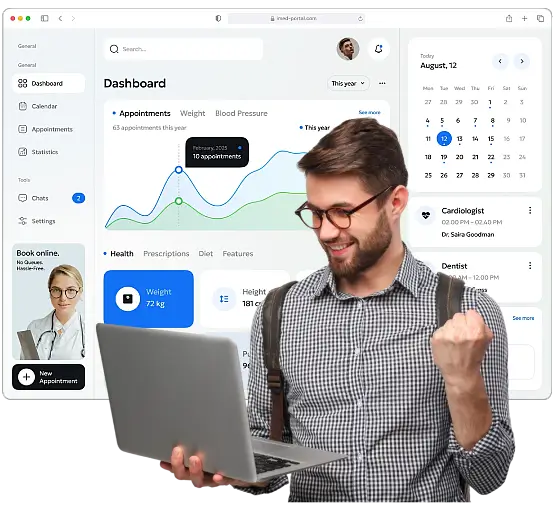
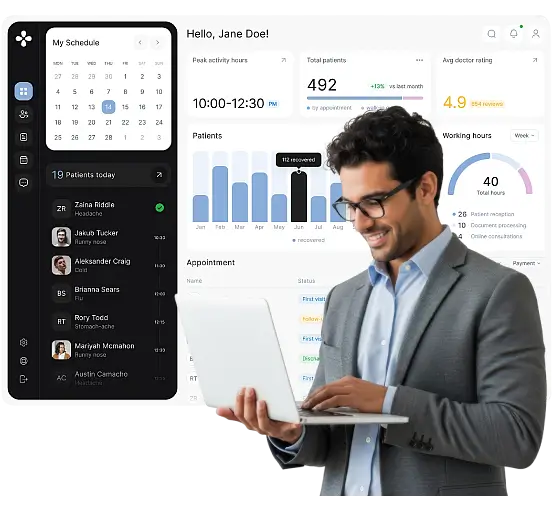
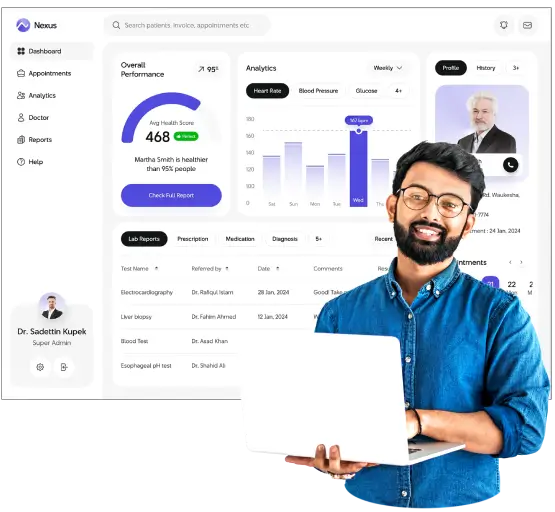
With over a decade of experience, we provide custom patient portal software development that is integrated with EHR/EMR systems. Empower your patients with secure access to medical records, appointment scheduling, telehealth, and billing, all within a user-friendly digital healthcare experience. Suffescom provides HIPAA-compliant patient portals that simplify coordination and patient care while reducing admin workload.
13+
Years of Experience
300+
Healthcare Projects
ISO 9001
Certified Partner
Featured on
Clutch & G2
Comprehensive Patient Portal Software Development Services
Our patient portal software development services are typically delivered as a set of interconnected solutions covering strategy, development, integration, and long-term evolution of the platform. Each service addresses a specific layer of the healthcare digital ecosystem, from patient-facing experiences to backend interoperability with clinical systems.
Custom Patient Portal Development
Suffescom specialises in custom patient portal software development, building feature-rich, HIPAA-compliant solutions that enhance patient engagement, streamline healthcare workflows, offer secure messaging and more.
Role-based dashboards for patients and providers
Personalized healthcare journeys
Multi-location and multi-specialty support
Web and mobile-first architectures
Modular feature expansion for future needs
Patient Portal Consulting and Strategy
Strategic consulting services for planning development roadmaps, evaluating designing and optimizing patient portal platforms to automate healthcare workflows, refine digital health goals, and meet interoperability requirements in healthcare.
Patient portal requirement analysis
Digital health and patient engagement strategy
EHR/EMR integration planning
UX and patient journey mapping
Regulatory compliance and security assessment
Scalable architecture and roadmap planning
Patient Portal UI/UX Design Services
Create intuitive, accessible, and patient-centric portal interfaces that simplify healthcare interactions, improve user engagement, and deliver seamless digital experiences across web and mobile platforms.
User research and usability analysis
Wireframing and interactive prototyping
Accessibility-first (WCAG-compliant) design
Patient-centric UX optimization
Responsive UI for web and mobile devices
EHR / EMR Integration Services
Connect patient portals with EHR/EMR systems and other healthcare systems, such as HIS, PMS, and HIE. Integrations services that enable secure clinical data exchange and automated record synchronization across the healthcare ecosystem.
HL7 and FHIR-based interoperability
Bi-directional data synchronization
Unified patient record access
Appointment and encounter data mapping
Clinical workflow alignment with existing hospital systems
Telehealth & Virtual Care Integration
Integration of telemedicine capabilities within patient portals to enable healthcare providers to deliver remote consultations and hybrid care experiences directly through patient portal platforms with secure communication and seamless clinical workflows.
Video consultations
Virtual waiting rooms
E-prescriptions and digital prescriptions
Post-consultation summaries
Integration with scheduling and billing systems
Medical Records & Data Management Systems
Secure and centralized medical records management solutions that consolidate patient health data from multiple healthcare systems into a unified and accessible platform.
Unified patient data view across systems
Lab results and diagnostic reports access
Medical history aggregation
Document upload and sharing
Encrypted data storage with encryption and audit trails
Healthcare Payment & Billing Integration
Development of secure financial modules within patient portals to streamline healthcare payments and insurance workflows, enabling transparent and secure transactions between patients and providers.
Next-generation AI-driven enhancements designed to improve patient engagement, automate healthcare workflows, and support smarter clinical decision-making within patient portal ecosystems.
Upgrading legacy healthcare portals into modern, scalable, and protected systems focused on high-performance digital healthcare platforms using modern technologies and cloud-native architecture.
Legacy system refactoring
UI/UX modernization
Cloud migration (AWS, Azure, GCP)
Performance optimization
Security and compliance upgrades
Core Feature Breakdown of Healthcare Patient Portal Development Solutions
Patient portal software functions integrate unified solutions while also keeping HIPAA, GDPR and HITECH regulatory requirements in mind for efficient management of patient data and secure communication.
Patient Management & Access Control
Centralize patient identity management with secure registration, role-based access, and advanced authentication. Protects sensitive healthcare data, simplifies access management, and ensures regulatory compliance across every user role.
• Digital onboarding and registration
• Patient profile and history management
• Role-based access for patients, caregivers, and providers
Focus: Ensures organized, and structured access to healthcare data.
Scheduling & Appointment Management
Automate appointment scheduling with self-service booking, real-time provider availability, and synchronized calendars. It reduces administrative workload, minimizes no-shows, and improves scheduling efficiency across healthcare facilities.
• Self-service appointment booking and rescheduling
• Provider calendar synchronization
• Automated reminders and follow-ups
• Waitlist and availability management
Focus: Reduces no-shows and improves operational efficiency.
Clinical Data & Health Records Access
Get secured access to electronic health records, laboratory results, diagnostic reports, prescriptions, visit summaries, imaging records, and medical documents through seamless EHR and EMR integration, keeping patient information available in a single location.
• EHR/EMR integration for unified records
• Lab results and diagnostic reports
• Prescription history and visit summaries
• Safe document storage and sharing
Focus: Enables patients to actively participate in their care journey.
Communication & Telehealth
Messaging, video consultations, virtual appointments, care team communication, document sharing, follow-up summaries, and patient-provider interactions, allows clinical communication to continue before, during, and after appointments.
• Encrypted messaging system
• Video consultations and virtual visits
• Post-visit summaries and follow-ups
• Care team collaboration tools
Focus: Improves accessibility and reduces dependency on in-person visits.
Billing & Financial Management
Streamlined financial workflows for transparent healthcare payments. Manages billing, online payments, insurance claims, invoices, payment history, outstanding balances, and financial records while integrating with existing billing systems for payment and reimbursement management.
• Online billing and payment processing
• Insurance claim tracking
• Payment history and invoices
• Integration with billing systems
Focus: Simplifies financial interactions between patients and providers.
Prescriptions & Medication Management
Streamline medication workflows with secure digital prescription management that improves access, accuracy, and patient adherence. Supports prescription requests, pharmacy integration, medication history, refill tracking, prescription status, and medication reminders.
• Prescription requests and renewals
• Pharmacy integration
• Medication tracking and support
• Dosage and refill reminders
Focus: Enhances treatment continuity and patient compliance.
Patient Engagement, Security & Administration
A unified module for patient engagement, platform security, and administration, including notifications, care plan tracking, patient feedback, role-based access, compliance monitoring, audit trails, encryption, system activity tracking, analytics, and reporting.
• Automated notifications and alerts
• HIPAA-compliant security & RBAC
• Audit logs & activity monitoring
Focus: Ensures secure, compliant, and data-driven healthcare operations.
Interoperability-Driven Integrations for Patient Portal Software Success
Patient portals achieve their full potential when they seamlessly integrate with the broader healthcare infrastructure. Suffescom develops interoperable portals that connect healthcare applications, eliminate data silos, automate information flow, and provide real-time access to accurate patient information across departments.
EHR & EMR System
Enable real-time synchronization of patient records, clinical notes, prescriptions, diagnoses, allergies, and visit histories between the patient portal and EHR/EMR systems for accurate, up-to-date healthcare information.
Laboratory Information System (LIS)
Provide instant access to lab orders, diagnostic reports, pathology results, and specimen tracking, allowing patients and providers to securely review test outcomes from a single portal.
Pharmacy & ePrescription System
Simplify medication management with electronic prescriptions, refill requests, prescription status tracking, pharmacy connectivity, and complete medication history access.
Telehealth Platform
Deliver virtual care through secure video consultations, digital prescriptions, virtual waiting rooms, appointment synchronization, and post-visit summaries within the patient portal.
Wearable & Remote Patient Monitoring
Capture real-time health data from wearable devices and remote monitoring systems, including heart rate, blood pressure, glucose levels, oxygen saturation, and activity tracking for continuous patient monitoring.
Healthcare CRM
Connect healthcare CRM platforms to automate patient communication, appointment reminders, follow-up campaigns, personalized engagement, and care coordination workflows.
Insurance & Revenue Cycle Management
Streamline insurance verification, eligibility checks, claims processing, billing, payment collection, and reimbursement workflows to improve financial transparency and operational efficiency.
Identity & Access Management
Strengthen portal security with Single Sign-On (SSO), Multi-Factor Authentication (MFA), OAuth, role-based access control, and centralized identity management for secure user authentication.
Medical Imaging & PACS
Integrate PACS and imaging systems to provide secure access to X-rays, MRIs, CT scans, ultrasounds, radiology images, and diagnostic reports directly within the patient portal.
AI & Clinical Decision Support
Leverage AI-powered assistants, predictive analytics, personalized health recommendations, intelligent scheduling, clinical alerts, and automated patient support to enhance care delivery and patient engagement.
Structured Development Process for Custom Patient Portal Software
A structured development process to create patient portal software aligns with automated healthcare workflows, regulatory requirements, and long-term business objectives while delivering a secure and seamless patient experience.
1.
Discovery & Business Analysis
Assess business goals, patient needs, compliance requirements, existing healthcare systems, and integration priorities to define the project scope and implementation roadmap.
2.
Solution Design & Prototyping
Create intuitive user journeys, information architecture, wireframes, and interactive prototypes that simplify patient-provider interactions across web and mobile platforms.
3.
Development & System Integration
Develop patient portal modules and integrate them with EHR/EMR systems, healthcare APIs, telehealth platforms, laboratory systems, pharmacies, and payment gateways using interoperability standards such as HL7 and FHIR.
4.
Quality Assurance & Compliance Testing
Validate functionality, usability, performance, interoperability, and security while ensuring compliance with HIPAA and other applicable healthcare regulations.
5.
Deployment & User Enablement
Deploy the solution within cloud, on-premises, or hybrid environments, migrate data, configure integrations, and support user onboarding for a smooth production launch.
6.
Ongoing Support & Optimization
Continuously monitor performance, strengthen security, introduce new features, and optimize the platform to meet evolving healthcare and patient engagement requirements.
Industry-Specific Use Cases of Patient Portal Software Development
Patient portal software is used across healthcare organizations to digitize patient interactions, streamline clinical workflows, and centralize healthcare data access across multiple care settings.
Clinics & Multi-Specialty Hospitals
Diagnostic Laboratories
Telehealth & Virtual Care Centers
Behavioral & Mental Health Clinics
Pharmacies & Medication Management
Multi-Location Healthcare Networks
When Does Your Healthcare Organization Need Custom Patient Portal Development Services?
Complex Healthcare Workflows
Support specialty-specific care pathways, custom clinical processes, and unique operational requirements that standard patient portals cannot accommodate.
Enterprise System Integrations
Connect seamlessly with EHR/EMR systems, laboratories, pharmacies, telehealth platforms, healthcare CRMs, and third-party applications.
Advanced Security & Compliance
Meet stringent HIPAA requirements with role-based access, encryption, audit trails, and secure patient data management.
Personalized Patient Experiences
Deliver branded portals with multilingual support, self-service capabilities, AI-powered assistance, and personalized patient engagement.
Multi-Location Healthcare Networks
Centralize patient interactions across hospitals, clinics, specialty centers, and provider groups through a unified platform.
Scalable Digital Healthcare
Build a future-ready solution that supports organizational growth, new healthcare services, remote patient monitoring, and emerging technologies.
Upgrade Your Hospital with a Custom Patient Portal Software Development!
Partner with Suffescom Solutions to build a HIPAA-compliant patient portal that enables secure communication, EHR integration, and seamless patient care management.
Compliance & Regulatory Standards for a Patient Portal Development Company
How Much Does It Cost to Build a Patient Portal Software?
The cost of custom patient portal development service varies based on the project's scope and complexity. A basic MVP typically costs between $30,000 and $50,000; a mid-level patient portal ranges from $50,000 to $80,000; and an enterprise-grade solution generally costs between $80,000 and $150,000+.
A basic patient portal with essential self-service features requires a lower investment, while enterprise-grade solutions with advanced interoperability, AI integrations, and custom workflows involve a higher development cost.
Need an Accurate Estimate for Your Patient Portal Project?
Choose Suffescom As Your Ideal Patient Portal Software Development Company
Building a successful patient portal requires the right balance of healthcare expertise, technical innovation, regulatory compliance, and seamless system integration. Suffescom, being the top company to build patient portal solutions, help healthcare organizations improve patient engagement, streamline clinical operations, and accelerate digital transformation.
Healthcare Domain Expertise
Develop patient portal solutions tailored to the unique workflows of hospitals, clinics, diagnostic laboratories, specialty care providers, and healthcare networks. Every solution is designed to align with evolving patient expectations, industry regulations, and organizational objectives.
Tailored Patient Portal Solutions
Every healthcare organization operates differently. Patient portals are custom-built to match specific clinical workflows, business processes, branding requirements, and patient engagement goals instead of relying on one-size-fits-all functionality.
Seamless Healthcare System Integration
Enable secure interoperability with EHR/EMR systems, healthcare CRMs, laboratory information systems (LIS), pharmacy platforms, telehealth solutions, billing software, and third-party healthcare applications using industry standards such as HL7 FHIR, and SMART on FHIR.
Security & Regulatory Compliance
Protect sensitive patient information with HIPAA-compliant software development practices, end-to-end encryption, multi-factor authentication, role-based access control, audit logging, and secure API architecture designed for modern healthcare environments.
AI-Driven Patient Experiences
Enhance patient engagement with AI-powered virtual health assistants, intelligent appointment scheduling, automated reminders, personalized healthcare recommendations, multilingual support, and workflow automation that improves both patient satisfaction and operational efficiency.
Scalable Cloud-Native Architecture
Build patient portals on flexible cloud infrastructure capable of supporting growing patient volumes, multiple healthcare facilities, expanding service offerings, and future technology integrations without compromising performance or security.
Agile Development & Transparent Delivery
Follow an agile development methodology with clearly defined milestones, regular progress updates, collaborative feedback cycles, and continuous quality assurance to ensure timely delivery and project transparency.
Long-Term Support & Continuous Improvement
Provide ongoing maintenance, security updates, feature enhancements, performance optimization, and technical support to ensure patient portal software continues to evolve alongside changing healthcare requirements and business growth.
Awards & Recognition for Delivering Software Development Excellence
At Suffescom Solutions, our commitment to building secure, intuitive, and HIPAA-compliant patient portal software has earned us industry recognition and the trust of healthcare providers worldwide. These awards reinforce our reputation as a reliable software development partner, delivering scalable digital healthcare solutions that improve patient engagement, streamline clinical workflows, and deliver exceptional care experiences.
What Our Clients Say
Max Collins
Clinical Operations Manager, Outpatient Clinic
What I appreciate most is how collaborative the entire process was. There were plenty of discussions, a few changes along the way, and some complex integration requirements, but nothing ever felt rushed. The team was patient, transparent, and easy to work with. Our staff adapted to the portal much faster than we expected, and patient feedback has been consistently positive since the rollout.
Emily Parker
Director of Digital Health, Regional Hospital
The integration with our EHR was the part we were most concerned about, but it went much more smoothly than we expected. Data synced correctly, and the transition was smooth.
Mark Anderson
Director of Information Technology, Multi-Specialty Hospital
To be honest, we expected the implementation to be much more disruptive than it turned out to be. We had multiple systems that needed to work together, and that was our biggest concern from day one. The team handled the integrations carefully, kept us informed throughout the project, and made sure our staff was comfortable before the portal went live. It's been several months now, and the portal has become part of our daily operations without any major issues.
T. Paul
Healthcare Operations Manager, Specialty Care Center
This wasn't our first software project, so we knew delays and last-minute changes were almost inevitable. What made this experience different was how openly everything was communicated. Whenever we requested changes or had questions, we got clear answers instead of vague promises. The end result feels stable, easy to use, and well suited to both our staff and our patients.
Frequently Asked Questions
What is patient portal software?
Patient portal software is a secure digital platform that enables patients to access medical records, schedule appointments, communicate with healthcare providers, view laboratory results, manage prescriptions, pay medical bills, and participate in virtual consultations. It integrates with EHR/EMR systems to provide a connected and convenient healthcare experience.
How much does it cost to develop a custom patient portal?
The cost of custom patient portal development varies based on scope and complexity. A basic MVP typically ranges from $30,000 to $50,000, a mid-level solution from $50,000 to $80,000, and an enterprise-grade platform from $80,000 to $150,000+.
Final cost depends on feature set, third-party API integrations, EHR/EMR connectivity, security and compliance requirements, deployment model, and ongoing maintenance and support.
How long does it take to develop a custom patient portal?
The development timeline typically ranges from 3 to 12 months, depending on the project's complexity, required features, third-party integrations, compliance requirements, and customization needs. A MVP takes from 3-5 months, 6-9 months for a mid-level solution, and an enterprise-grade patient portal with advanced interoperability and AI capabilities may require additional development time, around 9-12 months.
What features should a modern patient portal include?
A modern patient portal typically includes patient registration, appointment scheduling, EHR/EMR access, secure messaging, telehealth, prescription management, online payments, lab report access, notifications, document sharing, role-based access control, and analytics. Advanced portals may also include AI-powered virtual assistants, remote patient monitoring, and wearable device integration.
Can a patient portal integrate with existing healthcare systems?
Yes. Custom patient portals can integrate with EHR/EMR platforms, healthcare CRMs, laboratory information systems, radiology systems, telehealth platforms, pharmacy networks, payment gateways, insurance systems, and other third-party healthcare applications using standards such as HL7 FHIR, and SMART on FHIR.
x
Our website requires some cookies to function properly. Read our Privacy Policy to know more.
 +971-8000321216