Key Takeaways:
- AI pet translator app development combines machine learning, audio classification, and behavioural analysis to interpret possible meanings behind pet vocalisations.
- Dog translator and cat translator applications can analyse barks, meows, growls, whines, and other sounds to identify patterns associated with different situations.
- AI-powered features can include real-time sound recognition, pet emotion estimation, behaviour monitoring, personalised profiles, and translation history.
- Developing a pet translator app requires suitable animal sound datasets, trained AI models, mobile application architecture, cloud infrastructure, and continuous model improvement.
- The development cost depends on the number of supported animals, AI capabilities, application features, integrations, and infrastructure requirements.
Sometimes, pet owners attempt to decipher the messages that their pets are attempting to send in the form of barking, meowing, whining, growling, body language and other behaviours. Understanding the message that a pet is trying to send isn't always that easy; for example, a dog may bark because he is excited, frightened, nervous or trying to get our attention. And a cat's meow could mean anything.
So this opens a window for tech developers to help pet owners get a deeper understanding of their animals' communication. Thanks to AI, machine learning and audio recognition, developers can come up with apps that interpret and make sense of the sounds and actions of animals.
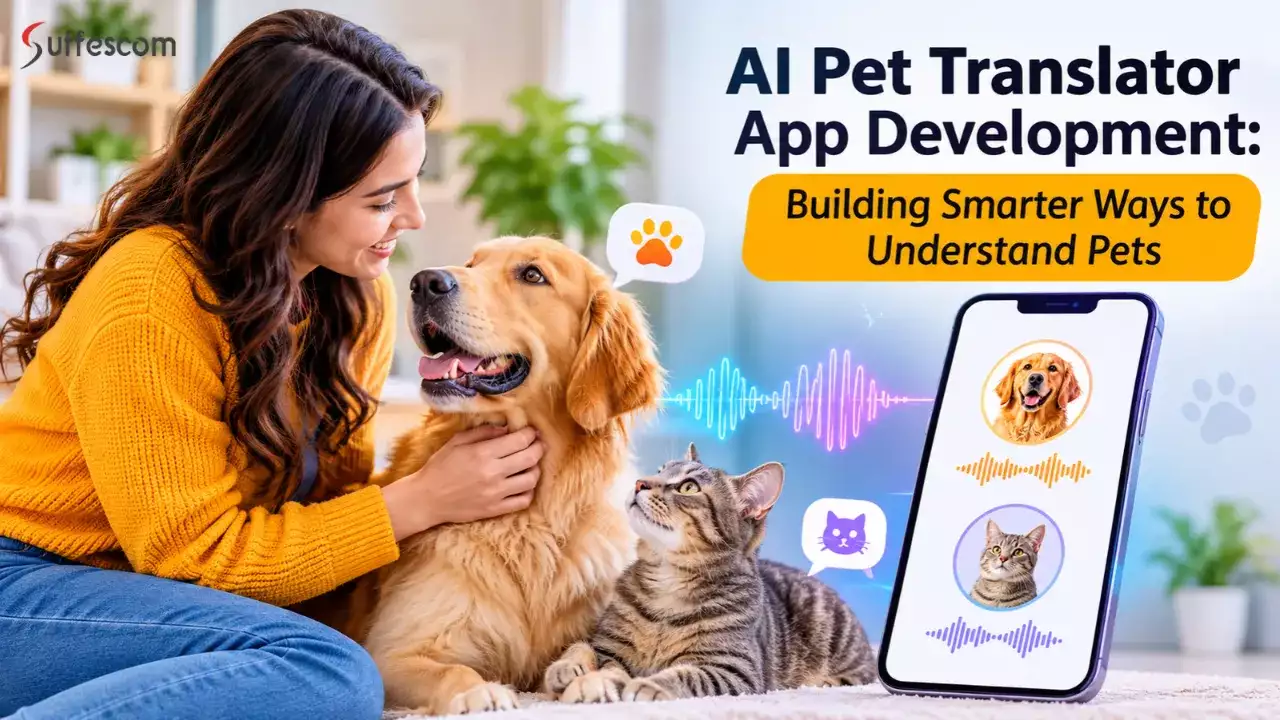
AI pet translator app development involves creating mobile applications that utilise machine learning algorithms to assess animal sounds to detect patterns and provide potential meanings of sounds in general terms. Based on the product, AI pet translation apps might also interpret visual signals and fluctuations in behaviour based on the pet's routine.
If a business plans on entering into the pet tech industry, then these applications give them options to take advantage of the subscription-based items, pet communication network, and AI-based pet care.
But one key difference: Today's AI system is not scientifically proven to translate animal language into words. Rather, it recognizes sounds, measures repetitions and/or similarities, and then calculates the probability for the best possible context. A good app would then relay that interpretation as a hypothesis.
Beyond Barks and Meows: Understanding AI Pet Translation App
An AI pet translator app is a mobile application that uses artificial intelligence to analyse animal sounds and, in some implementations, visual and behavioural signals. It helps pet owners understand possible reasons behind their pets' communication patterns.
Unlike conventional pet applications that focus on feeding schedules, veterinary appointments, grooming, or activity tracking, an AI pet translator focuses on interpreting communication signals.
The app for translating a dog might be able to examine how the dog barks and determine if a tone is more of an alert, attention, or stress type of sound. The cat's app might classify the meow into more general types for attention, requesting food, or discomfort.
The application can then display a simple interpretation, such as:
- Possible request for attention
- May be responding to an unfamiliar sound
- Vocalisation associated with excitement
- Possible discomfort or distress signal
- Repeated sound pattern that needs observation
The exact interpretation depends on the quality of the dataset, model performance, animal-specific information, and environmental context.
How Is an AI Pet Translator Different from a Regular Pet Care App?
A regular pet care application primarily helps owners manage daily responsibilities, whereas an AI pet translator focuses on understanding communication signals.
| Comparison Factor | Regular Pet Care App | AI Pet Translator App |
| Main purpose | Manage pet care activities | Interpret pet communication signals |
| Main purpose | Feeding reminders, appointments, tracking | Sound recognition and behaviour analysis |
| AI capabilities | Recommendations and predictive insights | Audio classification and signal interpretation |
| User interaction | Pet profiles, bookings, health records | Record sounds, analyse signals, review interpretations |
| Advanced integrations | GPS, wearables, payment systems | Microphones, cameras, audio and vision models |
Businesses can also combine these capabilities to create a broader pet care ecosystem with communication analysis, activity tracking, health records, and service access.
How Does an AI Pet Translator App Work?
An AI pet translator application works through a series of data collection, preprocessing, model inference, and interpretation steps. It captures a pet's sound, processes the recording, identifies relevant acoustic patterns, and generates a possible interpretation.
The application may also use information such as the animal's species, breed, age, previous recordings, and surrounding environment to improve contextual understanding.
Step 1: Capture Pet Sounds
The process begins when a pet owner records a sound using the smartphone microphone or an integrated pet monitoring device.
Depending on the application, the system can capture:
- Dog barks, growls, whines, and howls
- Cat meows, purrs, hisses, and trills
- Other supported animal vocalisations
- Repeated or unusual sound patterns
The application should provide a simple recording interface with controls to start, stop, replay, and submit audio for analysis.
Step 2: Process and Prepare Audio Data
Raw audio recordings may contain background noise, music, human speech, and other environmental sounds. These elements can affect the model's ability to identify the target animal vocalisation.
An audio preprocessing pipeline prepares the recording for analysis. It may include:
- Noise reduction and filtering
- Audio segmentation
- Volume normalisation
- Sample-rate conversion
- Silence detection
- Feature extraction
The processed audio is then converted into a representation suitable for the selected AI model. Depending on the architecture, this may include spectrograms, Mel-frequency cepstral coefficients (MFCCs), or learned audio embeddings.
Step 3: Identify the Animal and Vocalisation
The AI model processes your recording to see if it includes an animal sound it supports.
As an example, the system can differentiate between a dog bark and a human voice, noise or a sound from another animal. From there, it can also determine if the sound is a bark, yelp, squeal or bark.
In case of use for a cat translator, the model can be used to recognize your cat's meows, purrs, hisses or the like.
Depending on the quality of the recording and to further improve confidence, information can be output by the model as appropriate. If the recording is less than perfect or an unknown sound is heard in the recording then the application can prompt the user for another recording.
Step 4: Analyse Possible Meaning and Context
After identifying the vocalisation, the application evaluates its acoustic characteristics and available context.
For example, a dog bark may be analysed based on pitch, duration, repetition, intensity, and changes in sound patterns. The application can compare these characteristics with labelled training examples to estimate a likely category.
A more advanced system may combine audio with:
- Pet age and breed information
- Previous sound recordings
- Time and location context, where permitted
- Camera-based posture and movement observations
- Activity and wearable data
This helps the application provide more contextual interpretations instead of relying on a single sound in isolation.
Step 5: Generate a Human-Readable Interpretation
The model's output is converted into a simple message that pet owners can understand.
For example, instead of displaying a technical classification such as attention_seeking_vocalisation, the application might show:
"Your dog may be trying to get your attention."
Natural language generation can make these results easier to understand. However, the generated explanation must remain grounded in the model's actual output and should not introduce unsupported conclusions.
Step 6: Learn from Feedback and Improve Personalisation
Vocalisation is specific to each animal. Even your standard breed of pet may have their own unique way of speaking.
With the AI pet translator app, it would be up to the owner to comment on the translation. With time, this would help to individualise the experience and our knowledge of your pet.
For instance, if an owner has the dog associate a specific meow with food many times in the past, the app will use that feedback as context to inform subsequent predictions.
Personalisation must be taken with a pinch of salt. User feedback may be useful in adapting the recommendations, but should not be immediately treated as scientific training data.
Different Types of AI Pet Translator Applications
The development approach depends on the target animal, intended users, supported communication signals, and business model. Businesses can build specialised applications for dogs or cats or create a multi-pet communication platform.
Dog Translator App Development
A dog translator app analyses barking and other vocalisations to identify patterns that may indicate different behavioural contexts.
Possible features include:
- Bark classification
- Whining and growling recognition
- Howling pattern analysis
- Possible excitement or distress estimation
- Repeated vocalisation tracking
- Personalised dog profiles
For example, an application may identify repeated barking when a dog is left alone and suggest that the owner observe the animal's behaviour and surroundings. It should not automatically diagnose separation anxiety based on audio alone.
Cat Translator App Development
Cat translator applications focus on recognising different types of feline vocalisations and estimating their possible context.
Common capabilities include:
- Meow recognition
- Purring and hissing detection
- Vocalisation pattern analysis
- Attention-seeking signal classification
- Individual cat profile management
- Personalised sound history
Some applications also allow owners to correct or confirm broad interpretations, helping build a more personalised experience.
Multi-Pet Translator Applications
A multi-pet translator allows the user to have more than one species of pet in one software. The software can offer various profiles as well as interpretations for different species.
Dog and cat owners, for example, would be able to use one application to record and interpret the sounds produced by their pets.
For these reasons, the development team will have to take into consideration the following factors when building the model: differences in animals' sounds, the dataset, the model architecture, as well as the way it should be interpreted. For example, a model trained on dog barking won't work in the case of a cat meow.
Real-World Examples of AI Pet Translator Apps
There are several applications that are currently working on how to use artificial intelligence for a better understanding of animal sounds and behavior. They do this using different means such as analyzing meowing cats or barking dogs as well as recognizing visual signs. The following are some examples you may want to consider for your app.
1. MeowTalk – AI-Powered Cat Sound Interpretation
MeowTalk focuses on recognising and interpreting cat vocalisations. Its AI model analyses meows and classifies them into different intent categories, helping owners understand possible communication patterns. The app also supports personalised learning through user feedback and recorded sounds.
Development takeaway: Sound classification, personalised recognition, and recording history can form the foundation of a cat communication application.
2. VeriBark – AI-Based Dog Behaviour Analysis
VeriBark takes a visual approach to understanding dogs. It analyses uploaded videos to examine behavioural signals such as body posture, facial expressions, ear position, tail movement, and vocalisations. Based on these signals, the app provides possible interpretations and behavioural insights.
Development takeaway: Combining computer vision with audio analysis can provide a broader understanding of dog behaviour than sound recognition alone.
3. DogWOW – Interactive Dog Communication
DogWOW focuses on making dog-owner interactions more engaging. It analyses recorded dog barks and generates human-readable interpretations. The app also offers two-way interaction features that connect owner messages with dog-related sounds, along with AI-assisted training capabilities.
Development takeaway: Interactive communication, sound playback, and AI-generated responses can make a pet translator app more engaging for regular use.
4. Paworld – AI-Based Pet Mood Interpretation
Paworld uses photos and short videos to analyse visual signals associated with pet behaviour. Its AI features examine expressions, posture, and surrounding context to generate possible mood interpretations and personalised pet-voice responses.
Development takeaway: Photo and video analysis can extend an AI pet translator beyond audio recognition and create additional ways for owners to interact with their pets.
Must-Have Features for a Smarter Pet Translator App
An AI pet translator app should combine sound recognition, behavioural analysis, and simple communication tools to help pet owners understand their animals. The following features can form the core of the application.
1. AI-Powered Pet Sound Recognition
The application records and identifies animal vocalisations, including dog barks, growls, whines, cat meows, and purrs. AI models classify these sounds into supported categories while filtering background noise and unrelated audio.
2. Dog Bark and Cat Meow Interpretation
This feature analyses recognised vocalisations to estimate their possible meanings, such as attention-seeking, excitement, or discomfort. The app displays simple interpretations with appropriate confidence indicators rather than claiming literal translation.
3. Real-Time Sound Analysis
Users can analyse pet sounds directly through their smartphone microphone without manually uploading every recording. The application processes detected sounds and displays interpretations with minimal delay.
4. Pet Emotion and Behaviour Analysis
AI models analyse vocal patterns and behavioural signals to estimate possible emotional states, such as excitement, alertness, or anxiety. Advanced versions can combine audio with visual inputs, including posture, facial expressions, and movement.
5. Pet Profiles and Personalisation
Users can create individual profiles containing pet names, species, breeds, ages, and previous recordings. This information helps the application provide more contextual interpretations based on each pet's history.
6. Translation History and Audio Library
The application stores previous recordings, detected sound categories, and AI-generated interpretations. Pet owners can revisit these records to identify recurring vocalisation patterns and observe changes over time.
7. AI-Powered Recommendations
Based on detected sounds and behavioural observations, the app can provide contextual suggestions to pet owners. For example, it may recommend observing the pet's surroundings when repeated barking or unusual vocalisations are detected.
8. Push Notifications and Smart Alerts
Notifications can inform users about completed sound analyses, repeated vocalisation patterns, and new behavioural summaries. Customisable alerts help owners stay informed without receiving unnecessary notifications.
9. Multilingual Interface and Voice Output
The application can support multiple languages to make interpretations accessible to a wider audience. Text-to-speech functionality can also read AI-generated interpretations aloud.
10. Admin Dashboard and Analytics
An admin dashboard helps businesses manage users, pet profiles, subscriptions, and application activity. It can also provide analytics on feature usage, AI processing performance, user feedback, and technical issues.
How AI Models Make Pet Sound Recognition Possible
AI pet translator app development requires a combination of technologies for audio processing, pattern recognition, contextual analysis, and user interaction.
The exact technology selection depends on the supported animal species, available datasets, expected response time, and whether the application performs analysis on the device or through cloud services.
Machine Learning and Deep Learning
Machine learning models identify patterns in animal vocalisations and classify them into predefined categories.
A model can be trained using labelled recordings containing different types of animal sounds. During training, it learns acoustic patterns that help distinguish between categories.
Deep learning architectures such as convolutional neural networks (CNNs) can process spectrogram representations, while other neural network architectures can model audio sequences.
The selected approach depends on the dataset size, classification requirements, computational resources, and expected model performance.
Audio Classification and Signal Processing
Audio classification is one of the most important components of a pet translator application.
The system processes recorded sounds and extracts useful characteristics before passing them to a trained model.
Common techniques include:
- Short-time Fourier transform (STFT)
- Mel spectrograms
- MFCC feature extraction
- Audio segmentation
- Noise reduction
- Sound event detection
These techniques help models analyse the frequency, duration, intensity, and temporal patterns of animal vocalisations.
Natural Language Processing (NLP)
Natural language processing helps convert AI classification results into readable explanations.
For example, an audio model may identify a sound as a possible attention-seeking vocalisation. An NLP component can convert that output into a user-friendly message.
NLP can also support multilingual interfaces, search functionality, and conversational interactions.
The generated text should be based on the model's actual prediction and available context rather than inventing a detailed explanation of what the pet is thinking.
Computer Vision and Behaviour Recognition
Computer vision can extend an AI pet translator beyond sound recognition.
Using images or video captured through a smartphone or connected camera, the application can analyse visible behavioural signals, such as:
- Body posture
- Tail position and movement
- Ear position
- Facial expressions
- Movement patterns
- Interaction with surrounding objects
Combining audio and visual inputs can provide additional context for interpretation. However, camera-based predictions also require suitable datasets and validation across different breeds, environments, lighting conditions, and camera angles.
Generative AI for Conversational Pet Insights
Generative AI can make the application more interactive by explaining classification results in natural language.
For example, a user might ask:
"Why is my dog barking repeatedly?"
The application can use available sound classifications, pet profile information, and recorded observations to provide a contextual response.
A generative AI component can also:
- Summarise recent sound patterns
- Explain detected vocalisation categories
- Present behavioural observations
- Answer questions about application features
- Generate easy-to-understand activity summaries
For reliable results, the generative model should use structured outputs from the sound and behaviour analysis systems. It should not independently claim to know an animal's exact thoughts or diagnose medical conditions.
Technology Stack for Building an AI Pet Translator App
The technology stack should support mobile application performance, audio processing, AI inference, data storage, and secure communication between application components.
A possible technology stack includes:
| Technology Layer | Possible Technologies | Purpose |
| Mobile application | Flutter, React Native, Swift, Kotlin | Build Android and iOS applications |
| Backend development | Python, Node.js, Java | Manage APIs, users, and application workflows |
| AI and machine learning | PyTorch, TensorFlow, scikit-learn | Train and deploy sound classification models |
| Audio processing | Librosa, torchaudio, OpenCV for visual inputs | Process audio and visual data |
| Database | PostgreSQL, MongoDB | Store profiles, recording metadata, and application records |
| Cloud infrastructure | AWS, Google Cloud, Microsoft Azure | Host backend services and AI workloads |
| Object storage | Amazon S3 or compatible storage | Store audio and video files |
| Notifications | Firebase Cloud Messaging, APNs | Send alerts and updates |
| Analytics | Firebase Analytics, custom dashboards | Monitor engagement and application performance |
The final stack should be selected according to the product's requirements rather than using every technology listed above.
How to Bring an AI Pet Translator App to Life
Developing an AI pet translator application involves more than building a recording interface and connecting it to an AI model. The development process must address data collection, model training, mobile integration, application security, and continuous improvement.
Step 1: Conduct Market Research and Define the Product Scope
Begin by identifying the target audience, supported animal species, and primary problem the application will solve.
Businesses should evaluate:
- Whether the product will focus on dogs, cats, or multiple animals
- Whether it will analyse audio only or combine audio and video
- Which vocalisation categories the first version will support
- Whether AI processing will happen on-device or in the cloud
- Which regions and languages the application will support
- Whether the business model will use subscriptions, one-time purchases, or a freemium structure
Competitor analysis can also help identify existing features and gaps in the market.
Step 2: Define the MVP and Core Features
The minimum viable product (MVP) should focus on the features required to test the product concept.
A basic AI pet translator MVP may include:
- User registration and login
- Pet profile creation
- Audio recording and upload
- Basic sound classification
- Interpretation display
- Recording history
- User feedback
- Admin dashboard
Advanced features such as video-based behaviour analysis, wearable integrations, multilingual voice output, and generative AI can be introduced in later development phases.
Step 3: Collect and Prepare Animal Sound Datasets
The quality of an AI pet translator depends heavily on its training data.
Developers need animal vocalisation recordings that represent different species, breeds, ages, environments, and communication contexts.
The dataset preparation process includes:
- Collecting recordings from suitable sources with appropriate usage permissions.
- Removing corrupted, irrelevant, or low-quality audio.
- Identifying and labelling supported vocalisation categories.
- Separating training, validation, and testing datasets.
- Checking for data imbalance and duplicated recordings.
- Reviewing labels and annotations for consistency.
For example, a dog sound dataset should not contain only recordings of one breed or one recording environment. Otherwise, the model may perform poorly when exposed to unfamiliar dogs or background conditions.
Step 4: Develop and Train AI Models
Once the dataset is prepared, the development team selects suitable machine learning or deep learning models.
The training process involves:
- Audio feature extraction
- Model architecture selection
- Dataset splitting
- Model training
- Hyperparameter tuning
- Performance evaluation
- Error analysis
The model should be tested against recordings it has not seen during training.
Evaluation metrics may include precision, recall, F1-score, confusion matrices, and class-specific performance. These measurements help identify where the model makes incorrect predictions.
The team should also test recordings from different animals and environments to assess whether the model generalises beyond the training dataset.
Step 5: Develop the Mobile Application Interface
The mobile application should make sound recording and interpretation simple for pet owners.
The UI/UX design process can include:
- Home dashboard
- Pet profile screens
- Audio recording interface
- Sound analysis progress screen
- Interpretation results
- Recording history
- Settings and privacy controls
- Subscription and payment screens
The interface should clearly distinguish between a detected sound category and a possible interpretation. Users should not mistake AI-generated suggestions for verified translations.
Step 6: Integrate AI Models with the Application
The trained AI model must be integrated with the mobile application through an appropriate inference architecture.
Depending on the selected approach, the application may send recordings to a cloud API or run a lightweight model directly on the device.
The integration process should follow AI integration best practices, including:
- Audio upload and processing
- Model inference requests
- Response formatting
- Confidence scores
- Error handling
- API authentication
- Result storage
- Performance monitoring
The application should also handle incomplete uploads, unsupported audio formats, network failures, and recordings that do not contain recognisable animal sounds.
Step 7: Implement Backend and Cloud Infrastructure
The backend manages application data, user accounts, pet profiles, AI requests, subscription workflows, and communication between system components.
Cloud infrastructure may include:
- API services
- Authentication and access management
- Database services
- Audio storage
- AI inference endpoints
- Notification services
- Analytics and monitoring
The architecture should support increasing recording volumes and user activity without compromising application performance.
Step 8: Test the Application and AI Model
Testing should cover both software functionality and AI prediction quality.
Functional testing: Verify registration, pet profiles, recording, audio upload, history, and other application features.
AI model testing: Evaluate classification performance using unseen recordings and different recording environments.
Device testing: Check microphone access, audio quality, battery usage, and application compatibility across supported devices.
Performance testing: Measure model response time, API latency, concurrent requests, and cloud resource utilisation.
Security testing: Review authentication, access controls, data transmission, audio storage, and privacy settings.
Step 9: Deploy, Monitor, and Improve
After testing, the application can be deployed to the selected app stores and supported backend infrastructure.
Post-launch monitoring should track:
- Application crashes
- Audio processing failures
- AI prediction performance
- API response time
- User feedback
- Feature engagement
- Subscription activity
The development team can use these insights to improve the model, introduce new sound categories, refine the user experience, and release additional features.
Challenges in AI Pet Translator App Development and Their Solutions
Building an AI pet translator app presents several technical challenges because animal communication is complex and sound recordings can vary considerably.
Understanding these challenges early helps businesses establish realistic expectations and select appropriate development strategies.
1. Limited and Inconsistent Animal Sound Datasets
AI models require suitable training data to recognise animal vocalisations. However, recordings may differ in quality, environment, animal characteristics, and labelling standards.
A model trained primarily on recordings from one environment may struggle when analysing sounds captured in a busy home or outdoor setting.
How to address it: Build diverse datasets that include multiple animals, breeds, environments, and recording conditions. Establish consistent annotation guidelines and evaluate the model using recordings from animals and environments excluded from training.
2. Difficulty Interpreting Animal Communication
A single sound can occur in different situations. For example, barking does not always indicate aggression, and meowing does not always mean hunger.
The context surrounding a sound can significantly affect its interpretation.
How to address it: Combine sound classification with contextual information, pet profiles, owner feedback, and behavioural observations. Present results as possible interpretations and communicate uncertainty where the model cannot make a reliable prediction.
3. Background Noise and Poor Audio Quality
Smartphone recordings may contain traffic, television, human conversations, wind, and other environmental noise. These sounds can interfere with animal vocalisation recognition.
How to address it: Apply audio preprocessing, noise reduction, segmentation, and sound event detection. Include recordings with different noise conditions during model training and testing. Provide users with recording guidance when audio quality is insufficient.
4. Differences Between Individual Pets
Animals can have distinct vocalisation patterns. A sound that one dog produces when excited may have a different context for another dog.
A generalised model may not always account for these individual differences.
How to address it: Introduce individual pet profiles and allow owners to provide feedback on interpretations. Use personalisation techniques to adapt the experience while keeping a distinction between user-provided observations and scientifically validated labels.
5. Model Accuracy and Unreliable Predictions
An AI model may incorrectly classify a sound, particularly when it encounters unfamiliar vocalisations or recording conditions.
Presenting an uncertain result as a definite translation can mislead users.
How to address it: Evaluate class-specific model performance, use confidence thresholds, and provide an unclear or unknown category. The application should request another recording when the input is insufficient for a useful prediction.
6. Real-Time Processing and Application Performance
Real-time analysis requires efficient audio capture, processing, model inference, and result delivery. Large models and frequent cloud requests can increase response times and infrastructure costs.
How to address it: Optimise audio processing, use lightweight models for suitable on-device tasks, and apply cloud inference for more complex analysis. Monitor latency and resource usage across the complete processing pipeline.
7. Data Privacy and Recording Security
Pet translator applications may collect audio, video, device information, and user account details. Some recordings may also contain human voices or identifiable environmental information.
How to address it: Obtain clear permissions, minimise unnecessary data collection, encrypt data in transit and at rest, apply role-based access controls, and establish retention and deletion policies. Give users control over recordings and explain how their data is processed.
How Can AI Pet Translator Apps Generate Revenue?
Businesses can use different monetisation models depending on the target audience, application features, and expected user engagement.
Freemium Model
The application provides basic sound recognition and a limited number of daily analyses for free. Users can upgrade to access additional recordings, advanced interpretations, or personalised insights.
Subscription Plans
Monthly and annual subscriptions can provide access to premium features such as:
- Unlimited or higher-volume sound analysis
- Multiple pet profiles
- Advanced behavioural summaries
- Extended recording history
- AI-powered conversational insights
- Cloud-based storage
In-App Purchases
Users can purchase additional analysis credits, premium sound interpretation packages, or specialised training and educational content.
Affiliate Marketing
The application can partner with pet product brands, pet food providers, training services, and accessory retailers. Relevant recommendations can generate referral revenue when users purchase through affiliate links.
Sponsored Listings and Advertising
Pet-related businesses can promote relevant products and services through sponsored placements. Advertising should remain clearly labelled and should not interfere with the core user experience.
White-Label Licensing
Businesses can license a configurable pet communication application to pet care brands, veterinary service providers, or other organisations under their own branding.
The most suitable revenue model depends on the product's audience, operating costs, customer acquisition strategy, and the value of its premium features.
How Much Does AI Pet Translator App Development Cost?
The cost of AI pet translator app development depends on the application's feature set, supported animal types, AI model complexity, data requirements, integrations, and infrastructure.
A basic application that records and classifies a limited set of dog or cat sounds requires a different investment from a multi-pet platform with real-time analysis, computer vision, generative AI, and personalised model capabilities.
The following figures are indicative planning estimates, not fixed development quotations.
| Development Level | Estimated Cost (USD) | Possible Scope |
| Basic MVP | $25,000–$45,000 | User accounts, pet profiles, audio recording, basic sound classification, and history |
| Mid-Level Application | $45,000–$90,000 | Advanced sound analysis, personalised profiles, cloud AI integration, notifications, and subscriptions |
| Advanced AI Platform | $90,000–$180,000+ | Multimodal AI, video analysis, generative AI, real-time processing, multiple animal types, and advanced analytics |
Factors That Affect Development Cost
1. Number of Supported Animal Species
A dog-only translator requires a different dataset and model scope from an application that supports dogs, cats, and other animals. Each additional species can increase data collection, model training, testing, and maintenance requirements.
2. AI Model Development and Training
Using an existing suitable model may reduce initial development effort, while building custom models requires additional work involving dataset preparation, annotation, training, validation, and optimisation.
3. Real-Time Audio Processing
Real-time sound recognition requires efficient processing and infrastructure. On-device inference, cloud inference, and hybrid processing have different development and operating costs.
4. Computer Vision and Behaviour Analysis
Adding camera-based analysis increases the complexity of data processing, model development, device compatibility, and testing.
5. Third-Party Integrations
Integrations with cloud platforms, payment gateways, analytics services, pet wearables, and notification systems can affect the overall budget.
6. Security and Data Management
Audio and video storage, encryption, access management, consent workflows, and data retention controls add to development and infrastructure requirements.
7. Ongoing Maintenance and AI Model Improvement
After launch, businesses need to monitor application performance, maintain backend infrastructure, resolve technical issues, and evaluate model performance as new data becomes available.
For an accurate estimate, businesses should first define the supported animal types, expected number of users, AI capabilities, MVP features, and infrastructure requirements.
Future Opportunities in AI-Powered Pet Communication
AI pet translator applications can evolve beyond basic sound classification as audio models, computer vision, connected devices, and personalised AI systems improve.
Some potential development opportunities include:
Multimodal Pet Communication Analysis
Future applications can combine audio, video, and wearable data to provide more context when interpreting pet behaviour.
For example, a system may analyse a dog's vocalisation alongside its posture and activity patterns rather than relying only on the recorded sound.
Smart Wearable Integration
Connected collars, activity trackers, and other pet devices can provide information about movement, activity, and location.
Integrating these devices can help applications build a broader picture of a pet's daily behaviour and activity patterns.
Personalised AI Models
AI applications may increasingly adapt to individual pets using their recording history and owner feedback.
This can help identify recurring patterns and make interpretations more relevant to the specific animal.
AI-Based Behaviour Monitoring
Combining audio recognition with activity and visual analysis can help owners observe changes in their pets' routines.
The application may highlight unusual patterns for further observation, without treating them as medical diagnoses.
Conversational Pet Assistance
Generative AI can help owners ask questions about recorded sounds, review behavioural summaries, and understand application-generated insights.
These systems can also connect users with educational resources and appropriate pet care services when needed.
Why Choose Suffescom for AI Pet Translator App Development?
Building an AI pet translator application requires a combination of mobile engineering, AI integration, backend development, data processing, and cloud infrastructure. Businesses need a development approach that considers the complete product lifecycle, from initial planning and model selection to deployment and ongoing improvements.
At Suffescom, we provide AI development and custom application engineering services to help businesses turn product ideas into functional digital solutions.
Our approach to AI pet translator app development can cover:
Custom AI Application Development
We develop custom AI-powered applications based on the product's intended functionality, target audience, and technical requirements. This can include audio recognition, intelligent analysis, personalised insights, and AI-powered user interactions.
AI Model Integration and Data Processing
We help integrate suitable AI models and data-processing workflows into applications. Depending on the project scope, this can include audio classification, machine learning inference, data pipelines, and model integration.
Mobile Application Development
We build mobile applications with user-friendly interfaces, backend connectivity, and platform-specific functionality. Businesses can define their requirements for Android, iOS, or cross-platform development.
Cloud Infrastructure and API Integration
Our development approach can include cloud deployment, backend APIs, database, and third-party api integration to support application performance and scalability.
Ongoing Maintenance and Enhancements
After launch, we can support application updates, performance optimisation, integration improvements, and feature enhancements based on changing business requirements.
Businesses planning a broader digital product for pet owners can also explore our pet care app development solutions, which cover pet management, service booking, activity tracking, AI-powered features, and connected pet care experiences.
Planning to Build an AI Pet Translator App?
Discuss your project requirements with Suffescom and define a development roadmap aligned with your business goals.
Frequently Asked Questions (FAQs)
1. What Is AI Pet Translator App Development?
AI pet translator app development is the process of building a mobile application that uses artificial intelligence to analyse animal vocalisations and behavioural signals. It can identify sound patterns, classify possible communication categories, and provide contextual interpretations to pet owners.
2. How Does an AI Pet Translator App Work?
An AI pet translator app records animal sounds through a smartphone microphone or connected device. It processes the audio, extracts relevant features, and uses trained machine learning models to classify vocalisations. The application then displays a possible interpretation based on the model output and available context.
3. Can AI Translate Dog Barks into Human Language?
AI can analyse dog barks and classify them into broad categories associated with different contexts. However, it cannot reliably translate every bark into an exact human sentence. The results should be treated as possible interpretations rather than literal translations.
4. Can You Develop an AI Cat Translator App?
Yes. An AI cat translator app can be developed to recognise meows, purrs, hisses, and other vocalisations. Machine learning models can classify these sounds into broad categories and provide possible interpretations based on acoustic patterns and available context.
5. What AI Technologies Are Used in Pet Translator Apps?
Pet translator applications can use machine learning, deep learning, audio classification, signal processing, natural language processing, computer vision, and generative AI. The technology selection depends on whether the application analyses sound alone or combines audio with visual and behavioural information.
6. How Accurate Are AI Pet Translator Apps?
Accuracy depends on the quality and diversity of training data, model architecture, recording conditions, animal characteristics, and supported sound categories. Developers should evaluate models using unseen recordings and communicate uncertainty rather than claiming that every interpretation is correct.
7. How Much Does It Cost to Develop an AI Pet Translator App?
The estimated development cost can range from $25,000 to $45,000 for a basic MVP, $45,000 to $90,000 for a mid-level application, and $90,000 to $180,000 or more for an advanced AI platform. The final cost depends on AI capabilities, supported animal types, features, integrations, and infrastructure.
8. How Long Does It Take to Develop an AI Pet Translator App?
A basic MVP may take approximately 3–5 months, while a more advanced application can require 6–12 months or longer. The timeline depends on dataset availability, custom AI model development, feature complexity, integrations, testing, and deployment requirements.
9. Can an AI Pet Translator App Analyse Pet Behaviour?
Yes. An application can combine sound recognition with computer vision and other data sources to identify possible behavioural patterns. It may analyse posture, movement, facial expressions, and activity signals. However, these predictions should not be presented as definitive emotional or medical assessments.
10. Can AI Pet Translator Apps Work Without an Internet Connection?
Yes, if the application uses an appropriately optimised on-device AI model. Lightweight sound recognition can run directly on supported smartphones. More complex analysis may require cloud-based processing, so a hybrid architecture can support both offline and connected functionality.