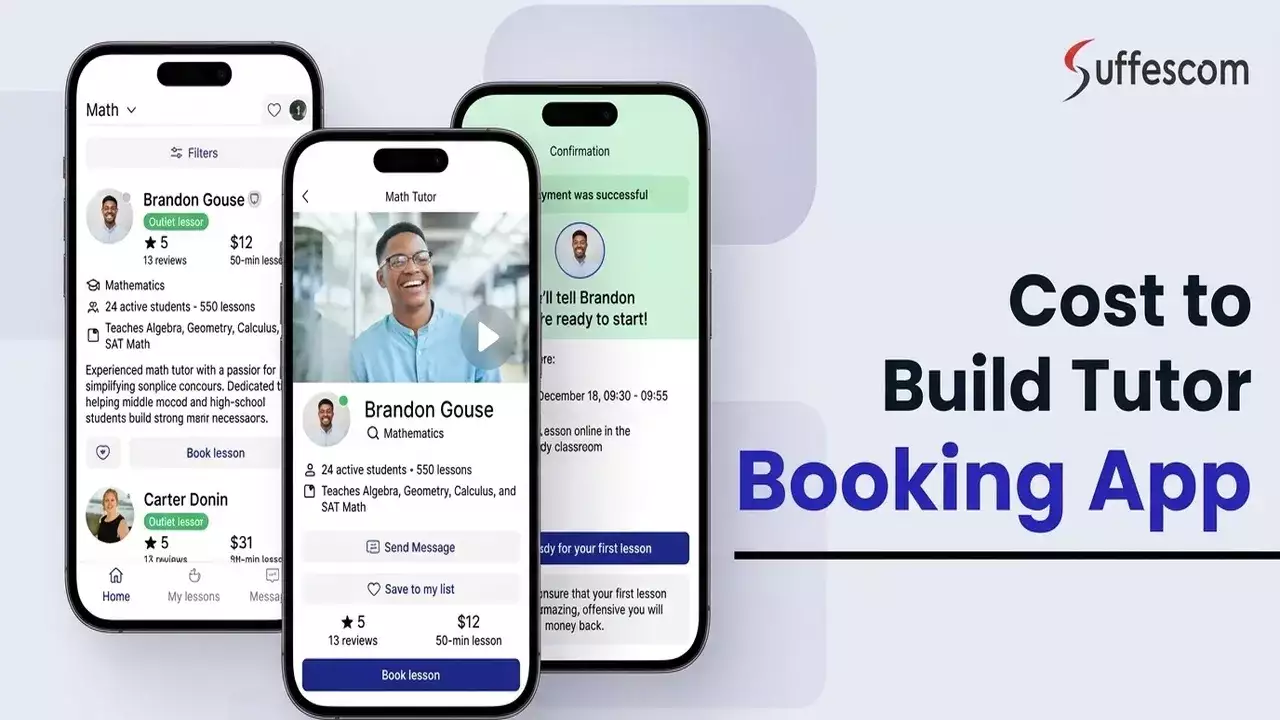
Online tutoring has changed how students access academic support, professional training, and personalised learning. Instead of depending entirely on physical coaching centres, learners can now find tutors, schedule lessons, attend virtual classes, and track their progress through digital platforms.
The growth of digital education reflects this opportunity. According to Statista's Online Education market forecast, global revenue is projected to reach US$280.99 billion in 2026, with a projected CAGR of 2.72% through 2031. Within this market, Online Learning Platforms are expected to generate US$40.58 billion in 2026, reaching US$46.16 billion by 2031.
For businesses planning to enter this market, the first consideration is the investment required to build a reliable tutoring application. The cost to build a tutor app can range from $25,000 to over $250,000, depending on its business model, user roles, learning features, integrations, and AI capabilities. This guide explains the cost of each development component and the expenses involved in launching and operating a tutoring platform in 2027.
Cost of Online Tutoring App Development
The cost to build a tutor app generally ranges from $25,000 to $250,000+, depending on the application's complexity, feature requirements, technology architecture, and level of customisation. A basic app with essential tutoring functionality requires a smaller investment, while advanced platforms with AI capabilities, real-time communication, and extensive integrations require a higher budget.
The estimated development costs can be divided into four levels:
Basic Tutor App ($25,000–$50,000)
A basic tutor app includes essential features such as student and tutor registration, profile management, tutor search, session booking, basic messaging, and payment processing. It is suitable for businesses launching an initial tutoring platform with a focused set of features. Development typically takes 3–4 months.
Medium Tutor App ($50,000–$100,000)
A medium-level application offers more advanced functionality, including live video classes, in-app chat, calendar synchronisation, tutor ratings, session management, notifications, and an administrative dashboard. It supports more detailed student and tutor workflows. Development generally takes 4–7 months.
Advanced Tutor App ($100,000–$180,000)
An advanced tutor app can include multiple user roles, interactive learning tools, group classes, recorded sessions, progress tracking, detailed analytics, subscription management, and custom integrations. Its architecture is designed to support more complex operations and growing user activity. Development may take 6–9 months.
AI-Powered Tutor App ($180,000–$250,000+)
An AI-powered platform incorporates capabilities such as conversational AI tutors, personalised learning recommendations, automated assessments, intelligent tutor matching, and performance analytics. Custom AI model development, data pipelines, and advanced integrations can further increase the investment. Development usually takes 8–12+ months.
| Tutor App Development Level | Estimated Cost | Estimated Timeline |
| Basic Tutor App | $25,000–$50,000 | 3–4 months |
| Medium Tutor App | $50,000–$100,000 | 4–7 months |
| Advanced Tutor App | $100,000–$180,000 | 6–9 months |
| AI-Powered Tutor App | $180,000–$250,000+ | 8–12+ months |
These figures are indicative planning estimates. The final budget depends on the selected features, application architecture, integrations, and development approach. The following sections break down how each factor influences the overall investment.
Key Factors That Affect Tutor App Development Cost
Tutor app development costs are influenced by several connected decisions. The business model determines the application architecture, while features, design, technology, integrations, and security requirements determine the engineering effort.
1. Application Type and Business Model
The type of tutoring application you plan to develop determines its user roles, workflows, booking processes, and overall feature requirements. A platform built for an individual tutor has a different development scope from a marketplace connecting thousands of students with multiple tutors.
Independent Tutor App ($25,000–$50,000)
This model is designed for an individual tutor or a small tutoring business managing its own students. It typically includes tutor profiles, student registration, class scheduling, online sessions, payments, and learning resources. Since it does not require a complex multi-vendor marketplace, the development scope is comparatively smaller.
Two-Sided Tutor Marketplace ($60,000–$120,000)
A two-sided marketplace connects students with multiple independent tutors through a single platform. It requires separate student and tutor accounts, tutor listings, search filters, booking management, payment processing, reviews, messaging, and administrative controls. Features such as tutor verification, commission management, and dispute handling add to development costs.
Tutoring Institution or Academy Platform ($50,000–$110,000)
This model supports coaching centres, tutoring companies, and educational institutions that manage multiple tutors, students, courses, and classes. It may include batch management, tutor allocation, attendance tracking, fee management, student progress reports, and role-based dashboards. The cost increases with the number of administrative workflows and institutional integrations.
Specialised Test-Prep or Language Learning Marketplace ($70,000–$140,000)
These platforms focus on specific learning categories, such as competitive exam preparation, language learning, or professional certification. Along with standard tutoring features, they may require practice tests, assessments, course materials, learning progress tracking, mock exams, and specialised learning tools. These additional requirements increase the development effort.
| Application Type | Suitable For | Key Functionality | Estimated Development Cost |
| Independent Tutor App | Individual tutors and small tutoring businesses | Student registration, tutor profiles, class scheduling, online sessions, payments, and learning resources | $25,000–$50,000 |
| Two-Sided Tutor Marketplace | Businesses connecting students with multiple independent tutors | Separate student and tutor accounts, tutor listings, search filters, bookings, payments, reviews, messaging, and tutor verification | $60,000–$120,000 |
| Tutoring Institution or Academy Platform | Coaching centres, tutoring companies, and educational institutions | Batch management, tutor allocation, attendance tracking, fee management, progress reports, and role-based dashboards | $50,000–$110,000 |
| Specialised Test-Prep or Language Learning Marketplace | Exam preparation, language learning, and professional certification businesses | Practice tests, assessments, course materials, progress tracking, mock exams, and specialised learning tools | $70,000–$140,000 |
2. Features and Functional Requirements
The number and complexity of features directly affect development time and cost. A platform with basic registration and booking workflows requires less engineering than one supporting live lessons, automated tutor matching, recurring payments, learning analytics, and AI-based recommendations.
The following estimates represent approximate costs for individual feature modules when developed as part of a custom platform.
| Feature Module | Estimated Development Cost |
| Student registration and profile | $2,000–$4,000 |
| Tutor registration and profile management | $3,000–$6,000 |
| Tutor search and filtering | $2,000–$5,000 |
| Booking and scheduling | $3,000–$7,000 |
| Video classroom and live sessions | $6,000–$15,000 |
| Chat and file sharing | $2,500–$6,000 |
| Payment and subscription management | $3,000–$7,000 |
| Reviews and ratings | $1,500–$3,500 |
| Admin dashboard and reporting | $4,000–$9,000 |
| Learning progress and analytics | $3,000–$8,000 |
These are indicative module-level estimates, not amounts that should automatically be added together. Shared backend services, authentication, design components, and integrations can reduce combined development costs.
3. UI/UX Design and Platform Complexity
The user interface influences how students discover tutors, compare profiles, book sessions, and participate in lessons. Tutors also need a convenient workspace to manage availability, communicate with learners, and review session details.
A basic interface with standard screens and reusable components may cost around $4,000–$8,000. A more customised design with separate student, tutor, and administrator journeys can range from $8,000–$15,000. Advanced interfaces with interactive classrooms, dashboards, accessibility requirements, and extensive prototyping may cost $15,000–$25,000+.
The number of platforms also matters. Developing an Android app, iOS app, and web application requires additional design and testing effort. Cross-platform development can reduce duplicated work, although device-specific functionality and performance testing are still necessary.
4. Technology Stack and Development Approach
The technology stack determines how the application handles user interactions, bookings, video sessions, payments, and learning data. The selection depends on performance requirements, expected traffic, developer expertise, and future expansion plans.
| Technology Layer | Possible Technologies | Cost Consideration |
| Mobile frontend | Swift, Kotlin, Flutter, React Native | Platform coverage and interface complexity |
| Web frontend | React, Next.js, Angular | Dashboards and responsive interfaces |
| Backend | Node.js, Python, Java, .NET | APIs, booking logic, and user management |
| Database | PostgreSQL, MySQL, MongoDB | User, tutor, booking, and learning records |
| Cloud infrastructure | AWS, Azure, Google Cloud | Hosting, storage, scaling, and backups |
| Real-time communication | WebRTC, video APIs | Live classes and interactive sessions |
For a standard tutor application, selecting established frameworks and managed cloud services can help control initial development costs. A more complex platform may require separate services for video sessions, payments, analytics, and AI processing.
Technology selection and architecture planning can account for approximately $5,000–$12,000 of initial engineering effort, depending on system complexity. This is a planning allocation within the overall project budget, not an additional mandatory charge.
5. Third-Party Integrations
Third-party integrations allow tutoring applications to use specialised services without developing every capability from scratch. Common integrations include payment gateways, video conferencing, calendar synchronisation, email and SMS notifications, analytics, and identity verification.
| Integration | Purpose | Estimated Integration Cost |
| Payment gateway | Session payments, refunds, and subscriptions | $1,500–$4,000 |
| Video conferencing API | Live tutoring sessions | $2,000–$6,000 |
| Calendar integration | Tutor availability and lesson scheduling | $1,000–$3,000 |
| Email and SMS services | Booking confirmations and reminders | $800–$2,500 |
| Push notifications | Lesson alerts and updates | $800–$2,000 |
| Analytics integration | Engagement and performance tracking | $1,500–$4,000 |
| Identity verification | Tutor and user verification | $1,500–$4,000 |
Integration costs depend on API documentation, authentication requirements, custom workflows, and testing. Third-party providers may also charge recurring fees, transaction charges, or usage-based rates separately from the initial integration work.
6. Security, Data Privacy, and Compliance
Tutoring platforms may process personal information, student profiles, tutor credentials, payment details, private messages, and learning records. Applications serving children or educational institutions may also need additional safeguards around parental consent, access permissions, and data handling.
Security development can include encrypted data transmission, secure authentication, role-based access, account recovery, audit logs, payment security, and backup systems. Depending on the platform's scope, initial security implementation and testing may cost approximately $3,000–$10,000.
Compliance requirements vary by operating region and user age group. For example, platforms serving users in the European Economic Area may need to consider GDPR, while US services collecting information from children under 13 may need to assess COPPA requirements. Payment processing must also follow the applicable PCI DSS responsibilities.
7. Development Team Location and Expertise
The development team's location, experience, and composition influence the overall project budget. A tutor application may require UI/UX designers, frontend and backend developers, mobile developers, QA engineers, cloud specialists, and project managers.
| Development Team Location | Indicative Hourly Rate |
| Eastern Europe | $35–$65 |
| Western Europe | $60–$110 |
| United States | $80–$150+ |
These are broad planning rates, not standard market prices. Actual rates depend on seniority, agency structure, project complexity, and engagement model.
A dedicated team can provide greater control over architecture, integrations, and future product updates. Businesses with a smaller initial budget may begin with a focused team and expand resources as the platform's requirements grow.
Hidden Expenses to Plan for Before Launching a Tutor App
The initial development budget does not cover every expense involved in operating a tutoring platform. Once users start booking lessons and attending classes, the business must account for infrastructure usage, video sessions, payment processing, maintenance, and customer support.
| Hidden or Recurring Expense | Indicative Cost |
| Cloud hosting and backend infrastructure | $100–$1,000+/month |
| Video and communication services | $100–$1,500+/month |
| Database, storage, and backups | $50–$500+/month |
| Maintenance and technical support | $500–$3,000+/month |
| Monitoring and analytics tools | $50–$400+/month |
| Customer support operations | Depends on team size |
| Payment processing | Provider and transaction dependent |
Actual recurring expenses depend on active users, lesson duration, video quality, file storage, transaction volume, and service-provider pricing. For example, a platform hosting thousands of video lessons will have different infrastructure requirements from one that mainly manages tutor bookings.
Businesses should also budget for marketing, tutor acquisition, customer onboarding, refunds, dispute handling, and app store-related expenses where applicable. These operational costs are separate from software development and can become significant as the marketplace grows.
AI's Impact on Tutor App Development Cost
AI in education is changing how tutoring platforms support learners, recommend educational content, and help tutors manage their work. In 2027, businesses can incorporate AI capabilities into different parts of the application, but the cost depends on the models, data, integrations, and level of customisation required.
AI Tutor Assistant and Conversational Learning
An AI tutor assistant can answer subject-related questions, explain concepts, provide practice questions, and guide students through learning activities. Developers can integrate large language models through APIs or build specialised systems using curated educational content and retrieval-augmented generation (RAG).
A basic AI assistant using an existing model API may add approximately $5,000–$12,000 to development. A more advanced assistant with subject-specific knowledge, conversation history, content retrieval, and safety controls may cost $15,000–$35,000+.
Personalised Learning and Recommendation Engines
AI-based recommendation systems can analyse student interests, learning progress, previous assessments, and subject preferences to suggest tutors, lessons, and study materials. This helps platforms move beyond generic course recommendations and provide more relevant learning experiences.
A basic recommendation module may cost $5,000–$12,000, while a more advanced system using behavioural data, learner profiles, and predictive models may require $15,000–$30,000+.
Automated Assessments and Learning Analytics
AI-powered assessment tools can evaluate selected answer types, generate practice exercises, identify knowledge gaps, and summarise student performance. For written responses, the system can provide feedback based on defined rubrics, with appropriate human review for high-stakes grading.
A basic automated assessment module may cost $6,000–$15,000. More advanced assessment and analytics systems with multiple question formats, reporting, and customised evaluation workflows can range from $15,000–$30,000+.
AI-Based Tutor Matching and Scheduling
AI can help match students with tutors by analysing subject requirements, availability, learning preferences, language, experience, and ratings. Predictive scheduling can also help platforms identify suitable time slots and reduce booking friction.
A basic matching feature may add $4,000–$10,000, while advanced matching models with multiple ranking signals and continuous optimisation may cost $12,000–$25,000+.
AI cost consideration: These estimates cover development and integration, not ongoing model usage. API calls, token consumption, vector databases, model hosting, monitoring, and content preparation can create recurring expenses. Human oversight is also important when AI provides educational guidance or evaluates student work.
Steps to Develop a Tutoring App With Cost Breakdown
Developing a tutoring application involves more than building student and tutor interfaces. The process includes validating the business model, planning learning workflows, designing the platform, developing its backend, integrating external services, and testing real-world tutoring scenarios.
1. Market Research and Requirement Planning
Begin by identifying the target learners, subjects, tutor categories, geographical markets, and business model. Define whether the platform will support tutor booking, live classes, group sessions, subscriptions, or a multi-tutor marketplace.
This stage also establishes the functional scope, user roles, technical requirements, and initial product roadmap.
Estimated cost: $2,000–$5,000.
2. UI/UX Design and Prototyping
Create user journeys and interface prototypes for students, tutors, and administrators. Design key screens such as registration, tutor discovery, booking, payment, virtual classrooms, and learning dashboards.
Validate the prototypes before development to reduce usability issues and avoid expensive changes later.
Estimated cost: $4,000–$12,000.
3. Frontend and Backend Development
Develop the mobile or web interfaces alongside backend services for authentication, profiles, tutor availability, bookings, payments, and notifications. Build the administrative dashboard to manage users, tutors, transactions, and platform activity.
The engineering scope depends on the number of applications and workflows included in the first release.
Estimated cost: $12,000–$30,000.
4. Learning Features and Third-Party Integrations
Implement the main tutoring workflows, including scheduling, live sessions, chat, file sharing, payment processing, and calendar synchronisation. Integrate video and communication services based on the expected class size and lesson requirements.
Additional features such as digital whiteboards, lesson recordings, and learning analytics increase development effort.
Estimated cost: $8,000–$25,000.
5. Security, Quality Assurance, and Testing
Test registration, tutor verification, bookings, payment transactions, cancellations, refunds, and live classes. Conduct usability, performance, compatibility, and security testing to identify issues before launch.
Verify that user permissions, student records, and payment workflows operate correctly across supported devices.
Estimated cost: $4,000–$10,000.
6. Deployment and Launch Preparation
Prepare production infrastructure, configure monitoring and backups, complete app store submissions where required, and deploy the web application. Set up support workflows and analytics to monitor platform performance after launch.
The team should also prepare release documentation and an initial maintenance plan.
Estimated cost: $2,000–$6,000.
These stage-level estimates are illustrative allocations for a focused custom application. The actual project budget depends on the selected application type and whether advanced modules are included. They should not be added mechanically to the application-type estimates, as some activities and integrations overlap.
Build vs. Buy: What Is Ideal for Your Online Tutoring Platform?
Businesses planning to launch a tutoring platform can choose between custom development, white-label software, and ready-made tutoring solutions. The right approach depends on budget, launch timelines, ownership requirements, and the level of control needed over the learning experience.
| Approach | Indicative Initial Cost | Flexibility | Best Suited For |
| Ready-made software | $500–$5,000+ | Limited | Small tutoring businesses testing demand |
| White-label solution | $5,000–$30,000+ | Moderate | Businesses launching with standard workflows |
| Custom development | $25,000–$250,000+ | High | Businesses building differentiated platforms |
Ready-Made Tutoring Software
Ready-made software offers existing tools for scheduling, student management, payments, and lesson administration. It can help individual tutors and small education providers start quickly without managing a full software development project.
However, custom workflows, advanced marketplace features, and ownership of the underlying platform may be limited. Subscription charges and provider restrictions should also be considered.
White-Label Tutoring Platform
A white-label solution allows businesses to launch a branded tutoring application using an existing software foundation. It can reduce initial development time and provide standard functionality such as tutor profiles, bookings, and online classes.
The trade-off is that customisation, integrations, data control, and scalability may depend on the provider. Businesses should review licensing terms, source-code ownership, and recurring fees before selecting this model.
Custom Tutor App Development
Custom mobile app development gives businesses control over application architecture, user journeys, integrations, feature roadmaps, and platform ownership. It is suitable for companies building a multi-tutor marketplace, specialised learning product, or AI-enabled tutoring application.
Although the initial investment is higher, custom software can support differentiated features and long-term product expansion. Businesses can also release an MVP first and introduce advanced capabilities as user demand becomes clearer.
Smart Ways to Manage Tutor App Development Costs While Maintaining Quality
To control development expenses without compromising the application's performance, security, or user experience, businesses need to make informed decisions at every stage. The following strategies help prioritise essential functionality, reduce unnecessary engineering work, and manage long-term operating costs.
1. Start With a Clearly Defined MVP Scope
Define the core problem your tutoring application needs to solve and plan MVP development around its primary user journey. Start with essential features such as student registration, tutor profiles, search, session booking, payments, and basic communication.
Avoid adding advanced analytics, AI recommendations, or complex learning tools during the initial release unless they are central to the business model. This keeps the first development phase manageable and allows you to validate demand before expanding functionality.
2. Prioritise Features Based on User Demand
Not every requested feature needs to be part of the first release. Gather feedback from students, tutors, and administrators to identify which capabilities directly improve the learning and booking experience.
For example, reliable video sessions and convenient scheduling may be more important initially than gamification or advanced reporting. Prioritising high-value features helps allocate the development budget where it creates the greatest user benefit.
3. Use Third-Party Services for Standard Functionality
Building every feature from scratch can increase development time and costs. Consider established third-party services for payments, video conferencing, calendar synchronisation, notifications, and identity verification.
For example, integrating an existing video communication SDK can be more practical than developing a complete video conferencing system. Evaluate subscription charges, usage limits, security standards, and API dependencies before selecting a provider.
4. Develop and Release the Application in Phases
Instead of building every planned feature in one development cycle, divide the project into manageable releases. Launch the essential application first, collect user feedback, and introduce additional capabilities based on actual usage patterns.
This approach helps businesses manage investment over time, identify usability issues earlier, and avoid spending on features that users may not need.
5. Invest in Testing Early
Resolving defects during development is generally less expensive than fixing major issues after launch. Include functional, performance, compatibility, and security testing throughout the development lifecycle.
Pay particular attention to booking workflows, payment transactions, live sessions, user permissions, and student data handling. Early testing reduces the risk of expensive rework and helps maintain a reliable learning experience.
Overcoming the Technical and Operational Challenges of Tutor App Development
Developing a tutoring application involves more than building student and tutor interfaces. Businesses must address technical and operational challenges related to live learning, tutor quality, scheduling, payment processing, and data protection. Addressing these issues early helps create a reliable learning environment and reduces costly changes after launch.
1. Maintaining Reliable Live Learning Experiences
Video interruptions, audio delays, connection drops, and poor streaming quality can disrupt online classes. These issues become more difficult to manage when multiple students attend live sessions simultaneously.
How to address it: Integrate reliable video conferencing SDKs, implement adaptive streaming, and provide session reconnection options. Test video and audio performance under different network conditions before launching the application.
2. Verifying Tutor Credentials and Maintaining Quality
Unverified tutor profiles, misleading qualifications, and inconsistent teaching quality can reduce student confidence in the platform. Maintaining a reliable pool of tutors is essential for building long-term user trust.
How to address it: Implement tutor verification workflows that support identity checks, qualification uploads, and profile approval. Include student reviews, ratings, and reporting mechanisms to maintain accountability.
3. Managing Tutor Availability and Scheduling Conflicts
Tutors may manage multiple students and work across different time zones. Without accurate availability management, double bookings, missed sessions, and scheduling conflicts can affect the learning experience.
How to address it: Develop synchronised calendars with real-time availability updates, automated reminders, time-zone conversion, and rescheduling options. Ensure booking slots are updated immediately after a session is confirmed.
4. Securing Online Payments and Tutor Payouts
Tutoring marketplaces handle student payments, subscriptions, refunds, platform commissions, and tutor payouts. Managing these transactions accurately becomes challenging when multiple payment methods and currencies are involved.
How to address it: Integrate established payment gateways with secure transaction processing. Implement payment status tracking, automated commission calculations, refund workflows, and transaction records to improve financial transparency.
5. Protecting Student Information and Learning Records
Tutor apps may store personal details, payment information, academic records, learning progress, and communication history. Unauthorised access or data exposure can affect user trust and create compliance risks.
How to address it: Apply encryption, role-based access controls, secure authentication, and regular vulnerability testing. Establish appropriate data retention policies and follow applicable privacy requirements in the markets where the application operates.
Maximizing Revenue: Monetization Models for Online Tutoring Marketplaces
A tutoring marketplace needs a revenue model that supports platform operations while remaining attractive to both tutors and learners. Businesses can combine several monetisation methods depending on their audience, lesson formats, and service positioning.
Commission on Tutor Bookings
The platform can deduct a percentage from every completed tutoring session. For example, if a student pays $40 for a lesson and the marketplace charges a 15% commission, the platform earns $6 before payment processing and other operating expenses.
Tutor Subscription Plans
Tutors can pay monthly or annual fees to access premium features such as enhanced profiles, advanced analytics, priority visibility, or additional scheduling tools. Subscription tiers can be structured around tutor activity and business needs.
Student Memberships
Offer students paid plans that include benefits such as discounted sessions, priority tutor matching, learning reports, or bundled lesson credits. Membership pricing should reflect the actual value delivered rather than restricting essential learning access.
Pay-Per-Session and Lesson Packages
Students can purchase individual lessons or bundles of sessions. Package pricing can encourage repeat bookings and provide more predictable revenue, while tutors receive payments based on completed sessions and the marketplace's commission rules.
Institutional and Corporate Plans
Tutoring platforms can offer dedicated plans to schools, colleges, training providers, and businesses. These plans may include bulk learner accounts, tutor management, progress reporting, administrative controls, and customised learning programmes.
Premium Learning Services
Additional revenue can come from exam preparation programmes, specialised courses, recorded lessons, certification support, and premium learning resources. These offerings can extend the platform beyond one-to-one tutoring and create additional reasons for users to return.
Power Your Online Tutoring Platform With Suffescom's Development Expertise
Building a tutoring application requires a combination of education-focused workflows, scalable software architecture, secure payment systems, and engaging user experiences. The development scope should reflect your target learners, tutor network, business model, and expected platform growth.
Suffescom Solutions provides mobile app development, software engineering, AI development, and product engineering services to help businesses turn digital product ideas into functional applications. From an initial tutoring MVP to a multi-user learning marketplace, the development approach can be aligned with your product requirements and budget.
Whether you are planning to build a tutor booking application, a live-learning platform, or an AI-powered tutoring solution, define your core requirements before committing to a development budget. A well-scoped first release can help validate demand and guide future investment.
Frequently Asked Questions
1. How much does it cost to build a tutor app?
The cost to build a tutor app can range from $25,000 to $250,000+. A basic booking application may cost $25,000–$50,000, while a live tutoring platform can require $50,000–$100,000. Advanced marketplaces and AI-powered applications generally require larger budgets.
2. How long does it take to develop an online tutoring app?
A basic tutor booking app may take around 3–4 months to develop. A live tutoring platform or marketplace can take 4–9 months, while an advanced AI-powered platform may require 8–12 months or longer depending on integrations and testing.
3. What are the essential features of a tutor app?
Core features include student and tutor registration, tutor profiles, search and filtering, availability management, lesson booking, payments, notifications, and an admin dashboard. Live-learning platforms may also require video sessions, chat, screen sharing, and digital whiteboards.
4. How much does it cost to add live video classes to a tutor app?
Adding live video classes can cost approximately $6,000–$15,000 for development and integration. The final amount depends on video quality, session controls, screen sharing, recording, group classes, and whether the application uses a third-party video API or custom WebRTC infrastructure.
5. Is it expensive to build an AI-powered tutor app?
An AI-powered tutoring application can cost approximately $120,000–$250,000+ depending on its capabilities. A basic AI assistant is less expensive than a platform with personalised learning, automated assessments, subject-specific knowledge, and custom recommendation models.
6. Can I build a tutoring app with a limited budget?
Yes. Businesses can start with an MVP that includes student registration, tutor profiles, search, booking, payments, and basic administration. Launching with essential workflows helps validate demand before investing in live classrooms, AI capabilities, and advanced analytics.
7. How do tutoring apps make money?
Tutoring applications commonly earn revenue through commissions on completed lessons, tutor subscriptions, student memberships, lesson packages, and institutional plans. Some platforms also charge for premium learning resources, specialised courses, and additional services.
8. Should I build a custom tutor app or use a white-label solution?
A white-label solution can suit businesses that want to launch quickly with standard tutoring features. Custom development is more appropriate when the platform needs unique workflows, advanced integrations, greater control over its architecture, or long-term product differentiation.
9. What technologies are used to develop a tutor app?
Common technologies include Flutter, React Native, Swift, and Kotlin for mobile development; React and Next.js for web interfaces; and Node.js, Python, Java, or .NET for backend services. PostgreSQL, cloud infrastructure, video APIs, and payment integrations support the platform's core operations.
10. What ongoing costs should I consider after launching a tutor app?
Ongoing expenses include cloud hosting, video API usage, database storage, maintenance, security updates, payment processing, customer support, and marketing. These costs vary with the number of users, lessons, transactions, and the services integrated into the platform.