D2C Subscription Marketplace
Microservices
Node.js · PostgreSQL · Redis · AWS
Production-Ready
About the Client
The client set out to build the first AI-driven platform in the market for truly personalized meal plans — letting users define exact macro targets, down to the per-meal level, and receive AI-generated recipes engineered to hit those specs.
A generative AI engine produces unlimited recipes across 15 diet types, while an integrated calculator derives daily requirements from age, weight, height, activity level, and fitness goals — with custom macro splits per meal, a feature unique to the market.
The business model is a D2C subscription meal delivery service — 2–3 meals a day, 2–6 days a week, across 1–4 week plans — currently serving Dubai, Abu Dhabi, and Sharjah.
Diet Types Supported
Keto
Diabetic-Friendly
Dairy-Free
Gluten-Free
Platform Roles
The Challenge
Building a production-ready AI meal platform required solving five interconnected challenges:
Producing nutritionally valid recipes that precisely match user macro targets across 15+ diet types, with unlimited variety. LLM-based generation is prone to hallucinated ingredients and structural failure rates above 25%, demanding careful retries and token cost management.
Every generated meal has to be checked against exact targets calculated via the Harris-Benedict equation and activity multipliers — with zero tolerance for silent errors slipping through.
Users refresh suggestions indefinitely with no duplicates allowed. An average session generates 15–20 recipes across 40+ refresh operations, all needing to stay novel.
The platform connects to USDA FoodData Central's 83,000+ foods, Stripe and PayPal, Twilio and SendGrid, logistics APIs, and Google Health Connect — each with its own reliability quirks to design around.
The Solution
AI GENERATION
MACRO ENGINE
RECIPE EXPLORATION
Architecture
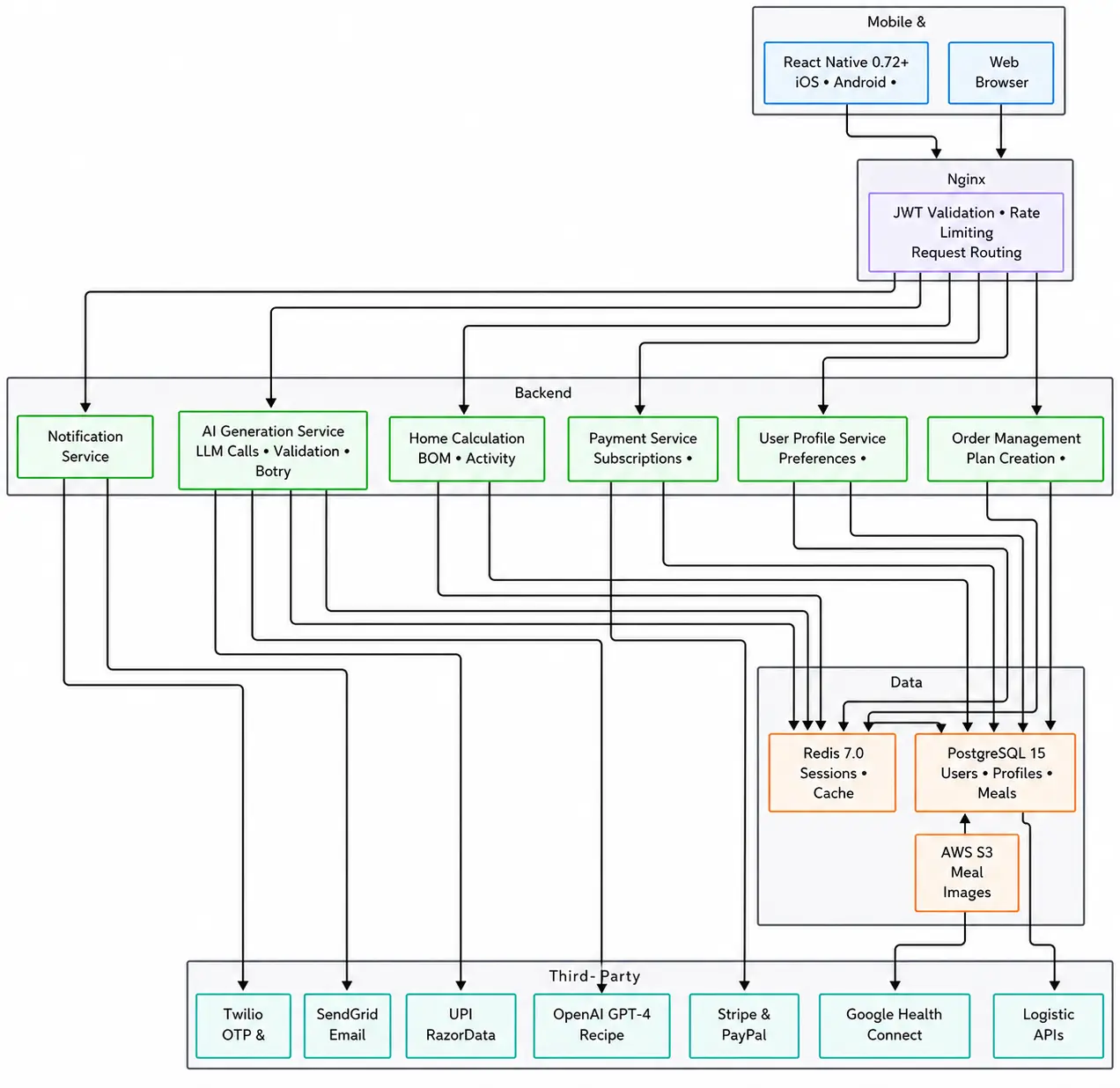
The platform integrates React Native mobile apps with an API gateway and dedicated backend microservices for AI recipe generation, macro calculation, user profiles, orders, payments, and notifications.
Architecture Highlights
Database Architecture
PostgreSQL was selected for ACID compliance, complex relational queries across 15+ tables, and GiST indexing for geospatial delivery routing across three cities. Redis caching reduces database read load by 70% on high-traffic endpoints.
PERFORMANCE BENCHMARKS
Key Outcomes & Business Value
Monthly Recurring Revenue
Projected by month 9, based on confirmed growth trajectory.
Gross Margin
30% food cost, 10% operations, 5% logistics.
Month-3 Retention
Versus a 45–55% industry average for subscription meal delivery.
Cities Served
Dubai, Abu Dhabi, and Sharjah, with expansion-ready architecture.
Tiered subscription pricing by plan duration (1–4 weeks) and meals per day (2–6), layered with a B2B corporate wellness channel targeted at 20% of revenue by year 2 — a scalable secondary stream requiring no added sales overhead.
First platform with per-meal macro customization, offering unlimited AI-generated recipes versus competitors' fixed menus of 30–50 options — paired with an integrated macro calculator that removes a step competitors leave to the user.
Conclusion
Failure rates exceed 25% even with careful prompting — deterministic pre-filtering, LLM generation, and automated validation each have to carry their share of the load.
A configuration-to-generation flow beats open-ended chat — chatbots produced 15-minute sessions and 4x higher token costs versus a 3-minute structured flow.
Sending the LLM only safe, relevant data cut token usage by 40%+ — essential when AI costs can't exceed 5% of revenue on thin delivery margins.
• SUFFESCOM SOLUTIONS
Build Smarter. Scale Faster. Grow More.
Have a Vision? Let’s Turn It Into a Digital Reality.
Get a quick response from our best experts in under 10 minutes.
Suffescom easily understood our main goal and delivered the best digital solution. Their team was very cooperative, and it was a very good experience working with them. I would highly recommend them.

Working with Suffescom was a really great experience. Their developers demonstrated technical knowledge and delivered our mobile app solution with all required functionalities on time.

Suffescom helped us build a logistics software solution that completely improved our fleet operations. Their professionalism and transparency are what make them a reliable technology partner.

Share Your Requirements. Our Experts Will Shape the Solution.
• SUFFESCOM SOLUTIONS
Build Smarter. Scale Faster. Grow More.
Have a Vision? Let’s Turn It Into a Digital Reality.
Get a quick response from our best experts in under 10 minutes.
Suffescom easily understood our main goal and delivered the best digital solution. Their team was very cooperative, and it was a very good experience working with them. I would highly recommend them.
Working with Suffescom was a really great experience. Their developers demonstrated technical knowledge and delivered our mobile app solution with all required functionalities on time.
Suffescom helped us build a logistics software solution that completely improved our fleet operations. Their professionalism and transparency are what make them a reliable technology partner.
Share Your Requirements. Our Experts Will Shape the Solution.
• SUFFESCOM SOLUTIONS
Build Smarter. Scale Faster. Grow More.
Have a Vision? Let’s Turn It Into a Digital Reality.
Get a quick response from our best experts in under 10 minutes.
Suffescom easily understood our main goal and delivered the best digital solution. Their team was very cooperative, and it was a very good experience working with them. I would highly recommend them.
Working with Suffescom was a really great experience. Their developers demonstrated technical knowledge and delivered our mobile app solution with all required functionalities on time.
Suffescom helped us build a logistics software solution that completely improved our fleet operations. Their professionalism and transparency are what make them a reliable technology partner.
Share Your Requirements. Our Experts Will Shape the Solution.
Fret Not! We have Something to Offer.