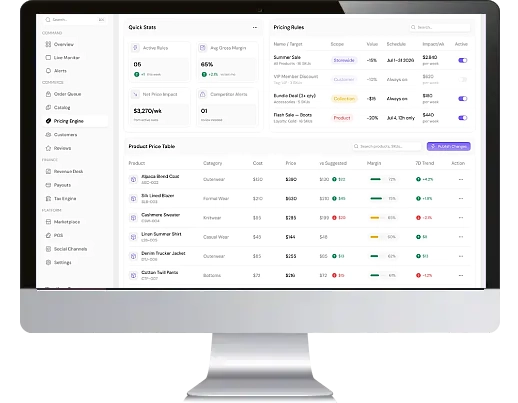
A USA-based automobile spare parts manufacturing and distribution company needed to extend its existing environment to cover processes associated with finances, inventory management, production, sales, and logistics. Different facilities and business units had unique processes that needed to be managed without modifying the ERP environment.
A custom internal management system was developed around the existing ERP architecture. The solution connected custom applications, business data, reporting, and workflow automation through the platform's established APIs and business object framework.
Different facilities and business units required an integrated operational view across manufacturing and distribution activities.
Automobile spare parts manufacturing and distribution processes required capabilities beyond those available in the standard ERP system.
Internal and external systems needed reliable data exchange across manufacturing, sales, procurement, inventory, and other business operations.
Financial and operational reports would require the use of automation and greater access to business data.
Order, purchase, inventory, and production processes would need to be made efficient.
The customized functionality needs to be scalable for future ERPs without hampering the business processes.
A customized management system has been developed in order to integrate the ERP system with various applications, API integrations, reporting capabilities, and workflow automation.
Custom applications were created for order management, inventory control, production planning, and other department-specific requirements. These applications worked with existing ERP business logic to support organization-specific spare parts manufacturing and distribution processes.
REST-based APIs and business objects connected the ERP environment with internal and external systems. Automated data exchange improved information flow across sales, procurement, inventory, production, and other operational functions.
Reporting dashboards were introduced for sales orders, inventory, receivables, cash flow, production, and other operational indicators. Automated data retrieval reduced dependence on manually prepared reports.
Recurring processes across order management, purchasing, production, and inventory were streamlined through workflow automation. Defined business rules helped reduce manual intervention and maintain consistent process execution.
Custom functionality was developed around established APIs, business objects, and extension capabilities instead of modifying the ERP's core functionality. This made it easier for the system to accommodate future changes in the platform.
Role-based access control was configured for administrators, managers, and end users. Access control was possible at application, business information, reporting, and administration levels depending upon user responsibilities.
Custom dashboards provided visibility into sales, inventory, production, financial indicators, and operational activity. Teams could access relevant business information through a centralized interface.
The solution incorporated authenticated API access, role-based authorization, encrypted data transmission, input validation, secure credential management, and audit logging to protect information exchanged between connected systems.
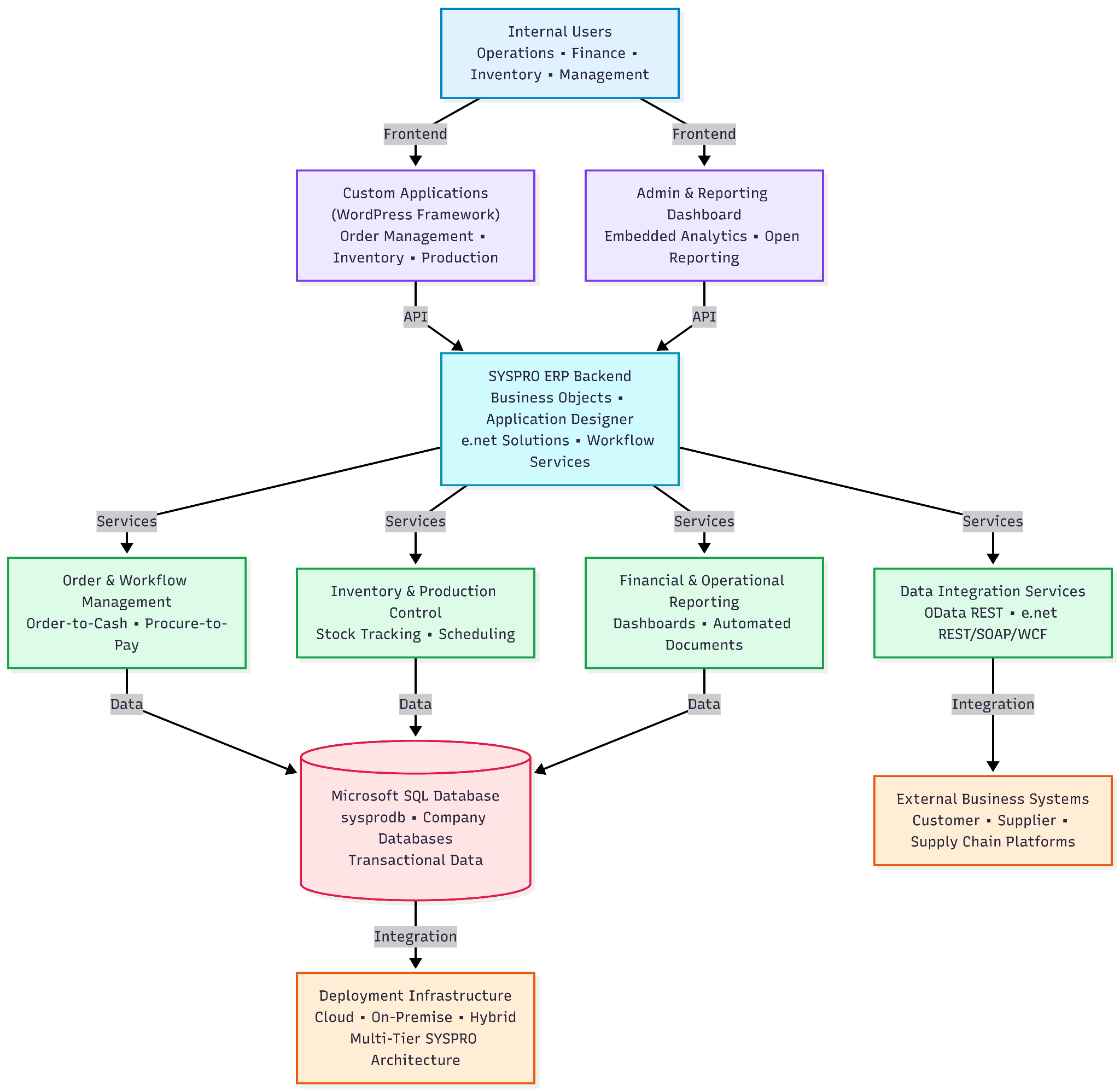
Based on the framework and provides web/desktop UIs for internal users. Features: custom order management dashboards, inventory control dashboards, production planning and scheduling dashboard, financial reporting and analytics dashboard, data integration and synchronization tools.
Core logic with customizations. Business objects (self-contained business logic modules within the environment). Custom applications developed using the platform’s extension capabilities. Custom services support applications working with business objects.
The custom management system uses a Microsoft SQL database. The system-wide database stores operator, administration, and licensing information. The company database for each company stores transactional data in hundreds of tables.
REST-based APIs access data via a REST interface across functional modules, including inventory, production, procurement, sales, and finance. Business object APIs develop custom business applications via REST, SOAP, and WCF. Reporting APIs run and distribute documents programmatically.
Deployment flexibility – Cloud, On-Premises, or Hybrid. The architecture of the system is designed to support scalability and can handle multiple branches of international companies. Data storage that is safe with Microsoft SQL.
Unique business processes demand customized applications affecting efficiency and flexibility.
Custom application development based on the existing extension capabilities and business object framework. Applications developed using a component-based approach, reflecting unique business rules and processes. Custom applications were created to prevent the need for redeploying when future ERP updates are deployed.
Benefits: Customized internal management applications, optimized processes, future proof investment.
Data isolation due to multiple different systems in place affects process consistency.
Utilized RESTful APIs for accessing real-time data from different modules. Utilized business objects for further integration needs. Created secure connections with encryption to external and partner systems.
Benefits: Consolidated data flow, automated data transfer, single source of truth.
The process of manual financial and operational reporting was very time consuming and prone to errors.
Custom dashboards were created by utilizing embedded analytics capabilities. Automated reporting using reporting APIs for documents and business intelligence. Created reports that could be refreshed using real-time data.
Outcome: Improved decision making, decreased time needed for reporting, improved flexibility.
The inefficiency of manual processes decreases productivity and increases the possibility of errors.
Internal processes such as order management, purchasing, and inventory were reviewed and optimized where necessary. Utilizing workflow automation services to automate processes and ensure compliance.
Outcome: Process optimization and improved compliance.
Unit testing (Jest) per commit. Integration testing (Postman) daily. Load testing (k6/Artillery) weekly on staging. Performance degradation of p95 more than 10% is a show-stopper for deployment. End-to-end testing of custom applications and data integrations.
Custom application workflows → data integrations → report generation → business process automation → user acceptance testing. User distribution: 60% internal operations, 25% reporting and analytics, 15% administration.
Multi-corporate database schema, more than 15,000 global customers, more than 1,500 channel partners.
The multi-tier architecture supports scaling to multi-national organizations with hundreds of subsidiaries. Database optimization with indexed tables supports high-volume transactions.
RTO — 15 minutes (Terraform). RPO — <5 minutes (RDS Multi-AZ). Monthly DR testing.
Specialized procedures need special software solutions. The extension framework and business object capabilities allow the creation of custom applications without affecting core upgrades.
Efficiency, future-proof investment.
Disjointed solutions affect performance. RESTful APIs and business objects support real-time, secure data exchange between internal and external systems.
Seamless data flow, fast order fulfillment.
Manual report creation leads to delays and mistakes. Embedded analytics and reporting APIs ensure real-time dashboards and automated reports.
Real-time data insight, sound decision-making.
Manual processes are not efficient and take a lot of time and effort. Workflow services automate repetitive processes and guarantee compliance.
No manual work, efficient processes.
Financial information is sensitive. An encrypted database using Microsoft SQL, role-based security, and SSO integration.
Enhanced protection and support for regulatory compliance.
Scalability of Infrastructure Facilitates Expansion. The multi-tiered architecture caters to expansion to a multi-national firm having hundreds of subsidiaries.
Future-proof system architecture, reliable performance.
The internal management system shows that a system architecture in the contemporary era using components with reliable APIs can be supplemented through custom application development, integration of data, and automated reporting, leading to the creation of an internal management system.
• SUFFESCOM SOLUTIONS
Build Smarter. Scale Faster. Grow More.
Have a Vision? Let’s Turn It Into a Digital Reality.
Get a quick response from our best experts in under 10 minutes.
Suffescom easily understood our main goal and delivered the best digital solution. Their team was very cooperative, and it was a very good experience working with them. I would highly recommend them.

Working with Suffescom was a really great experience. Their developers demonstrated technical knowledge and delivered our mobile app solution with all required functionalities on time.

Suffescom helped us build a logistics software solution that completely improved our fleet operations. Their professionalism and transparency are what make them a reliable technology partner.

Share Your Requirements. Our Experts Will Shape the Solution.
• SUFFESCOM SOLUTIONS
Build Smarter. Scale Faster. Grow More.
Have a Vision? Let’s Turn It Into a Digital Reality.
Get a quick response from our best experts in under 10 minutes.
Suffescom easily understood our main goal and delivered the best digital solution. Their team was very cooperative, and it was a very good experience working with them. I would highly recommend them.
Working with Suffescom was a really great experience. Their developers demonstrated technical knowledge and delivered our mobile app solution with all required functionalities on time.
Suffescom helped us build a logistics software solution that completely improved our fleet operations. Their professionalism and transparency are what make them a reliable technology partner.
Share Your Requirements. Our Experts Will Shape the Solution.
• SUFFESCOM SOLUTIONS
Build Smarter. Scale Faster. Grow More.
Have a Vision? Let’s Turn It Into a Digital Reality.
Get a quick response from our best experts in under 10 minutes.
Suffescom easily understood our main goal and delivered the best digital solution. Their team was very cooperative, and it was a very good experience working with them. I would highly recommend them.
Working with Suffescom was a really great experience. Their developers demonstrated technical knowledge and delivered our mobile app solution with all required functionalities on time.
Suffescom helped us build a logistics software solution that completely improved our fleet operations. Their professionalism and transparency are what make them a reliable technology partner.
Share Your Requirements. Our Experts Will Shape the Solution.
Fret Not! We have Something to Offer.