Enterprise EV Fleet Management Platform
Event-Driven / IoT-Based Microservices
Flutter · React.js · Node.js · PostgreSQL · AWS · OCPP
Production-Ready
About the Client
The client is a California-based electric trucking company operating more than 500 heavy-duty electric vehicles across 10 depots. With rapid fleet expansion, the company faced increasing challenges in managing charging infrastructure, energy consumption, and operational visibility.
As EV adoption accelerated, manual charging management became inefficient, resulting in underutilized chargers, higher electricity costs, and limited fleet monitoring capabilities.
The company envisioned a unified platform capable of optimizing charging schedules, monitoring fleet health in real time, and enabling predictive maintenance while supporting future fleet growth.
PLATFORM CAPABILITIES
Smart Charging Optimization
Real-Time Fleet Monitoring
Predictive Maintenance
Dynamic Energy Analytics
CORE MODULES
The Challenge
With 500+ vehicles and 200+ charging stations across 10 depots, charger availability was largely unknown. Vehicles often waited for charging while other stations remained underutilized, reducing overall fleet efficiency and increasing turnaround times.
Electricity tariffs fluctuated throughout the day, with peak-hour rates reaching up to 3x higher than off-peak pricing. Without intelligent scheduling, charging operations generated unnecessary expenses exceeding $100,000 per month.
Operations teams lacked a centralized view of charging sessions, vehicle battery health, and charger performance. Manual monitoring consumed 15+ hours weekly, delaying operational decisions and reducing responsiveness.
Battery degradation and charger failures resulted in nearly 12% monthly downtime, directly impacting fleet availability. Detecting issues early required continuous monitoring and predictive maintenance capabilities that did not exist within the existing infrastructure.
The Solution
SMART CHARGING OPTIMIZATION
REAL-TIME FLEET INTELLIGENCE
PREDICTIVE MAINTENANCE & INFRASTRUCTURE
ARCHITECTURE
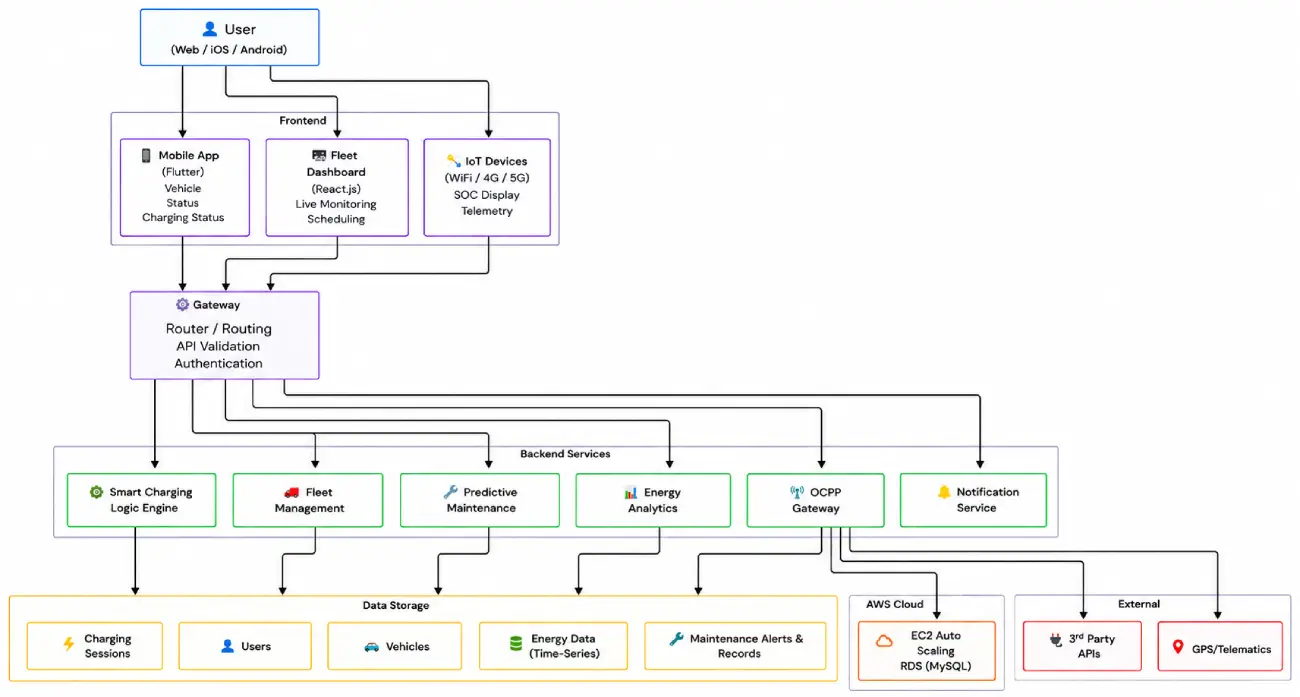
The platform was designed as a decoupled integration layer sitting between driver-facing mobile apps, the operations dashboard, and the physical charging network. Rather than bolting logic onto any single surface, the backend orchestrates schedule optimization, telemetry ingestion, predictive maintenance, and reporting centrally.
The architecture is built for scalability, resilience, and operational visibility — supporting 500+ vehicles and 200+ chargers today, with headroom for 10x growth without re-architecture.
Database Architecture
PostgreSQL handles relational and time-series data — users, fleets, 500+ vehicles, 5,000+ daily charging sessions, energy consumption, and maintenance alerts — with GiST indexes for geospatial queries and time-series partitioning for historical efficiency. Redis absorbs read-heavy traffic in front of it, caching hot data and coordinating distributed locks. Connection pooling supports 150 concurrent connections across the cluster.
Performance Benchmarks
KEY OUTCOMES & BUSINESS VALUE
Total Annual Savings
Combined charging optimization and reduced downtime, against $102K/year infrastructure cost.
Charging Cost Reduction
Smart scheduling shifts flexible charging to off-peak hours using real-time utility tariffs.
ROI Achieved
Full return on infrastructure investment reached within eight months of deployment.
Vehicle Availability
Up from 74%, driven by predictive maintenance that catches faults before failure.
Charging assignments are driven by real-time utility tariffs, battery levels, and departure schedules — shifting flexible load to off-peak hours. The result is a 29% cost reduction, worth $348,000+ a year, without any change to fleet output.
Built for 500+ vehicles and 200+ chargers across 10 depots, with 99.9% API uptime over 12 months and auto-scaling infrastructure that supports 10x fleet growth without re-architecture.
Fret Not! We have Something to Offer.