B2C + B2B Marketplace
Event-Driven / Pub/Sub
Node.js · PostgreSQL · Redis · AWS
Production-Ready
About the Client
The client was a logistics startup targeting a $12 trillion global logistics market and a $35–40B+ towing opportunity space historically fragmented across brokers, phone calls, and paper contracts.
Towing & Logistics Marketplace was envisioned as a mobile-first marketplace connecting customers with drivers. Each vehicle category carried distinct operational requirements — from payload capacity to licensing compliance — demanding a flexible rules engine rather than hardcoded logic.
The business model was dual-pronged: direct B2C consumer deliveries combined with embeddable B2B merchant widgets enabling one-hour dispatch for enterprise partners.
Vehicle Categories
Towing Vehicles
Pickup Trucks
Box Trucks
18-Wheelers
User Personas
The Challenge
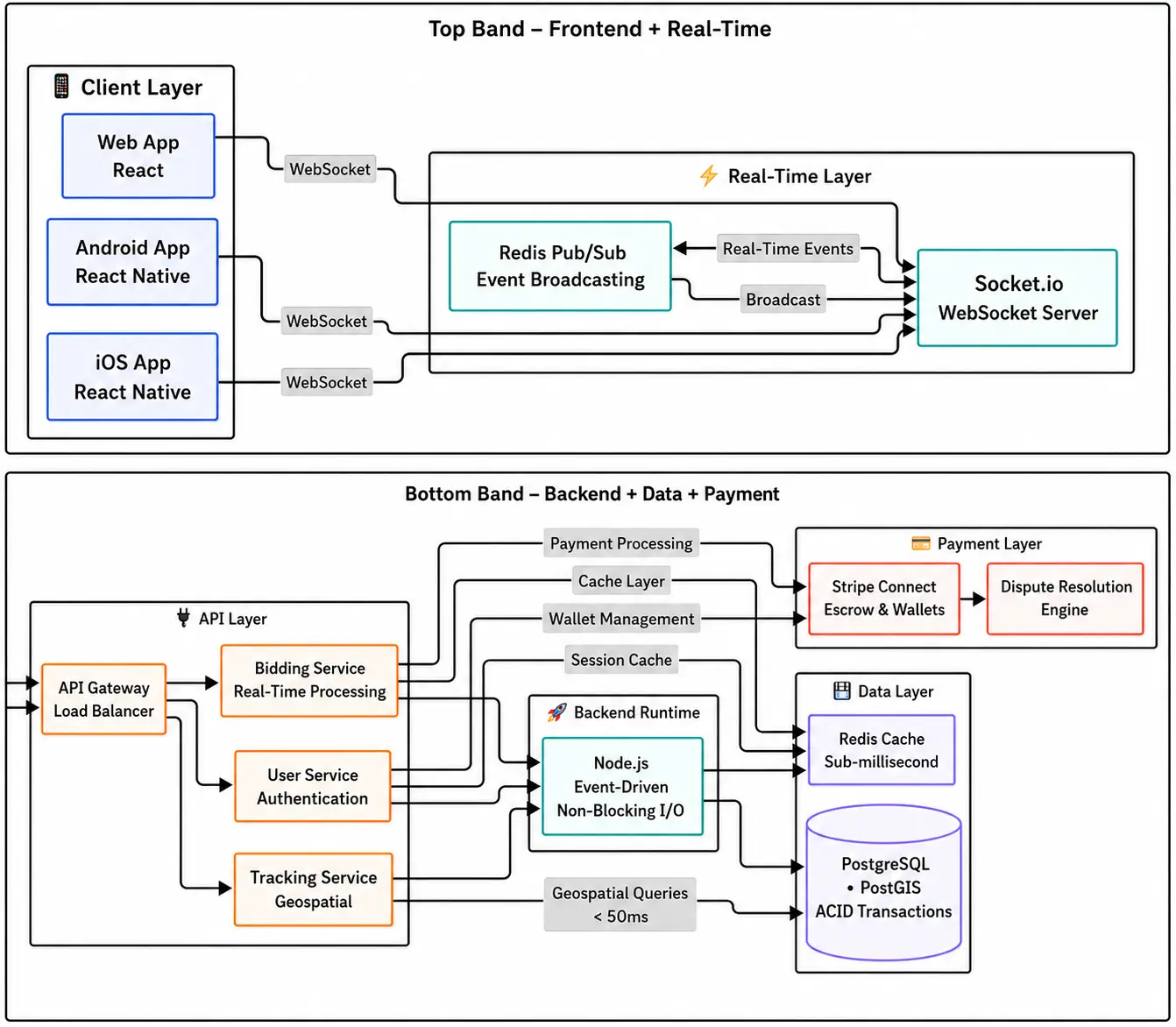
The business required instant bid negotiation between thousands of drivers and customers. Traditional request-response APIs would have introduced unacceptable latency, so we adopted an event-driven architecture built on Socket.io and Redis Pub/Sub.
Twilio had no native retry logic, meaning SMS delivery failures would go undetected — requiring a custom retry and acknowledgment layer.
Socket.io's in-memory adapter prevented horizontal scaling across multiple Node.js servers, demanding a distributed pub/sub message bus.
Bids, escrow holds, and payouts required absolute consistency. No partial writes or lost updates could be tolerated under any failure mode.
The Solution
Real-Time Bidding
Infrastructure
Disaster Recovery
Architecture
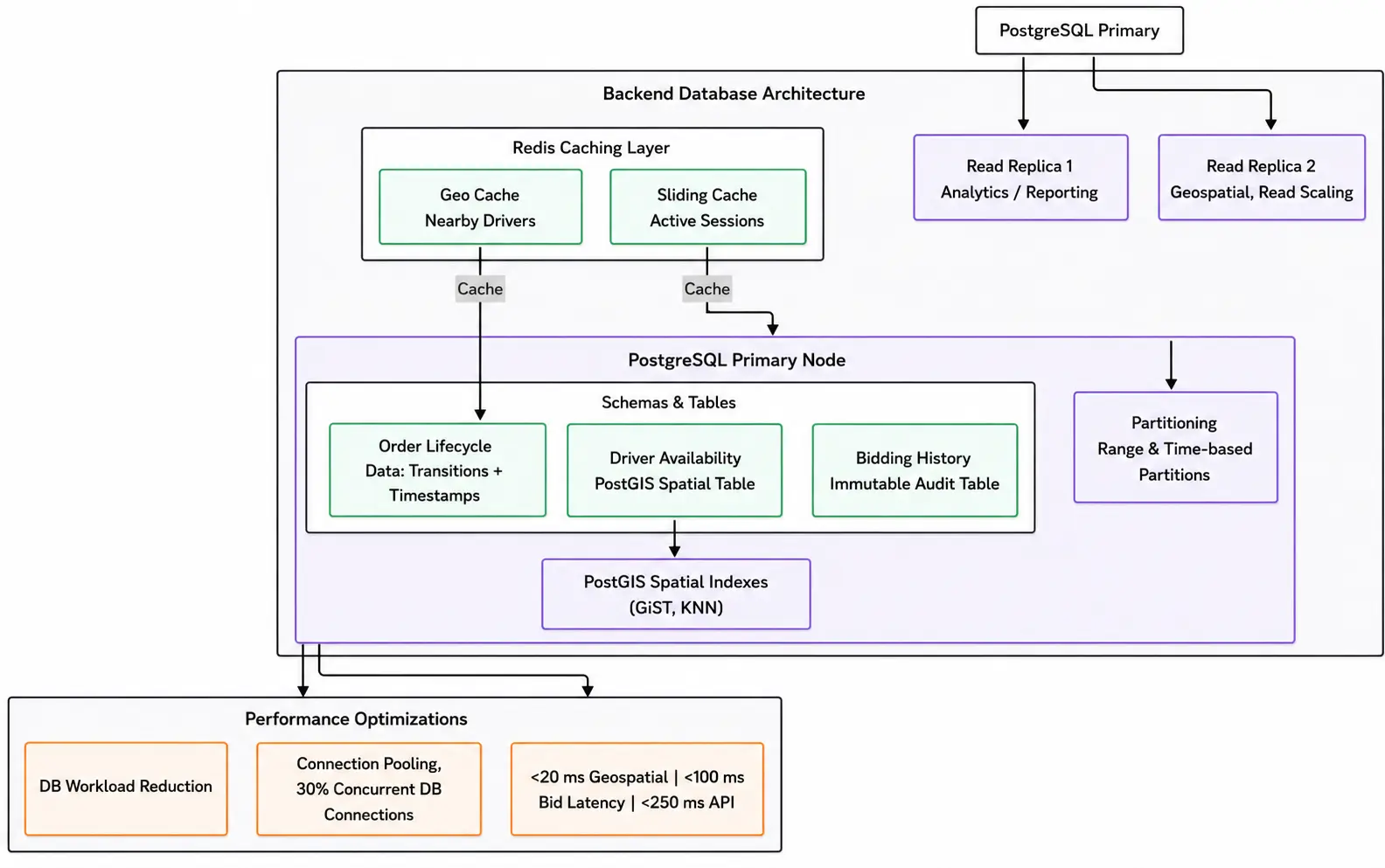
Database Architecture
PostgreSQL was selected for ACID compliance, complex relational queries, and PostGIS geospatial indexing enabling driver proximity searches under 50ms. Redis caching reduces database load for high-traffic endpoints.
Performance Benchmarks
Key Outcomes & Business Value
Annual GMV Projected
At 2,500 monthly deliveries based on confirmed growth trajectory.
Annual Revenue
Commission-based platform model with tiered structure by transaction value.
Break-Even Projected
Dual B2C and B2B channels accelerate merchant acquisition without sales overhead.
Revenue Channels
Embeddable B2B merchant widget enabling one-hour dispatch for enterprise partners.
Commission-based with tiered structure by transaction value and service type. The B2B merchant widget adds a scalable secondary channel with rapid merchant acquisition — no sales overhead required.
Dual B2C and B2B models capture consumer and merchant revenue streams simultaneously. The embeddable widget enables enterprise partners to dispatch in under one hour without custom development.
Conclusion
Bidding, tracking, and payments each require dedicated architectural patterns — a monolith would collapse under the load.
OCR automation reduces operational overhead while accelerating driver acquisition without human review bottlenecks.
Financial safeguards must be designed into the architecture from the start — retrofitting them is prohibitively expensive.
• SUFFESCOM SOLUTIONS
Build Smarter. Scale Faster. Grow More.
Have a Vision? Let’s Turn It Into a Digital Reality.
Get a quick response from our best experts in under 10 minutes.
Suffescom easily understood our main goal and delivered the best digital solution. Their team was very cooperative, and it was a very good experience working with them. I would highly recommend them.

Working with Suffescom was a really great experience. Their developers demonstrated technical knowledge and delivered our mobile app solution with all required functionalities on time.

Suffescom helped us build a logistics software solution that completely improved our fleet operations. Their professionalism and transparency are what make them a reliable technology partner.

Share Your Requirements. Our Experts Will Shape the Solution.
• SUFFESCOM SOLUTIONS
Build Smarter. Scale Faster. Grow More.
Have a Vision? Let’s Turn It Into a Digital Reality.
Get a quick response from our best experts in under 10 minutes.
Suffescom easily understood our main goal and delivered the best digital solution. Their team was very cooperative, and it was a very good experience working with them. I would highly recommend them.
Working with Suffescom was a really great experience. Their developers demonstrated technical knowledge and delivered our mobile app solution with all required functionalities on time.
Suffescom helped us build a logistics software solution that completely improved our fleet operations. Their professionalism and transparency are what make them a reliable technology partner.
Share Your Requirements. Our Experts Will Shape the Solution.
• SUFFESCOM SOLUTIONS
Build Smarter. Scale Faster. Grow More.
Have a Vision? Let’s Turn It Into a Digital Reality.
Get a quick response from our best experts in under 10 minutes.
Suffescom easily understood our main goal and delivered the best digital solution. Their team was very cooperative, and it was a very good experience working with them. I would highly recommend them.
Working with Suffescom was a really great experience. Their developers demonstrated technical knowledge and delivered our mobile app solution with all required functionalities on time.
Suffescom helped us build a logistics software solution that completely improved our fleet operations. Their professionalism and transparency are what make them a reliable technology partner.
Share Your Requirements. Our Experts Will Shape the Solution.
Fret Not! We have Something to Offer.