+971-8000321216




Key Takeaways:
- AI is changing how lenders handle loan applications, but successful automation takes more than plugging an AI model into an existing system. The real opportunity lies in building a reliable lending workflow that balances processing efficiency, responsible decision-making, and borrower trust.
- AI adoption in lending is accelerating, with 79% of surveyed U.S. financial institutions reporting AI pilots or integration into lending workflows by July 2026, compared with 34% in late 2025, according to Abrigo's AI in Lending Market Study.
- AI loan application processing software can automate document extraction, borrower data validation, verification workflows, and application routing while keeping credit policies and decision authorization under appropriate control.
- A reliable platform depends on more than AI models. It needs secure data pipelines, dependable credit bureau and identity verification integrations, exception handling, audit trails, and appropriate human review.
- Development costs can range from 25,000–60,000 for an MVP to 350,000–750,000 or more for an enterprise platform, based on the indicative planning estimates discussed in this guide. Actual costs depend on customization, data readiness, integrations, and governance requirements.
- A focused MVP may take a few months, while enterprise implementations can take considerably longer. Early validation of data quality, technical feasibility, integration dependencies, and acceptance criteria helps establish a more realistic delivery plan.
- The strongest results come from measuring turnaround time, straight-through processing, extraction accuracy, fraud-alert effectiveness, and cost per application. Lenders should use these metrics to evaluate ROI while monitoring model performance and maintaining responsible AI controls.
What if lenders could process loan applications faster without compromising accuracy, compliance, or borrower trust? AI loan application processing software helps lenders achieve this through intelligent document processing, data validation, workflow automation, and AI-assisted credit scoring. However, with a lack of integration, manual document review, inaccurate borrower data, and a slow underwriting process, a smooth application can become a lengthy process.
The shift is already underway. AI in Lending Market Study, 79% of surveyed U.S. financial institutions had AI pilots or integrated AI into lending workflows by July 2026, up from 34% in late 2025.
But it's not just about AI models to achieve effective automation. Lenders rely on integrations that are reliable and easily configurable, credit policies that are easily set up, human oversight, and auditable decisions. This guide examines the critical capabilities, structure, architecture, development process, security issues, and costs of creating a scalable solution.
What Is AI Loan Application Processing Software?
AI loan application processing software aids lenders in managing application data, assessing financial documents, confirming borrower details, and compiling underwriting cases. It integrates these tasks into a cohesive system, minimizing repetitive manual tasks and aiding lending teams in making informed decisions. But it's not about giving the entire lending decision over to AI. Lenders can have checks automated for routine processes and still have final approvals with authorized personnel or decision systems governed by them.
AI Loan Processing Software vs. Loan Origination Software
The terms are related but have different meanings. The AI loan processing system emphasizes intelligence on documents, data validation, analysis, and automation in the process. A loan origination system (LOS) oversees the broader pre-disbursement process, orchestrating loan workflow and approvals. An AI processing capability can be embedded within the LOS, integrated via a separate service layer or integrated with a larger digital lending platform.
A loan management system (LMS) is used, on the other hand, to facilitate post-origination operations like repayment supervision and loan servicing. A core banking system is responsible for storing the more general banking information and handling financial transactions.
| System | Primary responsibility |
| AI loan processing layer | Document analysis, validation, and processing automation |
| Loan origination system | Application workflow and decision coordination |
| Loan management system | Loan administration and servicing after origination |
| Core banking system | Banking records and transaction processing |
What Should a Custom Platform Include?
These are the essential elements a custom AI loan processing platform should include:
- Borrower intake and data ingestion: Gather application information and aggregate information from the appropriate sources.
- Document processing: Accurately gather and compile data from loan applications and supporting documentation.
- Verification integrations: Integrate with credit bureaus, ID verification providers, and other sources of data.
- Rules-based checks: Check the information on the application against a set of rules and eligibility criteria.
- Review workflows: Identify applications that are not complete, are inconsistent, or are higher risk and route them for manual review.
- Audit logs and monitoring: Keep an eye on important processing steps and allow teams to investigate errors.
Why Lenders Are Investing in AI Loan Processing Automation
Lending teams are regularly faced with a similar challenge: they get more applications, but their processes still rely on manual efforts. AI loan processing automation is a solution that aids lenders in overcoming these challenges while keeping a watchful eye on vital credit decisions.
Manual Application Review Creates Operational Bottlenecks
Loan officers can spend hours gathering documents, inputting the same information into various systems, and chasing missing information. Every time a handoff occurs from operations verification teams to underwriters, there is another chance for delays.
Disconnected Data Increases Reconciliation Effort
Information on an applicant's form, bank statements, identity documents, and credit report may be contradictory. Teams should delve into these differences before moving forward, adding additional work and delaying app reviews.
Scaling Lending Operations Requires Better Workflow Orchestration
Manual processes can strain existing teams as the volume of applications grows. If there are no coordinated workflows in place, lenders could find themselves overwhelmed by increasing workloads, but without additional complexity.
Lenders Need Traceability and Consistent Policy Execution
Lenders should have an understanding of the information that was looked at, the rules used, and why an application was flagged or escalated. Clear records facilitate internal review and audit and more uniform application of lending policies.
Personalization Must Remain Compatible With Responsible Lending
AI can be used to evaluate pertinent borrower data and provide customized recommendations for lending. However, alternative data or automatic recommendations need to be carefully controlled. The use of the data, credit decisions, and any required explanations must comply with laws in force and the lender's policies. With a well-designed FinTech software development solution, it can help bring together automation and current systems, operational requirements, and responsible lending practices.
How AI Loan Application Processing Works
An AI loan application processing workflow links the processes of reviewing an application, ranging from collecting data to making the final decision and handing it over. While the exact process differs depending on the lender, loan type, and regulations, most platforms go through a similar process.
Step 1: Application Intake and Initial Data Capture
It all starts with a loan request from a borrower, including their personal information, requested loan amount, loan purpose, borrower's consent, and supporting documents. Applications can come to the company via a website, mobile application, partnership platform, or a company's internal lending team.
Step 2: Identity Verification and Initial Eligibility Checks
The platform forwards the pertinent details to approved identity verification providers and verifies basic qualification in accordance with the lender's requirements. Successful or inconclusive checks will be recorded to move on to the next stage, and unsuccessful checks will be identified for further review.
Step 3: Document Classification and Information Extraction
Document AI identifies and then extracts information from submitted documents, like application forms, income proof, and bank statements. This converts unstructured documents into information that can be viewed and utilized by the lending team.
Step 4: Data Validation and Discrepancy Detection
The information extracted is standardized and then compared to the app information and allowed external information. If the data is missing, conflicting, or has low confidence, it is not considered a verified fact but is sent for clarification or manual review.
Step 5: Financial Assessment and Credit Policy Evaluation
Data is reviewed and validated against the lender's credit policies. In some systems, prior-scored credit models can also be used to evaluate the ability to pay back and credit risk.
Step 6: Underwriting Review and Decision Routing
The results of the application can be used to further pursue it based on an approved decision policy, to update the underwriter, or to send it back to the borrower for further information. The approval or rejection must be based on the lender's approved evaluation process and not an unchecked recommendation by AI.
If you are making applicable U.S. credit decisions, the Consumer Financial Protection Bureau's guidance on adverse-action notices provides an explanation of the need to provide specific reasons for adverse action even when using complex algorithms.
Step 7: Offer Generation and Handoff
If the application qualifies, the platform can prepare the loan offer and route it for required disclosures, borrower acceptance, and agreement execution. Relevant application and decision data can then pass to downstream lending systems.
Step 8: Recordkeeping and Status Updates
Throughout the process, the platform maintains application status, decision history, supporting evidence references, and operational records. Borrowers and staff can receive status updates based on workflow events, while authorized teams retain a record of how the application progressed.
Recommended workflow visual: Application → Identity Checks → Document AI → Data Validation → Credit Policy and Assessment → Decision or Human Review → Agreement and Downstream Handoff.
Lending Use Cases for AI Loan Application Processing Software
There are numerous types of loans, and each will have unique verification needs, monetary risks, and underwriting requirements. The ideal AI lending platform should take these factors into consideration rather than a one-size-fits-all approach.
Personal and Consumer Lending
The primary points of focus in the process of a personal loan will be verification of identity, income stability, completeness of the application, and checks for eligibility. Automation aids lenders in arranging borrower data and catching missing or inconsistent information prior to assessment.
SME and Business Lending
Business loans have a greater financial overview. The platform will be required to process the company's records, ownership documents, business bank statements, and revenue information to assist underwriters in considering cash flow and repayment capability.
Mortgage and Property-Backed Lending
There are more documents involved, property details, and detailed verification of income in mortgage applications. The software should be able to be expanded to provide for deeper evidence review and more robust communication and handoff between underwriting teams.
Auto and Asset-Backed Lending
For vehicles and asset financing, the information that will be processed will include borrower details, vehicle information, collateral information, and financing terms. Linking these records will assist lenders to evaluate the application along with the asset backing the loan application.
Embedded and Digital Lending
Embedded lending is the ability to integrate financing within another digital experience, like a merchant checkout or fintech app or a partner platform. The development of digital lending platforms must consider the need for API integration for seamless data sharing, the unique needs of each partner, and a seamless borrower experience.
A flexible loan application management system allows for the handling of multiple types of loans without having to replicate the entire process.
Accelerate Loan Processing With AI-Powered Automation
Explore how Suffescom can help you design an AI-powered workflow that improves operational efficiency while keeping critical checks in place.
Core Features of AI Loan Application Processing Software
The right features will depend on the lender's products, the number of applications they have, and their current systems. These features are a viable beginning for AI loan application software development.
Digital Application Intake and Borrower Onboarding
Configurable forms, secure document upload, save and resume, consent capture, and application status updates reduce the need to reach out to the lending team over and over again to submit information.
Intelligent Document Processing
AI document processing for loans classifies documents, pulls out data from fields, and normalizes data for analysis. Confidence indicators and ‘poor or unsupported document checks enable teams to identify results that require verification.
Identity Verification and Screening Orchestration
The platform integrates with identity verification service providers, relevant KYC/AML screening solutions, and authorized data providers. This handles checks and reports on the results, but a successful system response does not mean identity or regulatory compliance.
Configurable Lending Rules Engine
A rules engine is used to apply eligibility criteria, thresholds, and routing conditions that are defined by the lender. Versioned policies allow teams to keep track of changes and determine what policies were used during the evaluation of an application.
Financial Data Analysis and Affordability Assessment
The software groups income and expenses, liabilities, and cash-flow information into groups. It can calculate metrics that lenders specify for affordability and warn lenders of any outlying numbers that might require further investigation.
Credit Assessment and Underwriting Support
Underwriters put more than just a score. The system should display pertinent risk indicators, supporting evidence, and reason codes with each model-generated recommendation. Final decisions shall be made in accordance with the lender's approved decision policies and the lender's review requirements.
Exception Management and Manual-Review Queues
Inconsistencies and corrections, or missing documents with conflicting data, failed verification checks, and low-confidence extraction results should be added to a queue for review. Authorized users can investigate, ask questions about issues, record overrides, and escalate issues to the next level.
Loan Officer Dashboard and Application Tracking
A loan processing dashboard provides staff with a view of the status of the application, who is currently reviewing the application, loan check status, pending actions, and more. Operational reporting aids managers in detecting backlogs and recurring delays.
Audit Logs and Operational Reporting
The processing history, the changes performed by the users, the policy versions, and the versions of the model involved are stored and can be reconstructed by authorized teams using the timestamps. This will also help with internal reviews and relevant audit requirements through exportable records.
Key Features and Their Business Purpose
| Feature | Primary user | Business purpose |
| Document extraction | Operations team | Reduce repetitive data entry |
| Rules engine | Credit policy team | Apply approved policies consistently |
| Financial analysis | Underwriters | Organize borrower financial information |
| Exception queues | Reviewers | Route unresolved issues for action |
| Audit records | Compliance and operations | Reconstruct processing and decision history |
AI Technologies Used in Loan Application Processing
The type of AI models employed will differ based on the type of lending work. Some require accurate extraction of data, while others require data to be estimated, interpreted from documents, or synced for workflows. The key to making the right choice is to know what a technology can do, what information it requires, and where it is still necessary to have human verification.
OCR and Intelligent Document Processing
Optical character recognition (OCR) is a method for converting text in a scanned object or image into machine-readable data. IDP technology can be used to build on the advantages of OCR, identify the type of document, recognize the layout of the document, extract the document fields, and structure the data in the document into records.
The results may be affected by a lack of clarity in the scanned image or handwritten information, or unfamiliar layouts. If there is enough confidence in the information, then it should be passed forward; if there is not enough confidence, then it should be checked.
NLP and Document Understanding
Natural language processing (NLP) can be employed on unstructured financial text. It can identify relevant clauses, extract relevant information from lengthy records, and provide a structured summary. All information taken should be traceable to its source for reference by reviewers.
Machine Learning for Credit Risk Assessment
Using machine learning, credit risk can be predicted and a loan application classified based on some criteria when good historical data exists. These models are based on representative data, accurate labeling, and ongoing validation. Lenders also need to gauge for possible bias and fulfill regulatory requirements. A model's risk score does not automatically mean he or she is approved or denied; it is just a part of the decision-making process.
Anomaly Detection for Application Fraud
The anomaly detection feature detects patterns that are out of the norm when it comes to the application's behavior, such as inconsistent financial data, repeated identity information, or unexpected submission patterns. These can then be used for prioritizing investigations, but if they are unusual, it does not automatically mean fraud. Some valid uses could be slightly different in nature.
Generative AI for Document Summaries and Credit Memos
Generative AI can generate a summary of accurate financial statements and compile pertinent evidence for credit analysts. Summaries should be reviewed and include references to the source, include approved data, and minimize the number of unstated data claims, which will affect the consequential decision.
Agentic AI for Multi-Step Workflow Orchestration
With bounded tasks such as requesting missing data, calling authorized APIs, reconciling data, etc., agentic AI can handle them and then pass them over to other cases. Agent scope permissions and approved tools and actions are logged for review. For consequential actions as required by lender's policies and risk controls, human approval should be retained.
Explainable AI and Model Monitoring
For credit decisioning, explainable AI may help teams investigate the results of a model, determine what elements were at play, and connect the results and map them to a reason code. Other factors to be monitored are model versions, data pattern changes, performance drift, and validation results.
Internal explanations aren't always adequate for regulatory purposes. For applicable U.S. credit decisions, lenders are required to give specific, accurate explanations of their adverse action, even when using complex algorithms.
Comparing AI Technologies for Loan Processing
| Technology | Suitable role | Key limitation |
| OCR and document AI | Extracting application information | Poor scans and unusual layouts can reduce accuracy |
| NLP and LLMs | Interpreting and summarizing documents | Outputs need source grounding and verification |
| Machine learning | Risk estimation and classification | Requires suitable data and ongoing validation |
| Rules engine | Enforcing explicit lending policies | Cannot independently identify every new pattern |
| Anomaly detection | Flagging unusual activity | Anomalies can be legitimate |
| AI agents | Coordinating bounded tasks | Require strict permissions and oversight |
The technology that is leveraged should be as appropriate to the risk exposure of the lender as possible, and not because it can fit into the technology stack. The NIST AI Risk Management Framework offers a framework and guidance for the identification and management of AI risks.
AI Loan Processing Software Architecture
Designing a successful AI lending platform means more than just linking an AI model to a loan application form. It's about making the platform and the AI work seamlessly for the user and the technology. It must securely share information with borrower interfaces, document processing services, lending rules, review groups, and pre-existing financial systems. The role of each component should be clear, and there should be a history of decisions and a human review component with the design.
Borrower and Loan Officer Interfaces
The borrower portal is responsible for submission of the application, upload of documents, consent, and status notification. The loan officer console provides internal teams with access to the application information, the verification results, exceptions, and pending reviews. Access needs to be based on the role of each user.
API Gateway and Application Services
The API gateway is an access point that is created for an application by which requests can be made to it; this access point is regulated. It can be used for request authentication, rate limiting, request validation, authorization, and routing. Application services provide business functions without making the services available directly to each client.
Document Ingestion and Processing Services
This layer is used to upload files, check for file formats, conduct malware analysis (if applicable), and safely store documents. It also processes jobs, classifies documents, extracts relevant information, and provides results for validation. In order not to block other application requests, tasks to be performed should be asynchronous, when appropriate, for long-running tasks.
Data Normalization and Validation Layer
Data collected in forms, documents, and from external sources should be consistent in field definitions and data formats. The validation layer verifies missing values, contradictory records, and data quality problems but maintains source references. This allows reviewers to identify verified information from extracted information or information that they are not sure of.
Lending Rules and Decision Services
Separate policy configuration from execution of rules and AI model inference. Rules are used to assess explicit lending criteria, and approved models offer specific outputs, like the estimation of risk. The decision service gathers all the approved inputs and keeps relevant reason notes, and sends the output into the lender's permitted decision process.
Workflow Orchestration and Human Review
Application states, application review queues, retries, application deadlines, and escalations are all handled by the workflow service. It passes exceptions to the proper team and logs approvals or overrides. An important thing to consider here is idempotency; when a request is repeated, it shouldn't create an unnecessary duplicate offer, decision, or downstream transaction.
Data Storage & Event History
Utilize storage that is appropriate for data types. The application records can be maintained in relational databases, documents in object storage, and event records in event streams. Analytical storage might be considered for reporting and model monitoring. Final decisions should be based on load, retention needs, current infrastructure, and anticipated size.
AI Model Serving and MLOps
Model-serving services provide access to authorized model components for authorized application components. With MLOps tracking, you can monitor model versions, validate released models, monitor performance, and roll back when a deployment does things that you didn't expect. Model updates should be approved and controlled, not forced without review or consideration.
Security, Observability, and Integration Boundaries
Secure services and credentials, secrets, and connections to outside providers through access controls. Teams can examine failures and uncover bottlenecks with enhanced centralized logging, metrics, traces, and alerting without providing unnecessary sensitive borrower information.
Reference Architecture and Data Flow
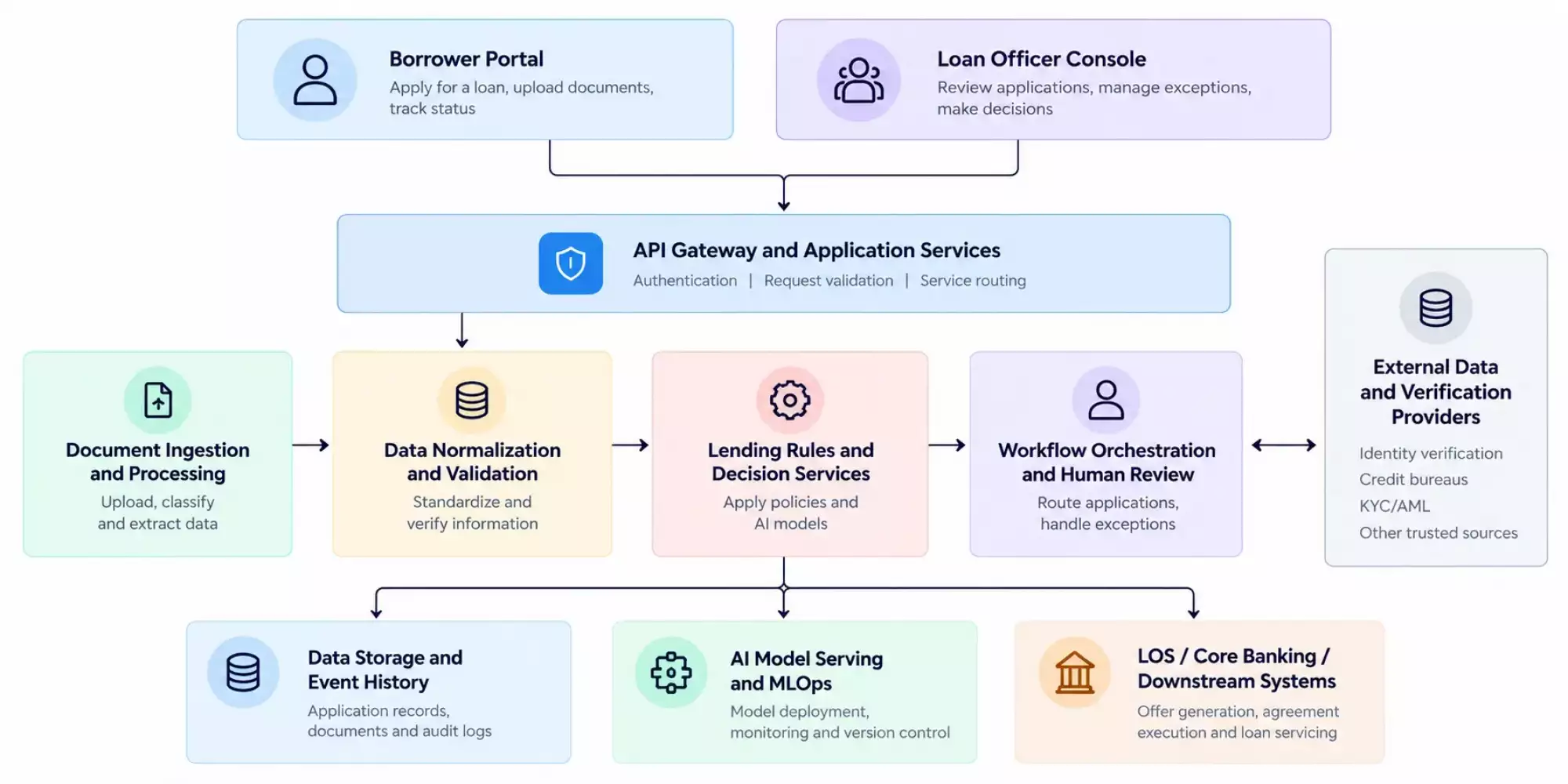
How to Build AI Loan Application Processing Software
Developing AI-powered loan application software is about gaining an understanding of how the loan process operates today, the areas that can be improved, and the decisions that can be automated safely. A staged AI loan application software development period aids groups in validating the option prior to rolling it out throughout loan products.
Step 1: Define Business Requirements and Lending Policies
Describe the different kinds of loans, the different categories of applicants, the market segments, and the number of applications and business objectives. Determine activities that can be automated and decisions that must be made by humans according to the lender's policies.
Step 2: Audit Existing Workflows and Data Sources
Describe the current application, verification, underwriting, and approval processes. Identify duplication of effort, missing data elements (and gaps), and integration challenges from existing banks, data providers, and document sources.
Step 3: Identify MVP and Acceptance Criteria
Don't automate everything all at once; start with one or two typical loan products. Define the parameters for accuracy of extraction and data validation, exception routing, audit records, and reliability of processing.
Step 4: Design the Canonical Data Model
Set up uniform borrower information, application, documents, verification process, and lending process. Clearly describe the process for resolving conflicting values and how critical data points can be tracked back to their origins.
Step 5: Create Document Ingestion and Validation Pipelines
Develop the process to retrieve documents, extract information, normalize the fields, and flag any that are not complete or clear. Use real-life documents like poor-quality scanned documents, missing pages, and varying document formats.
Step 6: Implement Rules-Based Decisioning and AI Services
Establish clear lending guidelines and test and fine-tune. If appropriate data and business value are included, use machine learning. Separate AI-generated assessments from the service that is responsible for approving lending decisions.
Step 7: Integrate External Systems
Integrate necessary identity verification vendors, credit bureaus, financial data vendors, e-signature solutions, and existing lending platforms. Simplify the test integrations in the sandbox, expecting timeouts, reattempts, provider failures, and data reconciliation.
Step 8: Create Review Workflows and Audit Records
Set up reviewers and queues, task assignments, approvers, escalations, and override logs. Make sure that the system records who made any significant actions, when they were made, and which versions of the system policies and model were applied.
Step 9: Validate, Deploy, and Optimize
Conduct pre-release testing and functional, integration, security, performance, model, and user-acceptance testing. Roll out in a phased and staged manner and track operational outcomes and procedures to investigate risks and reverse changes.
Essential Integrations for an AI Loan Processing Platform
An AI-powered loan processing platform isn't likely to stand completely alone. It talks with identity providers, credit bureaus, financial data services, and the already existing lending systems. It's not merely about successfully connecting your API; reliable integrations rely on far more. Data permissions, the quality of the responses, error handling, and consistent record-keeping are all important.
Identity Verification, KYC, and AML Providers
Integrations connect with identity verification and applicable KYC/AML providers, in return providing verification statuses and backing references. The platform should process API authentication, consent (if applicable), and acceptable data usage. If a response is not given or is not clear, it should not be considered successful verification, and a new attempt or review should be made.
Credit Bureaus and Credit Data Services
Credit Bureau API integration enables proper pull of the credit report and other data from a reliable credit bureau. The platform should normalize the response from various providers, provide a response for unavailable or incomplete reports, and keep the relevant report reference and retrieval records following applicable retention rules.
Open Banking and Financial Data Aggregation
Consented financial data can be used for income verification and cash flow analysis via the financial data aggregation API. Due to the fact that the source and the retrieval context may vary from provider to provider, the platform must be normalized while still maintaining the information's original source and the context from which it came.
Loan Origination, Loan Management, and Core Banking Systems
Loan origination API development is the integration of loan processing with the lender's current systems. Integrations must align the status of applications, decision records, borrowers, and loans. Ownership of each record and reconciliation process can help ensure consistency of updates to the loan origination system (LOS), loan management system (LMS), and core banking platform.
E-Signature, Payment, and Document Services
The status of agreements and references to the signed document are returned by the e-signature integration. Document services provide controlled storage and retrieval, and payment or disbursement integrations send approved instructions to the downstream payment or disbursement system. Do not leave records out of sync by not reconciling status updates and failed transactions.
Integration Matrix
| Integration | Main data exchanged | Key engineering concern |
| Identity provider | Verification status and evidence reference | Authentication and response handling |
| Credit bureau | Credit data and report reference | Authorized access and data quality |
| Financial data provider | Account and transaction data | Consent, normalization, and source tracking |
| LOS/LMS | Application, decision, and status records | Reconciliation and record ownership |
| E-signature provider | Agreement status and signed-document reference | Document integrity and status synchronization |
Upgrade Your Lending Platform With AI
Planning to add AI capabilities to your existing loan origination system without rebuilding your entire lending infrastructure?
Secure, Compliance, and Responsible AI in Lending
AI loan processing software deals with sensitive monetary information and can impact decisions that can affect a borrower's capability to get a loan. Security and responsible AI should therefore be built in from the beginning and not tacked on just before the product is launched.
Data Protection and Access Controls
Implement encryption for data in transit and at rest, role-based access controls, and least privilege permissions. Use different development, test, and production environments; secure API credentials and secrets; and limit access to sensitive borrower data. Logs should not reveal any unnecessary personal or financial information.
Consent, Data Minimization, and Retention
Only retrieve the data necessary for a specific lending objective, and set up the proper permissions prior to accessing external data. Record information use, access, retention, and deletion in accordance with legal requirements. The operating policies of the platform should incorporate consent and data-use rules.
Fair Lending and Model-Bias Assessment
Teams need to review training data, evaluate model performance in the relevant population for the purposes of the law, and investigate unexplained differences in the context of responsible AI in lending. If a problem is found in a test, record the results and corrective measures. There is no one "right" fairness measure, or technical security, to ensure that a lending model is fair or lawful.
Explainability and Adverse-Decision Records
When using AI for decisions, keep relevant evidence, applicable reason codes, policy and model versions, and reviewer actions. These records form evidence to assist a team in understanding how the outcome was achieved and provide appropriate explanations.
Auditability and Model Governance
Keep a log of access, policy changes, model approvals, model validation, and model production deployments. Establish clearly defined responsibility for the approval of updates to the model and for monitoring model performance over time. Monitoring should enable the discovery of any changes that are startling before they affect the quality of the decisions or operational reliability.
Jurisdiction-Specific Regulatory Requirements
The regulatory requirements vary based on the lender, loan product, jurisdiction, and operating model. Requirements should be verified by legal and compliance experts.
- United States: Applicable state laws, the Equal Credit Opportunity Act (ECOA) and Regulation B, the Fair Credit Reporting Act (FCRA), and the Gramm-Leach-Bliley Act (GLBA) are among the relevant requirements.
- In India, lenders should also consider the conditions to be met by the Reserve Bank of India (RBI) with regard to digital lending, as well as the responsibilities of regulated entities, consent, and obligations relating to data handling.
- Other markets: Examine relevant lending licenses, consumer credit regulations, privacy laws, outsourcing requirements, and data residency requirements.
For a secure loan processing software solution, it's necessary to have a clear sense of accountability for borrower data, model behavior, and lending decisions. Technical controls are a means to assist with that responsibility, but not a substitute for legal review, good lending policies, or good governance.
Testing AI Loan Processing Software Before Deployment
Prior to the launch of AI loan processing software, teams should demonstrate that the software can process routine applications correctly and can handle it safely when it does not go according to plan. Tests should be conducted on the software as well as AI-related risks, and the acceptance criteria should be agreed upon prior to deployment.
Functional and Workflow Testing
Application submission and document uploads, application status changes, application eligibility rules, permissions for reviewers, exception handling, and downstream handoffs. Ensure that invalid inputs are restricted correctly and applications take the correct paths, if they are required to do so, under various conditions.
Document Extraction and Data-Quality Testing
Create and use representative documents from a variety of sources, layouts, and levels of quality. Test extraction accuracy at the field level, missing field detection, and normalization errors. Add poor scans and incomplete documents to ensure that uncertain results are not accepted without being flagged.
Model Validation and Decision Consistency
Test and assess AI models with appropriate holdout data that is not training data. Analyze prediction errors, calibration as appropriate, and performance on suitable groups of applicants. Identify any limitations and ensure that the output from the model is dealt with in line with accepted lending policies.
Failure-Recovery Testing and Integration
Mock provider timeouts, as well as unavailable APIs, invalid responses, multiple events, and interrupted processing. Make sure that there are no duplicate business actions as a result of retries and that failed business actions or inconsistent transactions can be reconciled.
Security, Load, and User-Acceptance Testing
Monitor access control, data exposure, and audit log completeness. Run load tests to test the expected application volume and have loan officers and underwriters test realistic scenarios. Their comments can highlight unclear steps in their review or areas where they need to handle exceptions if they haven't already been tested.
What Should Pass Before Release?
Release should not occur until all the agreed acceptance criteria are fulfilled, all the critical defects are addressed, all the failures during integration are resolved with defined recovery procedures, and all the necessary model validation evidence is documented. If there is a limitation that cannot be resolved, it must be owned by someone and have a definitive release decision.
The NIST AI Risk Management Framework offers guidance to assess and manage risks associated with AI systems during the lifecycle of the system. The evidence of the testing should be retained by the team to provide an explanation of why the system would be considered ready for deployment.
How Much Does AI Loan Application Processing Software Cost?
The cost of AI loan application processing software development can range from $25,000 to $750,000+. The price depends on what the lender wants to automate, what systems will need to be integrated, and how much customization the project will require. The platform that is based on document extraction and simple lending rules will typically need less investment than one with enterprise-level governance, custom machine learning models, and legacy integrations.
The following are planning estimates for the purposes of this document only and will not be regarded as verified industry averages or a formal Suffescom quotation.
| Development tier | Indicative budget (USD) | Illustrative scope |
| MVP | $25,000–$60,000 | Application intake, basic document processing, rules engine, reviewer dashboard, limited integrations |
| Mid-level platform | $60,000–$150,000 | Multiple document types, verification APIs, configurable workflows, financial analysis, reporting |
| Advanced AI platform | $150,000–$350,000+ | Custom ML models, advanced validation, model monitoring, explainability, multiple integrations |
| Enterprise platform | $350,000–$750,000+ | Complex legacy integrations, multi-market support, high availability, enterprise governance, extensive automation |
These ranges are starting points for project planning. Actual estimates depend on scope, delivery location, third-party services, and regulatory requirements.
Cost by Development Module
Instead of assigning a specific price for each component, estimate the work within these areas:
- Discovery and Planning: Requirements and Workflow Assessment, Solution Design.
- Interfaces and document intelligence: Borrower portal, staff console, document extraction, and validation.
- Rules and decisioning: Policy configuration, decision support, and review workflows.
- Integrations: Financial data sources, existing lending systems, credit bureaus, and verification providers.
- Security and governance: Access and security controls, auditability, and compliance requirements.
- Testing & deployment: Functional validation, integration testing, release preparation, and production monitoring.
The modules are linked together, and the cost of each module should be viewed as part of the overall scope, not as a standalone project with a stand-alone fixed project price.
Factors That Influence Development Cost
There are a number of decisions that will have a significant impact on the budget:
- Loan product complexity: The support of one personal loan product is different from that of mortgages, SME lending, and asset-backed finance.
- Document and Data Requirements: There are multiple formats, languages, and inconsistent documents or data sources that require additional processing and validation efforts.
- AI requirements: Rules-based automation needs distinct data requirements, validation, and monitoring compared to custom machine learning.
- Complexity of integration: Engineering effort may be increased due to legacy systems, provider limits, and various APIs.
- Security and regulatory scope: The scope of security and regulatory requirements has an impact on validation and design.
- Scale and availability: High application volume, resilience needs, and deployment requirements impact infrastructure and engineering decisions.
Recurring Costs After Launch
The first construction is just one investment. Continued costs can include cloud hosting, AI inference fees, charges for third-party verification, monitoring tools, technical support, evaluating and retraining models, and adjustments to external integrations. Don't think of launch as the end of development spending, but rather include these as a component of the operating budget.
What Should a Development Estimate Include?
The agreed features, integrations, deliverables, milestones, assumptions, exclusions, third-party dependencies, acceptance criteria, and change control process are all useful elements to specify for a useful estimate. It should also explain the inclusion or exclusion of infrastructure, provider fees, model monitoring, and ongoing maintenance.
It's not an eye-catching price; it's the right estimate that begins with the lending workflow and business needs. Our AI development services can assist in outlining a solution based on your current systems and automation objectives.
AI Loan Processing Software Development Timeline
The loan processing software development process will take time based on the loan products, integration, data readiness, and automation requirements. A small MVP can be developed in a couple of months, and an enterprise platform can take much longer.
Discovery and Proof of Concept
Estimated duration: 2–4 weeks
The team validates the lending requirements, reviews current processes, measures data quality, and establishes the initial architecture. A small proof of concept can be important to validate feasibility if the performance of the AI or the extraction of documents carries technical risks before going to the trouble of full development.
Key milestone: Requirements approved, initial architecture, and validated technical approach.
MVP Development and Pilot
Estimated duration: 8–16 weeks from discovery
The MVP covers the essential business process of a single defined loan product, application intake, document processing, validation rules, priority integrations, and a review interface. Finally, a controlled pilot is conducted to ensure workflow reliability, data accuracy, exception handling, and adherence to lending policy.
Key milestone: A solution that satisfies the agreed-upon acceptance criteria and is ready for a pilot test.
Production Rollout and Expansion
Estimated treatment time: 4-12+ weeks
Pre-launch, the team performs security and performance testing, develops monitoring and recovery plans, and trains and documents escalation plans for operational teams. The phased rollout is a way to resolve issues before expanding to additional users, loan products, or areas.
Key milestone: A platform that is production-ready with functioning controls and an expansion strategy identified.
What Can Affect the Timeline?
Requirements, legacy system limitations, poor-quality data, changing requirements, and approvals from external providers can delay delivery. An MVP may be available in a few months, while an enterprise implementation of several products and complex integrations could be developed over months or years.
To calculate the realistic loan origination software development timeline, establish the initial release scope and determine the integration dependencies early on. Suffescom's FinTech software development services can assist you in creating a phased implementation based on your lending needs and systems.
Plan Your AI Loan Processing Software Development
Wondering how much it will cost to build AI loan processing software for your loan products, application volumes, and integration needs? Discuss your realistic development budget and roadmap.
Custom Development vs. Off-the-Shelf Loan Processing Software
Whether to use an existing platform or custom loan processing software will be based on the degree of similarity between the solutions you find and your lending workflows, configuration requirements, and your long-term business objectives. Purchasing an existing platform can minimize implementation time, but when the standard tools don't fit your needs, custom development may prove more useful.
When an Existing Platform Is Sufficient
For a lending business with specific, predictable requirements and predetermined workflows, an off-the-shelf solution may be the right fit for your business if the platform offers the necessary integrations. Application forms, approval stages, permissions, and reporting can be adapted with the help of configuration.
This can cut down the initial engineering work if the licensing requirements, design restrictions, and vendor support are right for you.
When to Extend an Existing LOS with AI
Not all the time is replacing an existing loan origination system (LOS) required. Lenders can integrate AI functions into their current system to help automate the extraction of information, validate application data, flag discrepancies, and provide assistance for underwriters with case summaries.
This way, you can maintain the current system of record but add in specific automation. It is dependent upon the feasibility of using its APIs, extension points, data access, and constraints for integration.
When Custom Development Makes Sense
If your lending model has workflows that are not covered by a standard loan origination system, then custom loan origination system development might be an option for you. This could involve special types of loans, partner integrations, unusual eligibility criteria, and specific data processing needs.
It also allows the business to have a better influence on the product roadmap and architecture of the project. But this flexibility has its drawbacks, such as the need for continuous maintenance, security, integration, and technical enhancements.
How to Compare Total Cost of Ownership
Look at more than just the upfront price and development costs. Assess the licensing, implementation, customization, integration, support, infrastructure, and cost of change issues. Remember vendor dependence, data portability, contract limitations, and the time it will take to move if your current platform is no longer working for you.
| Consideration | Existing platform | Custom development |
| Initial delivery | Often faster when requirements fit | Requires design and implementation |
| Workflow flexibility | Depends on configuration and extension options | Can be tailored to business requirements |
| Integrations | Depends on available connectors and APIs | Can be designed around required systems |
| Ownership and control | Governed by vendor terms and licensing | Depends on contracts, architecture, and IP rights |
| Long-term cost | Licensing, support, and customization | Engineering, infrastructure, and maintenance |
KPIs and ROI for AI Loan Processing Software
The value created by the AI loan processing software is only realized when it contributes to better measurable business outcomes without sacrificing quality of decision, compliance, or borrower experience. A lender should set a baseline of performance prior to deployment and compare the performance of similar loan products, application types, and reporting periods.
The keys to a practical loan automation ROI framework include monitoring the speed of loan processing, the amount of manual work required, document quality, the accuracy of fraud alerts, operational costs, and decision consistency. These indicators provide insight into the areas in which automation is already effective and those that can be enhanced.
Application Turnaround Time
Application turnaround time is the period that elapsed between application submission and specific application milestones like document verification, underwriting review, and application decision.
Measure overall elapsed time, independent of processing time. The delays for missing documents, third-party verification, or internal queuing should be isolated to determine if there are any turnaround delays.
Straight-Through Processing Rate
A straight-through processing (STP) rate is the percentage of eligible applications that can be processed without any manual steps.
Identify the target population for applications and the definition of "intervention. For instance, if an application needs an employee to make edits to the extracted data, this does not necessarily constitute being fully automated for that application. Consider STP in addition to error rates and the quality of decisions, not as a measure of success.
Document Extraction Accuracy and Exception Rate
Test the performance of document AI in the field and application. The field-level accuracy indicates the percentage of extracted values that are consistent with source information, and the exception rate captures the percentage of applications that must be corrected, reprocessed, or have additional information.
Monitor performance per document type and critical field (e.g., income, account balance). Even though the accuracy is high, mistakes in critical fields might exist because of errors in other fields, so evaluate accuracy field by field for each field's possible impact.
Fraud Detection Accuracy and Errors
The effectiveness of fraud monitoring should be assessed by the ability to filter out those alerts that are meaningful risks and not too many to review.
Precision is the percentage of investigated alerts that qualify as a lender's fraud. The false-positive rate is the percentage of true negative cases that were misclassified as true positive cases out of the total number of cases evaluated. Monitor alert resolution time and confirmed outcomes; note that labels of fraud may be delayed or incomplete. An anomaly is a reason to look into it; it's not evidence of fraud.
Cost per Processed Application
Cost per processed application reflects the amount of money that the lender expends per application processed. Compute it based on a uniform base and population of applications, such as staff time, infrastructure, AI inference, document processing, verification services, and third-party fees.
Do not make comparisons between similar loan products and do not ignore the effects of varying the volume and complexity of loan applications.
Model and Policy Performance
If machine learning is employed, track model performance, calibration, drift, and model results as compared to approved model validation criteria. Separately monitor policy exceptions, manual overrides, decision reversals, and discrepancies between AI recommendations and decisions authorized.
These indicators can be used to identify patterns in the model that are not reflective of a change in lending policy, application mix, or reviewer behavior.
AI Loan Processing Analytics: KPI Measurement Framework
| KPI | Measurement formula | Primary data source | Suggested cadence |
| Application turnaround time | Decision timestamp − submission timestamp; report active processing time separately | Workflow event logs | Weekly and monthly |
| Straight-through processing rate | Eligible applications completed without manual intervention ÷ total eligible completed applications × 100 | Workflow logs and review records | Weekly and monthly |
| Field extraction accuracy | Correctly extracted and verified fields ÷ total evaluated fields × 100 | Document AI results and verified records | Weekly, with monthly trend review |
| Exception rate | Applications requiring correction or additional information ÷ applications processed × 100 | Exception queues and application records | Weekly |
| Fraud-alert precision | Confirmed fraud alerts ÷ investigated alerts with resolved outcomes × 100 | Fraud alerts and investigation records | Monthly or quarterly |
| False-positive rate | Legitimate cases incorrectly flagged ÷ all evaluated legitimate cases × 100 | Investigation outcomes and validated labels | Monthly or quarterly |
| Cost per processed application | Total attributable processing cost ÷ applications processed | Finance, staffing, infrastructure, and vendor records | Monthly |
| Model and policy performance | Model validation metrics, drift indicators, policy exceptions, and override rates | Model monitoring, decision logs, and policy records | Risk-based monitoring and scheduled reviews |
These reporting periods are guidelines. There may be a need to monitor high-risk workflows more often or evaluate metrics based on confirmed fraud outcomes over longer periods.
How to Evaluate Loan Automation ROI
Compare post-deployment results with baseline results, adjusting for application volume, loan type, loan complexity, and other changes that may have taken place in the operation. Calculate the savings that could be achieved through less manual work, less rework, reduced processing errors, and increased capacity. Eliminate continuous software, infrastructure, third-party, maintenance, and model oversight expenses.
A simple calculation is:
ROI (%) = (Net benefit ÷ Total implementation and operating cost) × 100
Net benefit is the net financial benefit that is measured over the same time period as the costs that are relevant. Avoid double-counting released personnel resources as cash savings unless they are used to save on costs or to enable additional productive work.
The best loan processing efficiency measures are speed and cost versus accuracy, exception management, and decision quality. This helps lenders to get a better sense of the performance of the automation than a single performance metric.
Why Choose Suffescom Solutions for AI Loan Processing Software Development?
Integrating an AI model into loan processing software is not enough to build a successful AI loan processing platform. Lenders require a solution to be integrated into their current systems that will process and manage sensitive financial information responsibly and enable traceable lending processes. Suffescom Solutions can help you identify a development strategy in line with your business needs, technical context, and your automation goals.
Custom AI and FinTech Engineering
There are various application workflows, data sources, and approval policies for every lending business. Suffescom's AI development services can assist you with determining the space in which AI, rules-based automation, and custom software play a role in your lending operations.
Scalable Architecture and System Integration
You want your platform to be compatible with the systems that your lending staff use. Document-processing pipelines, data validation, external APIs, loan origination systems, and downstream banking applications can all be taken into account when designing the development.
Responsible AI and Workflow Control
Appropriate controls are required for AI outputs before they impact lending. The solution must be based on a traceable data flow, with rules that can be configured, handled, and reviewed by a human when needed. AI agent development services could also be applicable in cases of multi-step AI orchestration.
Security and Production Readiness
Access control, handling of sensitive information, audit trails, integration security, and operation monitoring are all important considerations in financial applications. They should be considered when designing the solutions and not only at the time of deployment.
Flexible Engagement and Project Scoping
The key to the right development plan is knowing what you have. Provide information on loan products, the existing loan origination system, the volume of applications expected, integration needs, goals of AI, and deployment considerations.
Ongoing Optimization and Future Expansion
The requirements for lending and operations may vary from year to year. The modular design can help to make it simpler to add new loan products, integrate new data sources, optimize workflows, or enhance monitoring without overhauling the platform.
Build Your AI Loan Processing Solution With Suffescom
Looking to automate loan application processing or extend an existing lending platform with AI?
The End Note!
The correct way to start with an AI loan application software development process is to understand the lending processes, rather than selecting AI technologies. Different document extraction, data verification, credit policy appraisal, and decision authorization help keep track of vital lending processes. For the same reasons of consistency and accountability, reliable integrations, exception handling, and audit trails are crucial.
Assess the budget and timeline, ensure data is available, and check for any integration obstacles before developing. After the launch, there is ongoing performance monitoring and responsible AI controls for reliability, adapting to evolving lending requirements.
Looking to upgrade your lending processes? Talk to Suffescom Solutions about your custom AI loan processing software needs.
FAQs
1. What Is AI Loan Application Processing Software?
AI loan application processing software helps lenders provide more efficient application processing by using artificial intelligence, document intelligence, data validation, and workflow automation. It can extract information from financial documents, detect inconsistencies, and support underwriting processes while complementing, not replacing, human efforts.
2. What Does AI Do in Loan Application Automation?
AI can classify documents, collect borrower details, ensure accurate data in loan applications, detect inaccuracies, and aid credit assessment. Workflows then automatically route applications for further processing, further information, or review according to the lending policies set up.
3. What features should an AI loan processing platform have?
The process of digital application intake, intelligent document processing, configurable rules, exception handling, reviewer dashboards, and audit logs are all key features. Some advanced platforms may also incorporate credit risk models, fraud detection, and model monitoring. The functionality needed will be based on the specific products and operating structure of the lender.
4. How Much Does AI Loan Processing Software Cost?
Indicative planning estimates range from $25,000–$60,000 for an MVP, $60,000–$150,000 for a mid-level platform, $150,000–$350,000+ for an advanced AI solution, and $350,000–$750,000+ for an enterprise platform. These are only indicative figures, not contracts or benchmark industry figures. The true expenses will depend upon the specifics of the integration, customization, data preparedness, security requirements, and complexity of the AI.
5. What is the timeframe for creating AI loan processing software?
The process may take a couple of months to develop the MVP and conduct initial validation. These implementations may take months to years when there are significant governance needs, legacy integrations, multiple loan products, and a large number of enterprise-specific machine learning models. The approval of the provider, data quality, and testing also affect delivery.
6. Is AI Loan Processing Software compatible with an existing LOS?
Yes, but only if the current loan origination system (LOS) could serve as the foundation for API implementation, data access, permissioning, and workflows. Document intelligence, data validation, and decision support are possible without changing the system of record with integration. Additional engineering might be needed due to legacy restrictions or limited interfaces.
7. Can AI Make Loan Approval Decisions Without Human Involvement?
In other words, systems are able to make some or all decisions, depending on rules, automatically. Automated decisions, however, may not be suitable or legally allowed for all lending products, areas, or requirements. Lenders need to establish approved decision policies, acceptable oversight, escalation policies, and protections against unreliable or unfair results.
8. How Can Lenders Make AI-Assisted Credit Decisions Explainable?
Lenders should keep a log of input data, model and policy versions, reason codes, human overrides, and decisions. The models should also be appropriately validated and continuously monitored. If there are requirements to provide an explanation for adverse action, lenders must give the required explanation, not just a generic AI-generated explanation.
9. What Integrations Does an AI Loan Processing Platform Require?
Typical integrations include credit bureaus, identity verification and financial data aggregation systems, document management systems, e-signature systems, existing LOS or loan management systems, and core banking systems. This will vary by loan product, available data, and lender's technology environment.
10. Is Custom Loan Processing Software Better Than an Off-the-Shelf Platform?
Both have pros and cons. For lenders who have a standard workflow and supported integrations, an existing platform might be the right fit. For specialized lending products, workflows, and complex integrations, custom development might be more suitable when it comes to achieving control. Adding specific AI functionalities to an existing LOS can also be a feasible compromise.
11. How Can Lenders Measure the ROI of AI Loan Processing Software?
Lenders can evaluate the efficiency and time of processing, straight-through processing rate, document extraction accuracy, exception rates, cost per application, and fraud alert effectiveness before and after implementation. Calculating ROI should take into account implementation and operating costs, complexity of application, and measurable financial gains, not the fact that every efficiency gain equals a cash gain.
12. Is AI Loan Processing Software Suitable for Small and Mid-Sized Lenders?
Yes. For smaller lenders, a solution that helps with high-volume tasks such as document extraction, application validation, and workflow routing can help them get started. A phased approach can help to progressively grow the scope and keep the initial scope reasonable as the volume of applications, data readiness, and business needs evolve.
13. What security and compliance considerations should lenders make?
The requirements differ from market to market, product to product, and data to data. These include things like encryption, role-based access control, consent and data retention policies, audit trails, model governance, and safe integrations with third parties. Lenders must also examine relevant financial services, consumer credit, privacy, and fair lending laws and regulations prior to deployment.
14. Is there a possibility to detect fraudulent applications using AI loan processing software?
AI can detect inconsistencies in documents, odd financial transactions, or mismatches between data sources. However, an alert is not enough to confirm an application is malicious. The right systems combine detection signals with verification, investigation processes, and the right human review.
15. What is the best way to begin an AI loan process software project?
First, determine the loan product, existing bottlenecks, data available, existing systems, and the tasks that can be automated. Set up a small initial solution scope, define measurable acceptance criteria, validate and test integration and data dependencies, and expand the solution after validation.