+971-8000321216




Key Takeaways:
- Not every pharmacy needs AI. Pharmacies that are large, have several locations, or experience complicated demand forecasts and problems with their stock will benefit from AI.
- Start with the basics. The pharmacy should have accurate inventories, lot and expiration date tracking, procurement, receiving, and stock transparency before implementing AI functionality.
- AI can help in making important inventory-related decisions. Demand forecasts, expiration risk alerts, shortage predictions, and stock transfers are viable uses of AI in pharmaceutical inventory.
- People should make decisions regarding risky activities. Controlled substances, product recalls, substitutions, write-offs, and abnormal stock movements should not be automated.
- Use the AI in shadow mode, compare its recommendations to actual results, and only automate after ensuring performance.
- AI pharmacy inventory management development costs depend on scope. A tailored AI for pharmaceutical inventory can cost between $35,000 and $250,000+.
Pharmacies run on availability. Out-of-stock medications result in delays in treatment, and an excess in stock translates into a loss as well as the risk of expiring. Whether you are a pharmacist, head of a pharmacy chain, or hospital pharmacy manager, you need effective solutions for your stock issues.
While some of these issues may be solved with the use of artificial intelligence, AI may not be suitable for every pharmacy. For those who consider developing an AI-based inventory management solution, this guide serves as a framework for development and scoping. This guide will help you determine whether AI development makes sense for your project, then walk you through defining the necessary features, forecasting process, required integrations and data, security and compliance considerations, and development costs and timeline. So, let's get started!
Do You Need an AI-Powered Pharmacy Inventory Management System?
Before anything, you must understand whether you need an AI-powered pharmacy inventory management system or not. Supply factors make the issue worthy of consideration. According to ASHP and the University of Utah Drug Information Service, there were 227 active drug shortages in the US in mid-2026, up from the previous quarter but well below the highest number ever recorded: 323 in early 2024. Almost 50% of 2026 drug shortages are due to products produced by one particular manufacturer, while 16% of the current shortage is that of controlled substances.
You likely need AI if
- You have many sites where you cannot view the stock status at any one moment.
- You have shortages of some items and too much inventory of other items.
- You have different lead times for your suppliers that are unpredictable.
- You have many SKUs in your product list that make manual review difficult.
- You have an outdated inventory software system with poor reports.
- Manually reconciling inventory takes too much time every week.
When AI may be unnecessary
A small pharmacy that does not have much inventory and does not change its inventory very often can use standard pharmacy software for pharmacies, along with min/max levels, effectively. The addition of machine learning would add unnecessary cost without delivering benefit.
Build, buy, or extend?
| Option | Choose it when |
| Buy | Standard workflows meet your needs. |
| Extend | Your current pharmacy system has usable APIs, and you need added analytics or forecasting. |
| Build | Your workflows, integrations, or AI requirements are differentiated enough that off-the-shelf tools constrain you. |
Need to know whether AI is actually right for your pharmacy?
Where AI Genuinely Adds Value in Pharmacy Inventory Management
The value that AI offers lies in the instances where the decision requires patterns that cannot be identified by any hard-and-fast rule. AI offers intelligent automation in situations where there is already a rule available.
Automation, Rules, Analytics or AI? A Practical Ladder
"AI" has become an umbrella term for just about any software capability, making purchase decisions and planning difficult. A pharmacy might spend money on machine learning where a simple reorder system would have accomplished the same task. This would be overspending and not necessarily achieving better outcomes. This reverse case is also possible; people might choose a simpler system when conditions require something more sophisticated than a threshold. The way forward is to apply the appropriate technology to the problem at hand. Below is a six-step ladder going from the simplest and cheapest to the most complex technology.
- Automation helps do repetitive jobs, like creating purchase orders from an approved list.
- Rules-based logic triggers actions when a fixed threshold is met, for example, "reorder at 20 units."
- Analytics explains what has happened, such as sales in a particular category or old stock.
- Machine learning and predictive AI use past data to predict the future, such as predicting demand for the next month.
- Optimization helps suggest the best course of action, such as the transfer of stock between stores.
- Language AI is used to answer English-language questions about the stock.
Begin from the bottom rung if it solves your problem. Only move up when you are sure it cannot.
AI Use Cases in Pharmacy Inventory Management
Once you realize the position of AI in the hierarchy, the next move will be to identify what inventory issues it can resolve. Listed below are the nine use cases that have the highest probability of being successful. For each case, there would be a method, the value that would be provided to the business from the method, the data needed, and human intervention. This is an important point to make, since some of the use cases are lower-risk and can be implemented with just a pre-approval, while some of them deal with stocks, security, or compliance and require a person to make the final decision.
1. Demand forecasting
- Technical approach: Machine learning and time-series forecasting
- Business value: Better replenishment planning
- Data required: Historical demand
- Human oversight: Recommended
2. Dynamic safety stock
- Technical approach: Forecasting combined with optimization
- Business value: Balances availability against excess inventory
- Data required: Demand data and supplier lead times
- Human oversight: Required
3. Expiry-risk prediction
- Technical approach: Predictive analytics and machine learning
- Business value: Reduces avoidable expiry and waste
- Data required: Inventory levels, expiry dates, and demand
- Human oversight: Required
4. Slow-mover detection
- Technical approach: Analytics and machine learning
- Business value: Identifies excess stock before it becomes waste
- Data required: Inventory and demand data
- Human oversight: Recommended
5. Anomaly and shrinkage detection
- Technical approach: Anomaly detection
- Business value: Flags unusual stock movements for review
- Data required: Transaction history
- Human oversight: Required
6. Shortage-risk alerts
- Technical approach: Forecasting combined with external signals
- Business value: Enables earlier intervention
- Data required: Demand data and supply data
- Human oversight: Required
7. Multi-location balancing
- Technical approach: Optimization
- Business value: Recommends stock transfers between locations
- Data required: Location-level inventory
- Human oversight: Human approval required
8. Supplier lead-time analysis
- Technical approach: Analytics and machine learning
- Business value: Improves purchasing decisions
- Data required: Purchase order history
- Human oversight: Recommended
9. Natural-language queries
- Technical approach: Large language models (LLMs) and natural language processing (NLP)
- Business value: Makes reporting and analysis easier for non-technical staff
- Data required: Inventory and analytics data
- Human oversight: Controlled (restricted access and verified outputs)
Evidence from research
Peer-reviewed work supports predictive methods in this setting. One study in Production and Operations Management proposed a pharmaceutical forecasting framework that trains advanced machine learning models on time series borrowed from many other products and adds non-demand features such as downstream inventory data and supply-chain structure. The authors also report empirical evidence of the value of downstream inventory information for demand forecasting. A separate systematic review of machine learning in pharmaceutical demand forecasting concluded that machine learning techniques are promising for the complex, nonlinear characteristics of pharmaceutical demand. Both are research findings, not guarantees of results in your pharmacy.
Where AI Should Advise, Not Decide
Keep a human approval step for high-risk actions, such as:
- Controlled-substance actions
- Recalls
- Product substitutions
- Write-offs
- Regulatory actions
- Unusual inventory adjustments
The system is ideal for recommendations, and a qualified person makes the final decision.
Have an inventory problem you want AI to solve?
The Pharmacy Inventory Lifecycle the System Must Support
Software must fit how medicines actually move. The lifecycle runs:
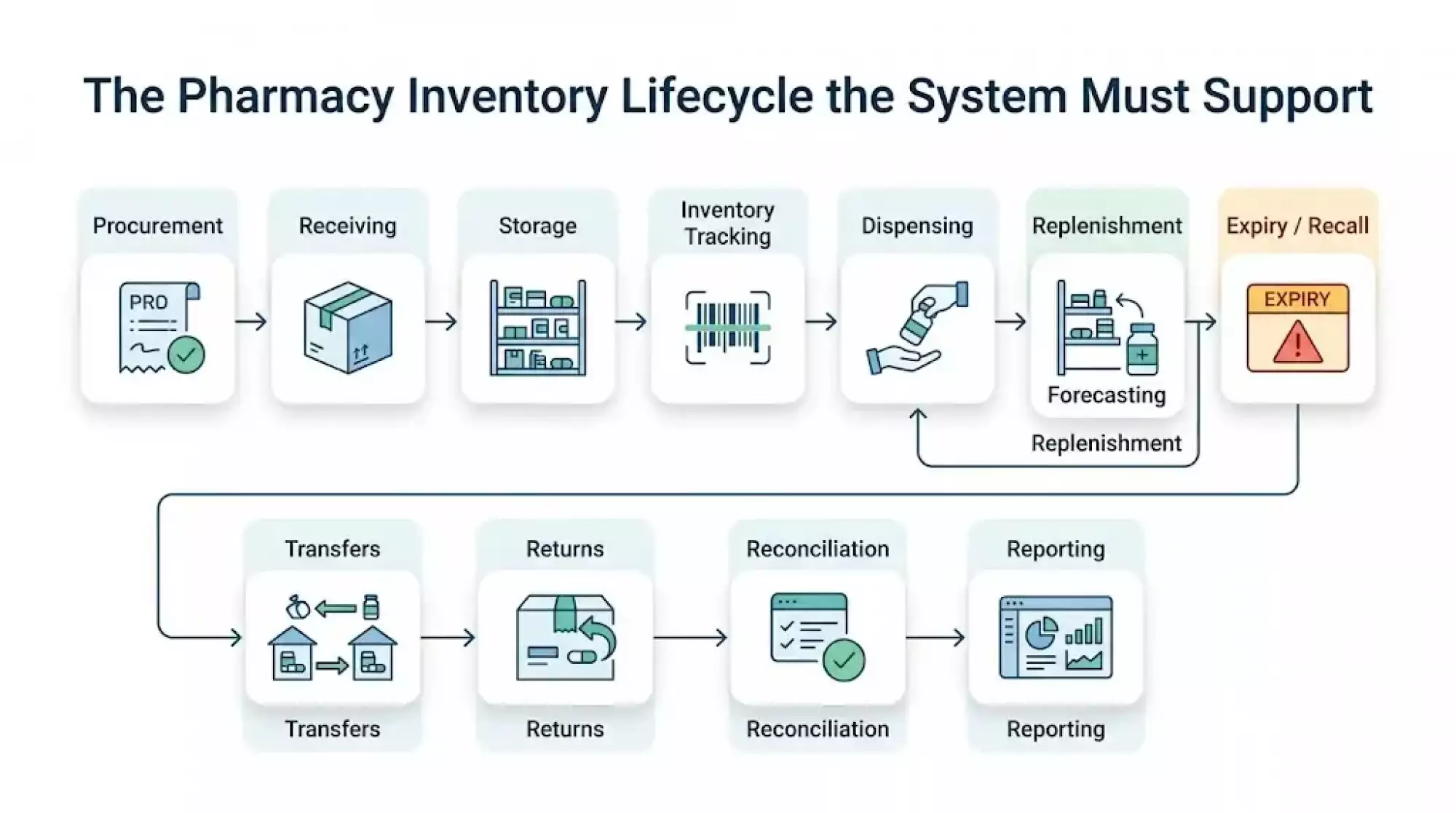
Receiving and tracking: Compare all deliveries against the purchase orders. Barcode-scan the lot numbers and expiration dates of the deliveries. Lot or batch control associates all items delivered to your inventory with that delivery for easier recall.
FEFO: The first-to-expire, first-out method refers to distributing inventory that expires the soonest to avoid wastage and can only be successful if you have lot and expiry data.
Storage: Temperature-sensitive medication needs proper storage. It’s costly to lose any cold chain medication; thus, you need to have storage information for all products.
Controlled substances: The Federal DEA requires that registrants take an initial inventory followed by a new inventory every two years. Record keeping usually extends to two years, although this requirement may vary from state to state. Your system needs to provide for controlled substance record keeping.
Tracing: DSCSA mandates electronic and product-level traceability for prescription drug products. The FDA has exempted small dispensers from some provisions till November 27, 2027. A small dispenser is one where the company that owns the business employs 25 or fewer full-time pharmacists and pharmacy technicians. This exemption does not apply to larger dispensers.
Return transfer and reconciliation: Returns need to be made for legitimate reasons and with proper authorization. Transfers between locations will require confirmations from the sender and recipient. Reconciliation involves comparing system counts and actual counts.
AI application: The AI system can aid in forecasting demand, detecting expiration issues, recommending transfers, and spotting irregularities. The inventory management process should be able to work independently of the AI system.
Core Features: What to Build First and What to Defer in an AI Pharmacy Inventory Management Software
Advanced AI only works on a reliable foundation.
Build first:
- Product/SKU management
- Barcode scanning
- Lot/batch and expiry tracking, with FEFO support
- Multi-location visibility
- Purchase orders and receiving
- Stock adjustments
- Replenishment rules and inventory alerts
- Audit trail
- Role-based access control (RBAC)
- Reporting and dashboards
Add later:
- Supplier performance analytics
- Automated transfer recommendations
- Mobile inventory workflows
- Integration with IoT services
- Advanced forecasting and predictive expiry alerts
- An optimization engine
Feature Roadmap
| Feature | MVP | Growth | Enterprise |
| Core inventory | ✓ | ✓ | ✓ |
| Barcode/lot/Expiry | ✓ | ✓ | ✓ |
| Purchase orders | ✓ | ✓ | ✓ |
| Multi-location | Optional | ✓ | ✓ |
| AI forecasting | Basic | Advanced | Custom |
| Supplier analytics | — | ✓ | ✓ |
| Mobile scanning | Optional | ✓ | ✓ |
| IoT / cold chain | — | Optional | ✓ |
| Advanced optimization | — | Optional | ✓ |
What are Data Requirements and How to plan AI Forecasting Pipeline?
For most pharmacy projects, data quality limits results more than model choice does.
What data does the system need?
- Historical Sales and Dispensing Data
- Current Inventory Levels
- Purchase Orders and Receipts
- Supplier Lead Times
- Product Master Data, including NDC Identifiers and Pack Sizes
- Storage Requirements
- Lot And Expiry Information
- Stockout, Return, and Recall Records
- Location Data
Data problems that distort forecasts
- Duplicate product identifiers split one product's history across several records.
- Unit-of-measure mismatches mix boxes, strips, and tablets.
- Incomplete transaction histories leave gaps.
- Backorders recorded as zero demand make the product look unwanted.
- Stockout-censored demand hides true demand. If a product was unavailable, zero sales does not mean zero demand.
- New-product cold starts leave no history to learn from.
- Supplier or formulary changes shift demand patterns.
Why pharmacy demand is hard to forecast
Pharmacy products are known to have irregular sales patterns. This is known as intermittent demand, whereby there may be times when there is absolutely no demand. It is difficult to handle through conventional methods, since specialized methods are available for handling this problem. In a pioneering peer-reviewed study of methods tested against 3,000 intermittent demand series, one that was based on Croston's method came out on top in terms of out-of-sample forecast performance.
Measuring accuracy honestly
No universal accuracy figure applies to pharmacy forecasting. Judge the system by operational outcomes:
- Service Level (How often demand is met)
- Stockout Frequency
- Excess Inventory
- Expiry and Waste
- Forecast Error by Product Category
System Architecture for AI Pharmacy Inventory Management
A practical architecture has these layers:
- Web And Mobile Application Interfaces
- Inventory Engine
- Transactional Database
- Analytics Layer Or Data Warehouse
- AI/ML Service And Forecasting Pipeline
- Integration Layer
- API/Backend Services
- Notification Service
- Identity and RBAC
- Audit Logging
- Monitoring
Key architecture decisions
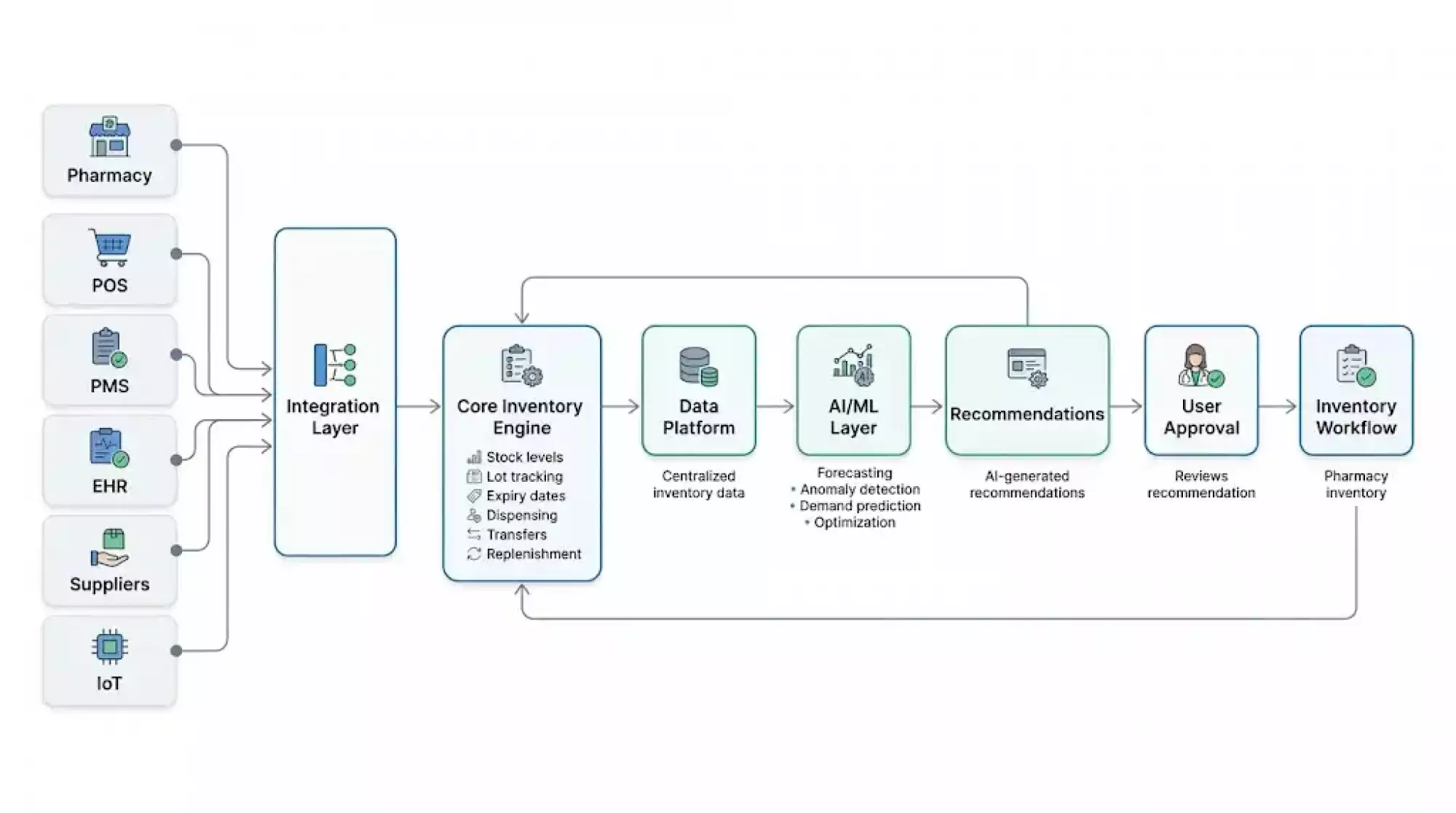
- The Inventory Ledger is the source of truth. All stock movements are logged there.
- AI does not touch key systems directly. The ML APIs work via controlled API integrations, and the recommendations go through the approval workflow.
- Forecasting, either batch or real-time, depends on the business need. Batch at night works well for replenishment, whereas real-time scoring is better for anomalies.
- Event-driven architecture will be helpful at higher volumes, such as large chains that have lots of transaction volumes.
- Data center location should correspond to your markets.
Integrations That Actually Matter
Not every integration deserves early investment. Prioritize by the value of the data.
Priority 1
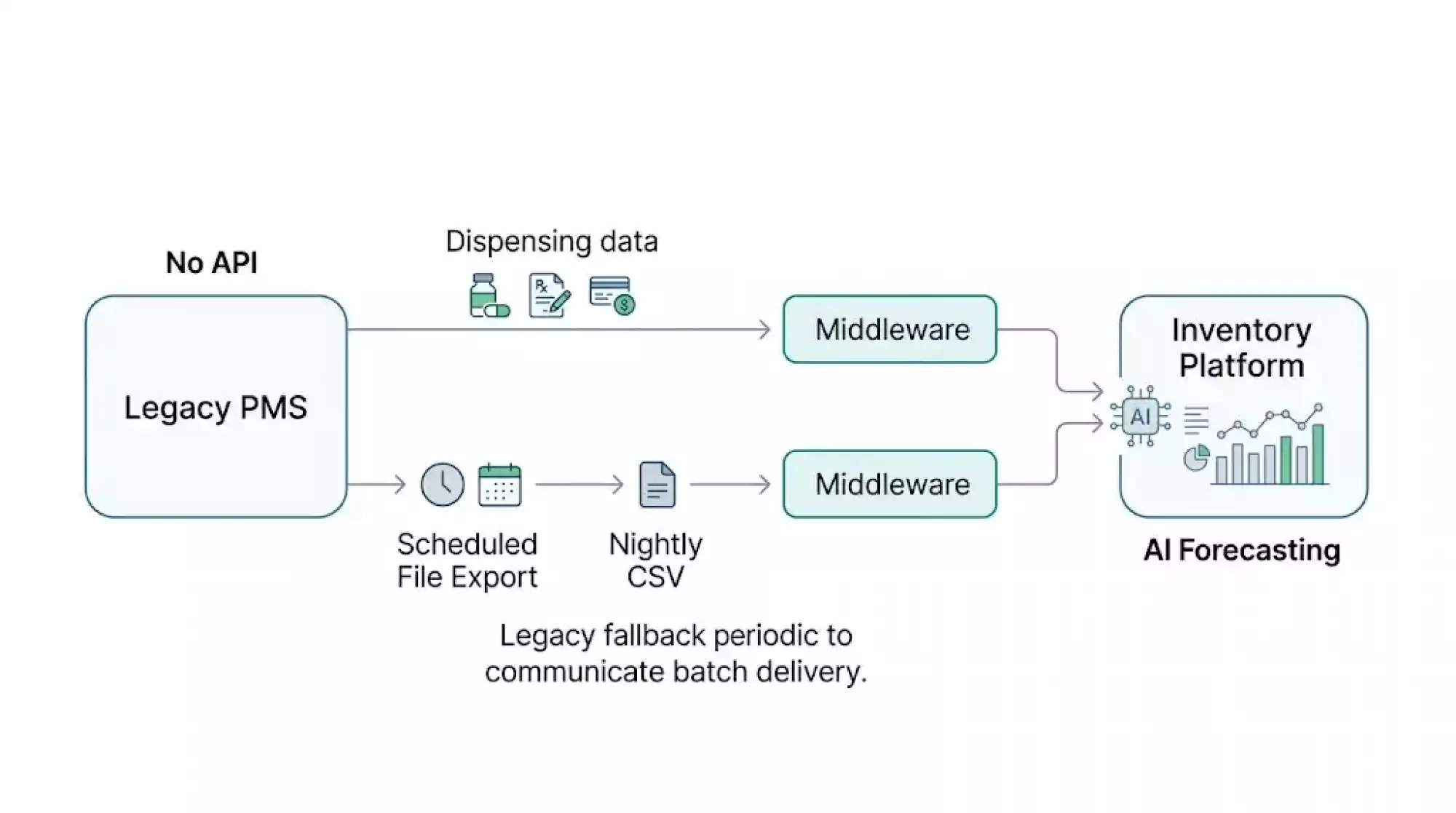
- Pharmacy management system (PMS)/POS. Supplies dispensing and transaction data. Main risk: limited or undocumented APIs.
- Wholesaler/distributor APIs or EDI. Supplies product, pricing, availability, and fulfillment data. Main risk: inconsistent formats between suppliers.
Priority 2
- ERP software/accounting (purchase and financial data; risk: mismatched product codes)
- Barcode scanners (lot and expiry capture; risk: poor label quality)
- EHR/EMR software and e-prescribing, where relevant (demand signals; risk: privacy scope)
- SSO/identity platforms (access control; risk: role mapping)
Priority 3
- IoT temperature sensors (cold-chain data; risk: hardware reliability)
- BI/analytics platforms (reporting; risk: duplicated logic)
Security, Privacy and Regulatory Compliance
Security must be built into the system at design time and not be an afterthought. The security design of an AI-based pharmacy inventory system will have to address security for data as well as the systems that process this data.
Security Practices
Some of the controls that should be considered include:
- Encrypted communication of sensitive data across systems and encryption of stored sensitive data.
- Role-based access control and multi-factor authentication so that there is no case of an attack from outside due to any compromised account.
- Audit logging that captures user activities, inventory, configuration, and administration.
- Secrets management that will ensure that no secret, such as API keys and configuration data, ends up in application code.
- Backup and restore for data continuity and availability.
- Security of APIs, including authentication, authorization, input validation, rate limiting, and monitoring.
- Vulnerability assessment and penetration testing to identify vulnerabilities before a threat actor exploits them.
- Third-party and vendor access controls in order to control access and review their integrations and permissions on an ongoing basis.
- Continuous security monitoring in order to detect suspicious activities and security breaches.
Regulatory obligations by market
HIPAA (United States): Inventories alone may not qualify as protected health information (PHI), but when linked to patients, drugs, or specific transactions, they can qualify as PHI. When there is PHI, the HIPAA Rules typically require covered entities and business associates to contract in such a way as to have the business associate protect the PHI. Thus, a software vendor responsible for the storage and management of PHI as part of its work for a pharmacy may have to sign a business associate agreement (BAA).
DEA (United States): Registrants dealing with controlled substances must keep inventory records. The rules require an initial inventory record and an updated inventory every two years. This system should be able to store these records in an accessible format.
DSCSA (United States): The law addresses the issue of product tracing and product verification of prescription drugs. Requirements for dispensers vary based on their size and deadlines. The general dispenser exemption expired on November 27, 2025, but some dispensers were granted more time. FDA provides the list of small-dispenser exemptions which expire on November 27, 2027. Check current requirements with FDA prior to construction because dates and exemptions changed several times.
Other markets: Depending upon your geographic location, you might also want to look into GDPR, regional health data regulations, state-level pharmacy regulations, and data retention regulations.
AI-specific governance
For every recommendation, record:
- The recommendation itself
- The source data used
- Confidence or context, where appropriate
- The human decision
- Any override
- The resulting action
This record supports audits and builds trust in the system.
Right Development Approach to Build an AI Pharmacy Inventory Management Software
The automation of an AI pharmacy inventory system should not try to automate the complete operations of a pharmacy right away. It would be more practical to create an accurate inventory database, verify the validity of data, prove forecasting in practice, and slowly move on to automation.
It is recommended to follow this order:
- Discovery & Requirements: Understand pharmacy workflow, inventory policies, user roles, business objectives, compliance requirements, and integration requirements.
- Data-readiness assessment: Perform an assessment to identify data availability, quality, history, consistency, and structure of dispensing, procurement, inventory, and suppliers.
- User experience & Product Design: Create workflows for pharmacists, inventory, buyers, and administration based on actual decision-making.
- Core Inventory Development: Develop a base for tracking inventory, managing batches/expiry, purchase orders, inventory movement, alerts, and visibility.
- Prioritize Integrations: Integrate PMS/POS/EHR/supplier systems or any other system that is crucial to workflow.
- Historical-data AI prototype: Use available historical data to test whether demand forecasting can produce useful results before introducing it into live operations.
- Shadow-mode forecasting: Run forecasts alongside the existing process without allowing the model to make or trigger purchasing decisions.
- Pilot deployment: Test the system with a limited pharmacy, location, product category, or user group and measure real-world performance.
- Recommendation-based workflow: Let the system suggest reorder quantities, identify potential stock risks, or flag unusual demand while keeping the final decision with authorized staff.
- Controlled automation: Automate only well-understood, low-risk actions with defined thresholds, approval rules, monitoring, and rollback mechanisms.
- Multi-location implementation: Implement in other locations only after the processes, integration, forecast accuracy, and control processes have been proven.
- Continuous improvement: Train and validate models, fine-tune business logic, performance management, and workflow improvements based on updated data.
The Recommended Progression
It is suggested that one should start with a robust foundation of inventory, then create a clean data pipeline, test the forecast in shadow mode, add recommendations approved by humans, and only then proceed to automation.
This process will separate the process of building the system from relying on AI. The inventory system will work even before the forecast model has been tested.
What is shadow mode?
In shadow mode, the AI creates forecasts and recommendations in the background without impacting the purchasing decisions made by the pharmacy in any way. However, the model's predictions are tracked and compared against reality. This allows the user to assess the accuracy of the AI in terms of forecasting and operations without risking anything significant until the AI can be entrusted with making decisions.
What the MVP should generally exclude
The MVP needs to focus on establishing the core flow and not try to automate all pharmacy processes. It will usually be more sensible to postpone:
- Fully autonomous purchase processes until the recommendation process is proven in operational reality.
- Fully autonomous operations with controlled substances, where far more security mechanisms are necessary.
- Multi-jurisdictional compliance, unless absolutely critical for first market launch.
- Deep learning models without any proof of necessity, especially when forecasting can be accomplished with simpler techniques.
- IoT hardware installation, unless real-time inventory tracking is crucial for the business case.
- Full mobile application development unless users can be served by a web application initially.
- Supplier optimization until demand forecasting and inventory management have been proven.
AI Pharmacy Inventory Software Development Cost and Timeline
The software development cost depends on various factors, including its features, AI functionality, integration, compliance, and scalability.
Development Cost and Timeline
| Software Complexity Tier | Key Capabilities & Scope | Estimated Cost Range (USD) | Estimated Timeline |
| Basic/ MVP | Basic stock tracking, drug batch & expiry alerts, barcode scanning, purchase orders, simple inventory dashboards. | $35,000 – $65,000 | 3 – 4 months |
| Mid-Level (Standard AI) | AI demand forecasting (basic ML models), automated reordering, multi-branch tracking, supplier API integration, HIPAA-compliant storage. | $65,000 – $130,000 | 5 – 7 months |
| Enterprise/Multi-Location | Predictive AI auto-fulfillment, FEFO/FIFO automation, ERP/EHR integration, RFID support, DSCSA compliance, real-time analytics. | $130,000 – $250,000+ | 8 – 12+ months |
Detailed Breakdown by Project Phase
| Phase | Core Deliverables & Focus Areas | Cost Allocation | Timeline |
| 1. Discovery & Compliance Architecture | Requirement mapping, regulatory compliance planning (HIPAA/DSCSA/FDA), data security architecture, UI/UX wireframing. | 10% – 15% | 3 – 5 weeks |
| 2. Core Platform Development | Database architecture, inventory catalog, supplier/POS API integration, user roles & access management (RBAC). | 35% – 40% | 8 – 14 weeks |
| 3. AI/ML Module Development | Data pipelines, predictive stock forecasting models, automated reordering algorithms, smart expiry/wastage alerts. | 25% – 30% | 6 – 10 weeks |
| 4. Testing, Auditing & Deployment | Security penetration testing, HIPAA compliance audit, integration testing, cloud setup (AWS/Azure), staff training. | 15% – 20% | 4 – 6 weeks |
Cost Drivers & Add-Ons
| Feature / Component | Impact on Cost | Description |
| AI Demand Forecasting Models | +$20,000 – $50,000 | Custom ML models analyzing historical sales, seasonal disease trends, and lead times. |
| EHR / ERP Integration | +$15,000 – $40,000 | Connects inventory directly with pharmacy POS, hospital EHR systems (Epic, Cerner), or ERPs (SAP, NetSuite). |
| RFID / Barcode Hardware Sync | +$10,000 – $25,000 | Real-time tracking using IoT RFID scanners or mobile camera-based scanning systems. |
| Compliance & Security Audits | +$8,000 – $20,000 | Ensures strict compliance with HIPAA, DSCSA, FDA 21 CFR Part 11, and data encryption standards. |
Ongoing Costs: Expect an additional 15% – 20% of initial development costs annually for cloud consulting and hosting (AWS/GCP), AI model maintenance, API license fees, and regulatory updates.
Common Challenges in AI Pharmacy Inventory Projects and How to Avoid Them
There may be potential benefits to using AI in pharmacy inventory management, but there are some challenges that developers may face when these issues are not considered from the beginning. One of the most frequent challenges is not necessarily related to the creation of an AI model but rather its reliability within pharmacy practice.
Poor Data Quality
The quality of the forecasts will only be as good as the quality of the data used in forecasting. Inconsistent product nomenclature, measures, transactional history, duplicated SKUs, and inaccurate inventory records can negatively impact the performance of your model. Perform a data audit before developing a model. Normalize the product nomenclature, measures, transaction history, and inventory records and create data quality guidelines to use even after deployment.
Low Trust in AI Recommendations
Pharmacists and inventory managers might not be inclined to follow the recommendations provided by the system because they do not understand why the system recommends reordering or stocking out. Make recommendations transparent. Provide the factors that led to the recommendation, like recent demand, historical demand, current inventory levels, lead time, and the risk of expiration.
How to Evaluate an AI Pharmacy Software Development Partner
Look for a development partner that cannot only develop an AI model but also understands pharmacy workflows, integration, data, security, and the challenges of running AI in a production environment.
Look for Relevant Pharmacy and Healthcare Experience
The relevant experience in pharmacy or healthcare software will minimize the time needed to grasp the workflows associated with dispensing, stocktaking, managing batches and expiry dates, purchases, and other aspects.
Integration Skills
Make sure that the partner has experience working on integrations with PMS, POS, EHR, ERP, supplier, and other systems that healthcare uses. It would be great if they could integrate with modern APIs as well as with legacy systems using EDI, HL7 interfaces, file exchange, or some middleware.
AI and MLOps Expertise
Creating a forecast model is one thing, but evaluating it, deploying it in production, monitoring it, retraining it, managing versions, and rolling back is another. It becomes even more important when demand changes over time.
Investigate Their Data-Readiness Process
Your data-readiness partner must evaluate past inventory and dispensing data before guaranteeing the efficacy of AI. Find out how they manage data problems, including missing information, inconsistencies between products, stockouts, duplicate data, unit changes, and other issues.
Evaluate Security Design Experience
Identify their security experience with such things as encryption, RBAC, MFA, auditing, secure APIs, secrets management, vulnerability testing, backups, and third-party access control. Your healthcare inventory software solution needs inherent architectural security design instead of after-the-fact development.
Check Out Testing and Validation Strategies
Your partner needs to have well-defined processes for functional testing, integration testing, performance testing, security testing, and AI model validation. If your situation is subject to regulation or high risk, find out how they manage test and validation documents.
Demand Transparent Estimates
An estimate that seems credible should detail the factors influencing costs and schedules, such as integrations, data migrations, AI complexities, compliance, mobility, infrastructure, and testing. Watch out for an overly low estimate that leaves all these aspects open-ended.
Take Post-Launch Support into Account
The deployment phase doesn't mark the end of your AI inventory development project. You may need additional support for monitoring, bug fixing, integration maintenance, model updates, security patches, performance tuning, etc. Make sure you know what's included and how it's charged.
Define Data and Intellectual Property Rights
Prior to starting the development process, settle issues of ownership of the application code, custom models, trained artifacts, datasets, documentation, and all other deliverables from your AI inventory development project.
Review Documentation Guidelines
Documentation should include the following areas of knowledge: architecture, APIs, integrations, data flow, deployment process, security, model behavior, tests, and operations. This is necessary to ensure that you do not depend too much on the initial developer team and to make it easier to maintain your system in the future.
Verification of References and Case Studies
Do not use only company logos or generic statements about its expertise in the healthcare industry. Request verifiable references and relevant case studies proving that the vendor has previous experience with such workflows, integrations, AI systems, or the healthcare environment at all.
Questions to ask
- How will you assess our existing inventory data before choosing an AI approach?
- How will recommendations be validated before they affect purchasing?
- How will the system integrate with our current pharmacy software?
- What happens when forecasting data is incomplete or distorted by shortages?
A good partner answers these specifically and does not promise guaranteed accuracy.
How Suffescom Solutions Approaches AI Pharmacy Inventory Projects
Suffescom Solutions can help businesses scope, design, develop, integrate, and evolve AI-powered pharmacy inventory products based on their workflows and technical environment. A typical engagement covers:
- Product Discovery And Workflow Mapping
- Data-Readiness Assessment
- Architecture Planning
- AI/ML Development
- PMS, ERP, EHR, & API Integrations
- Security Engineering
- Testing And Deployment
- Monitoring And Optimization
Ready to see if your pharmacy systems are AI-ready? Talk to our experts.
Conclusion
The use of AI should be focused on addressing the specific, quantifiable inventory issues rather than implementing AI just for the sake of implementing it. The best strategy in this case is to build a solid inventory foundation with accurate inventory data, lot-number and expiration tracking, purchase processes, and inventory visibility.
After that, start by building the minimum viable product addressing the most significant inventory issues. Start by using the forecasting and other AI-based recommendations in a shadow mode, not affecting your purchases or inventory decisions, until you are sure about the reliability of the solution, and then move towards automating workflows that have proven to work well for you.
When scoping the AI pharmacy inventory management software development project, you will need to determine your data readiness, pharmacy systems currently used, integrations needed, and the scope of your MVP.
FAQs
How much does a custom AI pharmacy inventory management system cost?
An individualized AI pharmacy inventory management system would be priced within the range of $35,000 - $250,000+, with development time being 3- 12 months or more based on the degree of complexity. Simple solutions would cost $35,000-$65,000, mid-range solutions that predict demand at $65,000-$130,000, while an enterprise-level system with multiple locations, electronic health records, and DSCSA compliance would be priced at $130,000-$250,000+. The final price would depend on the sophistication of the AI, hardware coordination (RFID), and healthcare compliance audits, plus 15-20% per year for hosting and support.
Can we add AI to our existing pharmacy management system instead of replacing it?
Usually, yes. If the system has any APIs that are useful, an AI layer can read data from them and give recommendations. In case there aren’t any useful APIs, the gap can be bridged with the help of middleware or scheduled file exports. Otherwise, replacement is required.
How accurate is AI demand forecasting for pharmacies?
No single factor exists. The accuracy depends on the type of item, nature of demand, quality of data, stockouts, and approach. Intermittent items are more difficult to forecast than steady ones. Assess accuracy on the basis of service level, stockouts, surplus, and wastage.
How long does it take before AI provides useful recommendations?
Generally, following data preparation, modeling, and a period of shadow testing. Products that have no track record take longer. Expect months of effort, not days.
Is AI pharmacy inventory software HIPAA compliant?
HIPAA compliance isn't just about software, it depends on architecture, data handling, policies, BAAs, and operations. HHS requires business associate agreements to help protect PHI. See how we helped a medical group modernize its patient portal with RBAC and audit logging while supporting HIPAA compliance. Read the case study.
Can AI automatically reorder controlled substances or approve returns?
It should not do so without controls. The activity is subject to both regulatory risk and diversion risk. DEA regulations mandate that registrants maintain accurate records of their controlled substances inventory, so keep the human review process and a complete audit trail.
What data should we prepare before developing the system?
Collect dispensing history information, current inventory levels, orders, receipts, lead times, NDCs, packs, product master file, location data, lots and expiries, and stockout and returns history. Remove duplicates and unit mismatches before proceeding with cleaning the data.