+971-8000321216



Key Takeaways
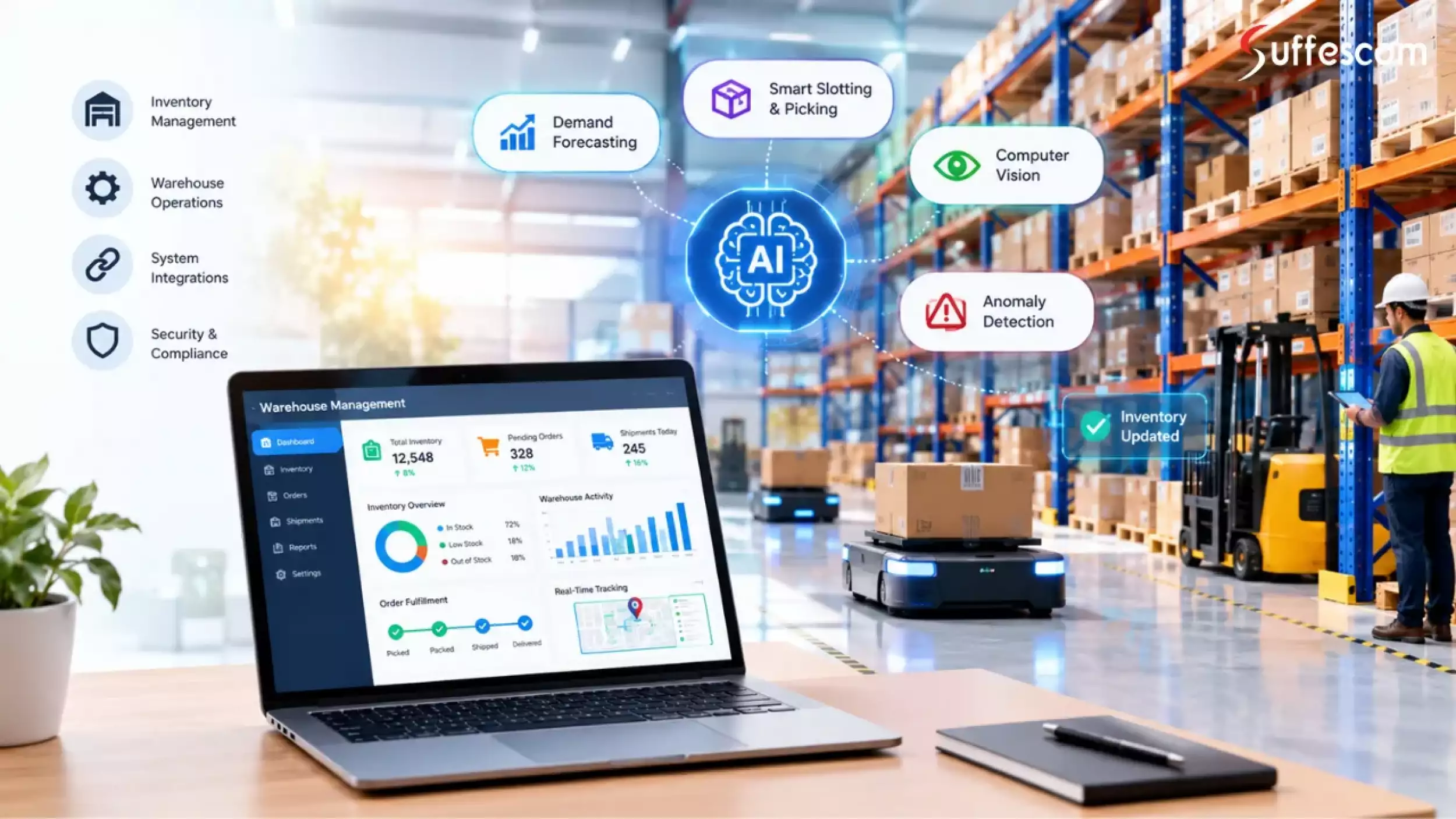
- Facing stockouts, picking delays, inventory mismatches, or equipment downtime? AI WMS development should start with measurable warehouse problems and business outcomes, not AI technology alone.
- Accurate inventory data, real-time warehouse events, business rules, integrations, and controlled execution turn AI recommendations into usable warehouse actions.
- Forecasting can predict demand, optimization can improve slotting and picking, computer vision can automate inspection, and anomaly detection can surface inventory issues for investigation.
- A strong AI WMS keeps the WMS as the authoritative transaction system while AI recommendations pass through validation, permissions, and execution controls.
- A focused AI WMS may cost around 40,000–90,000, while advanced or multi-site platforms can reach 350,000–750,000+, depending on AI complexity, integrations, data, and hardware.
- Pilot the highest-value use case, compare results against a baseline, measure ROI and payback, and expand only after the system demonstrates reliable operational improvements.
Imagine a priority order is waiting to ship, inventory records show a mismatch, and your AI system recommends moving stock to another bin. It seems like an easy solution, doesn't it? But what if the stock isn't actually available? If the destination bin is full or if the move causes other orders to be delayed, what will happen?
That's where AI warehouse management system development starts to get tricky, as opposed to just adding AI to current warehouse software. Your system is capable of making forecasts as well. It must be able to connect with precise data about stock, follow warehouse rules, talk to other connected devices' software programs, and translate artificial intelligence results into practical steps.
Market opportunities are increasing as well. The latest data states that the global AI in the warehousing market is valued at $17.8 billion in 2026 and is expected to reach $45.1 billion by 2030.
What is it like to build a machine learning-based warehouse management system that adds value instead of adding more complexity? Here, we'll explore important aspects like artificial intelligence features, design principles, development methodology, integration options, and software platforms used by companies for implementing them at their warehouse level, where there are high returns on investment.
What Is AI Warehouse Management System Development?
AI warehouse management system development is a warehouse management system that incorporates AI technologies such as forecasting needs, detecting anomalies, providing suggestions, and optimizing efficiency within it. A WMS powered by artificial intelligence is integrated to manage warehouses' stock levels and operational processes within them, as well as policies governing those activities, while an independent AI application does not do this.
What an AI-Powered WMS Actually Does
Think of a warehouse running low on stock. The typical WMS tracks inventory and manages stock movement. An AI-powered WMS can take this one step further to foresee what will likely be needed, suggest reordering, and assist with task prioritization.
In these cases, there are four different tasks:
- Recording: The WMS updates the stock when a confirmed stock movement is completed.
- Predicting: The AI model makes predictions about potential shortages.
- Recommending: The system suggests a replenishment activity as per the demand, stock, and operation priorities.
- Validating and execution: The WMS determines if any stock is available, if any bins are overfilled, if any tasks are in conflict, and if any authorizations are missing, and then releases the task for execution.
This is important because a prediction does not count as an inventory transaction, and a recommendation must not be considered a possible order without proper precautions.
Why Generic AI Tools Are Not Enough for Warehouse Operations
Generic AI tools can analyze data and generate recommendations, but warehouse operations require real-time data, business rules, system integrations, and controlled execution.
An AI WMS must work with accurate inventory data, current warehouse conditions, order priorities, equipment status, and operational constraints. Its recommendations also need to pass through permissions, validation, and audit controls before high-impact actions are executed.
A generic AI or LLM should not become the authoritative inventory system. Instead, the responsibilities should remain clearly separated.
AI WMS vs. Traditional WMS vs. Warehouse Automation Software
Although there might be some similarities between them due to vendors and products, each system is intended for its specific purpose of operation.
| System type | Primary responsibility |
| Traditional WMS | Inventory records, warehouse workflows, task execution, and operational controls |
| AI-enhanced WMS | Core WMS functions plus predictive analytics, anomaly detection, and decision optimization |
| Warehouse control system (WCS) | Coordinates material-handling equipment and associated control workflows |
| Robotics fleet management | Assigns supported robots, manages movement, and coordinates traffic |
| Supply-chain planning software | Supports demand forecasting, replenishment planning, and inventory decisions across the supply chain |
How to Use Custom AI WMS Development Appropriately?
Custom development is worth considering when standard products fail to meet specific workflow needs, inventory requirements, integration with existing ERP, order management, and automation systems, and multiple facility types.
For instance, a company with cold storage units requires some rules that are sensitive to temperature in addition to the demand forecast. A multi-warehouse distributor might require recommendations that take into account facility-specific capacity, transfer expense, and order commitments.
How to Identify the Right AI Use Cases Before Development
Not all advanced technology solutions are suitable for developing a good AI warehouse management software product. AI consulting can help businesses identify high-value use cases, assess data readiness, and define an appropriate implementation roadmap before development.
Map the Warehouse Bottleneck to a Measurable Business Outcome
Firstly, identify which parts of a warehouse are not performing well. Study past performance data to establish a baseline prior to providing an artificial intelligence service; identify trends towards delays.
Useful indicators include:
- Stock discrepancy rates of inventory items.
- Productivity is measured by pick count per labor hour and picking error rates.
- Duration from when an order was placed until it becomes ready for shipment.
- Frequency of stockouts is defined as how often there are shortages due to insufficient supply on hand.
- Delay in replenishing supplies between identifying an item requirement and when it becomes available for purchase or use.
- Time lost in downtime of machinery because machines stop working.
- Traffic jams and commuting time due to traffic congestion, excessive trips taken by individuals for no reason, poor job assignment problems, etc.
Baseline helps us decide whether this issue matters enough to develop an effective solution that makes a real impact on it.
Determine Whether the Problem Needs AI, Optimization, or Ordinary Automation
Machine learning is not an answer to every kind of warehouse problem. A bad strategy may lead to increased expenses without any benefit of improvement.
- Rule-based automation works well on predictable problems such as a blockage of bins that are full.
- Optimization techniques are employed to make an optimal choice among available options, such as allocating jobs so that they can be completed on time without violating delivery schedules.
- Machine learning helps predict demand trends, inventory shortages, and machine failures based on past data analysis.
- Computer vision is used for detecting broken packages, scanning barcodes, and checking products upon arrival.
- Generative AI is available for supervisors' queries about warehouses, such as exception summaries and finding data through natural language processing. It is not meant to replace the transactions management system or alter the stock ledger independently of them.
Some require an amalgamation of things. For example, a demand forecasting model can predict future needs while an optimization engine calculates stock levels and delivery schedules.
Score Use Cases by Value, Feasibility, and Operational Risk
Evaluate all candidates before proceeding towards their development by means of these six parameters.
- Impact on the business
- Availability and quality of data
- Integration complexity
- Implementation cost
- Consequences of providing the wrong recommendation
- Ability to measure the impact of an implementation with a controlled pilot
A high-value use case that is based on data that is not reliable or on an expensive integration is not necessarily the best first project. A more focused opportunity that may deliver more quickly with a clear owner and measurable outcomes may create a better opportunity for future capabilities with clean data.
Compare Candidate Use Cases Against Warehouse Needs
Let's look at three potential starting points:
| Use case | Potential value | Main feasibility question |
| Demand forecasting | Better inventory planning and fewer avoidable stockouts | Are historical orders, promotions, lead times, and stockout periods recorded reliably? |
| Dynamic slotting | Reduced picking travel and improved product placement | Are bin locations, product dimensions, order patterns, and movement constraints available? |
| Computer vision inspection | Faster identification of visible damage or packaging defects | Are suitable images available, and can inspection results be validated across real warehouse conditions? |
Evaluate Data Readiness and Operational Risk
Ensure the data used is accurate, available, and of adequate granularity for the use case. Outline what to do if the AI is incorrect, unavailable, or slow.
For instance, a damaged flag that is wrong may require manual checks on a package, or a replenishment flag that is wrong may interfere with active warehouse operations. The latter might need more stringent validation and approval measures prior to deployment.
Choose an Initial AI WMS Use Case
Select an initial task that is well defined by its owner; it should have some kind of scope for integration purposes, a reference point from which we can compare performance metrics during testing phases as well as post-deployment status reports. Try this out on an experimental level for a few warehouses of products to test them first, then implement it later.
Business Value, Data Readiness Level, Implementation Effort Matrix, and Operational Risk Score are useful for comparing these three factors (business value) of an organization’s performance. Find people who are cost-effective, well prepared for their job requirements, easy to work with, and low-risk. Although this application might be acceptable for an investment return analysis (ROI), it would not pass the screening tests because of safety, regulatory issues, and stock management problems.
To show how artificial intelligence can help achieve an objective at this store before buying a complete system.
Not sure which AI capability will actually make a difference in your warehouse?
Core AI Capabilities for Warehouse Management, Mapped to Operational Problems
The effectiveness of inventory control software for managing warehouses matters because it helps solve real problems faced by them. An effective tool would be able to connect an issue with information, generate results for analysis purposes, and improve some metrics of inventory management performance.
Demand Forecasting and Predictive Replenishment
- Operational problem: There is a shortage of high-demand items such as runners, while low-demand goods are getting filled instead.
- Input data: Historical sales records, seasonality of products, discounts offered by retailers, and delivery time from suppliers to customers' warehouse inventory levels for pending purchases.
- Output: SKU-level sales demand prediction, inventory shortage warning predictions, and order quantity recommendations.
- Downstream action: Replenishments will be done first; if necessary, a purchase order can also be submitted to the warehouse management system for processing.
- Success metrics: Stockout rate, forecast accuracy, turnover of stock levels, and lead times for restocking.
Stock levels must be taken into account when forecasting because there is a shortage, which led to lower-than-expected sales figures. Otherwise, it might be misleading due to a shortage of stock, which is low demand.
Inventory Anomaly Detection and Discrepancy Investigation
- Operational problem: Inventory records show unexplained adjustments, conflicting scans, or movements that are not following workflows.
- Input data: Inventory transaction information such as barcode or RFID scans for users' activities, including timestamps, locations, and modifications.
- Output: Unusual movement detection, conflict identification, and priority-based alert generation.
- Downstream Action: An investigator may be assigned to perform this activity within the warehouse management system by creating an inspection job; alternatively, they might suggest conducting a cycle count for that purpose.
- Success metrics: Inventory accuracy, discrepancy resolution time, false alerts cycle count, and productivity.
Investigation is not always a sign of thieves or criminals, but it serves as an investigative clue. Supporting transactions should accompany alerts for proper processing through an appropriate human review process.
Dynamic Slotting & Putaway Optimization
- Operational problem: frequently picked items are located far away from picking stations, while putting them back causes bottlenecks and additional restocking activities.
- Input data: Item size, quantity of items, weight limits for bins, and availability requirements such as stock levels or delivery times are also included here.
- Output: Proposal for storing items according to their pick-up rate, space utilization efficiency, and ease of restocking.
- Downstream action: Checks if a place is eligible for putting away goods there and whether it has enough space to do so before assigning them as such.
- Success Metrics: Better picker mileage, picks per labor hour, space utilization rate, and refill intervals.
Order Batching, Wave Planning, and Picking Optimization
- Operational problem: Time wasted due to poor routing efficiency, lack of proper grouping for orders, and competition between dispatchers' tasks.
- Input data: Open orders, cut-off time, item location, order priority, aisle congestion, worker availability, and packing capacity.
- Output: Order batch list, pick-up order sequence, and wave schedules are provided by AI.
- Downstream action: The WMS will send out approved jobs to be processed by others while taking into account delivery dates and space availability for shipments going forward.
- Success metrics: Order cycle time, picking productivity, on-time dispatch rate, and picking errors.
Labor and Workload Forecasting
- Operational problem: Due to insufficient personnel availability for tasks that vary according to order demand.
- Input data: Historical load of work, order arrivals, shift schedule, duration for tasks, skill level of workers, and machinery stock levels.
- Output: Workload forecasts, anticipated bottlenecks, and suggested task distribution.
- Downstream action: Supervisors adjust staffing plans and priorities within established policies and applicable employment requirements.
- Success metrics: Labor utilization, overtime hours, backlog, and orders processed per labor hour. Although AI suggestions are useful, they should not take over from humans' evaluation process, especially for job selection purposes.
Computer Vision for Receiving, Inspection, and Packing Verification
- Operational problem: Paper-based checks, which may lead to errors such as damage to packages, wrong labeling, or picking an item from a cart without entering it into an order form.
- Input data: Camera image input, expected content label details, shipping info specs, and quality standards.
- Output: Candidate items matching label discrepancies, obvious damage detection, and packaging verification results.
- Downstream action: Alerts from a WMS system about inspections before shipping.
- Success metrics: Detection precision and recall, false-rejection rate, inspection time, and shipment error rate.
Several factors may affect outcomes, like camera angle, illumination level of the light source, screen quality, or differences between packages. A system should exist to review important choices made by management.
Predictive Maintenance and Equipment Health Monitoring
- Operational problem: Conveyor breakage, forklift failure, and sorter malfunction, which slow down the production rate.
- Input data: Equipment telemetry, operational cycle information such as temperatures and vibrations, and fault code records for maintenance purposes.
- Output: Unusual device performance issues, predicted probability of failure, and warnings about maintenance needs.
- Downstream action: Maintenance requests are sent by this software to perform inspections through its maintenance management tool.
- Success metrics: Unplanned downtime, maintenance response time, mean time between failures, and cost per operating hour.
AI Assistants for Warehouse Supervisors
- Operational problem: Managers spend a lot of time searching through processes to find exceptions and updating shifts.
- Input data: Authorized WMS records, SOP documents, task history, and operation report files.
- Output: Natural language responses to questions, summaries about exceptions, and explanations for document or procedure approval processes.
- Downstream action: The supervisor's role is to resolve problems by following up on them and making decisions based on verified operational data.
- Success metrics: Time for resolving issues, information fetching speed, and precision answer rate.
AI Warehouse Management Use Cases by Industry
AI WMS capabilities can be adapted to different warehouse environments based on inventory types, order volumes, fulfillment models, and operational constraints.
AI WMS for E-commerce and D2C Fulfillment
AI in e-commerce warehouse management systems can forecast SKU demand, optimize warehouse slotting, prioritize picking, and identify inventory anomalies. Integration with OMS and carrier systems helps the warehouse respond to order changes, cancellations, and shipping deadlines. These capabilities are especially useful for handling high order volumes and seasonal fulfillment peaks.
AI WMS for 3PL and Logistics Providers
3PL warehouses manage different clients, SLAs, inventory rules, and workflows. AI WMS can forecast workloads, optimize labor allocation, prioritize tasks, and identify recurring bottlenecks. Multi-client inventory controls and configurable business rules ensure AI recommendations follow customer-specific requirements.
AI WMS for Retail Distribution
Retail warehouses need to balance store replenishment, inventory availability, seasonal demand, and delivery schedules. AI can improve demand forecasting, replenishment planning, dynamic slotting, and workload allocation. Anomaly detection can also identify unusual inventory movements before they affect store availability.
AI WMS for Manufacturing Warehouses
Manufacturing warehouses must align material availability with production requirements. AI in manufacturing WMS can support demand forecasting, replenishment, dynamic putaway, and inventory anomaly detection. ERP integration allows warehouse decisions to consider production schedules, material requirements, procurement status, and planned output.
AI WMS for Cold Storage and Temperature-Sensitive Inventory
AI WMS can combine inventory data with sensor telemetry to monitor temperature-sensitive products, identify environmental anomalies, and improve stock rotation. Demand forecasting and expiry-aware planning can reduce waste, while deterministic storage rules ensure AI recommendations remain within required temperature and handling constraints.
AI WMS for Pharmaceutical and Regulated Warehouses
Pharmaceutical warehouses require strict traceability, batch management, controlled access, and documented handling. AI can support forecasting, anomaly detection, inventory monitoring, and computer vision-based inspection. Audit trails and authorization controls ensure AI-generated recommendations remain traceable and compliant with operational requirements.
AI Warehouse Management System Architecture
An operationally ready AI warehouse management software requires more than just an application for monitoring purposes. There is an issue of how we go from warehouse event data towards AI-generated suggestions for decision-making process validation, as well as confirming operations through them.
Authoritative transaction records must be kept apart from an AI model for processing tasks but still allow them to share data promptly.
Layer 1: Warehouse User Interfaces and Device Applications
A web interface, a scanner for tablets or smartphones, and an app on your phone are some examples of this technology. Picking, receiving, and restocking duties are assigned to employees, whereas supervision involves checking out notifications for approval of exceptions by management personnel. The equipment-facing interface communicates to a device via its own controller.
Layer 2: Core WMS Transaction and Workflow Services
This layer owns inventory records, orders, locations, receiving, putaway, replenishment, picking, shipping, returns, and task status. Business rule application is used to record a transaction.
Stock trading can be suggested by AI services. However, the core WMS is responsible for confirming if it's valid and updating inventory accordingly.
Layer 3: Event Ingestion and Operational Data Processing
Continuous warehouse activities occur. Order updates from scanners are received via API messages, broker services of devices to send them along with other information, like scanner data on stock levels for products in an organization’s warehouse management system.
The processing layer validates incoming messages and provides relevant events for downstream services to use. It enables them to operate based on up-to-date data rather than waiting for old records.
Layer 4: AI Inference and Optimization Services
The layer is not a single model that makes all decisions about warehouses; it has its own specialization.
- APIs for forecasting are used to predict the needs of inventory management systems.
- The inventory anomaly detection service detects abnormal stock movement patterns of items within a warehouse environment.
- Task assignment optimization algorithms are used for scheduling tasks to slots and pickups within certain limits.
- Image analysis by computers is done at a reception area for inspections before shipping packages to customers' homes.
A service provides an output such as a prediction, score, or recommendation along with some information about it. Output isn't always a valid warehouse command line statement.
Layer 5: Decision Validation and Execution Orchestration
It is an intermediary for recommending products to customers by a store’s inventory management system. The orchestrator verifies if a suggestion remains relevant to present stock levels of items within bins and their interdependencies among tasks as per company policy and machinery statuses.
If the recommendation is approved by users, then it will be able to create tasks for them, ask for approvals from other people, or give instructions via some kind of software application. Should circumstances change, then they may not accept this suggestion but ask for another computation.
For instance, a replenishment suggestion might be useless because someone else has already relocated necessary inventory. Before releasing a job from this system, it should be checked for availability again by me.
Layer 6: Integration Services and External Systems
The integration service connects to a warehouse management system with:
- Enterprise resource planning (ERP)
- Order management systems (OMS)
- Transportation management systems (TMS)
- Warehouse control systems (WCS)
- Robotics fleet managers
- IoT platforms
- External data providers
API is for request-response communication, whereas event-based integration is for communicating about operational change. Ownership matters; a WMS manages stock management of warehouses, whereas an ERP handles accounting information, and a WCS operates machinery for handling materials.
Data Stores, Monitoring, and Audit Infrastructure
Operational transactions are recorded by transactional database systems. Historical data analytics is done by analytical storage, whereas models are maintained through a registry of approved version numbers along with their corresponding information.
Monitoring captures service latency, failed predictions, unusual output patterns, and operational KPIs. Reports are linked by audit data such as recommendation sources, validity reports, approval statuses, and outcome statistics for analysis purposes.
Modular Architecture vs. Microservice Architectures
An initial deployment of a modular monolithic architecture is suitable for having fewer features to be developed by smaller teams. This makes it simpler for you to deploy and also helps in managing transactions better.
Microservices might be suitable, as they allow for independent scaling and deployment of AI inference, event processing, or integration services. However, they introduce additional network calls, service monitoring, and distributed transaction challenges.
Designing the AI Decision-to-Execution Engine
AI Decision-to-Execute Engine links models' results with official warehouse management system control systems. Prevents predictions from becoming a warehouse instruction until all required validation is done.
Step 1: Capture the Current Warehouse State
Gather current data about stock levels, warehouse location details, and priority orders to be fulfilled first thing in the day; pending work items for processing by staff members at their stations within a facility, such as security personnel or maintenance workers on site. Also, it needs to be aware of when a particular piece of information is current.
Step 2: Generate a Prediction or Candidate Action
An appropriate AI optimization tool produces results according to its application needs. It might also be a demand prediction model for stock levels, an inventory shortage warning system, or an ordered selection from available products to restock them efficiently.
Output identification of suggested actions to be performed on stock levels; task impact analysis; constraint evaluation requirements; data collection needs before testing. Confidence scores are not enough to prove its validity as a practice.
Step 3: Validate the Recommendation Against Operational Constraints
Check before accepting any recommendations to ensure they are valid according to our policies for warehouses. These may include
- Available and allocatable inventory.
- Capacity of destination products to be compatible.
- Priority of orders to be shipped by date.
- Task dependency issues and constraints of existing tasks.
- Availability of equipment and safety constraints.
- User permissions and approval thresholds.
A violation of warehouse safety constraints by recommendations will be rejected or replaced with alternatives from this system. The model shouldn't be allowed to overrule this rule, as it is more accurate than that of other models.
Step 4: Check for Stale Data and Conflicting Tasks
Recommendations to the warehouse may differ from the actual implementation of them. A second employee could be reserved for stocks, a bin might get full of space, or machinery may stop working.
Before taking any step, it needs to be verified by an engineer in a critical situation. If available, a check on versions for conflicts of operation reservation transactions may be done by them. The recommendation needs to be updated if there is any change in the current situation.
Step 5: Authorize and Execute the Action
After successful verification by this system, it will apply an appropriate approval rule to you. Low-risk activities can be done by themselves without supervision, whereas high-impact or exceptional ones need supervisors' permission.
A valid task is created by the WMS inside of transactions. When there are mechanical components present, an appropriate WCS or robotic control system will receive instructions from them. A distinction must be made between the acceptance of commands by users and the physical initiation and completion of tasks.
Step 6: Record the Outcome and Reconcile the State
Record whether the action was completed, rejected, failed, or overridden. The authoritative WMS should be updated by confirmed movement transactions. If a task fails or is incomplete, it needs to be reconciled instead of being assumed as an updated inventory count.
Also, these results will be useful for further research. For instance, repeated rejection of a slotting suggestion might indicate incorrect location information or an omission within the decision-making process.
Worked Example: An AI-Recommended Replenishment Task
The following is a hypothetical example of what might happen to customers' devices rather than actual ones being deployed by them.
There are twelve items from a fast-moving SKU inside a picking bin. According to projected demand, this model predicts a shortage of bins for the upcoming shift and suggests restocking 40 units from reserve storage.
- Inventory check: According to the WMS, there are 40 units available for use that have not been assigned elsewhere.
- Destination check: The pickup area is sufficient to store products as per their specifications.
- Check conflicts: No current supply problem exists for this item; there are no other sources of supply available to address it.
- Apply approval rules: Replenish according to specified requirements of auto-creation tasks.
- Execute: The task is executed by a WMS for an authorized employee or another process application.
- Confirm: Verify that a scanner is working properly to confirm its presence by scanning an object. WMS tracks finished goods count and manages stock levels.
In case of unavailability of source stock prior to releasing tasks, it needs to be validated again by this engine for calculation purposes instead of issuing out-of-scope instructions. If only 30 units are received, then it records the actual amount of items available and handles any additional requirements separately.
Need an AI WMS that can make decisions without compromising inventory control?
AI WMS Integration With Enterprise and Warehouse Systems
An AI WMS needs to exchange inventory, order, transportation, equipment, and operational data with existing warehouse systems. The AI integration layer should define data ownership, synchronization, error handling, and reconciliation.
ERP Integration
ERP integration provides inventory, procurement, supplier, product, and financial data. AI WMS can use this information for forecasting, replenishment, and inventory planning while the ERP remains the authoritative source for enterprise and financial records.
OMS Integration
Order Management System development provides orders, fulfillment priorities, cancellations, order changes, and promised delivery dates. This allows AI WMS to adjust warehouse priorities based on current customer demand and fulfillment requirements.
TMS Integration
TMS integration connects warehouse activities with carrier information, shipping deadlines, dispatch schedules, and shipment status. AI WMS can use these inputs to prioritize picking, packing, and staging while helping prevent missed transportation cutoffs.
WCS Integration
WCS integration connects the WMS with conveyors, sorters, automated storage systems, and other material-handling equipment. The WMS manages warehouse tasks while the WCS coordinates equipment execution and returns status for reconciliation.
Robotics and AMR Integration
Robotics and AMR integration supports task assignment, robot availability, execution status, and completion feedback. AI can prioritize tasks, while warehouse rules, equipment constraints, and authorization controls govern execution.
IoT and Sensor Integration
IoT and sensors provide temperature, vibration, location, equipment, and environmental data. AI WMS can use these signals for anomaly detection, predictive maintenance, and operational monitoring while maintaining data quality and device controls.
API and Event-Driven Integration Architecture
APIs and standards such as GS1 EPCIS support direct system interactions, while event-driven architecture enables near-real-time updates for inventory movements, order changes, task completion, and equipment status. The integration layer should also handle unique IDs, retries, idempotency, and reconciliation.
At Suffescom Solutions, we have also applied automation and AI-driven data extraction in logistics and supply chain where information had to move between disconnected operational systems.
Data Engineering for AI WMS: Data Models, Pipelines, and Readiness
The effectiveness of an AI warehouse management system relies upon accurate representation by means of operational information from within a facility’s walls. Data engineering establishes consistent definitions, traceable events, and dependable inputs for warehouse decisions.
Define the Core Warehouse Entities and Relationships
Data models are meant to show how products interact with operations rather than merely storing individual items separately.
Core entities include
- Products: SKU, product ID, size, weight, and handling requirements.
- Location of warehouse: Facility, area, aisles, bins, and space limitations.
- Stock level: Quantity available for sale at the time of purchase; reservation status; batch identification numbers, if any.
- Orders and shipments: Order line orders of business, delivery date promises, allocation information, shipping statuses, and restock needs.
- Warehouse task: Task type, source and destination, assignment, dependency, and completion status.
- Equipment and sensors: Equipment identification; operation statuses, telemetry data, and related faults.
Identification consistency and relationship definition enable linking of forecasts to SKUs, recommendations for locations, and completed tasks with their corresponding changes in stock levels.
Establish an Event Model for Inventory and Task Movements
Identify significant warehouse operations by means of an event-based approach. Every entry must have an ID for events, types of events, source systems to them, and entities that are impacted by these entries, along with timestamps on when they were created or ingested, as well as any related transaction references.
Event time vs. ingest time is useful for detecting late-arriving packets. Idempotency of unique identifiers prevents retry messages from being considered another move on this platform. If an event comes in the wrong sequence, then there should be some rule to handle it, like sorting, reconciling, and dealing with delays.
It is especially relevant for scanners, a warehouse management system, and an automated machine to record the same activity on various occasions.
Prepare Historical Data for Each AI Use Case
Various types of artificial intelligence need distinct datasets for learning purposes. Time-based sales data, including demand forecasts, need to be collected for product availability levels during promotional campaigns and lead times. Normal operation pattern anomaly detection requires review of discrepancies when they occur. Image recognition needs good pictures that are labeled properly. Telemetry for equipment maintenance needs a link between it and failure records.
Operational context is an important part of historical data collection. Picking delays due to an obstructed aisle are not necessarily proof of bad work habits from employees.
Build Real-Time and Batch Data Pipelines
Use an event-driven or streaming pipeline for decisions based on changes like stock levels of items to order, conflicts between tasks, machine downtime, etc. Batch scheduling works well enough to forecast daily needs at night; it also helps with annual reports and regular model development tasks.
Hybrid models are typical where batch jobs generate predictions, whereas real-time warehouse management systems update their current status for validating inventory replenishment choices. Update frequency is determined by a company’s needs rather than an assumption of all streams being processed immediately.
Assess Data Readiness Before Committing to Model Development
Perform an assessment of this project to ensure that it is complete, consistent identifiers are used throughout its history, and accurate scans have been performed by sources within systems regularly updated for current information on users' accounts.
Identify missing fields, unreliable processes, and conflicting definitions before estimating model-development effort. If the warehouse doesn't keep track of inventory changes accurately, then better data collection techniques might be worth investing in rather than developing an advanced algorithm.
Prevent Data Leakage and Measure Model Drift
Separate training and testing datasets from each other. To forecast data sets, apply temporal partitioning to prevent leakage of current values from past forecasts. Limit the feature set by including only those details that were actually known at the time of making an appointment.
Monitor after deployment for changes in demand patterns, product mix, layout facilities, supplier lead time, and scanning behaviors. This may lead to unreliable results from old datasets or models due to these modifications. Monitor both input data quality and operational performance to help differentiate between issues related to a data pipeline versus those affecting models' behaviors.
Testing an AI WMS Under Real Warehouse Conditions
Testing artificial intelligence warehouse management software is not just about checking if it works on screen and making accurate forecasts from data analysis. Inventory management should be accurate; also, handling integration failures is required when there are changes in warehouses.
Functional and Inventory Consistency Testing
Check receipts, storage placement, pickups, restocking shipments, delivery orders, and status changes of tasks. Partial movement tests, canceled task cancellations, duplicated scan corrections, and stock level changes are performed. Verify if there is a discrepancy between recorded amounts of goods sold and actual sales figures; also ensure no loss due to unrecorded items or errors during processing.
Integration and Failure-Recovery Testing
Simulate delayed messages, duplicate events, unavailable ERP or OMS services, interrupted equipment connections, and failed API requests. Check whether retries create duplicate transactions, whether queued events are processed correctly after recovery, and whether incomplete operations can be reconciled without losing inventory history.
AI Model and Recommendation Testing
Assess predictions for anomalies and suggested responses on a sample of warehouses' records. False positive rate, false negative rates, and performance for various product types, shift periods, and levels of demand. Verify also if they are within operational limits. An algorithm may be able to make correct forecasts but also suggest something that is not useful.
Load, Latency, and Peak-Season Testing
Simulate order surges, concurrent users, high-volume scanner events, and multiple simultaneous AI requests. Response time measurement, queue length monitoring, throughput analysis, and resource usage statistics. Check if a time-sensitive warehouse AI workflow automation remains responsive to an increasing amount of data processing tasks.
Hardware, Device, and Warehouse Acceptance Testing
Check and validate barcodes and RFID readers, smartphones, camera systems, wireless network connectivity issues, and compatible software application interfaces for use at the site level. Look out for low light levels, unstable network connection problems, device handover issues, and process disruptions. The warehouse personnel must ensure that job directions are clear to employees working there during regular business hours.
Shadow Mode, Pilot Rollout, and Rollback Readiness
Begin by using a shadow mode for recommendation generation without execution capabilities of an algorithm. Compare it against real-world results for identifying bad advice while not disrupting current processes.
Then conduct an experiment on a small area, product line, or process flow. Set up success metrics targets for operations monitoring purposes to ensure an easy rollback if needed. Only expand if results are satisfactory according to agreement levels of exceptions.
Security, AI Governance, and Operational Resilience
An AI warehouse management system affects stock movement and the priority of orders by workers to perform certain tasks at their workstation while also controlling machinery connections. Therefore, security should also be concerned with protecting warehouse information as well as its use by people.
Role-Based Access Control and Least-Privilege Permissions
Permissions should be assigned based on roles of employees. Employees can do their job duties; managers have the power to grant certain exceptions, while administrators are responsible for setting up rules of operation. The AI service needs only the access required for its operation rather than any kind of freedom to modify warehouse data.
Secure APIs, Device Authentication, and Secrets Management
Authentication of users, device IDs, account credentials for services, and hardware connections. Protect APIs with appropriate authorization, encryption, and input validation. Keep your secret management system for storing credentials and API security instead of using them directly within applications; also rotate these regularly based on defined security policy requirements.
Audit Trails for AI Recommendations and Warehouse Actions
Keep track of important suggestions, model version validation approval overrides, and the results of the implementation process. The documents are useful for investigating inconsistencies between recommendations to identify if they came from a problem within our system versus something outside of it, such as errors during processing by humans or machines.
Human Approval and Restricted Autonomous Actions
Which decision is automatic, while another needs a person's input? Routine, low AI risk management might be eligible for automated control; however, abnormal stock changes, limited product handling restrictions, or hazardous operations would need more scrutiny. Approval rules should be explicit, configurable, and auditable.
Monitoring, Alerts, Incident Response, and Rollback
Detect anomalies in monitoring system failures, integration problems, artificial intelligence output deviation, and service malfunctions or unexpected changes in key performance indicators. Procedures should be established for disabling affected services, investigating incidents, reverting models back to their previous version, and switching over to an approved fallback workflow. Record incident reports for improvement of control measures.
High Availability, Disaster Recovery, and Offline Workflows
Failure plan for AI service failure, networking problems, and integration issues between enterprises' software applications and hardware devices. If possible, core WMS operations must be carried out according to predefined rules of thumb, stored references, and information database files, or authorized offline processes. Instances of functions that rely upon an inaccessible stock level status or device verification must stop instead of running under presumptions.
Specify restoration goals, backup plans, the reconciliation process of data management, and responsibility to restore service. Reconciliation of offline transactions after a connection is established for continuing to make dependent automated decision-making.
Already have a WMS, ERP, or warehouse automation stack in place?
We can help you evaluate the integration path and add AI capabilities without unnecessarily replacing your existing operational systems.
Technology Stack for AI Warehouse Management System Development
The AI Warehouse Management System Development Technology Stack needs to be compatible with warehouse processes, hardware limitations, the amount of information storage capacity, and compatibility standards. Select technology according to suitability for operations and maintenance rather than just popularity.
Frontend and Warehouse Mobile Applications
React and Angular are web frameworks that support supervisory dashboard views, inventory views, and exception handling modules. For warehouse-floor applications, choose native Android or cross-platform development based on scanner compatibility, device hardware access, and offline requirements. When employees have to keep monitoring during a network outage, this program requires local storage of information, queue management for events, and reliable sync capability.
Backend, Database, and Event Processing
Java, C, and Python can be used by teams based on their skill level and an organization’s current infrastructure needs. PostgreSQL and SQL Server are suitable for managing transactions of an inventory system and orders. Scanner events and order updates are sent from message brokerage services to streaming applications for processing. Choose based on the volume of events, reliability of deliveries, need for recoverability, and level of operations involved.
AI Frameworks and Optimization Libraries
Forecasting and anomaly detection can be done using established machine learning models like PyTorch or scikit-learn. Image processing tools are needed for computer vision, whereas language models require permission from an authorized warehouse database system. Route selection, slot assignment, and labor scheduling could be improved by using a mathematical optimization library rather than just machine learning techniques.
Cloud, On-Premises, and Hybrid Infrastructure
Scalability of cloud-based systems for data processing, analysis, and management is provided by them. Deployment on-premises is suitable for organizations that require strong security measures and have poor internet access. A hybrid environment allows latency-sensitive warehouse operations to remain on-premises while utilizing cloud services for machine learning model development and wider analytics purposes.
Selecting Technologies Based on Requirements
| Requirement | Selection priority |
| Scanner-heavy workflows | Device compatibility and offline support |
| High-volume transactions | Database reliability and event processing |
| Forecasting and anomaly detection | Model tooling and monitoring |
| Robotics or real-time control | Low latency and dependable connectivity |
| Strict data-control requirements | Deployment flexibility and access governance |
Step-by-Step AI WMS Development Roadmap
An effective AI warehouse management system development project must be developed through an identified issue before being deployed for use. Each stage should have an objective to be delivered by its own members, along with some kind of acceptance standard for that particular task.
Phase 1: Operational Discovery and Baseline Measurement
Workflow for map receipts, storage location assignment, restocking process, pick-up order fulfillment, and packaging delivery service. Talk to the warehouse manager, floor supervisor, IT staff, and operators about any issues they face to identify common problems. Baseline metrics for stock management, like inventory accuracy, order processing speed, picker efficiency, and delivery mistakes, should be recorded. This is an indicator for measuring the success rate.
Deliverable: Workflow diagram, problem statement, and baseline KPIs report.
Phase 2: Data and Integration Feasibility Assessment
Check out current versions of WMS, ERP systems, and OEM devices like scanners and sensors, and gather information from them. Data integrity check; identifier uniformity; availability of APIs for events; delay information on ownership of important documents. Find out which old hardware or software needs an adapter, middleware upgrade, or process change.
Deliverable: Data readiness evaluation report, integration inventory, feasibility risk analysis.
Phase 3: MVP Scope and Solution Design
Choose a high-value process to be part of an MVP, like predictive replenishment or inventory anomaly detection. User definition, functional limits of the system, acceptance requirements, security measures, and fallbacks. Specify which decisions AI may recommend, which actions require validation, and which need human approval.
Deliverables: Approved MVP scope, solution design, and measurable acceptance criteria.
Phase 4: Core WMS and AI Feature Development
Construct necessary warehouses for implementing an artificial intelligence recommendation system on a live basis. Develop the necessary data services, model interfaces, business-rule checks, monitoring, and user workflows. Inventory management tasks should be carried out by an authorized warehouse management system.
Deliverables: Integrated development build traceability recommendation control execution.
Phase 5: Integration, Validation, and Pilot Deployment
End-to-end testing of processes, integration issues, inventory accuracy and reliability, AI effectiveness, and recovery process efficiency. Operational training of customers for deployment to an MVP within a specific warehouse area, processing unit, or product line. Set up an escalation process for rollbacks prior to going live.
Deliverables: Pilot deployment, training for users, and documentation of testing outcomes.
Phase 6: Measure Results and Expand Gradually
Compare pilot outcomes to an initial standard of reference. KPIs, such as improvement rate vs. error incidence, exceptions count, and time of service downtime by employees' experience level. Fix weak data issues, integrate them properly, and provide reliable recommendation systems before moving on to more complex tasks like adding new processes or locations.
Deliverables: Evidence-based scaling-up decisions and priority improvement plans.
Planning note: Do not give an exact time for each stage of this process. The length of a project is determined by its workflow count, system architecture complexity, hardware interface specifications, database schema design issues, security needs, and installation limitations. Approve progress based on readiness and results, not calendar milestones alone.
How Much Does AI Warehouse Management System Development Cost?
The cost for developing an artificial intelligence warehouse management system can range from $40,000 to over $750,000 based upon its size, the level of sophistication required by AI technology integration needs, hardware specifications needed for implementation, and deployment scale. An integrated system for adding artificial intelligence features to current warehouse management software might be around $40,000-$90,000. Whereas an enterprise-level product featuring sophisticated AI technology, high levels of automation, and multi-site capabilities could cost more than $350,000.
The numbers here are just an estimate of what we would spend if things went as planned; they're not actual prices from any company like Suffescom Solutions. Actual costs need to be verified by evaluating workflow processes, current applications' compatibility issues, and available resources for implementation needs beforehand.
Indicative Development Cost by Project Scope
| Project scope | Preliminary budget (USD) | Indicative timeline |
| Core WMS with one focused AI capability | $40,000–$90,000 | 3–5 months |
| Mid-level AI WMS with multiple integrations | $90,000–$200,000 | 5–8 months |
| Advanced AI WMS with forecasting and optimization | $200,000–$350,000+ | 8–12+ months |
| Enterprise multi-site system with extensive automation | $350,000–$750,000+ | 10–18+ months |
The range overlaps due to differences between projects. Data migration is extensive; legacy integration issues are common to robots' hardware purchase process for multiple countries’ deployment.
AI Warehouse Management System Development Cost Breakdown
The total cost of developing an artificial intelligence warehouse management system (AI WMS) is determined by its complexity level, reliability requirements for current databases, and integration needs. This is just an example of how to allocate resources for a particular type of business rather than being set by any specific sector standard.
| Cost component | Indicative share of development budget |
| Core WMS modules and workflow development | 25–35% |
| AI model development and optimization | 15–25% |
| Data engineering and preparation | 10–15% |
| ERP, OMS, equipment, and API integrations | 10–20% |
| User interface and warehouse mobile applications | 5–10% |
| Testing, security, and deployment | 10–15% |
| Total | 100% after project-specific allocation |
This is an example of a range rather than an absolute percentage for adding up its maximum value. Allocations are different for each scope, and there might be overlaps between them.
Software Development and Core WMS Module Costs
The number of workflow complexities is usually responsible for starting an engineer's job. Order receipts are received at a warehouse for storage purposes; pickups occur when goods leave that location to be shipped out again.
An extension to a current WMS system could be used for inventory management purposes and order processing tasks. A ground-up build needs to be established first for effective use of artificial intelligence towards making better choices from a warehouse perspective.
AI Model Development and Data Preparation Costs
Costs for AI are dependent upon application requirements, data quality levels, and degree of autonomous operation. Historical data preparation and model evaluation might be needed for forecasting purposes. Image gathering, tagging, and environmental verification are done by computer vision technology. The optimization process needs precise warehouse limitations along with quantifiable goals to be effective.
Data cleansing, budgeting, experimental work, modeling infrastructure maintenance, and testing models' performance over time. Poor quality of sources may lead to higher expenses despite having a basic algorithm for it.
Enterprise Integration and Hardware Costs
ERPs, OEMs, transport networks, scanners, and RFID readers, as well as conveyor belt robots, are also required for their own purposes, requiring them separately from each other. Legacy APIs, proprietary equipment interfaces, and unreliable event handling can be very time-consuming to implement. Hardware upgrade costs and network infrastructure improvements are to be calculated individually if needed.
Infrastructure, Support, and Long-Term Operating Costs
On-premise infrastructure, databases and messaging systems, monitoring tools, patch management software, backup solutions, customer service department, and machine learning models. Integration maintenance, user training, and enhancement are ongoing expenses of a warehouse operation that changes over time.
How to Reduce Cost Without Compromising Reliability
Reduce unnecessary complexity in an AI-based warehouse management system cost model instead of eliminating necessary technical aspects and operations.
- Start with one high-value workflow: Begin by focusing on an important process like supply chain bottlenecks rather than building all your AI solutions simultaneously.
- Extend suitable existing software: Improve current applications by extending them through reuse of proven WMS components such as API interfaces for transactions to suit specific needs. Change just those parts that are truly limiting.
- Validate data before building models: Check for validity of data prior to the modeling process by checking its history, scanning accuracy level, identification codes, and any gaps therein. Solving issues related to data quality during modeling will save money in later stages of building models.
- Prioritize integrations by business impact: Integrate based on importance to businesses; connect necessary system requirements of initial launch before adding less important ones during subsequent stages.
- Use the simplest effective AI approach: The simplest effective AI approach is to use a rule-based system or an optimization algorithm rather than a complicated machine learning model for processing tasks.
- Define acceptance criteria upfront: Set out an acceptable level of precision in stock levels, speedy delivery times, low error rate, and good service quality metrics before starting a project so that there are no issues regarding scope or repeat work later on.
Have a warehouse AI idea but don't know what it will actually cost to build?
Share your workflows and requirements with our team to get a practical scope, technology approach, and preliminary AI WMS development estimate.
How to Calculate AI WMS ROI and Prove Business Value
Return on Investment (ROI) for an AI Warehouse Management System can be evaluated by verifying its effectiveness rather than counting how many AIs are used to manage warehouses. To approve an expenditure plan, first determine current spending based on warehouses' needs to improve their systems’ efficiency beforehand; then identify areas where this would help improve its effectiveness after implementation.
Establish the Pre-Implementation Baseline
Collect several weeks or months of representative operating data, depending on demand variability and seasonality. Labor hour records, cost of an item ordered, picking mistakes, and stock level delay times for delivery to customers.
Segment results by shift, product category, order type, or facility where relevant. This helps distinguish genuine improvements from changes in order volume or workload.
Calculate Annual Operational Benefits
Calculate cost savings from improving an AI-based warehouse management system.
- Labor productivity: Reduction in overtime costs; avoidance of temporary workers' expenses through increased output from current employees.
- Picking and inventory accuracy: Inventory accuracy and picking cost savings from fewer pick errors, return shipments, counting mistakes, and stock changes.
- Reduced downtime: Minimize downtime by preventing loss of products due to unavailability from machinery repairs.
- Space utilization: Utilization of space savings due to deferring expansion or reducing storage expenses that are measurable.
- Service improvements: Improvements to services due to fewer delays for customers, fewer unmet promises by providers, or faster shipping times.
Don't count an advantage more than once. For instance, higher throughput and lower labor costs could result due to an increase in productivity. Only consider how much money a company could possibly earn from it.
Include Total Cost of Ownership
The cost of initial implementation includes the ongoing expenses such as integration services, hardware hosting support, training, monitoring, model maintenance, and future enhancements. Compare them on an equal basis for three years instead of just looking at first-year benefit versus cost.
Calculate Payback Period and Return on Investment
Payback Period Formula
Payback Period = Initial Investment ÷ Annual Net Operating Benefit
ROI Formula
ROI (%) = [(Total Benefits − Total Costs) ÷ Total Costs] × 100
Hypothetical Example
Suppose AI WMS implementation costs $150,000 and generates $90,000 in verified annual net operating benefits.
Payback Period = $150,000 ÷ $90,000 = 1.67 years
Result: The estimated payback period is approximately 20 months.
That is approximately 20 months, assuming benefits and costs remain consistent. This is an illustrative calculation, not a typical warehouse forecast. For multi-year ROI, include both initial and recurring costs over the same evaluation period.
Design a Pilot That Can Prove or Disprove the Business Case
Select an appropriate warehouse area, product category (SKU), and process flowchart for this task. Baseline data collection; time frame definition, including seasonal effects of workforce fluctuations on sales volume, to be compared against them. Measurable targets for achievement are set to be monitored together with operational issues of expenses.
Expand if there is no significant decline in performance due to stockout problems, operational downtime, or security threats from an employee.
Who Should Invest in Custom AI WMS Development?
Custom AI WMS development is most useful when warehouse operations have enough complexity, scale, or unique requirements to justify a tailored platform. It can be a strong fit for businesses such as
- Large warehouse operations that need advanced inventory, labor, picking, or replenishment optimization.
- 3PL providers managing multiple clients, service levels, inventory rules, and warehouse workflows.
- E-commerce fulfillment businesses handling high order volumes, seasonal peaks, and changing fulfillment priorities.
- Manufacturers that need warehouse decisions to align with production schedules and material requirements.
- Retail distribution networks managing store replenishment and large product catalogs.
- Multi-warehouse enterprises that need centralized intelligence with facility-specific workflows.
- Businesses with legacy WMS limitations that need modern AI capabilities without rebuilding every operational process.
- Companies with significant operational enterprise software development can support forecasting, anomaly detection, optimization, or other AI use cases.
Build a Custom AI WMS, Extend an Existing WMS, or Buy a Packaged Solution?
How well a warehouse operates is determined by its compatibility with standard software requirements. Custom builds provide more freedom to developers, while they are responsible for their own maintenance, updates, troubleshooting issues, and ensuring the longevity of software products over time. This helps address operational issues without having to rebuild existing ones.
When Packaged WMS Software Is the Better Option
Select an integrated system for order fulfillment processes like receipt management, stock tracking, pick-and-pack operations, restocking procedures, and delivery logistics if they suit you best. It may be a better choice if there are integration options available; however, it has less flexibility for customization, and faster deployment times matter more to you than having ownership of that system.
Ensure compatibility between this software and our desired AI features for accessing information or data reports on hardware devices prior to the purchase decision-making process.
When Custom AI WMS Development Is Justified
Custom development may be necessary if you need special handling procedures, unique delivery methods, proprietary processes, or complicated multi-location management, which would not be affordable through a standard product package.
Also, it may be relevant because of differentiation strategy, specialization techniques, or compatibility with specific warehouses' technology for a company’s competitiveness. Business justification for extra costs of engineering and maintenance is needed in this document.
When Extending an Existing WMS With AI Is More Practical
The hybrid model preserves current warehouse management systems to manage stock levels and sales data but adds artificial intelligence applications such as predictive analytics models of demand forecasting, real-time slot optimization algorithms based on customer behavior analysis, machine learning-based anomaly detection techniques, image recognition technology through camera surveillance by supervisors, etc.
It may help to minimize disruptions while maintaining existing processes. Nevertheless, verify API availability, current status of data freshness, and time between system updates for integrations, as well as security measures related to transactions prior to linking suggestions on live systems.
Compare Cost, Control, Integration, and Long-Term Maintenance
| Decision factor | Packaged WMS | Custom AI WMS | Existing WMS + AI |
| Ownership and control | Vendor-led | Highest design control | Shared across systems |
| Flexibility | Product-dependent | Highest | Depends on APIs and extension points |
| Implementation time | Often shorter for standard needs | Usually longer | Moderate, depending on integration |
| Operational risk | Vendor fit and dependency | Build and maintenance responsibility | Integration and synchronization risk |
| Long-term cost | Licensing and customization | Engineering and ongoing support | Existing licenses plus AI and integration costs |
Practical decision rule: Purchase if it fits your existing workflow process; Extend to a new system where there are no specific needs for advanced technology management capabilities (WMS); build from scratch whenever neither of these options meets necessary business process requirements.
Common AI WMS Implementation Failures and How to Prevent Them
The AI warehouse management systems may still fail despite being developed correctly by an organization. Underlying issues may include incorrect stock levels, poor process design, bad integration between systems, and lack of consideration by artificial intelligence towards actual storage space limitations. Early identification of such hazards can help avoid disruptions to operations as well as excessive expenditures on development projects.
1. Deploying AI Before Fixing Inventory Data Quality
Data reliability is important for AI model performance. If there is a discrepancy between inventory records and actual stock levels, product location information might be out of date, while receiving and picking transaction data could have inconsistent entries.
Warning signals: These include frequent stock mismatches, missed scans of inventory items, and duplicates on records to be corrected by warehouse personnel.
How to prevent it: Audit stock levels, product codes, and locations; review past transaction records and scanning precision prior to building an algorithm for predicting sales figures. Align physical assets with software systems; assign responsibility to owners of information resources; set quality standards on a per-AI basis. If there are missing pieces of information at your site, start by doing some testing before you go ahead to make automated choices throughout that facility.
2. Optimizing One Workflow While Creating Another Bottleneck
The system might increase picking efficiency while overloading packing stations, staging areas, or outbound docks. It occurs because of focusing on a single activity rather than its overall completion.
Warning signals: Faster pick rates along with longer delivery times due to more delays at warehouses or higher levels of finished goods on hand.
How to prevent it: Model a warehouse as an interdependent system. Pickup, stockout management, packaging process, and shipping volume are evaluated as a whole. Define limits to downstream tasks like delivery times and on-time deliveries rather than just focusing on local efficiency measures.
3. Letting AI Recommendations Bypass Transaction Controls
The model may suggest transferring stocks from an old warehouse to another picker because of obsolete inventory information. The execution of a recommendation by this system may lead to conflicts between warehouses due to a lack of validation on inventory levels, reservation data, facility space availability for tasks, etc.
Warning signals: This includes duplicate work items and stockouts of products not available at all times for certain locations or areas where they need to be moved manually.
How to prevent it: Route recommendation by means of validation at the step before executing it. Check for stock levels of items to be checked; tasks that depend upon them; permission requirements; and location restrictions from current information systems' records. High-impact activities need proper authorization, whereas stock ledger entries must be recorded once a sale or purchase has been made physically.
4. Building Integrations Without Recovery and Reconciliation
ERPBL is exchanged between WMS and the ERP system; OEMs and WCS are also integrated by it. In case of API failures, there may be two messages sent at once, or a disconnect while running.
Warning signals: Repeated transactions, stuck orders, mismatched statuses, increasing message queue sizes, and manual reconciliations.
How to prevent it: Design integration points that have distinct IDs. Check for system compatibility issues by monitoring integration health and establishing reconciliation processes for identifying discrepancies among them. The recovery test is to ensure that restarting an application and re-running at times doesn't lead to duplication of work as well as silent loss of event data from warehouses.
5. Scaling Before the Pilot Proves Business Value
Successful demonstrations do not ensure consistent performance of any given AI features on various shift schedules, product types, warehouses during busy periods, etc. Early scaling may increase the cost of implementation but not necessarily result.
Warning signals: There are differences in results among organizations (places); employees often ignore advice given by management while operational expenses increase even though there is no improvement to key performance indicators.
How to prevent it: Define pilot success metrics prior to starting a project. Compare this KPI to an existing standard or past performance level of similar products; conduct tests on actual usage scenarios for effectiveness assessment; and assess customer acceptance rate, product dependability factor, and maintenance expenses over a time period. After showing consistent improvement on-site at least two months later than a month beforehand.
6. Ignoring Model Drift and Operational Changes
Over time, warehouse management changes. Seasonal demand, new SKUAs, updated pick paths, supplier modifications, and facility expansion may reduce the accuracy of previous models for predicting sales.
Warning signals: Increasing forecast error rates, higher frequency of manual override by users, and lower rate for recommendations to be accepted due to poor results from processes being changed.
How to prevent it: Monitor model accuracy and data integrity during operation. Set up limits on investigations, retraining, and validation processes. Keep track of model versions for rollbacks; also have an option of going back to pre-approved business logic if needed due to poor accuracy from models or lack of access to APIs.
Successful AI WMS implementation isn't just about having an accurate model; it has other factors too. Reliable data, end-to-end workflow design, controlled execution, resilient integrations, and continuous performance monitoring are equally important.
Why Choose Suffescom Solutions for AI Warehouse Management System Development?
Software development skills for artificial intelligence technology are important to develop a smart warehousing application; they also include AI capabilities, system integration, and operations management plans. Suffescom Solutions has experience designing an artificial intelligence-based warehousing solution for businesses' needs, like workflows and existing infrastructure requirements, as well as future expansion plans.
Custom AI WMS Development Around Your Business Needs
Each warehouse is unique. It must be tailored according to your business requirements. You need better tracking for stock levels and improved routing efficiency through automation of ordering processes, as well as forecasting sales trends.
Suffescom can help you define project scopes, prioritize AI features that are important for your company’s needs, and design solutions towards achieving those goals.
AI Integration With Your Existing Warehouse Systems
An upgrade of an existing warehouse might not need to happen at all. Integrate AI services with existing WMS, ERP, OMS, warehouse devices, and automated machinery according to the requirements of system compatibility.
To improve decision-making while maintaining integrity for information sharing and transactions.
Advanced AI Features for Smarter Warehouse Operations
AI technology has potential for solving certain business problems such as demand forecasting, stockout issues due to supply chain disruptions or equipment failures, warehouse layout design (slot allocation), order fulfillment efficiency through pick-picking algorithms, prediction models of machine health status, etc.
Suffescom will help evaluate your needs and what information is available to you for implementation of features.
A Phased Development Approach With Clear Milestones
Not required for adopting all of them simultaneously. A focus area for this project is to define an application-specific requirement and establish benchmarks of success prior to deployment.
It provides an opportunity for controlling scope, evaluating feasibility, and making investments according to actual pilots' outcomes.
Integration, Deployment, and Future Scalability
How could we imagine an effective AI WMS without any hardware support? Integration tests for deliveries must be done along with staff training programs, surveillance systems implementation, cybersecurity measures, and regular upkeep services. Also, future infrastructure needs a higher volume of transactions and more advanced artificial intelligence technologies to design an effective system architecture.
Still deciding whether to build, extend, or replace your warehouse management system?
Let our team evaluate your workflows, integrations, AI requirements, and long-term goals to help you choose the most practical development path.
Conclusion: Build an AI WMS That Delivers Measurable Warehouse Outcomes
Building an AI warehouse management system should start with measurable operational problems, not AI technology alone. Reliable warehouse data, strong transaction controls, resilient integrations, and a clear path from AI recommendations to approved actions are essential for delivering real business value.
The right approach is to start with a high-value use case, test it in a controlled warehouse environment, measure improvements in inventory accuracy, picking productivity, fulfillment speed, or operating costs, and then scale based on proven results.
For businesses looking to modernize warehouse operations, a warehouse management system can provide the foundation for integrating inventory control, automation, analytics, and AI capabilities into existing workflows. Suffescom Solutions can help design and develop a solution aligned with your operational requirements and future growth.
FAQs
1. What Is an AI Warehouse Management System?
An AI Warehouse Management System (AI WMS) refers to an application for managing warehouses through artificial intelligence technologies such as inventory control systems, predictive analytics models, order fulfillment processes, and supply chain optimization tools. An ordinary WMS is limited to recording and controlling transactions, while an artificial intelligence-based system for managing inventory (AI WMS) has forecasting and anomaly detection capabilities and suggests optimal solutions.
2. How Much Does It Cost to Develop an AI WMS?
AI WMS development costs approximately between $40,000 and $750,000 depending on its features, integration capabilities, data readiness level, hardware requirements, and size of deployment. An effective solution may cost between $40,000 and $90,000, while an enterprise platform could be over $350,000.
3. How Long Does AI WMS Development Take?
It might take 3-18 months for it to be developed. The timelines depend upon feature complexities, data preprocessing needs for integration purposes, and legacy system modernization. Hardware specifications also takes time during development phases before the deployment process.
4. Can AI Be Integrated Into an Existing WMS?
Yes. The AI service is compatible with a current warehouse management system for predicting demand patterns and detecting anomalies to improve the efficiency of pick-and-pack operations, while it handles stock control tasks like order fulfillment from customer orders at checkout time. API availability, database access, and limitations are factors that impact its viability.
5. Which AI Technologies Are Used in Warehouse Management?
Machine learning is applied to predict future trends while optimizing pick-and-slot processes through algorithmic techniques; it also involves image analysis of products during quality control checks by means of artificial intelligence systems that detect anomalies between stock levels at warehouses or retail stores.
6. What Data Is Required to Build an AI WMS?
Depending on the use case, data may include SKUs, inventory balances, warehouse locations, orders, stock movements, picking tasks, equipment telemetry, and historical operational KPIs. Accuracy and reliability of information are essential to obtain accurate outcomes.
7. How Do You Measure AI WMS ROI?
Monitor and report on improvements in metrics like labor productivity, pick rate, stock level mismatches, order processing times, and expenses. Consider cost factors such as ROI and payback period during implementation and maintenance expenses.
8. Can an AI WMS Support Multiple Warehouses?
Yes. An AI-based warehouse management system is a multi-warehouse solution that provides centralized visibility as well as location-specific forecasting or optimizations. Architecture should consider facility requirements, data synchronization, permissions, and variation of warehouse workflows.
9. How Do You Choose the Right AI WMS Development Approach?
Consider these aspects before choosing a solution: compatibility with existing processes, ease of integration, availability of required information or datasets for development purposes, need to modify or extend functionality according to business needs, total cost of ownership considerations, and scale-up potential.
10. How Can You Ensure AI Recommendations Are Safe to Execute in a Warehouse?
Check out these suggestions against current stock levels of inventory for each site, along with their needs, to be done first. Limit activities through access control permissions, require human authorization for major tasks, keep track of transactions via an audit trail system, and provide backup plans so that there are no hazardous or contradictory ones.