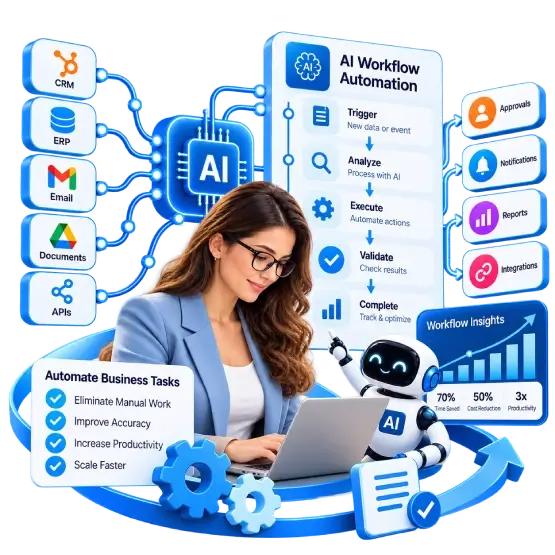
Suffescom focuses on practical AI solutions, not experiments. With more than 13 years of enterprise software development experience, we maintain the same discipline for AI workflow automation.
Before automating any workflow, we study how work is really performed in your organization, from the source of data, decision-making process, system interaction, and approval process to what happens in case of an exception. Then, we create an AI-enabled workflow taking into consideration the real process of your organization and integrating the models and agents with your applications, APIs, database, and business rules.
We combine AI/ML engineering with enterprise integration, workflow automation, and process engineering skills within our teams. This gives you a single technical team responsible for the complete workflow, not a group of disconnected automation vendors.
Our AI workflow automation services span the entire AI automation lifecycle, including evaluation, architecture, integration, testing, deployment, and optimization. Each of our services relates to an engineering step to automate AI workflows into practical enterprise use.
Begin with a detailed understanding of which workflows to automate for measurable business benefits. Our AI consulting services help you evaluate processes, systems, data, and AI preparedness to choose the right workflows, check feasibility, choose the right approach, and develop an implementation strategy.
The implementation of complex workflows involves more than just models and automation code. AI workflow orchestration requires designing workflow orchestration layers that connect various elements: AI agents, models, APIs, business logic, applications, data, approval steps, and error handling mechanisms.
From workflow logic to AI-driven decisions, implementation brings the architecture into operation. The engineering scope includes agent interactions, model calls, API actions, business rules, state management, human approvals, data exchange, and the execution logic connecting each stage.
Inconsistencies within enterprise systems may not allow the automated workflow to perform its designated functions. Helps link the CRMs, ERPs, databases, SaaS solutions, legacy systems, APIs, webhooks, middleware, and events so that workflow data and functionality flow through the technology landscape.
Legacy automation often becomes difficult to maintain as processes, applications, and business rules change. Our software modernization services restructure outdated workflows, replace brittle integrations, introduce AI where appropriate, and transition fragmented automation into more coherent custom AI workflow automation architectures.
Reliable automation depends on validating more than the expected success path. Testing covers workflow logic, integrations, AI outputs, agent behavior, data handling, approval stages, exception scenarios, failure recovery, and regression cases to verify that workflows behave correctly under real operating conditions.
Moving an automation workflow into production requires controlled releases across its supporting environments and dependencies. Deployment includes configuration, version control, dependency checking, production testing, rollback capabilities, and post-deployment validation of enterprise AI workflow automation platforms.
Execution in production serves as the data required for improving the automation process. Workflow monitoring ensures that failures, latency, bottlenecks, integration problems, AI actions, and operational patterns are known to optimize workflow logic, routing rules, integrations, and AI elements to evolve with requirements.
Explore our AI workflow automation projects to see how we translate business processes into practical automation systems.
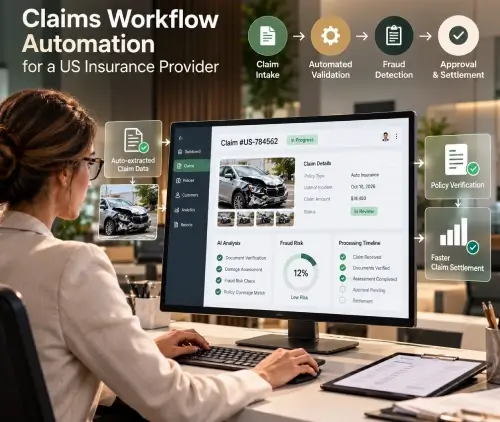
Business Requirements: An insurance provider in the USA needed to reduce manual claims intake, document review, and routing across its claims operations. Adjusters were spending significant time extracting information from submitted documents and assigning claims to the appropriate processing queues.
Automation: We implemented an AI-powered claims workflow that processed incoming documents, extracted policy and claim data, classified claim types, applied routing rules, and escalated low-confidence cases for human review. APIs connected the workflow with the existing claims management platform.
Outcomes:
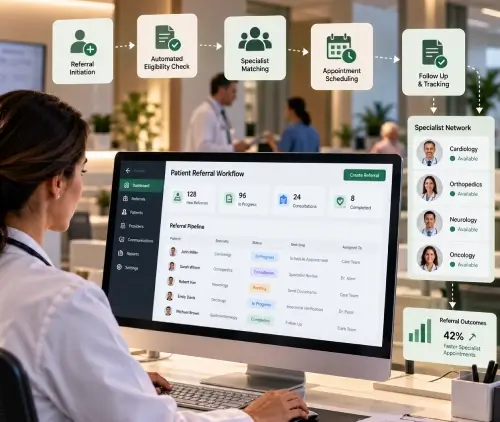
Business Requirements: A healthcare network in the USA needed to reduce delays in patient referral processing. Referral documents arrived through multiple channels and required staff to extract patient information, identify referral types, verify required fields, and route cases to appropriate departments.
Automation: We connected document-processing AI with the referral management workflow to extract and validate referral information, identify missing data, classify requests, and route referrals through defined workflow rules. Cases requiring additional information were automatically escalated to staff.
Outcomes:
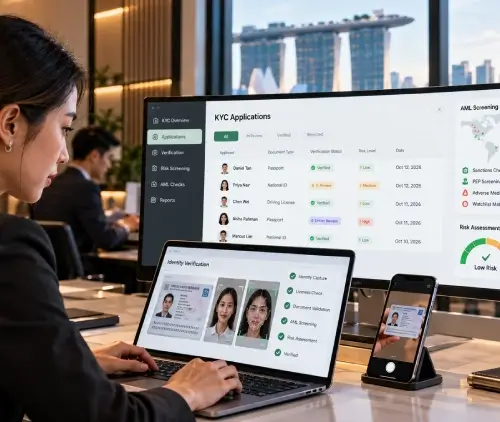
Business Requirements: A Singapore-based fintech company had to optimize the customer onboarding and KYC process. The compliance department manually screened the identities, extracted the customer details, checked mandatory fields, and processed the cases further for additional verification.
Automation: We implemented an AI-assisted KYC workflow that processed submitted documents, extracted identity information, performed validation checks, and routed applications based on predefined compliance rules. Cases requiring additional verification were directed to compliance reviewers.
Outcomes:
AI workflow automation follows different execution patterns depending on autonomy, data flow, decision logic, and human involvement. Suffescom designs AI workflow automation solutions around these patterns to support different enterprise processes and integration requirements.
A combination of deterministic business logic and AI. Rules provide conditions, permissions, thresholds, and paths to follow, while AI takes care of tasks such as classification, data extraction, or context-based analysis. It is appropriate for cases when AI workflow automation should be performed under specific business rules.
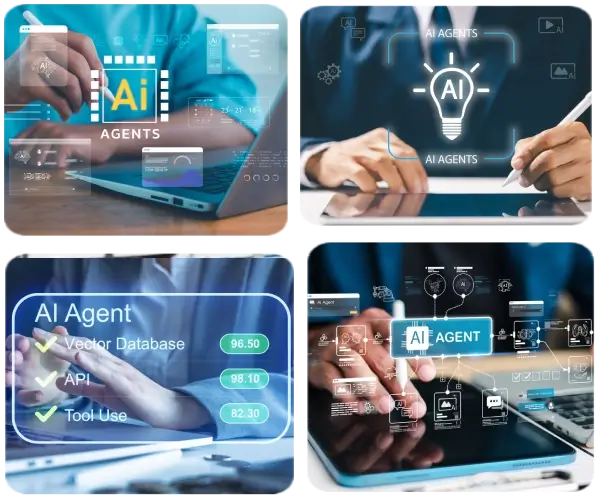
Allows agents to interpret a task, select available tools, retrieve relevant information, and execute multiple steps toward a defined objective. Our AI agent workflow automation approach uses an orchestration layer to control which actions an agent takes, when another system should be called, and when human intervention is required.
It starts when a particular event happens, which might be triggered by something like a new transaction, API callback, database update, uploaded document, or any other kind of system alert. An event sets off a series of processing steps through AI, validation, routing, and so on, which makes this method ideal for intelligent workflow automation.
It involves putting humans at some particular decision points in the workflow. AI makes the analysis and suggests the next step, while humans will manage approvals, exceptions, critical decisions, or any uncertain results. This is how companies have better control of their AI-based workflows when human intervention is important.
It uses a combination of AI-based interpretation and robotic execution of tasks. AI ensures document interpretation and classification and decides next steps, but the RPA system helps interact with applications that don’t provide proper APIs. This combination extends AI automation services to legacy environments and rule-driven operational processes.
Provides integration of AI capabilities to enterprise applications through APIs. Handles requests, responses, authentication, dependencies, retries, and the workflow as information flows between the systems. This becomes the basis for enterprise AI workflow automation between CRM, ERP, databases, SaaS platforms, and internal applications.
Employes OCR, machine learning, and language models for unstructured or semi-structured documents. Classifies documents, extracts fields, validates data, routes documents, and passes data to applications. AI workflow automation services are especially beneficial where document-intensive processes create a lot of manual work.
Combines AI or machine learning in a structured decision path. Models analyze the available data, perform prediction or classification, and return information to a workflow to decide the next action or for case review. This enables intelligent automation solutions to support decisions without removing established business controls.
An AI-based interface understands the user's request, fetching information, calling upon the approved tools/APIs, and delivering results, while the underlying process handles the real-world operation. The connection thus made is between conversational AI and business process automation instead of just question and answer.
Splits up various roles among dedicated AI agents. Different agents interpret requests, fetch information, and perform tasks, whereas the orchestrator layer coordinates between them. This architecture supports more complex AI workflow automation solutions where several specialized capabilities need to work within one controlled process.
As part of our AI workflow automation services, we provide AI development expertise for workflow orchestration and enterprise integrations, enabling businesses to automate processes across departments and operational functions.
An AI workflow automation process is not dependent on only an AI component but needs an additional orchestration layer that links all these components of AI with business applications, data sources, decision logic, and human controls. Suffescom engineers these components to work together as a coordinated AI workflow automation architecture.
The orchestration engine controls how each workflow progresses from trigger to completion. It manages task sequencing, dependencies, workflow state, retries, timeouts, and conditional routing. This provides the execution layer required for reliable intelligent workflow automation across multi-step business processes.
AI models have capabilities for things like classification, prediction, extraction, summarization, reasoning, and natural language processing. AI agents may use these capabilities to understand tasks, gather information, use permitted tools, and take actions inside the boundaries of their workflow process.
APIs connect the automation layer with CRMs, ERPs, databases, SaaS platforms, payment systems, communication platforms, and internal applications. The integration layer manages requests, responses, authentication, retries, webhooks, and data exchange so AI workflow automation solutions operate across environments.
AI workflow systems need relevant information available in structured and unstructured forms. This layer may include operational databases, data warehouses, documents, knowledge, and vector stores, or external data sources. Data retrieval and processing components give AI models the context to execute workflow activities properly.
Business rules refer to the restrictions within which an automated workflow operates. Conditions, limits, eligibility, conditions, rules, or policies determine post-AI-based outcomes. Mixing deterministic rules with AI capabilities helps in giving more control to the AI automation solution over business-critical processes.
A trigger determines initiation or continuation of a workflow. Possible triggers may include API calls, database changes, scheduled jobs, uploaded documents, user activity, transactions, system alerts, or webhook calls. The event handling component captures these triggers and starts the process for AI workflow automation.
Not all workflow activities may be automated. The human-in-the-loop component allows designated users to approve or take other action on low-confidence AI outputs, exceptions, or critical actions. The workflow records these interventions and resumes the appropriate execution path after the required action is completed.
Monitoring solutions allow you to track various aspects of workflow execution, including processing time, failures, AI responses, API calls, and dependencies. Logs, metrics, traces, alerts, and execution history are useful to technical teams in troubleshooting and optimizing AI workflow automation services post-deployment.
Access control restricts access by anyone to specific systems or specific actions to be performed, whether they are users, AI agents, services, or workflows. The process includes encryption, authentication, authorization, auditing, and policy enforcement to secure data and workflows while ensuring traceability for AI automation.
AI workflow automation varies by industry, data sources, decision rules, and operational controls involved. Suffescom connects AI models, APIs, enterprise applications, and data workflows to automate industry-specific processes in existing environments.
🗹 Banking and fintech workflow orchestration.
🗹 Loan origination and underwriting systems.
🗹 KYC, AML, and transaction-monitoring workflows.
🗹 Reconciliation and financial operations automation.
🗹 Electronic health record (EHR) workflow integration.
🗹 Patient intake and referral management.
🗹 Clinical documentation and medical-record processing.
🗹 Claims processing and revenue-cycle management.
🗹 Policy administration workflow automation.
🗹 Claims management and adjudication systems.
🗹 Underwriting and risk-assessment workflows.
🗹 Insurance document processing and verification.
🗹 Order management and eCommerce platforms.
🗹 Product catalog and merchandising workflows.
🗹 Inventory and fulfillment systems.
🗹 Customer engagement and service automation.
🗹 Manufacturing execution systems (MES).
🗹 Quality management workflows.
🗹 Production planning and scheduling systems.
🗹 Predictive maintenance and equipment monitoring.
🗹 Transportation management systems (TMS).
🗹 Warehouse management systems (WMS).
🗹 Shipment tracking and exception management.
🗹 Supplier and logistics document automation.
🗹 Property management platforms.
🗹 Tenant onboarding and service workflows.
🗹 Lease and contract document processing.
🗹 Property maintenance and work-order systems.
🗹 Chatbot integrations for hotel management.
🗹 Reservation and booking workflow automation.
🗹 Guest service and request management.
🗹 Revenue and occupancy management workflows.
🗹 Customer service and ticketing systems.
🗹 Network monitoring and incident management.
🗹 Service provisioning and order management.
🗹 Billing and revenue-assurance systems.
🗹 Contract lifecycle management (CLM).
🗹 Legal document review workflows.
🗹 Client intake and matter-management systems.
🗹 Legal research, knowledge, and compliance workflows.
AI workflow automation is constrained by fragmented systems, inconsistent data, complex decision paths, and exceptions. Suffescom addresses these challenges through controlled orchestration and enterprise integration.
CRM, ERP, database, SaaS, and legacy applications tend to be deployed in disconnected environments.
Our approach: Interconnect these applications using APIs, webhooks, middleware, and integration adapters to sync data and workflows.
Different teams and systems may apply different rules, approval paths, triggers, and exception conditions.
Our approach: Model workflow states, business rules, routing conditions, and approval paths within a centralized orchestration layer.
Incomplete, duplicated, and inconsistent source data influence the AI decision-making process and automation.
Solution: Validate, normalize, enrich, deduplicate, and map data to schemas prior to processing the data in critical workflow steps.
Business process implementation encountering gaps, integrations, requests, and exceptions where following the procedure is impossible.
Solution: Set up comprehensive fallback procedures, multiple retries, confidence levels, escalations, and human intervention points.
Often lack modern APIs or integration interfaces, which makes it more difficult to connect with newer systems.
Our approach: Use adapters, middleware, RPA, file-based interfaces, or controlled database integration where appropriate.
AI-generated classifications, extracted information, and recommendations may require deterministic validation before triggering actions.
Our approach: Combine model outputs with confidence scoring, business rules, validation layers, and human approval for controlled decision execution.
Long-running and asynchronous workflows fail midway, creating duplicate, incomplete, or inconsistent transactions.
Our approach: Maintain persistent workflow state with idempotency, retries, timeouts, checkpoints, and recovery logic.
Changes in APIs, source data, business rules, and model behavior affect workflow execution after deployment.
Our approach: Implement execution tracing, structured logs, failure alerts, workflow metrics, and monitoring across AI and integration components.
The cost of AI workflow automation depends on workflow complexity, integration requirements, AI decision points, data volume, exception paths, and operational controls. We estimate projects based on the depth of orchestration and the number of systems and processes involved.
USD $15,000 – $20,000
USD $20,000 – $30,000
USD $30,000 – $40,000+
At Suffescom, we follow a systematic AI automation approach that links workflows to the AI model, orchestrations, enterprise applications, and human supervision. From evaluating the business process and designing, implementing, and monitoring the automation.
We evaluate the existing business process, workflow steps, decisions, manual transitions, data, and system dependencies. We evaluate CRMs, ERPs, databases, SaaS applications, legacy systems, APIs, webhooks, and automation tools to determine where AI workflow automation is possible without modifying the system.
We identify processes suitable for AI process automation based on volume, decision complexity, repeatability, exception rates, and available data. Each workflow is mapped into automated actions, deterministic business rules, AI decision points, human approvals, exception paths, and downstream system actions.
We create the architecture for enterprise AI workflow automation. This includes workflow orchestration, triggers, state management, data flows, API integrations, AI services, rules engines, approval layers, retries, timeouts, and fallback mechanisms. The architecture is aligned with existing infrastructure and requirements.
We integrate the required AI capabilities with enterprise applications and data sources. This involves LLMs, AI agents, machine learning models, APIs, databases, CRMs, ERPs, and other applications. The focus is on connecting AI actions to workflow execution rather than deploying AI as an isolated capability.
We implement workflow logic, routing conditions, business rules, AI prompts, data transformations, approval gates, and exception handling. Workflows are validated across normal, edge-case, and failure scenarios to verify AI outputs, integrations, state transitions, permissions, retries, and recovery behavior.
Before deployment, each workflow is tested, including end-to-end execution. Testing includes API failures, invalid data, uncertain AI results, duplicate requests, timeouts, exception handling, access control, and responses from other systems. This deploys ready-to-use AI-driven solutions before they enter live operations.
Validated workflows are deployed across the required environments and connected to production systems through controlled releases. We configure API credentials, triggers, webhooks, and access controls while maintaining clear separation between development, staging, and production environments.
Once deployed, we monitor executions, errors, timelines, performance, exceptions, and AI output quality. Logs, alerts, traces, and operational metrics detect workflow bottlenecks. We then optimize our orchestration logic, prompts, rules, integrations, and automation flow as required in the production environment.
AI workflow automation solutions offered by Suffescom incorporate security standards, AI risk management, privacy needs, and regulatory compliance as per the deployment environment.
AI process automation involves tying the various features of AI with business processes and enterprise applications to reduce manual intervention and improve process execution and its control, and optimization. The result will be more consistent processes due to their complexity.
Automate the process of entering data, document processing, categorization, verification, routing, and status tracking. AI process automation reduces the amount of routine work handled manually across operational teams.
Reduce expenses from repetitive tasks, manual processes, and corrections to data, enhancing efficiency and resource allocation. Automation may enable increased volume of processing without a proportional increase in manual effort .
Apply defined business rules, validation logic, routing conditions, and approval requirements consistently across workflow runs. This creates more predictable business process automation across teams and departments.
Implement AI to classify data, retrieve and synthesize information, identify patterns, and offer recommendations. AI technology is introduced in any process that uses large amounts of structured and/or unstructured information.
The automation of processes such as data extraction, validation, normalization, and data transfer between systems reduces the likelihood of errors and inconsistencies in records that exist across interconnected applications.
Identify incomplete, ambiguous, or failed transactions and route them through predefined exception paths. Confidence thresholds and human approvals allow teams to intervene when automated processing should not continue.
Automated priority setting, with efficient routing, timely escalations, and proactive notifications, prevents queues and ensures that processes are aligned with established service levels and predetermined response targets.
Capture workflow execution data, processing metrics, failures, and exception patterns across automated processes. Technical teams locate bottlenecks and diagnose problems without the need for manual status checks alone.
Maintain records of workflow events, approvals, AI outputs, system actions, and execution outcomes. This provides clearer traceability for troubleshooting, governance, operational reviews, and audits.
Work process data identifies frequent exceptions, unneeded transfers, failed integrations, and process inefficiencies. The teams leverage this information to continually improve their AI workflow automation techniques.
Automate high-volume workflows and coordinate tasks across multiple systems without adding equivalent manual processing capacity. This allows teams to handle changing workloads through enterprise AI workflow automation.
Hear from clients about their experience working with Suffescom on AI workflow automation, enterprise system integrations, process automation, and production-ready software solutions.
Suffescom provides expertise in software engineering, artificial intelligence, and enterprise integration for workflow automation projects. We automate processes based on existing systems, data, workflows, and approval processes that your company uses, not just based on artificial intelligence alone.
We understand application architecture, APIs, databases, cloud environments, third-party integrations, and legacy systems, allowing automation to fit into existing technology environments.
Before implementing our AI workflow automation solutions, we chart out triggers, decision points, handover points within the system, workflow status, business rules, approvals, exceptions, and subsequent steps.
Our AI workflows integrate with apps like CRMs, ERPs, databases, SaaS, help desks, ticketing, and custom systems. APIs, webhooks, middleware, and integration adapters are used depending on the needs of different environments.
Not all workflow decisions need to be made using AI models. Our AI workflows use LLMs, AI agents, and AI abilities with business rules, validation logic, confidence levels, and fallbacks where deterministic control is required in the workflows.
Enterprise workflows rarely follow a single path. Our AI process automation approach accounts for incomplete data, failed integrations and transactions, low-confidence outputs, timeouts, and exceptions via defined routing and escalation logic.
We design workflows for real environments, including integration testing, access controls, deployment, recovery, and monitoring. The objective is dependable operational execution, not a proof of concept that stops at a demonstration.
Different workflows require different automation patterns. Depending on the process, we implement API-orchestrated workflows, AI agents, event-driven automation, human-in-the-loop processes, or AI combined with deterministic automation and RPA.
Business processes, APIs, models, and system dependencies change with time. Workflow execution monitoring, with operational data analysis, finds failure points and inefficient procedures optimized through automation logic.
AI workflow projects require more than model development. We bring together AI engineers, software developers, integration specialists, and QA resources to streamline automation, data, and testing requirements of the workflow.
Recognized across technology, software engineering, and digital product development for delivering technology solutions for businesses across industries.
We select technologies based on workflow requirements,
existing systems, integration constraints, and deployment environments rather than forcing a fixed stack.
AI-based workflow automation leverages AI models, workflow orchestration, business rules, APIs, and enterprise software to automate complex business processes. In contrast to simple task automation, AI workflows manage unstructured information, classification, decision support, routing, and exception processes without losing control and approvals.
Business processes that may leverage AI workflows include document processing, onboarding of customers, claims management, invoice processing, lead management, ticket routing, compliance workflows, and information lookup, among others.
Traditional automation generally follows predefined rules and fixed inputs. AI workflow automation includes LLMs, AI agents, machine learning models, classification, extraction, and contextual decision-making in workflows. Deterministic processes are used to dictate critical actions, approval processes, validation, and business logic.
Yes. AI workflow automation within an enterprise setting integrates legacy systems, applications, databases, APIs, and cloud-based software, as well as workflow state management, permissions, audit trails, approvals, exception handling, and production monitoring.
Yes. AI workflows connect with CRM systems, ERP systems, databases, ticketing systems, communication tools, SaaS software, and internal systems via REST APIs, GraphQL, webhooks, middleware, event-driven integrations, and other supported connectors.
Yes. Depending on the system, integration may be realized via API, middleware, file-based interface, database connection, RPA, or other means of adaptation to the legacy system. The integration approach will depend on the interfaces available in the legacy system, as well as the security and workflow requirements.
Depending on the workflow, the implementations may leverage large language models, machine learning models, AI agents, RAG, NLP, document intelligence, classification, extraction, and computer vision.
Yes. Depending on various criteria (e.g., task type, accuracy, speed, cost, context window, or data sensitivity), different tasks are routed to different models within one workflow. Model orchestration also includes validation and fallback logic before an automated action is executed.
We assess the workflow's transaction volume, manual effort, decision complexity, data availability, exception rate, integration dependencies, and business impact. Processes with repetitive steps, structured decision points, or AI-suitable unstructured data are evaluated for automation opportunities.
Yes. Human-in-the-loop controls are added at specific decision points. For example, an AI model classifies a document or recommends an action, while a designated user approves the result before the workflow performs a sensitive downstream operation.
Workflows use validation rules, confidence thresholds, retries, timeouts, fallback paths, escalation rules, and human review. Persistent workflow state and recovery mechanisms also allow long-running processes to resume without unnecessarily repeating completed steps.
Production monitoring tracks workflow executions, failures, latency, API health, exceptions, model outputs, and system performance. Logs, traces, metrics, alerts, and audit records help technical teams identify failures and optimize workflow logic over time.
The cost depends on workflow complexity, number of integrations, AI decision points, data requirements, exception handling, workflow state, and operational controls. Projects range from approximately $15,000 for basic/MVP workflow automation to $40,000+ for enterprise implementations.
Implementation time depends on workflow complexity, integration dependencies, data readiness, AI requirements, testing scope, and deployment environment. A straightforward workflow with limited integrations generally requires less engineering effort than a multi-system enterprise workflow with complex rules and approval paths.
Yes. Existing automation is extended with AI capabilities where fixed rules are insufficient. For example, AI classifies incoming documents, extracts information, interprets natural-language requests, or supports decision routing, while existing RPA or deterministic automation handles predefined actions.
Yes. We architect and implement workflows spanning triggers, data ingestion, AI processing, business rules, application integrations, approvals, downstream actions, exception handling, testing, deployment, and production monitoring based on the workflow and systems involved.
• SUFFESCOM SOLUTIONS
Build Smarter. Scale Faster. Grow More.
Have a Vision? Let’s Turn It Into a Digital Reality.
Get a quick response from our best experts in under 10 minutes.
Share Your Requirements. Our Experts Will Shape the Solution.
• SUFFESCOM SOLUTIONS
Build Smarter. Scale Faster. Grow More.
Have a Vision? Let’s Turn It Into a Digital Reality.
Get a quick response from our best experts in under 10 minutes.
Share Your Requirements. Our Experts Will Shape the Solution.
Fret Not! We have Something to Offer.