+971-8000321216



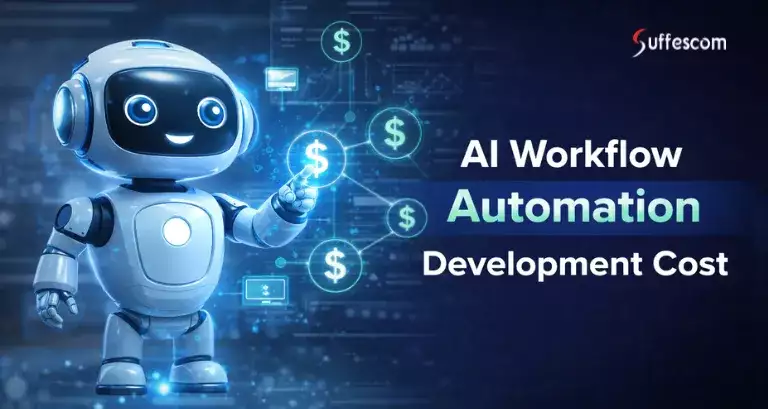
If you are exploring AI workflow automation development, the first question that follows is almost always the same: How much is this going to cost?
The answer is not a single number, it is a spectrum shaped by your industry, the complexity of your workflows, the depth of intelligence you want to embed, and the development model you choose.
In this guide, we break down every layer of the cost of building AI workflow automation software, from initial discovery through to enterprise-scale deployment so that you can plan, budget, and build with complete confidence.
📌 Quick Stat: According to McKinsey's global AI survey, 78% of organizations now have AI deployed in at least one business function, up from 72% a year earlier. The businesses leading this charge are those that understood the real costs upfront and built accordingly.
What Is AI Workflow Automation And Why Does It Cost?
AI workflow automation is the use of artificial intelligence to handle repetitive, multi-step business processes with minimal human intervention. Instead of a person manually moving data between tools, triggering actions, or making routine decisions, AI does it automatically and intelligently.
Why AI Workflow Automation Cost?
AI workflow automation isn't just scripting, it involves several expensive layers:
1. AI Model Usage
Every decision the AI makes calls an underlying model (like Claude, GPT, or a custom model). These are billed per token/request and can add up quickly at scale.
2. Integration Complexity
Connecting to your existing tools (Salesforce, SAP, Slack, etc.) requires custom connectors, API maintenance, security reviews and all labor-intensive.
3. Infrastructure
Running workflows reliably 24/7 requires cloud compute, orchestration layers, monitoring, and failover systems.
4. Training & Fine-tuning
Generic models often need customization on your specific data, documents, or terminology, a one-time but significant cost.
5. Human-in-the-Loop Design
Well-designed systems include checkpoints where humans review edge cases. Building those approval flows and audit trails takes engineering time.
6. Compliance & Security
Regulated industries (finance, healthcare, legal) require encryption, audit logs, data residency controls, and compliance certifications, all of which raise costs.
7. Ongoing Maintenance
AI systems drift as business processes change. Prompts need tuning, integrations break, and models get updated and require continuous upkeep.
Companies that integrate AI early in the digital transformation journey consistently report faster ROI cycles and lower total cost of ownership compared to those who retrofit AI into existing systems as an afterthought.
Not Sure What Your AI Automation Project Will Cost?
Cost to Build AI Workflow Automation Software: Tier Overview
At the broadest level, the market breaks into three tiers based on project scope and intelligence depth:
| Tier | Best For | Estimated Cost Range |
| Basic/ MVP Automation | SMB's, single-workflow automation, rule-based logic | $ 15,000 - $ 20,000 |
| Mid-Market Custom Build | Multi-department automation, CRM/ERP integrations, NLP | $ 20,000 - $ 30,000 |
| Enterprise AI Platform | Full decision automation, agentic AI, predictive analytics | $ 30,000 - $ 40,000 |
A fully functional AI workflow automation engine costs anywhere depending on scope, depth of AI, integrations, and enterprise scale. Projects that require white label AI workflow automation packaging for resale or multi-tenant deployment typically sit in the upper-mid to enterprise range due to the additional architecture required for customization at scale.
Key Factors That Influence AI Workflow Automation Development Cost
Beyond phase-level costs, several overarching factors act as multipliers of your total investment.
AI Complexity & Model Sophistication: Basic rule-based automation costs significantly less than full decision automation with predictive analytics, anomaly detection, and generative AI components. Each level up adds meaningful development effort and model training time.
Integration Depth: Legacy systems, custom protocols, varied data formats, and multi-platform SaaS/ERP environments significantly increase integration engineering time and cost. The more systems your AI engine must connect to, the more integration hours you should budget for.
Industry & Compliance: Healthcare, finance, aviation, and government face 20-40% higher costs due to regulatory requirements, audit trails, data sovereignty mandates, and explainability requirements that standard commercial deployments do not encounter.
Data Quality & Volume: Poor data quality or fragmented data infrastructure drives up preparation costs considerably. Organizations with clean, structured data pipelines already in place can save 20-30% on the data engineering phase alone.
Development Team Location: US/UK-based AI developers average $62/hr and above. Offshore teams in India offer comparable expertise at $25-$40/hr, making geography one of the most significant total cost levers available to any organization building AI systems.
Timeline & Rush Requirements: Standard timelines are sold at base rates. Accelerating delivery by 40-60% typically incurs a 10-25% premium due to larger parallel teams and compressed testing cycles.
Invisible Price Tag In AI Workflow Automation Development
Every experienced AI development team will tell you that the published project cost is rarely the full picture.
GPU & Cloud Infrastructure: Training and hosting AI models requires serious computing. GPU cloud instances for typical AI workloads run per hour, with H100-class GPUs costing on-premise deployments. Cloud-based model hosting adds ongoing monthly infrastructure costs that scale with usage, something that must be modeled in your total cost of ownership from day one.
Data Licensing & Annotation: Custom model training often requires proprietary datasets or licensed third-party data. Data annotation typically costs per data point and can represent a significant portion of pre-development costs in specialized use cases like medical imaging or legal document processing.
Security & Compliance Architecture: Organizations handling sensitive data through AI workflows must invest in encryption, access controls, audit logging, zero-trust architecture, and in some industries, explainable AI capabilities. These requirements add 15-25% to total development costs in standard environments and 30-40% in highly regulated sectors.
ROI: What Does AI Workflow Automation Actually Return?
Despite high initial costs, businesses typically see 30-200% ROI within 18 to 24 months through improved efficiency, reduced error rates, and faster cycle times.
A regional healthcare provider investing in an AI system that automates prior authorization requests can eliminate 15 to 20 hours of manual administrative work per day, a return that pays for the entire system within six months. A logistics company embedding AI into its freight documentation workflows can reduce processing time by 60-80%, directly impacting customer satisfaction and contract renewal rates.
For sales and customer-facing operations, AI assistants powered by enterprise AI chatbot development have delivered measurable reductions in support ticket volume, improved first-response accuracy, and significant gains in customer satisfaction scores, all of which translate directly to revenue retention.
Build-In-House vs. Outsource: What Does Each Model Actually Cost?
One of the most consequential decisions in your AI build journey is whether to develop in-house or partner with an experienced AI workflow automation software development company.
Building an internal AI team is a significant commitment. The overall investment required by an in-house AI team, including data scientists, ML engineers, DevOps, and QA specialists varies significantly depending on factors such as team size, expertise, and project complexity. AI project cost overruns from pilot to production average when organizations lack the institutional knowledge to scope and execute AI projects efficiently.
Outsourcing to a specialist firm removes that institutional risk. US/UK-based development firms charge per hour for senior AI engineers. Offshore teams, particularly in India, offer equivalent seniority per hour, making geographic arbitrage one of the most practical cost management levers available.
The right answer for most organizations is a hybrid model: a lean internal product owner and business analyst team working in close collaboration with an outsourced AI development partner. This captures the cost efficiency of outsourcing without sacrificing the organizational knowledge that only your internal team possesses.
How to Reduce AI Workflow Automation Development Costs ?
Here are the most effective strategies teams use to cut AI development costs without compromising quality:
1. Start With a Focused MVP
- Automate one high-impact workflow first, not everything at once
- Validate ROI in the real world before scaling investment
- Reduces financial risk significantly in early stages
2. Use Pre-Built AI Components
- Leverage open-source frameworks like TensorFlow and PyTorch
- Use API-based services for standard functions- NLP, OCR, speech recognition
- Reserve custom builds only for unique business logic
- Saves a significant portion of core development costs
3. Fix Your Data Before Development Starts
- Poor data quality silently doubles data engineering budgets mid-project
- Auditing and cleaning data before kickoff saves multiple rounds of rework
- Highest-ROI preparation step before any AI build
4. Consider White Label AI Workflow Automation
- Cuts time-to-market from months to weeks
- Significantly reduces upfront costs vs a fully custom build
- Best suited for standard workflows- approvals, routing, notifications, reporting
5. Partner With an Offshore Development Team
- Offshore teams in India offer equivalent expertise at a fraction of onshore rates
- Geography is one of the most powerful cost levers in AI development
- Choose partners with a proven AI workflow automation portfolio specifically
6. Budget for Maintenance From Day One
- Planned maintenance is systematic, efficient, and far cheaper than reactive fixes
- Teams that plan upfront consistently spend less over a three-year horizon
- Treat maintenance as part of the build, not an afterthought
7. Use Agile Development to Control Scope Creep
- Build in two-week sprints with regular review checkpoints
- Surfaces misalignments early when they are cheap to fix
- Scope creep is behind the majority of AI project budget overruns
Future Trends Impacting AI Workflow Automation Development Costs
The cost landscape for AI workflow automation is not static. Here are the key trends actively reshaping what it costs to build and maintain AI automation systems:
1. Commoditization of Foundation Models
- Access to LLMs like GPT-4o, Claude, and Gemini via API is slashing NLP development costs
- Standard AI capabilities now available at fractions of a cent per query
- Entry-level automation costs expected to drop 30-40% by 2027
2. Rise of Agentic AI
- Agentic systems are more expensive to build upfront
- But reduce long-term operational costs significantly
- Costs expected to commoditize by 2027-2028
3. Low-Code & No-Code AI Platforms
- Basic workflow automation now achievable for $5,000-$20,000 via no-code tools
- Pushes custom development budgets toward genuinely complex, high-value use cases
- Non-technical teams can configure intelligent workflows without writing code
4. Stricter AI Regulations (EU AI Act & Beyond)
- Healthcare, finance, and legal sectors face 20-35% additional compliance costs
- Mandatory explainability, bias auditing, and data governance requirements
- Enforcement maturing through 2026-2027 across the US, UK, India, and Singapore
5. Edge AI Reducing Cloud Infrastructure Costs
- AI inference moving onto devices and on-premise hardware
- Significantly lowers ongoing cloud operating costs for real-time automation
- Most impactful for manufacturing, logistics, and healthcare use cases
6. Rising AI Talent Costs
- Senior ML engineers in the US now command $15,000-$20,000 annually
- Offshore partnerships in India becoming a critical cost buffer
- Demand continues to outpace supply through at least 2026
What Makes Suffescom Solutions the Right AI Workflow Automation Partner ?
Choosing the right development partner is as important as the architectural decisions you make. Suffescom Solutions is a trusted AI development company with 13+ years of experience building enterprise-grade AI systems for startups, mid-market companies, and Fortune 1000 enterprises across the globe.
What sets Suffescom apart is a relentless focus on business outcomes rather than pure technology delivery. Our AI teams, spanning generative AI developers, adaptive AI specialists, agentic AI engineers, and LLM engineers, are built to design systems that automate intricate workflows, enhance operational efficiency, and deliver measurable ROI. Not just demos that impress on a pitch deck.
Our delivery model combines agile methodology with dedicated team structures, ensuring that projects are delivered on time, within budget, and with the transparency that complex AI builds demand. Clients across the healthcare, logistics, fintech, retail, and government sectors have consistently recognized Suffescom for its ability to turn ambitious AI visions into production-grade realities.
Whether you are exploring a basic automation MVP, a full AI workflow automation engine, white-label AI workflow automation for your product portfolio, or an AI-powered personal virtual assistant for your operations team, Suffescom brings the technical depth and commercial pragmatism to make it work at a cost structure built for real-world business budgets.
Your Competitors Are Already Automating. Are You?
Frequently Asked Questions
1. Is AI workflow automation suitable for small and mid-sized businesses?
Absolutely, AI workflow automation is not exclusive to large enterprises. Small and medium-sized businesses can start with a focused single-workflow MVP, validate ROI quickly, and scale from there. The key is starting with the right scope rather than trying to automate everything at once.
2. What is white label AI workflow automation and is it right for my business?
White label AI workflow automation allows businesses, particularly agencies, SaaS companies, and technology resellers, to deploy a fully built, rebrandable automation platform without building from scratch. It is ideal if you need to move quickly, serve multiple clients, or test a product concept before committing to a full custom build.
3. How do I get started with Suffescom Solutions for my AI automation project?
Getting started is simple; you only have to reach out to the Suffescom Solutions team with a brief overview of your automation goals. Our AI consultants will schedule a discovery call, assess your workflows, and walk you through a clear roadmap with full transparency on timeline, team structure, and approach before any commitment is made.
4. How is AI workflow automation different from traditional automation?
Traditional automation follows fixed rules. If this happens, do that. AI workflow automation goes further by learning from data, adapting to new patterns, making intelligent decisions, handling unstructured inputs like documents and emails, and improving over time without manual reprogramming.
5. Can AI workflow automation integrate with our existing tools and systems?
Yes, A well-architected AI automation system is designed to connect with your existing CRM, ERP, HRMS, e-commerce platform, communication tools, and any other systems your business runs on. Integration depth varies by project, but it is a core part of every professional AI automation build.
6. Where can I get reliable AI workflow automation development services?
This is where Suffescom Solutions comes in. We are a trusted partner for AI workflow automation, where businesses at every stage from MVP exploration to full-scale AI platform development. Whether you need a custom build or a white-label AI workflow automation solution, our team brings the technical depth and business understanding to deliver real results. Talk to the Suffescom team today and get a free consultation tailored to your specific workflows and goals.