+971-8000321216



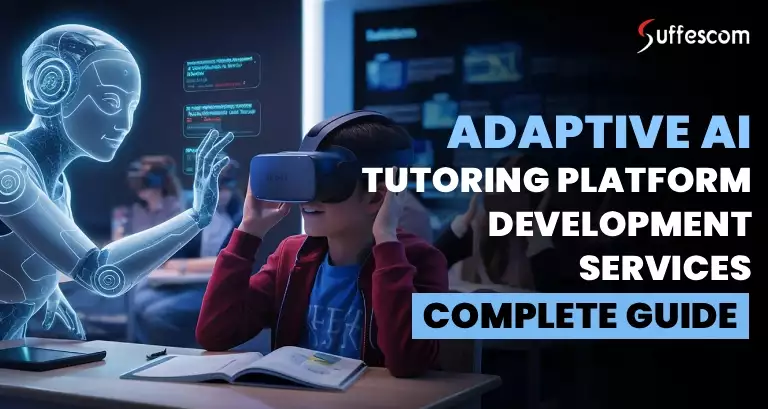
AI-powered tutoring systems fulfill the demand for every student to have a 24/7 available tutor. These systems revolutionize the one-size-fits-all traditional approach. It provides more dynamic, engaging, and effective learning.
AI in education is a whole new field for EdTech enterprises to explore. Today's learners and enterprise customers expect systems that do more than just deliver static content. Businesses with an AI adaptive tutoring platform leverage real-time data to tailor experiences.
Businesses seeking strategic investment, adaptive tutoring systems have emerged as a powerful choice. AI-powered tutor app unifies content delivery, assessment, and insights for businesses.
Reasons Why Adaptive AI Tutoring Systems Are Transforming Learning
AI eLearning system development service is reshaping the education system driven by a blend of industry trends. Below are the reasons:
1. Learner-Centric Experiences
On-demand tutor booking app dynamically tailors the learning system. It is based on individual progress, preferences, and performance input. Based on inputs, the content difficulty is managed in real time, focusing on learning gaps and providing support. The system helps businesses improve user retention and helps them achieve mastery faster.
2. Real-Time Automation & Support
An AI tutoring system development company automates features in the system. They help to adapt assessment, grading, feedback, and remediation. It lets learners receive instant guidance and support. This automated system helps educators focus on mentorship rather than administrative tasks.
3. Response to Skill-Gap Pressures
Organizations and institutions that develop AI adaptive tutoring platforms experience rapid change. Workforce demands are met by boosting competency development. It also fills skill gaps and measures learning outcomes effectively.
4. EdTech Growth
Investments in EdTech accelerate global shifts to hybrid models. With the adoption of remote learning, the system's appeal and scalability expand beyond traditional classrooms.
5. Cost Efficiency and Scalability
Adaptive AI enabled tutoring platform development personalizes instruction for large user bases. It decreases the human resource costs. It also reduces redundancy, automates tasks, and optimizes learning paths.
6. Data-Driven Insights & Accountability
Platforms generate rich analytics. It includes learner behavior, performance trends, and content effectiveness. Analytics analysis enables organizations to make data-driven decisions.
Transform Future of Learning with Cutting-Edge AI Tutoring Platform
Schedule a demo now to see how Suffescom personalizes learning for every learner. Unlock the future of learning today!
Use Cases of Adaptive Learning System Development Across Industries
Adaptive learning is no longer limited to traditional classrooms. Adaptive tutoring systems development is applied to various industries. The use cases of this system help with personalization, performance tracking, and content delivery.
Below are the impactful use cases where adaptive learning systems create business value.
1) K-12 and Higher Education Platforms
Educational institutions are implementing AI adaptive tutoring platform development solutions. It maintains curriculum compliance.
- Content tagging and API integrations with LMS platforms align learning paths with academic objectives.
- Generative AI creates assessments based on the curriculum.
- The AI teacher mobile app dynamically generates difficulty levels based on the learner’s inputs.
- Adaptive assessments simulate real exam conditions for learners.
- Data pipelines and integrations ensure seamless data exchange. It is done between SIS, LMS, and adaptive education software.
- Speech-to-text integration supports language learning models.
- Provides instant feedback, verbal response analysis, and an inclusive learning experience.
2) Corporate Learning & Development
Enterprises are leveraging adaptive eLearning system development for focused learning environments. These systems are aligned with business goals.
- HRMS and performance management tools create personalized learning. It is based on role-specific requirements.
- Adaptive learning reduces compliance fatigue. It adjusts module difficulty based on learner performance.
- Generative AI creates contextual examples based on the employee department.
- Businesses can deploy microlearning modules tailored to content length and complexity.
3) Test Prep & Certification Platforms
Adaptive tutoring systems development benefits businesses. It provides scalability and learner-specific personalization of content.
- Adaptive mock tests adjust question difficulty level in real time.
- AI evaluates response accuracy, time spent, and confidence levels. It creates a realistic exam simulation.
- Adaptive education software development enables comparative analytics.
- It provides individualized learning paths, strengthening test prep providers' competitive position.
- An adaptive system automatically identifies weak areas and generates remediation modules.
4) Professional Upskilling & EdTech Startups
AI tutoring system development company providers accelerate go-to-market strategies. It is built on scalable, cloud-native architectures.
- The system dynamically clusters learners into cohorts based on skill levels, pace, and goals.
- A form of structured yet personalized group learning environments powered by real-time data.
- API integration enables adaptive systems to monitor user engagement, session activity, and interactions.
- Predictive analytics trigger automated interface changes, increasing user retention.
- Tutoring system supports monetization strategies. It includes tiered subscription, performance-based pricing, and more add-ons.
- A generative AI system reduces content production costs.
5) Theatre & Drama
Adaptive learning has entered the creative industries. Adaptive AI enabled tutoring platform development solutions have improved performance in theatre and drama.
- Intelligent tutoring system development personalizes script practice, voice modulation, and performance coaching.
- Speech recognition, emotion analysis, and generative AI analytics allow learners refine delivery and expression.
- The system tracks rehearsal consistency, highlights improvement areas, and provides audience feedback.
- Creates new doors of opportunities for training platforms and performing arts education models.
Benefits of AI Adaptive Tutoring Platform Development for Enterprises
Investing in an AI adaptive tutoring platform development solution creates value beyond personalization. Businesses experience higher retention, skill development, and reduced operational overhead. It also helps achieve scalable revenue.
Below are the core business benefits of adaptive tutoring systems development solutions.
1) Improved Retention
Adaptive AI focuses on ensuring every learner receives content aligned to their understanding level. Intelligent tutoring system development adjusts pace, difficulty, and format. Gen AI improves engagement by producing contextual examples, explanation and practice tasks. These integrations improve the user interface and deliver personalized content updates, thereby increasing user retention.
2) Faster Mastery
An adaptive learning system eliminates redundant content and focuses on identifying knowledge gaps. An AI-powered learning system improves progress and captures it in real time. The system reduces training time while maintaining outcome quality. It results in quicker onboarding, improved productivity, and measurable ROI for businesses.
3) Operational Efficiency
This tutoring platform continuously generates assessments and summaries, reducing dependence on content teams. With an AI tutoring system development company, businesses create architect cloud-native, scalable infrastructures that support thousands of learners. It results in low cost per learner, increased scalability, and predictable infrastructure management.
4) Instructor Augmentation
ITS handles repetitive tasks such as basic queries, progress tracking, and recommendations. It allows instructors to focus on high-value interventions, mentoring, and strategic curriculum design. With analytics dashboards, instructors receive real-time performance metrics. It enables businesses to improve output without increasing staff.
5) Data Monetization
Organizations transform learning analytics into premium insights. With proper data architecture and API integrations, every content interaction becomes actionable intelligence. The custom adaptive ai tutoring software supports analytics dashboards, subscriptions, and white label performance solutions. Businesses with the right approach to building tutoring systems open new revenue streams. They are structured by AI-driven insights.
Niche Specific Features for a Future-Proof AI Tutoring Product
AI adaptive tutoring platform development is more than just generic features. It comes with modern features for niche-ready capabilities. These are integrated into the product's architecture from day one.
Below are the core features that strengthen adaptive tutoring systems development. They are categorized industry-wise, including Drama, Music, and more.
1) Personalized Dashboard
Adaptive AI learning with a personalized dashboard aggregates learner progress, skill gaps and performance metrics in real time.
Where it adds value:
- Drama: The dashboard tracks rehearsal frequency. It also monitors dialogue mastery. The scores use speech analytics.
- Music Learning: The dashboard displays pitch accuracy. Rhythm stability is also shown. Consistent metrics are provided.
- Science: Dashboard analytics highlight concept mastery. This is broken down by topic (physics, chemistry, biology).
- Space Education: Progress is recorded across astronomy modules. Simulations are tracked. Learning paths are also monitored.
- Corporate L&D: Competency mapping is shown. This is aligned with job roles. API integrations with HRMS are used.
- Healthcare Training: Clinical knowledge progression is tracked. Simulation performance is monitored.
2) Real-Time Feedback Engine
The system analyzes performance signals and responds instantly. Real-time feedback produces contextual explanations on demand.
Where it adds value:
- Drama: Real-time feedback on pronunciation, tone variation, and emotional delivery using AI speech models.
- Music Learning: Improves pitch and tempo with audio processing AI.
- Science: It provides instant feedback. It resolves problem-solving steps.
- Space Education: Simulation-based feedback during virtual experiments or mission planning.
- Test Prep Platforms: Adaptive hints are triggered. This occurs when a learner struggles repeatedly.
- Manufacturing Training: Safety simulation alerts during procedural training modules.
3) Gamification Layer
These features drive engagement. In B2B products, it aligns with measurable outcomes. It is integrated with analytics modules to ensure rewards reflect actual learning progress.
Where it adds value:
- Drama: Integration of performance badges for mastering character roles.
- Music Learning: Increases user retention with achievement for completing scales or live practice sessions.
- Science: Points for lab simulation accuracy and conceptual mastery.
- Space Education: Mission-based progression with unlockable advanced simulations.
- Corporate L&D: Leaderboards for compliance completion or skill certification.
- Sales Training: Performance-based progression is implemented. This is tied to real KPIs.
4) Multimodal Content Delivery
Modern adaptive AI enabled tutoring platform development solutions support multimodal content delivery. It includes text, video, audio, AR/VR simulations, and interactive modules. This feature optimizes content streaming capabilities.
Where it adds value:
- Drama: Script reading (text), performance recording (video), vocal analysis (audio).
- Music Learning: Sheet music (visual), playback (audio), interactive instrument simulations.
- Science: 3D lab simulations and experiment walkthrough videos.
- Space Education: Immersive mission simulations and astronomical visualizations.
- Healthcare: VR-based surgical simulations.
- Engineering & Technical Training: Interactive CAD or system modeling integrations.
5) Live Tutor Integration
AI does not replace human expertise. API Integrations with video conferencing tools are critical for AI tutoring system development company implementations.
Where it adds value:
- Drama: Hybrid coaching where AI handles rehearsal analysis and human tutors refine performance.
- Music Learning: Scheduled expert review sessions integrated into adaptive pathways.
- Science & Space: Provides live Q&A sessions after AI-led simulations.
- Corporate L&D: Instructor-led workshops triggered by AI-identified skill gaps.
- Executive Coaching: AI tracks progress, live mentors provide strategic feedback.
6) Secure Authentication
Role-based access control, encrypted APIs and secure cloud hosting protect data privacy. These are mandatory components for security.
Where it adds value:
- Drama & Creative Arts Schools: Protects intellectual property like scripts and compositions.
- Science & Space Research Platforms: Safeguards proprietary research content.
- Corporate L&D: Enables SSO integration with enterprise identity providers.
- Healthcare & Compliance Training: Ensures certification integrity and audit readiness.
- Financial Services Training: Protects sensitive operational data.
7) Multi-Device Access
Cross-platform compatibility increases adoption rates in enterprise environments. Scalable front-end frameworks and responsive design improve user experience and device compatibility.
Where it adds value:
- Drama: Cross-device functionality helps practice on mobile and performance review on desktop.
- Music Learning: Lets users analyze instrument simulations via tablets.
- Science & Space: Easy and accessible lab simulations on desktop, revision modules on mobile.
- Corporate Training: Microlearning facility on mobile during commute.
- Field Workforce Training: Provides on-site access via tablets for a better overview.
8) Admin Analytics & Control Panel
Admins get a clear overview of demand visibility and control. Analytics combined with predictive AI models strengthen decision-making at the management level.
Where it adds value:
- Drama & Arts Institutions: Admins track cohort performance trends for up-to-date information.
- Music Academies: A clear understanding of student retention. It also monitors instructor impact.
- Science & Space Programs: Admins have access to evaluate the effectiveness of the curriculum.
- Corporate L&D: Admins track ROI to ensure it aligns with business KPIs.
- EdTech Platforms: The control panel provides subscription analytics and churn prediction.
9) AI-Powered Chatbot Assistant
AI chatbots work to provide personalized recommendations and feedback. It is connected with learner models, performance history, and curriculum frameworks. It resolves user queries quickly.
Where it adds value:
- Drama: Helps learners with character motivation, dialogue interpretation, and emotional delivery.
- Music Academies: Provides answers for music theory, suggests practice drills, and explains chord progressions.
- Science: Delivers step-by-step problem-solving guidance instead of direct answers. Chatbots generate similar problems using Gen AI.
- Space Education: Explains astrophysics concepts or guides learners through simulation scenarios.
- Corporate L&D: Resolve queries of employees related to working processes, compliance frameworks, or technical SOPs.
Technology Stack for Enterprise-Grade Adaptive Tutoring Platforms
Build a scalable, secure, and high-performance system. However, it requires the right technical foundation. The technology stack directly impacts personalization accuracy, real-time feedback, and long-term growth in AI adaptive tutoring platform development.
Below is the technology stack aligned with enterprise-grade adaptive tutoring systems.
Technology Layer | Recommended Stack | Role in Adaptive Learning System Development |
Backend | Python (FastAPI / Django) | Handles assessment engines, generative AI calls, and analytics pipelines. |
Frontend | React.js (with TypeScript) | Builds dynamic dashboards, personalized learning interfaces, real-time progress tracking, and admin analytics panels. |
AI/ML Frameworks | TensorFlow / PyTorch | Develops and trains adaptive models, recommendation engines, performance prediction systems, and reinforcement learning algorithms. |
NLP Frameworks | Hugging Face, spaCy, OpenAI APIs | Powers conversational AI chatbots, generative AI explanations, speech-to-text processing, and automated feedback engines. |
Cloud Infrastructure | AWS / Microsoft Azure | Hosts scalable backend services, databases, AI workloads, and content delivery systems. Supports secure storage and global availability. |
Containerization & Orchestration | Docker + Kubernetes | Manages microservices architecture, AI model deployment, load balancing, and horizontal scaling of adaptive engines. |
Cost Factors That Influence Adaptive Tutoring System Development
Businesses planning to invest in an adaptive tutoring platform already understand what it is and why it is needed. However, the real question is how much to invest.
The development cost typically ranges from $5,000 and $25,000. Cost depends on several factors like complexity, feature integrations, and scalability.
Cost Factor | What It Covers | Estimated Cost Range (USD) |
Consultation | Discussion regarding business objectives and how to fulfill it | Free of cost at Suffescom |
AI Model Complexity | Personalization logic, adaptive pathways, ML model configuration, LLM integration | $2,000 – $7,000 |
Feature Scope & Adaptive Capabilities | Adaptive quizzes, learner profiling, recommendation engine, feedback loops | $1,500 – $5,000 |
UI/UX & Interactive Experience | Dashboard design, learner journey mapping, responsive UI, gamification layers | $1,000 – $4,000 |
LMS & Third-Party Integrations | API integrations, payment gateways, CRM/LMS syncing, analytics tools | $800 – $3,000 |
Cloud Infrastructure & Deployment | Hosting setup, database configuration, DevOps, microservices environment | $700 – $2,500 |
Security & Compliance Setup | Secure authentication, encrypted storage, and role-based access | $500 – $1,500 |
Testing & Optimization | Model tuning, performance testing, QA cycles, A/B testing | $500 – $2,000 |
Post-launch Support | Fix bugs, provide constant updates, and feature enhancements | Depends on expert's call |
Key Challenges for AI Tutoring System Development Companies
Building adaptive AI tutors isn’t about shipping features. It involves designing a secure, scalable, and fair platform. One of the biggest challenges is aligning the solution with learning outcomes.
There are several challenges involved in the process of AI tutors integrated into learning management systems.
Data Privacy & Compliance
Adaptive tutoring systems process sensitive data. It includes performance history, behavioral signals, and voice inputs. The architecture of business oriented app includes encrypted storage, consent management, access controls, and audit trails.
- GDPR compliance
- FERPA readiness
- Secure storage
Algorithm Bias & Fairness
An adaptive tutoring system with LMS integration influences learning paths, recommendations, and performance. However, if the models are biased, then personalization becomes unreliable. To ensure the system delivers fair and consistent results, focus on implementing bias audits, AI mechanisms, and inclusive training.
- Bias audits
- Transparent models
- Inclusive datasets
Content Quality & Pedagogy Alignment
Adaptive logic in FERPA compliant adaptive learning software must align with curriculum standards and learning principles. It indicates validating content with subject matter experts. By using strategies to map to academic frameworks, mastering learning, and spaced repetition, it designs a platform.
- SME validation
- Curriculum standards
- Learning science
Scalability & Performance
User bases increase, and so do the challenges of handling concurrent sessions, real-time models, and content delivery. It involves cloud-native architecture, load balancing, and optimized APIs. The cost-efficient infrastructure of custom adaptive learning software for enterprises stabilizes performance under scale.
- Load balancing
- Latency control
- Infrastructure costs
Change Management & Adoption
Even the most advanced AI tutors integrated into Learning Management Systems fail without user adoption. It needs structured onboarding, teacher enablement, intuitive UX design, and stakeholder management. It ensures smooth implementation and long-term engagement across enterprises.
- Teacher training
- User onboarding
- Stakeholder buy-in
Partner with Suffescom for Faster Time-to-Market AI Tutoring Product
Speed and execution quality matter as much as innovation. By partnering with Suffescom Solutions, businesses can launch uber-like tutoring app faster to market. We follow a structured, product-focused approach to launch Adaptive AI tutors without any delay.
Domain Expertise
With 13 years of experience, we are experts at developing adaptive tutoring solutions. We help businesses, schools, and educational institutions with production-ready architecture.
Proven Frameworks
Pre-built AI modules, scalable microservices architecture, and adaptive logic accelerators reduce development time.
Risk Mitigation
We build FERPA compliant adaptive learning software. It works on secure cloud deployment and role-based access control to minimze technical and regulatory risks.
Faster Deployment
Hire developers for adaptive tutoring systems for streamlined operations and faster deployment. We integrate AI tutors in LLM environments for a scalable process.
Post-Launch Support
Our team supports post-launch. We fix bugs, improve performance, integrate features, and provide continuous updates. It helps businesses align with a long-term product roadmap.
Invest in a Smarter & More Efficient Adaptive Tutoring Solution
Discover how our AI-driven tutoring system meets business long-term goals.
Future Trends in AI-Driven Adaptive Learning Platforms for Enterprises
Adaptive systems are beyond basic personalization. BusiFuture Trends in AI-Driven Adaptive Learning Platforms for Forward-Thinking Enterprisesnesses now invest in deeper AI integrations. It improves learner interaction, curriculum intelligence, and system scalability.
Below are the key trends that are shaping the next generation of Adaptive AI tutors.
Multimodal AI
Modern tutoring systems leverage multimodal AI models. It processes text, audio, video, and behavioral signals together. It analyzes learner responses, facial cues, and interaction patterns. For businesses, this model improves engagement and strengthens the adaptive tutoring system with LMS integration by capturing learner data.
Voice Tutoring
Speech recognition APIs and NLP-driven dialogue management support real-time verbal interaction. It helps schools or AI tutor systems for language training and accessibility use cases.
AR/VR Integration
AR/VR modules connected to adaptive engines improve immersive learning. To develop an AI tutoring platform for an EdTech startup, embedding spatial simulations and virtual labs is a powerful move.
Real-Time Co-Pilot
AI learning co-pilots let learners work with external tools and receive contextual guidance. These are operated through LLM-based reasoning layers. For businesses, this feature improves engagement without overhauling existing platforms.
Autonomous Curriculum
Autonomous curriculum updates learning paths dynamically based on performance inputs. For businesses, it combines compliance with scalable, future-ready learning ecosystems.
Conclusion
Adaptive tutoring systems are no longer optional for EdTech enterprises. With LMS integration, these systems create opportunities in building scalable, data-driven learning ecosystems. With the right company like Suffescom, businesses get the right architecture, compliance strategy, and AI integration product for long-term success.
FAQs
What is the cost of developing an Adaptive AI tutoring system?
The cost of developing adaptive tutoring systems typically ranges from $5,000 to $25,000. The overall cost depends on AI model complexity, LMS integrations, personalization depth, and cloud infrastructure.
How long does it take to build an adaptive tutoring platform?
An MVP with core adaptive features can be delivered in a few weeks, while white label adaptive tutoring systems usually take 2 to 3 months. A fully custom adaptive learning software solution for enterprises typically requires 3 to 4 months.
Can AI tutors be integrated into existing Learning Management Systems?
Yes, AI tutors integrated into Learning Management Systems can be deployed using secure APIs and a microservices architecture.
How do you integrate AI tutors in LLM-based systems?
To integrate AI tutors in LLM environments, developers implement conversational AI layers, context-aware memory modules, and adaptive inference pipelines. It provides personalized feedback, generates dynamic content, and understands contextual queries within enterprise platforms.
Is it possible to build an adaptive tutoring system for schools with compliance standards?
Yes, organizations can build adaptive tutoring systems for schools that meet regulatory requirements. It is achieved through an FERPA-compliant adaptive learning software architecture. This includes encrypted storage, audit logs, consent workflows, and secure multi-tenant deployment.
Should enterprises hire developers for adaptive tutoring systems or choose white-label solutions?
Enterprises aiming for differentiated product positioning often hire developers for adaptive tutoring systems. It builds proprietary AI logic and scalable infrastructure. White label solutions offer faster time-to-market, while custom development provides deeper personalization and enterprise-grade flexibility.