Key Takeaways:
- Building invoice processing software is about more than reading invoices. It is about making financial workflows faster, safer, and easier to control.
- Invoice processing averages 8.2 days and $9.84 per invoice, making automation a practical priority for businesses handling high volumes.
- A reliable platform combines OCR, document AI, machine learning, deterministic rules, and human review rather than relying on extraction alone.
- Strong architecture depends on accurate invoice data, exception handling, secure ERP integrations, and traceable financial decisions.
- Development costs typically range from $30,000–$70,000 for an MVP, with enterprise platforms costing $150,000–$300,000 or more.
- An MVP usually takes 3–5 months, while complex enterprise implementations can take 8–12 months or longer.
- Long-term success depends on measurable testing, secure deployment, continuous model monitoring, and improvements guided by real invoice data.
The invoice processing process remains expensive for finance departments. On average, an invoice takes 8.2 days to process at a cost of $9.84. However, 18.4% of invoices require exception handling, and only 35.4% are processed directly without exceptions. Manual processing, such as billing management and verification processes for payment approval errors, is a time-consuming task that can significantly reduce AP efficiency among companies dealing with large volumes of bills.
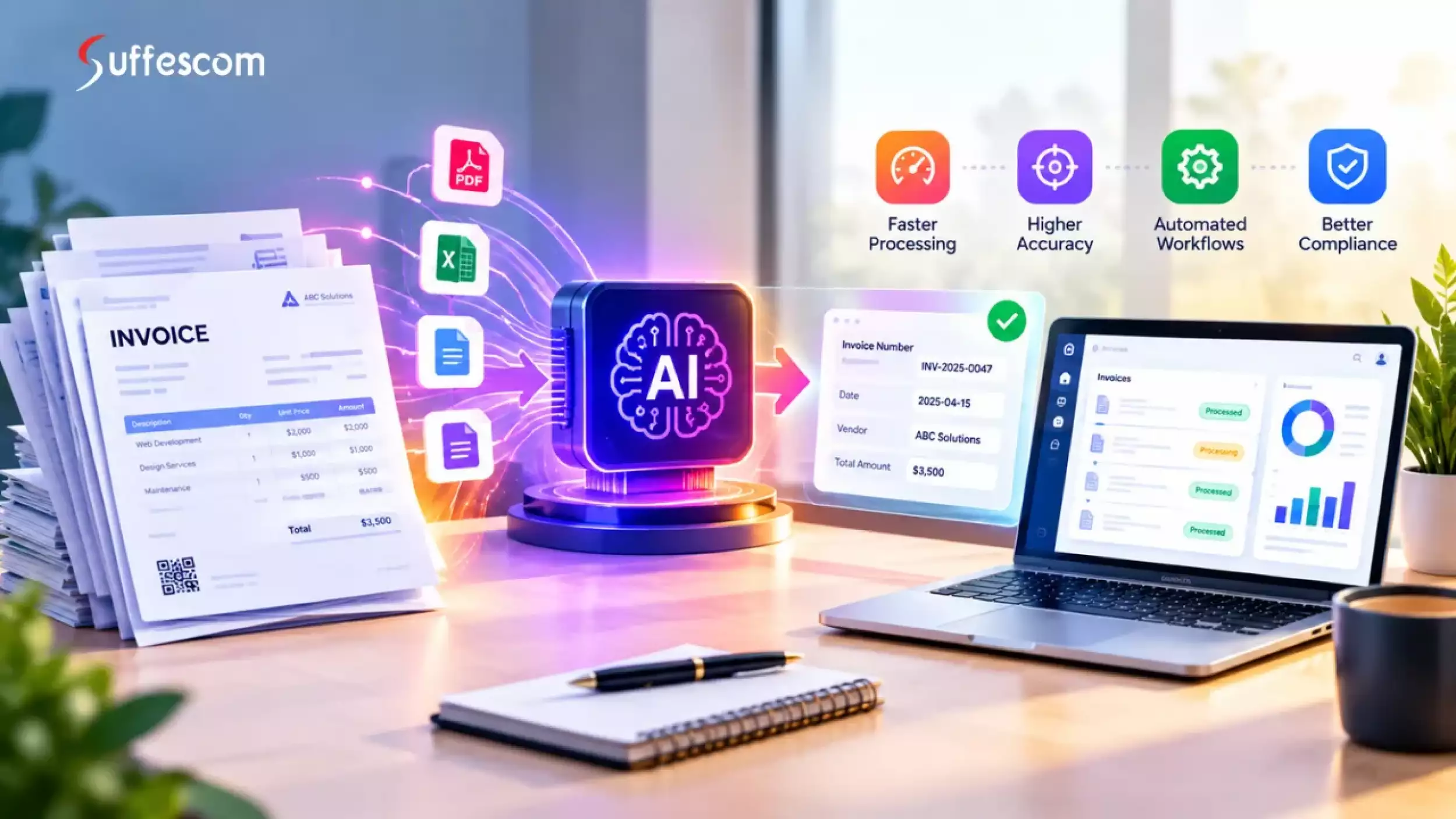
AI-powered invoice processing software development is designed to address those issues through the intelligent use of document handling, ML algorithms for data analysis of documents, a rule-based verification process, and automated workflows that are integrated with ERP systems. Nevertheless, simply applying OCR to an invoicing process is not enough. The modern solutions need to be able to understand the invoice data, detect anomalies, match purchase orders and receipts, route exceptions, support human review, and post verified information into financial systems.
This development guide covers the architecture, technologies, integrations, security controls, cost, timeline, and implementation decisions involved in building the platform.
What Problems Does AI Invoice Processing Software Solve?
An efficient system is needed to overcome inefficiencies of an in-house billing process, which are costly and prone to errors.
- Manual entry: Automatic extraction of invoice header and item details without manual intervention.
- Format variability: Variety of formats for processing invoice data by various suppliers instead of using a single template format.
- Processing delays: Delayed processing automation for repeated verification and routing tasks.
- Duplicate invoices: Identifies exact and similar invoice submissions.
- Invoice discrepancies: PO comparison to Purchase Order Receipts.
- Incorrect coding: Wrong code to use for GL account, cost center, or project codes.
- Approval Bottleneck: Approval process for routing of bills by amount, department, supplier, and policies.
- Non-PO invoices: Vendor history, contractual terms, policy guidelines, and manual verification are used for non-PO invoicing when there isn't a standard match available.
- Fraud and anomalies: Identification of fraudulent transactions, vendor information, payment bills, and materials pricing irregularities.
- Disconnected systems: Synchronization of validated invoices to ERP, accounting, purchasing department, and bill pay system.
AI Invoice Processing vs. Traditional Invoice Processing
| Traditional Invoice Processing | AI-Powered Invoice Processing |
| Manual data entry | Intelligent data extraction |
| Fixed OCR templates | Adaptive document understanding |
| Manual validation | AI-assisted validation and rules |
| Manual PO matching | Intelligent matching |
| Predefined coding rules | AI-assisted GL and cost-center coding |
| Manual exception identification | Confidence- and risk-based routing |
| Limited improvement | Feedback-driven learning |
Decision intelligence is what sets it apart from other things. While a traditional system is automated to perform a single task, an AI-based platform evaluates billing information and decides if it needs processing immediately, reviewed beforehand by employees, or flagged for further examination.
AI Invoice Processing vs Invoice Automation vs AP Automation
They are similar yet have a different scope.
| Aspect | AI Invoice Processing | Invoice Automation | AP Automation |
| Primary focus | Understanding and processing invoice data | Automating invoice workflows | Automating the broader accounts payable cycle |
| Core activities | Capture, extraction, validation, matching | Processing, routing, approvals, notifications | Invoicing, approvals, payments, reconciliation, supplier management |
| AI role | Extraction, classification, coding, anomaly detection | AI-assisted workflow decisions | AI across multiple AP processes |
| Typical integrations | ERP, accounting, procurement systems | ERP, accounting, payment systems | ERP, procurement, banking, payment and supplier systems |
| Scope | Invoice-level | Invoice workflow | End-to-end AP operations |
Who Needs AI Invoice Processing Software?
- Large enterprises: High volume of bills from large companies to automate it for different organizations, suppliers, and currency rates, as well as approval levels among them.
- Accounts Payable Teams: Reduce manual data entry, exceptions management, duplication detection, and approvals of bills.
- Shared Service Centers: Standardized invoice processing for shared services centers across departments and geographic regions.
- FinTech Platforms: AI-based invoice capture, validation, matching, and fraud detection embedded within FinTech products.
- Accounting Software Providers: Add intelligent invoice extraction, coding, reconciliation, and workflow capabilities to existing platforms.
- ERP Providers: Extending an existing ERP solution to include AI-based document management services rather than developing a new standalone application for it.
- Procurement Platforms: Invoice-to-Purchase Order system of a procurement platform that connects invoices with purchase orders, receipts, contracts, and supplier records for a closed-loop process.
- B2B SaaS Companies: Automate recurring vendor invoice processing, subscription management, approval workflow automation, and accounting process optimization at a large scale.
Why Businesses Are Investing in AI Invoice Processing in 2026
AI invoice processing isn't just about reducing entry times anymore; it has other benefits too. Finance teams are dealing with rising processing costs, growing invoice volumes, fragmented systems, stricter controls, and increasingly digital invoice formats. The goal for businesses would be to reduce time spent on making decisions about moving a bill from receipt to the approval process.
Rising Invoice Processing Costs
The current AP benchmark is a problem. A lot of money is spent by organizations on processing it. Only 35.4% of invoices are processed through straight-through processing, whereas 18.4% require exception handling.
On a large scale, they accumulate due to repeated entries of information for approvals; errors between them; correction needs; and duplicate payment issues. The AI invoice processing software is focused on resolving issues instead of just digitizing an invoice document.
Growth of AI and AP Automation
Market growth is happening because companies are moving towards more advanced AP processes rather than just simple invoicing. The current value of the automated invoice processing software is $19.20 billion in 2026; it will be $35.71 billion by 2032, which is an increase of 10.93%.
Estimates of market size differ as to what is included by an organization for invoice processing, APS automation, and other similar products or services. Consistent signals indicate a higher need for an automated system to make payments rather than just digitizing paperwork.
E-Invoicing Is Changing the Invoice Data Pipeline
Also, invoice processing is moving from:
Paper → PDF → OCR
toward:
Structured e-invoice → validation → workflow → ERP
A machine-readable structured invoice format does not require any OCR technology to process each line of an invoice. Simultaneously, electronic invoices require regulations for taxation purposes as well as reporting standards to be a significant component of automated billing systems today.
ERP Transformation Is Increasing Demand
Automation of invoices belongs to more comprehensive financial system upgrades. Companies are upgrading to SAP, as well as Oracle, Microsoft Dynamics, and NetSuite; they require an integrated solution for billing management instead of having a standalone system separate from their current finance processes.
Why OCR Alone Is No Longer Enough
An OCR system converts documents to machine-readable form; however, it cannot determine if they are valid purchases from PO numbers, correct account codes for transactions, etc., so you need human review before using them as proof of payment. Therefore, modern invoicing and processing require document intelligence verification, process validation, business rule application, and risk management workflow automation by humans.
How AI-Powered Invoice Processing Works
An ML & AI-powered document management system is better suited for handling billing documents instead of being used by OCR software to process them. An invoice comes from several sources of information, transforms them as per requirements for a company’s accounting books; checks its validity by comparing it with past transactions before approving any payment made through this application, then sends it on an approval basis to the bank account.
Invoice Capture → Classification → Extraction → Normalization → Validation → Matching → Coding → Risk Assessment → Approval → ERP Posting → Reconciliation → Feedback
Step 1: Capture Invoices
Collects invoice data through various sources such as emails, PDF files, scanned documents, mobile device transfers, and suppliers' websites. APIs, SFTP, and EDI feed structures generate an electronic invoicing network.
Step 2: Classify the Invoice
This system has certain documents like a receipt, credit note, debit note, purchase order invoice, non-purchase order (NPO), utility bills, and freight bills. The classification will determine what kind of validations or workflows are applicable to it at this stage.
Step 3: Extract Invoice Data
It is converted into formatted fields by this software.
- Vendor and invoice number
- Invoice and due dates
- PO reference
- Currency and payment terms
- Tax, subtotal, and total
- Bank details where required
- Item description, quantity, and price line items
Step 4: Normalize and Validate
Standardized extracted data is converted to a uniform form for further analysis. The system checks mandatory fields, mathematical totals, tax values, invoice dates, vendor status, currency, duplicate indicators, and predefined business rules. If there is a low confidence level or conflict between them, they should not be forwarded automatically but rather reviewed manually.
Step 5: Match and Verify
Invoices are compared to other documents such as purchase orders, goods receipts, contractual agreements, and vendor master files in this system. For instance, an agreement between two parties would be verified by checking if there is consistency in the amount and cost for items listed on their purchase orders against those that have been delivered to them. Tolerance levels are configurable to decide whether certain variations should be allowed or not.
Step 6: Route for Approval
After validation and matching is done by this software, it will determine an appropriate approval process according to invoice amount, department cost centers, vendor purchase risk levels, and organization policies. Low-risk invoice approvals are automatic under certain conditions but may be escalated for review by an authorized person if necessary.
Step 7: Post to ERP and Reconcile
Once approved, validated invoices are entered into an ERP and accounts payable system along with details about vendors, general ledger accounts (GL), taxes, cost centers, purchase orders, and payments. Then it monitors postings and payments, detects sync errors, and reconciles transactions so that an invoice doesn't go missing from approvals until its final settlement date.
Step 8: Learn From Human Decisions
Correcting invoice documents is useful for providing good information about them. These results will help us enhance our ability for better extraction, classification, and coding accuracy levels, as well as the exception handling process over the time period of this project.
Planning to Build an AI Invoice Processing Platform for Your Business?
How to Develop AI-Powered Invoice Processing Software
Creating an AI-powered invoice processing software isn't just about linking an Optical Character Recognition service with an approver process. AI development starts by making some financial choices about what kind of automation this software will need later on for building up its databases, artificial intelligence systems, verification processes, integrations between them, as well as providing feedback loops needed to make these things work properly.
Step 1: Define Business & AP Requirements
Firstly, profile an existing bill of goods before creating a new document for it.
Establish:
- Invoice monthly volume and peak amount of an account.
- PDFs, scans, structures, and electronic invoices.
- PO and non-PO percentages.
- Countries and tax jurisdictions.
- Current ERP and Accounting Systems.
- Approval hierarchies.
- Matching requirements.
- Compliance and retention requirements.
The baseline defines what features are included for an initial version, while others may be developed as part of a larger product lineup later on.
Step 2: Select the Automation Scope
Specify an appropriate scope for automation before choosing software solutions. MVP can be used for an automated invoicing process, including data entry, extraction from documents, verification, duplication checking, and an approval workflow within an ERP system.
Additionally, an enterprise might need multi-ERP integration, non-PO processing capabilities, sophisticated anomaly detection tools, tax engine functionality, electronic invoice generation services, multi-tenancy management features, customized workflow automation processes, and ongoing machine learning model refinement.
Our aim is to automate an API performance issue rather than building all features simultaneously.
Step 3: Design the Data & AI Strategy
Choose between using a pretrained model for some tasks while others need customization through organization-specific training and fine-tuning.
The AI strategy should define:
- Training data requirements for validation sets.
- Document and field-level accuracy targets
- Confidence thresholds
- Human-review rules
- Model evaluation metrics
- Feedback collection methods
Separate AI prediction from final finance control. A model may suggest an answer, whereas determinism checks if it is valid.
Step 4: Build the Invoice Capture & Extraction Engine
Implement an ingest channel before creating a normalized document processing workflow.
Email support, file upload capability for API access to suppliers' portal, and structured electronic invoice generation if needed. Preprocess data for classification of an invoice to extract information from it, such as layout analysis and line item extraction in a standard format.
Keep a copy of this file together with its content for future reference for any model predictions made from it.
Step 5: Develop Validation & Matching
Then, implement a deterministic financial control system and algorithm for matching purposes.
Build rules for:
- Mandatory fields
- Arithmetic and tax validation
- Vendor verification
- Duplicate detection
- 2-way, 3-way, and 4-way matching
- Tolerance thresholds
Test these rules against real exceptions, not only successful invoices. A strong system should explain why an invoice failed validation or matching.
Step 6: Build Workflow & Exception Management
Design state machines for queue management of tasks; create an approval process system where users can approve or reject items before they are processed by humans.
Low-confidence extraction, PO mismatch issues, tax discrepancy problems, duplication of indicator information, and non-PO billing documents need to be resolved explicitly.
A reviewer interface would show you an invoice along with its data extraction information, validation outcome, and related documents at once. It saves you from having to switch over again while dealing with exceptions.
Step 7: Integrate ERP & Accounting Systems
Link this application with an organization’s records database once its basic verification process has been completed successfully.
Implement:
- Vendor and master data
- PO and receipt retrieval
- Approved invoice posting
- Posting-status updates
- Payment-status
- Error handling and reconciliation
Implement an idempotent mechanism to prevent multiple instances of a transaction from being created by repeated attempts.
Step 8: Add AI Learning & Analytics
With enough data available for analysis, apply human correction techniques as well as performance results on an improved model.
Accuracy of tracking extraction rate for confidence calibration reason to exceptions occurrence rates per match duration through-to-processing speed.
The information will help to find out which suppliers are causing issues during extraction processes while identifying areas where there is a need for improved model development or rule-making process.
Step 9: Test With Real Invoice Datasets
The testing process must involve sample historical bills from various suppliers, designs, currencies, taxes, itemization styles, and exceptions.
Create separate evaluation sets for:
- Common invoices
- Poor-quality scans
- New vendor layouts
- Complex line items
- Non-PO invoices
- Duplicate invoices
- Tax and PO mismatches
Don't just assess extraction precision. Check if it is right to make a money decision at last.
Step 10: Deploy & Continuously Improve
Start by deploying to an initial stage for testing purposes, such as small-scale trials on select suppliers or billing categories. Check the accuracy of models, the exception rate, errors from ERPs, and the time taken for processing tasks by users to correct them prior to implementing more advanced systems.
Post-deployment tuning of models, rules, thresholds, integration points, and processes by means of data collected from operations. Mature systems will have an increasing amount of direct processing without any human intervention on ambiguous or risky cases.
Development goals are not about achieving full automation right away. Automation safety increases accuracy, measurability, and autonomy of systems through accumulation of production information.
Designing the AI Invoice Processing Architecture
An AI invoicing system’s design affects its ability to manage document inconsistencies, finance management system integration issues, and scalability requirements for high-volume transactions. Scalability requires separating the document knowledge base from the determination rules engine and the workflow decision-making process between an application server and a database connection through data analytics services.
Practical Enterprise Architecture is a model that consists of nine levels.
Ingestion → Document Processing → AI/ML → Rules & Validation → Matching → Workflow & Exceptions → Integration → Data & Analytics → Security & Observability
High-Level Architecture
The ingestion layer receives invoices from various sources. Document processing layers convert documents to a formatted representation. The AI/ML model interprets and scores the extracted information, whereas rule-based systems are used to check if it meets regulatory requirements for finance industry compliance.
Security and observability need to be integrated across all layers instead of being a standalone component.
Invoice Ingestion Layer
Ingestion is an interface to control access for a system. An API gateway for email parsers to upload files securely through SFTP ports, suppliers’ portal EDI, and invoice connector software.
Each incoming file will have an identifier assigned to it for processing purposes and placed in a permanent storage area of documents. It helps prevent large amounts of data overload on downstream AI systems while also allowing for failed tasks to be retried instead of being processed again.
Document Processing Layer
The model transforms unstructured data into an organized form for use by machines.
It typically includes:
- Pre-processing of images for better quality.
- OCR for scanned documents
- Document classification
- Layout and coordinate analysis
- Table detection
- Multi-page document handling
- Structured e-invoice parsing
AI/ML Layer
Probabilistic interpretation is handled by an AI layer, which does not work well for deterministic programs.
It can contain separate services for:
- Field and line-item extraction
- Document classification
- GL and cost-center prediction
- Vendor or category classification
- Duplicate and anomaly detection
- Confidence scoring
Rules & Validation Engine
Rules Engine is an interface for managing finances. It must be separate from an artificial intelligence model to avoid dependence on probabilistic results for important decisions.
Rules can validate:
- Mathematical totals and tax calculation
- Mandatory fields
- Vendor status
- Invoice-number uniqueness
- Currency restrictions
- Tolerance thresholds
- Approval limits
- Vendor-specific policies
Matching Engine
Invoice data is matched to company files like purchase orders, receipts, contract documents, and supplier databases through an application called a matching engine.
It should have 2-way, 3-way, and 4-way matching capabilities; configurable tolerance levels; partial receipts; split deliveries; quantity differences; price variances; and contract-based validation.
Workflow & Exception Engine
After validation and matching are done by an application to determine its current status for processing it as an invoice through some process or system.
A state machine is good at handling complicated business processes. Received, processed, verified, matched, pending approval, and exceptions are accepted by States.
Integration Layer
Integration Layer is responsible for connecting this system with ERP, accounting, Procure-to-Pay, taxes, banking and payments, and identity management systems.
API gateways, middleware services, webhook integration points, and message queue systems are able to handle both synchronous and asynchronous connections between applications. Event-driven communications are especially helpful to handle large volumes of transactions without any delay due to an unavailable ERP system while processing them.
Data & Analytics Layer
A separate store needs to be maintained by this system.
- Operational database: Invoice state information; metadata; workflow data and company details.
- Document storage: Original documents and copies of them for processing purposes are stored here.
- Audit store: Immutable processing and Decision History.
- Analytics warehouse: Operational and financial reporting analytics warehouse.
- Model feedback store: Corrections, reviewer decisions, confidence outcomes, and training signals
Security & Observability Layer
IAM, RBAC, data-at-rest and -in-transit encryption; secret management; tenant isolation and auditing are part of security design principles for applications.
Observability should track more than application uptime. Monitor team performance metrics like extraction accuracy rate, model failure times, queue length, time to process exceptions, error occurrence, and integrated system posting errors.
This system has a model for interpreting data through artificial intelligence; rule-based controls are used to manage finances, while workflows handle decision-making processes, and integration moves verified transactions into records management systems. The division between these two products allows them to be scalable, audit-ready, and appropriate for business financial management needs.
Data Model for an AI Invoice Processing System
An effective database schema should be used to store information about an invoice rather than just a list of items. Relationships among invoice documents, vendor, purchase order receipt, and approval decision audit should be preserved by this system. It provides an audit trail for financial information that helps improve prediction accuracy of this model by providing it with more historical data.
Core Invoice Entity
An invoice is a key accounting entry for transactions between parties involved in business dealings.
- Invoice ID
- Vendor ID
- Invoice and due dates
- Currency
- Subtotal, tax, and total
- PO
- Current processing status
Also, an invoice needs a reference for sources of documents, along with date stamps on them, as well as information about how they were created by some system or process that processed them before sending out this bill.
Invoice Line-Item Entity
Item-wise storage is better for line items instead of embedding them at an invoice level. Key fields include
- Description
- SKU or service code
- Quantity
- Unit price
- Tax
- Line total
- PO line
It is suitable for detailed matching, GL codes, tax verification, expenditure analysis, and anomaly detection.
Vendor Entity
Vendor entity holds information about suppliers' identities as well as their finances:
- Vendor ID
- Legal name
- Tax ID
- Address
- Payment information
- Risk or verification status
Invoices, purchase order documents, and contractual agreements must have vendor information associated with them. It allows for detection of abnormal patterns among suppliers rather than individual invoices being evaluated separately.
Purchase Order & Receipt Entities
Transaction data such as purchase order numbers and invoice details are needed to match them. The core relationship is
Vendor → Purchase Order → Receipt → Invoice
PO may have several pages, whereas a bill of delivery might be an incomplete transaction. Therefore, this database should have row-based identifiers instead of just document IDs. This supports accurate 2-way, 3-way, and 4-way matching.
Approval & Workflow Data
The workflow record must include a log of decisions made on an invoice.
- Approver
- Decision
- Timestamp
- Reason or comment
- Escalation status
The separation of workflows from an invoice allows for reconstruction of a full approval process while preserving prior choices.
AI Metadata
The AI specifics of data are important for an intelligent billing process. Each significant prediction from this system must be preserved by it.
- Extraction confidence
- Model and model-version ID
- Predicted value
- Corrected value
- Human reviewer
- Correction timestamp
It provides a way of getting back information about how well an algorithm is working so that we can make better forecasts next time around.
Audit Data
Changes to finances must be recorded as permanent audits instead of just updating an existing entry. Every event may include an actor ID, time stamp, prior value, current value, action type, and source information.
It provides an audit trail for changes by finance and compliance departments about who made them, why they were made, whether those changes are due to AI and human actions, and at which point in time these events happened.
Core Features of AI Invoice Processing Software
An enterprise-level AI billing system requires more than just a scanner for documents to be scanned by an optical character recognition engine. The features of this product must include all stages from receiving an invoice for processing through verification before recording it in accounts receivable, also providing financial staff authority on exception handling, approval processes, as well as auditing capabilities.
Multi-Channel Invoice Capture
Invoices can be accepted by this system via email, API, file upload, scanner apps, supplier portal, SFTP EDI, and structured electronic invoice. Incoming data is centralized to prevent it from being stuck between email clients and departments' databases; this provides an easy-to-use interface that allows us to process information more efficiently.
Intelligent Invoice Data Extraction
Extract headers and lines of data like this.
- Name of vendor and tax information.
- Invoice number and dates
- PO or reference numbers
- Payment terms and currency
- Subtotal, tax, and total
- Product or service descriptions
- Quantities, unit prices, and line-level taxes
Extraction of line items matters a lot since an invoice total by itself isn't enough to do proper matching codes or detect anomalies accurately.
Invoice Classification
Identify documents automatically by their type or category in this way.
- Standard invoice
- Credit or debit note
- PO or non-PO invoice
- Utility or freight invoice
- Vendor-specific invoice types
Also, classification is used to identify what kind of validations, matchings, or approvals are applicable for it.
Automated Invoice Validation
Validate all required information, such as payment details and the amount of money owed by customers to vendors, before approving a bill. Hard failures must be corrected, while tolerable variation may go on without interruption due to automation.
2-Way, 3-Way, and 4-Way Matching
Verify if a bill matches its source of revenue.
- 2-way: Purchase order ↔ Invoice
- 3-way: Order of purchase ↔ Receipt for goods ↔ Invoice
- 4-way: Order of purchase ↔ Receipt of goods ↔ Inspection / Acceptance ↔ Invoice
Configurable tolerance thresholds should determine whether differences are automatically accepted, flagged, or sent for review.
AI-Powered GL Coding
GL account recommendation, cost center information, department details, project data, as well as tax category from an invoicing history for a company. A finance team may have authority over approvals but can reduce redundant programming tasks.
Duplicate Invoice Detection
More than just the same amount or bill number detection. An effective solution would detect duplicate entries, identical bills for sale; multiple orders placed via various means like email or fax; repetitive purchases made by a single customer from several vendors at distinct dates on an individual billing statement. It prevents duplicated charges that are missed by simple field matching techniques.
Approval & Escalation Workflows
Policy-driven approval process to create an approach for it.
- Invoice value
- Department or cost center
- Vendor
- Purchase category
- Risk level
- Approval hierarchy
The SLA timer, reminder, and escalation prevent an invoice from sitting for too long without approval by any person or department.
Exception Management
Set up an in-house system to hold bills that can't be processed directly by automated systems. Common issues are PO or receipt mismatch errors, missing POs references, low confidence, field tax discrepancies, duplicate indicators, and invalid vendor policy violations. Every exception must have an explanation given by a reviewer for it to be resolved before being made into a decision.
Audit Trail & Reporting
Keep track of changes by recording who made them, when they were done so, why those modifications happened, what was found out from an initial analysis by machine learning algorithms, and any subsequent manual corrections performed on behalf of humans. The report will include information about processing times, error rates, direct processing rate, correction frequency, approval delays, etc.
AI Technologies Behind Intelligent Invoice Processing
The AI invoicing system isn't based on any single technology. A production system typically combines OCR, computer vision, intelligent document processing, machine learning, NLP, anomaly detection, and selective use of generative AI. Different technologies handle each level of processing an invoice, whereas there are also some rules that help to manage it by humans.
OCR for Text Recognition
Scanned documents are converted by OCR to a machine-readable format of an invoice. Still helpful to read old documents like scanned images of them. However, raw OCR doesn't know anything about its content, such as what it means within a company's culture or industry. Table errors, rotation of text documents, low-quality image scanning, and complicated formatting may affect accuracy levels for optical character recognition systems instead of being an all-in-one solution to them.
Computer Vision for Document Understanding
The computer vision system is used to analyze a document, such as an invoice, for its physical appearance, like format, table arrangement, coordinate positions, section divisions, label placement, and relationships among columns. It helps to differentiate between an invoice address and a billing address; it also identifies where line item tables start so that we can extract them later on.
Intelligent Document Processing
Document classification, extraction, validation, and contextual understanding are done by an Intelligent Document Processing (IDP) system. Instead of treating all invoices equally under a single format, an IDP pipeline is able to identify various formats while identifying important fields and relationships among them.
Machine Learning for Invoice Classification
A machine learning model is able to identify trends from past records for classifying bills of purchase according to their types, vendors' names, POs numbers, and categories. It is especially helpful if you have many changes to your layout from time to time because of changing vendor requirements; otherwise, it may need frequent updates due to being inflexible.
NLP for Unstructured Invoice Content
Text interpretation is done by NLP for texts like product specifications, service information, billing conditions, and itemized pricing. This may be useful for mapping out terms like consulting services or advisory services within a particular industry.
AI for Line-Item Extraction
Invoice data and line-item extraction is harder due to variations like different column structures, merged cells, various tax rates, discounts, unit prices, and multi-page formats. AI is able to recognize connections among descriptions, quantities, prices per unit, taxes, and line totals instead of handling them separately from other data points.
AI-Powered GL Code Prediction
ML may utilize past bills of goods sold (BOS), vendor information, department details, product description data, and prior financial decision-making processes for recommending GL account numbers, cost center codes, project names, or tax category identifiers. Recommendations must be reviewed if there is a lack of confidence to make sure they are not too far from past transactions.
Anomaly Detection Models
Anomaly detection is not limited to a single field; it identifies irregularities like high-value bills, excessive vendors' requests for services, abrupt alterations of payment details, oddly priced taxes, or any transaction that deviates from past trends. Risk scoring and exceptions are based on these data points.
Generative AI and LLMs
LLMs are best used when there is more benefit from natural language processing instead of traditional mathematical modeling for finance problems. Some examples of practical uses are bill statements and financial data retrieval by humans through language processing tasks such as explanations for exceptions to policies or audits. The tax calculation process, decision-making for approvals, and final entries to an ERP system must be based on predetermined procedures and approved processes.
Rules Engine + AI: Why Hybrid Intelligence Works Better
More than just prediction is needed for financial automation. A robust platform uses
- AI interprets documents, predicts classifications, and identifies anomalies.
- Rules are for enforcing tax rates, tolerance levels, approval limits, mandatory control measures, and accounting procedures.
- Human decision-making involves resolving ambiguity, value issues, and risk problems.
The hybrid approach offers flexibility for artificial intelligence while ensuring that it does not produce random results outside of monetary limits. At Suffescom Solutions, we also build an AI-powered document processing platform that automates data extraction.
ERP, Accounting & Business System Integrations
The AI invoicing system provides little benefit because it does not integrate with purchase order management, bill of goods approval process, or payment gateway for validating an invoice before sending to customers' accounts. Therefore, enterprise integration must be synchronized with an existing accounting system for processing bills without affecting its current state, policies, or auditing needs.
SAP Integration
In an SAP environment, it would be better if there were an integration between the invoicing process and vendor master details like purchase order information, goods received documents, bill of sale records, as well as current payment status. PO and GR data retrieval is possible from this system to match it; validation of suppliers' details prior to processing them; sending out an approval letter through SAP for posting purposes.
Integration must provide postings as well as status updates on payments. It forms an unbroken cycle rather than seeing it just as an endpoint for submitting to ERP systems.
Oracle Integration
Supplier details, order documents, bills of sale, and invoice statements for accounts payable and payments must be synchronized by the Oracle integration system. Oracle data is used by an invoicing system to validate it before returning approved transactions with proper accounting details.
In a large-scale Oracle environment, it is necessary to handle asynchronous processing and failed transactions during posting of invoice entries on the ERP side, where there may be errors in postings due to invalid data from source systems like SAP or MS Office applications.
Microsoft Dynamics Integration
Invoice processing integration of Microsoft Dynamics includes linking to vendor information such as order details, billing documents, and payments. AI-generated code suggestions are compatible with dynamic dimensions, whereas an ERP is a permanent source for financial statements.
NetSuite Integration
Vendor purchase data from NetSuite is available for retrieval of vendors' details and payments; it validates invoice amounts before approval by an approver while creating bill-of-purchase entries on behalf of a company. The mapping of custom fields to account classification is required to ensure that generated data does not violate NetSuite’s Accounting system.
QuickBooks, Xero, and Accounting Platforms
Integration of SMB Market applications like QuickBooks and Xero to these systems would be more effective if it focused on syncing vendors' data with them for invoicing purposes, creating accounts and tax codes, tracking payments, and preventing duplicates thereof.
Integration must verify account mapping prior to postings instead of permitting extraction by an algorithm for creating erroneous entries in the books.
Procurement & AP Platforms
The invoice processing system must be integrated with purchasing and AP systems for retrieving purchase order details, contract terms, supplier data sheets, bill of goods received (BOG) documents, and approvals process flowchart. It allows an invoicing system to verify purchases based on their origin instead of just looking at them individually.
API-Based Custom ERP Integration
Custom ERPs may utilize RESTful interfaces to perform regular transactions; SOAP is used by older business applications, while GraphQL offers an efficient way to access large amounts of related information selectively.
A webhook is a mechanism for pushing information, like an invoice being approved by someone else from another system, into your own application through this API endpoint. In a high-volume environment, event-driven sync would allow the invoicing process to be independent of ERP system status so that there is no need for long downtime during an issue.
Integration Best Practices
The financial integration requires more robust control mechanisms compared to regular inter-system communication between applications. Use
- Idempotency: Prevent posting of an invoice to avoid duplication.
- Retry: Automatic recovery of temporary API/net errors.
- Error queues: Isolate error queue for transactions requiring technical business intervention.
- Reconciliation: Invoice reconciliation is comparing invoices, postings, and payments between different systems.
- API versioning: Version control of APIs to avoid silent breakages on the connectors' side.
- Strong authentication: Use OAuth and service account certs for security purposes.
An integration layer must be able to keep track of the correlation ID for each transaction within a complex business environment. It enables tracking of an invoice back to its source file via AI analysis, ERP entry, and bill settlement while maintaining links among them.
Need AI Invoice Processing Software That Fits Your Existing ERP?
E-Invoicing, Tax & Compliance Considerations
The compliance needs to be incorporated within an AI bill of goods system instead of being added later during its design phase. The tax laws, electronic invoicing standards, accounting practices, confidentiality policies, and security measures are relevant to a database schema design for auditing purposes because they influence its architecture of models as well as validation mechanisms thereof.
Structured E-Invoices vs. PDF Invoices
An electronic bill of purchase is mainly an image file. An organized electronic invoice has a format that is read by machines for validation purposes and processing. It also allows for faster processing of invoices by skipping over standard OCR to directly upload them into a database format.
Therefore, a manufacturing process needs to be able to go either way.
PDF/Scan → OCR → AI Extraction → Validation
Structured E-Invoice → Schema Validation → Business Validation → Processing
It helps prevent erroneous extraction of documents while preserving their original tax and transaction meanings through a well-organized format for an invoice document.
E-Invoice Validation
An invoice needs to be validated by this system before it goes through a bookkeeping process for validation purposes of form and value. Key checks include
- Schema and mandatory-field validation
- Tax ID of supplier and customers.
- Number of invoice date documents.
- Income Tax Rate And Amounts.
- Subtotal and total calculations
- Currency and transaction details
- Signatures and electronic authentication methods available when needed.
Format validation and business validation are different types of architecture. The documents may have structural validity but might also contain errors such as wrong taxes paid by customers to suppliers or violations of company policies.
India GST & E-Invoicing
In order to be India-focused, GST should be included within an invoicing system instead of being treated separately from other reports. The notification of a taxpayer’s bill details goes through the Invoice Registration Portal (IRP), where it gets assigned an Invoice Reference Number (IRN). Also, it is a part of GSTN that automatically populates e-invoices into GSTR-1 forms.
Therefore, it must be able to handle GSTIN, HSN/SAC, tax component details such as invoice numbers, IRN codes, and QR code information for electronic billing records.
Development implications are evident here; tax rules and government connections need to be programmable or versioned instead of being fixed within an inbuilt billing system.
European E-Invoicing Requirements
A structured electronic invoice system is required for European countries, while there are different rules of value-added tax among them. EU's VAT in the Digital Age (ViDA) package will be implemented by 2025 and phased out by 2035. The cross-border electronic invoice reporting requirement will be implemented starting in July 2030, where e-invoicing would form part of this system.
Therefore, platforms that serve European companies need to have a standardized invoicing system and comply with national tax regulations across countries' borders for value-added taxes (VAT) information exchange between them through an international network like Peppol. Also, Peppol’s specs differentiate among standard billing formats as well as country-specific implementations, which highlights that we should have flexible validation mechanisms instead of having a single universal model.
Data Privacy
Personal financial data such as names, addresses, bank account numbers, and tax IDs of employees' salaries may be found on an invoice. Sensitive data classification is necessary to implement proper security measures on this website.
- Data minimization
- Encryption
- Access restrictions
- Retention and deletion policies
- Data residency requirements
- Secure document storage
- Controlled model-training access
Privacy concerns must also be taken into account when dealing with Indian citizens’ online information while complying with relevant laws of protection against it.
Financial Controls
Financial management is not affected by AI automation. Segregation of duties, approval limits, roles based on responsibilities, and immutability of the audit trail for account change management must be enforced by this system.
For instance, a person setting up an approvals process shouldn't be given automatic power over transactions approved under it. In this way, a recommendation by artificial intelligence is not to be treated as an account entry until it passes through proper checks.
AI Governance
Model output is an issue of AI governance because it affects accounting information. The platform should maintain model-version metadata, confidence scores, decision evidence, human overrides, and monitoring metrics.
Decisions that have a high impact but are not very confident must be reviewed by humans. Performance of models needs to be checked for extraction drift and vendor-specific error rate changes over time, as well as different types of documents like PDFs.
A strong compliance framework views artificial intelligence as a support function for decisions within an organization rather than being autonomous from it. This differentiation enables companies to enjoy automated advantages without losing control over taxes, accounting records, and confidentiality issues, as well as auditing processes through clear management policies.
Security Architecture for AI Invoice Processing Software
An invoice processing system handles accounting data such as customer names, vendor addresses, VAT numbers, and bank account details for payments to suppliers' accounts. Thus, it is necessary for security measures to safeguard applications as well as their associated documents such as invoices, artificial intelligence model files, or API calls made through them, along with transactions that are done on these platforms.
Identity & Access Management
Implement RBAC with least privilege and multi-factor authentication for security purposes. Functions like an AP clerk, a reviewer, an approver, a finance administrator, an integration admin, and an auditor are to be separated in terms of access.
Also, permissions are applicable for certain tasks. An individual capable of extracting information from it may not have access rights for modifying approvals or posting transactions within an ERP system.
Data Encryption
Securely encrypt bill of sale papers, extracted monetary information, passwords, and backup files on disk. Use TLS for data moving between users, application services, AI providers, databases, and external financial systems.
Keys for encryption management are to be kept separate from an app’s source code; they must have a set level of security controls along with periodic changes.
Tenant Isolation
Tenant separation plays an important role for SaaS billing systems. Customer bill of sale documents should not be shared between tenants' accounts, such as vendor information, product model details, configuration specifications, or auditing reports.
Isolation can be enforced through tenant-aware authorization, database controls, separate storage boundaries, encryption strategies, and automated cross-tenant access testing.
API Security
Integration of ERPs and e-invoices with banks and accounts is an added vulnerability for hackers. APIs should enforce
- Strong authentication and authorization
- Short-lived or securely managed tokens
- Input and schema validation
- Limiting rate and prevention of misuse
- Request signing where appropriate
- Strict endpoint-level permissions
Credentials must not be included within a program’s source file or on an application from users’ side.
Audit Logging
Security-sensitive financial event detection systems must be able to detect such incidents like this one.
- Invoice uploads
- AI extraction and corrections
- Approval decisions
- ERP postings
- Payment-status changes
- User access
- Configuration and rule changes
Tamper-proof logs must have a link to them via correlation IDs for investigation purposes to track down all transactions on that particular bill.
AI-Specific Security
The AI has a risk issue that is absent from standard billing systems. The sensitive information of an invoice must never be shared with any other party via an AI service provider because it is subject to legal agreements, confidentiality rules, and data protection policies.
When using LLMs for applications, there must be measures taken, such as preventing prompt injections by untrustworthy invoices and restricting models'access to unauthorized information. Additionally, the output of a model must be validated before it is executed on behalf of an accountant or auditor. This prevents them from performing any privileged transactions like transferring funds between accounts without proper authorization.
Artifacts of models, prompt templates, configuration files, and data sets must be secured from tampering by others.
Backup & Disaster Recovery
Backup of transactions to files along with original bill receipts is required here. Define Recovery Point Objective (RPO) and Recovery Time Objective (RTO) according to business criticality.
Resilience means having an encrypted backup system, a restore test procedure, and a failover plan to recover from database failure, document storage issues, queuing problems, and integration issues.
Security Testing
The security check must be done on entire applications, not just their websites. Key activities include
- Vulnerability and dependency scanning
- Penetration testing
- API security testing
- RBAC and privilege-escalation testing
- Tenant-isolation testing
- Authentication testing
- Secrets and configuration reviews
Security tests for an AI billing system must ensure it does not allow a payment to pass through without going through verification steps like approvals or authentication checks by humans.
Ready to Turn Your Invoice Automation Requirements Into a Working Platform?
What Technology Stack Is Used to Build AI Invoice Processing Software?
A reliable document processing system needs to be supported by this tech stack for scalability of AI workloads, security measures for sensitive information, as well as smooth integration between companies' systems. The exact choice depends upon the amount of billing, level of AI sophistication, and type of deployments, as well as current infrastructure requirements from an organization’s perspective.
Frontend
React or Next.js works well for responsive AP dashboards, invoice review screens, exception queues, and approval workflows. Angular is suitable for companies that have been using it on an existing project within them.
Backend
AI programming languages like Python are good for machine learning model development, document management tasks, etc. Java is good at building APIs driven by events, whereas Node.js or .NET may be chosen for compatibility purposes if there is a need for alignment between systems at an organization level.
AI & Document Processing
The AI layer can combine OCR, computer vision, NLP, intelligent document processing, machine learning, and LLM APIs. A pre-trained document AI is good at handling general text processing needs, whereas a customized model would be better suited for specific types of invoices or certain kinds of predictions within an organization.
Database & Storage
A transactional invoice management system for PostgreSQL and MySQL is available to handle these tasks. Document-oriented applications are suitable for MongoDB. Original bills of sale, receipts, and processing papers and documentation should be kept apart from transactions.
Cloud & Infrastructure
Scalability of computing power and data storage capacity for AWS; cloud hosting options available from Microsoft Azure and Google Cloud are also provided. In contrast, Docker is great at providing a uniform environment of deployment, whereas Kubernetes may help you manage bigger systems that need to scale out services independently.
Integration & Messaging
APIs for REST are available through Webhook services like Kafka and RabbitMQ to integrate them with the invoice processing system, accounting and finance management systems, Procure-to-Pay process management system, and e-invoicing service provider platforms such as SAP. The messaging system is especially good at handling asynchronous tasks and large volumes of data efficiently.
Monitoring & Security
Integrate centralized logging, application monitoring, secret management, identity and access management, encryption, and auditing at an early stage of development. They also safeguard against losses of money due to malfunctions by AI systems, APIs, or network outages from these types of incidents.
Testing & Evaluating AI Invoice Processing Software
The AI billing system needs to go beyond traditional testing methods since a payment may appear correct but result in wrong accounting decisions due to technical errors. Therefore, testing would be able to assess the entire process of recognizing documents before they are accounted for.
Functional Testing
Core business function testing for both standard cases and edge case situations such as invoicing, categorizing, and extracting data from documents to validate it against other systems like approval workflows or postings into an ERP system while also checking its current state.
To ensure proper functioning of all components without any failure leading to wrong results at later stages.
OCR & Extraction Accuracy Testing
Assess extraction from fields to lines of account. Measure accuracy for:
- Vendor and invoice identifiers
- Dates and currency
- Tax values and totals
- PO references
- Description of lines, quantity, price list.
Experiment with layout options, scanning quality levels, table types, multiple-page bills of goods, and new product specifications from vendors. Accuracy of headers does not matter when there are errors in extracting lines from documents for matching purposes.
Matching Accuracy
Test the matching engine against:
- Valid matches
- Full mismatches
- Partial matches
- Quantity and price variances
- Tolerance-bound differences
Not just an answer to find matches; it must provide information about why there was no match found by this algorithm.
AI Model Evaluation
Assess extraction and classification models by precision, recall, F1-score, as well as field-level accuracy and confidence calibration.
Thresholds of confidence need to be evaluated for performance results by businesses. An optimal level of automation may result in an excessive amount of erroneous bills due to being set at its maximum value.
Exception Testing
Inject intentionally low confidence data points without PO information, duplicated indicator values, tax inconsistencies among suppliers, and non-existent vendor details for integration purposes. Check if all conditions are placed on the right queue, reviewers' paths of escalation, and auditing records.
Security & Compliance Testing
Authentication validation, authorization access control, tenant isolation, encryption security of APIs, auditing, logging data, and retention controls. Check if a person is able to circumvent an approver limit or get into accounts beyond what they are allowed.
Load & Performance Testing
Peak volume of invoices instead of average traffic is simulated by this model. Ingestion rate measurement, extraction delay, queue length, processing duration, error recovery time (ERP), response handling, and fault tolerance after temporary service interruption.
User Acceptance Testing
The finance team and AP department must test it using sample production documents. Feedback for this product would include extractability issues, error explanation processes, approvals workflow management system correction mechanism, and resolution process.
Financial accuracy and functionality are more important than just passing a test for an app to meet its requirements.
Handling Complex Invoices and Exceptions
Straight-through processing is applicable if there are sufficient pieces of information available for making an accurate judgment. An enterprise-level AI billing system should have some kind of exception handling mechanism where we treat uncertainties like errors instead of failures.
Low-Confidence Extraction
A confidence level is needed for each significant area of artificial intelligence extraction. When an item like a vendor name, invoice number, tax amount, or line-item goes under some limit set by configuration, then this process will be stopped automatically to be reviewed manually.
It's more secure not to let any uncertainty get through to your accounts as a result of getting this information from models rather than people doing it themselves.
PO Mismatch
Invoicing based on PO may not match due to various issues.
- Quantity
- Price variance
- Missing PO
- Expired or closed PO
- Incorrect PO line
Matching Engine will detect an error and compare it to defined tolerances. Small deviations may be processed without any action required, whereas large discrepancies need to go into an exception list.
Tax Mismatch
Tax exemptions can be due to the wrong rate of taxation, bad tax ID numbers, inaccurate calculations, missing fields on invoices, and business records. The validation of these cases is done through deterministic taxation laws instead of just depending upon artificial intelligence prediction models.
Non-PO Invoice Processing
A non-purchase order (non-PO) bill of goods requires an alternative approach for processing it as opposed to purchase orders that allow us to match them properly.
The system can evaluate:
- Vendor history
- Contract terms
- Historical accounting treatment
- GL and cost center
- Department policies
- Approval thresholds
For instance, an ongoing bill for services provided by a well-known supplier may be compared against past prices and contracts prior to routing it towards its proper departmental account holder or manager.
Duplicate Invoice Exceptions
Invoice duplication detection is not just about matching an invoice number; it involves combining several indicators for better results. Exact matching will find the same entries, whereas fuzzy matching finds different ones, like a changed bill amount, date of issue, and vendor. Transaction history is another indicator of risk for us.
Human-in-the-Loop Review
An exception handling mechanism must be designed as an open-ended feedback system.
AI decision → Confidence threshold → Exception queue → Human correction → Approval → Feedback
Reviewers should see the original document, extracted values, confidence scores, validation failures, and relevant business records in one interface. It saves time on investigations while providing organized corrections to an artificial intelligence model.
Continuous Exception Learning
Exceptions will remain even if an invoice has been paid for it. The corrected information may help detect repeated issues from vendors for better model accuracy improvement by adjusting threshold values of matches while reducing exceptions going forward.
Not for eliminating all kinds of reviews by humans. To be more specific towards humans' actions of targeting them; explainability and decreasing frequency over time on repeated instances.
MLOps & Continuous Improvement After Deployment
The deployment of an AI bill payment system is just the start of its lifecycle rather than ending it there. Invoices are changed by vendors; taxes have evolved over time, while accounting methods also change along with different kinds of documents being used now. With no MLOps, accuracy of data extraction may decrease as it keeps on handling a large volume of bills through its system.
Monitor Model Accuracy
Monitor track fields' performance continually rather than depending upon an overall accuracy score from models alone. Measurement of usefulness is based on extraction rate from fields, vendors, types of documents, and amount paid through them.
The drop in a single supplier’s quality may go unnoticed due to good overall results from other suppliers. Therefore, it is necessary to monitor each segment separately.
Monitor Model Drift
The business pattern of an invoice changes as it evolves. Drift detection is needed to detect changes in layout, words used by vendors, distribution areas within fields, and prediction accuracy rates among them all.
For instance, when an important vendor modifies their billing format, we need to identify changes in confidence levels or error rates instead of having them reported by finance staff repeatedly.
Capture Human Corrections
Correction by humans is useful information for us to analyze. Original prediction, correction information, reviewer actions, confidence scores, and document contexts are stored here.
They are useful for identifying recurrent extraction issues, evaluating new algorithms, adjusting confidence levels of predictions, and generating more effective data sets.
Version AI Models
There must be trackable version information for each product type of this system.
- Model version
- Deployment date
- Training dataset or dataset version
- Evaluation results
- Configuration and threshold changes
In case of a change in extractor performance post-deployment, it is necessary for an organization’s team members to know precisely what model was used that led up to those results.
Retraining Pipeline
Training programs need to be initiated based on data instead of a fixed timetable. Triggers may be due to a persistent error rate decrease, a large amount of data drift over time, high-frequency corrections needed for correctness improvement, or the required quantity of annotated samples for better performance.
Firstly, new models must be tested on an offline test dataset and then through regression testing before being deployed to the production environment. Phased rollout may help avoid problems where an application works well in general but not for some specific bill types.
AI Performance Dashboard
A good dashboard combines models' performance data to show how it affects business results like this:
- Extraction accuracy
- Straight-through or auto-processing rate
- Exception rate
- Human correction rate
- Average review time
- Confidence distribution
- Model error trends
It makes a difference to compare AI results with company outcomes. High extraction rates may be achieved by a model that generates too many false positives and wrongly recommends an accountant’s advice.
A mature MLOps cycle is a closed-loop system.
Production invoices → AI predictions → Human corrections → Evaluation → Retraining → Controlled deployment → Monitoring
The feedback loop transforms an invoice processing process to be more dynamic than just an automated system for finance management.
How Much Does AI Invoice Processing Software Development Cost?
The cost of developing AI invoicing software ranges from $30,000 to $70,000 for an MVP; $70,000 to 150,000 dollars for a mid-level product and over $150,000 for enterprise solutions. AI technology, advanced integration of ERPs, complex workflow regulations, and customized models may raise overall expenses.
Estimated Development Cost by Product Complexity
These are some of the cost estimation ranges for custom development projects. These are range estimates rather than exact figures since they vary based on the integration needs of an organization, the type of artificial intelligence solution used by them, as well as the geographical area where it operates under regulatory requirements.
| Platform | Indicative development cost |
| AI invoice processing MVP | $30,000–$70,000 |
| Mid-level platform | $70,000–$150,000 |
| Enterprise platform | $150,000–$300,000+ |
What Determines Development Cost?
Highest costs come from.
- Invoice volume: Higher invoice volumes need more efficient queue management, faster processing times, and better scalability solutions.
- Complexity of AI: More complex than prediction models, anomaly detection algorithms, and machine learning techniques.
- Document diversity: More variety of documents, such as formats, languages, and invoices, increases complexity for modeling purposes.
- ERP integrations: Integration of ERP systems like SAP, Oracle, Dynamics, NetSuite, and custom ones is done differently by each company.
- Matching complexity: 2-way matching is easier to do compared to 3-way or 4-way matching due to its simplicity with complex tolerance levels.
- Compliance: Taxation across countries, electronic invoice processing, data protection laws, and record-keeping needs are more complex to implement for businesses operating internationally.
- Security and tenancy: Auditability of the enterprise Identity Management System (IAM) to improve its scope.
- Analytics: Operational dashboard Analytics is simpler than Predictive Finance and AI Performance Analysis.
The fraud detection system is an improvement to this project; it includes a more sophisticated workflow management tool for payments.
AI, API & Infrastructure Costs
The investment in the development is just a beginning. Recurring expenses are incurred by the production system as well.
- OCR and document-AI APIs
- LLM or machine-learning inference
- Cloud compute and storage
- Database and data-warehouse usage
- API gateways and queues
- Monitoring and logging
- ERP and third-party integrations.
The expenses are better represented by a rate of charge for each bill rather than just an annual amount spent on infrastructure services. The unit economics of an organization that processes 10,000 invoices per month is quite different than that which handles 1 million.
Custom AI vs Third-Party AI APIs
A pre-trained document AI API helps to save on early-stage programming effort for better base extraction without the need for a big proprietary data set. This is especially true when an invoicing system is very specific to a particular industry, has high-volume transactions, and yields significant returns through its precision.
Hybrid solutions are usually more effective; they involve using established documents to perform basic data mining activities such as extraction while also developing customized algorithms for validation, coding, matching anomalies, and making business-related choices.
How to Reduce Initial Development Cost
Begin by developing an initial version rather than constructing everything at once for the entire application environment. Restrict the initial launch of this product.
- Defined types for an invoice format.
- One or two ERP and accounting integrations
- Pre-trained AI models
- Core validation and matching
- Approval process for essential approvals and exceptions.
Expand by way of modules for invoices, corrections to data, and needs from businesses. It lowers initial costs while not requiring an entirely restricted design for this purpose.
Want to Estimate the Cost of Your AI Invoice Processing Software?
How Long Does It Take to Develop AI Invoice Processing Software?
An AI invoicing system usually requires 3 to 5 months of development time for an MVP, 5 to 8 months for a mid-level product, and up to 8-12+ months for an enterprise solution. The timeline is dependent upon invoice complexity, AI needs, system integration requirements for ERP systems, compliance level, process flow, and test duration.
| Development Stage | Estimated Timeline |
| Discovery & architecture | 2–4 weeks |
| AI & document processing | 4–8 weeks |
| Core platform development | 6–10 weeks |
| ERP & workflow integrations | 4–8 weeks |
| Testing & pilot | 3–6 weeks |
| Enterprise rollout | 2–4+ months |
Build vs. Buy vs. Hybrid: Which Invoice Processing Approach Is Right?
Customer needs determine what kind of solution you need for a company to be successful or not. Purchasing speeds up implementation, whereas customization gives more power to manage artificial intelligence systems, workflow management processes, as well as integration issues. Hybrid models are a combination of them all.
When to Buy
Purchasing works well if there are standardized invoicing processes and quick implementation of products or services needed by customers. It works best if there are few customization needs for your business, fewer accounting software options available, and no requirement to develop unique artificial intelligence features from scratch.
When to Build
Invoice processing that requires customization may be better suited to a company’s specific needs, such as an advanced ERP system, unique approvals or matches process flow, specialized AI solutions for its business processes across multiple countries' borders, and stringent information security policies.
Custom development provides greater control over architecture, integrations, AI behavior, and workflows.
When Hybrid Makes Sense
Hybrid solutions are useful for avoiding complete reconstruction of existing document processing systems without sacrificing customization options for specific needs.
A typical setup is
Third-Party Document AI -> Custom Validation -> Match->Workflow -> ERP Integration -> Proprietary Analytics.
It enables a model for extracting data from documents using an existing system, whereas another application is responsible for managing GL codes, company policy regulations, approval exceptions, and integration issues within organizations.
Build vs. Buy vs. Hybrid
| Factor | Buy | Build | Hybrid |
| Initial cost | Lower | Higher | Moderate |
| Deployment speed | Faster | Slower | Moderate |
| Customization | Limited | High | High |
| AI control | Vendor-dependent | Full | High |
| ERP integration | Available connectors | Fully custom | Custom where needed |
| Data control | Contract-dependent | Strong | Strong |
| Long-term ownership | Lower | Higher | Moderate |
Measuring ROI From AI Invoice Processing Software
ROI for an invoicing system needs to be compared with current accounting standards rather than just general cost reduction figures from other companies' reports on their own systems. To do this better, we should compare the cost of processing before and after it was implemented.
Cost per Invoice
Compute full load price for processing a bill; includes AP labor rate, exception handling charges, software development expenses, data center fees, and repair bills. Monitor changes to costs of processing an invoice due to automation.
Processing Cycle Time
Time between receiving an invoice for processing purposes and its entry into a system like ERP. Cycle times are reduced to increase cash flow transparency while reducing the need for manual follow-up procedures.
Straight-Through Processing Rate
Percentage of Invoice Processing Without Human Intervention. An increasing speed means that extraction, validation, matching, and workflow rules work well together.
Exception Rate
Count of invoice processing time for manual handling; classification reason. Lower rates of exceptions are helpful when there is no change in accuracy levels.
Duplicate Payments Prevented
Identify duplicates of an unpaid bill to prevent losses from them. It may also offer an immediate cost saving without any need for wage reduction.
Early-Payment Discounts Captured
Faster processing may lead to more approvals for eligible discounts on invoices. Measure actual discounts instead of all possible ones being considered as realized savings.
AP Productivity
Measure the number of invoices handled by each AP staff member, the number of handoffs for an invoice, duration to complete a single bill cycle, and hours spent on repetitive data entry tasks. It indicates whether automation increases team productivity instead of just decreasing personal workloads.
ROI Formula
A practical model is:
ROI = (Annual Savings + Financial Benefits − Annual Operating Cost) / Implementation Cost × 100
Annual savings can be lower processing expenses and recovered AP capacity. Duplicate payment prevention and early-payment discount capture are some of them.
To have an effective business proposal, set up initial benchmarks prior to launching it, then compare those figures post-launch. ROI is based on real sales figures of a company, including its expenses for staff salaries and overheads, as it does not reflect any assumptions about overall profitability rates.
Future of AI Invoice Processing Software
The AI billing process is evolving towards an automated finance system rather than just a document management solution. Next-generation systems won't just pull out invoice information from them. They will interpret transactions, make controlled decisions, and coordinate actions across AP and ERP systems.
Agentic AP Automation
AI agent coordination of multiple steps, like verifying bills, looking at suppliers' records, and confirming matches between them before approving a payment, would be done by AI agents. The guardrail system, limit of approvals, and logs for auditing purposes would still be needed.
Autonomous Exception Resolution
Instead of sending each error report directly from a customer service representative, our system resolves known problems by analyzing past transaction data, supplier behavior models, contractual agreements, and business logic. Risky or unclear situations may need to be reviewed by a person.
Conversational Finance Assistants
The finance team can ask questions like "Which invoices are blocked and why?" Or "Show unmatched invoices above $10,000." An AI assistant is able to convert invoices, approvals for action, and ERP information without needing any human intervention in generating reports.
Predictive Cash Flow & Autonomous Reconciliation
Invoice due date information, payment history data, and past trends can be used by the future platform for better cash flow forecast prediction. Also, AI can match bills of sale, receipts, payment records, and accounts to detect discrepancies between them without any human intervention.
Real-Time E-Invoicing & Embedded Finance
With the increasing importance of e-invoicing and ERP integration, and for automating payments, invoices are moving towards being processed as a transaction instead of just through PDF files and optical character recognition software. Forrester's 2026 AP invoice automation analysis provides an opportunity for embedding tax validation, payment workflows, financing, and supplier services directly into invoice processes.
Continuous AI Learning
Feedback on the production process will help us enhance extraction, coding, matching, and exceptions management. Instead of just automating more invoicing tasks, this is about taking better control over finances through less manual intervention.
As AI becomes more prevalent for automating routine decision-making, finance professionals can concentrate on control issues such as exception handling, vendor relations, and strategy-related matters like fiscal planning.
Why Choose Suffescom for AI Invoice Processing Software Development?
Developing an AI-based billing system involves knowledge of artificial intelligence technologies, finance process integration for businesses' needs, as well as data protection measures. Suffescom combines them to develop customizable bill payment software that fits within current company processes.
AI & Intelligent Automation Expertise
Suffescom works with AI/ML, GenAI, NLP, and intelligent automation. These are useful for tasks such as invoice extraction and categorization of codes to detect anomalies or exceptions intelligently.
Enterprise Software Engineering
A high-volume invoicing platform needs to be able to manage many documents from various companies' systems through integration. Our data engineering capabilities cover scalable applications, APIs, microservices, cloud infrastructure, and event-driven systems for building production-ready platforms.
Accounting & Financial Software Expertise
The invoice is related to APs, GLS reconciliations, approval processes, financial statement preparation, and payment transactions. Our financial software development services is designed to integrate seamlessly with other parts of a company’s finance process instead of being just another extractor program.
ERP Integration
Invoicing software integration is possible for Suffescom to use with SAP, Oracle, Microsoft Dynamics, NetSuite, as well as other accounting applications or customized ERPs. It keeps our current accounting software as a reference point for processing bills by an artificial intelligence application.
AI-Powered Document Processing Experience
Suffescom's AI bookkeeping case study showcases OCR, machine learning, multi-channel document capture, automated categorization, REST APIs, webhooks, and accounting integrations. Published case studies show a 99.9% document extraction rate and over 30 accounting platform integrations.
It is very similar to what you need for an automated billing system.
Security & Enterprise Readiness
Financial software requires strict access control, encryption, secure APIs, auditability, testing, and compliance-aware development. Security is an integral part of our company’s enterprise software development process for software products like Suffescom.
Looking for a Development Partner for Your AI Invoice Processing Solution?
Conclusion
Competitive edge is not just about getting invoice information quicker. This system builds an intelligent finance process that decides on each bill after it has been extracted from source documents.
The key considerations are:
- The AI billing process is more than just OCR; it includes data extraction, verification, and matching codes to records for approval decisions.
- AI should be combined with deterministic rules for balancing intelligence and finance management.
- Exceptions matter more than automation since actual bills don't always have a perfectly uniform format.
- Integration of ERP is about usability because it connects invoice intelligence with real-time finance management processes.
- The security and auditing of financial information are required for its handling process.
- Continuous learning ensures that our data remains accurate because of changes to invoices, supplier information, and company policies.
Building a machine learning-based billing system? Contact Suffescom Solutions for any invoicing & accounting software development, integration requirements, AI strategies, and project plans.
FAQs
1. What is AI-powered invoice processing software?
The AI-powered invoice processing system is an application of OCR technology for extracting information from documents using artificial intelligence algorithms such as machine learning models that can be used to validate, match, categorize, and route bills. It may also identify anomalies, suggest appropriate accounting standards to use for them, and integrate validated transaction data into an ERP or accounts payable system.
2. How does AI process invoices?
Invoice capture by AI is done through email, upload process, API portal, and electronic invoice system network. This software is used for classification of documents, extraction of headers and line items from them, and validation of financial fields such as payments, purchase orders, and receipts. It also identifies and assesses discrepancies between these two sets of information before routing any transaction through an integrated banking application.
3. What is the difference between OCR and AI invoice processing?
Scanning is an OCR process that reads a document to make it readable by computers. AI invoice processing goes further by understanding document structure, extracting line items, validating information, predicting accounting codes, detecting anomalies, matching records, and routing uncertain transactions for human review.
4. Can AI invoice processing handle non-PO invoices?
Yes. With AI technology, it is possible to handle PO documents through past records of vendors' histories, contractual agreements, product specifications, payment terms, approvals, and transactional data analysis trends. GL account and cost center recommendations for processing bill payments that need more verification from the accounting department before being sent onward.
5. Can AI invoice processing integrate with SAP and Oracle?
Yes. AI invoicing software is compatible with SAP, Oracle, and other enterprise resource planning applications via API integration options like middleware interfaces, connector services, and webhook connections to trigger events on your behalf for a transaction. Vendor records, purchase order details, receipts, invoices posted to accounts, and financial statements such as balance sheets or income statement reports are typical types of transactional data flow.
6. How much does AI invoice processing software development cost?
The cost of AI invoicing software is generally between $30,000-$70,000 for an MVP, $70,000-$150,000 for a mid-level platform, and $150,000-$300,000+ for an enterprise solution. Advanced integration of AI technology with various systems for business processes may lead to higher costs.
7. How long does it take to develop AI invoice processing software?
AI invoicing MVP usually takes three to five months. Mid-level platforms might need 5 to 8 months of development time, whereas enterprise implementation could take 8 to 12+ months. The timeline is dependent upon invoicing level of complexity, AI needs for system integration, ERP compatibility issues, regulatory enforcement process, operational intricacy levels, and quality assurance activities.
8. What AI technologies are used for invoice processing?
OCR, computer vision, intelligent document processing, machine learning, and natural language processing are some of them, while selective use of Generative AI is another technology among these. They are used for document categorization, information retrieval, item analysis, account code prediction, error identification, and financial help.
9. Is AI invoice processing secure?
Highly secure due to its design features like encryption, RBAC, MFA, tenant isolation, secure APIs, audit logging, data retention policy, and ongoing security testing. Model control mechanisms must include AI-specific ones for accessing models to handle confidential information securely while validating outputs by humans before releasing them into society.
10. Should I build or buy invoice processing software?
Purchase items that meet standards of uniformity and speedy delivery needs first. For custom solutions such as proprietary processes, advanced integration of an ERP system with AI technology for better management of information resources. Hybrid solutions are usually effective by integrating third-party document AI along with customized validation processes, workflow management system integration capabilities, and data analysis tools.
11. Can AI detect duplicate or fraudulent invoices?
Invoicing AI detects duplicates and fraudulent ones by analyzing data such as invoice numbers, amounts, vendor information, date timelines, and payment history. On the other hand, anomaly detection flags suspicious activity such as fraudulent payments; deterministic rules are used to identify riskier transactions prior to processing them for approval by a bank.