+971-8000321216



Key takeaways:
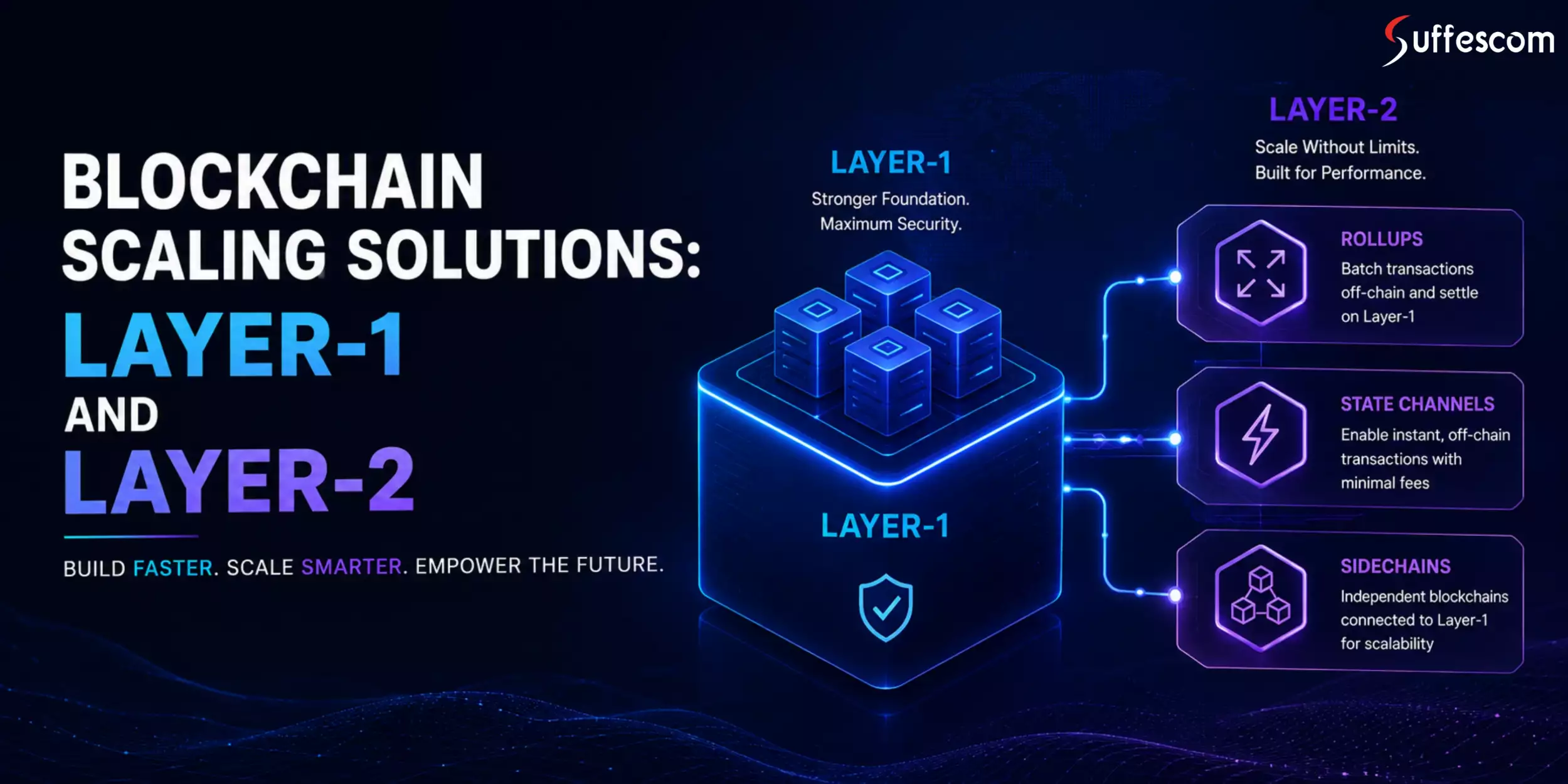
- Blockchain scaling solutions fall into two categories: Layer-1 (changes to the base chain, such as sharding or consensus upgrades) and Layer-2 (a secondary layer built on top, such as rollups or sidechains).
- The blockchain trilemma states that decentralization, security, and scalability are hard to maximize all at once. Every scaling choice is a trade-off among these three, not a free upgrade.
- Layer-2 rollups (Optimistic and ZK) are the dominant scaling approach in production today because they inherit Ethereum's security while processing transactions off-chain.
- Transaction fees on major Layer-2 networks dropped by more than 90% after Ethereum's March 2024 Dencun upgrade (EIP-4844). Cost is no longer the main differentiator between L2s; ecosystem depth, decentralization stage, and use-case fit are.
- There is no single "best" scaling solution. The right choice depends on whether your priority is cost, speed, security, or EVM compatibility (the ability to run standard Ethereum smart contracts without modification).
- Suffescom's default recommendation for most commercial builds is an Optimistic Rollup for go-to-market speed, with a defined migration path to a ZK-Rollup once transaction volume or privacy requirements justify the added engineering cost.
Want similar results? → Get a Free Quote
Scaling solutions for blockchain technology refer to the technical approaches employed to boost the transaction capacity of a blockchain network while retaining the security and decentralization features of the blockchain network. Decentralization implies there is no central authority governing the network. Scaling solutions include layer one and layer two solutions, where layer one entails modifying the underlying blockchain network itself, whereas layer two consists of building another processing layer atop the blockchain. Most blockchain networks currently in operation utilize both layer one and layer two approaches together.
The reason this matters commercially: a blockchain that cannot scale cannot support a real user base. Bitcoin processes roughly 7 transactions per second. Visa processes over 24,000. Any product built directly on an unscaled base layer, a gaming app, a payments app, an exchange, hits a throughput ceiling long before it hits meaningful adoption. Scaling architecture is a decision founders and CTOs have to make before writing a single smart contract, not after.
The speed of crypto transactions is not as fast as that of traditional payment methods.
Understanding the blockchain trilemma
The blockchain trilemma, a term coined by Ethereum co-founder Vitalik Buterin, describes a structural tension in blockchain design. A network can strongly optimize for two of the following three properties, but pushing all three at once runs into real engineering limits:
- Decentralization. No single entity or small group controls the network.
- Security. The network resists attacks, fraud, and manipulation.
- Scalability. The network processes a high volume of transactions quickly.
Bitcoin and Ethereum's base layer both lean toward decentralization and security, which is precisely why they scale poorly on their own. Layer-2 solutions exist to work around this trade-off: they process transactions off the main chain for speed, while still settling back to the base layer for security. That is the entire logic behind why Layer-2 has become the default scaling path rather than rebuilding Layer-1 from scratch.
Improve Transaction Speed with Blockchain Scaling Solutions!
Unlock faster transaction speeds and enhanced security with blockchain scaling solutions. Boost your blockchain performance and eliminate processing bottlenecks. Contact us to get started today!
How Blockchain Scaling Solutions Work
Blockchain scaling generally works by reducing the amount of work that the base blockchain needs to perform for every individual transaction or by increasing its native processing capacity.
Increase base-layer capacity: Layer-1 solutions improve the blockchain's own protocol, such as consensus, block structure, transaction execution, or data processing.
Move execution away from Layer-1: Layer-2 solutions process transactions through an additional execution layer while using the underlying blockchain for settlement.
Process transactions in batches: Layer-2 networks can combine multiple transactions and submit them together instead of recording every transaction separately on Layer-1.
Use proofs for verification: Rollups can submit fraud proofs or validity proofs to demonstrate that off-chain transactions have been processed correctly.
Reduce Layer-1 workload: Processing transactions outside the main chain reduces congestion and can improve throughput and transaction costs.
Settle on the base blockchain: The final transaction state or required data is ultimately submitted to Layer-1, allowing the base network to provide settlement and security.
Why Blockchain Networks Struggle to Scale
Three common characteristics appear each time when a blockchain network lacks scaling capabilities: low number of processed transactions per second, high fees in case of congestion, and increased confirmation time in congested conditions.
Limited transaction processing. Blockchain validation of transactions occurs through a vast decentralized network of nodes (network participants storing and validating the blockchain). Such a design of the technology guarantees its reliability but limits transaction processing speed. When transaction volume is high, it results in network congestion, long confirmation times, and poor user experience.
Fee volatility. Fees charged for processing transactions on Ethereum mainnet, called gas fees, may rise by more than $50 during network congestion, despite the average fees being much lower during off-peak periods. Volatility is sufficient reason itself to consider a product based on a blockchain base layer only as uneconomical for high-frequency usage cases, such as gaming or micropayments.
| Network | Transactions per second | Block time | Typical fee range |
| Bitcoin | ~7 TPS | 10 minutes | $2 to $10 |
| Ethereum (Layer-1) | 15 to 30 TPS | 12 seconds | $5 to $50, spiking higher during congestion |
| Visa (for reference) | 24,000+ TPS | Instant | $0.10 to $0.50 |
| Arbitrum One (Layer-2) | 4,000+ TPS | 2 to 5 seconds | $0.02 to $0.06 |
| Starknet (Layer-2) | 10,000+ TPS | ~2 seconds | Under $0.01 |
Layer-1 vs. Layer-2: The Two Ways to Solve It
Layer-1 solutions change the base blockchain's own protocol. Layer-2 solutions build a second layer on top of an existing blockchain and only settle back to it periodically. Neither is universally better. The right starting point depends on whether you are building a new chain from scratch or building a product on top of an established one like Ethereum. Most commercial projects today choose the second path, since it lets a business inherit Ethereum's security and liquidity without taking on the cost of bootstrapping a brand-new validator network. If you are weighing a custom blockchain development company approach for a purpose-built chain against a Layer-2 build on existing infrastructure, that decision alone is worth a scoping call before any development starts.
Layer-1 Scaling Solutions
A Layer-1 approach directly modifies the base blockchain. It's the more resource-intensive route, but it's the right call when a project needs a new chain purpose-built for a specific transaction pattern rather than inheriting an existing chain's constraints.
Consensus algorithm optimization. Older consensus mechanisms like Proof of Work require every node to compete on computationally expensive block validation, which limits throughput and burns energy. Moving to Proof of Stake or Delegated Proof of Stake cuts energy consumption by over 99%, speeds up block production, and lowers the barrier for new participants to join the network. Avalanche is a working example of a chain that balances scalability, security, and decentralization through this kind of consensus design.
Sharding. Sharding splits the network into smaller segments called shards, each processing its own subset of transactions in parallel instead of every node validating every transaction. This is one of the more technically demanding Layer-1 upgrades to implement correctly, which is why it typically shows up on newer chains designed for it from day one rather than retrofitted onto older ones.
Segregated Witness (SegWit). SegWit restructures how transaction data is stored by separating out digital signature data, which normally takes up around 70% of transaction space. Bitcoin implemented SegWit in August 2017, increasing effective block capacity and roughly doubling throughput from about 3 to about 7 TPS, while also enabling the Lightning Network to be built on top of it.
Hard forks. A hard fork changes a blockchain's core rules, such as block size or block time, in a way that is not backward-compatible. It is a blunt instrument and usually a last-resort scaling lever rather than a first choice, since it can split the network if the community does not adopt the change uniformly.
Suffescom's Layer 1 blockchain development company team scopes this work when a client's use case genuinely needs a purpose-built chain, not as a default recommendation. For most commercial products, Layer-2 gets you to market faster and cheaper.
Layer-2 Scaling Solutions
Layer-2 solutions sit on top of a Layer-1 blockchain and move the bulk of transaction processing off-chain, settling back to the base layer periodically for finality and security. This is the dominant scaling approach in production today, and it's where most commercial builds should start.
Rollups
Rollups process transactions off-chain, then post a compressed batch back to the main chain as a single record. There are two types, and the difference between them is the single most important technical decision in a Layer-2 build.
Optimistic Rollups assume every transaction is valid unless someone disputes it during a challenge period, typically around 7 days. This makes them cheaper to run computationally and easier to build on, since they are natively compatible with the Ethereum Virtual Machine (EVM), the runtime environment standard Ethereum smart contracts are written for. Arbitrum is the clearest working example, processing high volume while keeping full EVM compatibility.
ZK-Rollups use zero-knowledge proofs, a cryptographic method that mathematically proves a batch of transactions is valid without revealing the underlying transaction data, to skip the challenge period entirely. Withdrawals settle in minutes to hours instead of a week, and the security model is cryptographic certainty rather than a game-theoretic assumption that someone will catch fraud in time. The tradeoff is higher computational cost and, historically, weaker EVM compatibility, though that gap has been closing. Suffescom's ZK rollup development services team works with clients for whom that faster finality and stronger security model justifies the added engineering complexity, typically financial products handling higher transaction values.
| Feature | Optimistic Rollups | ZK-Rollups |
| Verification method | Fraud proofs (challenge-based) | Validity proofs (cryptographic) |
| Withdrawal time | ~7 days | Minutes to hours |
| EVM compatibility | Full, native | Partial, improving |
| Computational cost | Lower | Higher |
| Security model | Game-theoretic | Cryptographic |
Sidechains
Sidechains are independent blockchains that run in parallel to a main chain, with their own consensus mechanism and often their own native token, connected back via a two-way bridge. Unlike rollups, they don't inherit the main chain's security directly, which is the tradeoff for their flexibility. Polygon PoS is the most widely deployed example, combining sidechain and Layer-2 characteristics to process high transaction volume at low cost. Ronin, the sidechain built for Axie Infinity, is a useful case study in a sidechain purpose-built for one application's transaction pattern rather than general-purpose use.
State Channels
State channels let two or more parties transact off-chain directly and only settle the final state to the blockchain, which makes them extremely fast for repeated transactions between the same parties. The Lightning Network is the standard example on Bitcoin, built specifically for payment use cases. The tradeoff is that state channels work best for a known, fixed set of participants rather than open, many-to-many transaction patterns.
Plasma and Cross-chain Interoperability
Plasma creates child chains that process transactions independently and periodically commit checkpoints back to the main chain, using an exit mechanism that lets users withdraw by submitting proof of their transaction history. It has largely been superseded by rollups for most use cases but remains relevant for specific high-throughput payment applications.
Cross-chain interoperability protocols, Cosmos, Polkadot, LayerZero, and Wormhole among them, aren't strictly scaling solutions, but they indirectly ease congestion by letting transaction load spread across multiple connected chains instead of concentrating on one. Cosmos alone now connects more than 50 IBC-enabled (Inter-Blockchain Communication) chains that can transact with each other trustlessly.
Real-world Applications
Layer-2 scaling shows up differently depending on the use case:
Payment processing. Fast, low-cost settlement for everything from micropayments to high-value transfers. Lightning Network, Immutable X, and Polygon PoS are the standard references here.
Gaming and NFTs. Near-instant confirmations and low minting costs make Layer-2 close to mandatory for any game or NFT marketplace expecting meaningful daily active users. Ronin, StarkEx, and Arbitrum are the common infrastructure choices.
Decentralized exchanges. Layer-2 cuts gas costs on every trade and enables tighter, more efficient order matching. dYdX (StarkEx), Uniswap on Arbitrum, and GMX on Arbitrum are established examples.
DeFi. Lending, borrowing, and yield strategies that would be uneconomical on Ethereum mainnet become viable on Layer-2, which is a large part of why DeFi liquidity has migrated there over the past two years.
Privacy-preserving applications. Zero-knowledge proofs, the same cryptographic method behind ZK-Rollups, also enable verifiable computation without exposing underlying data, which matters for use cases like patient records or supply chain tracking that carry compliance requirements.
Layer-2 Market Snapshot
The Layer-2 landscape has consolidated significantly since the March 2024 Dencun upgrade collapsed fees across the board. As of mid-2026, Arbitrum One and Base together account for roughly three-quarters of all Layer-2 DeFi liquidity, with more than 70 active rollups splitting the remainder.
| Layer-2 network | Type | Approx. TVL (mid-2026) | Typical fee |
| Arbitrum One | Optimistic Rollup | ~$16B | $0.02 to $0.06 |
| Base | Optimistic Rollup | ~$11B to $12B | $0.02 to $0.03 |
| OP Mainnet | Optimistic Rollup | Mid-tier | $0.02 to $0.06 |
| Starknet | ZK-Rollup | Mid-tier | Under $0.01 |
| zkSync Era | ZK-Rollup | Mid-tier | $0.02 to $0.05 |
| Polygon PoS | ZK-Rollup | Multi-billion | $0.01 to $0.05 |
Total Value Locked (TVL, the dollar value of assets deposited in a network's protocols) on Layer-2 networks has been genuinely volatile through 2026, with different tracking sources reporting figures anywhere from roughly $5 billion to over $48 billion depending on measurement methodology and date. This table is intentionally directional rather than exact.
Cost Comparison: Ethereum L1 vs. Layer-2
| Transaction Type | Ethereum L1 | Arbitrum | Optimism | Starknet | Polygon PoS |
| Simple ETH Transfer | $15-50 | $0.50-2 | $0.50-2 | $0.01-0.05 | $0.01-0.05 |
| ERC-20 Token Transfer | $20-60 | $1-3 | $1-3 | $0.02-0.08 | $0.02-0.10 |
| Uniswap Swap | $30-100 | $2-5 | $2-5 | $0.05-0.15 | $0.05-0.15 |
| NFT Mint | $50-150 | $3-8 | $3-8 | $0.10-0.50 | $0.10-0.50 |
| Complex DeFi Operation | $100-300 | $5-15 | $5-15 | $0.20-1 | $0.20-1 |
Understanding the Importance of Blockchain Scalability Solutions
The importance of blockchain scalability solutions lies where blockchain networks become inefficient and complex. Let’s dig a little deeper to understand.
Scalability defines a network’s potential to manage high transaction throughput. It is also the primary factor for reducing network disruptions. The higher the scalability, the fewer the network disruptions.
Though blockchain technology is widely adopted, it does not affect the regular functions of the blockchain platform's scalability. Blockchain networks with higher congestion have weak scalability due to large data processing.
Increased Transaction Throughput
Transaction throughput refers to the number of transactions that a system can process in a particular time period - the faster, the better! It is the prime reason why blockchain systems needs scalability solutions. Multiple blockchain scalability solutions like Rollup aid in increasing transaction speed.
Lower Transaction Costs
Due to stagnant scalability levels, blockchains face a higher transactional load, increasing the fee per transaction. Scalability options come to the rescue, managing the workload and decreasing the transaction fee.
User Experience
None of the users want to use a blockchain with slow transaction speed, the transaction cost is higher, and all such factors decrease the user experience. Scalability solutions, on the other hand, provide foolproof solutions to increase the user experience by imposing sharding, sidechains, and rollups.
Wider Adoption
It is evident that a blockchain with higher transaction throughput, lower transaction costs, and a great user experience would have a wider user base. That’s all possible because of scalability solutions.
Environmental Sustainability
Scalability solutions contribute to blockchain's environmental sustainability by:
- Reducing energy per transaction: Layer-2 solutions process thousands of transactions using the same base-layer security, dramatically reducing energy per transaction
- Enabling Proof-of-Stake migration: Efficient consensus mechanisms made possible by scaling research
- Concentrating computation: Bundling transactions reduces redundant verification work
Comparing Layer-1 and Layer-2 Blockchain Scaling Solutions
Layer-1 and Layer-2 scaling solutions offer unique approaches to addressing blockchain scalability challenges. Here’s a comparative analysis of their key characteristics:
| Basis of Differentiation | Layer 1 (On-Chain) | Layer 2 (Off-Chain) |
| Scalability | Increases scalability by improving base layer protocols | Transfer transactions to the secondary layers while maintaining security. |
| Transaction Processing | Processes transactions directly on the main blockchain; this increases the workload | Processes transactions off-chain for quicker operations. |
| Security | More secure, as it relies on the base blockchain | These solutions have weaker intermediate security |
| Complexity in Implementation | Complex due to changes in blockchain’s core protocol | Easier to implement, as the main blockchain remains unaltered |
| Decentralization | Highly decentralized | Partially decentralized |
| Transaction Fees | Higher | Lesser |
| Transaction Throughput | Limited throughput | High throughput |
| Network Congestion | Highly congested due to high demand and slower processing times | Reduces congestion due to off-chain recording |
| User Experience | Slow and expensive | Faster and cheaper |
Blockchain Scaling Solutions For Higher User Experience
Deliver maximum user experience with reliable blockchain scaling solutions. Connect with our experts and witness the change!
Which Layer-2 Solution Should You Choose?
There is no one-size-fits-all solution here, and this is precisely why many vendor-produced pieces of information fail on this topic. It all depends on what your primary objective is:
- Security is your highest concern: ZK-Rollups (Starknet, zkSync, Polygon zkEVM) deliver cryptographic finality rather than the assumption of some challenge period.
- Cost-efficiency is your greatest concern: Either sidechains such as Polygon PoS or cost-efficient ZK-Rollups such as Starknet will make transaction costs near pennies.
- EVM compatibility is crucial to you: Optimistic Rollups (Arbitrum, Optimism, Base) still represent the easiest way to go for Solidity-based smart contracts.
- Speed of transactions among known parties matters most: State channels (such as the Lightning Network) or sidechains should be considered instead of rollups.
Suffescom's position: for most commercial builds without an immediate need for sub-hour withdrawal finality, we recommend starting on an Optimistic Rollup for faster time to market and full EVM compatibility, with the architecture designed so a later migration to a ZK-Rollup is possible without a full rebuild. Where a product is inherently high-value or privacy-sensitive from day one, financial settlement or healthcare data are common examples, we recommend starting directly on a ZK-Rollup rather than treating it as a future migration. This is a scoping decision worth having before development starts, not after; our Ethereum Blockchain Consulting Company team runs this as a standalone architecture review for teams that want the decision validated before committing engineering budget.
Factors to Consider While Choosing Between Layer-1 and Layer-2 Scaling Solutions
Choosing between Layer-1 and Layer-2 scaling depends on the blockchain's technical requirements, application type, and expected network usage. Key factors include:
Requirements for Scalability
Take into account transaction throughput, network capacity, latency, and the anticipated number of transactions. Layer-2 solutions might be a good fit when the base network is already the bottleneck in terms of performance.
Security and Lack of Trust
Assess how the solution guarantees transaction security and any additional trust requirements. Layer-1 scaling uses the underlying blockchain infrastructure directly, while Layer-2 solutions might require additional elements to be involved, such as sequencers or bridges.
Complexity to Implement
Take into account development, infrastructure needs, testing, and maintenance. While Layer-1 scaling requires protocol changes, Layer-2 adds another level of execution and integration.
Transaction Fees
Compare the transaction fees both under normal conditions and under high network load. By enabling off-chain transaction processing and subsequent settlement within the underlying Layer-1 network, Layer-2 solutions can reduce operational costs.
Compatibility
It is important to determine if the proposed solution is compatible with existing smart contracts, wallets, developer tools, and other infrastructure. High compatibility can make the adoption and integration easier.
Requirements of Applications
Ultimately, the decision should be driven by application requirements. Different types of applications have different criteria for transaction speed, cost, security, and finality.
Blockchain Scaling Solutions Development Process
To develop a blockchain scaling solution, one needs not only to choose between Layer-1 and Layer-2 solutions. The architecture should be tailored to fit the transactional volumes of the application, its performance and security requirements, and the current blockchain infrastructure.
1. Analyze Application Requirements
First of all, the application's expected transaction volumes, its user base, transaction frequency, assets involved, latency requirements, and the targeted blockchain environment should be analyzed. This helps to determine whether it is necessary to optimize the base-layer or to add a scaling layer on top of it.
2. Select the Scaling Architecture
There are several possible approaches that can be considered at this stage. These include Layer-1 optimization, Optimistic Rollups, ZK-Rollups, sidechains, and state channels. This step involves comparing their throughput, transaction fees, finality, EVM support, security model, and scalability.
3. Design the Technical Architecture
It is necessary to define which technical components are needed to implement the scaling architecture. These include, but are not limited to, smart contracts, execution environment, sequencers, bridges, nodes, wallets, APIs, data availability, and settlement mechanism.
4. Develop and Integrate
Develop the required protocol and application layers and integrate them with the wallet, DApp, exchange, payments system, or enterprise application. The development of smart contracts and other blockchain components must be done based on the chosen scaling architecture.
5. Test and Audit
Test the system under varying transaction loads to detect potential bottlenecks and failure points. Various testing types such as functional, load, stress, interoperability, smart contract, and security testing must be performed prior to deployment.
6. Deploy and Monitor
Deploy the scaling system and monitor performance and security-related metrics like transaction throughput, latency, gas fees, failed transactions, sequencer uptime, and network conditions.
Building Blockchain Scaling Solutions With Suffescom
Scaling architecture is not a feature you bolt on later. It's a decision that shapes your smart contract design, your cost structure, and your user experience from the first line of code. As a custom blockchain development company, Suffescom scopes Layer-1 and Layer-2 architecture as part of the initial project design, not as an afterthought once a product hits its first congestion problem.
If you're weighing sharding against a rollup or an Optimistic Rollup against a ZK-Rollup, that's a conversation worth having with an architect before development starts. Connect with Suffescom's blockchain team for a scalability assessment scoped to your specific transaction volume and use case.
FAQs
1. What is the difference between Layer-1 and Layer-2 blockchain scaling?
Layer-1 scaling changes the base blockchain's own protocol, such as its consensus mechanism or block structure. Layer-2 scaling adds a separate processing layer on top of an existing blockchain and only settles back to it periodically. Most commercial products today build on Layer-2 rather than modifying Layer-1 directly.
2. Are Layer-2 transaction fees actually lower than Layer-1?
Yes, substantially. Since Ethereum's March 2024 Dencun upgrade (EIP-4844), major Layer-2 fees dropped by more than 90%, typically running a few cents per transaction compared to several dollars, or more during congestion, on Ethereum mainnet.
3. Which is more secure, an Optimistic Rollup or a ZK-Rollup?
ZK-Rollups offer cryptographic certainty through validity proofs, meaning correctness is mathematically verified before a transaction batch is even accepted. Optimistic Rollups rely on a challenge period during which fraud must be caught and disputed. Both inherit Ethereum's base-layer security once finalized, but their interim security models differ.
4. Do I need a Layer-2 solution for a new blockchain product?
If you are building on an existing chain like Ethereum and expect meaningful transaction volume, yes, in almost every practical case. Building directly on Layer-1 without a scaling plan is one of the most common and most expensive architecture mistakes in early-stage blockchain products.