+971-8000321216



Key takeaways:
- No expiry, ever: perpetual contracts stay open indefinitely, held or closed at the trader's discretion, unlike traditional futures which settle on a fixed date.
- Funding rate keeps prices honest: a recurring payment, typically every eight hours, between long and short traders anchors the contract price to the spot market.
- Insurance fund and auto-deleveraging protect the platform: when a liquidation closes at a worse price than expected, the insurance fund absorbs the gap; auto-deleveraging is the last-resort backup if it can't.
- Hybrid architecture is the practical default: off-chain matching for speed, on-chain settlement for transparency, best for most businesses without a strong reason to pick a pure centralized or decentralized model.
- Revenue comes from multiple channels, not one: trading fees, funding rate spreads, liquidation penalties, API fees, and subscription plans all stack together.
- Liquidity, not technology, is usually the hardest early problem. A well-built matching engine with no liquidity behind it still produces wide spreads and poor fills.
- Custom vs. white label is a timeline and control decision: white label launches in weeks, custom takes months but gives full control over features and branding.
Want similar results? → Get a Free Quote
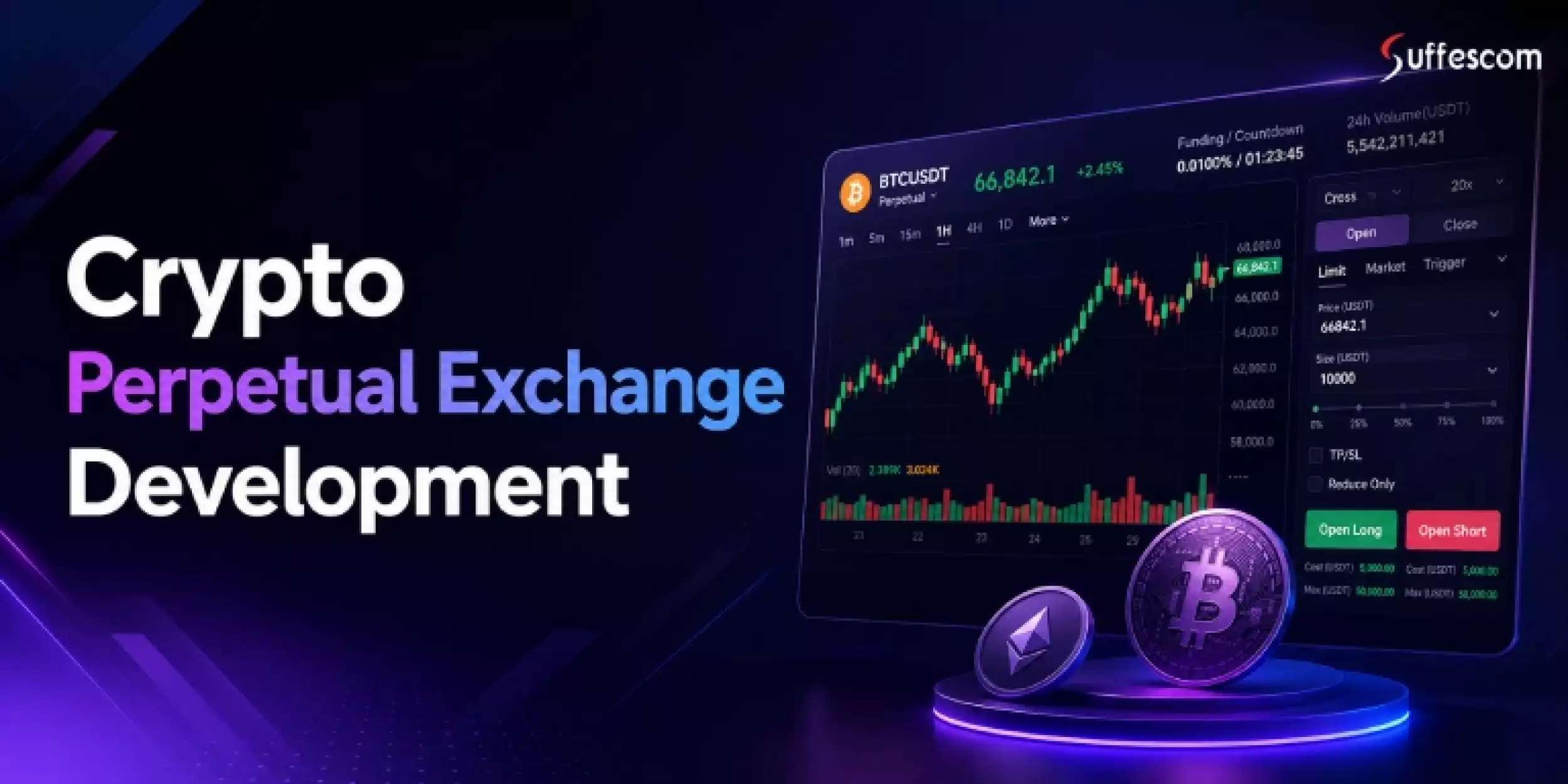
A crypto perpetual exchange is a trading platform for perpetual contracts: derivative agreements that let traders hold long or short positions with no expiration date. Prices stay anchored to the underlying asset through a funding rate, a recurring payment exchanged between long and short traders, typically settled every eight hours, a convention used across most major perpetual platforms.
Suffescom builds custom and white label crypto perpetual exchanges with real-time matching engines, cross and isolated margin, insurance fund protection, and compliance-ready architecture. Whether you need a centralized platform, a decentralized perpetual DEX, or a hybrid model, we build it around your business goals, your liquidity plan, and your regulatory footprint, not a generic template.
Core Infrastructure and Architecture
Every perpetual exchange runs on the same set of core systems. How well each one is built determines whether the platform holds up under real trading volume or breaks under it.
Matching engine: handles order placement, cancellation, and execution in real time. High-throughput, low-latency matching is what keeps trades filling instantly even during volatile markets.
Funding rate mechanism: a recurring payment, typically settled every eight hours, exchanged between long and short traders to keep the contract price anchored to the spot market price of the underlying asset.
Risk and margin engine: manages isolated margin (risk contained to a single position) and cross margin (shared balance across positions), dynamic leverage tiers, and automated liquidation.
Insurance fund: a reserve pool funded by liquidation fees that absorbs losses when a liquidated position closes at a worse price than expected, protecting the platform and other traders from socialized losses.
Auto-deleveraging (ADL): a fallback mechanism that reduces the largest, most profitable opposing positions when the insurance fund is insufficient to cover a loss. A last-resort system, but one every serious exchange needs and most competitor content skips over.
Oracle system: feeds real-time, tamper-resistant price data into the platform using providers like Chainlink or Pyth Network, preventing price manipulation and unfair liquidations.
How Perpetual Crypto Trading Platforms Operate (Funding Rate, Leverage, No Expiry)
A crypto perpetual trading platform follows a unique mechanism that keeps trading continuous, liquid, and fair. Here’s how it works:
1. No Expiry Contracts
Unlike traditional futures, perpetual contracts never expire. Traders can hold positions indefinitely, which means they don’t need to close or settle trades at specific dates. This continuous model ensures uninterrupted trading and better long-term strategy execution.
2. Funding Rate Mechanism
To keep contract prices close to the actual market value, perpetual exchanges use a funding rate. It’s a periodic payment between long and short traders.
When the contract price rises above the spot price, long traders pay a small fee to short traders.
When it drops below, short traders pay long traders.
This constant adjustment keeps the crypto perpetual exchange platform balanced and aligned with real-time market conditions.
3. Leverage Trading
Traders can use leverage, often ranging from 5x to 100x, to open positions larger than their actual capital. This boosts profit potential but also increases risk. Cross Margin Mode allows traders to use their entire balance to avoid liquidation.
Isolated Margin Mode limits risk to a single position. Together, these tools make leveraged trading more flexible and safer.
4. Continuous Price Alignment
There’s no expiry date; perpetual contracts rely on the funding rate and liquidity depth to maintain fair prices. The trading engine continuously adjusts market data, ensuring smooth execution even during volatile conditions.
5. Real-Time Risk Management
Modern crypto perpetual futures trading platforms include features like automatic liquidation alerts, balance monitoring, and dynamic leverage control. It is all designed to protect both traders and the platform itself.
6. Transparent User Experience
All these mechanisms function in the background so traders can focus on strategy rather than manual adjustments. It makes crypto perpetual trading platforms more efficient and attractive to both beginners and professionals
Launch Your Crypto Perpetual Exchange Today
Join the wave where perpetual contracts dominate 75% of derivatives trading and empower traders with a high-performance platform.
How Leverage and Margin Actually Work
An example makes this concrete faster than a definition does.
Say you open a 1 BTC position at $30,000, using 10x leverage.
- Initial margin = $30,000 ÷ 10 = $3,000 (your actual capital at risk)
- Maintenance margin = 50% of initial margin = $1,500 (the minimum balance required to keep the position open)
As long as your account balance stays above $1,500, the position stays open indefinitely, since perpetual contracts have no expiry. If it drops below that threshold, the risk engine liquidates the position automatically to prevent a negative balance.
Higher leverage means a smaller price move triggers liquidation. This is the trade-off every perpetual trading platform has to manage on the trader's behalf, and it's why margin engine design matters as much as the trading engine itself.
Platform Models: Centralized, Decentralized, or Hybrid
There isn't one right answer here, but there is a clear default for most businesses building today.
Centralized (CEX): Complete custody, fastest execution, familiar order e-book mechanics. It is best formed for groups that prioritize speed to market and whether it is traditional or deregulated institutional.
Decentralized (DEX): Non-custodial, smart contract-based, in-chain settlement. Platforms like GMX and dYdX work like this. Well-shaped for groups built around transparency and for Web3-local users, where users in turn hold their own keys.
Hybrid (off-chain matching, on-chain settlement): Combines a speed-off-chain compliance engine with an off-chain compromise for transparency. Best for most new structures entering the market as it balances the execution speed in terms of decentralization without better fuel fees and fully reduces the throughput of e-books for the on-chain system
If your priority is the fastest time to revenue with minimal infrastructure complexity, centralized wins. If, in particular, your customers want the preservation of their very own cost range and transparency across the entire chain, decentralization is really worth the delivered engineering value. Without a strong reason to overselect for maximum groups, a hybrid is a realistic place to start.
Key Features of Our Crypto Perpetual Trading Software
- Leverage and margin trading: configurable leverage, typically 5x to 100x, with cross and isolated margin modes so traders control their own risk exposure.
- No expiration date: positions stay open indefinitely, held or rolled over at the trader's discretion, with no forced settlement date.
- Advanced order types: market, limit, and stop-loss orders give traders precise control over entries and exits.
- Real-time risk dashboard: live profit and loss tracking, liquidation alerts, and platform-wide exposure monitoring for admins.
- Institutional-grade security: KYC/AML compliance, multi-signature wallets, and hot/cold storage segregation.
- Multi-asset support: BTC, ETH, stablecoins, and altcoin pairs configured to your target market from day one.
Our White Label Crypto Perpetual Exchange Software
- Ready to launch, fully brandable: your themes, your UI, your domain.
- Centralized or decentralized deployment: same white label foundation, either architecture.
- Modular design: plug in analytics dashboards, wallet systems, or additional trading modules as needed.
- Faster time to market: a pre-built framework gets you live in weeks, not months.
How to Build a Crypto Perpetual Exchange Platform
1. Define market goals and token pairs. Decide your audience (retail, institutional, or both), supported chains, and asset types before writing a line of code. This shapes every downstream technical decision.
2. Choose custom or white label. Custom gives full control over features and branding. White label gets you to market faster on a proven foundation. Budget and timeline usually decide this one.
3. Build the matching engine. This is the component that determines trading experience quality: order throughput, latency, and reliability under load.
4. Integrate the risk and margin engine. Cross and isolated margin, dynamic leverage tiers, automated liquidation, insurance fund, and auto-deleveraging all get built or configured here.
5. Add the oracle system. Real-time price feeds from providers like Chainlink or Pyth Network, ideally from more than one source, to prevent manipulation and unfair liquidations.
6. Integrate secure multi-sig wallets. Cold storage, hot/cold segregation, and withdrawal controls protect user funds from day one.
7. Build the frontend. Position visualization, funding rate tracking, real-time profit and loss, and order book depth, all need to render clearly on both desktop and mobile.
8. Run security audits and stress tests. Smart contract audits, penetration testing, load testing, and simulated market crash scenarios, before any real funds touch the platform.
9. Launch and monitor. Post-launch, track liquidity health, user growth, and platform performance continuously rather than treating launch as the finish line.
Revenue Streams for Perpetual Exchange Owners
A perpetual exchange earns from several channels running at once, not one single fee line:
- Trading (maker/taker) fees
- Funding rate spreads
- Liquidation penalties
- Subscription or license plans
- API access fees for developers and bots
- Token listing fees
- Staking service fees
- Bulk trading services for high-volume traders
Diversified revenue is also a resilience factor: platforms relying on trading fees alone feel every volume dip directly. Spreading revenue across several of these channels smooths that out.
Real-World Use Cases
Perpetual exchanges unlock advanced trading strategies across diverse markets, empowering smarter and faster decisions.
1. Hedging Strategies
Traders and institutions use perpetual contracts to hedge their spot holdings against market downturns without selling their assets.
2. Arbitrage Opportunities
Professional traders exploit funding rate differences between exchanges to generate consistent returns.
3. Speculation & Day Trading
Active traders leverage high volatility and 24/7 markets to profit from short-term price movements.
4. Portfolio Diversification
Access multiple asset classes through a single platform, from major cryptocurrencies to altcoins and indices.
5. Institutional Trading
Hedge funds and trading firms use perpetual contracts for efficient capital deployment and risk management.
6. Stablecoin Issuers
Use perpetual contracts to hedge against market fluctuations, ensuring their stablecoins maintain a consistent peg and reducing volatility risks.
7. Algo Trading Firms
Deploy algorithmic trading strategies around the clock, capitalizing on perpetual markets and high volatility to unlock automated profit opportunities.
When Not to Build a Perpetual Exchange (And What to Expect If You Do)
Perpetual exchange development is a real opportunity, but it isn't the right build for every business, and pretending otherwise doesn't serve you.
Liquidity Bootstrapping is the Hardest Early Problem, Not the Technology
A perfectly built matching engine with no liquidity behind it produces wide spreads and bad fills, which drives traders away before the platform gets a chance to grow. If you don't have a liquidity plan (market makers, external liquidity providers, or a partner exchange) before launch, the tech is not your bottleneck.
Regulatory Exposure is Real and Jurisdiction-dependent
Perpetual and leveraged derivatives sit under active regulatory scrutiny in most major markets. This isn't a "build it and figure compliance out later" category.
Ongoing Security Cost Doesn't Stop at Launch
Smart contract audits, bug bounty programs, and monitoring are recurring costs, not one-time line items, for as long as the platform holds user funds.
Cross-chain and Multi-asset Expansion Adds Real Complexity
Bridges and cross-chain settlement are frequent attack targets. Adding chains later is easier to plan for than to retrofit.
Competitive Pressure is High
Perpetual contracts account for a large majority of derivatives trading volume today, which means the segment is already crowded with well-capitalized platforms. A clear differentiation angle (asset focus, user segment, or geography) matters more here than in less competitive segments.
None of this is a reason to avoid the build. It's a reason to go in with a liquidity plan, a compliance plan, and a realistic view of ongoing cost, before development starts, not after.
Growing Adoption After Launch
Building the platform is the first half. A brief overview of what earns and keeps active traders:
- Low-friction onboarding, ideally wallet-connect trading with minimal signup steps
- Education: guides, short explainers, and onboarding content that make leverage and margin approachable for newer traders
- Active presence where crypto traders already are (Telegram, X, and similar communities)
- A mobile experience that matches the desktop platform, since a large share of trading now happens on mobile
Perpetual Contracts vs. Traditional Futures
| Aspect | Perpetual Contracts | Traditional Futures |
| Expiry | None, held indefinitely | Fixed expiry, requires rollover |
| Price alignment | Funding rate mechanism | No funding mechanism, converges at settlement |
| Leverage | Typically higher, up to 100x on many platforms | Usually lower, exchange-dependent |
| Market hours | 24/7 continuous | Limited to market hours, halts at expiry |
| Settlement | Never settles, closes when the trader chooses or is liquidated | Settles automatically at expiry |
Best for: perpetual contracts suit active traders, institutions, and platforms prioritizing continuous liquidity and flexible holding periods. Traditional futures suit traders and institutions who specifically need a fixed settlement date for hedging or accounting purposes. Most new crypto trading platforms today are built around perpetuals because trader demand has shifted decisively toward continuous, non-expiring contracts.
Build a Next-Gen Perpetual Crypto Exchange
Integrate real-time risk management, deep liquidity, and seamless trading experience for your users.
Technology Stack
We leverage modular frameworks to speed up perpetual trading app development, ensuring compatibility with APIs, liquidity providers, and DeFi integrations
| Component | Technologies / Tools | Purpose / Description |
| Frontend Framework | React.js, Next.js, Vue.js | Builds a fast, interactive trading interface with responsive UI components. |
| Backend Development | Node.js, GoLang, Rust | Powers the trading engine, API layer, and real-time transaction processing. |
| Blockchain Integration | Ethereum, BNB Chain, Solana, Polygon | Enables smart contract execution, perpetual contracts, and token settlements. |
| Database | PostgreSQL, Redis, MongoDB | Stores user data, trade history, and live market data efficiently. |
| Trading Engine | Custom-built low-latency engine | Handles order matching, price feeds, and leverage management in real-time. |
| APIs & Integration Layer | REST, WebSocket, FIX Protocol | Connects external liquidity providers, bots, and third-party analytics tools. |
| Security Framework | Multi-signature wallets, HSMs, 2FA, JWT | Protects user assets, ensures secure authentication, and prevents data breaches. |
| Compliance Modules | KYC/AML APIs, Chainalysis, Sumsub | Helps platforms stay regulatory compliant and identify suspicious activities. |
| Cloud & Infrastructure | AWS, Google Cloud, Azure, Kubernetes | Ensures high scalability, uptime, and load balancing for global traders. |
| Analytics & Monitoring | Grafana, Prometheus, Elastic Stack | Tracks platform performance, user metrics, and trading risk analytics. |
| DevOps & CI/CD | Docker, Jenkins, GitLab CI | Automates deployments, ensuring smooth version updates and maintenance. |
| Payment & Wallet Integration | MetaMask, WalletConnect, Transak, MoonPay | Facilitates multi-currency deposits, withdrawals, and fiat on-ramps. |
Compliance and Licensing
- AML, KYC, and GDPR compliance: protects users and meets global regulatory standards.
- Jurisdiction-specific adherence: built to align with evolving crypto regulation across the US, EU, and Asia.
- Compliance-ready architecture: designed for regulatory integration from the start, not retrofitted later.
- Ongoing monitoring: transaction monitoring and reporting tools built into the compliance layer, not bolted on separately.
Cost to Build a Crypto Perpetual Exchange
The cost of crypto perpetual exchange development typically falls into three tiers, depending on scope:
White label perpetual exchange: $25,000 to $45,000. A proven framework with your branding, standard feature set, single-chain deployment.
Custom, single-chain perpetual exchange: $60,000 to $150,000. Full control over architecture and features, including custom risk engine logic, multiple oracle integrations, and dedicated smart contract audits.
Advanced or cross-chain perpetual exchange: $150,000 to $300,000+. Adds cross-chain bridges, multi-chain deployment, and the additional security audits cross-chain infrastructure requires.
Within any tier, the main cost drivers are:
- Core development (matching engine, risk and margin engine, APIs)
- Smart contract development and security audits
- Infrastructure and cloud hosting setup
- Liquidity integration and market maker onboarding
- Compliance module integration (KYC/AML)
Decentralized and hybrid models generally cost more than centralized ones at the same feature tier, since on-chain settlement adds blockchain node integration and smart contract complexity that a purely centralized order book doesn't need.
Partner with a Trusted Crypto Exchange Development Company
Deliver a high-performance crypto perpetual trading platform to meet growing demand, with over 1M daily derivative trades globally.
Future of Perpetual Crypto Trading: AI, DeFi & Automation
The future of perpetual crypto trading is moving far beyond basic contracts. With rapid innovation in AI, DeFi, and automation, perpetual exchanges are becoming smarter, more transparent, and more efficient than ever before.
1. AI-Based Predictive Analytics
Artificial Intelligence is transforming how funding rates and liquidations are managed. AI models analyze live market data to predict funding fluctuations, helping traders minimize risk while improving platform stability. Our crypto perpetual exchange development services already integrate such AI-driven insights to enhance performance and user experience.
2. DeFi Liquidity Pool Integration
The next step in this evolution is the combination of perpetual contracts and DeFi liquidity pools, enabling traders to access decentralized funding in a far more transparent and intermediary-free manner. As a DeFi perpetual exchange platform developer, we help businesses create open, liquid trading environments that align with Web3 principles.
3. Automated & Algorithmic Trading Tools
Automation reimagines perpetual markets. Algorithmic trading bots, empowered by smart contracts, can execute real-time strategies based on price movements. These tools give users the power to trade 24/7 without having to intervene personally and drive more engagement and liquidity on your platform.
4. Rise of Perpetual DEXs and Hybrid Models
The demand for decentralized trading keeps surging. Development in perpetual DEX allows traders to have the best of both worlds: decentralized transparency coupled with centrally managed speed. Today, hybrid perpetual exchanges represent the next step in scalability and user ownership.
5. Adapting to the Future
At Suffescom, our crypto perpetual exchange development solutions are built to evolve with these trends. Whether it’s AI-powered analytics, DeFi integrations, or automated trading systems, we ensure your platform remains ahead of market shifts and trader expectations.
Why Businesses Choose Suffescom for Perpetual Exchange Development
As a crypto exchange development company with experience across centralized, decentralized, and hybrid architectures, here's what sets our perpetual exchange builds apart:
1. Proven Expertise in Crypto Exchange Development
Our team has years of experience building centralized, decentralized, and hybrid trading platforms. From perpetual futures to spot and margin trading, we’ve delivered solutions that scale globally.
2. Custom & White Label Flexibility
Regardless of whether you need an instant solution with our white label crypto perpetual exchange or custom software development, both are available for you to control all aspects of the project: branding, features, integrations.
3. Advanced Trading Infrastructure
We design crypto perpetual futures exchanges to be built with low-latency trading engines, liquidity APIs, and real-time risk management systems.
4. Regulatory Compliance & Security First Approach
Each solution we develop comes with modules for KYC/AML checks, multi-sig wallets, and cold storage technology. All our platforms are ready to comply with any regulation on cryptocurrencies worldwide.
5. End-to-End Development & Post-Launch Support
Everything is taken care of in proper order by us from the design of the product and backend, through testing and release, up until after going live when further updates, maintenance, and upgrades are provided.
6. Future-Ready Solutions with AI
We don’t just build for today. Our crypto perpetual exchange platform development integrates AI analytics, DeFi liquidity pools, and automated risk monitoring, preparing your exchange for the next market evolution.
FAQs
1. What is a crypto perpetual exchange?
A trading platform for perpetual contracts, derivative agreements with no expiration date. Prices stay aligned to the spot market through a funding rate, a recurring payment between long and short traders typically settled every eight hours.
2. How much does crypto perpetual exchange development cost?
White label perpetual exchange development typically costs $25,000 to $45,000. A custom, single-chain build ranges from $60,000 to $150,000, while an advanced or cross-chain platform runs $150,000 to $300,000 or more, depending on features like multi-chain support, institutional dashboards, and the depth of security auditing required.
3. What is the difference between custom and white label development?
White label uses a proven, pre-built framework for faster launch, typically weeks rather than months. Custom development gives full control over features, architecture, and branding, at a higher cost and longer timeline. Most early-stage platforms start white-label and move to custom once product-market fit is proven.
4. What happens if my position's balance drops below the maintenance margin?
The risk engine liquidates the position automatically. If the loss on liquidation exceeds what the trader's remaining margin covers, the insurance fund absorbs the difference. In rare, extreme cases where the insurance fund is insufficient, auto-deleveraging reduces the largest opposing positions to cover the gap.
5. Can I build a perpetual exchange with my own custom token pairs?
Yes. The matching engine, liquidity pools, and funding rate logic are configured around your chosen base pairs, whether major cryptocurrencies, stablecoins, or your own token.
6. Which architecture should I choose: centralized, decentralized, or hybrid?
Hybrid is the practical default for most new platforms, since it balances execution speed with on-chain transparency. Centralized suits teams prioritizing fastest time to market. Decentralized suits platforms built specifically around non-custodial, Web3-native trading.
7. How long does development take?
White label platforms can launch in roughly 4 to 6 weeks. Custom builds typically take 3 to 5 months, depending on features like cross-margin trading, institutional dashboards, or cross-chain support.