Every customer interaction contains signals about satisfaction, frustration, expectations, and buying intent. These signals appear in live chats, support tickets, emails, social media comments, product reviews, and customer surveys. However, when feedback is spread across multiple channels, businesses can struggle to identify recurring problems, understand changes in customer sentiment, and respond before dissatisfaction escalates.
AI sentiment analysis helps businesses interpret the tone and emotional signals behind customer communications. Using natural language processing (NLP), machine learning services, and large language models where appropriate, a sentiment analysis system can classify text, identify emotion-related patterns, detect recurring topics, and turn unstructured feedback into information that teams can act on.
For example, a customer support team can flag a conversation showing strong frustration, a product team can identify repeated complaints about a feature, and a social media team can investigate an unusual increase in negative brand mentions. When integrated with existing CRM and helpdesk workflows, these insights can support faster responses and more informed customer experience decisions.
Our AI sentiment analysis model gives you the power to understand exactly how your customers feel, in real-time.
| 98% Accuracy | 50+ Integrations | 10,000+ Users | Real-Time Analysis |
No More Missed Signals With Customer Sentiment Analysis AI
Customer feedback is not always expressed through direct complaints. A customer might use neutral language to describe a recurring problem, express frustration through sarcasm, or gradually become dissatisfied during a support conversation. Manual review can miss these signals, particularly when teams handle large volumes of messages.
AI-powered sentiment analysis helps businesses classify customer communications and identify patterns that warrant attention. Rather than relying exclusively on individual agents to recognise every signal, teams can use automated analysis to flag conversations, track feedback themes, and review sentiment trends across channels.
Improve & Maintain CSAT Score
Equip your customer support team with AI-powered sentiment analysis software and add an intelligence layer between your team & customers.
Pillars of Sentiment Analysis AI Tool Development
A well-designed sentiment analysis platform can combine several forms of analysis to provide more useful insights than a single positive, neutral, or negative label. The capabilities required depend on the business use case, data sources, and actions the system is expected to support.
Aspect-Based Sentiment Analysis
Aspect-based sentiment analysis identifies how customers feel about specific products, features, or service attributes rather than assigning one overall sentiment to an entire message.
For example, a customer might praise an application's design while complaining about its slow loading time. Aspect-based analysis can separate these opinions, helping product and service teams understand which aspects are performing well and which need improvement.
Fine-Grained Sentiment Analysis
Basic sentiment classification typically categorises text as positive, negative, or neutral. Fine-grained sentiment analysis uses more detailed categories or scoring scales to distinguish between different levels of sentiment.
This can help businesses identify a shift from mildly dissatisfied feedback to strong frustration. The scoring approach should be calibrated against labelled examples so that the difference between sentiment levels is meaningful for the intended use case.
Real-Time Emotion Detection
Emotion classification attempts to identify signals such as frustration, satisfaction, disappointment, or excitement in customer communications. In live chat, these signals can help agents recognise a change in tone while a conversation is still active.
For instance, a support platform could flag a conversation when frustration indicators increase and suggest that an agent review the interaction. Emotion labels are estimates based on available text or other permitted inputs, not definitive measurements of a customer's internal emotional state.
Predictive Intent Analysis
Predictive intent analysis examines language and interaction patterns to estimate a customer's likely next action or need. Depending on the data and model, it may help identify signals associated with cancellation requests, repeated support needs, or interest in a particular product.
These predictions require suitable historical data and validation. Sentiment alone cannot reliably establish that a customer will churn or make a purchase, so intent predictions should be evaluated alongside other relevant behavioural and operational signals.
Understand Customer Sentiment Behind Words
Built for developers and data teams who want to build, customize, and deploy.
Understand the Working Process of AI Sentiment Analysis Model
We utilize a sophisticated multilayered architecture for building a high-performing sentiment analysis AI. Engineered a seamless pipeline that combines AI in sentiment analysis with LLMs to ensure conversation-to-data in less than 200ms.
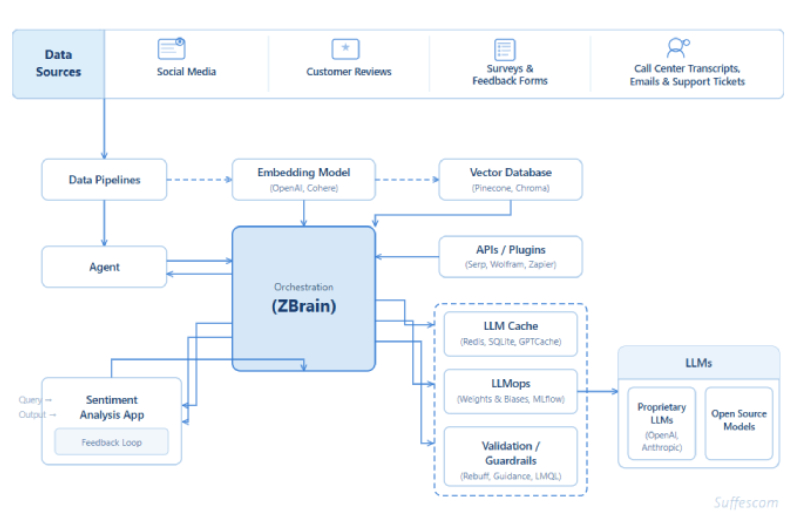
Omnichannel Data Collection
Capture the voice of the customer from every critical touchpoint.
Social & Web
Collect permitted brand mentions, comments, and messages from supported social media and web sources such as X, Instagram, Facebook, and more. This information can help businesses monitor customer reactions to campaigns, products, service changes, and public announcements.
Direct Customer
Analyse customer reviews, ratings, survey responses, and product feedback to identify common satisfaction drivers and recurring complaints.
Internal Support
Process permitted customer support data from email, live chat, ticketing systems, and call transcripts. Voice conversations generally need a transcription step before a text-based sentiment model can analyse them.
Intelligent Data Pipeline
Raw customer messages may contain spelling errors, duplicate content, irrelevant text, personal information, or inconsistent formatting. A preprocessing pipeline can clean and standardise this information before it reaches the sentiment model.
Depending on the use case, the pipeline may also detect language, remove duplicates, mask sensitive information, and split long conversations into relevant sections.
NLP for sentiment analysis helps process language and identify patterns that support sentiment classification. Techniques such as tokenisation, text normalisation, contextual embeddings, and language detection may be used according to the chosen model and dataset.
We build an intelligent data pipeline that collects, cleans, and processes customer feedback from multiple channels. Using NLP for sentiment analysis, the platform identifies sentiment patterns, extracts key topics, and prepares structured data for reporting. Integrating data analytics helps businesses turn these findings into actionable insights and track customer sentiment trends over time.
Advanced Orchestration & LLM Processing
The core functioning engine of the customer sentiment analysis AI tool.
Orchestration Layer
An orchestration layer manages the sequence of processing steps, including data preparation, model invocation, validation, and output delivery. For multi-message conversations, it can also select the relevant conversation history needed to interpret a new message in context.
The system should limit the context passed to the model to what is necessary for the task and permitted by the applicable data policies.
LLM Integration
Large language models can help interpret context-dependent language, including certain forms of sarcasm, indirect complaints, and nuanced expressions. Their performance depends on the model, prompt design, available context, and validation process.
For high-volume or latency-sensitive applications, a specialised sentiment classifier may be more cost-effective than running every message through a large language model. The architecture should be selected according to measurable requirements rather than assuming one model type is best for every task.
Validation & LLMOps
Sentiment outputs should be evaluated before they are used to trigger customer-facing or operational actions. A model that produces fluent explanations may still misclassify sentiment, misunderstand sarcasm, or perform poorly on domain-specific language.
Guardrail & Validation
Use labelled test datasets, confidence thresholds, and rules for handling uncertain predictions. Depending on the application, validation may include checks for unsupported labels, missing fields, inconsistent outputs, or unsuitable automated actions.
Guardrail frameworks and structured-output validation tools may support these checks, but they do not guarantee that a sentiment prediction is correct.
Continuous Learning
Create a feedback process through which authorised reviewers can correct inaccurate sentiment labels and identify recurring model errors. Periodic evaluation can help teams detect changes in customer language, product terminology, and channel behaviour.
Model updates should be tested and versioned before deployment so teams can compare performance and investigate unexpected changes.
Actionable Output & AI Agents
The final stage converts sentiment results into information that teams can review or use within approved workflows.
Dashboard
Display sentiment distributions, recurring feedback themes, channel-level patterns, and changes over time. Dashboards can also support comparisons by product, customer segment, or support team when the underlying data and access permissions allow it.
Autonomous Agents
AI agents or workflow automation can use validated sentiment signals to flag high-priority tickets, notify authorised staff, or route conversations according to configured business rules.
For consequential actions, keep human review and clear escalation procedures where needed. Sentiment scores should not independently determine sensitive customer decisions without appropriate validation and safeguards.
Everything You Need To Understand Your Customers Instantly
A sentiment analysis platform needs more than a classification model. Its features should support the full workflow, from processing customer messages to reviewing results and acting on the insights.
Real-time Sentiment Scoring in Live Chat
Every conversation is scored as it happens. Our AI tools for sentiment analysis in live chat detect mid-conversation tone shifts. Giving agents the live intelligence to de-escalate, personalise, and resolve before customer frustration peaks.
Multi-Language Sentiment Analysis
Multilingual sentiment analysis AI solutions. Track sentiment trends by agent, channel, time period, and customer segment. All from one customer sentiment analysis AI dashboard built for both frontline managers and C-suite reporting.
Native CRM & Helpdesk Integrations
Connect sentiment analysis with supported CRM and helpdesk platforms, such as Salesforce, HubSpot, Zendesk, and Intercom, using available APIs, connectors, webhooks, or platform-specific integration methods.
Businesses that need to connect sentiment processing with existing applications can explore AI integration services to assess the required data flows, APIs, and deployment architecture.
Custom Model Training
Fine-tune sentiment analysis AI model on your customer data, your industry language, and your edge cases.
| Feature | Capability |
| Realtime Scoring | Voice transcripts, Live Chat, Emails |
| Language Support | 40+ Languages |
| Dashboard | Agent Channel & Segment Level Views |
| Integrations | 50+ CRM, Helpdesk & Chat Platforms |
| Custom Training | Fine-Tune on Proprietary Data |
| Deployment | API, SDK, Webhook, No-code |
Benefits of Integrating AI Sentiment Analysis with CRMs, Helpdesks, and Social Media Platforms
Integrating AI sentiment analysis into existing business platforms helps teams interpret customer feedback without switching between disconnected tools. Instead of reviewing every message manually, businesses can use sentiment scores, emotion indicators, and topic-level insights to identify issues and prioritise responses within established workflows.
1. Faster Responses Through Immediate Workflow Integration
Connecting sentiment analysis with a CRM or helpdesk allows customer messages to be classified as they arrive. Negative sentiment, repeated complaints, or signs of frustration can trigger ticket prioritisation, escalation rules, or alerts for support agents.
This can help teams identify conversations that need attention without relying entirely on manual review. The rules should be tested to avoid unnecessary alerts or missed high-priority interactions.
2. More Affordable Implementation with Existing Platforms
Businesses do not always need to build a sentiment analysis engine from scratch. Connecting a third-party AI-powered sentiment analysis service or using a built-in analytics module can reduce initial development effort when standard sentiment categories and supported integrations meet business requirements.
The final cost still depends on API usage, subscription fees, data volume, integration complexity, and customisation needs. A ready-made service may be a practical starting point, while a custom implementation may be justified by more specialised requirements.
3. Better Customer Service Decisions
With AI sentiment analysis in customer service, support managers can identify recurring sources of frustration, compare feedback across channels, and spot patterns in unresolved complaints.
These insights can inform agent coaching, service improvements, and escalation policies. Sentiment scores should complement customer feedback and operational metrics rather than serve as a standalone measure of service quality.
4. Consistent Insights Across Customer Touchpoints
Customers may contact a business through live chat, email, social media, support tickets, and review platforms. Bringing these signals into a shared reporting workflow helps teams compare sentiment across channels and identify issues that may otherwise remain isolated.
Appropriate identity matching, data governance, and access controls are essential when connecting customer records across platforms.
5. When a Custom Sentiment Analysis Solution Makes More Sense
A ready-made service may be sufficient for businesses with standard requirements. However, custom development may be more suitable when strict data privacy requirements call for on-premises deployment, the industry relies on specialised terminology, or the system must interpret domain-specific sarcasm and nuanced expressions.
Businesses building a productised SaaS solution may also need greater control over model behaviour, deployment, branding, and usage costs.
The right approach depends on existing systems, data sensitivity, language requirements, and the level of customisation needed. Businesses can start with a third-party service for standard workflows and move toward a customised sentiment analysis model when their requirements justify the additional investment.
Use Cases of the AI Sentiment Analysis Model
An AI sentiment analysis model built for businesses that want to decode customer sentiment behind the texts and drive better business outcomes.
Customer Service & Contact Centres
Detect frustrated customers before they escalate. Identify coaching opportunities & score every agent interaction automatically.
- Escalation Prevention
- Agent Performance Scoring
- CSAT Improvement
E- Commerce & Product Reviews
AI in e-commerce helps businesses analyse online reviews, return comments, and support tickets to understand what customers like about their products and what causes dissatisfaction.
- Review Intelligence
- Return Reason Analysis
- Product Feedback Loops
Social Media Monitoring
Brand sentiment shifts in real time on social media. Customer sentiment analysis AI tracks mentions, comments, and DMs across platforms. Flagging negative sentiment spikes before they become brand crises.
- Crisis Detection
- Campaign Sentiment Tracking
- Competitor Benchmarking
Healthcare & Financial Services
Deploy a complaint and accurate sentiment analysis AI in highly sensitive, regulatory industries. Get detailed sentiment analysis across patient feedback, advisor calls, and client communications.
- Compliance Risk Flagging
- Patient Satisfaction Tracking
- Advisor Quality Monitoring
Developer & Data Teams
Building a custom sentiment pipeline? Our AI sentiment analysis model development solutions give data teams full Python SDK access, pre-trained models, fine-tuning capabilities, and REST API deployment.
- Custom Model Development
- Rapid Development
- Scalable NLP Infrastructure
Understand Customer Sentiment With AI
AI Sentiment Analysis Model Development Solutions for Every Industry
How To Build an AI Sentiment Analysis Model Using Python
We offer two paths to get started with sentiment analysis AI tools, as per the requirements of businesses and teams.
One for the developers who want full control, one for teams who want results without writing a single line of code.
Path 1 Python SDK
For developers and data teams who want to build, customize, and deploy.
Full programmatic access to our AI sentiment analysis model. Fine-tune on your dataset, integrate into your pipeline, and deploy via REST API or Webhook in your existing work.
| from sentimentai import SentimentModel # Initialize the model with your secure API key model = SentimentModel(api_key="your_key") # Analyze customer intent and emotion instantly result = model.analyze("Your customer message here") print(result) # Output: { "sentiment": "negative", "emotion": "frustration", # "urgency": "high", "confidence": 0.96 } |
View Full SDK Docs
Path 2 - No Code Setup
A no-code implementation may suit customer service managers, analysts, and operations teams who want to configure sentiment analysis without building a complete processing pipeline themselves.
A typical setup may involve:
- Connecting a supported CRM, live chat, or helpdesk data source.
- Selecting the sentiment categories and scoring rules.
- Configuring dashboards, alerts, and ticket-routing workflows.
- Testing the results against representative conversations.
- Deploying the workflow and reviewing performance over time.
The implementation time depends on the platform, data access, integration requirements, and the amount of configuration needed. Avoid promising a fixed setup time unless it has been validated for the actual product.
From API Call to Full Production Deployment
Sentiment Analysis AI Model Development Using Python
Python offers a broad ecosystem for text processing, machine learning, and model evaluation. The technologies selected for a sentiment analysis platform should match the data, deployment requirements, and expected model performance.
HuggingFace Transformers
The gold standard for production NLP. Access to 50,000+ pre-trained models, including BERT, RoBERTa, and DistilBERT. Fine-tune your own customer sentiment data in hours.
spaCy
spaCy provides tools for tokenisation, linguistic processing, named-entity recognition, and other NLP tasks. It can support preprocessing pipelines and language-specific processing alongside a sentiment classification model.
NLTK
The Natural Language Toolkit (NLTK) provides tools for text processing, linguistic analysis, and educational or research-oriented NLP workflows. It may be useful for preprocessing and lexicon-based approaches, depending on the project requirements.
Transformers + PyTorch/ TensorFlow
PyTorch and TensorFlow support deep-learning model development and training. They can be used with transformer architectures when a project requires custom training or fine-tuning on domain-specific customer language.
For industries such as retail, healthcare, finance, and SaaS, domain-specific evaluation is important because general-purpose models may misinterpret specialist terminology, abbreviations, or context-dependent expressions.
| 40% CSAT Improvement | 3x Faster Responses | 65% First Contact Resolution | 34% Fewer Escalations |
Data Privacy, Security, and Compliance
AI sentiment analysis platforms process customer reviews, support conversations, survey responses, and social media interactions, making data privacy and regulatory compliance important considerations during development. Businesses need to protect sensitive information while ensuring that customer data is collected, processed, and stored appropriately.
Our AI sentiment analysis solutions can incorporate security and privacy measures based on your business requirements, including:
- Data Encryption: Protect customer information during transmission and storage.
- Access Controls: Restrict access to sensitive data based on user roles and permissions.
- Data Anonymisation: Remove or mask personally identifiable information where appropriate before analysis.
- Secure Integrations: Connect CRMs, helpdesks, and customer feedback platforms using appropriate authentication and access controls.
- Flexible Deployment: Evaluate cloud-based, private-cloud, or on-premises deployment options according to your security and data governance requirements.
- Regulatory Alignment: Design data handling workflows around applicable requirements, such as GDPR, where relevant to your operations.
By integrating privacy and security considerations into the development process, businesses can use AI-powered sentiment analysis while managing data risks and building customer trust. Compliance requirements vary by industry and jurisdiction, so the final implementation should be assessed against the regulations applicable to your business.
Build a Sentiment Analysis Platform Around Your Business Needs
Understanding customer sentiment requires more than assigning positive or negative labels to messages. Businesses need a solution that can interpret their customers' language, work with existing communication channels, and turn validated insights into useful operational actions.
Suffescom develops AI-powered sentiment analysis platforms tailored to your business goals, customer communication channels, and data requirements. Whether you need AI sentiment analysis customer service to understand customer feedback, or NLP for sentiment analysis to classify opinions, detect emotions, and identify emerging trends, our solutions help turn unstructured text into actionable insights.
Explore our AI development services for custom AI capabilities and AI integration services for connecting AI workflows with existing business applications.
Planning an AI sentiment analysis platform? Contact Suffescom to discuss your use case, data sources, model requirements, integrations, and deployment options.
FAQs
Which AI development company offers the best sentiment analysis model solutions?
Suffescom provides AI sentiment analysis model development services covering requirements analysis, data preparation, model selection or training, integration, deployment, and ongoing support. The appropriate solution depends on your business use case, data sources, language requirements, and technical environment.
How long does it take to develop and deploy an AI sentiment analysis model?
The timeline depends on model complexity, data availability, language coverage, integration requirements, and deployment constraints. A solution using an existing model and supported integration may take less time than a custom-trained, multilingual platform with enterprise integrations. A reliable timeline should be provided after the requirements and scope are assessed.
What are the costs of developing an AI sentiment analysis model?
Development cost depends upon the complexity, integration requirements, language support, and deployment environment. Contact us for a scoped estimate based on your requirements.
Do you offer an AI sentiment analysis model as a white-label solution?
We develop and offer fully ready-to-sell sentiment analysis AI models branded entirely to your product. Ideal for agencies, software vendors, and enterprises building customer experience products.
How to use customer data to train AI sentiment analysis models?
Your proprietary customer data is the biggest advantage in custom sentiment analysis AI development. We train your existing sentiment analysis AI model with updated or new customer data as per your business requirements.